- Market Value (2025): USD 4.2 Bn
- Estimated Value (2026): USD 4.6 Bn
- Forecast Value (2036): USD 11.1 Bn
- CAGR (2026-2036): 9.2%
What is the High-Opacity Conductive Additives Market forecast to be worth by 2036?
USD 4.6 billion in 2026 to USD 11.1 billion by 2036 at a 9.2% CAGR.
- The High-Opacity Conductive Additives Market reached USD 4.2 billion in 2025.
- Demand is expected to increase from USD 4.6 billion in 2026 to USD 11.1 billion by 2036.
- The market is forecast to record 9.2% CAGR from 2026 to 2036.
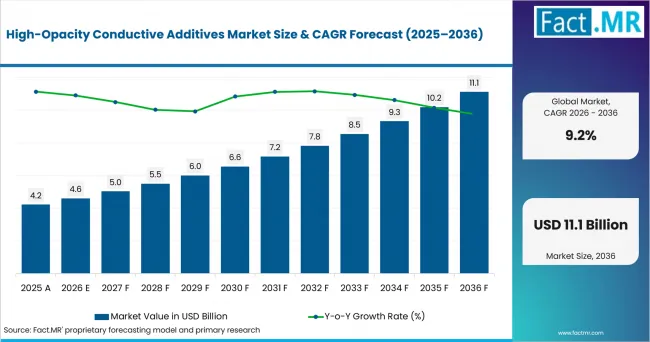
High Opacity Conductive Additives Market Value Analysis | Source: Fact.MR
What are the defining numbers behind High-Opacity Conductive Additives Market growth?
An absolute opportunity of USD 6.5 billion is expected between 2026 and 2036.
- Demand Drivers in the Market
- Industrial flooring contractors need antistatic or static-dissipative surfaces in areas that handle sensitive electronics and charged materials. The coating must maintain a defined resistance after cure and routine wear.
- Automotive electronics teams are placing more electrical functions close to sensors and power modules. Conductive or shielding coatings are likely to help control static charge and interference on selected housings.
- Coating makers need formulations that remain processable at the filler level required for electrical result. Particle structure and resin compatibility shape how quickly a conductive network forms.
- Data-center and telecom equipment builders are expected to need more surfaces with ESD and EMI control as hardware density rises. In January 2025, the U.S. Department of Commerce finalized USD 1.4 billion in awards for advanced chip packaging. The program supports packaging and materials work at production scale.
- Key Segments Analyzed
- By Conductive Pigment: Conductive carbon black is likely to hold 36.0% share in 2026 because it combines hiding power with established coating conductivity.
- By Opacity need: Low opacity is expected to hold 33.0% share in 2026. Formulators often seek conductivity while retaining some substrate or color-system flexibility.
- By Coating Type: Industrial coatings are anticipated to capture 29.0% share in 2026 owing to use across equipment and facility surfaces.
- By Conductivity: Antistatic is estimated to represent 36.0% share in 2026 because many uses need charge control before full conductive performance.
- Analyst Opinion at Fact.MR
- Shambhu Nath Jha, Principal Consultant at Fact.MR, states, “Conductivity is only one part of the commercial test for these additives. Formulators must reach a target resistance while keeping color and film quality within the required range. Suppliers with repeatable dispersion guidance and clear resistivity data are likely to move more smoothly through industrial and electronics coating approval.”
- Strategic Implications
- Coating producers should approve conductive packages in the same resin systems used for customer production. Binder chemistry changes particle spacing and film appearance.
- Electronics material teams should document shielding and ESD results after aging and thermal cycling.
- Industrial coating suppliers should align floor and equipment systems with measurable resistance ranges so facility managers can match a product to the electrical-control target.
The UK is forecast to record 11.4% CAGR through 2036 because electronics production supports a broad use base. The USA is expected to post 10.4% as chip investment expands. Germany is projected at 10.1% through microelectronics activity. France is estimated at 9.8% on the back of electronics output. Japan is forecast at 8.3% as chip policy supports domestic capacity.
How does the High-Opacity Conductive Additives Market break down by segment?
Conductive carbon black is expected to lead Conductive Pigment at 36.0% share in 2026; Antistatic leads Conductivity at 36.0%.
Which Conductive Pigment dominates?
Conductive carbon black is likely to hold 36.0% share in 2026.
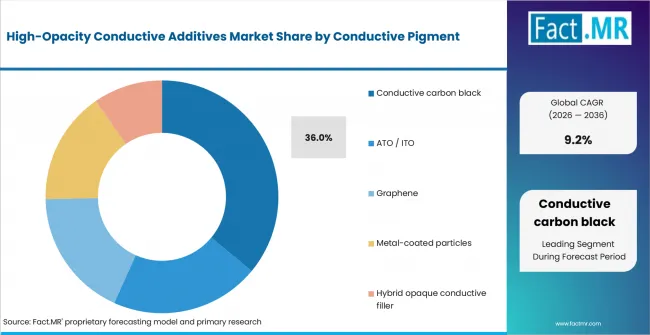
High Opacity Conductive Additives Market Analysis By Conductive Pigment | Source: Fact.MR
Conductive carbon black is likely to lead because its network-forming structure combines conductivity with deep visual hiding. It fits many liquid coating systems when dispersion is controlled and the binder is compatible. ATO and ITO serve projects that need oxide-based conductivity. Graphene is used in selected systems where a thin conductive network is useful. Metal-coated particles target lower resistance at a higher material cost. Hybrid fillers blend particle types to balance color and electrical targets.
What leads the Opacity need segment?
Low opacity is expected to hold 33.0% share in 2026.
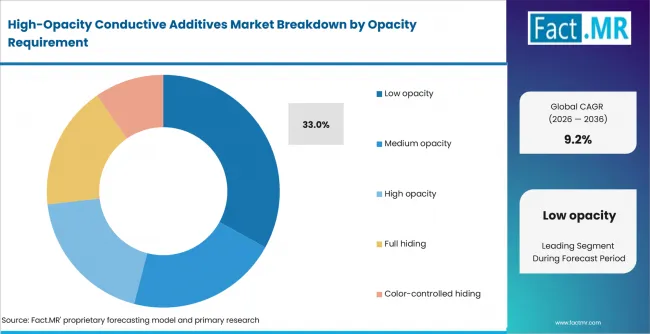
High Opacity Conductive Additives Market Analysis By Opacity Requirement | Source: Fact.MR
Low-opacity formulations are projected to lead when a coating needs electrical control and some color flexibility. Medium-opacity products move toward stronger hiding while preserving room for tint adjustment. High-opacity systems place more weight on substrate coverage and a uniform surface. Full-hiding products suit parts where the underlying material should disappear from view. Color-controlled hiding serves designs that need conductivity within a defined finish. Filler loading remains important because stronger conductive networks can change shade and flow.
How does Coating Type shape demand?
Industrial coatings are expected to capture 29.0% share in 2026.
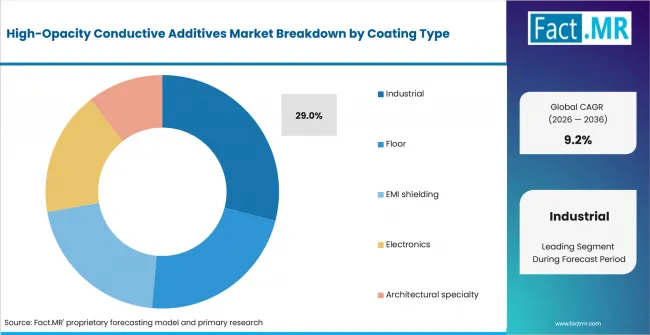
High Opacity Conductive Additives Market Analysis By Coating Type | Source: Fact.MR
Industrial coatings are expected to lead because conductive surfaces are used on equipment and facility hardware. Floor systems need stable resistance across large areas and repeated cleaning. EMI-shielding coatings serve electronic housings where a surface layer can replace some secondary shielding work. Electronics coatings need tighter control of film thickness and cure. Architectural specialty use remains narrower because the electrical need is less common.
What supports Antistatic within Conductivity?
Antistatic is expected to hold 36.0% share in 2026.
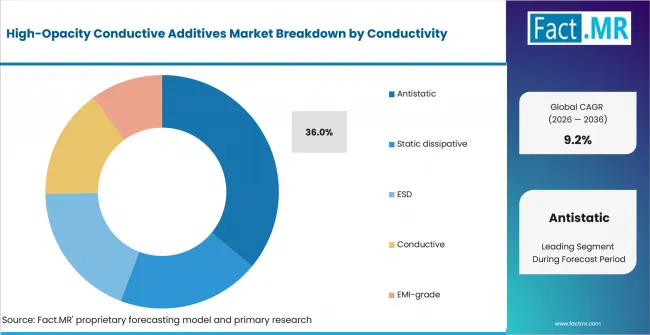
High Opacity Conductive Additives Market Analysis By Conductivity | Source: Fact.MR
Antistatic performance is estimated to lead because many coated surfaces need charge control before they need a low-resistance path. Static-dissipative systems serve tighter resistance ranges and are used where charge must drain in a controlled way. ESD coatings address areas around sensitive electronic parts. Conductive systems provide a lower-resistance route when grounding is central to the design. EMI-grade coatings add shielding performance for electronic enclosures and related components.
What is accelerating High-Opacity Conductive Additives Market adoption, and what is holding it back?
Electronics density and static-control needs drive adoption; dispersion difficulty and formulation trade-offs restrain it.
Drivers Impact Analysis
| DRIVER | (~) % IMPACT ON CAGR | GEOGRAPHIC RELEVANCE | IMPACT TIMELINE |
|---|---|---|---|
| Electronics and EMI-control requirements | +1.8% | North America, Europe, East Asia | Short term (<= 2 years) |
| Industrial antistatic flooring and equipment coatings | +1.4% | North America, Europe | Medium term (2-4 years) |
| Vehicle electrification and power electronics | +1.2% | Europe, North America, Japan | Medium term (2-4 years) |
| Higher-value conductive pigment systems | +0.9% | Global | Long term (>= 4 years) |
Opportunity Impact Analysis
| OPPORTUNITY | (~) % IMPACT ON CAGR | GEOGRAPHIC RELEVANCE | IMPACT TIMELINE |
|---|---|---|---|
| EMI-shielding coatings for compact electronics | +1.1% | North America, Europe, Japan | Medium term (2-4 years) |
| Static-dissipative industrial flooring | +0.8% | Europe, North America | Short term (<= 2 years) |
| Color-controlled conductive coatings | +0.7% | Global | Long term (>= 4 years) |
Restraints Impact Analysis
| RESTRAINT | (~) % IMPACT ON CAGR | GEOGRAPHIC RELEVANCE | IMPACT TIMELINE |
|---|---|---|---|
| Dispersion and viscosity limits at conductive loading | -0.8% | Global | Short term (<= 2 years) |
| Cost of conductive oxides and metal-coated fillers | -0.6% | Europe, North America, Japan | Medium term (2-4 years) |
| Qualification burden for ESD and EMI applications | -0.5% | Global | Long term (>= 4 years) |
Which countries are scaling the High-Opacity Conductive Additives Market through 2036?
- The country comparison spans 3.1 percentage points across the five profiled markets and forms a clear growth range through 2036.
- The UK records 11.4% CAGR, supported by electronics production and the wider use of conductive surfaces in power and digital equipment.
- The USA reaches 10.4% CAGR, reflecting a broad base of electronics production and industrial coating uses.
- Germany posts 10.1% CAGR, supported by chip investment and electrical equipment production.
- France records 9.8% CAGR, linked to electronics production and transport equipment activity.
- Japan reaches 8.3% CAGR, supported by chip policy and a large electronics production base.
Similar growth rates can create different entry conditions because each country has a different electronics base and coating mix. Material cost and approval work are expected to shape how quickly new additive packages move into regular use.
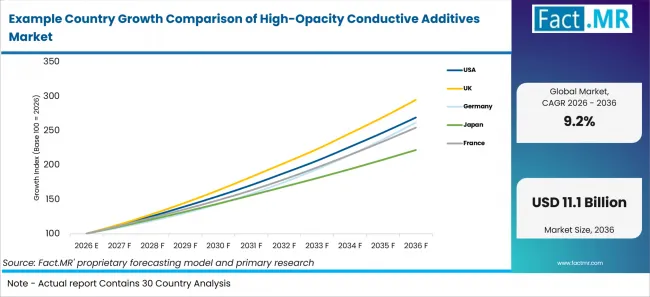
Example Country Growth Comparison Of High Opacity Conductive Additives Market | Source: Fact.MR
| Country | CAGR (2026-2036) |
|---|---|
| United Kingdom | 11.4% |
| United States | 10.4% |
| Germany | 10.1% |
| France | 9.8% |
| Japan | 8.3% |
What supports USA adoption?
10.4% CAGR, supported by electronics investment and industrial coating demand.
U.S. coating formulators serve electronics and industrial equipment that need controlled surface resistance. In June 2025, the U.S. Department of Commerce announced Micron plans for USD 200 billion in chip production and R&D investment in the United States. That scale of electronics capacity is expected to widen the base of housings and production tools that use ESD or EMI control. Conductive carbon black remains practical when dark color and strong hiding are acceptable.
What supports the United Kingdom’s growth?
11.4% CAGR, backed by electronics production and digital infrastructure.
UK demand is expected to benefit from a broad production base and more electrical content in industrial equipment. In July 2026, the Office for National Statistics reported GBP 452.0 billion of UK makers’ product sales for 2025. Functional coatings are expected to serve electronics and machinery where static control is built into a coated surface. Formulators are likely to favor additives that hold a steady resistance after cure and routine cleaning.
What is supporting Germany’s adoption?
10.1% CAGR, led by microelectronics investment and industrial electrification.
Germany combines a large industrial coating base with fresh investment in power chips. In February 2025, Germany’s Federal Ministry for Economic Affairs and Climate Action reported that Infineon planned to invest around EUR 3.4 billion at its Dresden site. The new capacity is aimed at power chip production for energy and electric-mobility uses. That activity is expected to support nearby need for static control and EMI management. Conductive coating suppliers are likely to focus on dispersion guidance because filler loading can change viscosity and film texture.
How is France developing demand?
9.8% CAGR, driven by electronics and transport-equipment activity.
France has an established electronics chain that covers microelectronics and printed circuits. In July 2025, the Ministry of the Economy reported that the French electronics sector generated nearly EUR 18 billion in revenue. This base is expected to support coating use in electronic parts and industrial equipment that need static control or signal protection. High-opacity conductive systems fit uses where one surface must provide electrical function and a controlled finish.
How does Japan perform?
8.3% CAGR, shaped by chip investment and electronics production.
Japan remains closely tied to electronics and chip production where small parts often need stable ESD and EMI control. In February 2025, the Ministry of Economy, Trade and Industry said the national AI and chip framework would provide more than JPY 10 trillion in public support over seven years. The policy is expected to support more domestic chip and server capacity. Conductive coatings are expected to serve housings and work areas around that equipment.
Who leads the High-Opacity Conductive Additives Market?
Birla Carbon, Orion S.A., Tokai Carbon, Denka, NanoXplore, and Cabot Corporation form the profiled competitive group. Their participation places the market around conductive pigment and filler systems used where electrical performance must be combined with visible hiding, opacity control, and coating compatibility.
Across the market, suppliers compete through materials that can support antistatic, static-dissipative, ESD, conductive, and EMI-grade coating functions. Conductive carbon black, oxide-based materials, graphene, metal-coated particles, and hybrid conductive fillers represent the principal material routes available to formulators.
Provider selection is shaped by more than conductivity alone. Coating formulators also evaluate dispersion behavior, resin compatibility, viscosity, film appearance, opacity, and the ability to reach a defined resistance after cure. Consistent technical guidance therefore becomes important when conductive loading changes both electrical performance and coating quality.
Competition consequently centers on repeatable electrical performance, dispersion control, opacity management, and application fit. Suppliers able to support industrial, flooring, electronics, and EMI-shielding coatings across different resistance requirements are positioned to address a broader range of formulation needs.
Which companies are the key providers?
Key companies include Birla Carbon; Orion S.A.; Tokai Carbon; Denka; NanoXplore; and Cabot Corporation.
- Birla Carbon
- Orion S.A.
- Tokai Carbon
- Denka
- NanoXplore
- Cabot Corporation
Bibliography
- U.S. Department of Commerce. (2025, January 16). U.S. Department of Commerce announces $1.4 billion in final awards to support the next generation of U.S. semiconductor advanced packaging.
- U.S. Department of Commerce. (2025, June 12). President Trump secures $200B investment from Micron Technology for memory chip manufacturing in the United States.
- Office for National Statistics. (2026, July 24). UK manufacturers’ sales by product: 2025.
- Federal Ministry for Economic Affairs and Climate Action. (2025, February 20). Europäische Kommission genehmigt weiteres deutsches Chips-Act-Projekt: Infineon baut seine Chip-Produktion in Dresden aus [European Commission approves another German Chips Act project: Infineon expands chip production in Dresden].
- Ministère de l’Économie, des Finances et de la Souveraineté industrielle et numérique. (2025, July 7). Signature du contrat stratégique de la filière (CSF) Électronique pour 2025-2028.
- Ministry of Economy, Trade and Industry. (2025, February 7). Press conference by Minister Muto (excerpt).
- Cabot Corporation. (2025, July 29). Cabot Corporation launches new LITX® 95F conductive carbon engineered for energy storage systems.
This Report Answers
- The report explains where high-opacity conductive additives are used across pigment type and opacity need. It also covers coating type and conductivity level so readers can compare the technical role of each leading segment.
- Segment analysis identifies the leading 2026 subsegments and the formulation reasons behind their position.
- Country analysis compares the five listed markets and links growth to a named local production or policy condition. Each country block uses one official statistic so the evidence remains easy to trace and read.
- Competitive analysis reviews active providers across conductive pigments and conductive coatings. It also covers EMI shielding materials and electronics adhesive systems where those portfolios overlap with electrical-control coatings.
What does the High-Opacity Conductive Additives Market cover?
The market covers conductive pigments and filler packages used in coatings where electrical result and visible hiding are both required.
uses include industrial coatings, floors, EMI-shielding coatings, electronics coatings, and architectural specialty finishes.
What is included in the scope?
The scope includes additives used in liquid or formulated coatings where electrical result is a stated function. It covers pigment choice and dispersion behavior as well as opacity control. The assessment also considers how filler loading changes the electrical result after cure. uses include industrial surfaces and electronic housings where a coating carries part of the static-control or shielding function.
Conductive plastics and shielding foils are treated as competing or complementary routes when they provide the electrical function outside a coating. Conductive adhesives and metal meshes are handled the same way. The report keeps its focus on additives that are formulated into a coating layer.
What is excluded from the scope?
The scope excludes commodity pigments used only for color, standalone metal enclosures, conductive plastics sold without a coating function, and finished electronic devices.
Battery conductive additives are excluded when they are used only inside electrode slurries and do not form a coating covered by the defined market boundary.
How Was the Analysis Built?
The analysis draws on 120+ sources, 35+ company portfolios, 25+ countries, and more than 20 industry interviews.
- Primary Research: Primary research includes discussions with manufacturers, service providers, technology developers, distributors, end users, and subject-matter experts. These conversations examine purchasing priorities, product adoption, operational challenges, approval requirements, competitive positioning, and the factors that influence wider market acceptance.
- Desk Research: Desk research covers government statistics, regulatory publications, company filings, trade data, technical studies, industry associations, standards, public policy, and other authoritative sources. Every source used in the analysis is documented in the bibliography.
- Market Sizing and Forecasting: Market estimates combine historical performance, demand indicators, pricing and volume trends, segment shares, company participation, country-level growth, adoption patterns, investment activity, and barriers to market expansion.
- Data Validation and Update Cycle: Findings are validated by comparing primary interviews with public data, company activity, regulatory changes, trade patterns, and industry developments. Regular updates review new product launches, capacity changes, partnerships, approvals, and shifts in commercial adoption.
What is the report’s scope and coverage?
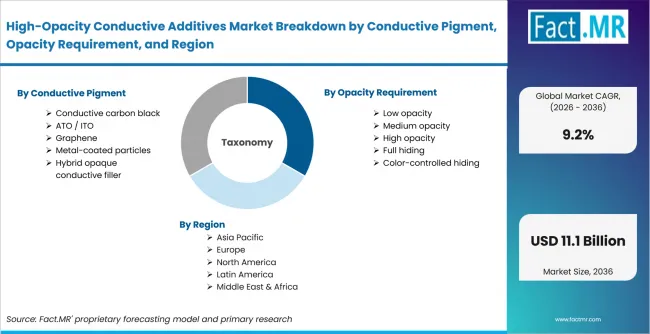
High Opacity Conductive Additives Market Breakdown By Conductive Pigment, Opacity Requirement, And Region | Source: Fact.MR
| Attribute | Details |
|---|---|
| Quantitative Units | USD billion |
| Market Definition | Conductive pigments and filler systems used in coatings where electrical conductivity and visible hiding or opacity are both required. The scope covers antistatic, static-dissipative, ESD, conductive, and EMI-grade coating functions. |
| Conductive Pigment | Conductive carbon black; ATO / ITO; Graphene; Metal-coated particles; Hybrid opaque conductive filler |
| Opacity Requirement | Low opacity; Medium opacity; High opacity; Full hiding; Color-controlled hiding |
| Coating Type | Industrial; Floor; EMI shielding; Electronics; Architectural specialty |
| Conductivity | Antistatic; Static dissipative; ESD; Conductive; EMI-grade |
| Regions Covered | North America; Latin America; Western Europe; Eastern Europe; East Asia; South Asia & Pacific; Middle East & Africa |
| Countries Covered | United States; United Kingdom; Germany; Japan; France |
| Key Companies Profiled | Birla Carbon; Orion S.A.; Tokai Carbon; Denka; NanoXplore; Cabot Corporation |
| Forecast Period | 2026 to 2036 |
| Approach | Hybrid top-down and bottom-up approach using coating demand, conductive filler use, end-use exposure, country manufacturing indicators, and provider portfolio review. |
How is the market segmented?
-
By Conductive Pigment:
- Conductive carbon black
- ATO / ITO
- Graphene
- Metal-coated particles
- Hybrid opaque conductive filler
-
By Opacity need:
- Low opacity
- Medium opacity
- High opacity
- Full hiding
- Color-controlled hiding
-
By Coating Type:
- Industrial
- Floor
- EMI shielding
- Electronics
- Architectural specialty
-
By Conductivity:
- Antistatic
- Static dissipative
- ESD
- Conductive
- EMI-grade
-
By Region:
- North America
- Latin America
- Western Europe
- Eastern Europe
- East Asia
- South Asia & Pacific
- Middle East & Africa