- Base Value (2025): 9.4 Bn
- Estimated Value (2026): 10.0 Bn
- Forecast Value (2036): 19.3 Bn
- CAGR (2026–2036): 6.8%
Conductive Silicone Rubber Market Size, Market Forecast and Outlook By Fact.MR
The conductive silicone rubber market was valued at USD Billion 9.40 in 2025, projected to reach USD Billion 10.04 in 2026, and is forecast to expand to USD Billion 19.38 by 2036 at a 6.80% CAGR. Expanding end-use application requirements, tightening performance specifications, and growing adoption across industrial and commercial sectors are driving sustained procurement growth globally.
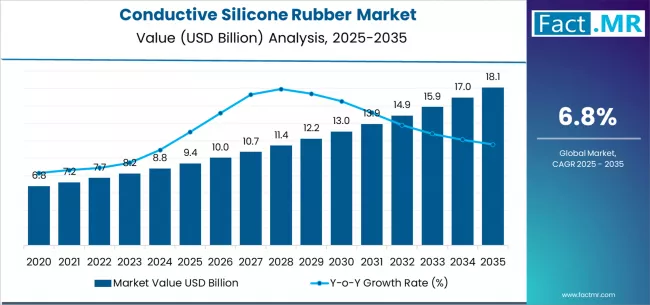
Conductive Silicone Rubber Market Market Value Analysis | Source: Fact.MR
Summary of Conductive Silicone Rubber Market
- Market Overview
-
The market is valued at USD Billion 9.40 in 2025 and is projected to reach USD Billion 19.38 by 2036.
-
The industry is expected to grow at a 6.80% CAGR from 2026 to 2036, creating an incremental opportunity of USD Billion 9.34.
-
The market is a performance-driven category where product quality specifications, application-specific qualification, and supply chain reliability define competitive positioning across primary end-use sectors.
-
- Demand and Growth Drivers
-
Demand is sustained by expanding automotive & transportation application requirements that specify thermally conductive product configurations for performance-critical operations.
-
Tightening regulatory and quality standards across major consuming industries are driving specification upgrades toward higher-performance product grades.
-
Growing adoption in emerging application segments is creating incremental demand channels beyond traditional end-use categories.
-
Supply chain reliability and product consistency requirements are consolidating procurement toward qualified suppliers with demonstrated manufacturing capabilities.
-
- Product and Segment View
-
The conductive silicone rubber market encompasses specialized products serving multiple industrial and commercial end-use applications with differentiated specifications.
-
The market is segmented by Product (Thermally Conductive, Electrically Conductive, Others) and Application (Automotive & Transportation, Electrical & Electronics, Industrial Machines, Others).
-
Thermally Conductive leads by Product with 48.4% share in 2026.
-
Automotive & Transportation leads by Application with 30.4% share in 2026.
-
Scope includes all product variants and grades within the defined market, while excluding raw material feedstock valuations, downstream finished product pricing, and processing equipment.
-
- Geography and Competitive Outlook
-
The global market spans all major manufacturing and consuming regions, with regional dynamics shaped by local regulatory frameworks and end-use industry concentration.
-
Competition is shaped by production capability, application expertise, and regulatory compliance, with key players including Dow Inc., Compagnie de Saint-Gobain S.A., Wacker Chemie AG, Western Rubbers India Pvt. Ltd., Western Polyrub India Pvt. Ltd., Shin-Etsu Chemical Co., Ltd..
-
Supply chain positioning and customer qualification credentials determine procurement allocation across tier-1 and tier-2 supplier categories.
-
- Analyst Opinion at Fact.MR
- Shambhu Nath Jha, Principal Consultant at Fact.MR, opines: 'In my analysis, I have observed that procurement decisions in the conductive silicone rubber market increasingly depend on application-specific performance documentation and supply chain reliability credentials rather than per-unit pricing alone. Suppliers investing in technical service capabilities and quality consistency documentation hold procurement advantages over commodity-positioned competitors.'
- Strategic Implications / Executive Takeaways
-
Manufacturers must invest in application-specific performance testing and qualification data to secure procurement positions with tier-1 end-use customers.
-
Procurement teams should evaluate total cost of ownership including product performance benefits and supply reliability rather than unit material pricing alone.
-
Companies must monitor regulatory developments across key consuming markets to anticipate specification changes and reformulation requirements.
-
Conductive Silicone Rubber Market Key Takeaways
| Metric | Details |
|---|---|
| Industry Size (2026) | USD Billion 10.04 |
| Industry Value (2036) | USD Billion 19.38 |
| CAGR (2026 to 2036) | 6.80% |
Source: Fact.MR analysis. Updated Apr 8, 2026
Source: Fact.MR, 2026
The absolute dollar expansion of USD Billion 9.34 between 2026 and 2036 reflects structural demand growth across multiple independent consumption channels. As per Fact.MR, Thermally Conductive maintains category leadership at 48.4% share, supported by established performance characteristics and cost-effectiveness advantages across primary application segments.
Fact.MR analysis indicates that Automotive & Transportation applications command 30.4% of end-use demand, driven by specification requirements that favour established product formulations. The competitive landscape features both global multinational suppliers and specialized regional manufacturers competing on technical performance, application expertise, and supply chain reliability.
Why is the Conductive Silicone Rubber Market Experiencing Robust Growth?
The conductive silicone rubber market grows by enabling automotive manufacturers, electronics companies, and industrial equipment producers to access high-performance elastomer materials that support thermal management while meeting industrial demand for consistent conductivity specifications.
Electric vehicle manufacturers and power electronics assemblers face mounting pressure to develop efficient thermal interface materials with proven heat dissipation properties and electrical performance characteristics, with conductive silicone rubber formulations typically providing exceptional thermal conductivity values ranging from 1-5 W/mK and reliable electrical resistance properties essential for component cooling and EMI shielding applications, making these materials essential for competitive product positioning in automotive electrification, consumer electronics, and industrial automation categories.
The electronics industry's need for reliable thermal management solutions and consistent material quality creates demand for diverse conductive silicone rubber grades that can provide superior heat transfer characteristics, maintain predictable performance across different operating temperatures, and ensure quality compliance without compromising processing economics or assembly compatibility.
Government initiatives promoting electric vehicle adoption and energy efficiency standards drive adoption in automotive manufacturing facilities, electronics assembly plants, and industrial equipment production operations, where conductive silicone rubber utilization has a direct impact on thermal management outcomes and component reliability.
The automotive industry's accelerating focus on vehicle electrification and battery thermal management further expands market opportunities, with engineering research demonstrating measurable performance advantages from thermally conductive silicone materials, including reduced operating temperatures and improved component longevity.
Formulation complexity during material compounding and the technical requirements for filler dispersion optimization and conductivity validation processes may limit accessibility among smaller manufacturers and developing regions with limited infrastructure for advanced silicone rubber processing and quality assurance systems.
Segmental Analysis
The market is segmented by product, application, and region. By product, the market is divided into thermally conductive, electrically conductive, and others. By application, the market is divided into automotive & transportation, electrical & electronics, industrial machines, and others. Regionally, the market is divided into Asia Pacific, North America, Europe, Latin America, and Middle East & Africa.
Why is Thermally Conductive Silicone Rubber the Preferred Choice?
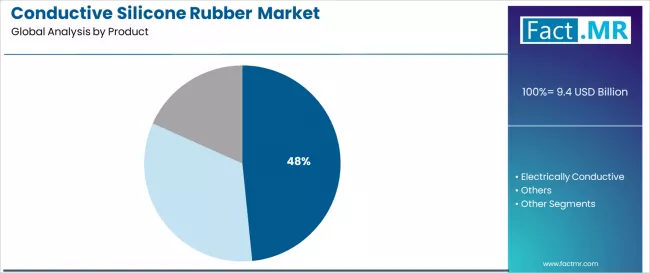
Conductive Silicone Rubber Market Analysis By Product | Source: Fact.MR
Thermally conductive silicone rubber represents the dominant force in the market, capturing a 48.4% of total market share in 2025. This established product category encompasses solutions featuring critical heat dissipation functionality for electric vehicle battery cooling, power electronics thermal management, and LED lighting heat transfer applications, including ceramic-filled and metal-filled silicone compounds that enable enhanced thermal conductivity, improved component reliability, and superior operating temperature control across all thermal interface applications.
The thermally conductive segment's market leadership stems from its essential role in electric vehicle battery pack thermal management, with thermally conductive silicone materials capable of meeting diverse heat transfer requirements while maintaining cost-effective processing and operational reliability across all automotive and electronics manufacturing environments. Within the thermally conductive segment, automotive electrification applications account for the largest consumption share, driven by stringent thermal management specifications and continuous battery safety initiatives across global electric vehicle production operations.
Electrically conductive silicone rubber maintains a substantial 32.0% market share, serving manufacturers who require EMI shielding materials, grounding solutions, and static dissipation applications for electronics enclosures, automotive sensors, and industrial control systems.
Electrically conductive silicone rubber offers versatile electrical conductivity solutions for electromagnetic interference protection while providing sufficient mechanical flexibility to meet assembly demands and environmental requirements. The others category accounts for approximately 19.6% of the market, serving specialized applications requiring unique property combinations such as dual thermal-electrical conductivity, flame retardancy, or specialized surface characteristics for niche industrial requirements.
Key advantages driving the thermally conductive segment include:
- Established automotive integration infrastructure with electric vehicle production facilities that reduce application complexity and ensure consistent thermal performance
- Critical thermal management functionality allowing enhanced heat dissipation across different component designs without significant material cost penalties
- Proven application reliability, delivering consistent thermal conductivity while maintaining competitiveness against alternative thermal interface materials
- Broad OEM acceptance enabling straightforward material specification and performance validation standards across multiple automotive and electronics sectors
Which Application Category Leads the Conductive Silicone Rubber Market?
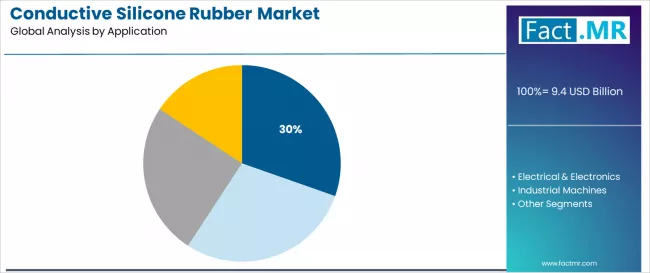
Conductive Silicone Rubber Market Analysis By Application | Source: Fact.MR
The automotive & transportation application segment commands the largest market share at 30.4% in 2025, driven by extensive utilization in electric vehicle battery thermal management systems, engine component cooling applications, and wiring harness protection solutions.
Automotive applications incorporating conductive silicone rubber provide comprehensive thermal control through integrated thermal interface pads, gap fillers, and potting compounds, enabling optimized heat dissipation from batteries, power electronics, and electric motors for demanding transportation applications across passenger vehicles, commercial trucks, and hybrid powertrains. The rapid adoption of electric vehicles and the growing complexity of automotive electronics create sustained demand for thermally conductive silicone materials that deliver enhanced component protection and extended operating life capabilities.
The electrical & electronics segment accounts for 28.5% of the market, serving consumer electronics thermal management, LED lighting cooling applications, and power supply thermal interface requirements. Electronics applications provide essential heat transfer functionality for processors, power semiconductors, and high-brightness LED arrays where thermal management directly impacts device performance and reliability.
The industrial machines segment holds 25.0% market share, driven by growing adoption in packaging equipment thermal management, casting machinery temperature control, and oil & gas electronics protection applications where harsh operating environments create compelling value propositions. Others collectively represent 16.1% of the market, encompassing diverse applications including construction equipment, food & beverage processing machinery, and specialty industrial systems requiring thermal or electrical conductivity performance.
What are the Drivers, Restraints, and Key Trends of the Conductive Silicone Rubber Market?
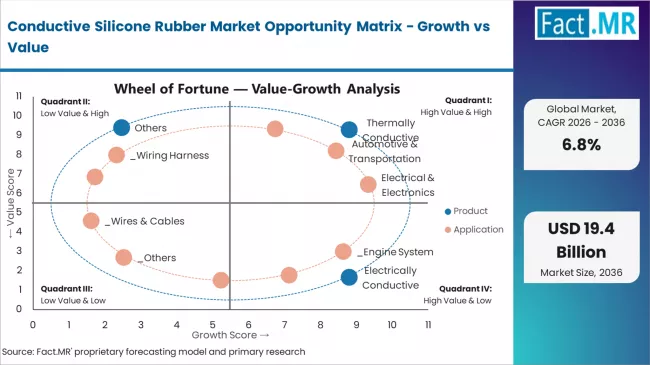
Conductive Silicone Rubber Market Opportunity Matrix Growth Vs Value | Source: Fact.MR
The market is driven by three concrete demand factors tied to technological advancement and industrial electrification. First, accelerating electric vehicle adoption and automotive electrification requirements create growing demand for thermally conductive silicone materials, with global electric vehicle production expanding by 20-25% annually in major automotive markets worldwide, requiring comprehensive thermal management material infrastructure. Second, expanding power electronics deployment for renewable energy systems and industrial automation drives increased utilization of conductive silicone rubber solutions, with many electronics manufacturers implementing capacity expansion programs for advanced thermal interface material applications by 2030. Third, technological advancements in conductive filler technologies and silicone polymer chemistry enable more effective and efficient thermal conductivity enhancement that reduces thermal resistance while improving material processing and assembly compatibility capabilities.
Market restraints include high raw material costs for specialized conductive fillers such as aluminum oxide, boron nitride, and silver particles that can deter smaller manufacturers from adopting premium conductive silicone formulations, particularly in price-sensitive applications where thermal management requirements face budget constraints or alternative material competition. Processing complexity and quality control requirements pose another significant challenge, as conductive silicone rubber compounding demands precise filler loading optimization and uniform dispersion control, potentially causing increased manufacturing costs and material waste. Performance trade-offs between thermal conductivity enhancement and mechanical property retention across different formulation approaches create additional development challenges for application optimization, demanding ongoing investment in material science research and application testing programs.
Key trends indicate accelerated capacity expansion in Asia Pacific markets, particularly China and India, where automotive electrification and electronics manufacturing growth drive comprehensive conductive silicone rubber adoption. Material innovation trends toward hybrid filler systems combining multiple conductive particle types, enhanced thermal conductivity formulations exceeding 5 W/mK performance, and processing optimization technologies enable improved material approaches that maximize heat transfer efficiency while maintaining mechanical integrity. However, the market thesis could face disruption if significant advances in alternative thermal interface materials such as graphene-based compounds or phase change materials achieve cost-competitive thermal performance, potentially reducing reliance on traditional conductive silicone rubber formulations.
Analysis of the Conductive Silicone Rubber Market by Key Countries
.webp "Top Country Growth Comparison Conductive Silicone Rubber Market Cagr (2026 2036)")
Top Country Growth Comparison Conductive Silicone Rubber Market Cagr (2026 2036) | Source: Fact.MR
| Country | CAGR (2025-2035) |
|---|---|
| China | 10.2% |
| India | 9.8% |
| South Korea | 8.2% |
| Brazil | 7.5% |
| USA | 7.0% |
| Japan | 6.8% |
| Germany | 6.5% |
Source: Fact.MR analysis. Updated Apr 8, 2026
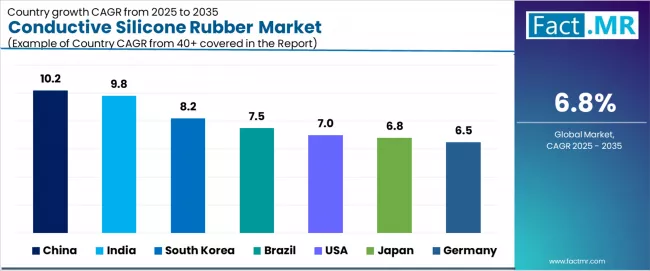
Conductive Silicone Rubber Market Cagr Analysis By Country | Source: Fact.MR
The conductive silicone rubber market is expanding robustly, with China leading at a 10.2% CAGR through 2035, driven by largest global manufacturing base, accelerating EV and electronics expansion, and comprehensive government industrial incentives. India follows at 9.8%, supported by rapid industrial growth trajectory, expanding electronics and automotive sector development, and government manufacturing support initiatives.
South Korea records 8.2%, reflecting advanced electronics manufacturing capabilities and semiconductor industry growth with innovation in conductive material technologies. Brazil posts 7.5%, anchored by growing automotive sector presence and industrial expansion with urbanization trends.
USA grows at 7.0%, with strong technological infrastructure supporting high adoption of advanced electronics and EV market growth. Japan advances at 6.8%, emphasizing electronics manufacturing excellence and high-tech R&D capabilities with industrial automation leadership, while Germany grows steadily at 6.5%, focusing on automotive electrification initiatives and renewable energy project deployment.
China Leads Global Market Expansion
China demonstrates the strongest growth potential in the conductive silicone rubber market with a CAGR of 10.2% through 2035. The country's leadership position stems from largest global manufacturing base, accelerating electric vehicle production capacity, and expanding electronics manufacturing operations enabling mainstream conductive silicone rubber adoption.
Growth is concentrated in major industrial regions, including Guangdong, Jiangsu, Zhejiang, and Shanghai, where automotive manufacturing clusters and expanding electronics production infrastructure are implementing thermally conductive materials for enhanced battery thermal management and component cooling applications.
Distribution channels through integrated automotive supply chains, direct material supply agreements with electronics assemblers, and manufacturing partnerships expand deployment across electric vehicle manufacturers and consumer electronics producers. The country's massive electric vehicle market provides policy support for automotive electrification, including subsidies for new energy vehicles and comprehensive charging infrastructure development.
Key market factors:
- Industrial demand concentrated in electric vehicle manufacturing hubs and electronics production centers with comprehensive supply chain networks
- Infrastructure development through automotive electrification facilities and advanced electronics manufacturing investments
- Comprehensive material ecosystem, including established silicone compounding industry with proven conductive material capabilities
- Technology integration featuring modern mixing equipment, thermal conductivity testing systems, and quality control technologies
India Emerges as High-Growth Market
In major industrial states including Maharashtra, Tamil Nadu, Gujarat, and Karnataka, the consumption of conductive silicone rubber is accelerating across automotive manufacturing operations and electronics assembly segments, driven by expanding industrial capacity and growing domestic demand. The market demonstrates strong growth momentum with a CAGR of 9.8% through 2035, linked to government manufacturing initiatives, developing automotive electrification infrastructure, and sustained electronics production growth.
Indian manufacturers are implementing modern conductive silicone rubber materials and thermal management solutions to enhance product performance while meeting growing demand in expanding automotive sectors and consumer electronics industries. The country's Make in India initiatives create persistent demand for advanced manufacturing materials, while increasing emphasis on electric vehicle adoption drives utilization of high-performance thermally conductive silicone systems.
Key development areas:
- Automotive and electronics manufacturing sectors leading conductive silicone rubber consumption with comprehensive adoption programs
- Developing supply chains providing improved material availability with expanding distribution infrastructure
- Technology partnerships between international material suppliers and domestic manufacturers are expanding market access
- Integration of quality management systems and comprehensive performance validation protocols
South Korea Shows Technology Leadership
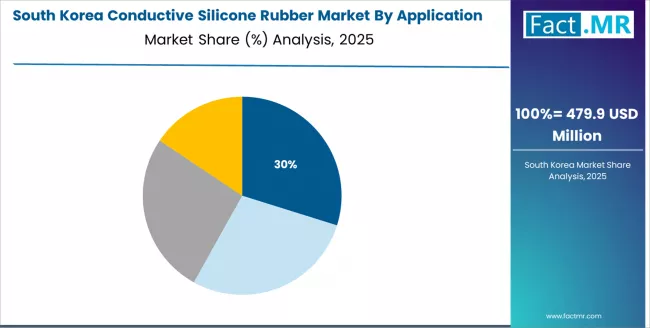
Conductive Silicone Rubber Market South Korea Market Share Analysis By Application | Source: Fact.MR
The South Korean market leads in advanced conductive silicone rubber applications based on integration with semiconductor manufacturing operations and premium electronics production for enhanced thermal management performance. The country shows robust potential with a CAGR of 8.2% through 2035, driven by world-class electronics industry presence, strong semiconductor manufacturing capabilities, and the expansion of specialized material technology facilities in major industrial centers, including Seoul metropolitan area, Gyeonggi Province, and Chungcheong regions.
South Korean manufacturers are adopting innovative conductive silicone formulations for advanced semiconductor packaging and high-performance electronics cooling applications, particularly in facilities with sophisticated thermal management requirements and specialized applications demanding comprehensive material validation standards. Technology deployment channels through established electronics manufacturers and semiconductor companies expand coverage across consumer electronics producers and industrial equipment manufacturers.
Leading market segments:
- Electronics manufacturing operations and semiconductor packaging facilities implementing comprehensive thermal management solutions
- Strategic partnerships with material technology suppliers, achieving stringent thermal conductivity specifications and reliability standards
- Collaborative research between technical institutes and commercial operations are expanding innovation capabilities
- Focus on next-generation material development and thermal interface optimization methodologies
Brazil Demonstrates Regional Growth Potential
Brazil's market expansion is driven by automotive sector development, including electric vehicle assembly initiatives in São Paulo and Minas Gerais, and expanding industrial manufacturing operations across multiple production regions. The country demonstrates promising growth potential with a CAGR of 7.5% through 2035, supported by growing automotive manufacturing presence for South American markets, increasing industrial equipment production capacity, and urban infrastructure development creating industrial demand.
Brazilian manufacturers face implementation challenges related to material import costs and technical expertise availability, requiring partnerships with international silicone material suppliers and support from technology providers. However, expanding automotive production volumes and growing industrial automation adoption create compelling business cases for conductive silicone rubber utilization, particularly in automotive applications where thermal management has a direct impact on electric vehicle component reliability and performance optimization.
Key market characteristics:
- Automotive and industrial equipment segments showing fastest growth with substantial increase in thermal management material requirements
- Regional expansion trends focused on automotive manufacturing clusters in southeastern states
- Future projections indicate the need for expanded material supply infrastructure and technical support capability development programs
- Growing emphasis on technology transfer and competitive positioning in Latin American markets
USA Emphasizes Advanced Technology Applications
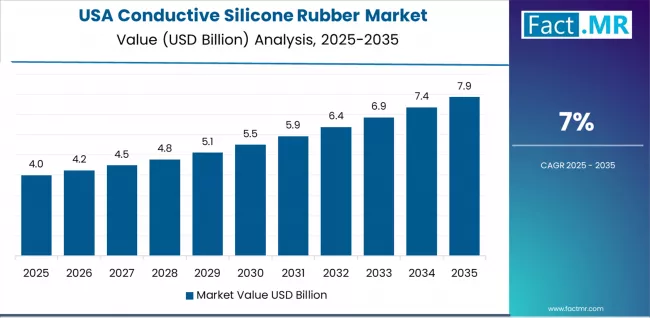
Conductive Silicone Rubber Market Country Value Analysis | Source: Fact.MR
In major manufacturing regions including Michigan, California, Texas, and the Southeast automotive corridor, automotive manufacturers and electronics companies are implementing comprehensive thermal management strategies to optimize electric vehicle battery cooling requirements and power electronics thermal control, with documented case studies showing significant temperature reduction achievements through advanced thermally conductive silicone formulations and optimized thermal interface designs.
The market shows steady growth potential with a CAGR of 7.0% through 2035, linked to established automotive manufacturing infrastructure, strong technological development capabilities, and ongoing electric vehicle market expansion in major regions.
American manufacturers are adopting advanced conductive silicone rubber specifications and comprehensive testing protocols to enhance thermal management performance while maintaining reliability standards demanded by automotive safety requirements and electronics thermal specifications. The country's mature automotive and electronics industries create persistent demand for validated thermal interface materials and consistent quality solutions that integrate with existing manufacturing systems.
Market development factors:
- Automotive manufacturers and electronics producers leading conductive silicone rubber consumption across USA
- Electric vehicle adoption policies and clean energy initiatives providing support for thermal management material deployment
- Strategic relationships between American manufacturers and global material suppliers are expanding technology access
- Emphasis on performance validation and comprehensive thermal testing across regulated automotive applications
Japan Emphasizes Manufacturing Excellence
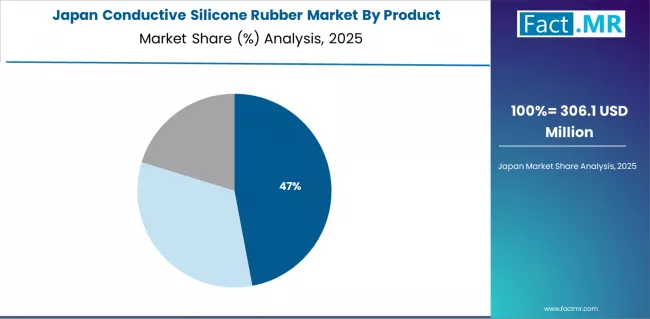
Conductive Silicone Rubber Market Japan Market Share Analysis By Product | Source: Fact.MR
Japan's conductive silicone rubber market demonstrates sophisticated and technology-focused landscape, characterized by advanced integration of high-performance thermal management materials with existing electronics manufacturing operations across semiconductor production, automotive component manufacturing, and precision industrial equipment applications.
The country shows steady growth momentum with a CAGR of 6.8% through 2035, driven by advanced material technologies for ultra-precise thermal management in specialized facilities concentrated in industrial regions. Japan's emphasis on technological excellence and quality optimization creates requirements for premium conductive silicone rubber formulations that support comprehensive electronics miniaturization initiatives and stringent thermal performance requirements in manufacturing operations.
The market benefits from strong partnerships between domestic silicone material producers and electronics manufacturers, creating comprehensive supply ecosystems that prioritize thermal conductivity consistency and reliability validation. Electronics manufacturing facilities in major technology regions showcase advanced conductive silicone implementations where material performance achieves rigorous thermal management standards through integrated quality programs.
Key market characteristics:
- Electronics manufacturers and automotive component producers driving high-performance material requirements with emphasis on technical excellence and consistency
- Quality assurance partnerships enabling stringent thermal conductivity specifications with comprehensive testing programs
- Technology collaboration between Japanese companies and international material technology providers is expanding innovation capabilities
- Emphasis on continuous material development and thermal management optimization methodologies
Germany Demonstrates Automotive Electrification Focus
The market in Germany leads in automotive-grade conductive silicone rubber applications based on integration with electric vehicle production operations and premium automotive component manufacturing for enhanced thermal management. The country shows steady potential with a CAGR of 6.5% through 2035, driven by world-class automotive industry presence, strong electrification commitment, and the expansion of specialized electric vehicle component facilities in major automotive centers, including Baden-Württemberg, Bavaria, Lower Saxony, and North Rhine-Westphalia.
German manufacturers are adopting advanced thermally conductive silicone formulations for battery thermal management optimization and power electronics cooling applications, particularly in premium electric vehicle segments with sophisticated thermal control requirements and specialized applications demanding comprehensive validation standards. Technology deployment channels through established automotive suppliers and electric vehicle manufacturers expand coverage across passenger vehicle producers and commercial vehicle manufacturers.
Leading market segments:
- Electric vehicle battery thermal management systems in major production centers implementing comprehensive cooling solutions
- Strategic partnerships with material suppliers, achieving stringent automotive qualification specifications and durability standards
- Collaborative research between automotive institutes and material producers are expanding thermal management capabilities
- Focus on renewable energy integration and sustainable automotive manufacturing methodologies
Europe Market Split by Country
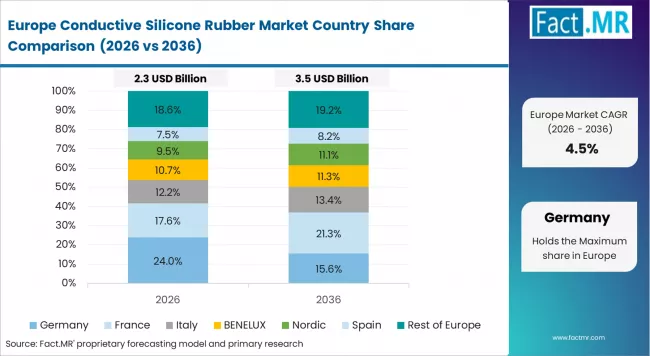
Conductive Silicone Rubber Market Europe Country Market Share Analysis, 2026 & 2036 | Source: Fact.MR
The conductive silicone rubber market in Europe is projected to grow from USD 2.3 billion in 2025 to USD 4.3 billion by 2035, registering a CAGR of 6.5% over the forecast period. Germany is expected to maintain its leadership position with a 36.2% market share in 2025, supported by its advanced automotive manufacturing infrastructure, comprehensive electric vehicle development programs, and strong industrial equipment manufacturing presence across major production centers.
France follows with a 21.4% share in 2025, driven by established automotive production operations and integrated electronics manufacturing sectors. UK holds a 17.8% share in 2025 through its automotive component manufacturing capabilities and advanced electronics production operations. Italy commands a 14.3% share, while Rest of Europe accounts for 10.3% in 2025.
By 2035, Germany is projected to hold 35.8% share, France 21.7%, UK 17.6%, Italy 14.5%, and rest of Europe 10.4%, reflecting sustained growth momentum across all major European markets and increasing conductive silicone rubber adoption in diversified automotive electrification and electronics manufacturing applications implementing advanced thermal management programs.
Competitive Landscape of the Conductive Silicone Rubber Market
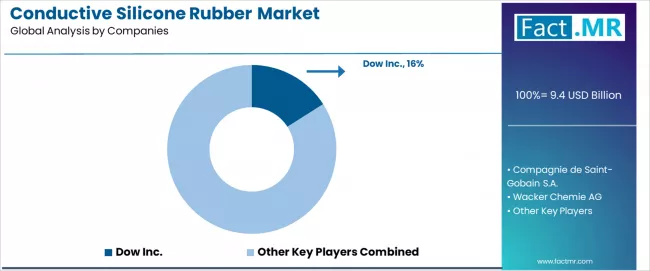
Conductive Silicone Rubber Market Analysis By Company | Source: Fact.MR
The conductive silicone rubber market features approximately 25-30 meaningful players with moderate concentration, where the top three companies control roughly 35-45% of global market share through established material production platforms and extensive customer relationships across automotive and electronics manufacturing sectors.
Market leaders include Dow, which maintains competitive advantages through comprehensive silicone material portfolios, global production networks, and deep expertise in the thermal management and conductive elastomer sectors, creating strong customer relationships among automotive OEMs and electronics manufacturers. The company leverages established silicone production facilities and ongoing material innovation initiatives to defend market positions while expanding into adjacent electric vehicle thermal management applications and advanced electronics cooling markets. Dow Inc. commands approximately 16.0% market share through integrated material operations and strategic positioning in automotive and electronics markets.
Challengers encompass Saint-Gobain, Wacker Chemie AG, and Shin-Etsu Chemical Co., Ltd., which compete through specialized material formulations and strong regional presence in key manufacturing markets. Regional producers, including Western Rubbers, Western Polyrub India Pvt. Ltd., and Specialty Silicone Products, Inc., focus on specific application segments or geographic markets, offering differentiated capabilities in customized compound development, technical application support, and specialized material grades.
Emerging players and regional compounders create competitive pressure through cost-optimized production capabilities and strategic market positioning, particularly in high-growth markets including China and India, where local presence provides advantages in technical service optimization and customer proximity.
Market dynamics favor companies that combine advanced compounding technologies with comprehensive application engineering support that addresses the complete value chain from raw material selection through formulation development and performance validation. Strategic investments in conductive filler technology development and thermal conductivity enhancement initiatives enable performance optimization and customer satisfaction across automotive and electronics applications.
Global Conductive Silicone Rubber Market - Stakeholder Contribution Framework
Conductive silicone rubber products represent a critical thermal management material that enables automotive manufacturers, electronics companies, and industrial equipment producers to enhance heat dissipation performance and component reliability without substantial design modifications, typically providing exceptional thermal conductivity characteristics and electrical performance capabilities while supporting diverse manufacturing applications.
With the market projected to grow from USD 9.4 billion in 2025 to USD 18.1 billion by 2035 at an 6.8% CAGR, these products offer compelling advantages - superior thermal transfer properties, excellent temperature stability, and versatile processing capabilities - making them essential for automotive electrification applications (largest segment), electronics thermal management (critical growth area), and diverse industrial applications seeking proven thermal interface technologies. Scaling production capacity and market development requires coordinated action across industrial policy, material standards, silicone compounders, automotive OEMs, and research institutions.
How Governments Could Spur Local Production and Adoption?
- Electric Vehicle Support Programs: Include thermal management material development in electric vehicle promotion strategies, providing targeted funding for automotive thermal interface material production in regions with established automotive manufacturing and supporting local material suppliers through investment incentives and development support.
- Research & Development Funding: Implement comprehensive funding programs for conductive material innovation, provide access to thermal testing infrastructure for material development, and establish technology centers that support collaborative thermal management research and commercial material application.
- Manufacturing Infrastructure Investment: Create favorable policies for silicone compounding facility development, provide access to competitive energy resources for material production, and establish industrial infrastructure that supports large-scale elastomer manufacturing operations.
- Skills Development & Training: Fund technical education programs for material engineers, thermal management specialists, and quality validation technicians. Invest in technology transfer initiatives that bridge research institutions with commercial silicone compounding operations and automotive thermal management applications.
How Industry Bodies Could Support Market Development?
- Material Standards & Certification: Define standardized thermal conductivity testing methodologies for conductive silicone rubber across automotive, electronics, and industrial applications, establish universal performance metrics and qualification protocols, and create certification programs for thermal management materials that manufacturers can rely on.
- Market Education & Best Practices: Lead communication initiatives that demonstrate conductive silicone rubber applications, emphasizing proven thermal management benefits, reliability advantages, and performance characteristics compared to alternative thermal interface materials and heat dissipation technologies.
- Sustainability Standards: Develop environmental performance benchmarks for silicone production operations, comprehensive lifecycle assessment methodologies for conductive elastomers, and recycling exploration programs, ensuring responsible production across different manufacturing environments and operational scales.
How Manufacturers and Technology Players Could Strengthen the Ecosystem?
- Material Technology Development: Develop next-generation conductive filler systems with enhanced thermal conductivity capabilities, improved filler dispersion technologies, and processing-optimized formulations that maximize heat transfer performance while improving manufacturing economics and material reliability.
- Technical Support Platforms: Provide comprehensive application engineering support that integrates thermal modeling, material selection guidance, performance validation testing, and reliability assessment, enabling customers to maximize thermal management effectiveness and component protection.
- Supply Chain Integration: Offer flexible supply arrangements for automotive manufacturers and electronics producers, including long-term material supply agreements, technical development partnerships, and application optimization services that keep conductive silicone rubber supply consistent with customer thermal management requirements and production schedules.
Key Players in the Conductive Silicone Rubber Market
- Dow Inc.
- Compagnie de Saint-Gobain S.A.
- Wacker Chemie AG
- Western Rubbers India Pvt. Ltd.
- Western Polyrub India Pvt. Ltd.
- Shin-Etsu Chemical Co., Ltd.
- Specialty Silicone Products, Inc.
- KCC Corporation
- China National Bluestar (Group) Co., Ltd.
- Reiss Manufacturing, Inc.
Bibliography
- Relevant industry regulatory authority. (2025). Industry guidance and standards documentation.
- International trade association. (2025). Market statistics and industry annual report.
- International standards organization. (2025). Product specification and testing standards.
- Leading industry participant. (2025). Annual report and public filings.
- Government statistical agency. (2025). Production and trade statistics database.
- This bibliography is provided for reader reference. The full Fact.MR report contains the complete reference list with primary research documentation.
This Report Addresses
- Market sizing and quantitative forecast metrics detailing consumption across product and application segments globally through 2036.
- Product analysis comparing adoption rates and evaluating performance differentials across product categories.
- Application intelligence evaluating demand trajectories across leading application segments.
- Regulatory compliance assessment analyzing specification standard impacts on procurement decisions.
- Competitive posture evaluation tracking manufacturer capability investments and market positioning strategies.
- Supply chain intelligence identifying sourcing dynamics and pricing trends across major consuming regions.
- Custom data delivery formats encompassing interactive dashboards, raw Excel datasets, and comprehensive PDF narrative reports.
Conductive Silicone Rubber Market Definition
The conductive silicone rubber market encompasses the production, distribution, and consumption of specialized products serving defined industrial, commercial, and consumer applications globally. Products within this category are manufactured to specific quality, purity, and performance standards required by downstream end-use specifications.
Conductive Silicone Rubber Market Inclusions
Market scope includes all product types and grades within the conductive silicone rubber market consumed across defined end-use applications globally. Forecast coverage spans 2026 to 2036 across product and application segments.
Conductive Silicone Rubber Market Exclusions
The scope excludes raw material feedstock valuations prior to processing, downstream finished end-use product pricing, and manufacturing equipment used in production processes.
Conductive Silicone Rubber Market Research Methodology
Primary Research: Analysts conducted interviews with end-use manufacturers, procurement directors, and product development managers across key consuming industries.
Desk Research: Data collection aggregated regulatory databases, trade association statistics, and publicly filed company annual reports from major market participants.
Market-Sizing and Forecasting: Baseline values derive from a bottom-up aggregation of product shipment volumes by type and application, applying end-use consumption growth rates and market penetration projections.
Data Validation and Update Cycle: Projections are cross-validated against industry production statistics, trade flow data, and quarterly pricing benchmarks from recognized industry sources.
Segmentation
Scope of the Report
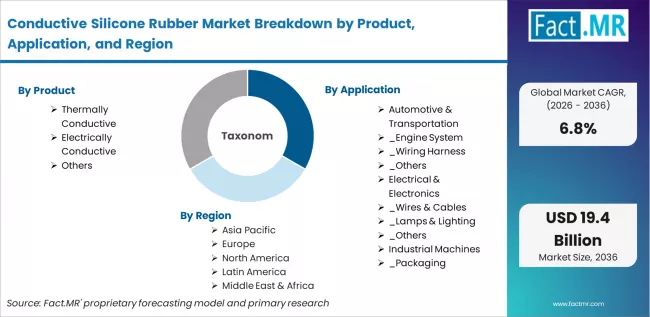
Conductive Silicone Rubber Market Breakdown By Product, Application, And Region | Source: Fact.MR
| Metric | Value |
|---|---|
| Quantitative Units | USD Billion 10.04 to USD Billion 19.38, at a CAGR of 6.80% |
| Market Definition | The Conductive Silicone Rubber Market encompasses all defined product types and grades across end-use applications globally. |
| Product Segmentation | Thermally Conductive, Electrically Conductive, Others |
| Application Segmentation | Automotive & Transportation, _Engine System, _Wiring Harness, _Others, Electrical & Electronics, _Wires & Cables, _Lamps & Lighting, _Others, Industrial Machines, _Packaging, _Stamping & Casting, _Oil & Gas, _Others, Others |
| Regions Covered | North America, Latin America, Europe, East Asia, South Asia, Oceania, Middle East & Africa |
| Key Companies Profiled | Dow Inc., Compagnie de Saint-Gobain S.A., Wacker Chemie AG, Western Rubbers India Pvt. Ltd., Western Polyrub India Pvt. Ltd., Shin-Etsu Chemical Co., Ltd., Specialty Silicone Products, Inc., KCC Corporation |
| Forecast Period | 2026 to 2036 |
| Approach | Forecasting models apply a bottom-up methodology starting from product consumption volumes, projecting growth based on end-use demand trends, regulatory conversion timelines, and market penetration rates. |
Source: Fact.MR analysis. Updated Apr 8, 2026
Conductive Silicone Rubber Market by Segments
-
Product :
- Thermally Conductive
- Electrically Conductive
- Others
-
Application :
- Automotive & Transportation
- Engine System
- Wiring Harness
- Others
- Electrical & Electronics
- Wires & Cables
- Lamps & Lighting
- Others
- Industrial Machines
- Packaging
- Stamping & Casting
- Oil & Gas
- Others
- Others (Construction, F&B, etc.)
- Automotive & Transportation
-
Region :
- Asia Pacific
- China
- Japan
- South Korea
- India
- Australia & New Zealand
- ASEAN
- Rest of Asia Pacific
- North America
- USA
- Canada
- Mexico
- Europe
- Germany
- France
- UK
- Italy
- Rest of Europe
- Latin America
- Brazil
- Rest of Latin America
- Middle East & Africa
- Kingdom of Saudi Arabia
- Other GCC Countries
- Turkey
- South Africa
- Rest of Middle East & Africa
- Asia Pacific
Frequently Asked Questions
How large is the conductive silicone rubber market in 2026?
What will be the market size by 2036?
What is the expected CAGR between 2026 and 2036?
Which product is poised to lead in 2026?
Which application leads in 2026?
What is driving market growth?
What is the conductive silicone rubber market?
Who worked on this report


Preview the report firsthand - request a free sample
Free SampleGet the brochure for pricing and purchase details
Download PDF