- Base Value(2025): 21.2 Bn
- Estimated Value(2026): 23.0 Bn
- Forecast Value (2036): 50.9 Bn
- CAGR (2026 - 2036): 8.3%
Home Security Sensors Market Forecast By Fact.MR
In 2025, the home security sensors market was valued at USD 21.2 billion. Based on Fact MR analysis, demand for home security sensors is estimated to grow to USD 23.0 billion in 2026 and USD 50.9 billion by 2036. FMR projects a CAGR of 8.3% during the forecast period.
The absolute dollar growth from 2026 to 2036 is USD 27.9 billion. This expansion reflects steady development in residential security systems rather than a structural transformation of the broader consumer electronics market. Home security sensors such as motion detectors, door and window sensors, and environmental monitoring devices are increasingly integrated into connected home ecosystems. Demand continues to grow as homeowners adopt smart security systems linked with mobile applications and home automation platforms. Growth pace remains moderated by installation costs, interoperability challenges across smart home devices, and cybersecurity concerns associated with connected security systems.
India leads with a projected CAGR of 11.5%, supported by rising adoption of smart home technologies and increasing demand for residential security solutions. China follows with a CAGR of 11.1%, driven by large scale deployment of connected home systems and expanding urban housing infrastructure. The United States records a CAGR of 10.4%, supported by strong demand for integrated home security platforms and smart monitoring systems. Japan shows a CAGR of 9.9%, reflecting steady adoption of connected home devices across residential settings. Germany records the slowest growth at 9.7%, reflecting a mature consumer electronics market where demand is increasingly linked to system upgrades and replacement cycles. Mature markets generate a significant share of replacement demand as existing security systems are upgraded with connected sensor technologies.
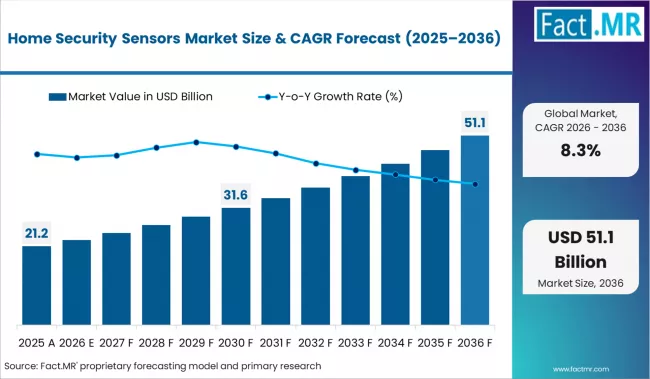
Home Security Sensors Market Market Value Analysis | Source: Fact.MR
| Metric | Details |
|---|---|
| Industry Size (2026E) | USD 23 billion |
| Industry Value (2036F) | USD 50.9 billion |
| CAGR (2026 to 2036) | 8.3% |
Home Security Sensors Market Definition
The Home Security Sensors Market includes electronic sensing devices used in residential environments to detect intrusion, movement, environmental changes, and safety risks. These sensors monitor conditions such as motion, door and window access, glass breakage, smoke, and gas presence. They are integrated into home security systems and connected through wired or wireless networks to control panels or smart home platforms. Home security sensors are widely used to enhance residential safety and enable real time alerts. The primary function of these devices is to detect security threats or hazards and trigger notifications or alarms for homeowners.
Home Security Sensors Market Inclusions
This report covers global and regional market sizes for home security sensors with forecast analysis for the study period. The market is segmented by sensor type including motion sensors, contact sensors, glass break sensors, smoke detectors, and gas sensors. Application segments include intrusion detection, fire safety monitoring, and environmental hazard detection. End users include homeowners, residential property developers, and home security service providers. The report also evaluates pricing patterns, product deployment trends, and selected trade flow analysis across major residential security markets.
Home Security Sensors Market Exclusions
The report excludes complete home security systems that include cameras, control panels, and monitoring services. Surveillance cameras and video doorbells are not included. The scope also excludes commercial and industrial security sensors used outside residential settings. Smart home devices that do not perform sensing functions, such as smart lighting or smart speakers, are outside the defined market scope, as the analysis focuses strictly on sensor devices used for home security and safety detection.
Home Security Sensors Market Research Methodology
- Primary Research: Interviews were conducted with security device manufacturers, system integrators, residential developers, and home automation providers.
- Desk Research: Public information was collected from security technology publications, company reports, regulatory filings, and trade statistics.
- Market-Sizing and Forecasting: A hybrid model combining bottom up device shipment analysis with top down residential demand assessment was applied.
- Data Validation and Update Cycle: Findings were cross verified using multiple industry data sources and expert inputs, with periodic updates conducted as new market information becomes available.
Summary of the Home Security Sensors Market
- Market Definition
- The market comprises electronic sensing devices installed in residential environments to detect intrusion, motion, and environmental risks. These sensors monitor door and window access, movement, glass breakage, and hazard conditions such as smoke or gas presence. They are integrated into wired or wireless home security systems and connected to control panels or smart home platforms. The primary function is to enable real time monitoring and trigger alerts or alarms to enhance residential safety.
- Demand Drivers
- Increasing adoption of smart home systems integrating sensors with mobile applications and automation platforms.
- Rising demand for residential security solutions driven by safety concerns and property protection requirements.
- Growth in connected home ecosystems enabling remote monitoring and real time alert systems.
- Expansion of residential construction and urban housing supporting deployment of security sensors.
- Key Segments Analyzed
- Application: Door and window sensors account for about 35% share due to focus on entry point monitoring.
- Product: Magnetic sensors represent roughly 30% share supported by simple design and ease of installation.
- Application Areas: Intrusion detection and environmental monitoring drive demand across residential settings.
- Geography: India records the fastest expansion supported by rising adoption of smart home technologies.
- Analyst Opinion at Fact MR
- Shambhu Nath Jha, Principal Consultant, Fact MR, opines, "In this updated edition of the Home Security Sensors Market report, industry participants will observe that residential security systems are increasingly integrated with connected home platforms. These systems enable real time monitoring, remote access, and automated response mechanisms. Companies offering reliable sensor technologies and seamless smart home integration will maintain competitive positions in residential security markets."
- Strategic Implications or Executive Takeaways
- Invest in development of connected sensor systems compatible with smart home platforms and mobile applications.
- Strengthen integration capabilities across home automation ecosystems to ensure interoperability.
- Enhance product reliability and ease of installation to support residential adoption.
- Address cybersecurity concerns associated with connected home security systems.
- Methodology
- Primary interviews conducted with security device manufacturers, system integrators, residential developers, and home automation providers.
- Desk research based on security technology publications, company reports, regulatory filings, and trade statistics.
- Market sizing developed through a hybrid approach combining bottom up device shipment analysis and top down residential demand assessment.
- Findings validated through multiple industry data sources and expert consultations following Fact MR internal modeling standards.
Segmental Analysis
Home Security Sensors Market Analysis by Application
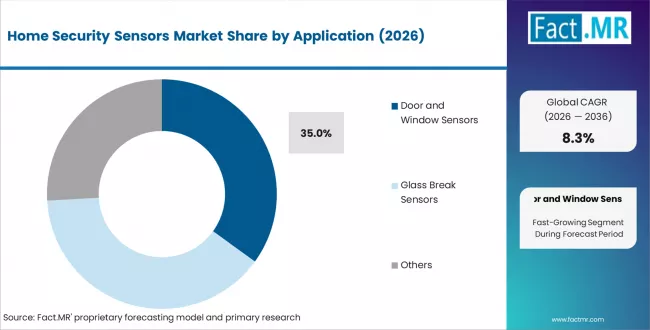
Home Security Sensors Market Analysis By Application | Source: Fact.MR
- Market Overview: Door and window sensor applications are projected to account for around 35% share of the home security sensors market by 2026. These sensors are installed at entry points to detect unauthorized opening or forced access in residential properties. The systems trigger alerts when doors or windows are opened, supporting intrusion detection and home security monitoring. Homeowners deploy these sensors as part of integrated security systems that connect with alarm units, mobile applications, and monitoring services. The importance of securing entry points continues to support strong adoption of door and window sensor applications in residential security setups.
- Demand Drivers:
- Entry Point Monitoring: Door and window sensors detect opening or tampering at primary access points in residential properties.
- Integration with Security Systems: These sensors are connected with alarm systems and mobile applications to provide real time alerts to homeowners.
- Residential Security Adoption: Increasing use of home security systems supports demand for sensors that monitor doors and windows.
Home Security Sensors Market Analysis by Product
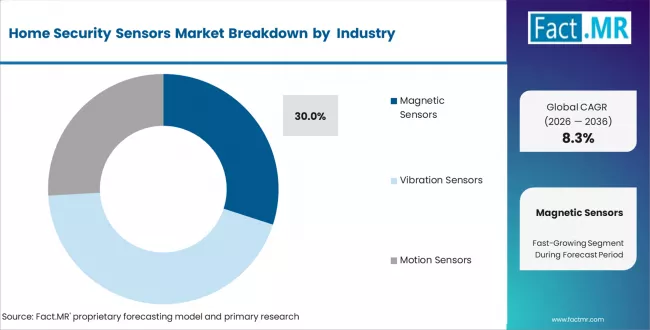
Home Security Sensors Market Analysis By Product | Source: Fact.MR
- Market Overview: Magnetic sensors are expected to represent approximately 30% share of the home security sensors market in 2026. Magnetic sensors operate by detecting changes in magnetic fields when a door or window is opened or closed. These sensors consist of two components that align when the entry point is closed and trigger an alert when separation occurs. Magnetic sensors are widely used in residential security systems due to their simple design, reliability, and ease of installation. Their compatibility with wireless security systems supports their continued adoption in home monitoring applications.
- Demand Drivers:
- Simple Detection Mechanism: Magnetic sensors detect the opening of doors and windows through changes in magnetic alignment.
- Ease of Installation: These sensors can be installed without complex wiring, making them suitable for residential security setups.
- Compatibility with Wireless Systems: Magnetic sensors integrate with wireless home security systems and monitoring applications.
Home Security Sensors Market Drivers, Restraints, and Opportunities
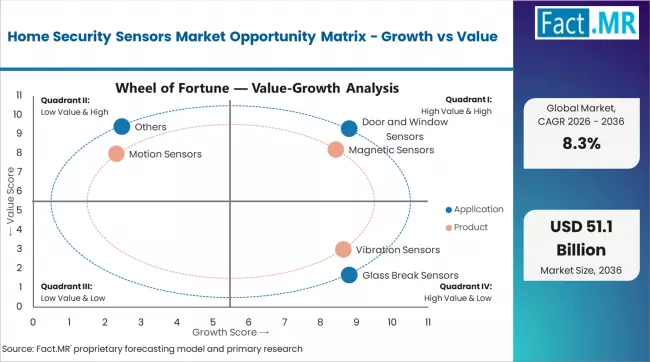
Home Security Sensors Market Opportunity Matrix Growth Vs Value | Source: Fact.MR
Fact MR analysis indicates that the home security sensors market developed from traditional alarm systems used in residential properties to detect unauthorized entry and environmental risks. Early systems relied on wired motion detectors, door contacts, and basic alarm panels that triggered audible alerts during intrusion events. The current market valuation reflects the integration of wireless sensors, smart home connectivity, and mobile-based monitoring platforms. Demand persists because homeowners seek continuous security monitoring and remote access control across residential environments.
A structural shift is occurring as conventional standalone alarm systems transition toward connected home security ecosystems integrated with broader smart home platforms. Basic sensors remain widely used in cost-sensitive installations where simple intrusion detection is sufficient. Advanced security sensors now include motion detection with AI-based filtering, video-enabled door sensors, and environmental monitoring for smoke, gas, and water leaks. These systems require higher device costs and subscription-based monitoring services. Even with gradual adoption across existing households, higher pricing associated with connected security systems supports steady market value expansion.
- Smart Home Integration: Homeowners deploy interconnected sensors linked with mobile applications and central hubs to enable real-time monitoring and remote security management.
- Safety Certification Standards: Standards such as UL 1023 household burglar alarm system requirements and EN 50131 intrusion alarm standards influence product design and certification.
- North America Residential Demand: The United States and Canada maintain strong demand for home security systems supported by high smart home adoption and organized security service providers.
Regional Analysis
The home security sensors market is assessed across North America, Europe, Asia Pacific, Latin America, and Middle East & Africa, segmented by country-level adoption of smart home systems, security regulations, and residential infrastructure. Regional demand reflects IoT integration, urban housing patterns, and consumer security awareness. The full report offers market attractiveness analysis.
.webp "Top Country Growth Comparison Home Security Sensors Market Cagr (2026 2036)")
Top Country Growth Comparison Home Security Sensors Market Cagr (2026 2036) | Source: Fact.MR
| Country | CAGR (2026-2036) |
|---|---|
| USA | 10.4% |
| China | 11.1% |
| Germany | 9.7% |
| Japan | 9.9% |
| India | 11.5% |
Source: Fact MR analysis, based on proprietary forecasting model and primary research
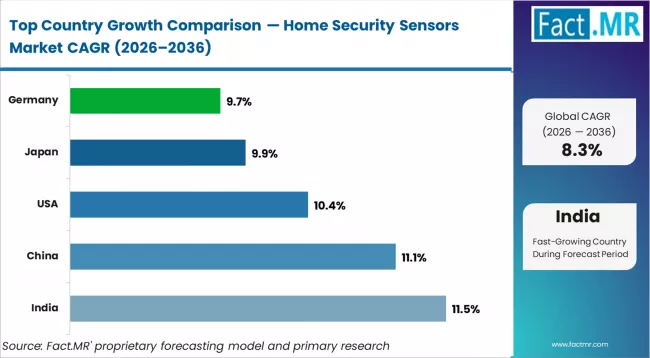
Home Security Sensors Market Cagr Analysis By Country | Source: Fact.MR
North America
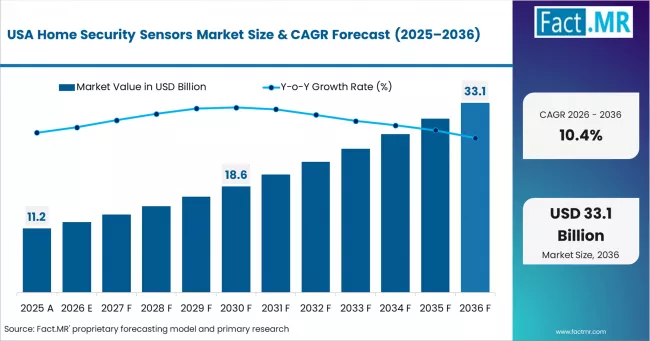
Home Security Sensors Market Country Value Analysis | Source: Fact.MR
North America functions as the smart home security and IoT integration hub, supported by high residential automation adoption and strong distribution networks. Honeywell International Inc. maintains a leading position in home security systems. Johnson Controls International plc expands smart security solutions. ADT Inc. sustains strong presence in residential monitoring services.
- USA: Demand for home security sensors in USA is projected to rise at 10.4% CAGR through 2036. Growth is supported by FCC smart home device regulations (Federal Communications Commission, updated 2021), enabling IoT device deployment. ADT Inc. expanded smart home security offerings (April 2023), supporting adoption.
Europe
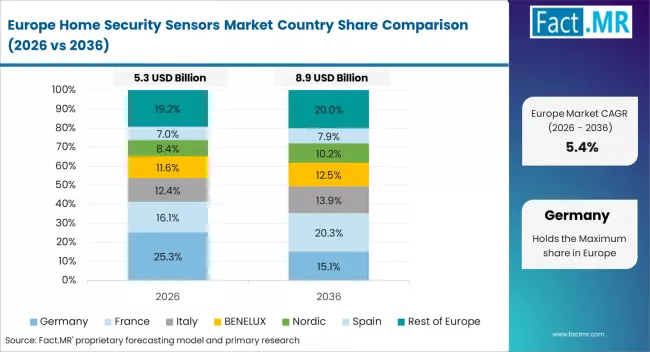
Home Security Sensors Market Europe Country Market Share Analysis, 2026 & 2036 | Source: Fact.MR
Europe operates as the regulatory and residential safety compliance base, shaped by strict building codes and data protection frameworks. Bosch Security Systems GmbH leads in sensor-based security solutions. Siemens AG supports smart building security integration. Schneider Electric SE expands connected home solutions.
- Germany: Demand for home security sensors in Germany is projected to rise at 9.7% CAGR through 2036. The EU Radio Equipment Directive update (European Commission, January 2022) strengthens IoT security requirements. Bosch Security Systems GmbH expanded smart home sensor solutions (February 2023), supporting market growth.
Asia Pacific
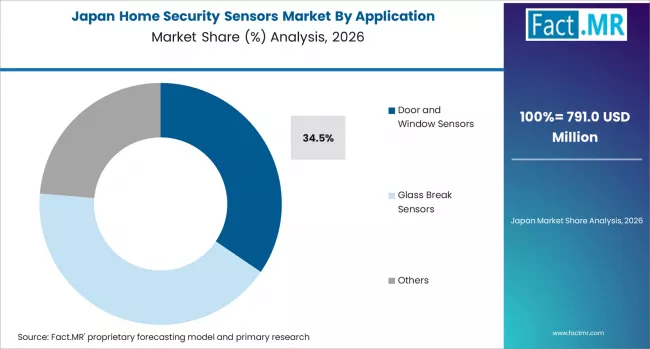
Home Security Sensors Market Japan Market Share Analysis By Application | Source: Fact.MR
Asia Pacific serves as the high-growth residential security and smart home adoption market, supported by urban housing expansion and digital infrastructure. Hikvision Digital Technology Co., Ltd. leads in surveillance and sensor integration. Panasonic Holdings Corporation develops home automation solutions. Godrej & Boyce Manufacturing Company Limited strengthens domestic security product offerings.
- China: Demand for home security sensors in China is projected to rise at 11.1% CAGR through 2036. The Smart Community initiatives (Ministry of Housing and Urban-Rural Development, ongoing) support residential security deployment. Hikvision Digital Technology Co., Ltd. expanded smart home security product lines (March 2023), supporting adoption.
- Japan: Demand for home security sensors in Japan is projected to rise at 9.9% CAGR through 2036. The Society 5.0 initiative (Cabinet Office, updated 2021) promotes smart home technologies. Panasonic Holdings Corporation expanded connected home security systems (January 2023), supporting market penetration.
- India: Demand for home security sensors in India is projected to rise at 11.5% CAGR through 2036. The Smart Cities Mission (Ministry of Housing and Urban Affairs, ongoing since 2015) supports residential security infrastructure. Godrej & Boyce Manufacturing Company Limited expanded home security product offerings (May 2023), supporting domestic growth.
Fact MR's analysis of home security sensors market in global regions consists of country-wise assessment that includes USA, China, Germany, Japan, and India. Readers can find smart home adoption trends, regulatory developments, product deployment patterns, and competitive positioning across key markets.
Competitive Structure and Buyer Dynamics in the Home Security Sensors Market
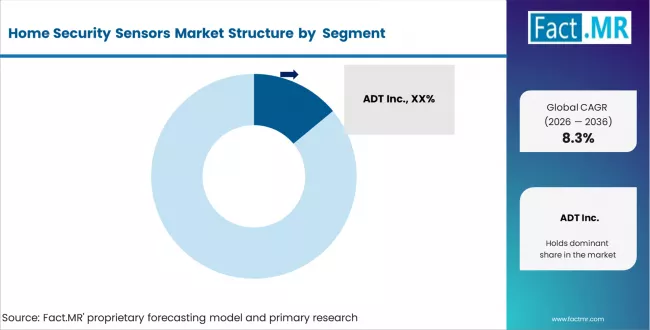
Home Security Sensors Market Analysis By Company | Source: Fact.MR
The competitive structure of the Home Security Sensors Market is moderately fragmented, with a mix of integrated security service providers, consumer electronics companies, and specialized smart home firms participating in supply. Companies such as ADT Inc., Honeywell International Inc., Bosch Sicherheitssysteme GmbH, and Johnson Controls International plc maintain strong positions through comprehensive security system portfolios and established service networks. Consumer focused players including Ring LLC, Google LLC (Nest brand), SimpliSafe, Inc., Vivint Smart Home, Inc., Abode Systems, Inc., Frontpoint Security Solutions, LLC, and Brinks Home LLC compete through connected home security solutions and direct to consumer distribution models. Competition is primarily influenced by sensor reliability, system integration with smart home platforms, ease of installation, and mobile application functionality. Subscription based monitoring services and bundled security offerings also shape competitive positioning across the market.
Several companies maintain structural advantages through integrated security ecosystems and established customer relationships. Firms such as ADT Inc., Johnson Controls International plc, and Honeywell International Inc. benefit from long standing service contracts and large installed customer bases. Ring LLC and Google LLC leverage broader consumer technology ecosystems and smart home platforms to support connected device integration. Service providers and device manufacturers often operate hybrid models combining hardware sales with recurring monitoring services. Consumers typically compare multiple providers before purchase and may switch based on pricing, service quality, and system compatibility. Retail distribution and direct sales channels offer competing product options, which reduces dependency on a single supplier. This purchasing behavior moderates supplier pricing leverage, though companies with integrated platforms and subscription services retain moderate negotiating influence.
Key Players of the Home Security Sensors Market
- ADT Inc.
- Honeywell International Inc.
- Bosch Sicherheitssysteme GmbH (Bosch Security Systems)
- Johnson Controls International plc
- Ring LLC (a subsidiary of Amazon.com, Inc.)
- SimpliSafe, Inc.
- Vivint Smart Home, Inc.
- Google LLC (Nest brand)
- Abode Systems, Inc.
- Frontpoint Security Solutions, LLC
- Brinks Home LLC
Report Scope
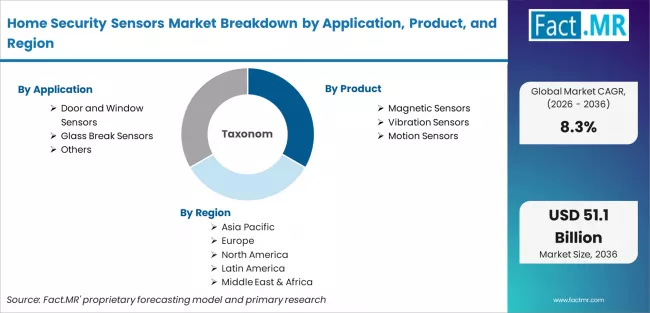
Home Security Sensors Market Breakdown By Application, Product, And Region | Source: Fact.MR
| Metric | Value |
|---|---|
| Quantitative Units | USD 23 billion (2026) to USD 50.9 billion (2036), at a CAGR of 8.3% |
| Market Definition | The home security sensors market includes electronic sensing devices installed in residential environments to detect intrusion, motion, glass breakage, and perimeter breaches, enabling real time monitoring, alarm triggering, and integration with home security systems and smart home platforms. |
| Application Segmentation | Door and Window Sensors, Glass Break Sensors, Motion Sensors, Boundary Protection Sensors |
| Product Segmentation | Magnetic Sensors, Vibration Sensors, Motion Sensors, Passive Infrared (PIR), Microwave (MW), Dual Technology, Area Reflective, Ultrasonic, Photoelectric Beam Sensors |
| Regions Covered | North America, Latin America, Europe, East Asia, South Asia, Oceania, Middle East and Africa |
| Countries Covered | United States, Canada, Mexico, Brazil, Germany, United Kingdom, France, Italy, Spain, China, India, Japan, South Korea, Australia, and 40+ countries |
| Key Companies Profiled | ADT Inc., Honeywell International Inc., Bosch Sicherheitssysteme GmbH (Bosch Security Systems), Johnson Controls International plc, Ring LLC (a subsidiary of Amazon.com, Inc.), SimpliSafe, Inc., Vivint Smart Home, Inc., Google LLC (Nest brand), Abode Systems, Inc., Frontpoint Security Solutions, LLC, Brinks Home LLC |
| Forecast Period | 2026 to 2036 |
| Approach | Hybrid top-down and bottom-up market modeling supported by residential security system adoption trends, sensor shipment analysis, smart home integration data, and validation through interviews with security solution providers, device manufacturers, and residential service providers. |
Bibliographies
- [1] Federal Communications Commission (FCC), USA. (2021). Smart home device regulations.
- [2] European Commission. (2022). EU Radio Equipment Directive update.
- [3] Ministry of Housing and Urban-Rural Development (MOHURD), China. (ongoing). Smart Community initiatives.
- [4] Cabinet Office, Japan. (2021). Society 5.0 initiative.
- [5] Ministry of Housing and Urban Affairs, India. (2015, ongoing). Smart Cities Mission.
- [6] ADT Inc. (2023). Smart home security offerings expansion.
- [7] Bosch Security Systems GmbH. (2023). Smart home sensor solutions expansion.
- [8] Hikvision Digital Technology Co., Ltd. (2023). Smart home security product expansion.
- [9] Panasonic Holdings Corporation. (2023). Connected home security systems expansion.
This Report Addresses
- Market size estimation and revenue forecasts for the Home Security Sensors Market from 2026 to 2036, supported by residential security system adoption benchmarks and smart home device deployment indicators across global housing markets.
- Growth opportunity analysis across door and window sensors, glass break sensors, motion sensors, and boundary protection systems, along with product categories such as magnetic, vibration, passive infrared, microwave, dual technology, ultrasonic, and photoelectric beam sensors.
- Segment and regional revenue forecasts covering intrusion detection, fire and safety monitoring, and environmental hazard detection applications across residential households and property developments.
- Competitive strategy assessment including sensor reliability, wireless connectivity integration, and smart home platform compatibility benchmarking among home security device manufacturers and service providers.
- Regulatory and compliance evaluation covering frameworks such as UL household alarm system standards and EN intrusion detection certification requirements influencing product safety, performance, and installation practices.
- Market report delivery in PDF, Excel, PPT, and interactive dashboard formats designed for residential security planning, smart home system evaluation, and sensor deployment strategy assessment.
- Supply chain and operational risk analysis identifying installation cost barriers, interoperability challenges across connected home devices, and cybersecurity risks associated with networked security systems affecting adoption of home security sensors.
Home Security Sensors Market Key Segments
-
Application
- Door and Window Sensors
- Glass Break Sensors
- Motion Sensors
- Boundary Protection Sensors
-
Product
- Magnetic Sensors
- Vibration Sensors
- Motion Sensors
- Passive Infrared (PIR)
- Microwave (MW)
- Dual Technology
- Area Reflective
- Ultrasonic
- Photoelectric Beam Sensors
-
Region
- North America
- USA
- Canada
- Mexico
- Europe
- Germany
- UK
- France
- Italy
- Spain
- Nordic Countries
- BENELUX
- Rest of Europe
- Asia Pacific
- China
- Japan
- South Korea
- India
- Australia
- Rest of Asia Pacific
- Latin America
- Brazil
- Argentina
- Rest of Latin America
- Middle East and Africa
- Kingdom of Saudi Arabia
- United Arab Emirates
- South Africa
- Rest of Middle East and Africa
- Other Regions
- Oceania
- Central Asia
- Other Markets
- North America