- Base Value(2025): 2.1 Bn
- Estimated Value(2026): 2.5 Bn
- Forecast Value (2036): 12.6 Bn
- CAGR (2026 - 2036): 17.6%
Home Fitness App Market Analysis and Forecast by Fact.MR
- The Home Fitness App Market is expected to grow from USD 2.5 billion in 2026 to USD 12.6 billion by 2036, at a 17.6% CAGR.
- Demand is driven by rising adoption of AI-based personalized training programs, deeper integration of wearable biometric data into workout planning platforms, and expanding demand from individual users seeking cost-effective alternatives to gym memberships.
- AI personalized fitness apps accounting for 59.4% of the product segment and weight management programs contributing 71.2% of application share as companies prioritize engagement retention through adaptive coaching, subscription stickiness, and cross-platform interoperability.
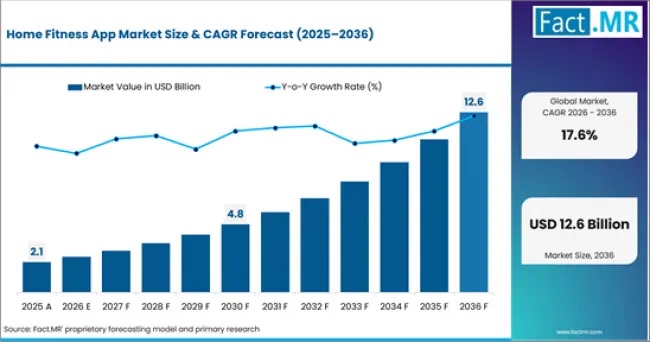
Home Fitness App Market Value Analysis | Source: Fact.MR
Summary of Home Fitness App Market
- Market Snapshot
- In 2025, the global Home Fitness App Market was valued at approximately USD 2.1 billion.
- The market is estimated to reach USD 2.5 billion in 2026 and is projected to attain USD 12.6 billion by 2036.
- The home fitness app market is likely to expand at a CAGR of 17.6% during the forecast period.
- The market is anticipated to create an absolute dollar opportunity of USD 10.1 billion between 2026 and 2036.
- AI personalized fitness apps account for 59.4% of the product segment share in 2026.
- China (23.8%) and India (22.0%) are the key growth markets during the forecast period.
- Demand and Growth Drivers
- Growing consumer shift from gym-based to at-home and hybrid fitness routines is expanding the addressable user base for app-based workout platforms across both developed and emerging markets.
- Deeper integration of wearable device biometric data, including heart rate, sleep quality, and activity patterns, into personalized training algorithms is increasing user engagement and retention.
- Expansion of AI-driven coaching features, including real-time form correction and adaptive workout generation, is improving the value proposition of subscription-tier fitness apps.
- Rising health awareness among younger demographics and working professionals is supporting uptake of on-demand fitness solutions that fit into flexible daily schedules.
- Product and Segment View
- AI personalized fitness apps account for 59.4% of the product segment in 2026, supported by their ability to deliver adaptive workout plans, real-time form correction, and goal-based training through machine learning algorithms.
- Weight management programs represent 71.2% of the application segment in 2026, with structured calorie tracking, macro monitoring, and diet-exercise integration acting as the primary demand channels.
- Subscription-based platforms are growing faster in percentage terms, with their share projected to rise as users shift toward recurring payment models that bundle workout content, nutrition planning, and progress analytics.
- Key segmentation includes:
- Product Type: AI Personalized Fitness Apps, Workout Tracking Apps, Nutrition and Diet Apps, Yoga and Mindfulness Apps
- Application: Weight Management Programs, Strength Training, Cardio Fitness, Rehabilitation and Recovery
- End Use: Individual Users, Corporate Wellness Programs, Healthcare and Rehabilitation Providers
- Technology: Artificial Intelligence Based Training, Wearable Integrated Platforms, Video and Live Streaming Coaching
- These systems enable:
- Personalized workout generation and adaptive training plan adjustment based on real-time biometric feedback
- Integrated nutrition tracking, calorie monitoring, and meal planning through AI-powered food recognition
- Progress visualization, performance benchmarking, and social community engagement across connected platforms
- Geography and Competitive Outlook
- North America is the most developed regional market, supported by high smartphone penetration, established subscription payment culture, and strong demand from both individual users and corporate wellness programs.
- Europe shows steady demand, with Germany (20.2%) and the United Kingdom (15.0%) reflecting growing adoption of digital fitness solutions among health-conscious consumers and employer-sponsored wellness initiatives.
- Asia Pacific is the fastest-growing region, led by China (23.8%) and India (22.0%), where rising smartphone ownership, increasing health awareness, and affordable app pricing are accelerating user acquisition.
- China (23.8%) and India (22.0%) are the key growth markets, followed by Germany (20.2%), Brazil (18.5%), and the USA (16.7%) as established and emerging economies converge on digital fitness adoption.
- Key companies active in the market include Nike, Outside Interactive, Inc. / MapMyFitness, Adidas, Google LLC / Fitbit, MyFitnessPal Inc., Noom, Inc., Polar Electro Oy / Polar Flow, ASICS America Corporation.
- Analyst Opinion
- Shambhu Nath Jha, Principal Consultant at Fact.MR, says "The home fitness app market is shifting from general workout delivery to personalized health management platforms. Growth is increasingly shaped by AI-driven coaching models that combine exercise programming with nutrition tracking, sleep analysis, and recovery planning. Users are moving beyond basic step counting toward integrated platforms that connect wearable data with adaptive training algorithms. This convergence of fitness, wellness, and data analytics is creating higher subscription stickiness and expanding the revenue model from one-time downloads toward recurring platform engagement. Markets in China and India are contributing disproportionate growth as affordable smartphone access and rising health awareness create large new user cohorts."
Key Growth Drivers, Constraints, and Opportunities
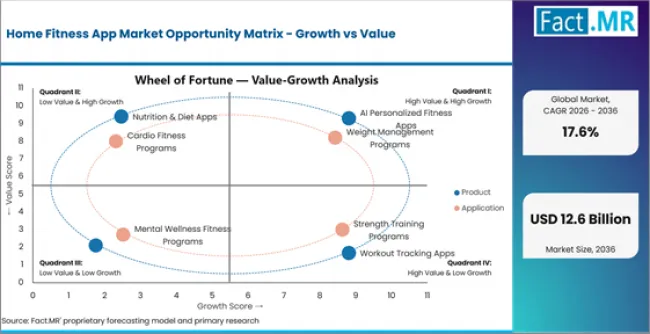
Home Fitness App Market Opportunity Matrix Growth Vs Value | Source: Fact.MR
Key Factors Driving Growth
- AI-powered personalization is enabling fitness apps to deliver adaptive workout plans that respond to individual biometric data, training history, and recovery status, increasing subscription conversion rates and long-term engagement across both beginner and advanced user segments.
- Wearable device proliferation is creating a continuous data feedback loop between smartwatches, fitness bands, and app platforms, allowing real-time exercise optimization and post-workout analytics that improve user outcomes and willingness to pay for premium tiers.
- Employer-sponsored corporate wellness programs are expanding the institutional demand channel for fitness app licenses, with companies purchasing bulk subscriptions to reduce healthcare costs, improve employee productivity, and meet workplace wellness compliance targets.
Key Market Constraints
- High user churn rates remain a persistent challenge, with a significant share of free-tier users abandoning apps within the first 30 days due to low engagement, generic content, or failure to integrate with their existing fitness habits.
- Data privacy concerns around biometric information collection, including heart rate, sleep patterns, and location data, are creating regulatory friction in markets with strict personal data protection laws such as the EU and select US states.
- Market fragmentation across hundreds of competing apps makes it difficult for mid-tier players to achieve the user scale needed to justify continued AI development and content investment, compressing margins and limiting profitability outside the top 10 platforms.
Key Opportunity Areas
- Integration of fitness apps into formal healthcare pathways, including physician-prescribed exercise programs and insurance-linked wellness incentives, is opening a new reimbursement-linked demand channel that extends beyond discretionary consumer spending.
- Expansion into emerging markets where smartphone penetration is outpacing gym infrastructure is creating large addressable populations for affordable, localized fitness app content delivered in regional languages.
- Growing demand for hybrid fitness models that combine in-app digital coaching with periodic in-person classes or personal training sessions is creating premium bundling opportunities that support higher average revenue per user.
Segment-wise Analysis of the Home Fitness App Market
- AI personalized fitness apps hold 59.4% of the product type segment in 2026, supported by their adaptive training algorithms, real-time biometric integration, and higher subscription retention rates compared to static workout apps.
- Weight management programs represent 71.2% of the application segment in 2026, with calorie tracking, macro monitoring, and structured exercise-diet integration acting as the primary demand drivers across individual users.
- Individual users account for 64.9% of the end-use segment in 2026, reflecting the consumer-led nature of the market where personal health goals and flexible scheduling preferences drive adoption more than institutional mandates.
The home fitness app market is segmented by product type, application, end use, technology, and region. By product type, the market covers AI personalized fitness apps, workout tracking apps, nutrition and diet apps, and yoga and mindfulness apps. By application, coverage includes weight management programs, strength training, cardio fitness, and rehabilitation and recovery. AI personalized fitness apps lead by value due to their higher subscription pricing and stronger retention metrics, while nutrition and diet apps are expected to gain share as food tracking becomes more automated through AI image recognition.
Which Product Type Segment Dominates the Home Fitness App Market?
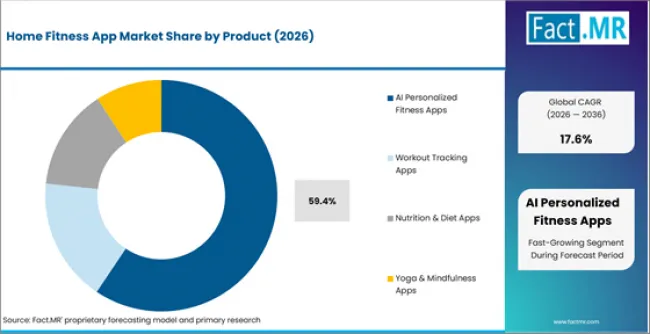
Home Fitness App Market Analysis By Product | Source: Fact.MR
AI personalized fitness apps account for 59.4% of the product type segment in 2026. Their leadership stems from the ability to deliver dynamic, user-specific workout plans that adjust based on real-time performance data, wearable biometric inputs, and stated fitness goals. These apps use machine learning to modify exercise intensity, volume, and rest periods across training cycles, creating a coaching experience that static content-based apps cannot replicate. The higher engagement rates and subscription conversion metrics associated with AI-driven personalization are the main factors supporting premium pricing in this category.
Workout tracking apps and nutrition and diet apps hold smaller but meaningful shares. Workout trackers remain relevant for users who prefer logging-based approaches to fitness, while nutrition apps are gaining ground as AI-powered food recognition simplifies calorie and macro tracking. Yoga and mindfulness apps represent a niche segment supported by growing consumer interest in mental wellness alongside physical fitness.
Which Application Segment Dominates the Home Fitness App Market?
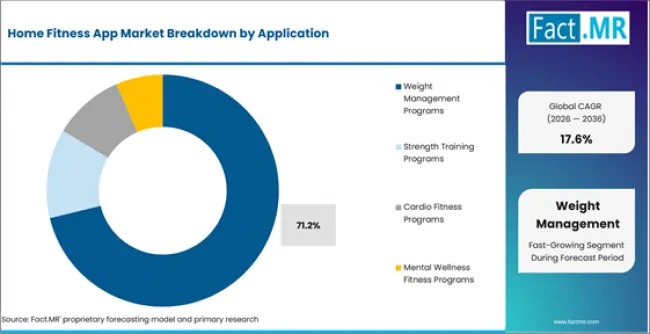
Home Fitness App Market Analysis By Application | Source: Fact.MR
Weight management programs are expected to lead the application segment with a 71.2% share in 2026. Demand is supported by the global prevalence of weight-related health goals and the direct link between calorie management, structured exercise, and measurable progress. These programs combine diet tracking with workout prescriptions, creating an integrated approach that appeals to both first-time fitness users and experienced consumers seeking data-driven accountability.
Strength training and cardio fitness applications hold supporting positions, catering to users with specific performance or endurance objectives. Rehabilitation and recovery applications remain a smaller segment but are gaining attention as fitness apps expand into post-injury and age-related mobility support. Weight management programs are expected to retain their dominant share through 2036 as consumer focus on metabolic health and body composition continues to grow across all age groups and income levels.
Which Product Trend is Shaping the Next Phase of Growth in the Home Fitness App Market?
AI personalized fitness apps lead the product type segment and define the next phase of growth in the home fitness app market. Their share is projected to rise as more platforms integrate machine learning models that go beyond static workout libraries to deliver continuously adaptive training experiences. These apps analyze user inputs such as heart rate variability, sleep quality, exercise completion rates, and subjective effort ratings to modify upcoming workouts in real time. This creates a feedback loop that improves user outcomes and increases the perceived value of paid subscriptions.
The shift toward AI-driven coaching reflects a broader change in user expectations. Consumers increasingly expect their fitness apps to function as intelligent platforms rather than content repositories. As a result, apps that can combine workout programming, nutrition guidance, recovery analysis, and social community features into a single adaptive ecosystem are capturing a disproportionate share of subscription revenue.
Regional Outlook Across Key Markets
- China leads growth at 23.8%, supported by rising smartphone ownership, growing health awareness among urban populations, domestic app platform strength, and increasing adoption of wearable-connected fitness programs.
- India follows at 22.0%, driven by expanding mobile internet access, a young demographic profile favoring digital fitness solutions, and growing availability of affordable subscription tiers in regional languages.
- North America shows mixed growth, with the USA at 16.7% reflecting a mature but expanding market where premium subscriptions, corporate wellness integration, and AI-driven platforms continue to drive revenue growth.
- European demand remains steady, with Germany at 20.2% supported by strong digital health adoption, employer wellness programs, and consumer preference for data-driven fitness platforms.
.webp "Top Country Growth Comparison Home Fitness App Market Cagr (2026 2036)")
Top Country Growth Comparison Home Fitness App Market Cagr (2026 2036) | Source: Fact.MR
| Country | CAGR (2026 to 2036) (%) |
|---|---|
| China | 23.8% |
| India | 22.0% |
| Germany | 20.2% |
| Brazil | 18.5% |
| USA | 16.7% |
| United Kingdom | 15.0% |
Source: Fact.MR analysis. Updated Jun 11, 2026
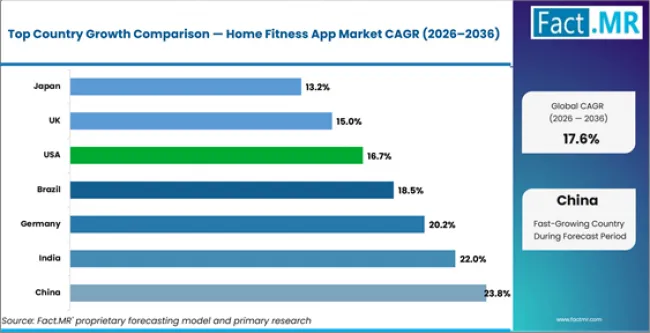
Home Fitness App Market Cagr Analysis By Country | Source: Fact.MR
Market Outlook for Home Fitness Apps in the United States
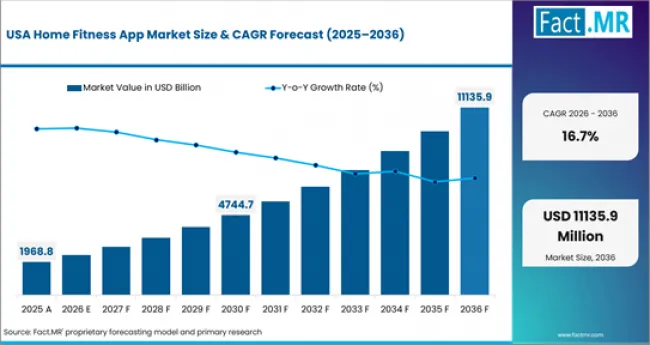
Home Fitness App Market Country Value Analysis | Source: Fact.MR
The USA home fitness app market is projected to grow at a CAGR of 16.7% through 2036. Demand is shaped by high smartphone penetration, established subscription payment culture, and growing integration of fitness apps into employer-sponsored corporate wellness programs. Premium AI-driven coaching platforms and wearable-integrated training systems are the primary growth pockets within a competitive landscape.
- Corporate wellness program adoption is expanding the institutional demand channel for bulk app subscriptions.
- Premium AI coaching platforms with wearable integration support replacement of basic workout trackers.
Home Fitness App Demand Trends in China
Domestic app platform strength and deep integration with local wearable ecosystems are the primary forces shaping demand in the Chinese home fitness app market. The scale of the urban fitness-conscious population, combined with the prevalence of super-app ecosystems that bundle health, payments, and social features, creates a distribution advantage that supports rapid user acquisition and low customer acquisition costs.
- Local platform strength creates distribution advantages through super-app integrations and social fitness features.
- Government health promotion campaigns support rising participation in digital fitness across urban centers.
India Home Fitness App Growth Assessment
PLI scheme incentives for smartphone manufacturing and expanding 4G/5G mobile coverage across tier-2 and tier-3 cities are creating the infrastructure base for fitness app adoption in India. The young demographic profile, with over 65% of the population under 35, provides a large addressable user base that favors affordable, mobile-first health and wellness solutions over traditional gym memberships.
- Tier-2 and tier-3 city mobile internet expansion creates new user pools for localized fitness content.
- Affordable subscription pricing and freemium models lower barriers for first-time digital fitness users.
Germany Home Fitness App Market Demand Analysis
EU data protection regulations under GDPR are shaping how fitness app providers handle biometric and health data in Germany, creating a compliance-driven market where user trust and data security serve as competitive differentiators. Employer wellness programs and integration with statutory health insurance schemes support institutional demand alongside strong individual consumer adoption.
- GDPR compliance requirements create a trust-driven competitive landscape favoring established platforms.
- Employer wellness programs and health insurance integration support institutional subscription demand.
Competitive Benchmarking and Company Positioning
Home Fitness App Market Analysis By Company
- Nike, Under Armour, and Adidas hold strong positions through established brand recognition, proprietary training content, and integration of fitness apps with their sportswear and footwear product ecosystems.
- MyFitnessPal, Noom, Inc., and Fitbit participate meaningfully through specialized capabilities in nutrition tracking, behavioral health coaching, and wearable-integrated fitness monitoring, with competition shaped by data analytics depth and subscription retention.
- Technology integration creates an important barrier to differentiation, especially in AI-driven coaching where data quality, algorithmic sophistication, and wearable compatibility influence user stickiness and willingness to pay for premium tiers.
The competitive landscape is moderately fragmented, with a mix of sportswear brand-linked apps, dedicated fitness technology companies, and health-focused digital platforms. Nike, Under Armour, and Adidas compete through brand credibility, broad user bases built on their existing customer relationships, and growing investment in AI-powered training features that complement their physical product lines.
Below these established brands, MyFitnessPal, Noom, Inc., Fitbit, Polar Electro Oy / Polar Flow, and ASICS maintain relevance through specialized offerings in nutrition tracking, behavioral coaching, wearable integration, and performance analytics. These players compete on data accuracy, user interface quality, and retention features rather than brand reach alone.
Key Companies in the Home Fitness App Market
- Nike, Outside Interactive, Inc. / MapMyFitness, and Adidas are among the leading players in the home fitness app market globally, supported by strong brand recognition, broad user bases tied to their sportswear ecosystems, and growing investment in AI-driven training and wearable integration.
- MyFitnessPal Inc., Noom, Inc., and Fitbit, Inc. hold established positions across nutrition tracking, behavioral health coaching, and wearable-integrated fitness monitoring, supported by deep data analytics capabilities and strong subscription retention metrics.
Recent Industry Developments
- MyFitnessPal, Acquisition of Cal AI (March 2026)
- MyFitnessPal acquired Cal AI, an AI calorie-counting app built by teen founders. The deal was reported in March 2026 after closing in December 2025. Cal AI had reached over 15 million downloads and more than USD 30 million in annual revenue. The acquisition strengthened MyFitnessPal’s position in digital nutrition by adding photo-based calorie estimation and a fast-growing user funnel.
- Nike, NikeSkims Activewear Brand Launch (2025)
- Nike and SKIMS introduced NikeSKIMS in February 2025 as a women-focused fitness and activewear brand. The first collection launched on September 26, 2025 through Nike and SKIMS websites and selected retail stores. Nike stated that global expansion would follow in 2026.
- MyFitnessPal, ChatGPT Health Integration (January 2026)
- MyFitnessPal launched an integration in ChatGPT Health in January 2026. The integration brings MyFitnessPal recipes, macro guidance and nutrition support into ChatGPT. OpenAI also identifies MyFitnessPal as a wellness app that users can connect within ChatGPT Health.
Leading Companies Shaping the Home Fitness App Market
- Nike
- Outside Interactive, Inc. / MapMyFitness
- Adidas
- Google LLC / Fitbit
- MyFitnessPal Inc.
- Noom, Inc.
- Polar Electro Oy / Polar Flow
- ASICS America Corporation
Sources and Research References
- Nike. (2025, February 18). NIKE, Inc. and SKIMS introduce new brand for women: NikeSKIMS.
- MyFitnessPal. (2026, January 5). Premium+. MyFitnessPal Support.
- Noom. (2025, August 4). Noom program cost in 2026: Explore pricing and benefits. Noom.
- Noom. (2025, October). What is the Premium Subscription? Noom Support.
- American College of Sports Medicine. (2024, January 23). Fitness trends 2024: A guiding light for the year ahead. ACSM.
- American College of Sports Medicine. (2024). Wearable technology named top fitness trend for 2024. ACSM.
This bibliography is provided for reader reference and is not exhaustive. The full report contains the complete reference list and detailed citations.
Key Questions
- What is the current and future size of the Home Fitness App Market?
- How fast is the home fitness app market expected to grow between 2026 and 2036?
- Which product type is likely to lead the market by 2026?
- Which application segment is expected to account for the highest demand by 2026?
- What factors are driving demand for home fitness apps globally?
- How is the shift toward AI personalized coaching influencing the market?
- Why are China and India emerging as the fastest-growing markets?
- How are corporate wellness programs supporting demand?
- Which countries are projected to show the fastest growth through 2036?
- Who are the key companies active in the Home Fitness App Market?
- How does Fact.MR estimate and validate the market forecast?
Home Fitness App Market Definition
The home fitness app market covers mobile and web-based applications designed for individual and group fitness engagement outside of traditional gym environments. It includes AI-powered workout generators, activity tracking apps, nutrition and diet planning tools, yoga and mindfulness programs, and integrated wellness platforms that connect with wearable devices for biometric feedback and personalized coaching.
Home Fitness App Market Inclusions
- The scope covers global and regional market size and forecasts for 2026 to 2036 across product type, application, end use, technology, distribution channel, and region.
- It includes regional demand analysis across major geographies, based on factors such as smartphone penetration, health awareness levels, wearable device adoption, and digital subscription culture.
- The report covers technology trends, market drivers and constraints, and the competitive landscape, including product portfolios, subscription pricing, user base metrics, and platform expansion strategies of leading players.
- It includes pricing and monetization analysis across freemium, subscription-tier, and premium coaching models, including hardware-software bundle strategies tied to wearable integration.
Home Fitness App Market Exclusions
- The scope excludes general-purpose health monitoring apps not primarily designed for fitness training, such as telemedicine platforms, electronic health record applications, and standalone sleep tracking apps without exercise components.
- It excludes hardware-only fitness equipment such as treadmills, stationary bikes, and weight machines sold without integrated app subscriptions or digital platforms.
- The report excludes social media fitness content, unstructured YouTube workout channels, and informal fitness influencer platforms not sold as subscription or app-based products.
- It also excludes enterprise-grade occupational health software, clinical rehabilitation platforms used exclusively within hospital settings, and corporate ERP wellness modules without direct consumer app interfaces.
Home Fitness App Market Research Methodology
- The methodology combines secondary research, primary interviews, and forecast modelling.
- It draws on 150+ secondary sources and benchmarks 80+ company product portfolios.
- Market sizing covers 40+ countries through a demand-side model, supported by top-down validation.
- Key inputs include smartphone penetration, wearable device ownership, digital subscription rates, health awareness indices, and app store download volumes.
- The model cross-checks demand with subscriber growth, pricing trends, retention rates, and product launches.
- Primary validation includes 30+ interviews across app developers, platform operators, wearable manufacturers, fitness professionals, and institutional wellness buyers.
- Final estimates go through engagement-metric checks, revenue-pattern review, and sensitivity testing.
Segmentation
Scope of Analysis
| Parameter | Details | ||
|---|---|---|---|
| Quantitative Units | USD billion to USD billion, at a CAGR | ||
| Market Definition | The Home Fitness App Market covers mobile and web-based fitness applications for individual and group workout engagement, including AI coaching, activity tracking, nutrition planning, and integrated wellness platforms. | ||
| Product Type | AI Personalized Fitness Apps, Work Tracking app, Nutrition & Diet Apps, Yoga & Mindfulness Apps, Mental Wellness Fitness Programs | ||
| End User | Individual Users, Fitness Professionals, Corporate Wellness Users, Healthcare Rehabilitation Users | ||
| Technology | Artificial Intelligence Based Training, Wearable Integration Technology, Computer Vision Technology, Cloud Based Platforms | ||
| Formulation | Subscription Based Platforms, Freemium Models, Personalized Program Models, Gamified Fitness Systems | ||
| Application | Weight Management Programs, Strength Training Programs, Cardio Fitness Programs | ||
| Distribution Channel | Mobile App Stores, Direct Digital Platforms, Fitness Equipment Partnerships, Corporate Distribution Channels | ||
| Regions Covered | North America, Latin America, Europe, East Asia, South Asia and Pacific, Middle East and Africa | ||
| Countries Covered | USA, China, India, Germany, Brazil, United Kingdom, Japan, 40 plus countries | ||
| Key Companies | Nike, Outside Interactive, Inc. / MapMyFitness, Adidas, Google LLC / Fitbit, MyFitnessPal Inc., Noom, Inc., Polar Electro Oy / Polar Flow, ASICS America Corporation | ||
| Forecast Period | 2026 to 2036 | ||
| Approach | Hybrid demand-side and top-down methodology built on country-level app adoption rates, subscription pricing, wearable integration data, product benchmarking, and primary interviews across app developers, platform operators, fitness professionals, and institutional wellness buyers |
Source: Fact.MR analysis. Updated Jun 11, 2026
Home Fitness App Market Segmentation
-
Home Fitness App Market Market Segmented by Product:
- AI Personalized Fitness Apps
- Adaptive Workout Generator Apps
- Real-Time Form Correction Apps
- Goal-Based Training Apps
- Virtual Personal Trainer Apps
- Live Coaching Platforms
- Chat-Based Fitness Assistants
- Adaptive Workout Generator Apps
- Workout Tracking Apps
- Activity Logging Apps
- Step & Movement Tracking Apps
- Calorie Monitoring Apps
- Performance Analytics Apps
- Progress Visualization Dashboards
- Fitness Benchmarking Tools
- Activity Logging Apps
- Nutrition & Diet Apps
- Meal Planning Apps
- Macro Tracking Apps
- Calorie Deficit Planner Apps
- Food Database Apps
- Barcode Nutrition Scanners
- Recipe Recommendation Apps
- Meal Planning Apps
- Yoga & Mindfulness Apps
- Guided Yoga Apps
- Beginner Yoga Programs
- Advanced Yoga Flows
- Meditation Fitness Apps
- Stress Reduction Programs
- Sleep Optimization Modules
- Guided Yoga Apps
- AI Personalized Fitness Apps
-
Home Fitness App Market Market Segmented by Application:
- Weight Management Programs
- Fat Loss Programs
- High Intensity Interval Training Apps
- Calorie Deficit Workouts
- Body Toning Programs
- Muscle Definition Workouts
- Core Strength Programs
- Fat Loss Programs
- Strength Training Programs
- Home Gym Workouts
- Dumbbell Training Apps
- Bodyweight Training Systems
- Progressive Overload Programs
- Strength Progress Tracking
- Resistance Training Plans
- Home Gym Workouts
- Cardio Fitness Programs
- Endurance Training Apps
- Running Coaching Programs
- Cycling Workout Apps
- High Intensity Cardio Apps
- HIIT Timer Systems
- Fat Burn Circuits
- Endurance Training Apps
- Mental Wellness Fitness Programs
- Stress Reduction Workouts
- Breathing Exercise Apps
- Relaxation Training Programs
- Mind Body Integration Programs
- Yoga Therapy Workouts
- Meditation Fitness Blends
- Stress Reduction Workouts
- Weight Management Programs
-
Home Fitness App Market Market Segmented by End Use:
- Individual Users
- Urban Fitness Consumers
- Young Adult Fitness Users
- Working Professional Users
- Rural Fitness Users
- Low Equipment Home Users
- Basic Mobile Fitness Users
- Urban Fitness Consumers
- Fitness Professionals
- Personal Trainers
- Certified Fitness Coaches
- Online Coaching Trainers
- Fitness Influencers
- Social Media Fitness Coaches
- Content Based Training Providers
- Personal Trainers
- Corporate Wellness Users
- Employee Wellness Programs
- Work From Home Wellness Users
- Corporate Health Initiative Users
- Insurance Wellness Programs
- Preventive Health Participants
- Fitness Incentive Users
- Employee Wellness Programs
- Healthcare Rehabilitation Users
- Physiotherapy Patients
- Post Injury Recovery Users
- Chronic Condition Fitness Users
- Clinical Wellness Patients
- Cardiac Rehab Patients
- Obesity Treatment Users
- Physiotherapy Patients
- Individual Users
-
Home Fitness App Market Market Segmented by Technology:
- Artificial Intelligence Based Training
- Machine Learning Recommendation Systems
- Adaptive Workout Engines
- Behavior Prediction Models
- AI Form Correction Systems
- Posture Detection Algorithms
- Real Time Movement Analysis
- Machine Learning Recommendation Systems
- Wearable Integration Technology
- Smart Watch Synchronization Systems
- Heart Rate Monitoring Integration
- Activity Tracking Connectivity
- IoT Fitness Ecosystems
- Connected Home Fitness Devices
- Sensor Based Workout Tracking
- Smart Watch Synchronization Systems
- Computer Vision Technology
- Motion Tracking Systems
- Camera Based Exercise Analysis
- Pose Estimation Algorithms
- Augmented Reality Fitness Systems
- AR Guided Workout Systems
- Virtual Fitness Environment Tools
- Motion Tracking Systems
- Cloud Based Platforms
- Data Storage Systems
- Workout History Analytics Platforms
- Cross Device Sync Systems
- Scalable Fitness Infrastructure
- Real Time User Data Processing
- Multi User Fitness Ecosystems
- Data Storage Systems
- Artificial Intelligence Based Training
-
Home Fitness App Market Market Segmented by Formulation:
- Subscription Based Platforms
- Monthly Subscription Models
- Basic Fitness Access Plans
- Premium Coaching Subscriptions
- Annual Subscription Models
- Discounted Long Term Plans
- Enterprise Fitness Plans
- Monthly Subscription Models
- Freemium Models
- Ad Supported Platforms
- Free Workout Access Apps
- Limited Feature Fitness Apps
- Paid Upgrade Models
- In App Purchase Systems
- Premium Feature Unlock Models
- Ad Supported Platforms
- Personalized Program Models
- AI Generated Fitness Plans
- Dynamic Workout Generation Systems
- User Behavior Adaptive Programs
- Human Trainer Hybrid Models
- Coach Assisted Digital Programs
- Live Trainer Integration Systems
- AI Generated Fitness Plans
- Gamified Fitness Systems
- Reward Based Fitness Apps
- Point Based Workout Systems
- Challenge Based Fitness Programs
- Competition Driven Models
- Leaderboard Fitness Platforms
- Social Fitness Competition Apps
- Reward Based Fitness Apps
- Subscription Based Platforms
-
Home Fitness App Market Market Segmented by Distribution Channel:
- Mobile App Stores
- Android App Ecosystem
- Google Play Fitness Apps
- Third Party Android Stores
- iOS App Ecosystem
- Apple App Store Fitness Apps
- Subscription Based iOS Platforms
- Android App Ecosystem
- Direct Digital Platforms
- Web Based Fitness Platforms
- Browser Based Workout Systems
- Cloud Fitness Portals
- Company Owned Platforms
- Brand Specific Fitness Apps
- Exclusive Training Platforms
- Web Based Fitness Platforms
- Fitness Equipment Partnerships
- Smart Equipment Integration Channels
- Treadmill Connected Apps
- Bike Training Integration Apps
- Wearable Device Partnerships
- Smartwatch Fitness Ecosystems
- Fitness Band Integration Platforms
- Smart Equipment Integration Channels
- Corporate Distribution Channels
- Mobile App Stores
-
Home Fitness App Market Market by Region:
- North America
- USA
- Canada
- Latin America
- Brazil
- Chile
- Mexico
- Rest of Latin America
- Western Europe
- Germany
- United Kingdom
- Italy
- Spain
- France
- Nordic
- BENELUX
- Rest of Western Europe
- Eastern Europe
- Russia
- Poland
- Hungary
- Balkan & Baltic
- Rest of Eastern Europe
- East Asia
- China
- Japan
- South Korea
- South Asia and Pacific
- India
- ASEAN
- Australia & New Zealand
- Rest of South Asia and Pacific
- Middle East & Africa
- Kingdom of Saudi Arabia
- Other GCC Countries
- Turkiye
- South Africa
- Other African Union
- Rest of Middle East & Africa
- North America
Frequently Asked Questions
What are the key products in the home fitness app market?
Which application segment is expected to contribute significant share in the home fitness app market in 2026?
Which country is projected to grow the fastest in the Home Fitness App Market?
What is the expected growth rate of the Home Fitness App Market in Germany?
How is the Home Fitness App Market expected to grow in Brazil?
Who worked on this report


Preview the report firsthand - request a free sample
Free SampleGet the brochure for pricing and purchase details
Download PDF