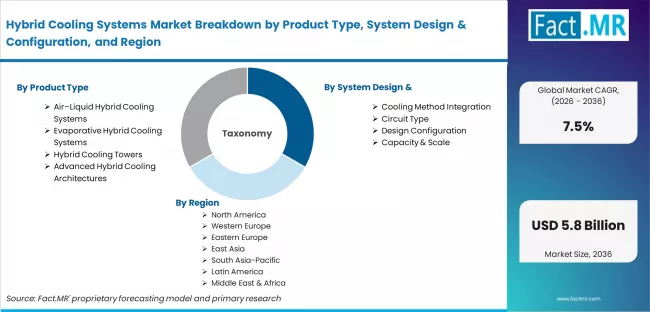
Hybrid Cooling Systems Market Size, Share, Growth and Forecast (2026 - 2036)

The Hybrid Cooling Systems Market is segmented by Product Type, System Design & Configuration, Application, End-Use Industry and Region. Forecast for 2026 to 2036.

According to Fact.MR estimates, the hybrid cooling systems market stood at USD 2.6 billion in 2025. The market is projected to reach USD 2.8 billion in 2026 and climb to USD 5.8 billion by 2036, progressing at a CAGR of 7.5%. Air–Liquid Hybrid Cooling Systems is anticipated to account for nearly 34% share of the product type segment, while Cooling Method Integration is expected to remain the leading system design & configuration with around 30% share, driven by rapid expansion of AI-driven data centers, rising demand for energy- and water-efficient cooling infrastructure, increasing adoption of hybrid thermal management technologies, and the need for sustainable, high-performance cooling solutions across industrial, commercial, and high-density computing environments.

Hybrid Cooling Systems Market Overview, Growth Outlook, and Forecast by Fact.MR

  • Global hybrid cooling system market was valued at USD 2.6 Bn in 2025 and is expected to reach USD 5.8 Bn by 2036.
  • At a 7.5% CAGR from 2026 to 2036, this market is set to expand ~2.1x in value, adding USD 3.0 Bn in absolute opportunity.
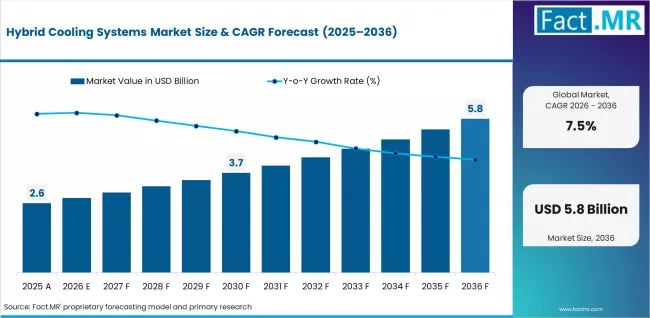
Hybrid Cooling Systems Market  Value Analysis

Summary of the Hybrid Cooling Systems Market

  • Demand and Growth Drivers
    • Increasing expansion of data centers and high-density computing infrastructure is driving demand for advanced hybrid cooling systems.
    • Growing emphasis on energy efficiency and sustainability is supporting adoption of hybrid cooling technologies that reduce water and electricity consumption.
    • Rising industrialization and process heat management requirements are encouraging deployment of hybrid cooling systems across manufacturing facilities.
    • Increasing environmental regulations related to water usage and carbon emissions are accelerating transition toward efficient cooling architectures.
    • Growing investments in commercial HVAC modernization and smart building infrastructure are supporting long-term market growth.
    • Advancements in cooling integration technologies and intelligent thermal management systems are improving operational efficiency and reliability.
  • Product and Segment View
    • Air-liquid hybrid cooling systems hold 34% share of product type segment, driven by superior cooling efficiency and widespread adoption in data centers and industrial applications
    • Hybrid cooling towers account for 24% share, supported by increasing use in industrial process cooling and HVAC infrastructure.
    • Evaporative hybrid cooling systems represent 22% share, reflecting growing demand for water-efficient cooling technologies.
    • Advanced hybrid cooling architectures contribute 20% share, driven by adoption in high-performance and emerging applications.
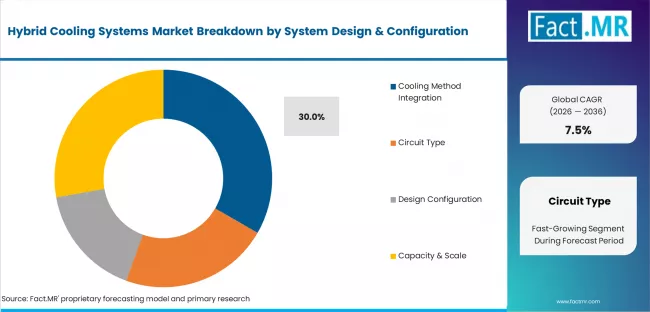
    • Cooling method integration holds 30% share by system design & configuration, supported by increasing adoption of integrated thermal management platforms.
    • Capacity & scale account for 25% share, while circuit type contributes 20% share.
    • Design configuration represents 15% share, followed by material type at 10%.
  • Geography and Competitive Outlook
    • North America and Europe represent key markets supported by investments in energy-efficient infrastructure and advanced cooling technologies.
    • Asia Pacific is witnessing strong growth driven by rapid industrialization, expansion of hyperscale data centers, and urban infrastructure development.
    • China and India are emerging as high-growth markets due to increasing investments in digital infrastructure and manufacturing capacity expansion.
    • Market growth is influenced by advancements in liquid cooling technologies, intelligent thermal monitoring systems, and sustainability-focused cooling solutions.
    • Key companies active in this market include Vertiv Group Corp., Schneider Electric, Johnson Controls, Baltimore Aircoil Company, and Trane Technologies.
  • Analyst Opinion
    • Shambhu Nath Jha, Principal Consultant at Fact.MR, says, “The Hybrid Cooling Systems Market is no longer defined solely by conventional air or liquid cooling technologies. Growth is increasingly driven by rising AI and high-density computing workloads, the need for energy- and water-efficient thermal management, and the shift toward advanced hybrid cooling architectures that optimize operational efficiency, reduce environmental impact, and support next-generation industrial and digital infrastructure.

Hybrid Cooling Systems Market— At a Glance

Attribute Details
Market Value 2025 USD 2.6 billion
Market Value 2036 USD 5.8 billion
Absolute Dollar Opportunity USD 3.0 billion
CAGR 7.5%
Growth Multiple 2.1x
Key Demand Theme Increasing demand for energy-efficient and sustainable cooling solutions
Leading Product Type Air-Liquid Hybrid Cooling Systems
Segment Share 34%
Leading Application Data Centers
Segment Share 38%
Leading End-use Industry Industrial Sector
Segment Share 45%
Key Growth Regions North America, Europe, Asia Pacific
Key Companies Vertiv, Schneider Electric, Johnson Controls, Baltimore Aircoil, Trane Technologies
Segmentation by Product Type Air-Liquid Hybrid Cooling Systems, Evaporative Hybrid Cooling Systems, Hybrid Cooling Towers, Advanced Hybrid Cooling Architectures
Segmentation by System Design & Configuration Circuit Type, Cooling Method Integration, Design Configuration, Capacity & Scale, Material Type
Segmentation by Application Data Centers, Industrial Applications, Commercial & HVAC, Emerging Applications
Segmentation by End-use Industry Industrial Sector, Commercial Sector, Residential / Consumer
Segmentation by Region North America, Latin America, Europe, East Asia, South Asia & Pacific, Middle East & Africa

Key Growth Drivers, Constraints, and Opportunities
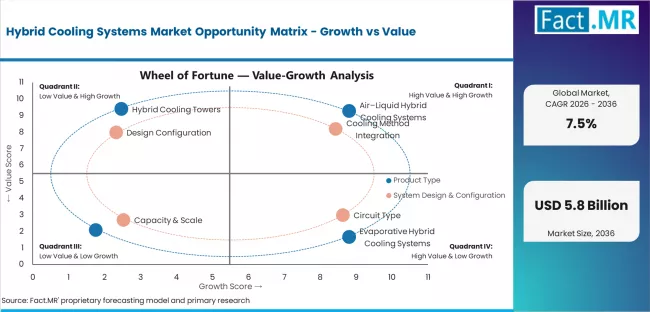
Hybrid Cooling Systems Market Opportunity Matrix Growth Vs Value

Key Factors Driving Growth

  • There will be more adoption of hybrid cooling technologies due to the fast rise in the number of data centers driven by artificial intelligence and high-density computing.
  • Energy savings, water savings, and environmental sustainability will push organizations towards adopting hybrid cooling technologies.
  • Heat-generating industrial processes and increased automation will create a need for efficient cooling technologies.
Growth Driver Demand Impact Time Horizon Key Impact Area Fact.MR Insight
Rapid expansion of AI-driven data centers and high-density computing High Short-Mid Term Digital infrastructure Increasing deployment of AI workloads and hyperscale data centers is driving strong demand for advanced hybrid cooling systems
Rising focus on energy efficiency and water conservation High Short-Mid Term Sustainability adoption Growing pressure to reduce energy consumption and water usage is accelerating adoption of hybrid thermal management solutions
Increasing industrial automation and heat-intensive manufacturing High Short-Mid Term Industrial operations Automation-led industrial processes require efficient and adaptive cooling infrastructure to maintain operational reliability
Advancements in hybrid cooling technologies and smart thermal management Medium-High Mid-Long Term Technology transformation Development of AI-enabled, liquid-assisted, and closed-loop cooling systems is improving efficiency and expanding application scope
Growth in semiconductor, power generation, and commercial infrastructure sectors Medium Short-Mid Term End-use industry expansion Expansion of heat-intensive industries is boosting installation of hybrid cooling systems across industrial and commercial facilities

Key Market Constraints

  • The expensive cost incurred during installation and integration may hinder the adoption of hybrid cooling technology.
    • Complexity in operations, maintenance needs, and the efficiency of managing hybrid cooling systems can hinder their adoption.
    • Lack of modernization and limited awareness about advanced cooling technologies in developing countries may pose challenges to the development of hybrid cooling technologies.

Key Opportunity Areas

  • Intelligent thermal management technologies, artificial intelligence, and smart cooling systems will present opportunities for hybrid cooling systems.
    • Data centers, semiconductor manufacturing industries, and industries involved in processing raw materials will provide room for hybrid cooling systems to grow.
    • Innovations such as liquid-based, evaporation, and closed-loop cooling systems will enhance the adoption of hybrid cooling technology.

Segment-wise Analysis of the Hybrid Cooling Systems Market

  • By the year 2026, Air–Liquid Hybrid Cooling Systems account for a 38% market share of the product type segment due to their superior thermal efficiency, rising deployment in high-density data centers, and growing adoption across industrial cooling applications requiring energy- and water-efficient thermal management solutions.
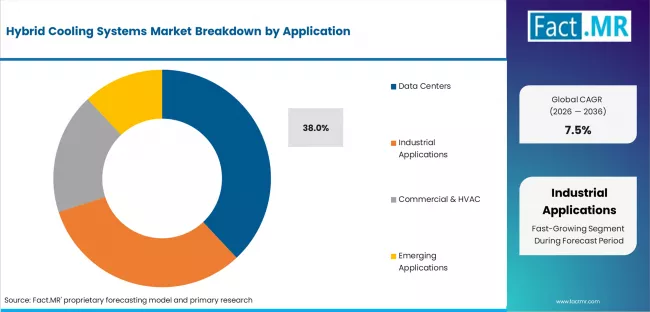
  • Data Centers represent a 35% market share of the application segment by 2026, driven by rapid expansion of AI-driven computing infrastructure, increasing rack power densities, and rising demand for advanced hybrid cooling technologies capable of supporting hyperscale and high-performance computing environments.

The segmentation of the market includes product type, system design & configuration, application, end-use industry, and region.

Which Product Type Dominates the Hybrid Cooling Systems Market?
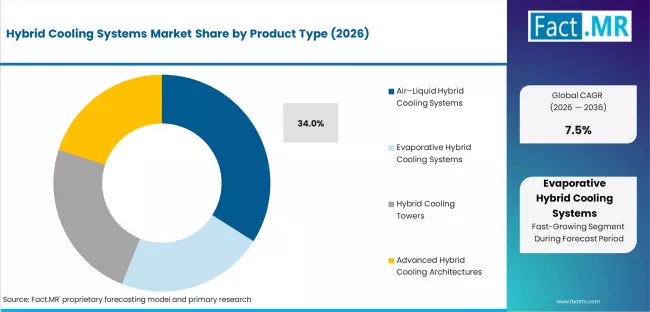
Hybrid Cooling Systems Market Analysis By Product Type

Among the types, Air-Liquid Hybrid Cooling Systems have the largest market share of 34%. This type of cooling system has been adopted on a large scale within the industrial facilities and data centers because of their high thermal efficiency, high density workloads capabilities, and lower energy consumption than any other cooling technology. Hybrid Cooling Towers have the second-largest market share of 24%. The adoption of this type of cooling systems has been growing in industrial processes and power generation facilities as they provide efficient cooling with minimal use of water. Evaporative Hybrid Cooling Systems account for 22% share because of their energy savings capability. Advanced Hybrid Cooling Architectures make up for the remaining 20% market share as a result of rising adoption of intelligent thermal management techniques.

Which System Design & Configuration Segment Leads the Hybrid Cooling Systems Market?
Hybrid Cooling Systems Market Analysis By System Design & Configuration

The integration of different types of cooling technologies makes up for the highest market share within the segment of System Design & Configuration. Cooling Method Integration has the largest market share of 30% since the industry is seeing a growing adoption of cooling systems that incorporate different types of cooling methods. Capacity & Scale accounts for the second-largest share of 25%. This has been influenced by growing demand for large-scale cooling infrastructure in the form of hyperscale data centers. The rising adoption of closed-loop cooling systems has led to Circuit Type taking up third place with the 20% share. The remaining shares in the segment are made up of 15% Design Configuration and 10% Material Type.

Which Application Segment Dominates the Hybrid Cooling Systems Market?
Hybrid Cooling Systems Market Analysis By Application

Data Centers account for the largest market share of 38% within the application segment. The rising need for cooling systems in the rapidly expanding market of AI-based computing, cloud infrastructure, and other data centers has led to rising demand for advanced hybrid cooling systems. Industrial Applications take up the second position with a market share of 32% since there is growing demand for energy-efficient thermal management systems within the manufacturing process. Commercial & HVAC applications contribute the 18% market share to the segment owing to initiatives for promoting sustainability within buildings. Lastly, Emerging Applications account for the 12% share.

Which End-Use Industry Holds the Largest Share in the Hybrid Cooling Systems Market?
Hybrid Cooling Systems Market Analysis By End Use Industry

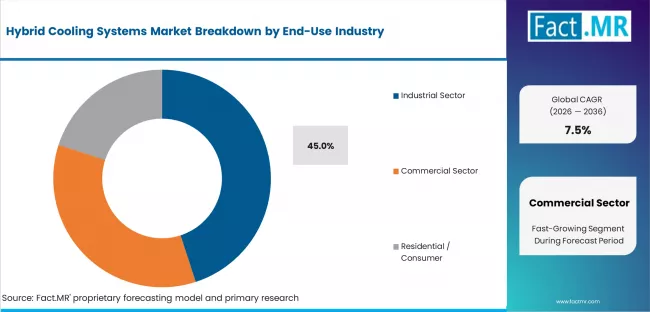
Among the sectors, the Industrial Sector dominates the hybrid cooling systems market share. It takes up the largest share of 45% within the segment because of growing adoption of cooling infrastructure within the manufacturing sector, power plants, and industrial automation. On the second position is the Commercial Sector, which accounts for 35% of the market share. Growing adoption of energy-efficient HVAC and thermal management systems for commercial applications has contributed greatly to this number. Lastly, Residential / Consumer contributes to the remaining 20% market share of the segment.

Regional Outlook Across Key Markets

The market analysis covers key global regions, including South Asia and Pacific, Middle East & Africa, North America, Latin America, Western Europe, and Eastern Europe. It is segmented geographically, with specific market dynamics for each region. The full report provides a detailed market attractiveness analysis.

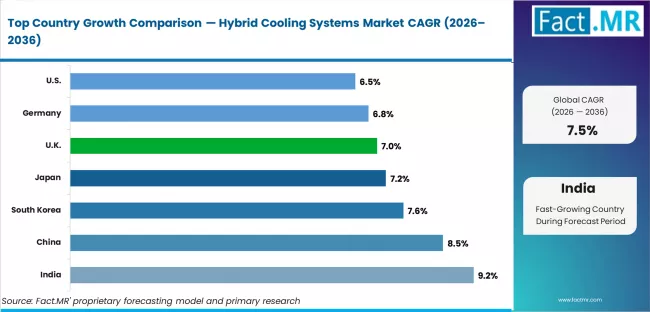
Top Country Growth Comparison Hybrid Cooling Systems Market Cagr (2026 2036)

CAGR Table

Country CAGR (%)
U.S. 6.5%
Germany 6.8%
U.K. 7.0%
Japan 7.2%
South Korea 7.6%
China 8.5%
India 9.2%

Source: Fact.MR (FMR) analysis, based on proprietary forecasting model and primary research.
Hybrid Cooling Systems Market Cagr Analysis By Country

North America: The Global AI Infrastructure and Cooling Innovation Hub

North America represents the technology leadership center of the Hybrid Cooling Systems Market, driven by hyperscale data center expansion, AI infrastructure investments, and advanced thermal management adoption. Major players including Schneider Electric, Vertiv, and Johnson Controls maintain strong competitive positioning through liquid-assisted and AI-enabled cooling solutions. The region benefits from rapid cloud infrastructure deployment, sustainability mandates, and increasing investments in high-density computing facilities requiring advanced hybrid cooling architectures.

  • U.S.: Demand for hybrid cooling systems in the U.S. is projected to rise at 6.5% CAGR through 2036.

Growth is driven by accelerating AI data center investments and increasing deployment of liquid-assisted thermal management infrastructure. Rising rack densities and sustainability requirements continue supporting adoption of advanced thermal management systems across hyperscale facilities.

Western Europe: The Global Sustainability and Energy-Efficiency Benchmark
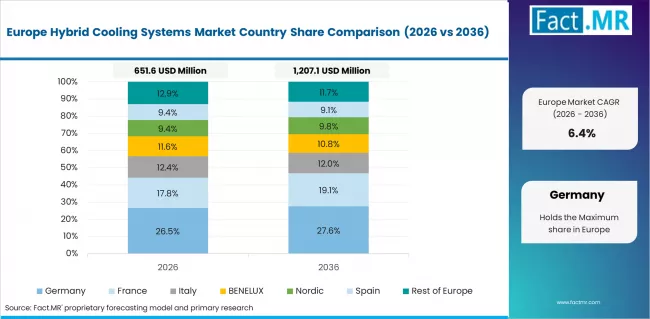
Hybrid Cooling Systems Market Europe Country Market Share Analysis, 2026 & 2036

Western Europe acts as the global regulatory and sustainability benchmark for hybrid cooling systems, driven by stringent energy-efficiency policies and rising deployment of green data center infrastructure. Leading companies including Schneider Electric, STULZ GmbH, and Rittal are strengthening regional competitiveness through advanced liquid and hybrid cooling innovations. The region’s focus on decarbonization, water conservation, and AI-ready infrastructure is accelerating adoption of energy-efficient thermal management technologies across industrial and digital applications.

  • Germany: Demand for hybrid cooling systems in Germany is projected to rise at 6.8% CAGR through 2036.

Germany’s market growth is supported by industrial digitalization, AI infrastructure investments, and stringent energy-efficiency regulations Germany’s strong industrial manufacturing base and increasing deployment of sustainable industrial cooling systems are further driving demand. Rising adoption of hybrid liquid-air cooling technologies in automotive manufacturing and industrial automation facilities is also strengthening long-term market growth.

East Asia: The Fastest-Growing Digital Infrastructure Cooling Market

East Asia is emerging as the fastest-growing regional market for hybrid cooling systems due to aggressive semiconductor investments, hyperscale data center expansion, and strong government-backed digital infrastructure initiatives. Key players such as Daikin Industries, Fujitsu, and Samsung SDS are strengthening regional competitiveness through energy-efficient and AI-ready cooling technologies. The region benefits from rising AI workloads, semiconductor manufacturing growth, and increasing demand for sustainable thermal management systems.

  • South Korea: Demand for hybrid cooling systems in South Korea is projected to rise at 7.6% CAGR through 2036.

South Korea’s market is driven by rapid hyperscale data center expansion and strong investments from telecom and semiconductor companies. In August 2025, reports indicated that Seoul’s operational data center capacity exceeded 520 MW, with more than 638 MW under development [1]. LG Uplus completed advanced hyperscale facilities featuring cooling systems twice as energy efficient as previous generations. Increasing AI infrastructure deployment and expansion by companies such as Samsung SDS and SK Broadband continue driving demand for advanced hybrid cooling technologies.
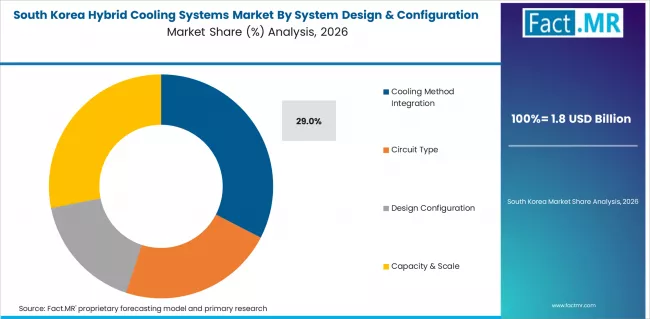
Hybrid Cooling Systems Market South Korea Market Share Analysis By System Design & Configuration

  • China: Demand for hybrid cooling systems in China is projected to rise at 8.5% CAGR through 2036.

China remains one of the largest growth markets due to massive hyperscale data center investments, industrial automation expansion, and government-backed digital economy initiatives. Increasing deployment of AI infrastructure and cloud computing facilities is accelerating demand for advanced hybrid cooling technologies capable of supporting high-density workloads. Domestic and international technology companies are investing heavily in energy-efficient thermal management systems to reduce operational costs and meet sustainability targets. China’s strong manufacturing ecosystem and growing semiconductor production capacity are also increasing adoption of hybrid cooling solutions across industrial and commercial infrastructure applications.

South Asia & Pacific: The Emerging High-Growth Cooling Infrastructure Market

South Asia & Pacific is becoming a major growth center for hybrid cooling systems due to accelerating digital transformation, hyperscale data center investments, and industrial infrastructure expansion. Companies including Schneider Electric, Vertiv, and Daikin Industries are expanding regional presence through localized manufacturing and AI-ready cooling technologies. Rising energy demand, hot climatic conditions, and rapid cloud infrastructure deployment are increasing the need for efficient hybrid thermal management systems.

  • India: Demand for hybrid cooling systems in India is projected to rise at 9.2% CAGR through 2036.

India is the fastest-growing major market driven by aggressive data center expansion, localization policies, and increasing AI infrastructure deployment. Industry estimates released in February 2026 indicated India’s data center cooling market could grow at over 25% annually due to hyperscale investments and rising cooling demand. Expansion of domestic cloud infrastructure and increasing regulatory emphasis on data localization are further supporting hybrid cooling adoption.

Fact.MR’s analysis of the global Hybrid Cooling Systems Market provides a comprehensive regional assessment across North America, Western Europe, East Asia, and South Asia & Pacific, covering key countries including the U.S., Germany, the U.K., Japan, South Korea, China, India, and ASEAN. Readers can access detailed insights on AI-driven data center expansion, industrial automation trends, sustainability regulations, energy-efficiency initiatives, hyperscale infrastructure investments, and adoption of advanced hybrid thermal management technologies shaping regional demand patterns and long-term competitive positioning across the global market landscape.

Competitive Benchmarking and Company Positioning

Leading Companies Shaping the Hybrid Cooling Systems Market
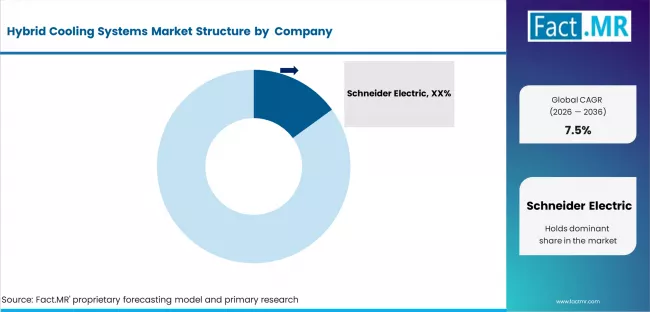
Hybrid Cooling Systems Market Analysis By Company

The market for hybrid cooling systems is fairly concentrated, with the top participants being Schneider Electric, Vertiv, Johnson Controls, Daikin Industries, and Trane Technologies together controlling close to 40-50% market share. The key competitive factors in this market include energy efficiency, thermal efficiency, sustainability, and artificial intelligence-assisted cooling. Companies with diversified product lines, wide geographical reach, and good connections with hyperscale data centers possess inherent competitive advantages. End-users now rely on multiple suppliers’ solutions to mitigate risk from a single vendor, thus curbing any price-setting power companies might otherwise possess.

Key Players of the Hybrid Cooling Systems Market

  • Schneider Electric
  • Vertiv
  • Johnson Controls
  • Daikin Industries
  • Trane
  • STULZ GMBH
  • Rittal LLC
  • AIREDALE INTERNATIONAL AIR CONDITIONING LTD.
  • Condair Evaporative Technologies
  • Baltimore Aircoil Company
  • EVAPCO

Recent Industry Developments

  • Schneider Electric unveils advanced liquid cooling portfolio for AI data centers (September 2025): Schneider Electric introduced its Motivair liquid cooling portfolio featuring dedicated hybrid cooling solutions for HPC and AI workloads following the company’s acquisition of Motivair earlier in 2025. The launch strengthens Schneider Electric’s position in high-density thermal management infrastructure for hyperscale data centers. [2]
  • Vertiv expands liquid cooling capabilities through PurgeRite acquisition (December 2025): Vertiv completed the acquisition of PurgeRite Intermediate LLC for approximately USD 1 billion to strengthen its liquid cooling and thermal management services portfolio for AI-driven and high-density computing environments. The acquisition enhances Vertiv’s specialized fluid management, flushing, purging, and filtration capabilities for hyperscale and mission-critical facilities. [3]
  • Schneider Electric launches Motivair liquid cooling manufacturing facility in India (February 2026): Schneider Electric launched its first Motivair liquid cooling solutions manufacturing facility in Bengaluru, India, to support the country’s rapidly growing AI and hyperscale data center infrastructure market. The facility strengthens localized production of advanced hybrid cooling systems for high-density computing applications. [4]

Sources and Research References

  • [1] W.Media, “A Closer Look at South Korea’s Data Center Market in 2025,” August 2025
  • [2] Schneider Electric, “Schneider Electric Unveils Liquid Cooling Portfolio with Motivair Featuring Dedicated Solutions and Services for HPC and AI Workloads,” September 2025
  • [3] Vertiv, “Vertiv Completes Acquisition of PurgeRite, Expanding Leadership in Liquid Cooling Services,” December 2025
  • [4] Schneider Electric, “Schneider Electric Launches Motivair Liquid Cooling Solutions Factory, to Accelerate India’s High-Density AI Infrastructure,” February 2026

Hybrid Cooling Systems Market Definition

The hybrid cooling systems market encompasses cooling products that integrate more than one cooling solution like air, liquid, and evaporative cooling to enhance their energy efficiency and minimize water and power utilization. Hybrid cooling solutions are designed to regulate temperature levels for industrial machinery, data center racks, commercial establishments, and manufacturing plants. In simple terms, these solutions help ensure that ideal operating temperature levels are maintained in these sectors while ensuring minimum expenses and maximum energy efficiency.

Hybrid Cooling SystemsMarket Inclusions

This report provides estimates and forecasts of the Hybrid Cooling Systems Market globally and regionally from 2026 to 2036. Market estimates and forecasts include segmentation analysis based on Product Type, Design & Configuration of Systems, Applications, End-use Industries, and regions. Further, other aspects such as market shares, price analysis, technology trends, competitive analysis, infrastructure investments, and demand analysis of the Hybrid Cooling Systems Market are discussed in this report.

Hybrid Cooling SystemsMarket Exclusions

Hybrid cooling solutions that are used only as a separate air-cooling system, only as a liquid cooling system, or basic air-conditioning and heating systems without any hybrid capabilities are out of the scope of this report. In addition, products such as residential fans, home air conditioners, refrigerators, consumer electronics, and any niche cooling products which are used only in laboratories, defense sectors, aerospace, and others are also not considered.

Hybrid Cooling SystemsMarket Research Methodology

  • Primary Research
    • The analysts at Fact.MR conducted interviews with cooling systems manufacturers, thermal management solutions providers, data centers, HVAC consulting firms, industrial automation experts, and cooling systems component suppliers. The information derived from conversations with executive officials, product managers, and procurement professionals was used for demand assessment.
  • Desk Research
    • The research employed annual reports from leading companies, investor presentations, whitepapers, industry-specific trade journals, databases, government publications, energy efficiency regulations, and statistics on data center infrastructure. Patenting activity in the field of cooling technologies, sustainability efforts, and industrial investments were some other factors considered in secondary research.
  • Market-Sizing and Forecasting
    • The analysts employed a hybrid approach in market modeling that includes both bottom-up and top-down approaches. Market size was estimated by analyzing revenue earned by major companies, infrastructure expenditure, addition in cooling capacities, and end use consumption trends between 2026 and 2036.
  • Data Validation and Update Cycle
    • Multiple rounds of expert consultation, comparison with industry databases, and past market performance served as validation tools for all results obtained in the research. Technology developments, regulatory changes, macroeconomic trends, and shifts in end user investment patterns would continue to influence the forecasts made.

Scope of Analysis

Hybrid Cooling Systems Market Breakdown By Product Type, System Design & Configuration, And Region

Parameter Details
Quantitative Units USD 2.6 billion in 2025 to USD 5.8 billion in 2036, at a CAGR of 7.5%
Market Definition The Hybrid Cooling Systems Market comprises integrated cooling technologies combining air, liquid, and evaporative methods to improve thermal efficiency, reduce energy consumption, and support industrial, commercial, and high-density digital infrastructure applications.
Regions Covered North America, Latin America, Europe, East Asia, South Asia and Pacific, MiddleEastand Africa
Countries Covered USA, Canada, UK, Germany, China, India, 30 plus countries
Key Companies Schneider Electric, Vertiv, Johnson Controls, Daikin Industries, Trane, STULZ GMBH, Rittal LLC, AIREDALE INTERNATIONAL AIR CONDITIONING LTD., Condair Evaporative Technologies, Baltimore Aircoil Company, EVAPCO
Forecast Period 2026 to 2036
Approach Hybrid demand-side and top-downmethodologybuilt on country-level application demand, product benchmarking, pricing analysis, shipment validation, and primary interviews across manufacturers, distributors, retailers, and end users

Analysis by Product Type, by System Design & Configuration, by Application, by End-Use Industry and by Region

  • Hybrid Cooling Systems Market by Product Type:

    • Air–Liquid Hybrid Cooling Systems
      • Liquid-to-Air Hybrid Systems
      • Air-to-Liquid Hybrid Systems
    • Evaporative Hybrid Cooling Systems
      • Direct + Indirect Evaporative Cooling
      • Evaporative + Mechanical Cooling
    • Hybrid Cooling Towers
      • Direct Contact (Wet-Dry Hybrid)
      • Closed Circuit Hybrid Cooling Towers
      • Open Circuit Hybrid Cooling Towers
    • Advanced Hybrid Cooling Architectures
      • Close-Coupled Hybrid Cooling
      • AI-driven Hybrid Cooling Systems
  • Hybrid Cooling Systems Market by System Design & Configuration:

    • Circuit Type
      • Open Loop Systems
      • Closed Loop Systems
    • Cooling Method Integration
      • Air + Liquid Hybrid
      • Air + Evaporative Hybrid
      • Liquid + Refrigeration Hybrid
      • Multi-Mode Hybrid Systems (Air + Liquid + Evaporative)
    • Design Configuration
      • Forced Draft Systems
      • Induced Draft Systems
    • Capacity & Scale
      • Small Scale (<5k TR)
      • Medium Scale (5–10k TR)
      • Large Scale (>10k TR)
    • Material Type
      • Steel
      • Concrete
      • Fiberglass Reinforced Plastic (FRP)
  • Hybrid Cooling Systems Market by Application:

    • Data Centers
      • Hyperscale Data Centers
      • Enterprise Data Centers
      • Colocation Data Centers
      • Edge Data Centers
      • High-Performance Computing (HPC)
    • Industrial Applications
      • Power Generation
      • Oil & Gas
      • Chemical & Petrochemical
      • Metals & Mining
      • Food & Beverage Processing
    • Commercial & HVAC
      • Commercial Buildings
      • District Cooling Systems
      • Smart Buildings & Green Infrastructure
    • Emerging Applications
      • Renewable Energy Systems
      • Electric Vehicle Infrastructure
      • Semiconductor Manufacturing
      • Pharmaceuticals & Cleanrooms
  • Hybrid Cooling Systems Market by End-Use Industry:

    • Industrial Sector
    • Commercial Sector
    • Residential / Consumer
  • Hybrid Cooling Systems Market by Region:

    • North America
      • USA
      • Canada
      • Mexico
    • Latin America
      • Brazil
      • Chile
      • Rest of LATAM
    • East Asia
      • China
      • Japan
      • South Korea
    • Western Europe
      • Germany
      • Italy
      • France
      • U.K.
      • Spain
      • BENELUX
      • Nordic
      • Rest of W. Europe
    • Eastern Europe
      • Russia
      • Hungary
      • Poland
      • Balkan & Baltics
      • Rest of E. Europe
    • South Asia & Pacific
      • India
      • ASEAN
      • ANZ
      • Rest of SAP
    • Middle East and Africa
      • Kingdom of Saudi Arabia
      • United Arab Emirates
      • South Africa
      • Rest of Middle East and Africa

- Frequently Asked Questions -

How large is the demand for Hybrid Cooling Systems in the global market in 2026?

Demand for Hybrid Cooling Systems in the global market is estimated to be valued at USD 2.8 billion in 2026.

What will be the market size of Hybrid Cooling Systems in the global market by 2036?

The market size for Hybrid Cooling Systems is projected to reach USD 5.8 billion by 2036.

What is the expected demand growth for Hybrid Cooling Systems in the global market between 2026 and 2036?

Demand for Hybrid Cooling Systems in the global market is expected to grow at a CAGR of 7.5% between 2026 and 2036, driven by increasing demand for energy-efficient thermal management solutions in data centers and industrial facilities.

Which product type is expected to dominate the market?

Air–Liquid Hybrid Cooling Systems are expected to dominate the market, accounting for 34% of the market share in 2026, due to their ability to balance cooling efficiency, energy savings, and operational flexibility.

Which country is expected to show the highest growth rate for Hybrid Cooling Systems?

India is projected to show the highest regional CAGR at 9.2%, supported by rapid expansion of digital infrastructure, industrial automation, and data center investments.

How significant is the growth outlook for China in this market?

China is expected to grow at a CAGR of 8.5%, reflecting strong demand from hyperscale data centers, electronics manufacturing, and industrial cooling applications.

Which company is identified as a leading player in the Hybrid Cooling Systems market?

Schneider Electric is recognized as a leading player, offering advanced hybrid cooling technologies for data centers, industrial facilities, and critical infrastructure environments.

Table of Content

  1. Hybrid Cooling Systems Market – Executive Summary
  2. Market Overview
    • Market Definition & Introduction
    • Market Taxonomy & Research Scope
  3. Global Hybrid Cooling Systems Market Demand Analysis 2021-2025 and Forecast, 2026–2036
    • Historical Market Volume (Units) Analysis, 2021-2025
    • Current and Future Market Volume (Units) Projections, 2026–2036
    • Y-o-Y Growth Trend Analysis
  4. Global Hybrid Cooling Systems Market - Pricing Analysis
    • Product Category and Country-Level Pricing Analysis
    • Region Average Pricing Analysis Benchmark
    • Price Trends and Forecasts
      • Historical price trends
      • Future price forecasts
    • Factors Influencing Pricing
    • Competitive Pricing Strategies
    • Cost Structure Analysis: Elementary Deep Dive
  5. Global Hybrid Cooling Systems Market Demand (in Value or Size in US$ Mn) Analysis 2021-2025 and Forecast, 2026–2036
    • Historical Market Value (US$ Bn) Analysis, 2021-2025
    • Current and Future Market Value (US$ Bn) Projections, 2026–2036
      • Y-o-Y Growth Trend Analysis
      • Absolute $ Opportunity Analysis
  6. Market Background and Foundational Data Points
    • Installed base of cooling systems (units / TR / kW)
    • Annual shipment volume of hybrid cooling systems
    • Replacement & retrofit rate of legacy cooling systems
    • Data center capacity additions (MW / rack density growth)
    • Industrial output growth (manufacturing, power generation, etc.)
    • HVAC infrastructure expansion (commercial floor space growth)
    • Capital expenditure (CAPEX) in cooling infrastructure
    • Energy consumption trends and cooling demand (kWh usage)
    • Regional infrastructure investments (USD allocation)
    • Adoption rate of hybrid vs air/liquid cooling technologies
    • Regulatory policies on energy efficiency & water usage
    • Sustainability and carbon reduction initiatives
    • Technology advancements (AI-driven cooling, smart systems)
    • Industry shift toward high-density computing (AI, HPC)
    • Trade Scenario, 2025
      • Imports and Export Analysis
        • By Region
        • By Country
    • Start-up Ecosystem Analysis, 2021-2025
    • Hybrid Cooling Systems Market Opportunity Assessment
      • Total Available Market (US$ Mn)
      • Serviceable Addressable Market (US$ Mn)
      • Serviceable Obtainable Market (US$ Mn)
    • Porter’s Five Forces and PESTEL Analysis
    • Investment Feasibility Analysis
    • Macro-Economic Factors & Forecast Factors - Relevance & Impact
    • Industry Value and Supply Chain Analysis
      • List of Key Channel Partners
      • Profit Margin & Operating Margin at Each Node of Supply Chain.
      • Notes on Value Added at Each Node in the Value Chain
      • Factors Influencing Value Chain
    • Market Dynamics
      • Drivers
      • Restraints
      • Opportunity Analysis
    • Key Regulations & Certifications
  7. Hybrid Cooling Systems Market Analysis 2021-2025 and Forecast 2026–2036, By Product Type
    • Introduction / Key Findings
    • Historical Market Size (US$ Bn) & Volume (Units) Trend Analysis By Product Type, 2021-2025
    • Current and Future Market Size (US$ Bn) & Volume (Units) Analysis and Forecast By Product Type, 2026-2036
      • Air–Liquid Hybrid Cooling Systems
        • Liquid-to-Air Hybrid Systems
        • Air-to-Liquid Hybrid Systems
      • Evaporative Hybrid Cooling Systems
        • Direct + Indirect Evaporative Cooling
        • Evaporative + Mechanical Cooling
      • Hybrid Cooling Towers
        • Direct Contact (Wet-Dry Hybrid)
        • Closed Circuit Hybrid Cooling Towers
        • Open Circuit Hybrid Cooling Towers
      • Advanced Hybrid Cooling Architectures
        • Close-Coupled Hybrid Cooling
        • AI-driven Hybrid Cooling Systems
    • Market Attractiveness Analysis By Product Type
  8. Hybrid Cooling Systems Market Analysis 2021-2025 and Forecast 2026–2036, By System Design & Configuration
    • Introduction / Key Findings
    • Historical Market Size (US$ Bn) & Volume (Units) Trend Analysis By System Design & Configuration, 2021-2025
    • Current and Future Market Size (US$ Bn) & Volume (Units) Analysis and Forecast By System Design & Configuration, 2026-2036
      • Circuit Type
        • Open Loop Systems
        • Closed Loop Systems
      • Cooling Method Integration
        • Air + Liquid Hybrid
        • Air + Evaporative Hybrid
        • Liquid + Refrigeration Hybrid
        • Multi-Mode Hybrid Systems (Air + Liquid + Evaporative)
      • Design Configuration
        • Forced Draft Systems
        • Induced Draft Systems
      • Capacity & Scale
        • Small Scale (<5k TR)
        • Medium Scale (5–10k TR)
        • Large Scale (>10k TR)
      • Material Type
        • Steel
        • Concrete
        • Fiberglass Reinforced Plastic (FRP)
    • Market Attractiveness Analysis By System Design & Configuration
  9. Hybrid Cooling Systems Market Analysis 2021-2025 and Forecast 2026–2036, By Application
    • Introduction / Key Findings
    • Historical Market Size (US$ Bn) & Volume (Units) Trend Analysis By Application, 2021-2025
    • Current and Future Market Size (US$ Bn) & Volume (Units) Analysis and Forecast By Application, 2026-2036
      • Data Centers
        • Hyperscale Data Centers
        • Enterprise Data Centers
        • Colocation Data Centers
        • Edge Data Centers
        • High-Performance Computing (HPC)
      • Industrial Applications
        • Power Generation
        • Oil & Gas
        • Chemical & Petrochemical
        • Metals & Mining
        • Food & Beverage Processing
      • Commercial & HVAC
        • Commercial Buildings
        • District Cooling Systems
        • Smart Buildings & Green Infrastructure
      • Emerging Applications
        • Renewable Energy Systems
        • Electric Vehicle Infrastructure
        • Semiconductor Manufacturing
        • Pharmaceuticals & Cleanrooms
    • Market Attractiveness Analysis By Application
  10. Hybrid Cooling Systems Market Analysis 2021-2025 and Forecast 2026–2036, By End-Use Industry
    • Introduction / Key Findings
    • Historical Market Size (US$ Bn) & Volume (Units) Trend Analysis By End-Use Industry, 2021-2025
    • Current and Future Market Size (US$ Bn) & Volume (Units) Analysis and Forecast By End-Use Industry, 2026-2036
      • Industrial Sector
      • Commercial Sector
      • Residential / Consumer
    • Market Attractiveness Analysis By End-Use Industry
  11. Global Hybrid Cooling Systems Market Analysis and Forecast, by Region
    • Introduction / Key Findings
    • Historical Market Size (US$ Bn) & Volume (Units) Trend Analysis by Region, 2021-2025
    • Current and Future Market Size (US$ Bn) & Volume (Units) Analysis and Forecast by Region, 2026-2036
      • North America
      • Latin America
      • Western Europe
      • Eastern Europe
      • East Asia
      • South Asia & Pacific
      • Middle East & Africa
    • Market Attractiveness Analysis by Region
  12. North America Hybrid Cooling Systems Market Analysis and Forecast
    • Introduction / Key Findings
    • Pricing Analysis
    • Historical Market Size (US$ Bn) & Volume (Units) Trend Analysis by Market Taxonomy, 2021-2025
    • Current and Future Market Size (US$ Bn) and Volume (Units) Analysis & Forecast by Market Taxonomy, 2026-2036
    • By Country
      • United States
      • Canada
      • Mexico
    • By Taxonomy
    • Market Attractiveness Analysis By Country & Taxonomy
    • Market Trends
    • Key Market Participants – Intensity Mapping
    • Drivers and Restraints - Impact Analysis
  13. Latin America Hybrid Cooling Systems Market Analysis and Forecast
    • Introduction / Key Findings
    • Pricing Analysis
    • Historical Market Size (US$ Bn) & Volume (Units) Trend Analysis by Market Taxonomy, 2021-2025
    • Current and Future Market Size (US$ Bn) and Volume (Units) Analysis & Forecast by Market Taxonomy, 2026-2036
    • By Country
      • Brazil
      • Chile
      • Rest of LATAM
    • By Taxonomy
    • Market Attractiveness Analysis By Country & Taxonomy
    • Market Trends
    • Key Market Participants – Intensity Mapping
    • Drivers and Restraints - Impact Analysis
  14. Western Europe Hybrid Cooling Systems Market Analysis and Forecast
    • Introduction / Key Findings
    • Pricing Analysis
    • Historical Market Size (US$ Bn) & Volume (Units) Trend Analysis by Market Taxonomy, 2021-2025
    • Current and Future Market Size (US$ Bn) and Volume (Units) Analysis & Forecast by Market Taxonomy, 2026-2036
    • By Country
      • Germany
      • Italy
      • France
      • United Kingdom
      • Spain
      • BENELUX
      • Nordics
      • Rest of Western Europe
    • By Taxonomy
    • Market Attractiveness Analysis By Country & Taxonomy
    • Market Trends
    • Key Market Participants – Intensity Mapping
    • Drivers and Restraints - Impact Analysis
  15. Eastern Europe Hybrid Cooling Systems Market Analysis and Forecast
    • Introduction / Key Findings
    • Pricing Analysis
    • Historical Market Size (US$ Bn) & Volume (Units) Trend Analysis by Market Taxonomy, 2021-2025
    • Current and Future Market Size (US$ Bn) and Volume (Units) Analysis & Forecast by Market Taxonomy, 2026-2036
    • By Country
      • Russia
      • Hungary
      • Poland
      • Balkan & Baltics
      • Rest of Eastern Europe
    • By Taxonomy
    • Market Attractiveness Analysis By Country & Taxonomy
    • Market Trends
    • Key Market Participants – Intensity Mapping
    • Drivers and Restraints - Impact Analysis
  16. East Asia Hybrid Cooling Systems Market Analysis and Forecast
    • Introduction / Key Findings
    • Pricing Analysis
    • Historical Market Size (US$ Bn) & Volume (Units) Trend Analysis by Market Taxonomy, 2021-2025
    • Current and Future Market Size (US$ Bn) and Volume (Units) Analysis & Forecast by Market Taxonomy, 2026-2036
    • By Country
      • China
      • Japan
      • South Korea
    • By Taxonomy
    • Market Attractiveness Analysis By Country & Taxonomy
    • Market Trends
    • Key Market Participants – Intensity Mapping
    • Drivers and Restraints - Impact Analysis
  17. South Asia & Pacific Hybrid Cooling Systems Market Analysis and Forecast
    • Introduction / Key Findings
    • Pricing Analysis
    • Historical Market Size (US$ Bn) & Volume (Units) Trend Analysis by Market Taxonomy, 2021-2025
    • Current and Future Market Size (US$ Bn) and Volume (Units) Analysis & Forecast by Market Taxonomy, 2026-2036
    • By Country
      • India
      • ASEAN
      • Australia & New Zealand
      • Rest of South Asia & Pacific
    • By Taxonomy
    • Market Attractiveness Analysis By Country & Taxonomy
    • Market Trends
    • Key Market Participants – Intensity Mapping
    • Drivers and Restraints - Impact Analysis
  18. Middle East & Africa Hybrid Cooling Systems Market Analysis and Forecast
    • Introduction / Key Findings
    • Pricing Analysis
    • Historical Market Size (US$ Bn) & Volume (Units) Trend Analysis by Market Taxonomy, 2021-2025
    • Current and Future Market Size (US$ Bn) and Volume (Units) Analysis & Forecast by Market Taxonomy, 2026-2036
    • By Country
      • Kingdom of Saudi Arabia
      • Other GCC Countries
      • Turkiye
      • South Africa
      • Other African Union
    • By Taxonomy
    • Market Attractiveness Analysis By Country & Taxonomy
    • Market Trends
    • Key Market Participants – Intensity Mapping
    • Drivers and Restraints - Impact Analysis
  19. Country-level Hybrid Cooling Systems Market Analysis and Forecast
    • Introduction
    • Market Value Proportion Analysis, By Key Countries
    • Global Vs. Country Growth Comparison
      • United States Hybrid Cooling Systems Market Analysis
        • Market Size (US$ Bn) & Volume (Units) Analysis by Market Taxonomy, 2021–2036
        • By Product Type
        • By System Design & Configuration
        • By Application
        • By End-Use Industry
        • By Optical Technology
        • Canada Hybrid Cooling Systems Market Analysis
        • Mexico Hybrid Cooling Systems Market Analysis
        • Brazil Hybrid Cooling Systems Market Analysis
        • Chile Hybrid Cooling Systems Market Analysis
        • Germany Hybrid Cooling Systems Market Analysis
        • France Hybrid Cooling Systems Market Analysis
        • Italy Hybrid Cooling Systems Market Analysis
        • Spain Hybrid Cooling Systems Market Analysis
        • United Kingdom Hybrid Cooling Systems Market Analysis
        • BENELUX Hybrid Cooling Systems Market Analysis
        • Nordics Hybrid Cooling Systems Market Analysis
        • Poland Hybrid Cooling Systems Market Analysis
        • Russia Hybrid Cooling Systems Market Analysis
        • Hungary Hybrid Cooling Systems Market Analysis
        • Balkan & Baltics Hybrid Cooling Systems Market Analysis
        • China Hybrid Cooling Systems Market Analysis
        • Japan Hybrid Cooling Systems Market Analysis
        • South Korea Hybrid Cooling Systems Market Analysis
        • India Hybrid Cooling Systems Market Analysis
        • ASEAN Hybrid Cooling Systems Market Analysis
        • ANZ Hybrid Cooling Systems Market Analysis
        • KSA Hybrid Cooling Systems Market Analysis
        • Other GCC Countries Hybrid Cooling Systems Market Analysis
        • South Africa Hybrid Cooling Systems Market Analysis
        • Turkiye Hybrid Cooling Systems Market Analysis
    • Hybrid Cooling Systems Market Structure Analysis
      • Market Analysis by Tier of Companies
      • Market Concentration
      • Market Share Analysis of Top Players
      • Market Space for New Brands and Dollar Opportunity
      • Market Presence Analysis
        • Regional Footprint of Players
        • Product Footprint by Players
    • Mobile Optical Pluggable Competition Analysis
      • Competition Dashboard
      • Pricing Analysis by Competition
      • Competition Benchmarking
      • Competition Deep Dive
        • Schneider Electric
          • Overview
          • Product Portfolio
          • Sales Footprint
          • Key Developments
          • SWOT Analysis
          • Strategy Overview
          • Key Financials
        • Vertiv
        • Johnson Controls
        • Daikin Industries
        • Trane
        • STULZ GMBH
        • Rittal LLC
        • AIREDALE INTERNATIONAL AIR CONDITIONING LTD.
        • Condair Evaporative Technologies
        • Baltimore Aircoil Company
        • EVAPCO
        • Other Prominent Players
    • Primary insights
    • Assumptions & Acronyms Used
    • Research Methodology & Data Sources

List Of Table

  • Table 1: Global Market Value (USD Bn) Forecast by Region, 2021 to 2036
  • Table 2: Global Market Volume (Units) Forecast by Region, 2021 to 2036
  • Table 3: Global Market Value (USD Bn) Forecast by Product Type, 2021 to 2036
  • Table 4: Global Market Volume (Units) Forecast by Product Type, 2021 to 2036
  • Table 5: Global Market Value (USD Bn) Forecast by System Design & Configuration, 2021 to 2036
  • Table 6: Global Market Volume (Units) Forecast by System Design & Configuration, 2021 to 2036
  • Table 7: Global Market Value (USD Bn) Forecast by Application, 2021 to 2036
  • Table 8: Global Market Volume (Units) Forecast by Application, 2021 to 2036
  • Table 9: Global Market Value (USD Bn) Forecast by End-Use Industry, 2021 to 2036
  • Table 10: Global Market Volume (Units) Forecast by End-Use Industry, 2021 to 2036
  • Table 11: North America Market Value (USD Bn) Forecast by Country, 2021 to 2036
  • Table 12: North America Market Volume (Units) Forecast by Country, 2021 to 2036
  • Table 13: North America Market Value (USD Bn) Forecast by Product Type, 2021 to 2036
  • Table 14: North America Market Volume (Units) Forecast by Product Type, 2021 to 2036
  • Table 15: North America Market Value (USD Bn) Forecast by System Design & Configuration, 2021 to 2036
  • Table 16: North America Market Volume (Units) Forecast by System Design & Configuration, 2021 to 2036
  • Table 17: North America Market Value (USD Bn) Forecast by Application, 2021 to 2036
  • Table 18: North America Market Volume (Units) Forecast by Application, 2021 to 2036
  • Table 19: North America Market Value (USD Bn) Forecast by End-Use Industry, 2021 to 2036
  • Table 20: North America Market Volume (Units) Forecast by End-Use Industry, 2021 to 2036
  • Table 21: Latin America Market Value (USD Bn) Forecast by Country, 2021 to 2036
  • Table 22: Latin America Market Volume (Units) Forecast by Country, 2021 to 2036
  • Table 23: Latin America Market Value (USD Bn) Forecast by Product Type, 2021 to 2036
  • Table 24: Latin America Market Volume (Units) Forecast by Product Type, 2021 to 2036
  • Table 25: Latin America Market Value (USD Bn) Forecast by System Design & Configuration, 2021 to 2036
  • Table 26: Latin America Market Volume (Units) Forecast by System Design & Configuration, 2021 to 2036
  • Table 27: Latin America Market Value (USD Bn) Forecast by Application, 2021 to 2036
  • Table 28: Latin America Market Volume (Units) Forecast by Application, 2021 to 2036
  • Table 29: Latin America Market Value (USD Bn) Forecast by End-Use Industry, 2021 to 2036
  • Table 30: Latin America Market Volume (Units) Forecast by End-Use Industry, 2021 to 2036
  • Table 31: Western Europe Market Value (USD Bn) Forecast by Country, 2021 to 2036
  • Table 32: Western Europe Market Volume (Units) Forecast by Country, 2021 to 2036
  • Table 33: Western Europe Market Value (USD Bn) Forecast by Product Type, 2021 to 2036
  • Table 34: Western Europe Market Volume (Units) Forecast by Product Type, 2021 to 2036
  • Table 35: Western Europe Market Value (USD Bn) Forecast by System Design & Configuration, 2021 to 2036
  • Table 36: Western Europe Market Volume (Units) Forecast by System Design & Configuration, 2021 to 2036
  • Table 37: Western Europe Market Value (USD Bn) Forecast by Application, 2021 to 2036
  • Table 38: Western Europe Market Volume (Units) Forecast by Application, 2021 to 2036
  • Table 39: Western Europe Market Value (USD Bn) Forecast by End-Use Industry, 2021 to 2036
  • Table 40: Western Europe Market Volume (Units) Forecast by End-Use Industry, 2021 to 2036
  • Table 41: Eastern Europe Market Value (USD Bn) Forecast by Country, 2021 to 2036
  • Table 42: Eastern Europe Market Volume (Units) Forecast by Country, 2021 to 2036
  • Table 43: Eastern Europe Market Value (USD Bn) Forecast by Product Type, 2021 to 2036
  • Table 44: Eastern Europe Market Volume (Units) Forecast by Product Type, 2021 to 2036
  • Table 45: Eastern Europe Market Value (USD Bn) Forecast by System Design & Configuration, 2021 to 2036
  • Table 46: Eastern Europe Market Volume (Units) Forecast by System Design & Configuration, 2021 to 2036
  • Table 47: Eastern Europe Market Value (USD Bn) Forecast by Application, 2021 to 2036
  • Table 48: Eastern Europe Market Volume (Units) Forecast by Application, 2021 to 2036
  • Table 49: Eastern Europe Market Value (USD Bn) Forecast by End-Use Industry, 2021 to 2036
  • Table 50: Eastern Europe Market Volume (Units) Forecast by End-Use Industry, 2021 to 2036
  • Table 51: East Asia Market Value (USD Bn) Forecast by Country, 2021 to 2036
  • Table 52: East Asia Market Volume (Units) Forecast by Country, 2021 to 2036
  • Table 53: East Asia Market Value (USD Bn) Forecast by Product Type, 2021 to 2036
  • Table 54: East Asia Market Volume (Units) Forecast by Product Type, 2021 to 2036
  • Table 55: East Asia Market Value (USD Bn) Forecast by System Design & Configuration, 2021 to 2036
  • Table 56: East Asia Market Volume (Units) Forecast by System Design & Configuration, 2021 to 2036
  • Table 57: East Asia Market Value (USD Bn) Forecast by Application, 2021 to 2036
  • Table 58: East Asia Market Volume (Units) Forecast by Application, 2021 to 2036
  • Table 59: East Asia Market Value (USD Bn) Forecast by End-Use Industry, 2021 to 2036
  • Table 60: East Asia Market Volume (Units) Forecast by End-Use Industry, 2021 to 2036
  • Table 61: South Asia and Pacific Market Value (USD Bn) Forecast by Country, 2021 to 2036
  • Table 62: South Asia and Pacific Market Volume (Units) Forecast by Country, 2021 to 2036
  • Table 63: South Asia and Pacific Market Value (USD Bn) Forecast by Product Type, 2021 to 2036
  • Table 64: South Asia and Pacific Market Volume (Units) Forecast by Product Type, 2021 to 2036
  • Table 65: South Asia and Pacific Market Value (USD Bn) Forecast by System Design & Configuration, 2021 to 2036
  • Table 66: South Asia and Pacific Market Volume (Units) Forecast by System Design & Configuration, 2021 to 2036
  • Table 67: South Asia and Pacific Market Value (USD Bn) Forecast by Application, 2021 to 2036
  • Table 68: South Asia and Pacific Market Volume (Units) Forecast by Application, 2021 to 2036
  • Table 69: South Asia and Pacific Market Value (USD Bn) Forecast by End-Use Industry, 2021 to 2036
  • Table 70: South Asia and Pacific Market Volume (Units) Forecast by End-Use Industry, 2021 to 2036
  • Table 71: Middle East & Africa Market Value (USD Bn) Forecast by Country, 2021 to 2036
  • Table 72: Middle East & Africa Market Volume (Units) Forecast by Country, 2021 to 2036
  • Table 73: Middle East & Africa Market Value (USD Bn) Forecast by Product Type, 2021 to 2036
  • Table 74: Middle East & Africa Market Volume (Units) Forecast by Product Type, 2021 to 2036
  • Table 75: Middle East & Africa Market Value (USD Bn) Forecast by System Design & Configuration, 2021 to 2036
  • Table 76: Middle East & Africa Market Volume (Units) Forecast by System Design & Configuration, 2021 to 2036
  • Table 77: Middle East & Africa Market Value (USD Bn) Forecast by Application, 2021 to 2036
  • Table 78: Middle East & Africa Market Volume (Units) Forecast by Application, 2021 to 2036
  • Table 79: Middle East & Africa Market Value (USD Bn) Forecast by End-Use Industry, 2021 to 2036
  • Table 80: Middle East & Africa Market Volume (Units) Forecast by End-Use Industry, 2021 to 2036

List Of Figures

  • Figure 1: Global Market Volume (Units) Forecast 2021 to 2036
  • Figure 2: Global Market Pricing Analysis
  • Figure 3: Global Market Value (USD Bn) Forecast 2021 to 2036
  • Figure 4: Global Market Value Share and BPS Analysis by Product Type, 2026 and 2036
  • Figure 5: Global Market Y-o-Y Growth Comparison by Product Type, 2026 to 2036
  • Figure 6: Global Market Attractiveness Analysis by Product Type
  • Figure 7: Global Market Value Share and BPS Analysis by System Design & Configuration, 2026 and 2036
  • Figure 8: Global Market Y-o-Y Growth Comparison by System Design & Configuration, 2026 to 2036
  • Figure 9: Global Market Attractiveness Analysis by System Design & Configuration
  • Figure 10: Global Market Value Share and BPS Analysis by Application, 2026 and 2036
  • Figure 11: Global Market Y-o-Y Growth Comparison by Application, 2026 to 2036
  • Figure 12: Global Market Attractiveness Analysis by Application
  • Figure 13: Global Market Value Share and BPS Analysis by End-Use Industry, 2026 and 2036
  • Figure 14: Global Market Y-o-Y Growth Comparison by End-Use Industry, 2026 to 2036
  • Figure 15: Global Market Attractiveness Analysis by End-Use Industry
  • Figure 16: Global Market Value (USD Bn) Share and BPS Analysis by Region, 2026 and 2036
  • Figure 17: Global Market Y-o-Y Growth Comparison by Region, 2026 to 2036
  • Figure 18: Global Market Attractiveness Analysis by Region
  • Figure 19: North America Market Incremental $ Opportunity, 2026 to 2036
  • Figure 20: Latin America Market Incremental $ Opportunity, 2026 to 2036
  • Figure 21: Western Europe Market Incremental $ Opportunity, 2026 to 2036
  • Figure 22: Eastern Europe Market Incremental $ Opportunity, 2026 to 2036
  • Figure 23: East Asia Market Incremental $ Opportunity, 2026 to 2036
  • Figure 24: South Asia and Pacific Market Incremental $ Opportunity, 2026 to 2036
  • Figure 25: Middle East & Africa Market Incremental $ Opportunity, 2026 to 2036
  • Figure 26: North America Market Value Share and BPS Analysis by Country, 2026 and 2036
  • Figure 27: North America Market Value Share and BPS Analysis by Product Type, 2026 and 2036
  • Figure 28: North America Market Y-o-Y Growth Comparison by Product Type, 2026 to 2036
  • Figure 29: North America Market Attractiveness Analysis by Product Type
  • Figure 30: North America Market Value Share and BPS Analysis by System Design & Configuration, 2026 and 2036
  • Figure 31: North America Market Y-o-Y Growth Comparison by System Design & Configuration, 2026 to 2036
  • Figure 32: North America Market Attractiveness Analysis by System Design & Configuration
  • Figure 33: North America Market Value Share and BPS Analysis by Application, 2026 and 2036
  • Figure 34: North America Market Y-o-Y Growth Comparison by Application, 2026 to 2036
  • Figure 35: North America Market Attractiveness Analysis by Application
  • Figure 36: North America Market Value Share and BPS Analysis by End-Use Industry, 2026 and 2036
  • Figure 37: North America Market Y-o-Y Growth Comparison by End-Use Industry, 2026 to 2036
  • Figure 38: North America Market Attractiveness Analysis by End-Use Industry
  • Figure 39: Latin America Market Value Share and BPS Analysis by Country, 2026 and 2036
  • Figure 40: Latin America Market Value Share and BPS Analysis by Product Type, 2026 and 2036
  • Figure 41: Latin America Market Y-o-Y Growth Comparison by Product Type, 2026 to 2036
  • Figure 42: Latin America Market Attractiveness Analysis by Product Type
  • Figure 43: Latin America Market Value Share and BPS Analysis by System Design & Configuration, 2026 and 2036
  • Figure 44: Latin America Market Y-o-Y Growth Comparison by System Design & Configuration, 2026 to 2036
  • Figure 45: Latin America Market Attractiveness Analysis by System Design & Configuration
  • Figure 46: Latin America Market Value Share and BPS Analysis by Application, 2026 and 2036
  • Figure 47: Latin America Market Y-o-Y Growth Comparison by Application, 2026 to 2036
  • Figure 48: Latin America Market Attractiveness Analysis by Application
  • Figure 49: Latin America Market Value Share and BPS Analysis by End-Use Industry, 2026 and 2036
  • Figure 50: Latin America Market Y-o-Y Growth Comparison by End-Use Industry, 2026 to 2036
  • Figure 51: Latin America Market Attractiveness Analysis by End-Use Industry
  • Figure 52: Western Europe Market Value Share and BPS Analysis by Country, 2026 and 2036
  • Figure 53: Western Europe Market Value Share and BPS Analysis by Product Type, 2026 and 2036
  • Figure 54: Western Europe Market Y-o-Y Growth Comparison by Product Type, 2026 to 2036
  • Figure 55: Western Europe Market Attractiveness Analysis by Product Type
  • Figure 56: Western Europe Market Value Share and BPS Analysis by System Design & Configuration, 2026 and 2036
  • Figure 57: Western Europe Market Y-o-Y Growth Comparison by System Design & Configuration, 2026 to 2036
  • Figure 58: Western Europe Market Attractiveness Analysis by System Design & Configuration
  • Figure 59: Western Europe Market Value Share and BPS Analysis by Application, 2026 and 2036
  • Figure 60: Western Europe Market Y-o-Y Growth Comparison by Application, 2026 to 2036
  • Figure 61: Western Europe Market Attractiveness Analysis by Application
  • Figure 62: Western Europe Market Value Share and BPS Analysis by End-Use Industry, 2026 and 2036
  • Figure 63: Western Europe Market Y-o-Y Growth Comparison by End-Use Industry, 2026 to 2036
  • Figure 64: Western Europe Market Attractiveness Analysis by End-Use Industry
  • Figure 65: Eastern Europe Market Value Share and BPS Analysis by Country, 2026 and 2036
  • Figure 66: Eastern Europe Market Value Share and BPS Analysis by Product Type, 2026 and 2036
  • Figure 67: Eastern Europe Market Y-o-Y Growth Comparison by Product Type, 2026 to 2036
  • Figure 68: Eastern Europe Market Attractiveness Analysis by Product Type
  • Figure 69: Eastern Europe Market Value Share and BPS Analysis by System Design & Configuration, 2026 and 2036
  • Figure 70: Eastern Europe Market Y-o-Y Growth Comparison by System Design & Configuration, 2026 to 2036
  • Figure 71: Eastern Europe Market Attractiveness Analysis by System Design & Configuration
  • Figure 72: Eastern Europe Market Value Share and BPS Analysis by Application, 2026 and 2036
  • Figure 73: Eastern Europe Market Y-o-Y Growth Comparison by Application, 2026 to 2036
  • Figure 74: Eastern Europe Market Attractiveness Analysis by Application
  • Figure 75: Eastern Europe Market Value Share and BPS Analysis by End-Use Industry, 2026 and 2036
  • Figure 76: Eastern Europe Market Y-o-Y Growth Comparison by End-Use Industry, 2026 to 2036
  • Figure 77: Eastern Europe Market Attractiveness Analysis by End-Use Industry
  • Figure 78: East Asia Market Value Share and BPS Analysis by Country, 2026 and 2036
  • Figure 79: East Asia Market Value Share and BPS Analysis by Product Type, 2026 and 2036
  • Figure 80: East Asia Market Y-o-Y Growth Comparison by Product Type, 2026 to 2036
  • Figure 81: East Asia Market Attractiveness Analysis by Product Type
  • Figure 82: East Asia Market Value Share and BPS Analysis by System Design & Configuration, 2026 and 2036
  • Figure 83: East Asia Market Y-o-Y Growth Comparison by System Design & Configuration, 2026 to 2036
  • Figure 84: East Asia Market Attractiveness Analysis by System Design & Configuration
  • Figure 85: East Asia Market Value Share and BPS Analysis by Application, 2026 and 2036
  • Figure 86: East Asia Market Y-o-Y Growth Comparison by Application, 2026 to 2036
  • Figure 87: East Asia Market Attractiveness Analysis by Application
  • Figure 88: East Asia Market Value Share and BPS Analysis by End-Use Industry, 2026 and 2036
  • Figure 89: East Asia Market Y-o-Y Growth Comparison by End-Use Industry, 2026 to 2036
  • Figure 90: East Asia Market Attractiveness Analysis by End-Use Industry
  • Figure 91: South Asia and Pacific Market Value Share and BPS Analysis by Country, 2026 and 2036
  • Figure 92: South Asia and Pacific Market Value Share and BPS Analysis by Product Type, 2026 and 2036
  • Figure 93: South Asia and Pacific Market Y-o-Y Growth Comparison by Product Type, 2026 to 2036
  • Figure 94: South Asia and Pacific Market Attractiveness Analysis by Product Type
  • Figure 95: South Asia and Pacific Market Value Share and BPS Analysis by System Design & Configuration, 2026 and 2036
  • Figure 96: South Asia and Pacific Market Y-o-Y Growth Comparison by System Design & Configuration, 2026 to 2036
  • Figure 97: South Asia and Pacific Market Attractiveness Analysis by System Design & Configuration
  • Figure 98: South Asia and Pacific Market Value Share and BPS Analysis by Application, 2026 and 2036
  • Figure 99: South Asia and Pacific Market Y-o-Y Growth Comparison by Application, 2026 to 2036
  • Figure 100: South Asia and Pacific Market Attractiveness Analysis by Application
  • Figure 101: South Asia and Pacific Market Value Share and BPS Analysis by End-Use Industry, 2026 and 2036
  • Figure 102: South Asia and Pacific Market Y-o-Y Growth Comparison by End-Use Industry, 2026 to 2036
  • Figure 103: South Asia and Pacific Market Attractiveness Analysis by End-Use Industry
  • Figure 104: Middle East & Africa Market Value Share and BPS Analysis by Country, 2026 and 2036
  • Figure 105: Middle East & Africa Market Value Share and BPS Analysis by Product Type, 2026 and 2036
  • Figure 106: Middle East & Africa Market Y-o-Y Growth Comparison by Product Type, 2026 to 2036
  • Figure 107: Middle East & Africa Market Attractiveness Analysis by Product Type
  • Figure 108: Middle East & Africa Market Value Share and BPS Analysis by System Design & Configuration, 2026 and 2036
  • Figure 109: Middle East & Africa Market Y-o-Y Growth Comparison by System Design & Configuration, 2026 to 2036
  • Figure 110: Middle East & Africa Market Attractiveness Analysis by System Design & Configuration
  • Figure 111: Middle East & Africa Market Value Share and BPS Analysis by Application, 2026 and 2036
  • Figure 112: Middle East & Africa Market Y-o-Y Growth Comparison by Application, 2026 to 2036
  • Figure 113: Middle East & Africa Market Attractiveness Analysis by Application
  • Figure 114: Middle East & Africa Market Value Share and BPS Analysis by End-Use Industry, 2026 and 2036
  • Figure 115: Middle East & Africa Market Y-o-Y Growth Comparison by End-Use Industry, 2026 to 2036
  • Figure 116: Middle East & Africa Market Attractiveness Analysis by End-Use Industry
  • Figure 117: Global Market – Tier Structure Analysis
  • Figure 118: Global Market – Company Share Analysis

Hybrid Cooling Systems Market