- Base Value(2025): 7.1 Bn
- Estimated Value(2026): 7.8 Bn
- Forecast Value (2036): 21.3 Bn
- CAGR (2026 - 2036): 10.5%
Energy-efficient Industrial Cooling Systems Market Analysis and Forecast by Fact.MR
- The global energy-efficient industrial cooling systems market is estimated at USD 7.85 billion in 2026 and is forecast to expand at a CAGR of 10.5% to reach USD 21.29 billion by 2036.
- Energy-efficient industrial cooling systems encompass water-based, air-based, and hybrid cooling solutions including cooling towers, chillers, precision air conditioning, evaporative coolers, and adiabatic systems designed to reduce energy consumption while maintaining thermal performance in industrial facilities.
- The market is driven by data center cooling requirements from AI workload expansion, industrial energy efficiency mandates, rising electricity costs, F-gas phase-down regulations, and growing adoption of free cooling and hybrid technologies that deliver 30 to 50% energy savings compared to conventional mechanical cooling systems.
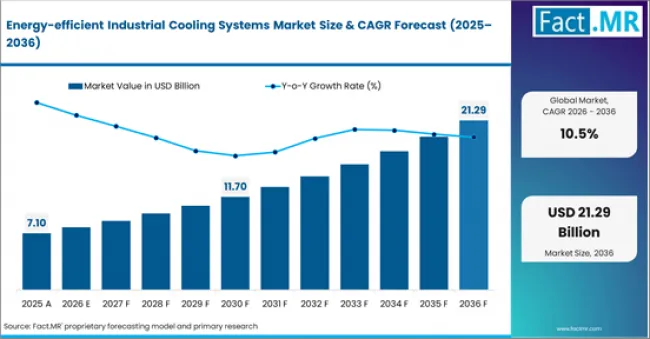
Energy Efficient Industrial Cooling Systems Market Value Analysis | Source: Fact.MR
Summary of Energy-efficient Industrial Cooling Systems Market
- Market Snapshot
- In 2025, the global Energy-efficient Industrial Cooling Systems Market was valued at approximately USD 7.10 billion.
- The market is estimated to reach USD 7.85 billion in 2026 and is projected to attain USD 21.29 billion by 2036.
- The energy-efficient industrial cooling systems market is likely to expand at a CAGR of 10.5% during the forecast period.
- The market is anticipated to create an absolute dollar opportunity of USD 13.45 billion between 2026 and 2036.
- Compressors account for 30% of component share in 2026.
- China (12.5%) and India (12.1%) are the key growth markets during the forecast period.
- Demand and Growth Drivers
- Data center cooling requirements driven by AI workloads, cloud computing, and hyperscale facility construction are creating concentrated demand for precision cooling systems with high energy efficiency ratings.
- Industrial energy efficiency mandates and rising electricity costs are driving replacement of conventional cooling with high-efficiency chillers, variable-speed compressors, and free cooling systems.
- F-gas phase-down regulations under the EU F-gas Regulation and Kigali Amendment are accelerating adoption of natural refrigerant systems and low-GWP cooling technologies.
- Manufacturing sector modernization across automotive, metals, food processing, and chemicals is generating demand for process cooling systems that combine thermal precision with energy optimization.
- Smart building and industrial IoT integration is enabling real-time cooling load optimization, predictive maintenance, and energy consumption monitoring that improve system efficiency by 15 to 25%.
- Product and Segment View
- Water-based cooling systems account for 45% of the product type segment in 2026, driven by demand for cooling towers and chillers that serve manufacturing plants, power generation, and data center applications.
- Mechanical cooling holds 40% of the technology segment in 2026, sustained by vapor compression and absorption cooling systems serving the majority of industrial and commercial applications.
- Medium capacity systems (500 kW to 10 MW) account for 45% of the cooling capacity segment, reflecting the breadth of industrial plants and data centers operating in this range.
- Key segmentation includes:
- Product Type: Water-based (cooling towers, chillers), Air-based (industrial air coolers, precision AC), Hybrid systems
- Technology: Mechanical cooling, Evaporative cooling, Free cooling
- Application: Manufacturing, Power generation, Data centers, Food and beverage, Chemical and petrochemical
- End Use Industry: Industrial manufacturing, Energy and utilities, IT and data centers, Food and beverage, Chemical
- Cooling Capacity: Small, Medium, Large capacity systems
- Component: Compressors, Heat exchangers, Cooling towers, Pumps and fans
- These systems enable:
- 30 to 50% energy savings compared to conventional mechanical cooling through free cooling, evaporative, and hybrid technologies
- Precision temperature control for data centers, semiconductor fabrication, and food processing where thermal stability is critical
- Natural refrigerant compatibility supporting F-gas regulation compliance and reduced environmental impact
- Geography and Competitive Outlook
- Asia Pacific leads growth through China and India, driven by industrial expansion, data center construction, power plant cooling needs, and energy efficiency regulations.
- North America sustains demand through the USA, supported by hyperscale data center construction, manufacturing sector cooling upgrades, and energy efficiency standards.
- Europe maintains growth through Germany and France, driven by F-gas regulations, industrial energy efficiency mandates, and data center cooling innovation.
- China (12.5%) and India (12.1%) lead growth, while the USA (10.6%), Germany (9.8%), South Korea (9.3%), Japan (8.4%), and France (7.6%) sustain demand.
- Major players include Johnson Controls, ABB, Alfa Laval, Baltimore Aircoil Company, Carrier, Schneider Electric, Danfoss, and Trane Technologies.
- Analyst Opinion
- Shambhu Nath Jha, Principal Consultant at Fact.MR, says 'The energy-efficient industrial cooling market is experiencing its fastest growth period as three structural demand waves converge: data center cooling for AI workloads, industrial energy efficiency mandates driven by electricity cost inflation, and regulatory phase-down of high-GWP refrigerants. Companies offering integrated cooling-as-a-service platforms that combine variable-speed compressors, free cooling modules, and IoT-based load optimization are capturing specification advantages. The competitive divide is forming between full-system integrators with digital monitoring capabilities and component-only manufacturers that lack the service and analytics layer increasingly demanded by facility operators and data center builders.'
Key Growth Drivers, Constraints, and Opportunities
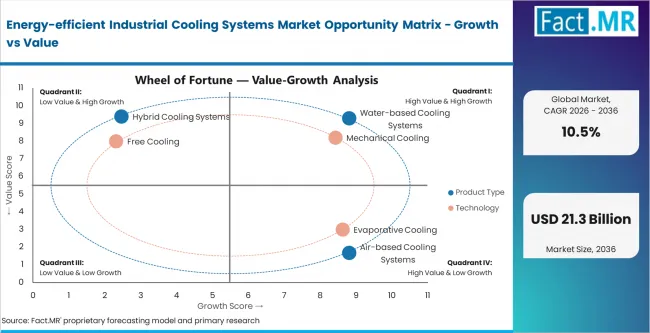
Energy Efficient Industrial Cooling Systems Market Opportunity Matrix Growth Vs Value | Source: Fact.MR
Key Factors Driving Growth
- Data center cooling for AI and cloud workloads is the fastest-growing demand driver, with hyperscale facilities requiring precision cooling at power densities exceeding 30 kW per rack.
- Industrial energy efficiency mandates and rising electricity costs are driving replacement of conventional systems with high-efficiency chillers and free cooling technologies.
- F-gas phase-down regulations under the Kigali Amendment and EU F-gas Regulation are accelerating the transition to natural refrigerant and low-GWP cooling systems.
Key Market Constraints
- High upfront capital costs for energy-efficient cooling systems compared to conventional alternatives create procurement resistance despite lower lifecycle operating costs.
- Complexity of retrofit installations in existing industrial facilities creates project execution challenges and extended payback periods for efficiency upgrades.
- Limited availability of skilled technicians for natural refrigerant systems creates installation and maintenance bottlenecks in emerging markets.
Key Opportunity Areas
- Cooling-as-a-service business models that bundle equipment, monitoring, and maintenance into recurring revenue contracts are creating differentiation opportunities.
- Liquid cooling and immersion cooling for high-density data center racks represent a premium growth segment as AI workloads push thermal management beyond air cooling limits.
- Industrial IoT integration enabling real-time cooling optimization, predictive maintenance, and energy analytics is creating service revenue streams beyond equipment sales.
Segment-wise Analysis of the Energy-efficient Industrial Cooling Systems Market
- Water-based cooling systems hold 45% of the product type segment in 2026, driven by cooling tower and chiller demand across manufacturing, power generation, and data center applications.
- Industrial manufacturing accounts for 35% of the end use industry segment in 2026, encompassing automotive, metals, and chemical processing cooling requirements.
- New installations account for 60% of the installation type segment, reflecting greenfield industrial plant construction and new data center commissioning.
The market is segmented by product type, technology, application, end use industry, cooling capacity, component, installation type, and region. Water-based systems lead by product type. Mechanical cooling leads by technology. Manufacturing leads by application, and medium capacity systems dominate by cooling capacity range.
Which Product Type Segment Dominates the Energy-efficient Industrial Cooling Systems Market?
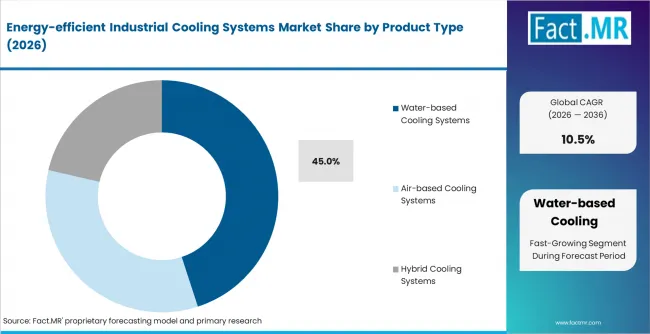
Energy Efficient Industrial Cooling Systems Market Analysis By Product Type | Source: Fact.MR
Water-based cooling systems account for 45% of the product type segment in 2026. Cooling towers and water-cooled chillers serve the majority of large-scale industrial and data center cooling applications where water-based heat rejection delivers superior energy efficiency per unit of cooling capacity. Wet and dry cooling tower configurations serve power plants, manufacturing facilities, and data center campuses.
Air-based cooling systems, including industrial air coolers and precision air conditioning, serve applications where water availability is limited or process requirements demand close temperature control. Hybrid systems combining adiabatic pre-cooling with mechanical chillers are the fastest-growing segment, delivering energy savings of 30 to 50% by maximizing free cooling hours.
Which Technology Segment Dominates the Energy-efficient Industrial Cooling Systems Market?
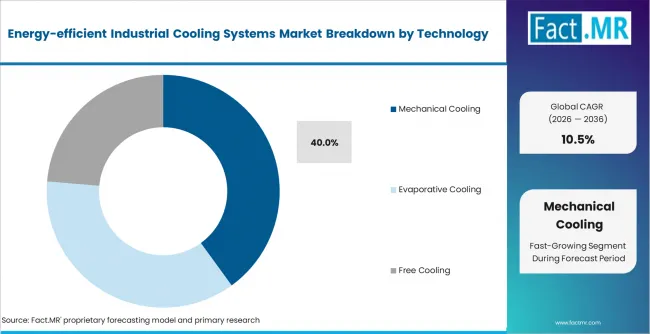
Energy Efficient Industrial Cooling Systems Market Analysis By Technology | Source: Fact.MR
Mechanical cooling accounts for 40% of the technology segment in 2026. High-efficiency vapor compression systems with variable-speed compressors remain the backbone of industrial cooling, while absorption cooling using waste heat is gaining adoption in chemical plants and power generation facilities.
Free cooling, using ambient air or water temperatures to reduce or eliminate mechanical cooling, is the fastest-growing technology segment. Air-side and water-side economizers deliver significant energy savings in climates where ambient temperatures fall below cooling setpoints for substantial portions of the year, making them particularly attractive for data center applications.
Which Application Segment Dominates the Energy-efficient Industrial Cooling Systems Market?
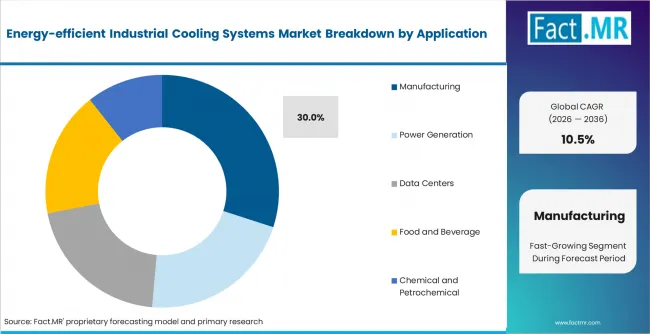
Energy Efficient Industrial Cooling Systems Market Analysis By Application | Source: Fact.MR
Manufacturing accounts for 30% of the application segment in 2026. Process cooling for machinery, metal processing, chemical reactions, and facility temperature management drives the largest share of industrial cooling system procurement. Automotive paint shops, steel mills, and chemical plants represent the most cooling-intensive manufacturing applications.
Data centers are the fastest-growing application segment, driven by AI workload expansion, cloud computing growth, and the construction of hyperscale facilities requiring precision cooling at increasingly high power densities. Power generation and food and beverage processing sustain steady demand through turbine cooling, cold storage, and processing line temperature management.
Which Product Trend is Shaping the Next Phase of Growth in the Energy-efficient Industrial Cooling Systems Market?
AI-driven cooling optimization platforms integrated with high-efficiency hardware are the defining trend. The convergence of variable-speed compressors, free cooling modules, and IoT-based monitoring is creating cooling systems that automatically adjust capacity to match real-time thermal loads, reducing energy consumption by 20 to 40% compared to fixed-speed conventional systems. Johnson Controls, Schneider Electric, and Trane Technologies are leading this integration with platforms that combine equipment control with building and facility management analytics.
For data centers specifically, the shift from air cooling to liquid and immersion cooling represents a transformative trend as AI chip power densities exceed the thermal limits of conventional air-based systems. This transition is creating a premium equipment segment where thermal management technology becomes a competitive differentiator for data center operators. The broader industrial cooling market is similarly being reshaped by the combination of natural refrigerants (CO2, ammonia, propane) with digital monitoring, creating systems that deliver both regulatory compliance and operational efficiency advantages.
Regional Outlook Across Key Markets
.webp "Top Country Growth Comparison Energy Efficient Industrial Cooling Systems Market Cagr (2026 2036)")
Top Country Growth Comparison Energy Efficient Industrial Cooling Systems Market Cagr (2026 2036) | Source: Fact.MR
| Country | CAGR (%) |
|---|---|
| China | 12.5% |
| India | 12.1% |
| USA | 10.6% |
| Germany | 9.8% |
| South Korea | 9.3% |
| Japan | 8.4% |
| France | 7.6% |
Source: Fact.MR analysis. Updated May 25, 2026
- China leads growth at 12.5%, driven by industrial modernization, data center buildout, power plant cooling requirements, and energy efficiency regulations.
- India follows at 12.1%, supported by manufacturing expansion, data center investment, smart city development, and growing emphasis on industrial energy efficiency.
- The USA grows at 10.6%, driven by hyperscale data center construction, industrial cooling upgrades, and energy efficiency standards.
- Europe sustains growth through Germany (9.8%) and France (7.6%), driven by F-gas regulations, industrial efficiency mandates, and data center cooling innovation.
Source: Fact MR (FMR) analysis, based on proprietary forecasting model and primary research.
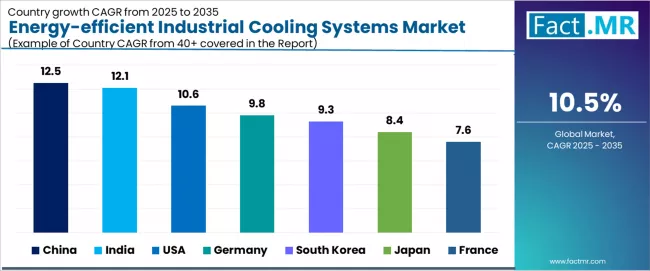
Energy Efficient Industrial Cooling Systems Market Cagr Analysis By Country | Source: Fact.MR
Market Outlook for Energy-efficient Industrial Cooling Systems in China
The China market is projected to grow at a CAGR of 12.5% through 2036. Demand is driven by industrial modernization, hyperscale data center construction, power plant cooling, and government energy efficiency mandates.
- Industrial modernization drives replacement of conventional cooling with high-efficiency systems.
- Data center construction creates precision cooling demand at scale.
- Energy efficiency mandates accelerate adoption of variable-speed and free cooling technologies.
Energy-efficient Industrial Cooling Demand Trends in India
The India market is projected to grow at a CAGR of 12.1% through 2036. Growth is supported by manufacturing expansion, data center investment, smart city programs, and growing emphasis on industrial energy efficiency.
- Manufacturing expansion drives process cooling system procurement.
- Data center investment creates concentrated cooling equipment demand.
- Industrial energy efficiency programs support system upgrade adoption.
United States Energy-efficient Industrial Cooling Market Growth Assessment
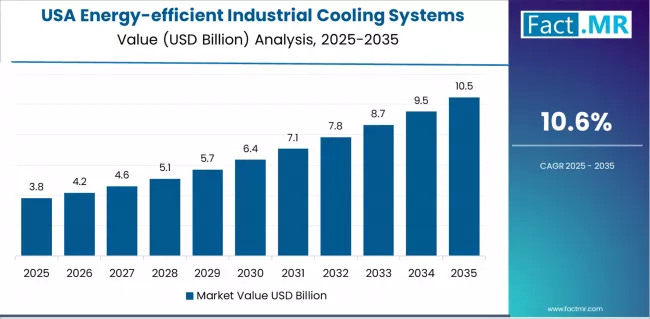
Energy Efficient Industrial Cooling Systems Market Country Value Analysis | Source: Fact.MR
The U.S. market is projected to grow at a CAGR of 10.6% through 2036. Demand is driven by hyperscale data center cooling, industrial facility upgrades, F-gas regulation compliance, and energy efficiency incentive programs.
- Hyperscale data center programs drive precision cooling procurement at scale.
- Industrial upgrade cycles replace aging cooling systems with high-efficiency alternatives.
- Energy efficiency incentives support adoption of free cooling and hybrid technologies.
Germany Energy-efficient Industrial Cooling Market Demand Analysis
The Germany market is projected to grow at a CAGR of 9.8% through 2036. Demand is shaped by F-gas phase-down compliance, industrial energy efficiency leadership, data center cooling requirements, and natural refrigerant system adoption.
- F-gas regulations drive transition to natural refrigerant cooling systems.
- Industrial energy efficiency leadership supports premium system specification.
- Data center cooling serves growing European cloud infrastructure demand.
South Korea Energy-efficient Industrial Cooling Market Opportunity Outlook
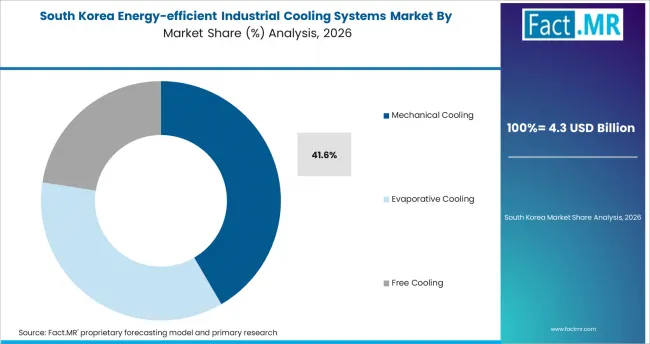
Energy Efficient Industrial Cooling Systems Market South Korea Market Share Analysis By Technology | Source: Fact.MR
The South Korea market is projected to grow at a CAGR of 9.3% through 2036. Demand is supported by semiconductor fabrication cooling, data center construction, industrial energy efficiency programs, and advanced manufacturing cooling requirements.
- Semiconductor fabrication drives precision cooling demand.
- Data center construction creates concentrated system procurement.
- Advanced manufacturing sustains process cooling equipment demand.
Competitive Benchmarking and Company Positioning
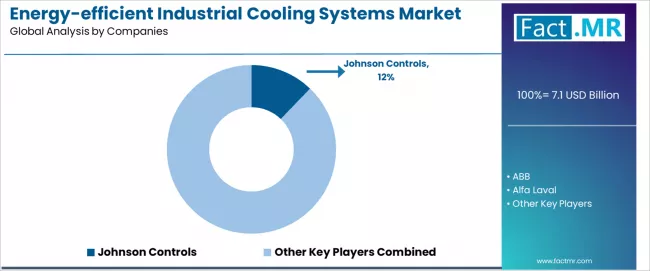
Energy Efficient Industrial Cooling Systems Market Analysis By Company | Source: Fact.MR
Energy-efficient Industrial Cooling Systems Market Analysis By Company
- Johnson Controls, Carrier, and Trane Technologies dominate through broad cooling product portfolios, integrated building management platforms, and global service networks.
- ABB, Schneider Electric, and Danfoss compete through automation integration, energy management platforms, and component-level efficiency leadership.
- System integration capability, digital monitoring platform, refrigerant portfolio breadth, and energy performance guarantees are primary differentiators.
The competitive landscape is moderately consolidated. Johnson Controls holds approximately 12% market share through its broad HVAC and cooling portfolio, York chiller platform, and OpenBlue digital building management system. The company's position is built on system-level integration that combines cooling hardware with analytics-driven energy optimization.
Carrier and Trane Technologies maintain strong positions through established chiller platforms, global service networks, and growing capabilities in natural refrigerant systems. Schneider Electric and ABB compete through energy management integration, while Danfoss leads in variable-speed compressor technology and refrigerant component innovation.
Alfa Laval serves heat exchanger requirements, Baltimore Aircoil Company specializes in cooling towers, and SPX Cooling Technologies provides industrial-scale evaporative cooling solutions. Rittal serves the precision cooling segment for data center and industrial enclosure applications.
Strategic priorities include expanding natural refrigerant capabilities, integrating AI-driven cooling optimization, developing liquid cooling solutions for high-density data centers, and building cooling-as-a-service business models.
Key Companies in the Energy-efficient Industrial Cooling Systems Market
- Johnson Controls, Carrier, and Trane Technologies lead through broad cooling portfolios, digital management platforms, and global service networks.
- ABB, Schneider Electric, and Danfoss A/S hold established positions through energy management integration and component technology leadership.
- Alfa Laval, Baltimore Aircoil Company (BAC), SPX Cooling Technologies, and Rittal Pvt Ltd compete through specialized product focus and application-specific expertise.
Recent Industry Developments
- Johnson Controls - Platform Enhancement / OpenBlue AI-Driven Cooling Optimization (2025)
- Johnson Controls continued expanding its OpenBlue digital platform with AI-driven cooling optimization capabilities, enabling facility operators to reduce cooling energy consumption by up to 25% through real-time load prediction and system adjustment.
- Danfoss A/S - Product Innovation / Natural Refrigerant Compressor Range Expansion (2025)
- Danfoss expanded its natural refrigerant compressor portfolio to support the industry's transition from high-GWP refrigerants, addressing F-gas regulation compliance requirements across European and North American industrial cooling markets.
- Trane Technologies - Sustainability Milestone / Science-Based Net-Zero Target Achievement Progress (2025)
- Trane Technologies reported progress toward its science-based net-zero targets, with its EcoWise portfolio of next-generation cooling systems designed to reduce customer emissions through improved efficiency and lower-GWP refrigerant options.
Leading Companies Shaping the Energy-efficient Industrial Cooling Systems Market
- Johnson Controls
- ABB
- Alfa Laval
- Baltimore Aircoil Company (BAC)
- Carrier
- Schneider Electric
- Danfoss A/S
- SPX Cooling Technologies
- Trane Technologies
- Rittal Pvt Ltd
Sources and Research References
- Johnson Controls. OpenBlue digital platform and AI-driven cooling optimization documentation.
- Danfoss A/S. Natural refrigerant compressor portfolio expansion documentation.
- Trane Technologies. EcoWise portfolio and science-based net-zero target progress.
- F-gas regulation databases, data center construction pipelines, and industrial energy efficiency program documentation.
- Primary interviews with system manufacturers, integrators, facility operators, and data center developers.
This bibliography is provided for reader reference and is not exhaustive. The full report contains the complete reference list and detailed citations.
Key Questions This Report Addresses
- What is the current and future size of the Energy-efficient Industrial Cooling Systems market?
- How fast is the market expected to grow between 2026 and 2036?
- Which product type leads in 2026?
- Which application holds highest share?
- What drives demand?
- How is data center cooling influencing the market?
- Why is China the fastest-growing market?
- How are F-gas regulations shaping demand?
- Which countries show fastest growth?
- Who are the key companies?
- How does Fact.MR validate the forecast?
Energy-efficient Industrial Cooling Systems Market Definition
The energy-efficient industrial cooling systems market covers cooling towers, chillers, precision air conditioning, evaporative coolers, and hybrid cooling solutions designed to reduce energy consumption in industrial manufacturing, power generation, data centers, food processing, and chemical operations.
Energy-efficient Industrial Cooling Systems Market Inclusions
- The scope covers global and regional market size and forecasts for 2026 to 2036 across product type, technology, application, end use industry, cooling capacity, component, installation type, and region.
- It includes analysis of data center construction pipelines, industrial energy efficiency regulations, F-gas phase-down timelines, and electricity cost trends.
- The report covers pricing and cost analysis across cooling system categories including capital costs, operating costs, and total cost of ownership.
- It covers technology trends, market drivers, and the competitive landscape including product portfolios and digital capabilities of leading vendors.
Energy-efficient Industrial Cooling Systems Market Exclusions
- The scope excludes residential HVAC systems and commercial building comfort cooling not classified as industrial cooling.
- It excludes refrigeration systems for cold storage and transportation that operate below 0 degrees Celsius.
- The report excludes cooling system components sold individually for maintenance and replacement without system-level integration.
- It also excludes district cooling networks operated by utility companies as centralized infrastructure services.
Energy-efficient Industrial Cooling Systems Market Research Methodology
- The methodology combines secondary research, primary interviews, and forecast modelling.
- It draws on 80+ secondary sources and benchmarks 35+ manufacturer product portfolios.
- Market sizing covers 25+ countries through a demand-side model, supported by top-down validation.
- Key inputs include data center construction pipelines, industrial energy consumption, electricity pricing, F-gas regulation timelines, and cooling system replacement cycles.
- The model cross-checks demand with manufacturing capacity, component pricing, and installation volumes.
- Primary validation includes 25+ interviews across system manufacturers, integrators, facility operators, and data center developers.
- Final estimates go through project-pipeline checks, energy-savings analysis, and sensitivity testing.
Segmentation
Scope of Analysis
| Parameter | Details |
|---|---|
| Quantitative Units | USD 7.85 billion to USD 21.29 billion, at a CAGR of 10.5% |
| Market Definition | The market covers cooling towers, chillers, precision AC, evaporative coolers, and hybrid cooling solutions designed for energy-efficient operation in industrial, data center, and commercial applications. |
| Regions Covered | North America, Latin America, Europe, East Asia, South Asia and Pacific, Middle East and Africa |
| Countries Covered | China, India, USA, Germany, South Korea, Japan, France, 25 plus countries |
| Key Companies | Johnson Controls, ABB, Alfa Laval, BAC, Carrier, Schneider Electric, Danfoss, SPX Cooling, Trane Technologies, Rittal |
| Forecast Period | 2026 to 2036 |
| Approach | Hybrid demand-side and top-down methodology built on data center construction pipelines, industrial energy consumption, F-gas regulation analysis, and primary interviews across system manufacturers, integrators, and facility operators |
Source: Fact.MR analysis. Updated May 25, 2026
Energy-efficient Industrial Cooling Systems Market Segmentation
-
Energy-efficient Industrial Cooling Systems Market Segmented by Product Type:
- Water-based Cooling Systems
- Cooling Towers
- Wet Cooling Towers
- Dry Cooling Towers
- Chillers
- Air-cooled Chillers
- Water-cooled Chillers
- Cooling Towers
- Air-based Cooling Systems
- Industrial Air Coolers
- Evaporative Air Coolers
- Dry Air Cooling Systems
- Precision Air Conditioning Systems
- Close Control Units (CCU)
- Computer Room Air Conditioning (CRAC)
- Industrial Air Coolers
- Hybrid Cooling Systems
- Adiabatic Cooling Systems
- Pre-cooling Units
- Energy-efficient Operation
- Combined Air-Water Systems
- Hybrid Cooling Towers
- Low Water Consumption
- Adiabatic Cooling Systems
- Water-based Cooling Systems
-
Energy-efficient Industrial Cooling Systems Market Segmented by Technology:
- Mechanical Cooling
- Vapor Compression Systems
- High Efficiency Compressors
- Industrial Chillers
- Absorption Cooling
- Heat-driven Systems
- Waste Heat Utilization
- Vapor Compression Systems
- Evaporative Cooling
- Direct Evaporative Cooling
- Air Cooling
- Low Energy Consumption
- Indirect Evaporative Cooling
- Heat Exchanger-based
- Humidity Control
- Direct Evaporative Cooling
- Free Cooling
- Air-side Economizers
- Ambient Air Cooling
- Reduced Energy Use
- Water-side Economizers
- Cooling Towers Integration
- Seasonal Efficiency
- Air-side Economizers
- Mechanical Cooling
-
Energy-efficient Industrial Cooling Systems Market Segmented by Application:
- Manufacturing
- Process Cooling
- Machinery Cooling
- Metal Processing
- Facility Cooling
- Workspaces
- Production Areas
- Process Cooling
- Power Generation
- Thermal Power Plants
- Turbine Cooling
- Generator Cooling
- Renewable Power
- Solar Plants
- Wind Turbine Components
- Thermal Power Plants
- Data Centers
- Server Cooling
- Rack Cooling
- Hot/Cold Aisle Containment
- Infrastructure Cooling
- HVAC Systems
- Precision Cooling
- Server Cooling
- Food and Beverage
- Food Processing
- Cooling Lines
- Storage Areas
- Cold Storage
- Refrigeration Systems
- Freezing Units
- Food Processing
- Chemical and Petrochemical
- Process Cooling
- Reactors
- Distillation Units
- Safety Cooling
- Hazard Control
- Temperature Regulation
- Process Cooling
- Manufacturing
-
Energy-efficient Industrial Cooling Systems Market Segmented by End Use Industry:
- Industrial Manufacturing
- Automotive Manufacturing
- Assembly Lines
- Paint Shops
- Metals and Mining
- Smelting
- Refining
- Automotive Manufacturing
- Energy and Utilities
- Power Plants
- Thermal
- Hydropower
- Renewable Energy
- Solar Farms
- Wind Farms
- Power Plants
- IT and Data Centers
- Hyperscale Data Centers
- Cloud Infrastructure
- Large Facilities
- Enterprise Data Centers
- Corporate IT
- Server Rooms
- Hyperscale Data Centers
- Food and Beverage Industry
- Processing Plants
- Dairy
- Meat Processing
- Storage Facilities
- Cold Storage
- Warehousing
- Processing Plants
- Chemical Industry
- Petrochemicals
- Refineries
- Processing Units
- Specialty Chemicals
- Batch Processing
- Continuous Processing
- Petrochemicals
- Industrial Manufacturing
-
Energy-efficient Industrial Cooling Systems Market Segmented by Cooling Capacity:
- Medium Capacity
- 500 kW–2 MW
- Industrial Plants
- Data Centers
- 2–10 MW
- Large Facilities
- Manufacturing Units
- 500 kW–2 MW
- Small Capacity
- Below 100 kW
- Small Facilities
- Localized Cooling
- 100–500 kW
- Medium Workshops
- Commercial Use
- Below 100 kW
- Large Capacity
- Above 10 MW
- Power Plants
- Mega Facilities
- Ultra-large Capacity
- Utility-scale Systems
- Industrial Complexes
- Above 10 MW
- Medium Capacity
-
Energy-efficient Industrial Cooling Systems Market Segmented by Component:
- Compressors
- Reciprocating Compressors
- Small Systems
- Low Capacity
- Centrifugal Compressors
- High Efficiency
- Large Systems
- Reciprocating Compressors
- Heat Exchangers
- Shell and Tube
- Industrial Cooling
- Process Applications
- Plate Heat Exchangers
- Compact Systems
- High Efficiency
- Shell and Tube
- Cooling Towers
- Open Circuit Towers
- Evaporative Cooling
- Industrial Use
- Closed Circuit Towers
- Fluid Cooling
- Contamination Control
- Open Circuit Towers
- Pumps and Fans
- Centrifugal Pumps
- Water Circulation
- Process Cooling
- Industrial Fans
- Air Movement
- Ventilation
- Centrifugal Pumps
- Compressors
-
Energy-efficient Industrial Cooling Systems Market Segmented by Installation Type:
- New Installations
- Greenfield Projects
- New Plants
- Infrastructure Development
- System Integration
- Turnkey Solutions
- Large Projects
- Greenfield Projects
- Retrofit and Upgrades
- System Upgrades
- Efficiency Improvement
- Energy Saving
- Component Replacement
- Modernization
- Performance Enhancement
- System Upgrades
- New Installations
-
Energy-efficient Industrial Cooling Systems Market by Region:
- North America
- USA
- Canada
- Mexico
- Latin America
- Brazil
- Chile
- Rest of Latin America
- Western Europe
- Germany
- UK
- Italy
- Spain
- France
- Nordic
- BENELUX
- Rest of Western Europe
- Eastern Europe
- Russia
- Poland
- Hungary
- Balkan & Baltic
- Rest of Eastern Europe
- East Asia
- China
- Japan
- South Korea
- South Asia and Pacific
- India
- ASEAN
- Australia & New Zealand
- Rest of South Asia and Pacific
- Middle East & Africa
- Kingdom of Saudi Arabia
- Other GCC Countries
- Turkiye
- South Africa
- Other African Union
- Rest of Middle East & Africa
- North America
Frequently Asked Questions
How big is the Energy-efficient Industrial Cooling Systems Market in 2025?
What will be the size of the Energy-efficient Industrial Cooling Systems Market by 2036?
How much will the Energy-efficient Industrial Cooling Systems Market grow between 2026 and 2036?
What are the key product types in the Energy-efficient Industrial Cooling Systems Market?
Which product type holds the highest share in the Energy-efficient Industrial Cooling Systems Market in 2026?
Which technology holds the highest share in the Energy-efficient Industrial Cooling Systems Market in 2026?
Which application holds the highest share in the Energy-efficient Industrial Cooling Systems Market in 2026?
Which are the fastest-growing countries in the Energy-efficient Industrial Cooling Systems Market?
Who worked on this report


Preview the report firsthand - request a free sample
Free SampleGet the brochure for pricing and purchase details
Download PDF