Hydropower Market
Hydropower Market Size and Share Forecast Outlook 2025 to 2035
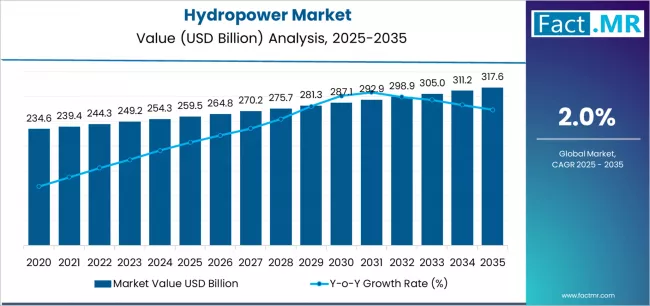
Hydropower market is projected to grow from USD 259.5 billion in 2025 to USD 317.6 billion by 2035, at a CAGR of 2.0%. Civil Construction will dominate with a 33.2% market share, while mini will lead the capacity segment with a 55.0% share.
Hydropower Market Forecast and Outlook 2025 to 2035
The global hydropower market is projected to reach USD 317.6 billion by 2035, recording an absolute increase of USD 58.1 billion over the forecast period. The market is valued at USD 259.51 billion in 2025 and is set to rise at a CAGR of 2.0% during the assessment period.
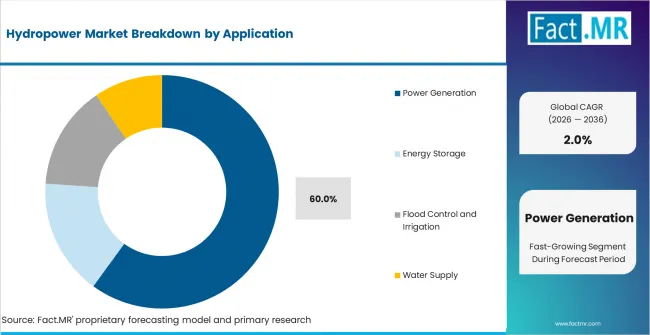
The overall market size is expected to grow by approximately 1.2 times during the same period, supported by increasing global emphasis on renewable energy transition and decarbonization commitments worldwide, driving demand for reliable baseload power generation and increasing investments in hydroelectric infrastructure modernization with operational efficiency across grid stabilization and energy storage applications globally.
Quick Stats for Hydropower Market
- Hydropower Market Value (2025): USD 259.51 billion
- Hydropower Market Forecast Value (2035): USD 317.6 billion
- Hydropower Market Forecast CAGR: 2.0%
- Leading Component in Hydropower Market: Civil Construction (33.24%)
- Key Growth Regions in Hydropower Market: Asia Pacific, North America, and Europe
- Top Players in Hydropower Market: China Three Gorges Corporation, Siemens, Statkraft Sweden, ANDRITZ, Voith GmbH & Co. KGaA, ALFA LAVAL, ABB, ENGIE, Tata Power, Norsk Hydro ASA

Power utilities face mounting pressure to integrate variable renewable energy sources while maintaining grid stability and meeting peak demand requirements, with modern hydropower facilities providing documented operational benefits including rapid response capabilities, long-term energy storage, and flexible power dispatch compared to intermittent renewable sources alone. Rising awareness about climate change mitigation and expanding pumped-storage hydropower installations enabling grid balancing create substantial opportunities for equipment manufacturers and engineering partners. However, high capital investment requirements and environmental considerations may pose obstacles to new project development.
The civil construction segment dominates market activity, driven by extensive infrastructure requirements supporting dam construction, waterway modifications, and powerhouse facilities across diverse hydropower project configurations worldwide. Power developers increasingly recognize the fundamental importance of robust civil engineering, with typical hydropower projects requiring substantial concrete structures, tunneling systems, and water conveyance infrastructure at accessible cost efficiency through established construction methodologies.
The electromechanical equipment segment demonstrates robust presence, supported by critical turbine, generator, and control system requirements enabling efficient energy conversion and grid integration in modern hydropower operations. Large and medium capacity installations emerge as the dominant category, reflecting continued emphasis on utility-scale hydropower development providing significant generation capacity and grid support services.
Regional dynamics show Asia Pacific maintaining market leadership, supported by extensive hydropower development programs and established generation capacity. North America demonstrates steady growth trajectory driven by hydropower modernization initiatives and pumped-storage expansion, while Europe emphasizes facility refurbishment and efficiency enhancement for existing hydropower assets.
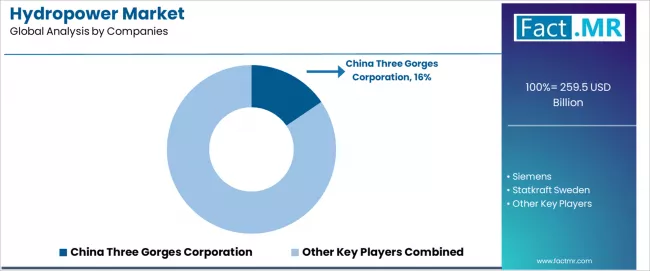
China leads country-level growth through massive hydropower infrastructure investment and continued project development, followed by USA supported by facility upgrades and regulatory support for clean energy. The competitive landscape features moderate concentration with China Three Gorges Corporation maintaining market leadership position, while established equipment manufacturers including Siemens, ANDRITZ, and Voith GmbH & Co. KGaA compete through advanced turbine technologies and comprehensive engineering services across diverse hydropower applications.
Hydropower Market Year-over-Year Forecast 2025 to 2035
Between 2025 and 2029, the hydropower market is projected to expand from USD 259.51 billion to USD 281.6 billion, resulting in a value increase of USD 22.09 billion, which represents 38.0% of the total forecast growth for the period. This phase of development will be shaped by rising demand for grid flexibility and energy storage solutions addressing renewable integration challenges, infrastructure modernization programs enhancing efficiency and extending facility lifespans, as well as expanding pumped-storage hydropower development and digitalization initiatives. Companies are establishing competitive positions through investment in advanced turbine technology partnerships, digital monitoring systems, and strategic market expansion across facility refurbishment projects, new development opportunities, and energy storage applications.
From 2029 to 2035, the market is forecast to grow from USD 281.6 billion to USD 317.6 billion, adding another USD 36.0 billion, which constitutes 62.0% of the overall expansion. This period is expected to be characterized by the expansion of specialized applications, including variable-speed turbine installations and hybrid renewable energy systems integrating hydropower with solar and wind generation, strategic collaborations between equipment manufacturers and power utilities, and an enhanced focus on environmental sustainability and fish-passage technologies. The growing emphasis on climate resilience and rising adoption of digitally optimized hydropower operations will drive demand for comprehensive facility enhancement solutions across diverse geographical regions.
Hydropower Market Key Takeaways
| Metric | Value |
|---|---|
| Market Value (2025) | USD 259.51 billion |
| Market Forecast Value (2035) | USD 317.6 billion |
| Forecast CAGR (2025-2035) | 2.0% |
Why is the Hydropower Market Growing?
The hydropower market grows by enabling power utilities to deliver reliable baseload electricity generation and grid stabilization services while addressing renewable energy integration challenges and energy security requirements without exclusive reliance on fossil fuel generation sources.
Power system operators face mounting pressure to balance variable renewable generation and maintain grid frequency stability while meeting peak demand periods, with modern hydropower facilities typically providing rapid response capabilities including black-start capability for grid restoration, load-following flexibility for demand matching, and long-duration energy storage for seasonal balancing compared to conventional thermal generation alone, making hydropower essential for comprehensive clean energy transition.
The global electricity sector's need for dispatchable renewable generation creates demand for hydropower solutions that can provide grid stability, enhance renewable integration, and support energy security without compromising operational reliability or environmental commitments. Government support and climate policy frameworks drive investment in hydropower development, facility modernization, and pumped-storage expansion, where generation capacity directly impacts national energy security and decarbonization progress.
The increasing renewable energy penetration globally, with wind and solar installations requiring grid balancing services, creates expanding opportunities for hydropower providing complementary generation and storage capabilities. Rising awareness about hydropower's role in water management, flood control, and irrigation support enables integrated resource planning and multi-purpose facility development. However, high upfront capital requirements and lengthy development timelines may limit project financing availability and investment returns among diverse stakeholder groups with different risk tolerance profiles.
Segmental Analysis
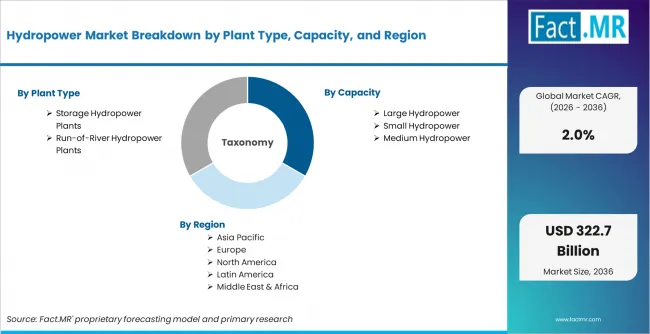
The market is segmented by component, capacity, and region. By component, the market is divided into civil construction, electromechanical equipment, power infrastructure, and others. Based on capacity, the market is categorized into mini, micro & pico, small, and large & medium. Regionally, the market is divided into Asia Pacific, Europe, North America, Latin America, and Middle East & Africa.
By Component, Which Segment Accounts for the Dominant Market Share?

The civil construction segment represents the dominant force in the hydropower market, capturing approximately 33.24% of total market share in 2025. This established component category encompasses solutions featuring dam structures, waterway construction, and powerhouse facilities, including advanced engineering approaches combining roller-compacted concrete technologies, underground cavern excavation, and seismic-resistant design methodologies that enable superior project durability and operational safety across run-of-river, reservoir, and pumped-storage hydropower applications worldwide.
The civil construction segment's market leadership stems from its fundamental infrastructure requirements, with solutions capable of creating essential water storage, pressure head generation, and equipment housing facilities while maintaining excellent structural integrity and environmental integration standards across diverse geographical conditions.
The electromechanical equipment segment maintains substantial market share in the 28-29% range, serving hydropower developers who require sophisticated turbine-generator systems, control equipment, and auxiliary mechanical components for efficient energy conversion and grid synchronization.
These solutions offer advanced engineering capabilities for power utilities managing complex generation requirements while providing sufficient reliability to support decades-long operational lifecycles. The electromechanical segment demonstrates important market presence, driven by ongoing technology advancement in variable-speed turbines, digital monitoring systems, and efficiency optimization.
Within the component category, power infrastructure including transmission lines, substations, and grid connection equipment demonstrates meaningful adoption, driven by requirements for evacuating generated electricity and integrating hydropower facilities with transmission networks. This sub-segment benefits from grid modernization initiatives and renewable energy interconnection mandates.
Key performance advantages driving the civil construction segment include:
- Comprehensive infrastructure capabilities with engineered dam structures providing water storage, flood control, and reliable pressure head generation across hydropower configurations
- Established construction methodologies allowing large-scale project execution without extensive technical uncertainty or construction complexity
- Enhanced durability characteristics enabling multi-decade facility lifespans and minimal maintenance requirements while maintaining structural integrity and safety standards
- Superior site adaptation features providing optimal resource utilization across various topographical conditions and hydrological regimes through customized engineering solutions
By Capacity, Which Segment Accounts for the Largest Market Share?

Large and medium capacity installations dominate the hydropower capacity landscape with approximately 55.0% market share in 2025, reflecting the critical role of utility-scale generation facilities in supporting baseload electricity supply, grid stability services, and significant renewable energy contributions across power systems worldwide. The large and medium segment's market leadership is reinforced by economies of scale advantages, transmission infrastructure compatibility, and ability to provide substantial generation capacity through single project development.
Within this segment, large hydropower facilities exceeding 100 MW represent the dominant configuration, driven by their capacity to deliver substantial electricity volumes serving metropolitan areas and industrial loads. These installations benefit from established project development frameworks, proven technology platforms, and comprehensive financing mechanisms supporting multi-billion dollar investments.
The small hydropower segment represents an important capacity category with 22.5% market share, demonstrating growth through specialized requirements for distributed generation, rural electrification, and environmentally sensitive development approaches. This segment benefits from simplified regulatory pathways, reduced environmental impacts, and community-scale implementation models.
The mini hydropower category maintains meaningful presence through applications in remote areas and off-grid communities requiring localized generation solutions. Micro and pico hydropower installations serve specific niche markets including residential applications, agricultural operations, and telecommunications infrastructure requiring reliable small-scale power generation.
Key market dynamics supporting capacity segmentation include:
- Large and medium capacity expansion driven by utility-scale generation requirements and grid stability service provision
- Small hydropower development trends require streamlined permitting processes and environmental assessment methodologies
- Integration of pumped-storage configurations enabling energy storage across multiple capacity scales
- Growing emphasis on facility modernization and capacity upgrades extending existing asset productivity
What Drives Electromechanical Equipment Adoption?
Electromechanical equipment emerges as a significant component segment in the hydropower market with approximately 28.4% market share in 2025, reflecting the fundamental role of turbine-generator systems, control equipment, and auxiliary mechanical components in converting hydraulic energy to electrical power across hydropower facilities. The electromechanical equipment segment demonstrates consistent demand driven by the need for efficient energy conversion, reliable operation, and advanced control capabilities supporting modern grid requirements.
The segment's market strength stems from continuous technology advancement in turbine design, generator efficiency, and digital control systems enabling improved performance and operational flexibility. Electromechanical equipment providers deliver comprehensive solutions including Francis turbines for medium-head applications, Kaplan turbines for low-head installations, and Pelton wheels for high-head configurations, each optimized for specific hydraulic conditions.
Within electromechanical applications, variable-speed turbine-generator systems demonstrate growing adoption, driven by enhanced grid flexibility requirements and improved efficiency across varying load conditions. Digital monitoring and predictive maintenance systems integrate with electromechanical equipment, enabling optimized operations and reduced downtime through condition-based maintenance strategies.
Key segment characteristics include:
- Turbine technology advancement accelerating across capacity ranges with emphasis on efficiency optimization and cavitation resistance
- Generator design evolution driving adoption of variable-speed configurations and advanced cooling systems
- Control system digitalization prioritizing remote monitoring, automated dispatch optimization, and predictive maintenance capabilities
- Integration with grid management systems enabling coordinated hydropower operation supporting renewable energy balancing
What Characterizes Small Hydropower Development?
Small hydropower represents an important segment in the hydropower market with approximately 22.5% market share in 2025, reflecting specialized development approaches for installations typically ranging from 1 MW to 30 MW providing distributed generation, rural electrification, and environmentally sensitive power production. The small hydropower segment demonstrates steady demand driven by simplified regulatory requirements, reduced environmental footprints, and community development benefits.
Within small hydropower applications, run-of-river configurations demonstrate significant adoption for minimizing environmental impacts through reduced water storage requirements and maintaining natural flow regimes. These installations benefit from faster permitting processes, lower capital costs per project, and suitability for previously undeveloped river reaches.
The segment benefits from standardized equipment packages, modular construction approaches, and established financing mechanisms supporting private sector participation. Feed-in tariffs, renewable energy incentives, and carbon credit opportunities enhance small hydropower project economics across diverse markets.
Key capacity dynamics include:
- Run-of-river design emphasis addressing environmental considerations with minimal reservoir requirements
- Distributed generation benefits providing localized electricity supply and transmission loss reduction
- Community participation models enabling local ownership and economic development opportunities
- Technology standardization supporting cost reduction through proven equipment configurations and simplified engineering
What are the Drivers, Restraints, and Key Trends of the Hydropower Market?
The market is driven by three concrete demand factors tied to energy system transformation. First, increasing renewable energy integration requirements create expanding demand for flexible generation and energy storage services, with hydropower representing a critical grid balancing resource in comprehensive clean energy systems, requiring continued facility development and modernization investments. Second, growing emphasis on energy security and supply reliability drives government support for hydropower infrastructure, with strategic importance demonstrated through baseload generation capability, drought resilience, and multi-decade operational lifespans supporting long-term energy planning by 2030. Third, advancing digitalization capabilities and turbine efficiency improvements enable enhanced facility performance approaches that increase energy output while reducing operational costs and environmental impacts.
Market restraints include high capital investment requirements and extended project development timelines that can challenge project financing and investment returns, particularly in regions where electricity prices remain relatively low and alternative generation technologies demonstrate improving cost competitiveness. Environmental and social considerations including ecosystem impacts, fish passage requirements, and community displacement concerns pose another significant obstacle, as hydropower development depends on careful environmental assessment and stakeholder engagement, potentially affecting project viability and public acceptance. Limited suitable site availability and competing water use demands create additional barriers for new facility development, demanding comprehensive resource planning and multi-purpose facility design addressing irrigation, flood control, and recreation alongside electricity generation.
Key trends indicate accelerated pumped-storage hydropower development in developed markets, particularly North America and Europe, where grid operators demonstrate increasing demand for long-duration energy storage supporting high renewable penetration scenarios. Digitalization trends toward advanced monitoring systems, predictive maintenance platforms, and automated dispatch optimization enable comprehensive facility performance enhancement that maximizes generation revenue and minimizes downtime. However, the market thesis could face disruption if significant advances in alternative energy storage technologies or major regulatory changes affecting hydropower licensing substantially alter competitive economics and development attractiveness in electricity generation markets.
Analysis of the Hydropower Market by Key Countries

| Country | CAGR (2025-2035) |
|---|---|
| China | 2.1% |
| USA | 1.8% |
| India | 2.0% |
| Germany | 1.6% |
| Brazil | 1.5% |
| Canada | 1.4% |
| Japan | 1.3% |
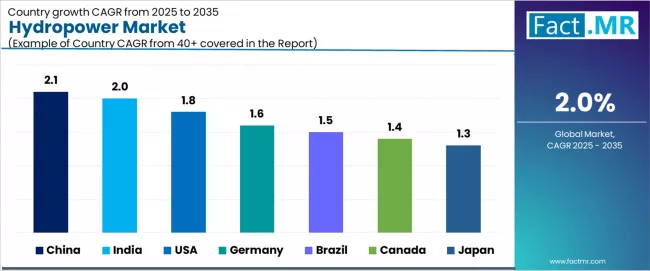
The global hydropower market is expanding steadily, with China leading at a 2.0% CAGR through 2035, driven by continued large-scale hydropower project development, extensive pumped-storage expansion, and comprehensive renewable energy infrastructure investment. USA follows at 1.8%, supported by hydropower facility modernization programs, pumped-storage development initiatives, and regulatory support for clean energy generation. India records 2.0%, reflecting ongoing hydropower development in Himalayan regions, small hydropower expansion, and government renewable energy targets.
Germany advances at 1.6%, leveraging facility refurbishment programs and pumped-storage optimization. Brazil posts 1.5%, focusing on Amazon basin hydropower development and existing facility upgrades, while Canada grows steadily at 1.4%, anchored by provincial hydropower expansion and export market development. Japan demonstrates 1.3% growth, driven by pumped-storage development and facility modernization.
How is China Leading Global Market Expansion?
China demonstrates the strongest growth potential in the hydropower market with a CAGR of 2.1% through 2035. The country's leadership position stems from ambitious hydropower development targets, extensive pumped-storage expansion programs, and comprehensive renewable energy infrastructure investment supporting grid stability and carbon neutrality goals.
Growth is concentrated in southwestern provinces and western regions, including Sichuan, Yunnan, Qinghai, and Tibet, where abundant water resources enable large-scale hydropower development serving eastern load centers through ultra-high voltage transmission systems. Distribution infrastructure through state-owned power companies, provincial grid operators, and national transmission networks expands generation capacity across diverse geographical regions. The country's established hydropower engineering capabilities and domestic manufacturing ecosystem provide strong momentum for continued market expansion, including comprehensive development across capacity scales from mega-projects exceeding 10 GW to distributed small hydropower installations.
Key market factors:
- Major river basin development concentrated in Yangtze, Yellow, and Mekong watersheds with substantial remaining hydropower potential
- Pumped-storage expansion through ambitious capacity targets exceeding 120 GW supporting renewable energy integration requirements
- Comprehensive equipment manufacturing ecosystem featuring domestic turbine manufacturers and civil engineering contractors
- Government policy support including renewable energy mandates and carbon reduction commitments driving hydropower investment
Why is USA Emerging as a Modernization-Focused Market?

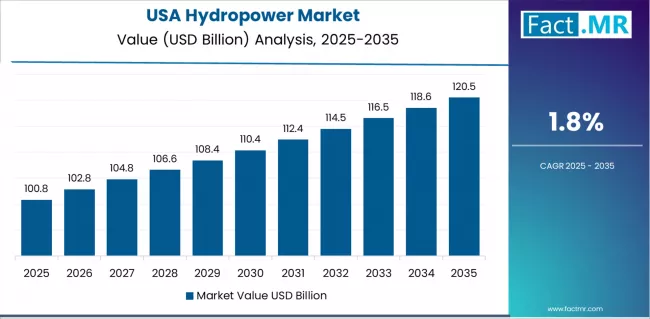
In major hydropower regions including Pacific Northwest, Tennessee Valley, and California, the adoption of facility modernization and efficiency enhancement programs is accelerating across aging hydropower infrastructure, driven by operational improvement imperatives and renewable energy optimization. The market demonstrates steady growth momentum with a CAGR of 1.8% through 2035, linked to comprehensive infrastructure investment programs and increasing emphasis on pumped-storage development supporting grid flexibility requirements.
American power utilities are implementing advanced turbine upgrades, digital monitoring systems, and environmental enhancement technologies to improve facility performance while meeting evolving regulatory standards. The country's expanding renewable energy portfolio creates ongoing demand for flexible hydropower generation providing grid balancing services, while federal infrastructure funding drives modernization of aging facilities commissioned during mid-20th century development era.
Key development areas:
- Existing facility modernization leading hydropower investment with emphasis on turbine runner replacement and generator rewinding
- Pumped-storage development initiatives addressing long-duration energy storage requirements for renewable integration
- Environmental compliance upgrades including fish passage systems and flow management technologies
- Federal licensing reform efforts streamlining regulatory processes for facility relicensing and capacity expansion
What Drives India Market Growth?
India market expansion is driven by Himalayan hydropower development potential, small hydropower programs supporting rural electrification, and government renewable energy targets prioritizing clean generation capacity addition. The country demonstrates meaningful growth potential with a CAGR of 2.0% through 2035, supported by strategic emphasis on northeastern region development and private sector participation frameworks. Indian power developers face implementation challenges related to geological complexities, environmental clearance processes, and project financing arrangements, requiring innovative risk-sharing mechanisms and streamlined regulatory approaches.
However, growing electricity demand and renewable energy commitments create stable baseline opportunities for hydropower development, particularly in Himalayan states including Uttarakhand, Himachal Pradesh, Arunachal Pradesh, and Sikkim where abundant water resources support generation potential exceeding 150 GW across various capacity configurations.
Market characteristics:
- Himalayan region development showcasing substantial untapped hydropower potential with challenging topography and seismic considerations
- Small hydropower programs emphasizing distributed generation and rural electrification objectives
- Public-private partnership models facilitating investment in large hydropower projects requiring substantial capital
- Interstate water sharing agreements and basin-level planning addressing resource allocation and regional cooperation
How Does Germany Demonstrate Grid Integration Leadership?
The market in Germany leads in pumped-storage optimization based on integration with variable renewable energy sources and comprehensive grid management strategies for enhanced system stability. The country shows steady potential with a CAGR of 1.6% through 2035, driven by energy transition requirements and facility modernization emphasis in major regions, including Bavaria, Baden-Württemberg, and Rhineland-Palatinate.
German power utilities are optimizing existing pumped-storage facilities through turbine upgrades, digitalization programs, and operational strategy enhancements for renewable energy balancing, particularly in established facilities providing critical flexibility services during wind and solar generation fluctuations. Infrastructure development through facility refurbishment and efficiency improvement programs expands operational capabilities across alpine regions and medium-elevation installations.
Leading market segments:
- Pumped-storage facility optimization in alpine regions implementing advanced variable-speed turbine technologies
- Grid flexibility service provision achieving high utilization rates through coordinated renewable energy management
- Environmental enhancement programs addressing ecological considerations and recreational access
- Technology demonstration projects exploring underground pumped-storage concepts and hybrid system configurations
What Positions Brazil for Resource Development?
In major hydropower regions including Amazon basin, Paraná River basin, and São Francisco River system, power utilities are developing large-scale hydropower projects and upgrading existing facilities to enhance generation capacity. The market shows steady growth potential with a CAGR of 1.5% through 2035, linked to ongoing infrastructure expansion and increasing emphasis on renewable energy dominance in national electricity matrix.
Brazilian developers are implementing environmentally responsible hydropower projects with comprehensive stakeholder consultation to address social and ecological considerations while maintaining competitive generation costs. The country's established hydropower sector supporting over 60% of national electricity generation creates ongoing opportunities for facility optimization and strategic capacity additions.
Market development factors:
- Amazon basin development focusing on run-of-river configurations minimizing environmental footprint
- Existing facility upgrade programs enhancing efficiency and extending operational lifespans
- Transmission infrastructure expansion enabling remote hydropower integration with southern load centers
- Environmental licensing frameworks balancing development objectives with conservation priorities
How does Canada Show Export Market Leadership?
Canada's hydropower market demonstrates sophisticated development in provincial electricity systems focused on clean energy generation and export market opportunities, with documented integration of large-scale facilities achieving substantial capacity supporting domestic consumption and cross-border electricity sales.
The country maintains steady growth momentum with a CAGR of 1.4% through 2035, driven by provincial development strategies emphasizing hydropower expansion in Quebec, British Columbia, Manitoba, and Newfoundland and Labrador. Major provincial utilities showcase advanced hydropower operations where established infrastructure integrates with transmission systems serving Canadian markets and northern USA regions through extensive cross-border interconnections.
Key market characteristics:
- Provincial utility leadership driving hydropower development with emphasis on large-scale generation projects
- Export market development providing revenue streams through electricity sales to northeastern and northwestern USA
- Indigenous partnership models addressing rights and benefits in hydropower development on traditional territories
- Hydropower-renewable integration supporting provincial decarbonization strategies and industrial electrification
What Characterizes Japan's Pumped-Storage Focus?

In major industrial regions including Kanto, Kansai, and Chubu, power utilities are optimizing pumped-storage facilities and developing new installations to support grid stability, driven by nuclear generation uncertainty and renewable energy integration requirements. The market demonstrates steady growth potential with a CAGR of 1.3% through 2035, linked to comprehensive grid management strategies and increasing emphasis on energy storage capabilities supporting variable renewable generation.
Japanese utilities are implementing advanced variable-speed pumped-storage systems and facility modernization programs to enhance operational flexibility while meeting stringent seismic design standards. The country's mountainous topography and established civil engineering capabilities create ongoing opportunities for pumped-storage development addressing grid balancing requirements in high-demand industrial regions.
Key development areas:
- Pumped-storage facility development in mountainous regions providing grid stability services
- Variable-speed technology adoption enabling enhanced frequency regulation and rapid response capabilities
- Seismic resilience enhancement through comprehensive structural upgrades and safety improvements
- Hybrid renewable integration supporting solar and wind generation balancing across island grid systems
Europe Market Split by Country

The hydropower market in Europe is projected to grow from USD 52.3 billion in 2025 to USD 61.2 billion by 2035, registering a CAGR of 1.6% over the forecast period. Norway is expected to maintain its leadership position with a 26.4% market share in 2025, adjusting to 26.8% by 2035, supported by its extensive hydropower generation capacity, advanced pumped-storage facilities, and comprehensive grid integration capabilities serving Nordic electricity markets.
Switzerland follows with a 18.7% share in 2025, projected to reach 19.1% by 2035, driven by comprehensive alpine hydropower infrastructure and pumped-storage optimization supporting European grid balancing. Austria holds a 15.3% share in 2025, expected to maintain 15.6% by 2035 through ongoing facility modernization and environmental enhancement programs.
Sweden commands a 14.8% share, while France accounts for 12.2% in 2025. The rest of Europe region is anticipated to gain momentum, expanding its collective share from 12.6% to 12.7% by 2035, attributed to increasing small hydropower development in Balkan countries and facility refurbishment across Central European markets implementing renewable energy strategies.
Competitive Landscape of the Hydropower Market

The hydropower market features approximately 15-20 meaningful players with moderate concentration, where the top three companies control roughly 35-45% of global market share through established project development capabilities, comprehensive equipment portfolios, and extensive engineering expertise. Competition centers on technology advancement, project execution excellence, and integrated service delivery rather than price competition alone.
Market leaders include China Three Gorges Corporation, Siemens, and ANDRITZ, which maintain competitive advantages through comprehensive hydropower development capabilities, advanced turbine-generator technologies, and deep expertise in civil engineering and electromechanical systems, creating high customer confidence among power utilities seeking proven project delivery. These companies leverage ongoing research and development investments and strategic project portfolios to defend market positions while expanding into pumped-storage applications, facility modernization services, and digital optimization platforms.
Challengers encompass established equipment manufacturers including Voith GmbH & Co. KGaA, ABB, and ENGIE, which compete through specialized turbine technologies, electrical system integration capabilities, and comprehensive operation and maintenance services. Power generation companies, including Tata Power, Statkraft Sweden, and Norsk Hydro ASA, focus on hydropower facility development and operations, offering vertically integrated capabilities spanning project development through long-term asset management.
Emerging technology providers and engineering firms create competitive pressure through innovative digital monitoring systems, advanced materials applications, and environmental enhancement technologies, particularly in modernization-focused markets including USA and Europe, where aging infrastructure provides opportunities for performance optimization and capacity enhancement.
Market dynamics favor companies that combine proven engineering expertise with comprehensive project delivery capabilities addressing the complete facility lifecycle from initial development through decades-long operations. Strategic emphasis on digitalization, environmental sustainability, and integrated renewable energy systems enables differentiation in mature hydropower markets while supporting expansion in emerging regions with substantial undeveloped potential.
Global Hydropower Market - Stakeholder Contribution Framework
Hydropower represents a critical renewable energy generation technology that enables power systems to deliver reliable baseload electricity and grid stability services while addressing variable renewable integration challenges and energy security requirements without fossil fuel dependency, typically providing rapid response capabilities including frequency regulation, load following, and long-duration energy storage compared to intermittent renewable sources alone while ensuring comprehensive grid support and sustainable generation.
With the market projected to grow from USD 259.51 billion in 2025 to USD 317.6 billion by 2035 at a 2.0% CAGR, these solutions offer compelling advantages for grid stability applications, renewable energy integration, and diverse geographical regions seeking clean baseload generation. Scaling development potential and operational optimization requires coordinated action across energy policy, environmental standards, equipment manufacturers, power utilities, and sustainable development frameworks.
How Could Governments Spur Local Development and Adoption?
- National Energy Strategy Integration: Include hydropower in comprehensive renewable energy roadmaps, providing targeted support for facility modernization programs and supporting project development through streamlined licensing processes and development grants.
- Regulatory Framework Optimization: Implement balanced licensing procedures addressing environmental protection and development efficiency, provide clear guidelines for facility relicensing and capacity expansion, and establish transparent processes facilitating project approvals.
- Financial Support Mechanisms: Create favorable financing frameworks for hydropower development, provide tax incentives for facility modernization and efficiency improvements, and establish public financing institutions supporting long-term capital-intensive projects.
- Infrastructure Investment Programs: Fund transmission infrastructure connecting remote hydropower resources with load centers, invest in pumped-storage development supporting renewable integration, and support research programs advancing hydropower technology.
- Environmental Standards Development: Establish science-based environmental assessment frameworks balancing ecological protection with renewable energy development, create standardized mitigation requirements and monitoring protocols, and support multi-purpose facility planning integrating water management objectives.
How Could Industry Bodies Support Market Development?
- Technical Standards & Performance: Define standardized efficiency metrics for hydropower facilities across turbine types, operating conditions, and facility configurations, establish universal safety standards and maintenance protocols, and create performance benchmarking databases supporting operational optimization.
- Market Education & Best Practices: Lead messaging demonstrating hydropower benefits, emphasizing grid stability contributions, renewable energy balancing capabilities, and environmental responsibility compared to fossil fuel alternatives.
- Sustainability Guidelines: Develop standards for environmental impact mitigation, fish passage technologies, and sediment management practices, ensuring ecological sustainability across hydropower operations.
- Professional Development: Run certification programs for hydropower engineers, facility operators, and environmental specialists on optimizing plant operations, implementing best management practices, and achieving compliance across diverse regulatory environments.
How Could Manufacturers and Technology Players Strengthen the Ecosystem?
- Advanced Equipment Development: Develop next-generation turbine-generator systems with enhanced efficiency characteristics, variable-speed capabilities, and application-specific designs that improve facility performance while reducing environmental impacts.
- Digitalization Solutions: Provide comprehensive monitoring systems, predictive maintenance platforms, and optimization algorithms that support power utilities in maximizing generation revenue and minimizing operational costs.
- Technical Support Excellence: Offer comprehensive engineering services, retrofit design capabilities, and performance optimization assistance that help facility owners successfully implement modernization programs.
- Research & Development Programs: Build comprehensive technology development capabilities, collaborative research partnerships, and innovation platforms that ensure continuous efficiency improvement and environmental performance enhancement.
How Could Power Utilities and Developers Navigate the Market?
- Strategic Facility Optimization: Incorporate proven modernization technologies into asset management programs, with particular focus on turbine runner replacements, generator rewinds, and digital control system upgrades.
- Environmental Excellence: Establish comprehensive environmental management programs addressing fish passage, flow management, and ecosystem protection through optimized operational frameworks and stakeholder engagement.
- Grid Integration Enhancement: Implement coordinated hydropower operations supporting renewable energy balancing, frequency regulation services, and energy storage applications through optimized dispatch strategies.
- Asset Lifecycle Management: Develop systematic facility assessment processes, long-term capital planning frameworks, and predictive maintenance strategies that ensure sustained performance throughout multi-decade operational lifespans.
How Could Investors and Financial Enablers Unlock Value?
- Modernization Project Financing: Provide growth capital for established power utilities implementing facility upgrade programs that enhance efficiency, extend lifespans, and improve environmental performance.
- New Development Support: Back hydropower project development in high-potential regions including India and Southeast Asia, supporting site assessment, permitting processes, and construction financing for greenfield facilities.
- Pumped-Storage Investment: Finance pumped-storage development projects addressing long-duration energy storage requirements and grid flexibility services in renewable energy transition markets.
- Technology Innovation Funding: Support companies developing breakthrough hydropower technologies including advanced turbine designs, digital optimization platforms, and environmental enhancement systems that improve industry performance.
Key Players in the Hydropower Market
- China Three Gorges Corporation
- Siemens
- Statkraft Sweden
- ANDRITZ
- Voith GmbH & Co. KGaA
- ALFA LAVAL
- ABB
- ENGIE
- Tata Power
- Norsk Hydro ASA
Scope of the Report
| Items | Values |
|---|---|
| Quantitative Units | USD 259.51 Billion |
| Component | Civil Construction, Electromechanical Equipment, Power Infrastructure, Others |
| Capacity | Mini, Micro & Pico, Small, Large & Medium |
| Regions Covered | Asia Pacific, Europe, North America, Latin America, Middle East & Africa |
| Country Covered | China, USA, India, Germany, Brazil, Canada, Japan, and 40+ countries |
| Key Companies Profiled | China Three Gorges Corporation, Siemens, Statkraft Sweden, ANDRITZ, Voith GmbH & Co. KGaA, ALFA LAVAL, ABB, ENGIE, Tata Power, Norsk Hydro ASA |
| Additional Attributes | Dollar sales by component and capacity categories, regional development trends across Asia Pacific, Europe, and North America, competitive landscape with hydropower developers and equipment manufacturers, facility specifications and engineering requirements, integration with grid management systems and renewable energy portfolios, innovations in variable-speed turbine technology and digital monitoring platforms, and development of specialized applications with environmental sustainability capabilities and operational optimization systems. |
Hydropower Market by Segments
-
Component :
- Civil Construction
- Electromechanical Equipment
- Power Infrastructure
- Others
-
Capacity :
- Mini
- Micro & Pico
- Small
- Large & Medium
-
Region :
- Asia Pacific
- China
- Japan
- South Korea
- India
- Australia
- Thailand
- Rest of Asia Pacific
- Europe
- Germany
- UK
- France
- Italy
- Spain
- Denmark
- Sweden
- Norway
- Rest of Europe
- North America
- USA
- Canada
- Mexico
- Latin America
- Brazil
- Argentina
- Rest of Latin America
- Middle East & Africa
- South Africa
- Saudi Arabia
- UAE
- Kuwait
- Rest of Middle East & Africa
- Asia Pacific
Table of Content
- Executive Summary
- Global Market Outlook
- Demand to side Trends
- Supply to side Trends
- Technology Roadmap Analysis
- Analysis and Recommendations
- Market Overview
- Market Coverage / Taxonomy
- Market Definition / Scope / Limitations
- Market Background
- Market Dynamics
- Drivers
- Restraints
- Opportunity
- Trends
- Scenario Forecast
- Demand in Optimistic Scenario
- Demand in Likely Scenario
- Demand in Conservative Scenario
- Opportunity Map Analysis
- Product Life Cycle Analysis
- Supply Chain Analysis
- Investment Feasibility Matrix
- Value Chain Analysis
- PESTLE and Porter’s Analysis
- Regulatory Landscape
- Regional Parent Market Outlook
- Production and Consumption Statistics
- Import and Export Statistics
- Market Dynamics
- Global Market Analysis 2020 to 2024 and Forecast, 2025 to 2035
- Historical Market Size Value (USD Million) Analysis, 2020 to 2024
- Current and Future Market Size Value (USD Million) Projections, 2025 to 2035
- Y to o to Y Growth Trend Analysis
- Absolute $ Opportunity Analysis
- Global Market Pricing Analysis 2020 to 2024 and Forecast 2025 to 2035
- Global Market Analysis 2020 to 2024 and Forecast 2025 to 2035, By Component
- Introduction / Key Findings
- Historical Market Size Value (USD Million) Analysis By Component, 2020 to 2024
- Current and Future Market Size Value (USD Million) Analysis and Forecast By Component, 2025 to 2035
- Civil Construction
- Electromechanical Equipment
- Power Infrastructure
- Others
- Y to o to Y Growth Trend Analysis By Component, 2020 to 2024
- Absolute $ Opportunity Analysis By Component, 2025 to 2035
- Global Market Analysis 2020 to 2024 and Forecast 2025 to 2035, By Capacity
- Introduction / Key Findings
- Historical Market Size Value (USD Million) Analysis By Capacity, 2020 to 2024
- Current and Future Market Size Value (USD Million) Analysis and Forecast By Capacity, 2025 to 2035
- Mini
- Micro & Pico
- Small
- Large & Medium
- Y to o to Y Growth Trend Analysis By Capacity, 2020 to 2024
- Absolute $ Opportunity Analysis By Capacity, 2025 to 2035
- Global Market Analysis 2020 to 2024 and Forecast 2025 to 2035, By Region
- Introduction
- Historical Market Size Value (USD Million) Analysis By Region, 2020 to 2024
- Current Market Size Value (USD Million) Analysis and Forecast By Region, 2025 to 2035
- North America
- Latin America
- Western Europe
- Eastern Europe
- East Asia
- South Asia and Pacific
- Middle East & Africa
- Market Attractiveness Analysis By Region
- North America Market Analysis 2020 to 2024 and Forecast 2025 to 2035, By Country
- Historical Market Size Value (USD Million) Trend Analysis By Market Taxonomy, 2020 to 2024
- Market Size Value (USD Million) Forecast By Market Taxonomy, 2025 to 2035
- By Country
- USA
- Canada
- Mexico
- By Component
- By Capacity
- By Country
- Market Attractiveness Analysis
- By Country
- By Component
- By Capacity
- Key Takeaways
- Latin America Market Analysis 2020 to 2024 and Forecast 2025 to 2035, By Country
- Historical Market Size Value (USD Million) Trend Analysis By Market Taxonomy, 2020 to 2024
- Market Size Value (USD Million) Forecast By Market Taxonomy, 2025 to 2035
- By Country
- Brazil
- Chile
- Rest of Latin America
- By Component
- By Capacity
- By Country
- Market Attractiveness Analysis
- By Country
- By Component
- By Capacity
- Key Takeaways
- Western Europe Market Analysis 2020 to 2024 and Forecast 2025 to 2035, By Country
- Historical Market Size Value (USD Million) Trend Analysis By Market Taxonomy, 2020 to 2024
- Market Size Value (USD Million) Forecast By Market Taxonomy, 2025 to 2035
- By Country
- Germany
- UK
- Italy
- Spain
- France
- Nordic
- BENELUX
- Rest of Western Europe
- By Component
- By Capacity
- By Country
- Market Attractiveness Analysis
- By Country
- By Component
- By Capacity
- Key Takeaways
- Eastern Europe Market Analysis 2020 to 2024 and Forecast 2025 to 2035, By Country
- Historical Market Size Value (USD Million) Trend Analysis By Market Taxonomy, 2020 to 2024
- Market Size Value (USD Million) Forecast By Market Taxonomy, 2025 to 2035
- By Country
- Russia
- Poland
- Hungary
- Balkan & Baltic
- Rest of Eastern Europe
- By Component
- By Capacity
- By Country
- Market Attractiveness Analysis
- By Country
- By Component
- By Capacity
- Key Takeaways
- East Asia Market Analysis 2020 to 2024 and Forecast 2025 to 2035, By Country
- Historical Market Size Value (USD Million) Trend Analysis By Market Taxonomy, 2020 to 2024
- Market Size Value (USD Million) Forecast By Market Taxonomy, 2025 to 2035
- By Country
- China
- Japan
- South Korea
- By Component
- By Capacity
- By Country
- Market Attractiveness Analysis
- By Country
- By Component
- By Capacity
- Key Takeaways
- South Asia and Pacific Market Analysis 2020 to 2024 and Forecast 2025 to 2035, By Country
- Historical Market Size Value (USD Million) Trend Analysis By Market Taxonomy, 2020 to 2024
- Market Size Value (USD Million) Forecast By Market Taxonomy, 2025 to 2035
- By Country
- India
- ASEAN
- Australia & New Zealand
- Rest of South Asia and Pacific
- By Component
- By Capacity
- By Country
- Market Attractiveness Analysis
- By Country
- By Component
- By Capacity
- Key Takeaways
- Middle East & Africa Market Analysis 2020 to 2024 and Forecast 2025 to 2035, By Country
- Historical Market Size Value (USD Million) Trend Analysis By Market Taxonomy, 2020 to 2024
- Market Size Value (USD Million) Forecast By Market Taxonomy, 2025 to 2035
- By Country
- Kingdom of Saudi Arabia
- Other GCC Countries
- Turkiye
- South Africa
- Other African Union
- Rest of Middle East & Africa
- By Component
- By Capacity
- By Country
- Market Attractiveness Analysis
- By Country
- By Component
- By Capacity
- Key Takeaways
- Key Countries Market Analysis
- USA
- Pricing Analysis
- Market Share Analysis, 2024
- By Component
- By Capacity
- Canada
- Pricing Analysis
- Market Share Analysis, 2024
- By Component
- By Capacity
- Mexico
- Pricing Analysis
- Market Share Analysis, 2024
- By Component
- By Capacity
- Brazil
- Pricing Analysis
- Market Share Analysis, 2024
- By Component
- By Capacity
- Chile
- Pricing Analysis
- Market Share Analysis, 2024
- By Component
- By Capacity
- Germany
- Pricing Analysis
- Market Share Analysis, 2024
- By Component
- By Capacity
- UK
- Pricing Analysis
- Market Share Analysis, 2024
- By Component
- By Capacity
- Italy
- Pricing Analysis
- Market Share Analysis, 2024
- By Component
- By Capacity
- Spain
- Pricing Analysis
- Market Share Analysis, 2024
- By Component
- By Capacity
- France
- Pricing Analysis
- Market Share Analysis, 2024
- By Component
- By Capacity
- India
- Pricing Analysis
- Market Share Analysis, 2024
- By Component
- By Capacity
- ASEAN
- Pricing Analysis
- Market Share Analysis, 2024
- By Component
- By Capacity
- Australia & New Zealand
- Pricing Analysis
- Market Share Analysis, 2024
- By Component
- By Capacity
- China
- Pricing Analysis
- Market Share Analysis, 2024
- By Component
- By Capacity
- Japan
- Pricing Analysis
- Market Share Analysis, 2024
- By Component
- By Capacity
- South Korea
- Pricing Analysis
- Market Share Analysis, 2024
- By Component
- By Capacity
- Russia
- Pricing Analysis
- Market Share Analysis, 2024
- By Component
- By Capacity
- Poland
- Pricing Analysis
- Market Share Analysis, 2024
- By Component
- By Capacity
- Hungary
- Pricing Analysis
- Market Share Analysis, 2024
- By Component
- By Capacity
- Kingdom of Saudi Arabia
- Pricing Analysis
- Market Share Analysis, 2024
- By Component
- By Capacity
- Turkiye
- Pricing Analysis
- Market Share Analysis, 2024
- By Component
- By Capacity
- South Africa
- Pricing Analysis
- Market Share Analysis, 2024
- By Component
- By Capacity
- USA
- Market Structure Analysis
- Competition Dashboard
- Competition Benchmarking
- Market Share Analysis of Top Players
- By Regional
- By Component
- By Capacity
- Competition Analysis
- Competition Deep Dive
- China Three Gorges Corporation
- Overview
- Product Portfolio
- Profitability by Market Segments (Product/Age /Sales Channel/Region)
- Sales Footprint
- Strategy Overview
- Marketing Strategy
- Product Strategy
- Channel Strategy
- Siemens
- Statkraft Sweden
- ANDRITZ
- Voith GmbH & Co. KGaA
- ALFA LAVAL
- ABB
- ENGIE
- Tata Power
- Norsk Hydro ASA
- China Three Gorges Corporation
- Competition Deep Dive
- Assumptions & Acronyms Used
- Research Methodology
List Of Table
- Table 1: Global Market Value (USD Million) Forecast by Region, 2020 to 2035
- Table 2: Global Market Value (USD Million) Forecast by Component, 2020 to 2035
- Table 3: Global Market Value (USD Million) Forecast by Capacity, 2020 to 2035
- Table 4: North America Market Value (USD Million) Forecast by Country, 2020 to 2035
- Table 5: North America Market Value (USD Million) Forecast by Component, 2020 to 2035
- Table 6: North America Market Value (USD Million) Forecast by Capacity, 2020 to 2035
- Table 7: Latin America Market Value (USD Million) Forecast by Country, 2020 to 2035
- Table 8: Latin America Market Value (USD Million) Forecast by Component, 2020 to 2035
- Table 9: Latin America Market Value (USD Million) Forecast by Capacity, 2020 to 2035
- Table 10: Western Europe Market Value (USD Million) Forecast by Country, 2020 to 2035
- Table 11: Western Europe Market Value (USD Million) Forecast by Component, 2020 to 2035
- Table 12: Western Europe Market Value (USD Million) Forecast by Capacity, 2020 to 2035
- Table 13: Eastern Europe Market Value (USD Million) Forecast by Country, 2020 to 2035
- Table 14: Eastern Europe Market Value (USD Million) Forecast by Component, 2020 to 2035
- Table 15: Eastern Europe Market Value (USD Million) Forecast by Capacity, 2020 to 2035
- Table 16: East Asia Market Value (USD Million) Forecast by Country, 2020 to 2035
- Table 17: East Asia Market Value (USD Million) Forecast by Component, 2020 to 2035
- Table 18: East Asia Market Value (USD Million) Forecast by Capacity, 2020 to 2035
- Table 19: South Asia and Pacific Market Value (USD Million) Forecast by Country, 2020 to 2035
- Table 20: South Asia and Pacific Market Value (USD Million) Forecast by Component, 2020 to 2035
- Table 21: South Asia and Pacific Market Value (USD Million) Forecast by Capacity, 2020 to 2035
- Table 22: Middle East & Africa Market Value (USD Million) Forecast by Country, 2020 to 2035
- Table 23: Middle East & Africa Market Value (USD Million) Forecast by Component, 2020 to 2035
- Table 24: Middle East & Africa Market Value (USD Million) Forecast by Capacity, 2020 to 2035
List Of Figures
- Figure 1: Global Market Pricing Analysis
- Figure 2: Global Market Value (USD Million) Forecast 2020 to 2035
- Figure 3: Global Market Value Share and BPS Analysis by Component, 2025 and 2035
- Figure 4: Global Market Y to o to Y Growth Comparison by Component, 2025 to 2035
- Figure 5: Global Market Attractiveness Analysis by Component
- Figure 6: Global Market Value Share and BPS Analysis by Capacity, 2025 and 2035
- Figure 7: Global Market Y to o to Y Growth Comparison by Capacity, 2025 to 2035
- Figure 8: Global Market Attractiveness Analysis by Capacity
- Figure 9: Global Market Value (USD Million) Share and BPS Analysis by Region, 2025 and 2035
- Figure 10: Global Market Y to o to Y Growth Comparison by Region, 2025 to 2035
- Figure 11: Global Market Attractiveness Analysis by Region
- Figure 12: North America Market Incremental Dollar Opportunity, 2025 to 2035
- Figure 13: Latin America Market Incremental Dollar Opportunity, 2025 to 2035
- Figure 14: Western Europe Market Incremental Dollar Opportunity, 2025 to 2035
- Figure 15: Eastern Europe Market Incremental Dollar Opportunity, 2025 to 2035
- Figure 16: East Asia Market Incremental Dollar Opportunity, 2025 to 2035
- Figure 17: South Asia and Pacific Market Incremental Dollar Opportunity, 2025 to 2035
- Figure 18: Middle East & Africa Market Incremental Dollar Opportunity, 2025 to 2035
- Figure 19: North America Market Value Share and BPS Analysis by Country, 2025 and 2035
- Figure 20: North America Market Value Share and BPS Analysis by Component, 2025 and 2035
- Figure 21: North America Market Y to o to Y Growth Comparison by Component, 2025 to 2035
- Figure 22: North America Market Attractiveness Analysis by Component
- Figure 23: North America Market Value Share and BPS Analysis by Capacity, 2025 and 2035
- Figure 24: North America Market Y to o to Y Growth Comparison by Capacity, 2025 to 2035
- Figure 25: North America Market Attractiveness Analysis by Capacity
- Figure 26: Latin America Market Value Share and BPS Analysis by Country, 2025 and 2035
- Figure 27: Latin America Market Value Share and BPS Analysis by Component, 2025 and 2035
- Figure 28: Latin America Market Y to o to Y Growth Comparison by Component, 2025 to 2035
- Figure 29: Latin America Market Attractiveness Analysis by Component
- Figure 30: Latin America Market Value Share and BPS Analysis by Capacity, 2025 and 2035
- Figure 31: Latin America Market Y to o to Y Growth Comparison by Capacity, 2025 to 2035
- Figure 32: Latin America Market Attractiveness Analysis by Capacity
- Figure 33: Western Europe Market Value Share and BPS Analysis by Country, 2025 and 2035
- Figure 34: Western Europe Market Value Share and BPS Analysis by Component, 2025 and 2035
- Figure 35: Western Europe Market Y to o to Y Growth Comparison by Component, 2025 to 2035
- Figure 36: Western Europe Market Attractiveness Analysis by Component
- Figure 37: Western Europe Market Value Share and BPS Analysis by Capacity, 2025 and 2035
- Figure 38: Western Europe Market Y to o to Y Growth Comparison by Capacity, 2025 to 2035
- Figure 39: Western Europe Market Attractiveness Analysis by Capacity
- Figure 40: Eastern Europe Market Value Share and BPS Analysis by Country, 2025 and 2035
- Figure 41: Eastern Europe Market Value Share and BPS Analysis by Component, 2025 and 2035
- Figure 42: Eastern Europe Market Y to o to Y Growth Comparison by Component, 2025 to 2035
- Figure 43: Eastern Europe Market Attractiveness Analysis by Component
- Figure 44: Eastern Europe Market Value Share and BPS Analysis by Capacity, 2025 and 2035
- Figure 45: Eastern Europe Market Y to o to Y Growth Comparison by Capacity, 2025 to 2035
- Figure 46: Eastern Europe Market Attractiveness Analysis by Capacity
- Figure 47: East Asia Market Value Share and BPS Analysis by Country, 2025 and 2035
- Figure 48: East Asia Market Value Share and BPS Analysis by Component, 2025 and 2035
- Figure 49: East Asia Market Y to o to Y Growth Comparison by Component, 2025 to 2035
- Figure 50: East Asia Market Attractiveness Analysis by Component
- Figure 51: East Asia Market Value Share and BPS Analysis by Capacity, 2025 and 2035
- Figure 52: East Asia Market Y to o to Y Growth Comparison by Capacity, 2025 to 2035
- Figure 53: East Asia Market Attractiveness Analysis by Capacity
- Figure 54: South Asia and Pacific Market Value Share and BPS Analysis by Country, 2025 and 2035
- Figure 55: South Asia and Pacific Market Value Share and BPS Analysis by Component, 2025 and 2035
- Figure 56: South Asia and Pacific Market Y to o to Y Growth Comparison by Component, 2025 to 2035
- Figure 57: South Asia and Pacific Market Attractiveness Analysis by Component
- Figure 58: South Asia and Pacific Market Value Share and BPS Analysis by Capacity, 2025 and 2035
- Figure 59: South Asia and Pacific Market Y to o to Y Growth Comparison by Capacity, 2025 to 2035
- Figure 60: South Asia and Pacific Market Attractiveness Analysis by Capacity
- Figure 61: Middle East & Africa Market Value Share and BPS Analysis by Country, 2025 and 2035
- Figure 62: Middle East & Africa Market Value Share and BPS Analysis by Component, 2025 and 2035
- Figure 63: Middle East & Africa Market Y to o to Y Growth Comparison by Component, 2025 to 2035
- Figure 64: Middle East & Africa Market Attractiveness Analysis by Component
- Figure 65: Middle East & Africa Market Value Share and BPS Analysis by Capacity, 2025 and 2035
- Figure 66: Middle East & Africa Market Y to o to Y Growth Comparison by Capacity, 2025 to 2035
- Figure 67: Middle East & Africa Market Attractiveness Analysis by Capacity
- Figure 68: Global Market - Tier Structure Analysis
- Figure 69: Global Market - Company Share Analysis
- FAQs -
How big is the hydropower market in 2025?
The global hydropower market is estimated to be valued at USD 259.5 billion in 2025.
What will be the size of hydropower market in 2035?
The market size for the hydropower market is projected to reach USD 317.6 billion by 2035.
How much will be the hydropower market growth between 2025 and 2035?
The hydropower market is expected to grow at a 2.0% CAGR between 2025 and 2035.
What are the key product types in the hydropower market?
The key product types in hydropower market are civil construction, electromechanical equipment, power infrastructure and others.
Which capacity segment to contribute significant share in the hydropower market in 2025?
In terms of capacity, mini segment to command 55.0% share in the hydropower market in 2025.