Industrial-Grade PCR Filaments for 3D Printing Market
The Industrial-Grade PCR Filaments for 3D Printing Market is analyzed across its key product, application and end-use segments, with regional trends and demand outlook, forecast 2026 to 2036.
By Fact.MR Industrial Goods DeskLead analyst:
Shubham PatidarPublished :
Updated :
11 min read
Fact-checked under the Fact.MR editorial process
Industrial-Grade PCR Filaments for 3D Printing Market Forecast and Outlook 2026 to 2036
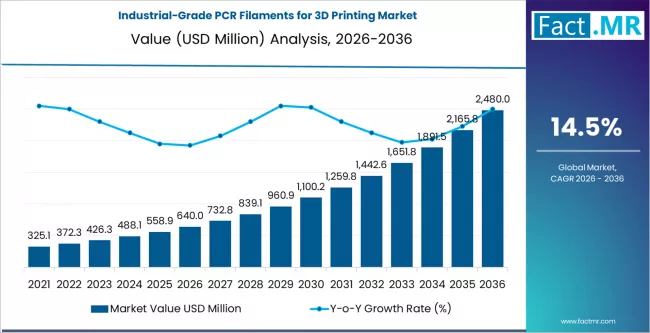
The industrial-grade PCR filaments for 3D printing market is projected to reach USD 640 million in 2026 and grow to USD 2,480 million by 2036, expanding at a CAGR of 14.5%. Dominant players in this market protect their pricing power through strategic control over high-quality material production and long-term supplier relationships, ensuring consistent cost efficiency.
Industrial Grade Pcr Filaments For 3d Printing Market Market Value Analysis | Source: Fact.MR
Summary of Industrial-Grade PCR Filaments for 3D Printing Market
Market Snapshot
Global industrial-grade PCR filaments for 3D printing market revenue stood atUSD 640 million in 2026and is forecast to reachUSD 2,480 million by 2036.
At a14.5% CAGR from 2026 to 2036, this market is set to expand~3.9x in value, addingUSD 1,840 million in absolute opportunity.
Growth is driven by increasing demand forsustainable additive manufacturing materialsand high-performance recycled filament solutions.
The market is evolving into astrategically controlled ecosystem, where leading playersmaintainpricing power through material quality, supplier relationships, and proprietary formulations.
Demand and Growth Drivers
Rising adoption ofcircular economy practices in manufacturingis a primary growth driver.
Increasing use of3D printing in industrial applicationsis accelerating demand.
Strong reliance onsupplier relationships and cost-efficient sourcingis shaping competitive dynamics.
Industry movement towardstandardization and consolidationis influencing long-term growth patterns.
Product and Segment View
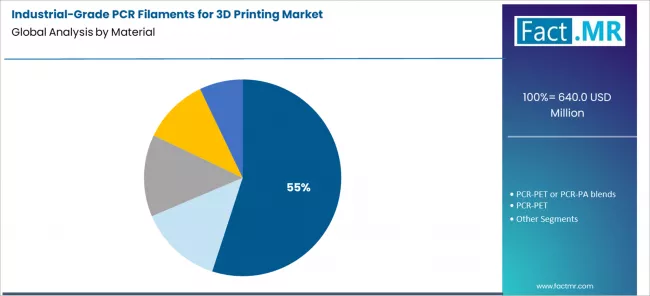
PCR-PETG, PCR-ABS, and PCR-PLA collectively hold 55% of material segment share in 2026,emergingas the dominant category due to versatility and performance balance.
Key material categories include:
PCR-PETG
PCR-ABS
PCR-PLA
Other recycled filaments
Key applications include:
Industrial prototyping
Functional parts production
Tooling and fixtures
Specialized industrial components
Geography and Competitive Outlook
Asia Pacific is the leading growth region, driven by expanding manufacturing and additive production ecosystems.
Market expansion is closely tied tointellectual property control, proprietary material formulations, and distribution networks.
Competitive dynamics showmoderate fragmentation, with niche players serving specialized applications, while larger companies strengthen market control through acquisitions.
Key companies active in this market include
Stratasys, BASF Forward AM,eSUN, Mitsubishi Chemical Advanced Materials, 3D Systems,Evonik, andPolymaker.
Industrial-Grade PCR Filaments for 3D Printing Market — At a Glance
Attribute
Details
Market Value 2026
USD 640 million
Market Value 2036
USD 2,480 million
Absolute Dollar Opportunity 2026–2036
USD 1,840 million
Total Growth 2026–2036
287.5%
CAGR 2026–2036
14.5%
Growth Multiple
~3.9x
Key Demand Theme
Increasing adoption of high-performance recycled filaments in industrial additive manufacturing
Leading Segment by Material (2026)
PCR-PETG / PCR-ABS / PCR-PLA
Segment Share (2026)
55%
Key Growth Region
Asia Pacific
Top Companies
Stratasys, BASF Forward AM,eSUN, Mitsubishi Chemical Advanced Materials, 3D Systems,Evonik,Polymaker
North America, Latin America, Western Europe, Eastern Europe, East Asia, South Asia & Pacific, MEA
Source: Fact.MR analysis. Updated May 6, 2026
Barriers to entry are maintained through intellectual property, proprietary filament formulations, and established distribution networks. These factors make it difficult for new entrants to compete on equal footing. Fragmentation in the market is driven by the diverse range of applications across industries, each with specific material requirements, leaving room for niche players. However, as demand consolidates and industry standards evolve, market fragmentation may narrow. Larger companies are likely to strengthen their position by acquiring smaller firms, thereby enhancing their control over both pricing and supply chains.
Category
Category
Segments
End-Use
Industrial prototyping and tooling; Engineering components; Manufacturing jigs; Precision parts; Tooling and fixtures; Local manufacturing
PCR-PETG or PCR-ABS or PCR-PLA; PCR-PET or PCR-PA blends; PCR-PET; PCR-PC blends; Others
Printing Technology
FDM or FFF compatible compounds; Industrial-grade extrusion; High-volume filament extrusion; Tight tolerance filament control
Region
North America; Europe; Asia Pacific; Latin America; Middle East & Africa
Source: Fact.MR analysis. Updated May 6, 2026
Segmental Analysis
What Is the Impact of Filament Type on the Industrial-Grade Pcr Filaments for 3D Printing Market?
Industrial Grade Pcr Filaments For 3d Printing Market Analysis By Filament Type | Source: Fact.MR
In the industrial-grade PCR filaments for 3D printing market, filament type plays a critical role in determining the performance and application of the filaments. High-strength filaments lead the market with a 50% share. These filaments are favored for their durability and reliability in demanding industrial applications. They provide enhanced mechanical properties, making them suitable for a wide range of 3D printing tasks, including structural and functional parts. As industries require more robust solutions, the demand for high-strength filaments will continue to grow, offering significant advantages in terms of performance and product lifespan.
How Does Material Influence the Industrial-Grade Pcr Filaments for 3D Printing Market?
Industrial Grade Pcr Filaments For 3d Printing Market Analysis By Material | Source: Fact.MR
Material is a key determinant of the properties and versatility of PCR filaments in 3D printing. PCR-PETG or PCR-ABS or PCR-PLA leads the market with a 55% share. These materials are valued for their balance of strength, flexibility, and recyclability, which makes them ideal for a variety of 3D printing applications. PCR-PETG and PCR-ABS offer high impact resistance, while PCR-PLA is known for its ease of use and environmental friendliness. As sustainability and material performance remain central to the industry, these materials are expected to maintain a dominant position, supporting the market’s continued growth in industrial-grade 3D printing.
What are the Principal Drivers, Constraints, and Evolving Dynamics of the Industrial Grade PCR Filaments for 3D Printing Market?
Demand for industrial grade polymer filaments suitable for PCR and laboratory equipment has been influenced by the need for customized components in scientific instrumentation. Manufacturers and research facilities seek robust materials that withstand repeated sterilization cycles and thermal stress. Requirements for dimensional accuracy in parts used in PCR device assemblies have supported interest in high performance filaments.
Cost of specialty filaments remains a constraint for small facilities that use standard materials for noncritical parts. Limited availability of validated materials certified for laboratory use has slowed broader adoption. Efforts to expand material libraries and improve compatibility with industrial printers are ongoing. Work on establishing performance benchmarks for filament properties such as heat resistance and chemical inertness is under way. Collaboration between filament producers and laboratory equipment designers is shaping future offerings.
Analysis of the Industrial-Grade PCR Filaments for 3D Printing Market by Key Country
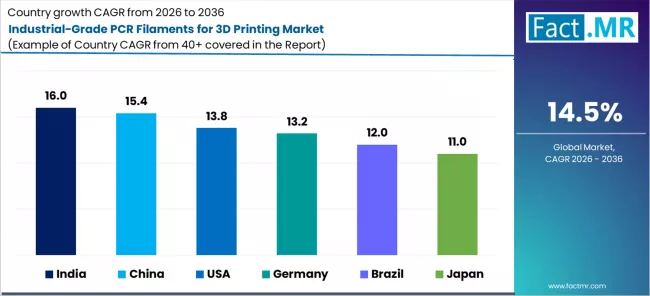
Industrial Grade Pcr Filaments For 3d Printing Market Cagr Analysis By Country | Source: Fact.MR
Country
CAGR (2026–2036)
USA
13.8%
Germany
13.2%
China
15.4%
Japan
11%
India
16%
Brazil
12%
Source: Fact.MR analysis. Updated May 6, 2026
The report covers an in-depth analysis of 40+ countries; top-performing countries are highlighted below.
What is the Growth Outlook for Industrial-Grade PCR Filaments for 3D Printing in the USA?
The USA’s industrial-grade PCR filaments for 3D printing market is projected to grow at a CAGR of 13.8% from 2026 to 2036. The country’s strong manufacturing sector and increasing emphasis on sustainable production methods are key drivers for adopting PCR-based filaments. As industries look to reduce environmental impact while maintaining material performance, the demand for industrial-grade PCR filaments is expected to rise. The USA’s focus on advancing 3D printing technologies, combined with environmental considerations, creates a conducive environment for the expansion of this market.
How is the Industrial-Grade PCR Filaments for 3D Printing Market Performing in Germany?
Germany's industrial-grade PCR filaments for 3D printing market is forecast to grow at a CAGR of 13.2% from 2026 to 2036. Germany is at the forefront of sustainable manufacturing, making it a prime market for the adoption of PCR-based filaments. As industries in the country increasingly focus on reducing waste and promoting sustainability, the demand for eco-friendly 3D printing materials is expected to rise. Germany’s well-established technological infrastructure and commitment to innovation will continue to support the growth of industrial-grade PCR filaments for 3D printing.
What is the Growth Potential for Industrial-Grade PCR Filaments for 3D Printing in China?
China is expected to experience significant growth in the industrial-grade PCR filaments for 3D printing market, with a CAGR of 15.4% from 2026 to 2036. The rapid expansion of China’s manufacturing sector, coupled with the government’s push toward more sustainable production practices, is driving the demand for eco-friendly 3D printing materials. The adoption of industrial-grade PCR filaments is expected to gain momentum as industries seek cost-effective and environmentally responsible solutions. China’s large-scale manufacturing capabilities and focus on reducing plastic waste will likely propel market growth in the coming years.
What is the Demand for Industrial-Grade PCR Filaments for 3D Printing in Japan?
Japan’s industrial-grade PCR filaments for 3D printing market is projected to grow at a CAGR of 11% from 2026 to 2036. The country’s focus on sustainability and innovation in manufacturing technologies is expected to drive demand for PCR-based filaments. Japan’s advanced manufacturing infrastructure and commitment to reducing environmental impact in production processes support the integration of eco-friendly materials like PCR filaments in 3D printing. While Japan’s growth rate may be slower compared to some other markets, the demand for industrial-grade PCR filaments will continue to expand as industries embrace more sustainable production methods.
What is the Growth Outlook for Industrial-Grade PCR Filaments for 3D Printing in India?
India’s industrial-grade PCR filaments for 3D printing market is set to experience rapid growth, with a projected CAGR of 16% from 2026 to 2036. The country's expanding manufacturing sector, coupled with an increasing focus on sustainability and waste reduction, positions it as a key market for the adoption of PCR-based 3D printing materials. India’s burgeoning tech industry and rising awareness about environmental issues are further fueling demand for eco-friendly and cost-effective 3D printing solutions. The adoption of industrial-grade PCR filaments is expected to grow steadily as more industries look for sustainable alternatives in production.
What is the Market Expansion Outlook for Industrial-Grade PCR Filaments for 3D Printing in Brazil?
Brazil is forecast to experience steady growth in the industrial-grade PCR filaments for 3D printing market, with a CAGR of 12% from 2026 to 2036. The country’s growing focus on sustainable manufacturing practices, combined with its expanding 3D printing industry, is expected to drive the demand for PCR-based filaments. As Brazil continues to prioritize environmental sustainability and cost-efficiency in its manufacturing processes, the adoption of eco-friendly 3D printing materials will increase. The market for industrial-grade PCR filaments will likely expand as industries in Brazil seek more sustainable solutions for their production needs.
What is the Competitive Landscape in the IndustrialGrade PCR Filaments for 3D Printing Market?
Competition in the industrial grade PCR filaments market is driven by material performance, application breadth, and process consistency. Stratasys and 3D Systems Materials leverage longstanding positions in 3D printing with established customer bases and broad portfolios. BASF Forward AM and Mitsubishi Chemical Advanced Materials focus on tailored material solutions that meet specific mechanical and thermal criteria for industrial uses.
eSUN and Polymaker compete on costeffective filament ranges with growing emphasis on recycled content and print reliability. Evonik positions its offerings through material science expertise and partnerships that target engineered applications. Firms differentiate by certification standards, supply chain stability, and compatibility with diverse printing platforms. Product literature often highlights tensile strength, thermal resistance, and circularity attributes in technical detail.
Key Players of the Industrial-Grade PCR Filaments for 3D Printing Market
Stratasys
BASF Forward AM
eSUN
Mitsubishi Chemical Advanced Materials
3D Systems Materials
Evonik
Polymaker
Bibliography
International Organization for Standardization. (2023). ISO/ASTM 52900: Additive manufacturing—General principles—Fundamentals and vocabulary. ISO.
International Organization for Standardization. (2023). ISO/ASTM 52921: Standard terminology for additive manufacturing materials and processes. ISO.
Organisation for Economic Co-operation and Development. (2023). Plastics recycling, secondary polymers, and material circularity in advanced manufacturing. OECD Publishing.
European Commission. (2023). Circular economy and recycled plastic content requirements in industrial products and manufacturing materials. European Union.
Journal of Cleaner Production. (2024). Performance, variability, and lifecycle impacts of recycled polymer filaments in industrial additive manufacturing. Journal of Cleaner Production.
Additive Manufacturing. (2024). Qualification and mechanical performance of post-consumer recycled thermoplastics for fused filament fabrication. Additive Manufacturing.
Market Breakdown
Segmentation
Scope of the Report
Items
Values
Quantitative Units (2026)
USD Million
End-use
Industrial prototyping and tooling, Engineering components, Manufacturing jigs, Precision parts, Tooling and fixtures
North America, Europe, Asia Pacific, Latin America, Middle East & Africa
Countries Covered
United States, Canada, Mexico, Brazil, Germany, United Kingdom, France, Italy, Spain, China, Japan, South Korea, India, Australia & New Zealand
Key Companies Profiled
Stratasys, BASF Forward AM, eSUN, Mitsubishi Chemical Advanced Materials, 3D Systems Materials, Evonik, Polymaker
Additional Attributes
Dollar revenue by end-use, filament type, material, and printing technology; regional demand trends, competitive landscape, technological advancements in PCR filaments, and innovations in 3D printing.
Source: Fact.MR analysis. Updated May 6, 2026
Industrial-Grade PCR Filaments for 3D Printing Market Key Segments
End-use :
Industrial prototyping and tooling
Engineering components
Manufacturing jigs
Precision parts
Tooling and fixtures
Local manufacturing
Filament Type :
High-strength filaments
Reinforced filaments
Cost-optimised filaments
Engineering filaments
Others
Material :
PCR-PETG or PCR-ABS or PCR-PLA
PCR-PET or PCR-PA blends
PCR-PET
PCR-PC blends
Others
Printing Technology :
FDM or FFF compatible compounds
Industrial-grade extrusion
High-volume filament extrusion
Tight tolerance filament control
Others
Region :
North America
USA
Canada
Mexico
Europe
Germany
UK
France
Italy
Spain
Nordic Countries
BENELUX
Rest of Europe
Asia Pacific
China
Japan
South Korea
India
Australia
Rest of Asia Pacific
Latin America
Brazil
Argentina
Rest of Latin America
Middle East and Africa
Kingdom of Saudi Arabia
United Arab Emirates
South Africa
Rest of Middle East and Africa
Other Regions
Oceania
Central Asia
Other Markets
Questions Answered
Frequently Asked Questions
How big is the industrial-grade pcr filaments for 3d printing market in 2026?
The global industrial-grade pcr filaments for 3d printing market is estimated to be valued at USD 640.0 million in 2026.
What will be the size of industrial-grade pcr filaments for 3d printing market in 2036?
The market size for the industrial-grade pcr filaments for 3d printing market is projected to reach USD 2,480.0 million by 2036.
How much will be the industrial-grade pcr filaments for 3d printing market growth between 2026 and 2036?
The industrial-grade pcr filaments for 3d printing market is expected to grow at a 14.5% CAGR between 2026 and 2036.
What are the key product types in the industrial-grade pcr filaments for 3d printing market?
The key product types in industrial-grade pcr filaments for 3d printing market are industrial prototyping and tooling, engineering components, manufacturing jigs, precision parts, tooling and fixtures and local manufacturing.
Which filament type segment to contribute significant share in the industrial-grade pcr filaments for 3d printing market in 2026?
In terms of filament type, high-strength filaments segment to command 50.0% share in the industrial-grade pcr filaments for 3d printing market in 2026.