- Market Value (2025): USD 269 Mn
- Estimated Value (2026): USD 285 Mn
- Forecast Value (2036): USD 515 Mn
- CAGR (2026-2036): 6.1%
What is the IBC Agitator Systems Market forecast to be worth by 2036?
USD 285 million in 2026 to USD 515 million by 2036 at a 6.1% CAGR.
- The IBC agitator systems market reached USD 268.6 million in 2025.
- Demand is projected to increase from USD 285 million in 2026 to USD 515 million by 2036.
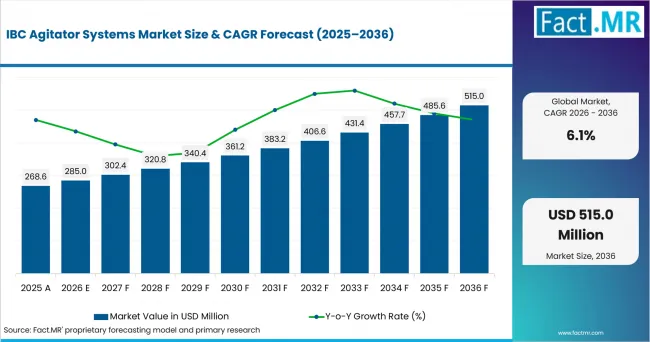
Ibc Agitator Systems Market Value Analysis | Source: Fact.MR
What are the defining numbers behind IBC Agitator Systems Market growth?
An absolute opportunity of USD 230 million is expected between 2026 and 2036.
- Demand Drivers in the Market
- Intermediate bulk containers are used to hold and transport liquid or flowable materials across chemical and process operations. UNECE ADR rules include construction and testing requirements for IBCs used with dangerous goods. When products settle or separate during storage and transport, manufacturers need controlled agitation before transfer so concentration and process performance remain consistent.
- Chemical processing creates demand for agitators that can work safely around solvents and other hazardous materials. The EU ATEX framework applies to equipment intended for potentially explosive atmospheres, while U.S. OSHA rules govern electrical equipment in hazardous classified locations. This supports demand for drive and mounting configurations selected for the operating environment.
- Food and beverage users require mixing equipment that can be cleaned and maintained without creating contamination risks. U.S. food manufacturing rules require food-contact equipment to be adequately cleanable. IBC agitators with suitable product-contact materials therefore have a defined role where ingredients, syrups or liquid preparations are mixed directly in the tote before use.
- Pharmaceutical and cosmetic manufacturing increases the value of controlled re-dispersion and cleanable equipment. EU GMP guidance requires processing equipment to suit the operation and permit effective cleaning. IBC agitation can reduce product transfers by allowing a stored intermediate to be blended or re-suspended in the same container before the next process step.
- Supplier portfolios are becoming more purpose-built for container mixing. Silverson markets the Ultramix for IBC tote-bin applications, while Lightnin offers ECL portable mixer configurations that include Tote Bridge and Quick Connect options. These designs help users match the mixer, mounting arrangement and drive to container geometry and process duty.
- Key Segments Analyzed
- Bung-mounted/folding impeller systems account for 43.0% of Mounting Type in 2026 because they can enter through the container opening and deploy an impeller inside the IBC without requiring a permanent vessel modification.
- Electric drives represent 47.0% of Drive in 2026 because they provide controllable speed and straightforward integration where the processing area permits electrically driven equipment.
- Blending/homogenising holds 38.0% of Application in 2026 as users frequently need to restore concentration uniformity before pumping an IBC-stored material into the next production stage.
- Chemicals account for 30.0% of End-Use Industry in 2026 because IBCs are suited to batch ingredients and intermediates that may require agitation before transfer, dosing or filling.
- Analyst Opinion at Fact.MR
- Shambhu Nath Jha, Principal Consultant at Fact.MR, states, “IBC agitation is increasingly treated as a process-control step rather than an accessory to storage. Buyers want a mounting system that fits the tote, a drive suited to the operating area and an impeller matched to settling behavior or viscosity. Suppliers that reduce setup time while supporting cleaning and safe operation are better placed for repeat industrial orders.”
- Strategic Implications
- Suppliers should specify IBC compatibility by opening size, container geometry and operating volume. Buyers need mounting and impeller configurations tied to the actual tote rather than a generic tank-mixer specification.
- Drive selection should be linked to the plant environment. Electric systems suit many general-purpose applications, while pneumatic designs remain relevant where hazardous-area requirements or site utilities shape equipment choice.
- Application support should distinguish blending from solids suspension and re-dispersion. These duties require different flow patterns and torque, so clear sizing guidance can reduce the risk of an underpowered or unnecessarily oversized mixer.
- Food and pharmaceutical suppliers should emphasize cleanability and material compatibility. Buyers in hygienic processing assess surface finish, sealing and ease of cleaning alongside mixing performance because the agitator becomes part of the product-contact process.
How does the IBC Agitator Systems Market break down by segment?
The market is segmented by Mounting Type, Drive, Application and End-Use Industry.
Why does Bung-mounted/folding impeller lead Mounting Type?
Bung-mounted/folding impeller leads Mounting Type in 2026.
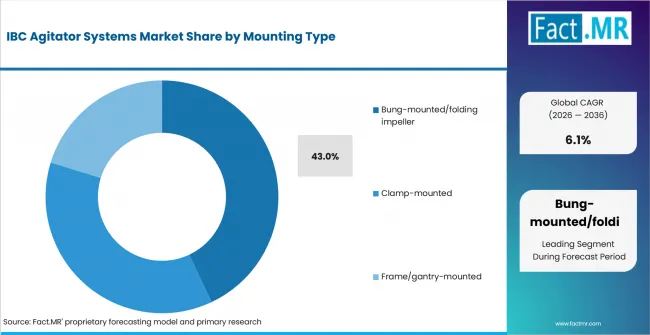
Ibc Agitator Systems Market Analysis By Mounting Type | Source: Fact.MR
Bung-mounted systems lead because they use the existing container opening and avoid the need for a large support structure around every tote. A folding impeller can pass through a restricted opening and then expand inside the container, allowing practical agitation of stored material with limited modification to the IBC.
This configuration also suits plants that move a mixer among several containers. IBC-focused mixing systems from suppliers such as Silverson and Lightnin are designed around container access and portable mounting, reducing setup work when batches are stored or delivered in standard tote formats.
Why does Electric lead Drive?
Electric leads Drive in 2026.
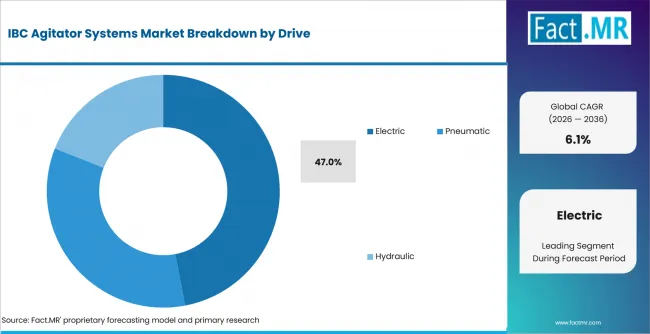
Ibc Agitator Systems Market Analysis By Drive | Source: Fact.MR
Electric drives lead because speed control is straightforward and motors can be paired with gear reduction when an application needs lower shaft speed and higher torque. This makes the drive adaptable across blending and re-dispersion tasks where product viscosity or solids loading changes from one formulation to another.
Hazardous-area requirements still affect selection. ATEX rules in the European Union and OSHA hazardous-location requirements in the USA mean users must match electrical equipment to the operating environment. Pneumatic drives therefore remain relevant in selected chemical applications, while electric systems cover many general industrial settings.
Why does Blending/homogenising lead Application?
Blending/homogenising leads Application in 2026.
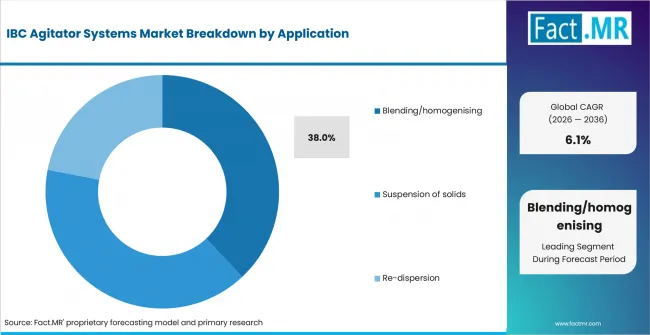
Ibc Agitator Systems Market Analysis By Application | Source: Fact.MR
Blending and homogenising lead because many IBC-stored products do not need intensive size reduction. The operational requirement is frequently to restore concentration uniformity after storage, combine a liquid additive or return a batch to a consistent state before it is pumped into a processing line.
Supplier application portfolios reflect this duty. ProQuip covers liquid blending and solids suspension, while INOXPA supplies agitators for mixing, dissolution and dispersion. IBC-specific systems adapt these established mixing functions to a portable container workflow.
Why do Chemicals lead End-Use Industry?
Chemicals lead End-Use Industry in 2026.
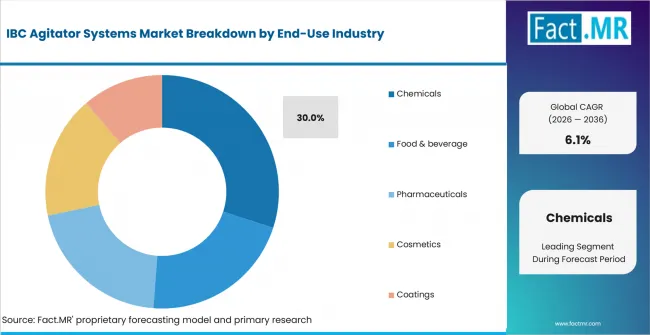
Ibc Agitator Systems Market Analysis By End Use Industry | Source: Fact.MR
Chemicals lead because intermediates, additives and formulated liquids are commonly handled in batch quantities where an IBC can serve as both transport package and short-term process vessel. Settling or phase separation before dosing creates a direct need for agitation at the point of use.
Safety requirements also increase equipment specificity. ADR rules govern IBCs used for dangerous goods, and hazardous-area frameworks influence motor and installation choices in chemical plants. Buyers therefore assess mounting, drive and sealing arrangements against the material and production area.
What is accelerating IBC Agitator Systems Market adoption, and what is holding it back?
Drivers Impact Analysis
| Driver | (~) % Impact on CAGR | Geographic Relevance | Impact Timeline |
|---|---|---|---|
| Routine need to re-homogenise IBC contents before dosing | +1.5% | Global | Near term |
| ATEX/IECEx certification requirements for flammable-solvent handling | +1.2% | USA and Europe | Near term |
| Hygienic design expectations in food and pharmaceutical IBC use | +0.9% | USA and Europe | Mid term |
| Shift toward closed-transfer processing and sealed-container agitation | +0.6% | Global | Mid term |
Opportunity Impact Analysis
| Opportunity | (~) % Impact on CAGR | Geographic Relevance | Impact Timeline |
|---|---|---|---|
| Retrofit agitator packages for existing IBC fleets in chemical tolling | +0.8% | USA and Europe | Mid term |
| Integrated agitator with IoT-based runtime and cycle-count tracking | +0.5% | USA, Europe and Japan | Long term |
| Lightweight portable agitators for cosmetic and personal-care IBCs | +0.4% | Global | Mid term |
Restraints Impact Analysis
| Restraint | (~) % Impact on CAGR | Geographic Relevance | Impact Timeline |
|---|---|---|---|
| Capital cost of certified drives for small and mid-size toll processors | -0.8% | Global | Near term |
| Single-use and disposable-container trends reducing returnable IBC demand in biopharma | -0.5% | USA and Europe | Mid term |
| Availability of contract mixing services as an alternative to on-site agitation | -0.4% | USA and Europe | Long term |
Which countries are scaling the IBC Agitator Systems Market through 2036?
- South Korea: Expansion in biopharmaceutical and cosmetics production supports demand for cleanable small-batch mixing equipment used with intermediates and formulated liquids handled in portable containers.
- USA: A broad chemical manufacturing base, together with food and pharmaceutical production, creates recurring applications for portable IBC blending and re-dispersion. Hazardous-location and food-contact requirements also influence drive and material selection.
- Spain: Chemical manufacturing and formulated-product operations support container-level mixing where ingredients or intermediates are stored in IBCs before transfer. EU hazardous-area requirements reinforce the need for application-specific equipment selection.
- United Kingdom: Chemicals, food products and pharmaceuticals remain distinct manufacturing activities in official production reporting. Plants in these sectors use batch handling and intermediate storage, supporting portable agitation that can be moved between IBCs.
- Italy: Food and beverage processing together with pharmaceutical manufacturing creates demand for hygienic mixing equipment used with liquid ingredients, intermediates and small-batch preparations.
- Germany: Chemical and pharmaceutical manufacturing sustains demand for industrial mixing equipment, while ATEX requirements influence the selection of electric or alternative drives in potentially explosive atmospheres.
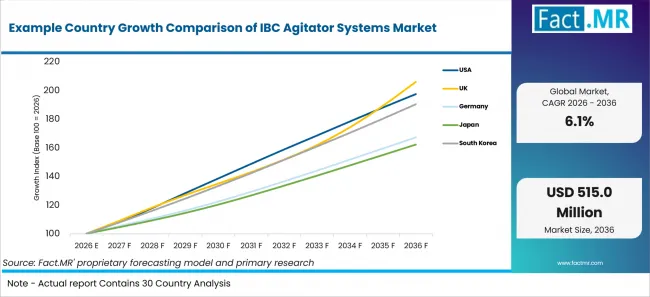
Example Country Growth Comparison Of Ibc Agitator Systems Market | Source: Fact.MR
Country CAGR (2026-2036)
| Country | CAGR (2026-2036) |
|---|---|
| South Korea | 8.2% |
| USA | 7.5% |
| Spain | 7.0% |
| United Kingdom | 6.3% |
| Italy | 5.5% |
| Germany | 5.5% |
What is driving South Korea’s growth through 2036?
South Korea is forecast to expand at an 8.2% CAGR from 2026 to 2036.
Demand conditions include biohealth production and exports spanning biopharmaceuticals and cosmetics. These industries use liquid intermediates that must remain uniform before filling or downstream processing, creating applications for cleanable container-level agitation.
Manufacturing guidance also increases the importance of controllable equipment and documented cleaning. IBC agitation is relevant where a formulation or intermediate remains in the same container before the next process step, reducing unnecessary transfers.
What is driving USA’s growth through 2036?
The USA is forecast to expand at a 7.5% CAGR from 2026 to 2036.
The USA has a broad chemical manufacturing footprint. U.S. Census Bureau data show that chemical manufacturing establishments increased from 13,571 in 2017 to 14,961 in 2022, supporting a wide installed base of plants that handle batch ingredients and intermediates.
Equipment choice is also shaped by operating conditions. OSHA requirements apply to electrical equipment in hazardous classified locations, while federal food manufacturing rules require food-contact equipment to be adequately cleanable. These requirements support distinct demand for rated and hygienic IBC agitation systems.
What is driving Spain’s growth through 2036?
Spain is forecast to expand at a 7.0% CAGR from 2026 to 2036.
Spain’s official industrial-products survey identifies chemicals as a material part of manufacturing output. Batch chemicals handled in IBCs may require blending or re-dispersion after storage before they enter dosing, filling or formulation operations.
Spain also operates under the EU ATEX framework, which affects equipment intended for potentially explosive atmospheres. This supports demand for drives and mounting arrangements selected around the plant environment and material handled.
What is driving the United Kingdom’s growth through 2036?
The United Kingdom is forecast to expand at a 6.3% CAGR from 2026 to 2036.
UK production reporting tracks chemicals, food products and pharmaceuticals as manufacturing subsectors. These activities use batch preparation and intermediate storage in parts of their production chains, giving IBC agitation a role where a stored product needs mixing before transfer to a dedicated process vessel.
Portable systems can also reduce fixed-equipment utilization constraints because one agitator can be moved among containers when the mounting and operating requirements are compatible.
What is driving Italy’s growth through 2036?
Italy is forecast to expand at a 5.5% CAGR from 2026 to 2036.
Italy’s manufacturing base includes food and beverage processing together with pharmaceutical production. Both activities create applications for hygienic mixing of liquid ingredients, intermediates and small-batch preparations stored in portable containers.
IBC agitators can reduce transfers and the number of separate vessels that require cleaning. Buyers in these settings therefore assess product-contact materials and ease of dismantling alongside mixing performance.
What is driving Germany’s growth through 2036?
Germany is forecast to expand at a 5.5% CAGR from 2026 to 2036.
Germany has continuing chemical and pharmaceutical manufacturing activity, providing an installed base of process plants that use industrial agitation for formulation and intermediate handling. IBC systems fit applications involving additives, intermediates and smaller production batches.
German users also operate under EU ATEX requirements where explosive atmospheres may occur. Equipment selection can therefore favor appropriately specified electric configurations or alternative drives when plants need mixing flexibility across several containers.
Who leads the IBC Agitator Systems Market?
Silverson Machines Ltd. supplies the market through its Ultramix range, which includes configurations engineered for IBC tote-bin mixing and narrow container openings. This gives users a purpose-built option where material must be mixed directly in a portable container.
Lightnin competes with portable mixers that include Tote Bridge and Quick Connect options for IBC use. The Lightnin portfolio is now part of ITT Flow Technologies following ITT’s March 2026 acquisition of SPX FLOW. ProQuip Inc. supplies industrial agitators for blending and solids-suspension duties.
Alfa Laval AB and INOXPA S.A.U. add hygienic agitation capabilities relevant to food and pharmaceutical users. Statiflo International Ltd. participates in the broader process-mixing environment through static mixers, so its role is adjacent where buyers compare direct IBC agitation with inline mixing approaches.
Supplier selection depends on mounting compatibility and drive suitability for the operating area. Buyers also assess impeller performance, cleanability and support for the product viscosity or solids-loading range expected in service.
Which companies are the key providers?
Key companies profiled include Silverson Machines Ltd.; ProQuip Inc.; ITT Flow Technologies (Lightnin); Alfa Laval AB; INOXPA S.A.U.; and Statiflo International Ltd.
- Silverson Machines Ltd.
- ProQuip Inc.
- ITT Flow Technologies (Lightnin)
- Alfa Laval AB
- INOXPA S.A.U.
- Statiflo International Ltd.
Research Sources and Bibliography
- United Nations Economic Commission for Europe. (2025). ADR 2025: European Agreement concerning the International Carriage of Dangerous Goods by Road. United Nations.
- European Commission. (2026). Equipment for Potentially Explosive Atmospheres (ATEX): Directive 2014/34/EU. European Commission.
- Occupational Safety and Health Administration. (2026). 29 CFR 1910.307: Hazardous (Classified) Locations. U.S. Department of Labor.
- U.S. Food and Drug Administration. (2026). 21 CFR 117.40: Equipment and Utensils. U.S. Department of Health and Human Services.
- European Commission. (2015). EudraLex Volume 4, Part I, Chapter 3: Premises and Equipment. European Commission.
- U.S. Census Bureau. (2026). Chemical Manufacturers Produce Everything from Basic Chemicals to Advanced Materials. U.S. Department of Commerce.
- Instituto Nacional de Estadística. (2025). Annual Industrial Products Survey: Year 2024. Government of Spain.
- Office for National Statistics. (2026). Index of Production, UK: December 2025. UK Government.
- Federal Statistical Office of Germany. (2026). Industry and Manufacturing Statistics. Destatis.
- Italian National Institute of Statistics. (2026). Industrial Production: December 2025. Istat.
- Government of the Republic of Korea. (2026). Biohealth Exports Reach USD 27.9 Billion in 2025. Korea.net.
- Silverson Machines Ltd. (2026). Ultramix Mixers and IBC Tote Mixing. Silverson Machines.
- ITT Flow Technologies. (2026). Lightnin ECL Small Portable Mixer. ITT Flow Technologies.
- ITT Inc. (2026). ITT Completes Acquisition of SPX FLOW. ITT Inc.
- ProQuip Inc. (2026). Solid Suspension Mixing Solutions. ProQuip Inc.
- Alfa Laval AB. (2026). Mixing Equipment and Agitators. Alfa Laval.
- INOXPA S.A.U. (2026). Industrial Agitators. INOXPA.
- Statiflo International Ltd. (2026). Static Mixers and Process Mixing Solutions. Statiflo International Ltd.
This Report Answers
- The report explains demand for IBC agitator systems across mounting configurations and drive types.
- Segment analysis covers blending, solids suspension and re-dispersion requirements in portable containers.
- Country analysis examines South Korea and the USA. It also compares Spain and the United Kingdom with Italy and Germany.
- Competitive analysis reviews industrial agitation suppliers and process-mixing companies relevant to IBC applications.
- End-use analysis covers chemicals and food and beverage production. It also examines pharmaceuticals and cosmetics. Coatings are assessed separately.
What does the IBC Agitator Systems Market cover?
The market covers portable and fixed agitator systems engineered to mix material directly inside an intermediate bulk container. These systems use a motor or other drive, shaft and impeller assembly with a mounting arrangement that fits the IBC opening or external support structure.
The analysis includes systems used to blend liquids, maintain solids in suspension or re-disperse material that has settled during storage and transport. Demand is assessed across chemical, food and beverage, pharmaceutical, cosmetic and coatings applications.
What is included in the scope?
The scope includes bung-mounted and folding-impeller systems, clamp-mounted agitators and frame or gantry-mounted equipment designed for IBC use. Electric, pneumatic and hydraulic drive configurations are included within the stated segmentation.
The analysis includes agitators supplied for blending, homogenising, solids suspension and re-dispersion in the listed end-use industries. Portable systems that can be moved among IBCs and fixed systems dedicated to a defined container station are included when the equipment is engineered for direct container agitation.
What is excluded from the scope?
The scope excludes general tank agitators sold without an IBC-compatible mounting or operating configuration. Dedicated reactor mixers, large storage-tank agitators and high-shear inline systems are outside the market when they are not used to mix material directly in an intermediate bulk container.
Pumps, IBC filling systems, container washers and standalone static mixers are treated as adjacent equipment unless supplied as an integrated part of an IBC agitation system. The IBC container itself is excluded from market sizing.
How Was the Analysis Built?
Fact.MR is of the opinion that this assessment combines primary research with a structured review of public information and industry evidence relevant to the market.
- Primary Research: Interviews with agitator manufacturers, process engineers, chemical formulators and food or pharmaceutical manufacturers examine IBC use, drive selection and purchasing requirements.
- Desk Research: The review covers dangerous-goods rules, hazardous-area requirements, hygiene and GMP guidance, official manufacturing statistics and current supplier portfolios.
- Market Sizing and Forecasting: Estimates combine IBC mixing installations, replacement demand, application mix, mounting configuration, drive type and country-level process-industry activity.
- Data Validation and Update Cycle: Evidence is reviewed against the defined market scope, segment boundaries and forecast period. The assessment is updated when source data, technology conditions, regulation or supplier activity materially changes the outlook.
Research Scope and Coverage
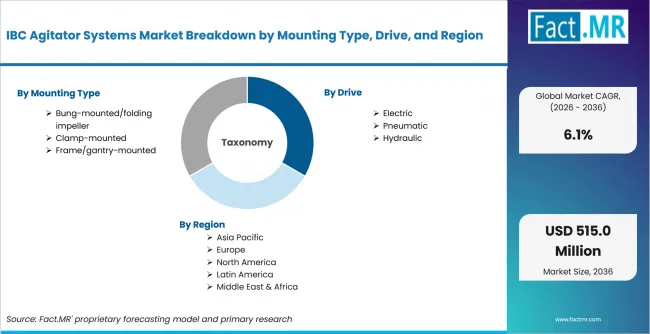
Ibc Agitator Systems Market Breakdown By Mounting Type, Drive, And Region | Source: Fact.MR
| Attribute | Details |
|---|---|
| Quantitative Units | USD 285 million in 2026 to USD 515 million by 2036 at a 6.1% CAGR |
| Market Definition | Portable and fixed agitator systems designed to mix, homogenise, suspend or re-disperse materials directly in intermediate bulk containers |
| Segments Covered | Mounting Type; Drive; Application; End-Use Industry |
| Regions Covered | North America; Latin America; Western Europe; Eastern Europe; East Asia; South Asia & Pacific; Middle East & Africa |
| Countries Covered | South Korea; USA; Spain; United Kingdom; Italy; Germany |
| Key Companies Profiled | Silverson Machines Ltd.; ProQuip Inc.; ITT Flow Technologies (Lightnin); Alfa Laval AB; INOXPA S.A.U.; Statiflo International Ltd. |
| Forecast Period | 2026 to 2036 |
| Approach | Hybrid top-down and bottom-up approach using IBC mixing demand, segment shares, country growth, process-industry activity, equipment pricing and company portfolio review |
Market Breakdown by Segments
-
By Mounting Type
- Bung-mounted/folding impeller
- Clamp-mounted
- Frame/gantry-mounted
-
By Drive
- Electric
- Pneumatic
- Hydraulic
-
By Application
- Blending/homogenising
- Suspension of solids
- Re-dispersion
-
By End-Use Industry
- Chemicals
- Food & beverage
- Pharmaceuticals
- Cosmetics
- Coatings
-
By Region
- North America
- Latin America
- Western Europe
- Eastern Europe
- East Asia
- South Asia & Pacific
- Middle East & Africa