- Market Value (2025): USD 177.1 Mn
- Estimated Value (2026): USD 192.0 Mn
- Forecast Value (2036): USD 430.0 Mn
- CAGR (2026-2036): 8.4%
What is the IBC Dosing Units Market forecast to be worth by 2036?
USD 192.0 million in 2026 to USD 430.0 million by 2036 at an 8.4% CAGR from 2026 to 2036.
- The market crossed a valuation of USD 177.1 million in 2025 as water treatment, chemical processing and plant services kept demand steady.
- Demand is projected to increase from USD 192.0 million in 2026 to USD 430.0 million by 2036.
- The market is forecast to record an 8.4% CAGR from 2026 to 2036 as plants replace improvised tote unloading with safer dosing stations.
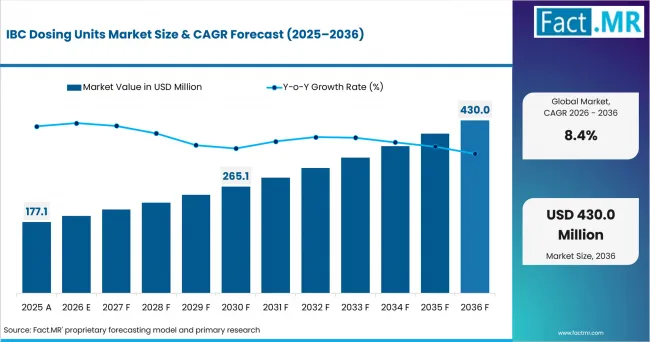
Ibc Dosing Units Market Value Analysis | Source: Fact.MR
What are the defining numbers behind IBC Dosing Units Market growth?
USD 238.0 million absolute opportunity is expected by 2036. Pump-over-IBC skids and Diaphragm pumps lead alongside Water treatment chemicals, Manual/local control and Chemical processors.
- Demand Drivers in the Market
- Chemical processors need safer and more controlled ways to transfer liquids from intermediate bulk containers without relying on temporary hoses, manual pouring or permanent storage tanks.
- Plants benefit from dosing stations that combine pumps, couplings and containment features, making container changeovers easier to document while reducing splash exposure and connection errors.
- Water treatment, food processing and manufacturing facilities require dosing systems that work with different chemicals while maintaining accurate feed rates and clear batch traceability through barcode or PLC integration.
- Mobile and skid-mounted IBC dosing units are expected to support pilot projects, seasonal production and short-term campaigns where flexible chemical handling is more practical than installing fixed storage infrastructure.
- Key Segments Analyzed
- By Unit Type: Pump-over-IBC skids are expected to hold 32.0% share in 2026 because they solve the basic tote-to-process transfer problem with the fewest added parts.
- By Pump Type: Diaphragm pumps are projected to account for 31.0% share in 2026 owing to sealed chemical handling and dependable metering across corrosive duties.
- By Chemical Handled: Water treatment chemicals are anticipated to capture 30.0% share in 2026 due to steady use of coagulants, flocculants and disinfectants.
- By Control: Manual/local control is estimated to represent 28.0% share in 2026 as smaller facilities keep operator-attended dosing stations in service.
- By End User: Chemical processors are forecast to hold 29.0% share in 2026 because they handle the widest range of changing formulations at IBC-appropriate volumes.
- Analyst Opinion at Fact.MR
- Shambhu Nath Jha, Senior Analyst at Fact.MR, states, “Operators do not choose an IBC dosing unit based only on pump performance. They also look closely at what happens when a tote is replaced and the connection is opened. At that point, the system must prevent the wrong chemical from entering the wrong line. Suppliers that make this changeover safer and easier to record are more likely to protect their margins than those selling only a basic skid.”
- Strategic Implications
- Plant operators can create clear steps for connecting each tote, checking the chemical and changing containers before the units are used across several production lines.
- Equipment suppliers can make dosing safer by adding matched couplings, spill trays and simple barcode or control checks. These features help prevent the wrong chemical from entering the line and keep each dosing record linked to the correct batch.
- Plant buyers can compare spare-part supply, changeover time and support for different IBC fittings before selecting a supplier. They can also check whether mobile units are suitable for short production runs without requiring new storage areas.
In November 2025, ProMinent launched DULCODOS SAFE-IBC F&B for food and beverage IBC metering. The company stated that the station includes an around 80-liter intermediate container and is designed to continue dosing during IBC changeover.
China is projected to record a 9.6% CAGR from 2026 to 2036. UAE is estimated to post a 9.1% CAGR through 2036. USA is anticipated to advance at an 8.4% CAGR from 2026 to 2036. Japan is forecast to record an 8.3% CAGR by 2036. United Kingdom is projected to post an 8.1% CAGR through 2036. Germany is estimated to record a 7.8% CAGR from 2026 to 2036.
How does the IBC Dosing Units Market break down by segment?
Pump-over-IBC skids are expected to lead Unit Type at 32.0% share in 2026. Diaphragm pumps are projected to lead Pump Type at 31.0% share in 2026.
Why do Pump-over-IBC Skids lead Unit Type?
Pump-over-IBC Skids are estimated to hold 32.0% share in 2026.
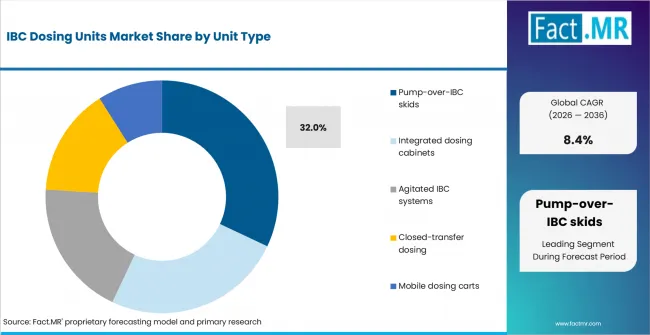
Ibc Dosing Units Market Analysis By Unit Type | Source: Fact.MR
Pump-over-IBC Skids give plants a simple way to draw chemicals directly from a standard tote. The pump, suction lance and spill-control area can sit over or beside the container, which keeps installation work limited. Integrated Dosing Cabinets add more enclosure where worker exposure is a concern. Agitated IBC Systems suit liquids that settle during storage. Closed-Transfer Dosing is used for hazardous chemicals, while Mobile Dosing Carts support short production runs and maintenance work.
Why do Diaphragm Pumps lead Pump Type?
Diaphragm Pumps account for 31.0% share in 2026.
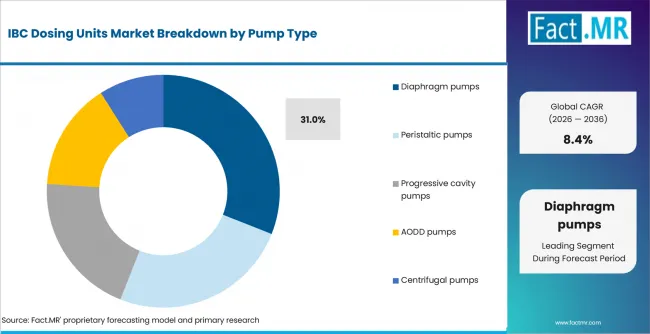
Ibc Dosing Units Market Analysis By Pump Type | Source: Fact.MR
Diaphragm Pumps keep the chemical inside a sealed pumping section, away from most moving parts. This makes them a common choice for corrosive or expensive liquids. Peristaltic Pumps work well with abrasive or easily damaged fluids. Progressive Cavity Pumps handle thicker liquids that move slowly from the tote. AODD Pumps fit transfer-heavy jobs where strength is more important than exact dosing. Centrifugal Pumps remain suitable for basic low-pressure circulation.
Why do Water Treatment Chemicals lead Chemical Handled?
Water Treatment Chemicals lead with 30.0% share in 2026.
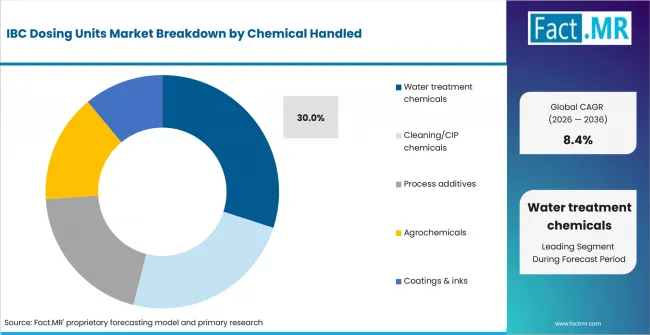
Ibc Dosing Units Market Analysis By Chemical Handled | Source: Fact.MR
Coagulants, flocculants and disinfectants are often used in amounts that suit IBC delivery better than small drums or permanent bulk tanks. Cleaning and CIP Chemicals require careful changeover so residue does not affect the next process. Process Additives change with each recipe, which makes flexible dosing stations useful. Agrochemicals often follow seasonal demand, so mobile units avoid leaving fixed equipment unused. Coatings and Inks rely on steady feed to protect batch quality.
Why does Manual/Local Control lead Control?
Manual/Local Control holds 28.0% share in 2026.
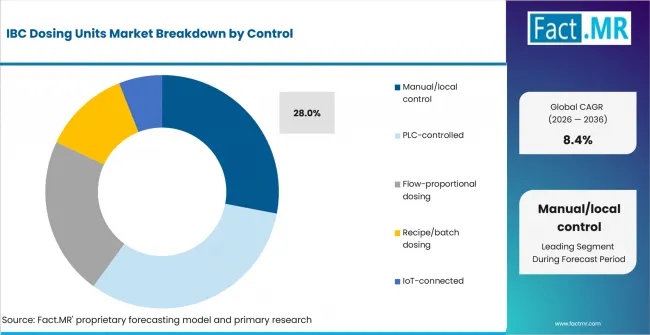
Ibc Dosing Units Market Analysis By Control | Source: Fact.MR
Many dosing stations still operate beside smaller production lines where a worker checks the tote and starts the pump by hand. PLC-Controlled Systems are becoming more common in plants that follow set recipes. Flow-Proportional Dosing changes the chemical feed when water flow rises or falls. Recipe and Batch Dosing deliver a set amount for each production run. IoT-Connected Controls add remote alarms and records of chemical use.
Why do Chemical Processors lead End User?
Chemical Processors are forecast to hold 29.0% share in 2026.
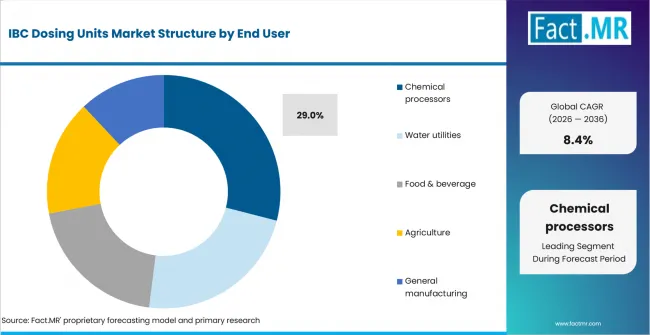
Ibc Dosing Units Market Analysis By End User | Source: Fact.MR
Chemical plants handle many liquids in volumes that fit tote-based dosing. These units make it easier to change formulas without installing a separate tank for every material. Water Utilities use them for treatment chemicals. Food and Beverage Plants look for clean and secure connections where ingredients or additives enter the line. Agriculture uses mobile units during seasonal work. General Manufacturing relies on compact stations for plant upkeep, cleaning and other support tasks.
What is accelerating IBC Dosing Units Market adoption, and what is holding it back?
Flexible chemical supply is anticipated to expand IBC Dosing Units Market demand. Container variability is expected to restrain adoption where fittings, liners and viscosities differ between suppliers.
Drivers Impact Analysis
| DRIVER | (~) % IMPACT ON CAGR | GEOGRAPHIC RELEVANCE | IMPACT TIMELINE |
|---|---|---|---|
| Flexible chemical supply | +2.4% | China; UAE; USA | Short term (<=2 years) |
| Safer container changeover | +1.8% | USA; UK; Germany | Short term (<=2 years) |
| Batch traceability | +1.3% | Japan; Germany; USA | Medium term (2-4 years) |
| Mobile dosing demand | +0.8% | China; UAE; general manufacturing | Medium term (2-4 years) |
Source: Fact.MR analysis. Updated Jul 21, 2026
- Flexible chemical supply: China’s National Bureau of Statistics reported in February 2026 that value added for raw chemical materials and chemical products rose 7.8% in 2025. That production base is expected to keep IBC stations relevant where plants need mid-volume chemical feeds without permanent storage.
- Safer container changeover: OSHA published its Hazard Communication Standard final rule in May 2024 and set the effective date for July 2024. That rule is expected to keep labels, safety data sheets and chemical handling procedures visible in U.S. plants.
- Batch traceability: Recipe-linked dosing is expected to matter where one line consumes several additives during the same shift. Barcode checks and PLC records give supervisors a clearer link between the tote and the batch.
- Mobile dosing demand: Portable skids are projected to suit shutdown cleaning, pilot runs and seasonal chemical use. A mobile unit lets a plant dose from an IBC without building a fixed storage point.
Opportunity Impact Analysis
| OPPORTUNITY | (~) % IMPACT ON CAGR | GEOGRAPHIC RELEVANCE | IMPACT TIMELINE |
|---|---|---|---|
| Smart connection verification | +1.5% | Japan; Germany; USA | Short term (<=2 years) |
| Low-heel suction systems | +1.1% | China; UAE; water treatment | Medium term (2-4 years) |
| Rental fleets | +0.8% | UAE; China; general manufacturing | Medium term (2-4 years) |
Source: Fact.MR analysis. Updated Jul 21, 2026
- Smart connection verification: Keyed couplings and digital checks are expected to reduce the chance of connecting the wrong tote. This opportunity fits plants where a mistake affects product quality and worker exposure at the same time.
- Low-heel suction systems: ProMinent stated in November 2025 that its SAFE-IBC F&B uses an inclined IBC surface to reduce residues. Lower heel loss is expected to appeal where additives are costly or disposal costs are high.
- Rental fleets: Short projects need dosing capacity without a permanent installation. Rental and service models are expected to work best where distributors can maintain pumps, hoses and couplings between jobs.
Restraints Impact Analysis
| RESTRAINT | (~) % IMPACT ON CAGR | GEOGRAPHIC RELEVANCE | IMPACT TIMELINE |
|---|---|---|---|
| Container variability | -1.9% | Global | Medium term (2-4 years) |
| Manual handling exposure | -1.3% | USA; UK; Germany | Short term (<=2 years) |
| Low technical entry barrier | -1.0% | Global | Short term (<=2 years) |
Source: Fact.MR analysis. Updated Jul 21, 2026
- Container variability: Outlet fittings, liners and chemical viscosity differ across IBC suppliers. A station that works well with one tote design can need adapters before it works safely with another.
- Manual handling exposure: A closed-transfer station still depends on the operator connecting, purging and removing the tote correctly. Poor procedure is expected to weaken the safety value of the equipment.
- Low technical entry barrier: A basic pump-over-IBC skid is simple enough for local fabrication. That puts price pressure on standard units and pushes branded suppliers toward service, controls and safer connection hardware.
Which countries are scaling IBC Dosing Units Market fastest?
A global growth rate represents the weighted average of all markets included in the analysis. It therefore cannot exceed the growth rate of every individual market within the coverage set. China and the UAE are positioned above the 8.4% global rate, while Japan, the United Kingdom and Germany remain below it. The six countries presented are illustrative examples, and their comparison with the global figure makes this difference visible.
- China and the UAE form a compact upper group. China benefits from chemical production and water-treatment demand, while the UAE relies more on industrial projects that need controlled chemical feed without permanent bulk storage.
- The USA and Japan remain closely aligned near the global rate. USA demand reflects chemical-safety documentation and retrofit work, while Japan places more weight on compact equipment and recipe-linked dosing. The United Kingdom and Germany form a measured lower group shaped by exposure control and automation upgrades.
- Markets with broadly similar CAGRs can therefore follow substantially different development paths. These differences become relevant when comparing changeover safety, control requirements and the availability of engineered chemical-handling systems.
The full report examines these dynamics for every market included in the study. It provides country-level CAGR analysis across North America, Latin America, Europe, East Asia, South Asia, Oceania, and the Middle East and Africa.
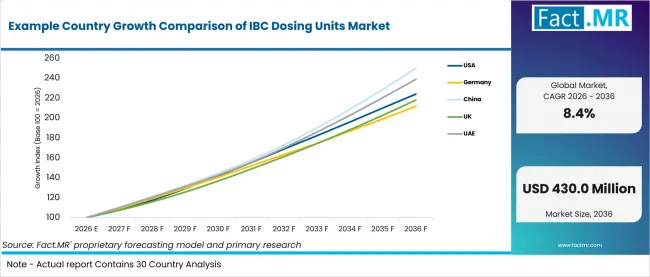
Example Country Growth Comparison Of Ibc Dosing Units Market | Source: Fact.MR
| COUNTRY | CAGR (2026 to 2036) |
|---|---|
| UAE | 9.1% |
| USA | 8.4% |
| Japan | 8.3% |
| UK | 8.1% |
| Germany | 7.8% |
Source: Fact.MR analysis. Updated Jul 21, 2026
Where does the UAE market opportunity come from?
9.1% CAGR, linked to water reuse projects and changing industrial needs.
Many sites in the UAE need chemical-feed systems that are quick to install and easy to move when plant needs change. IBC dosing units fit between small drums and large storage tanks, which makes them useful for medium-volume chemical use. Their small size also suits desalination plants, water-treatment sites and industrial facilities where space is limited and equipment must be ready for use without long installation work.
How are safety rules influencing USA adoption?
8.4% CAGR, led by safer handling of hazardous chemicals and better tote changeover.
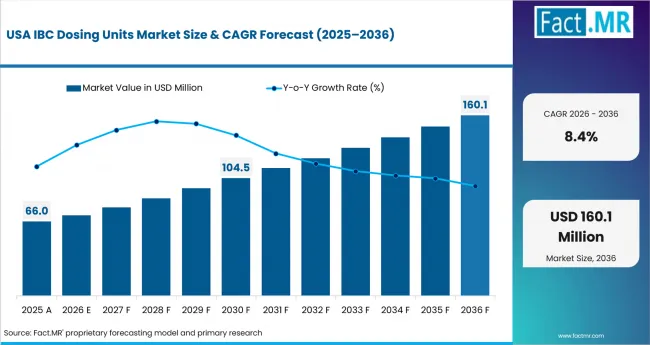
Ibc Dosing Units Market Country Value Analysis | Source: Fact.MR
Workplace rules in the USA require clear labels, proper safety records and employee training when chemicals are handled. IBC dosing stations help apply these controls at the point where the chemical enters the production line. Locked or matched connections reduce the risk of using the wrong line. Covered transfer points and tote checks also help protect workers from spills and splashes.
Why does Japan favor compact dosing systems?
8.3% CAGR, supported by limited factory space and strict control over production formulas.
Factories in Japan often have to fit new dosing equipment around machines that are already in place. Compact IBC units work well in these settings because they use less floor space while still giving a steady and accurate chemical feed. Digital recipe links and batch records also help operators check that the right additive was used in each production run.
What is directing demand in the United Kingdom?
8.1% CAGR, shaped by the need to reduce worker contact with chemicals.
Demand in the United Kingdom is closely linked to the way workers connect, clean and remove IBC totes. These steps can expose them to liquid, mist or vapor even when the pump is covered. Sealed connections and clear handling steps help plants lower this risk and follow existing COSHH safety rules.
Where are German suppliers finding new demand?
7.8% CAGR, tied to upgrades of older chemical-feed systems.
Germany already has many well-built dosing systems, so demand is less focused on basic first-time installations. More opportunities are coming from upgrades that improve checking, recording and chemical changeover. Barcode scanning can confirm that the correct tote is connected, while automatic batch records make it easier to track chemical use. Safer connection designs are also becoming more important, giving suppliers more room to grow than a basic pump-frame system alone.
Who leads the IBC Dosing Units Market?
ProMinent leads direct IBC dosing-system coverage, while Watson-Marlow and Verder strengthen pump technology and application-specific chemical handling.
ProMinent supports the market through dedicated systems such as DULCODOS SAFE-IBC F&B, which combines hygienic metering with continued dosing during tote replacement. Watson-Marlow adds peristaltic metering technology suited to corrosive and difficult fluids, while Verder broadens the field through dosing pumps and control systems used in water treatment and industrial processes. Lutz-Jesco contributes chemical-feed equipment for treatment and process applications. Grundfos adds broad metering-pump reach across utilities and manufacturing sites.
Through 2036, competition is expected to depend on changeover safety, chemical compatibility and dosing accuracy. Plant buyers are also likely to compare tote verification, spill containment and spare-part availability. Providers that connect pumps with safer couplings, simple controls and reliable service support may gain stronger demand.
Which companies are the key providers?
Key companies include ProMinent; Watson-Marlow; Verder; Lutz-Jesco; Grundfos.
- ProMinent
- Watson-Marlow
- Verder
- Lutz-Jesco
- Grundfos
Bibliography
- National Bureau of Statistics of China. (2026, February 28). Statistical Communiqué of the People’s Republic of China on the 2025 National Economic and Social Development.
- Occupational Safety and Health Administration. (2024, May 20). Hazard Communication Standard; Final Rule.
- U.S. Department of Labor. (2024, May 20). Department of Labor announces final rule updating the Hazard Communication Standard to better protect workers, first responders.
- UK Health and Safety Executive. (2026). Workplace exposure limits: COSHH.
This Report Addresses
- The report provides strategic intelligence on IBC Dosing Units Market across Unit Type and Pump Type choices that shape purchasing decisions.
- Segment analysis covers Pump-over-IBC skids as the share leader within the 2026 market.
- Regional outlook evaluates China and UAE alongside USA and Japan, with UK and Germany completing the growth comparison.
- Competitive analysis profiles ProMinent alongside Watson-Marlow and Verder, followed by additional active providers.
- Use-case assessment covers chemical handling categories and control formats that shape IBC dosing units market demand across the forecast period.
What does the IBC Dosing Units Market cover?
Equipment used to connect an intermediate bulk container with a controlled chemical-feed point through pumps, suction lances, couplings, containment and control hardware.
The IBC Dosing Units Market covers pump-over-IBC skids, integrated dosing cabinets, agitated systems, closed-transfer units and mobile dosing carts. Coverage includes diaphragm, peristaltic, progressive cavity, AODD and centrifugal pump configurations. The market also includes manual controls, PLC systems, flow-proportional dosing, recipe-based dosing and connected monitoring when these functions with the dosing station.
The market differs from general chemical transfer equipment because value comes from controlled metering, safer tote changeover and direct connection with the process line. The IBC container and chemical contents remain outside the boundary. Permanent bulk-storage systems and standalone transfer pumps are also excluded when they do not form part of an integrated dosing unit.
What is included in the scope?
IBC dosing equipment used across chemical processing, water treatment, food and beverage production, agriculture and general manufacturing is included.
The scope covers Unit Type and Pump Type alongside Chemical Handled, Control and End User. Chemical coverage includes water-treatment chemicals, cleaning and CIP liquids, process additives, agrochemicals, coatings and inks. Suction lances, matched couplings, drip containment and flow instruments are included within the dosing system. PLC panels, barcode checks and mobile frames follow the same integration rule.
What is excluded from the scope?
The IBC container, chemical contents and unrelated bulk-transfer equipment remain outside the market.
The scope excludes permanent storage tanks and pumps sold without dosing integration. Bulk unloading equipment used only to move chemicals into storage is excluded. Temporary hoses, standalone mixers and general plant piping are outside the boundary unless they form part of a complete IBC dosing station. Chemical purchasing value and downstream product value are not counted.
How Was the Analysis Built?
The analysis draws on 120+ sources, 35+ company portfolios, 25+ countries, and more than 20 industry interviews.
- Primary Research: Primary research includes discussions with manufacturers, service providers, technology developers, distributors, end users, procurement teams, and subject-matter experts. These conversations examine purchasing priorities, product adoption, operational challenges, approval requirements, competitive positioning, and the factors that influence wider market acceptance.
- Desk Research: Desk research covers government statistics, regulatory publications, company filings, trade data, technical studies, industry associations, standards, public policy, and other authoritative sources. Every source used in the analysis is documented in the bibliography.
- Market Sizing and Forecasting: Market estimates combine historical performance, demand indicators, pricing and volume trends, segment shares, company participation, country-level growth, adoption patterns, investment activity, and barriers to market expansion.
- Data Validation and Update Cycle: Findings are validated by comparing primary interviews with public data, company activity, regulatory changes, trade patterns, and industry developments. Regular updates review new product launches, capacity changes, partnerships, approvals, procurement trends, and shifts in commercial adoption.
Segmentation
What is the report's scope and coverage?
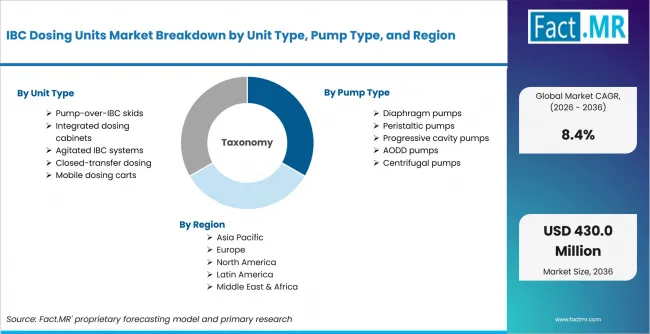
Ibc Dosing Units Market Breakdown By Unit Type, Pump Type, And Region | Source: Fact.MR
| Attribute | Details |
|---|---|
| Quantitative Units | USD Million |
| Market Definition | An IBC dosing unit connects an intermediate bulk container to a controlled chemical dosing process through pumps, lances, couplings, containment and controls. |
| Unit Type | Pump-over-IBC skids; Integrated dosing cabinets; Agitated IBC systems; Closed-transfer dosing; Mobile dosing carts |
| Pump Type | Diaphragm pumps; Peristaltic pumps; Progressive cavity pumps; AODD pumps; Centrifugal pumps |
| Chemical Handled | Water treatment chemicals; Cleaning/CIP chemicals; Process additives; Agrochemicals; Coatings & inks |
| Control | Manual/local control; PLC-controlled; Flow-proportional dosing; Recipe/batch dosing; IoT-connected |
| End User | Chemical processors; Water utilities; Food & beverage; Agriculture; General manufacturing |
| Regions Covered | North America; Latin America; Europe; East Asia; South Asia & Oceania; Middle East & Africa |
| Countries Covered | USA; Canada; Brazil; Mexico; Germany; U.K.; France; Italy; Spain; South Korea; Japan; China; India; Australia & New Zealand; GCC Countries; South Africa; UAE |
| Key Companies Profiled | ProMinent; Watson-Marlow; Verder; Lutz-Jesco; Grundfos |
| Forecast Period | 2026 to 2036 |
| Approach | Hybrid top-down and bottom-up approach using demand indicators across Unit Type, Pump Type, Chemical Handled, Control and End User |
Source: Fact.MR analysis. Updated Jul 21, 2026
How is the market segmented?
-
By Unit Type:
- Pump-over-IBC skids
- Integrated dosing cabinets
- Agitated IBC systems
- Closed-transfer dosing
- Mobile dosing carts
-
By Pump Type:
- Diaphragm pumps
- Peristaltic pumps
- Progressive cavity pumps
- AODD pumps
- Centrifugal pumps
-
By Chemical Handled:
- Water treatment chemicals
- Cleaning/CIP chemicals
- Process additives
- Agrochemicals
- Coatings & inks
-
By Control:
- Manual/local control
- PLC-controlled
- Flow-proportional dosing
- Recipe/batch dosing
- IoT-connected
-
By End User:
- Chemical processors
- Water utilities
- Food & beverage
- Agriculture
- General manufacturing
-
By Region:
- North America
- USA
- Canada
- Latin America
- Brazil
- Mexico
- Rest of Latin America
- Europe
- Germany
- U.K.
- France
- Italy
- Spain
- Rest of Europe
- East Asia
- South Korea
- Japan
- China
- South Asia & Oceania
- India
- Australia & New Zealand
- Rest of South Asia & Oceania
- Middle East & Africa
- GCC Countries
- South Africa
- UAE
- Rest of Middle East & Africa
- North America
Frequently Asked Questions
Which Unit Type leads the IBC Dosing Units Market?
Which Pump Type leads the IBC Dosing Units Market?
Which Chemical Handled leads the IBC Dosing Units Market?
Which Control leads the IBC Dosing Units Market?
Which End User leads the IBC Dosing Units Market?
Which country records the highest CAGR in the IBC Dosing Units Market?
How does UAE perform in the IBC Dosing Units Market?
How does USA perform in the IBC Dosing Units Market?
What is the primary driver in the IBC Dosing Units Market?
What is the main restraint in the IBC Dosing Units Market?
Who worked on this report


Preview the report firsthand - request a free sample
Free SampleGet the brochure for pricing and purchase details
Download PDF