- Base Value(2025): 34.4 Bn
- Estimated Value(2026): 43.9 Bn
- Forecast Value (2036): 287.4 Bn
- CAGR (2026 - 2036): 27.5%
iBeacon and Bluetooth Beacon Market Forecast By Fact.MR
In 2025, the iBeacon and bluetooth beacon market was valued at USD 34.4 billion. Based on Fact MR analysis, demand for iBeacon and Bluetooth beacon solutions is estimated to grow to USD 43.9 billion in 2026 and USD 287.4 billion by 2036. FMR projects a CAGR of 27.5% during the forecast period.
The absolute dollar growth from 2026 to 2036 is USD 243.5 billion. This magnitude of expansion reflects a structural shift in proximity based communication and location intelligence systems rather than incremental growth in wireless hardware. Beacon technologies are widely deployed across retail, transportation, healthcare, and smart infrastructure environments to enable indoor navigation, asset tracking, and location based marketing. Demand continues to expand as organizations integrate proximity data into customer engagement systems and operational analytics platforms. Growth remains influenced by privacy regulations, integration complexity with mobile applications, and competition from alternative positioning technologies.
India leads with a projected CAGR of 10.1%, supported by expanding retail digitization and increasing deployment of location based services across commercial spaces. China follows with a CAGR of 9.8%, driven by large scale adoption of smart infrastructure and mobile driven digital ecosystems. The United States records a CAGR of 9.2%, supported by demand for proximity marketing and indoor analytics solutions across retail and enterprise environments. Japan shows a CAGR of 8.9%, reflecting steady adoption in transportation systems and commercial facilities. Australia records the slowest growth at 8.7%, reflecting a smaller deployment base and mature wireless infrastructure environment. Mature markets generate a significant share of replacement demand as beacon systems are upgraded within existing digital infrastructure.
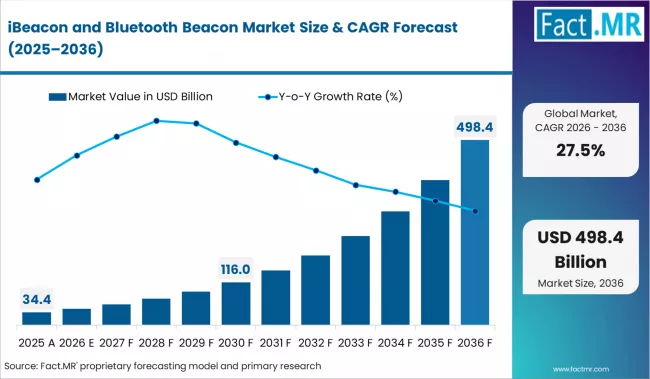
Ibeacon And Bluetooth Beacon Market Market Value Analysis | Source: Fact.MR
| Metric | Details |
|---|---|
| Industry Size (2026E) | USD 43.9 billion |
| Industry Value (2036F) | USD 287.4 billion |
| CAGR (2026 to 2036) | 27.5% |
Source: Fact.MR analysis. Updated Mar 23, 2026
iBeacon and Bluetooth Beacon Market Definition
The iBeacon and Bluetooth Beacon Market includes small wireless devices that use Bluetooth low energy technology to transmit signals to nearby smartphones or connected devices. These beacons broadcast unique identifiers that trigger location based actions such as notifications, content delivery, or tracking. iBeacon refers to a specific protocol used within the broader Bluetooth beacon ecosystem. These devices are widely deployed in retail stores, airports, museums, and public spaces to support proximity marketing, indoor navigation, and asset tracking. The primary function of beacon technology is to enable short range location awareness and interaction between physical environments and mobile applications.
iBeacon and Bluetooth Beacon Market Inclusions
This report covers global and regional market sizes for iBeacon and Bluetooth beacon devices with forecast analysis for the study period. The market is segmented by component including beacon hardware and associated management software. Application segments include proximity marketing, indoor navigation, asset tracking, and location based analytics. End users include retail businesses, transportation hubs, hospitality providers, and public infrastructure operators. The report also evaluates pricing structures, deployment trends, and selected trade flow analysis across major location based technology markets.
iBeacon and Bluetooth Beacon Market Exclusions
The report excludes other wireless communication technologies such as Wi Fi based tracking systems, RFID solutions, and ultra wideband positioning systems. Consumer devices such as smartphones and tablets that receive beacon signals are not included. The scope also excludes general mobile applications that use location services without beacon integration. Large scale positioning infrastructure such as GPS satellite systems is outside the defined market scope, as the analysis focuses strictly on Bluetooth based beacon devices and related software.
iBeacon and Bluetooth Beacon Market Research Methodology
- Primary Research: Interviews were conducted with beacon device manufacturers, software platform providers, system integrators, and retail technology specialists.
- Desk Research: Public information was collected from wireless technology publications, company reports, regulatory documents, and international trade statistics.
- Market-Sizing and Forecasting: A hybrid model combining bottom up device shipment analysis with top down demand assessment across retail and location based service sectors was applied.
- Data Validation and Update Cycle: Findings were cross verified using multiple industry data sources and expert inputs, with periodic updates conducted as new market information becomes available.
Summary of the iBeacon and Bluetooth Beacon Market
- Market Definition
- The market comprises Bluetooth low energy based devices and associated software platforms that enable short range wireless communication between physical environments and mobile devices. These beacons transmit unique identifiers to trigger location based actions such as notifications, navigation, and asset tracking. iBeacon represents a specific protocol within the broader beacon ecosystem. These technologies are widely deployed across retail, transportation, public infrastructure, and commercial environments to support indoor positioning and proximity based interaction.
- Demand Drivers
- Increasing deployment of location based services across retail, transportation, and public infrastructure environments.
- Rising demand for proximity based communication systems enabling customer engagement, navigation, and asset tracking.
- Expansion of smart infrastructure and indoor positioning systems across commercial and public spaces.
- Growing integration of beacon data with analytics platforms for operational insights and user behavior tracking.
- Key Segments Analyzed
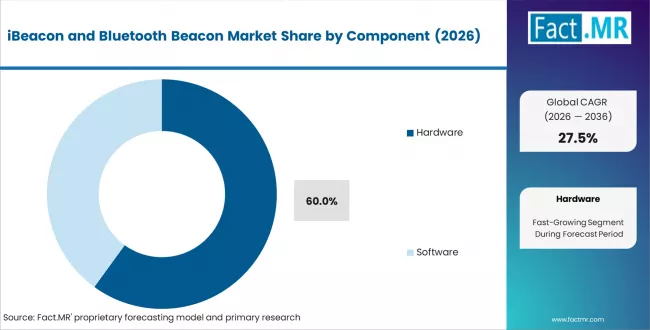
- Component: Hardware accounts for about 60% share supported by widespread deployment of beacon devices across physical environments.
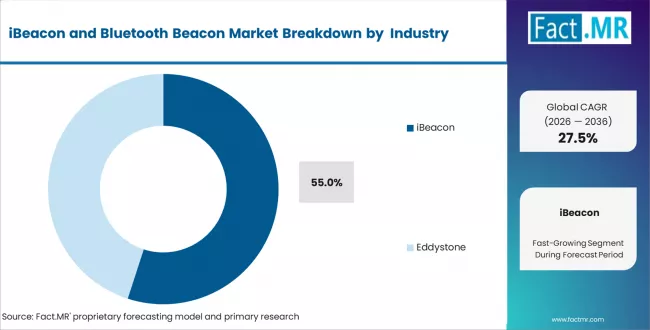
- Technology Platform: iBeacon represents roughly 55% share due to compatibility with mobile ecosystems and application integration.
- End Use: Retail, transportation, and public infrastructure drive demand through proximity marketing and navigation use cases.
- Geography: India records the fastest expansion supported by retail digitization and adoption of location based services.
- Analyst Opinion at Fact MR
- Shambhu Nath Jha, Principal Consultant, Fact MR, opines, "In this updated edition of the iBeacon and Bluetooth Beacon Market report, industry participants will observe that proximity based communication systems are increasingly integrated with analytics and digital engagement platforms. These technologies enable location aware services and real time interaction across commercial environments. Companies offering scalable beacon infrastructure and data integration capabilities will maintain competitive positions in location based technology markets."
- Strategic Implications or Executive Takeaways
- Invest in development of integrated beacon platforms supporting indoor navigation, asset tracking, and proximity based services.
- Strengthen compatibility with mobile applications and analytics systems to enhance data utilization and service delivery.
- Address privacy and data protection requirements associated with location based technologies.
- Expand deployment across smart infrastructure, retail environments, and transportation systems.
- Methodology
- Primary interviews conducted with beacon device manufacturers, software platform providers, system integrators, and retail technology specialists.
- Desk research based on wireless technology publications, company reports, regulatory documents, and international trade statistics.
- Market sizing developed through a hybrid approach combining bottom up device shipment analysis and top down demand assessment across location based service sectors.
- Findings validated through multiple industry data sources and expert consultations following Fact MR internal modeling standards.
Segmental Analysis
iBeacon and Bluetooth Beacon Market Analysis by Component
Ibeacon And Bluetooth Beacon Market Analysis By Component | Source: Fact.MR
- Market Overview: Hardware components are projected to account for around 60% share of the iBeacon and Bluetooth beacon market by 2026. Hardware devices include beacon transmitters, sensors, and supporting infrastructure that enable proximity based communication using Bluetooth low energy technology. These devices are deployed in retail stores, transportation hubs, healthcare facilities, and public venues to transmit location based signals to nearby smartphones and connected devices. Organizations rely on beacon hardware to enable indoor navigation, asset tracking, and location based marketing. The physical deployment of beacon infrastructure across commercial environments supports sustained demand for hardware components.
- Demand Drivers:
- Proximity Based Communication Systems: Beacon hardware transmits signals to nearby devices, enabling location based services and user interaction.
- Retail and Commercial Deployment: Businesses install beacon devices in stores and public spaces to support customer engagement and navigation.
- Infrastructure Expansion: Increasing deployment of beacon networks across indoor environments drives demand for hardware components.
iBeacon and Bluetooth Beacon Market Analysis by Technology Platform
Ibeacon And Bluetooth Beacon Market Analysis By Technology Platform | Source: Fact.MR
- Market Overview: iBeacon technology is expected to represent approximately 55% share of the iBeacon and Bluetooth beacon market in 2026. iBeacon is a proximity based communication protocol that enables devices to broadcast identifiers to nearby smartphones and applications using Bluetooth low energy signals. The technology is widely used in retail, hospitality, and event management to deliver location based notifications, promotions, and navigation assistance. Organizations deploy iBeacon platforms to enhance customer engagement and provide contextual information within indoor environments. The compatibility of iBeacon with mobile applications supports its widespread adoption across commercial use cases.
- Demand Drivers:
- Mobile Device Integration: iBeacon technology enables smartphones to receive location based signals and notifications within proximity enabled environments.
- Location Based Services: Businesses use iBeacon platforms to deliver targeted content, navigation assistance, and promotional messaging to users.
- Indoor Positioning Applications: iBeacon systems support indoor navigation and asset tracking within commercial and public facilities.
iBeacon and Bluetooth Beacon Market Drivers, Restraints, and Opportunities
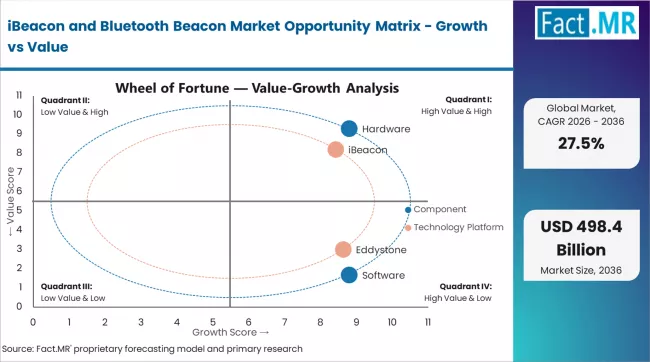
Ibeacon And Bluetooth Beacon Market Opportunity Matrix Growth Vs Value | Source: Fact.MR
Fact MR analysis indicates that the iBeacon and Bluetooth beacon market developed from proximity-based wireless communication technologies used in retail and indoor navigation systems. Early beacon deployments enabled location-based messaging within stores, museums, and public venues where GPS signals were unreliable indoors. The current market valuation reflects the integration of low-energy Bluetooth beacons into retail analytics, asset tracking, and smart building systems. Demand persists because beacon technology enables precise indoor positioning and targeted communication without requiring high power consumption or complex infrastructure.
A structural shift is occurring as standalone proximity marketing applications decline in relevance while broader location intelligence and asset tracking use cases expand. Traditional beacon deployments in retail environments remain present where proximity-based promotions continue to support in-store engagement strategies. Advanced beacon systems now integrate with analytics platforms, mobile applications, and IoT infrastructure to support indoor navigation, workforce tracking, and equipment monitoring. These integrated solutions require higher deployment and software costs compared with basic beacon hardware. Even with moderate hardware shipment growth, higher-value software and analytics services support overall market value expansion.
- Indoor Location Services: Enterprises deploy Bluetooth beacons to enable indoor navigation, asset tracking, and location-based service delivery across retail, healthcare, and logistics environments.
- Wireless Communication Standards: Protocols such as Bluetooth Low Energy (BLE) standards and Apple iBeacon specifications define device interoperability and signal transmission characteristics.
- North America Retail Deployment: The United States remains a key market where retailers and venue operators implement beacon technology for customer engagement and operational analytics.
Regional Analysis
The iBeacon and Bluetooth Beacon Market is assessed across North America, Europe, Asia Pacific, Latin America, and Middle East & Africa, segmented by country-level proximity marketing adoption, retail digitization, and indoor positioning deployments. Regional demand reflects location-based services, mobile integration, and infrastructure readiness. The full report offers market attractiveness analysis.
.webp "Top Country Growth Comparison Ibeacon And Bluetooth Beacon Market Cagr (2026 2036)")
Top Country Growth Comparison Ibeacon And Bluetooth Beacon Market Cagr (2026 2036) | Source: Fact.MR
| Country | CAGR (2026-2036) |
|---|---|
| USA | 9.2% |
| China | 9.8% |
| Japan | 8.9% |
| India | 10.1% |
| Australia | 8.7% |
Source: Fact.MR analysis. Updated Mar 23, 2026
Source: Fact MR analysis, based on proprietary forecasting model and primary research
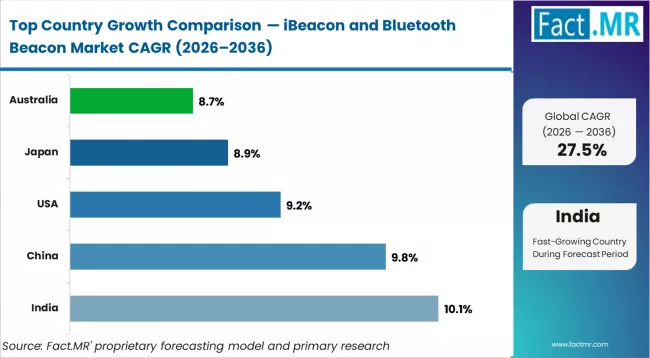
Ibeacon And Bluetooth Beacon Market Cagr Analysis By Country | Source: Fact.MR
North America
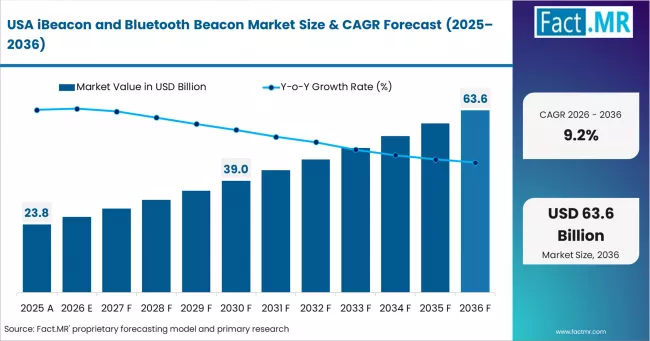
Ibeacon And Bluetooth Beacon Market Country Value Analysis | Source: Fact.MR
North America functions as the proximity marketing and location analytics innovation hub, supported by strong retail digitization and mobile ecosystem integration. Apple Inc. established the iBeacon protocol and maintains ecosystem influence. Estimote, Inc. focuses on enterprise beacon solutions. Kontakt.io Inc. expands indoor location services.
- USA: Demand for iBeacon and Bluetooth beacon in USA is projected to rise at 9.2% CAGR through 2036. Growth is supported by FCC indoor positioning initiatives (Federal Communications Commission, March 2020) enabling location accuracy improvements. Apple Inc. expanded location-based service capabilities across iOS devices (June 2023), supporting adoption.
Asia Pacific
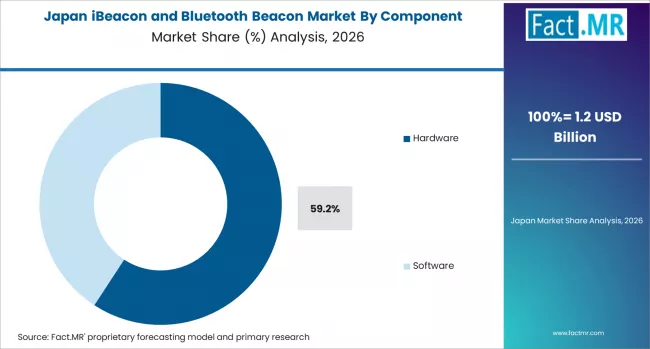
Ibeacon And Bluetooth Beacon Market Japan Market Share Analysis By Component | Source: Fact.MR
Asia Pacific serves as the high-growth location-based services and smart infrastructure market, supported by mobile penetration and smart city programs. Alibaba Group Holding Limited integrates beacon technology into retail ecosystems. Sony Group Corporation develops Bluetooth beacon hardware. Gimbal, Inc. supports proximity marketing platforms.
- China: Demand for iBeacon and Bluetooth beacon in China is projected to rise at 9.8% CAGR through 2036. The Smart City initiatives (Ministry of Housing and Urban-Rural Development, ongoing) support indoor positioning deployments. Alibaba Group Holding Limited expanded proximity marketing and retail analytics solutions (April 2023), supporting adoption.
- Japan: Demand for iBeacon and Bluetooth beacon in Japan is projected to rise at 8.9% CAGR through 2036. The Society 5.0 initiative (Cabinet Office, updated 2021) promotes smart infrastructure adoption. Sony Group Corporation expanded Bluetooth beacon product offerings (February 2023), supporting enterprise deployment.
- India: Demand for iBeacon and Bluetooth beacon in India is projected to rise at 10.1% CAGR through 2036. The Smart Cities Mission (Ministry of Housing and Urban Affairs, ongoing since 2015) supports location-based service deployment. Gimbal, Inc. expanded partnerships for proximity marketing solutions (May 2023), supporting market growth.
- Australia: Demand for iBeacon and Bluetooth beacon in Australia is projected to rise at 8.7% CAGR through 2036. The Digital Economy Strategy (Australian Government, May 2021) supports adoption of location-based technologies. Kontakt.io Inc. expanded indoor navigation and asset tracking solutions (March 2023), supporting enterprise adoption.
Fact MR's analysis of iBeacon and Bluetooth beacon market in global regions consists of country-wise assessment that includes USA, China, Japan, India, and Australia. Readers can find proximity technology trends, deployment patterns, regulatory developments, and competitive positioning across key markets.
Competitive Structure and Buyer Dynamics in the iBeacon and Bluetooth Beacon Market
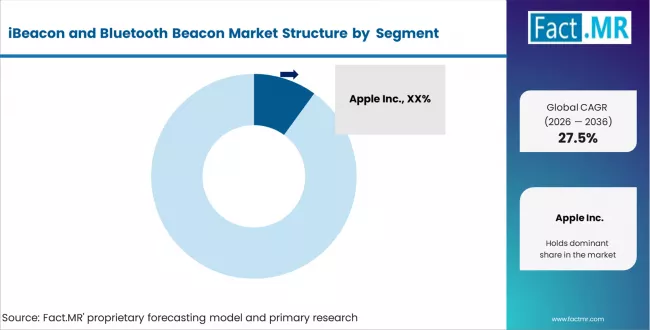
Ibeacon And Bluetooth Beacon Market Analysis By Company | Source: Fact.MR
The competitive structure of the iBeacon and Bluetooth Beacon Market is moderately fragmented, with a mix of platform developers, hardware manufacturers, and proximity marketing solution providers participating in supply. Apple Inc. maintains a central role through its iBeacon protocol, which supports ecosystem development across retail, hospitality, and event management applications. Companies such as Estimote, Inc., Kontakt.io, Inc., Gimbal, Inc., Radius Networks, Inc., BlueCats Australia Pty Ltd, Beaconinside GmbH, Sensoro Co., Ltd., Jaalee Technology Co., Ltd., and Digital Payments Group Ltd. operate in beacon hardware, software platforms, and location based analytics solutions. Aruba Networks, Inc. contributes through enterprise networking integration and location services platforms. Competition is primarily influenced by beacon accuracy, battery efficiency, device management capability, and integration with mobile applications and enterprise systems.
Several companies maintain structural advantages through control of platform ecosystems and enterprise network integration capabilities. Apple Inc. benefits from its mobile operating system ecosystem, enabling seamless compatibility with iBeacon enabled applications. Aruba Networks, Inc. maintains advantages through integration with enterprise Wi-Fi infrastructure and location analytics platforms. Specialized providers such as Kontakt.io, Inc. and Estimote, Inc. offer advanced beacon management systems and analytics capabilities tailored for enterprise deployments. Buyers, including retailers and facility operators, often adopt multi vendor strategies to reduce dependence on a single provider and ensure system flexibility. Procurement decisions evaluate vendors based on deployment scalability, data accuracy, and long term device management support. This purchasing behavior moderates supplier pricing leverage, while providers with integrated platforms and strong ecosystem compatibility retain stronger negotiating influence.
Key Players of the iBeacon and Bluetooth Beacon Market
- Apple Inc.
- Estimote, Inc.
- Kontakt.io, Inc.
- Gimbal, Inc.
- Radius Networks, Inc.
- BlueCats Australia Pty Ltd
- Beaconinside GmbH
- Sensoro Co., Ltd.
- Aruba Networks, Inc.
- Jaalee Technology Co., Ltd.
- Digital Payments Group Ltd
Report Scope
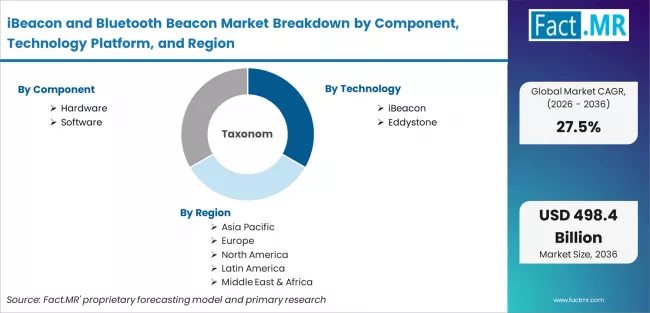
Ibeacon And Bluetooth Beacon Market Breakdown By Component, Technology Platform, And Region | Source: Fact.MR
| Metric | Value |
|---|---|
| Quantitative Units | USD 43.9 billion (2026) to USD 287.4 billion (2036), at a CAGR of 27.5% |
| Market Definition | The iBeacon and Bluetooth beacon market includes proximity based wireless communication systems that use Bluetooth Low Energy technology to transmit signals between beacons and smart devices, enabling location based services, asset tracking, indoor navigation, and customer engagement across commercial and industrial environments. |
| Component Segmentation | Hardware, Software |
| Technology Platform Segmentation | iBeacon, Eddystone |
| End Use Segmentation | Retail, Airports, Museums, Manufacturing and R&D, Transportation, Buildings and Infrastructure, Other End Uses |
| Regions Covered | North America, Latin America, Europe, East Asia, South Asia, Oceania, Middle East and Africa |
| Countries Covered | United States, Canada, Mexico, Brazil, Germany, United Kingdom, France, Italy, Spain, China, India, Japan, South Korea, Australia, and 40+ countries |
| Key Companies Profiled | Apple Inc., Estimote, Inc., Kontakt.io, Inc., Gimbal, Inc., Radius Networks, Inc., BlueCats Australia Pty Ltd, Beaconinside GmbH, Sensoro Co., Ltd., Aruba Networks, Inc., Jaalee Technology Co., Ltd., Digital Payments Group Ltd |
| Forecast Period | 2026 to 2036 |
| Approach | Hybrid top-down and bottom-up market modeling supported by proximity marketing adoption analysis, Bluetooth device penetration data, indoor location service deployment trends, and validation through interviews with beacon manufacturers, platform providers, and enterprise users. |
Source: Fact.MR analysis. Updated Mar 23, 2026
Bibliographies
- [1] Federal Communications Commission (FCC), USA. (2020). Indoor positioning initiatives.
- [2] Ministry of Housing and Urban-Rural Development (MOHURD), China. (ongoing). Smart City initiatives.
- [3] Cabinet Office, Japan. (2021). Society 5.0 initiative.
- [4] Ministry of Housing and Urban Affairs, India. (2015, ongoing). Smart Cities Mission.
- [5] Australian Government. (2021). Digital Economy Strategy.
- [6] Apple Inc. (2023). Location-based service capabilities expansion.
- [7] Alibaba Group Holding Limited. (2023). Proximity marketing solutions expansion.
- [8] Sony Group Corporation. (2023). Bluetooth beacon offerings expansion.
- [9] Gimbal, Inc. (2023). Proximity marketing partnerships expansion.
This Report Addresses
- Market size estimation and revenue forecasts for the iBeacon and Bluetooth Beacon Market from 2026 to 2036, supported by proximity technology deployment benchmarks and indoor positioning system adoption indicators across commercial and public infrastructure environments.
- Growth opportunity analysis across hardware and software components, along with iBeacon and Eddystone technology platforms used in Bluetooth low energy based proximity communication systems.
- Segment and regional revenue forecasts covering retail, airports, museums, manufacturing and R&D, transportation, buildings and infrastructure, and other end use environments deploying beacon enabled location intelligence solutions.
- Competitive strategy assessment including beacon device performance capability, mobile ecosystem integration, and location analytics platform benchmarking among proximity technology providers and enterprise solution vendors.
- Regulatory and standards evaluation covering frameworks such as Bluetooth Low Energy communication standards and regional data privacy regulations affecting proximity data usage and location based service deployment.
- Market report delivery in PDF, Excel, PPT, and interactive dashboard formats designed for location based service strategy planning, retail analytics evaluation, and indoor navigation system deployment.
- Supply chain and operational risk analysis identifying privacy regulation constraints, integration complexity with mobile applications, and competition from alternative indoor positioning technologies affecting adoption of beacon based proximity systems.
Segmentation
iBeacon and Bluetooth Beacon Market Key Segments
-
Component :
- Hardware
- Software
-
Technology Platform :
- iBeacon
- Eddystone
-
End Use :
- Retail
- Airports
- Museums
- Manufacturing and R and D
- Transportation
- Buildings and Infrastructure
- Other End Uses
-
Region :
- North America
- USA
- Canada
- Mexico
- Europe
- Germany
- UK
- France
- Italy
- Spain
- Nordic Countries
- BENELUX
- Rest of Europe
- Asia Pacific
- China
- Japan
- South Korea
- India
- Australia
- Rest of Asia Pacific
- Latin America
- Brazil
- Argentina
- Rest of Latin America
- Middle East and Africa
- Kingdom of Saudi Arabia
- United Arab Emirates
- South Africa
- Rest of Middle East and Africa
- Other Regions
- Oceania
- Central Asia
- Other Markets
- North America
Frequently Asked Questions
How large is the demand for iBeacon and Bluetooth Beacon in the global market in 2026?
What will be the market size of iBeacon and Bluetooth Beacon in the global market by 2036?
What is the expected demand growth for iBeacon and Bluetooth Beacon in the global market between 2026 and 2036?
Which Component Segment is poised to lead global demand by 2026?
Which Company is Identified as a Leading Participant in the iBeacon and Bluetooth Beacon Market?
What is Driving iBeacon and Bluetooth Beacon Demand in the United States?
What is the United States Growth Outlook in this Report?
Why is China an Important Market for iBeacon and Bluetooth Beacon?
What is the China Growth Outlook in this Report?
Why is Japan an Important Market for iBeacon and Bluetooth Beacon?
What is the Japan Growth Outlook in this Report?
What Factors Support iBeacon and Bluetooth Beacon Demand in India?
What is the India Growth Outlook in this Report?
Why is Australia Included in the iBeacon and Bluetooth Beacon Market Outlook?
What is the Australia Growth Outlook in this Report?
What are iBeacon and Bluetooth Beacons and What are They Mainly Used For?
What does iBeacon and Bluetooth Beacon Market Mean in this Report?
What is Included in the Scope of this iBeacon and Bluetooth Beacon Market Report?
What is Excluded from the Scope of this Report?
What does Market Forecast Mean on this Page?
How is the iBeacon and Bluetooth Beacon Market Forecast Developed in this Report?
Who worked on this report


Preview the report firsthand - request a free sample
Free SampleGet the brochure for pricing and purchase details
Download PDF