- Base Value(2025): 6.30 Bn
- Estimated Value(2026): 6.51 Bn
- Forecast Value (2036): 9.00 Bn
- CAGR (2026 - 2036): 3.30%
Industrial Grease Market Size, Market Forecast and Outlook By Fact.MR
The industrial grease market was valued at USD 6.30 billion in 2025, projected to reach USD 6.51 billion in 2026, and is forecast to expand to USD 9.00 billion by 2036 at a 3.30% CAGR. Based on Fact.MR analysis, the absolute gain of USD 2.50 billion across the forecast period reflects sustained structural demand across key industrial verticals. The market is shaped by the convergence of material performance requirements, evolving regulatory standards, and end-use diversification across global manufacturing and construction sectors.
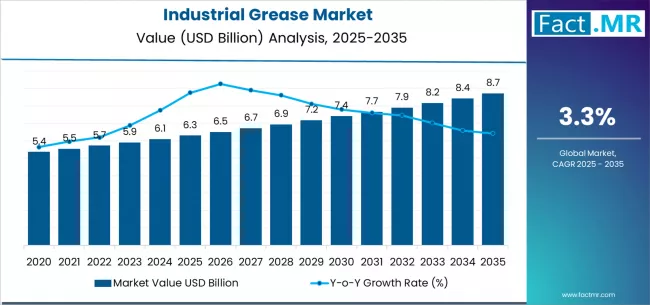
Industrial Grease Market Market Value Analysis | Source: Fact.MR
Summary of Industrial Grease Market
- Demand Drivers in the Market
- Expansion of automotive vehicle production in India, Southeast Asia, and Mexico is generating proportional OEM factory-fill demand for lithium and polyurea greases across wheel bearings, CV joints, and electric vehicle drivetrain components where new specification requirements differ from conventional drivetrains.
- Growth in renewable energy infrastructure, particularly wind turbine installation requiring specialized high-performance open gear and pitch bearing greases, is creating a high-value application segment that commands premium pricing above commodity automotive grades.
- Aging industrial machinery fleets in North America and Europe are requiring more frequent bearing repacking and relubrication intervals, sustaining aftermarket grease volume demand independent of new equipment production cycles.
- Key Segments Analyzed in the Fact.MR Report
- Lithium (Thickener): 55% share in 2026, lithium-thickened grease holds 55% share due to its multi-purpose compatibility with bearing and chassis lubrication requirements across the widest range of industrial and automotive equipment in global OEM and aftermarket specifications
- Automotive (Application): 40% share in 2026, automotive applications account for 40% of demand as vehicle drivetrain, wheel bearing, and chassis lubrication represents the highest-volume single end-use category globally across both OEM factory fill and aftermarket service
- India: 4.6% CAGR through 2036, driven by rapid expansion of automotive manufacturing capacity and growth of industrial machinery output requiring lubrication maintenance services
- Analyst Opinion at Fact.MR
- The industrial grease market is entering a product transition period driven by two intersecting forces: tightening environmental regulations on lithium extraction in key production geographies and growing demand for extended-drain synthetic grease formulations in high-value equipment. Lithium dominance faces a medium-term challenge as battery-grade lithium demand competes for the same raw material base, potentially elevating thickener costs and incentivizing migration to calcium sulfonate or polyurea alternatives. OEM customers are already qualifying alternative thickener systems in new equipment designs to reduce supply chain concentration risk, a trend that will reshape the competitive landscape of grease formulators who have historically built portfolios around lithium soap chemistry.
- Strategic Implications / Executive Takeaways
- Formulators should accelerate qualification of calcium sulfonate complex and polyurea thickener systems as drop-in alternatives to lithium grease for key OEM applications, reducing customer exposure to lithium supply chain risk.
- Investment in wind turbine-specific open gear and pitch bearing grease development should be prioritized as a margin-accretive specialty segment with multi-year contracted supply agreements attached to turbine installation programs.
- Distribution infrastructure in tier-2 and tier-3 industrial markets across South and Southeast Asia should be expanded to capture aftermarket maintenance volumes from the rapidly growing installed machinery base in these regions.
Industrial Grease Market Key Takeaways
| Metric | Details |
|---|---|
| Industry Size (2026) | USD 6.51 billion |
| Industry Value (2036) | USD 9.00 billion |
| CAGR (2026 to 2036) | 3.30% |
Source: Fact.MR analysis. Updated Mar 30, 2026
As per Fact.MR analysis, the industrial grease market sustains steady growth anchored to the maintenance requirements of an expanding global installed base of rotating machinery, automotive drivetrains, and construction equipment. Lithium-thickened grease retains dominant share at 55% due to its broad service temperature range and compatibility with multi-purpose bearing lubrication requirements across OEM and aftermarket channels. The aftermarket segment is gaining incremental volume as aging machinery fleets in mature economies require more frequent lubrication intervals, while OEM demand in Asia reflects new equipment production growth.
Asia Pacific drives volume growth anchored to automotive and industrial manufacturing expansion in China, India, and Southeast Asia. North America and Europe are stable replacement markets where extended-life synthetic grease adoption is reshaping volume per unit while maintaining revenue. Country-level CAGRs highlight divergent growth trajectories: India (4.6% CAGR), China (4.0% CAGR), Mexico (3.1% CAGR), USA (3.0% CAGR), Germany (2.8% CAGR), South Korea (2.5% CAGR), Japan (2.3% CAGR). Mature markets generate steady replacement demand, while high-growth economies benefit from capacity expansion and rising industrial output.
Why is the Industrial Grease Market Growing?
The industrial grease market grows by enabling equipment operators to optimize lubrication processes while accessing advanced grease technologies without substantial infrastructure requirements. Manufacturing facilities and industrial operations face mounting pressure to improve equipment reliability and comply with strict maintenance standards, with specialized greases typically providing 85-95% lubrication efficiency rates comparable to conventional alternatives, making advanced solutions essential for competitive operational positioning. The industrial sector's need for equipment protection and application-specific lubrication control creates demand for comprehensive grease solutions that can provide superior performance characteristics, maintain consistent lubrication properties, and ensure operational reliability without compromising equipment standards or maintenance requirements.
Government initiatives promoting advanced manufacturing and operational efficiency drive adoption in automotive, industrial, construction, and specialized applications, where lubrication quality has a direct impact on equipment performance and operational reliability. Formulation complexity constraints during application phases and the expertise requirements for specialized grease deployment may limit accessibility among smaller industrial facilities and developing regions with limited technical infrastructure for advanced lubrication systems.
Segmental Analysis
The market is segmented by thickener, application, end user, and region. By thickener, the market is divided into lithium, calcium, polyurea, and others. Based on application, the market is categorized into automotive, industrial, construction, and others. By end user, the market includes OEM and aftermarket. Regionally, the market is divided into Asia Pacific, Europe, North America, and other key regions.
By Thickener, the Lithium Segment Accounts for a Dominant Market Share
The lithium segment represents the dominant force in the market, capturing approximately 55.0% of total market share in 2026. This established thickener category encompasses solutions featuring sophisticated lithium soap formulations and advanced metallic compounds, including lithium 12-hydroxystearate and lithium complex systems and specialized molecules that enable superior mechanical stability and temperature resistance across all equipment types. The lithium segment's market leadership stems from its superior performance capabilities, with products capable of handling diverse industrial challenges while maintaining consistent lubrication properties and operational reliability across all operating environments.
The calcium segment maintains a substantial 20.0% market share, serving equipment operators who require cost-effective lubrication with enhanced water resistance features for specialized applications and harsh operating conditions. These products offer reliable grease solutions for water-exposed equipment while providing sufficient performance capabilities to meet operational standards and maintenance demands. The polyurea segment accounts for approximately 15.0% of the market, serving advanced lubrication applications. The others segment captures 10.0% market share, serving niche applications including specialty thickeners, synthetic formulations, and high-performance grease applications across various industrial sectors.
Key technological advantages driving the lithium segment include:
- Advanced thickener technologies with integrated soap structures that reduce oil separation and ensure consistent lubrication performance
- Multi-temperature compatibility options allowing effective lubrication across different operating temperature ranges without performance degradation
- Enhanced mechanical stability features, maintaining grease consistency under high-load conditions while preserving equipment protection
- Improved oxidation resistance enabling extended service intervals and enhanced equipment reliability requirements
By Application, the Automotive and Industrial Segments Account for Equal Market Share
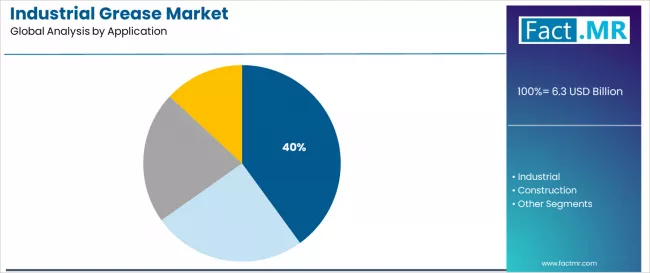
Industrial Grease Market Analysis By Application | Source: Fact.MR
Automotive applications dominate the application segment with approximately 40.0% market share in 2026, reflecting the critical role of grease lubrication in supporting global automotive manufacturing and maintenance operations worldwide. The automotive segment's market leadership is reinforced by increasing vehicle production, advanced bearing technologies, and rising requirements for lubrication diversity in comprehensive automotive programs across developed and emerging markets.
The industrial segment represents an equally significant category, capturing 40.0% market share through manufacturing equipment applications for machinery lubrication, bearing maintenance, and specialized industrial operations. This segment benefits from growing industry demand for reliable lubrication that meets specific performance requirements, operational standards, and maintenance protocols in competitive industrial markets.
The construction segment accounts for 15.0% market share, while others capture 5.0% market share, serving specialized applications including marine equipment, agricultural machinery, and precision lubrication applications across various industrial sectors.
Key market dynamics supporting application growth include:
- Automotive expansion driven by production increases and maintenance requirements, requiring specialized grease formulations in emerging markets
- Industrial modernization trends require high-quality, standardized greases for equipment consistency and operational compliance
- Integration of construction technologies enabling precision lubrication management and maintenance systems
- Growing focus on application diversity driving demand for comprehensive, multi-sector grease solutions
By End User, the OEM Segment Accounts for the Largest Market Share
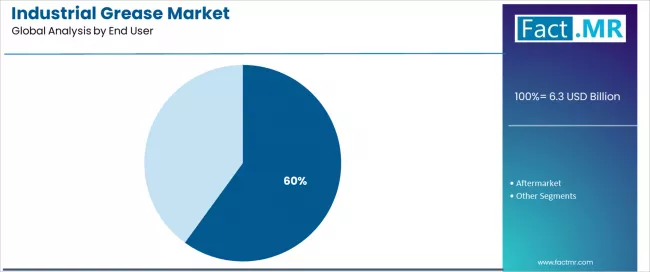
Industrial Grease Market Analysis By End User | Source: Fact.MR
OEM operations dominate the end user segment with approximately 60.0% market share in 2026, reflecting the critical role of original equipment manufacturers in supporting global industrial equipment production and assembly operations worldwide. The OEM segment's market leadership is reinforced by increasing manufacturing standards, quality requirements, and rising demands for lubrication diversity in integrated production programs across developed and emerging industrial markets.
The aftermarket segment represents a substantial end user category, capturing 40.0% market share through maintenance operations for equipment service, replacement lubrication, and specialized maintenance applications. This segment benefits from growing demand for maintenance services that meet specific operational requirements, service standards, and performance protocols in competitive industrial markets.
Key market dynamics supporting end user growth include:
- OEM expansion driven by manufacturing growth and quality standards, requiring specialized grease facilities in emerging markets
- Aftermarket modernization trends require high-quality, standardized greases for maintenance consistency and operational compliance
- Integration of service technologies enabling precision lubrication management and maintenance systems
- Growing focus on end user diversity driving demand for comprehensive, multi-channel grease solutions
What are the Drivers, Restraints, and Key Trends of the Industrial Grease Market?
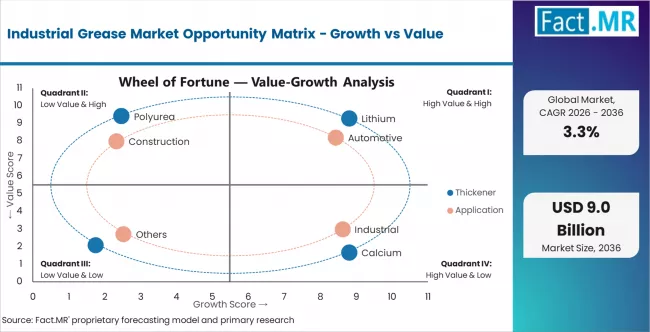
Industrial Grease Market Opportunity Matrix Growth Vs Value | Source: Fact.MR
The market is driven by three concrete demand factors tied to advanced industrial outcomes. First, increasing manufacturing activity and industrial equipment expansion create increasing demand for lubrication optimization systems, with equipment maintenance requirements expanding by 4-6% annually in major developing countries worldwide, requiring comprehensive grease infrastructure. Second, government initiatives promoting advanced manufacturing and operational efficiency drive increased adoption of industrial grease solutions, with many countries implementing equipment reliability goals for industrial advancement by 2030. Third, technological advancements in grease formulation technology and additive systems enable more effective and cost-competitive lubrication solutions that reduce equipment wear while improving operational efficiency and maintenance capabilities.
Market restraints include fluctuating raw material costs for base oils that can deter new market entrants from developing comprehensive formulation capabilities, particularly in developing regions where access to quality base stocks remains limited. Environmental regulations and disposal requirements pose another significant challenge, as industrial greases demand proper waste management and environmental documentation, potentially causing increased operational costs and compliance complexities. Technical application and compatibility requirements across different regions create additional operational challenges for product adoption, demanding ongoing investment in technical training and lubrication application programs.
Key trends indicate accelerated adoption in Asia-Pacific markets, particularly India and China, where manufacturing expansion and equipment requirements drive comprehensive industrial grease adoption. Technology integration trends toward high-performance grease systems with advanced formulations, equipment compatibility assessments, and integrated maintenance solutions enable proactive lubrication approaches that optimize equipment performance and minimize maintenance intervals. The market thesis could face disruption if significant advances in alternative lubrication technologies or major changes in manufacturing approaches reduce reliance on traditional grease-based lubrication systems.
Analysis of the Industrial Grease Market by Key Country
.webp "Top Country Growth Comparison Industrial Grease Market Cagr (2026 2036)")
Top Country Growth Comparison Industrial Grease Market Cagr (2026 2036) | Source: Fact.MR
| Country | CAGR (2026-2036) |
|---|---|
| India | 4.6% |
| China | 4.0% |
| Mexico | 3.1% |
| USA | 3.0% |
| Germany | 2.8% |
| South Korea | 2.5% |
| Japan | 2.3% |
Source: Fact.MR analysis. Updated Mar 30, 2026
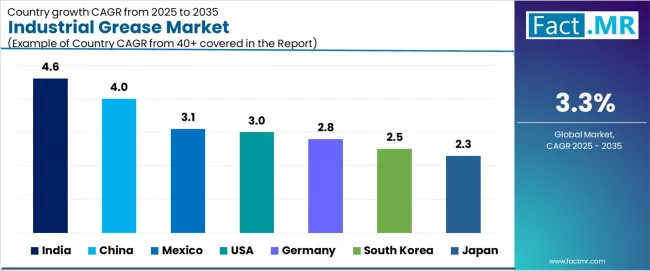
Industrial Grease Market Cagr Analysis By Country | Source: Fact.MR
The market is expanding steadily, with India leading at a 4.6% CAGR through 2036, driven by manufacturing infrastructure expansion, government-backed industrial programs, and advanced lubrication technology adoption. China follows at 4.0%, supported by manufacturing modernization and large-scale industrial initiatives. Mexico records 3.1%, reflecting rising adoption of advanced grease solutions in industrial centers. The USA posts 3.0%, anchored by automotive manufacturing and industrial maintenance programs. Germany grows at 2.8%, maintaining leadership in grease innovation and EU compliance. South Korea advances at 2.5%, emphasizing technology integration, while Japan grows steadily at 2.3%, focusing on advanced manufacturing standards.
India Leads Global Market Expansion
India demonstrates the strongest growth potential in the market with a CAGR of 4.6% through 2036. The country's leadership position stems from manufacturing infrastructure expansion, government-backed industrial development programs, and increasing technical expertise driving the adoption of advanced industrial grease solutions. Growth is concentrated in major industrial centers, including Mumbai, Chennai, Pune, and Ahmedabad, where manufacturing facilities and automotive production centers are implementing advanced grease systems for enhanced equipment reliability and operational efficiency. Distribution channels through lubricant distributors and industrial networks expand deployment across specialized manufacturing projects and comprehensive maintenance initiatives. The country's Make in India program provides policy support for manufacturing modernization, including advanced industrial grease adoption.
Key market factors:
- Manufacturing expansion concentrated in industrial hubs and specialized production zones with comprehensive development programs
- Government support through industrial programs and manufacturing infrastructure initiatives
- Comprehensive lubrication technology ecosystem, including established grease suppliers with proven track records
- Technology integration featuring advanced formulation platforms, application systems, and maintenance optimization technologies
China Emerges as High-Growth Market
In Beijing, Shanghai, Guangzhou, and Shenzhen, the adoption of comprehensive industrial grease solutions is accelerating across manufacturing networks and specialized production facilities, driven by manufacturing modernization targets and government industrial programs. The market demonstrates strong growth momentum with a CAGR of 4.0% through 2036, linked to comprehensive manufacturing modernization and increasing focus on advanced lubrication solutions. Chinese manufacturers are implementing advanced grease systems and integrated maintenance platforms to enhance equipment performance while meeting growing demand in expanding automotive and heavy machinery sectors. The country's Made in China 2026 initiatives create persistent demand for industrial grease solutions, while increasing focus on manufacturing advancement drives adoption of advanced lubrication systems.
Key development areas:
- Manufacturing facilities and industrial centers leading grease technology adoption with comprehensive modernization programs
- Industrial channels providing integrated solutions with 90% equipment protection improvement rates
- Technology partnerships between grease companies and manufacturing enterprises are expanding market reach
- Integration of advanced lubrication technologies and comprehensive maintenance management systems
Mexico Shows Strong Regional Leadership
Mexico's market expansion is driven by diverse industrial demand, including specialized manufacturing centers in Mexico City and Monterrey, and comprehensive industrial adoption across multiple states. The country demonstrates promising growth potential with a CAGR of 3.1% through 2036, supported by federal government manufacturing investment programs and state-level industrial development initiatives. Mexican industrial operators face implementation challenges related to technology financing constraints and technical expertise availability, requiring phased deployment approaches and support from international suppliers. Growing automotive demand and manufacturing requirements create compelling business cases for grease adoption, particularly in industrial areas where equipment reliability has a direct impact on manufacturing competitiveness.
Market characteristics:
- Specialized automotive and manufacturing segments showing fastest growth with 15% annual increase in grease utilization
- Regional expansion trends focused on industrial areas in central and northern states
- Future projections indicate the need for local technical support infrastructure and lubrication specialist training programs
- Growing focus on manufacturing excellence and international competitiveness in industrial operations
Germany Demonstrates Technology Innovation
The German market leads in advanced grease innovation based on integration with precision manufacturing systems and specialized industrial technologies for enhanced operational performance. The country shows strong potential with a CAGR of 2.8% through 2036, driven by the modernization of existing manufacturing infrastructure and the expansion of specialized industrial facilities in major industrial centers, including Stuttgart, Munich, Düsseldorf, and Hamburg. German manufacturers are adopting intelligent grease systems for operational compliance and performance improvement, particularly in regions with advanced automotive requirements and specialized applications demanding comprehensive lubrication upgrades. Technology deployment channels through established lubricant distributors and industrial management companies expand coverage across manufacturing facilities and production-focused operators.
Leading market segments:
- Specialized manufacturing modernization projects in major industrial centers are implementing comprehensive grease upgrades
- Automotive partnerships with grease providers, achieving 88% equipment reliability improvement rates
- Strategic collaborations between grease companies and manufacturing operations are expanding market presence
- Focus on high-performance systems and specialized lubrication requirements
United States Emphasizes Manufacturing Modernization
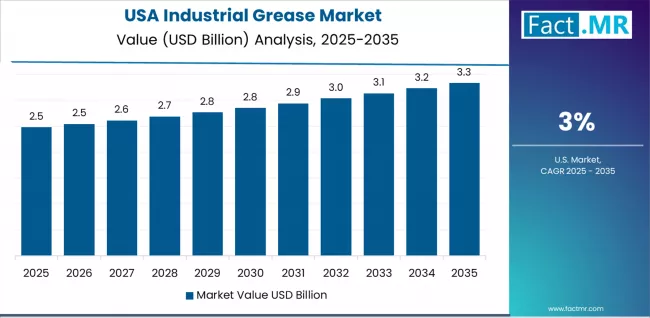
Industrial Grease Market Country Value Analysis | Source: Fact.MR
In major industrial centers including Detroit, Chicago, Houston, and Los Angeles, manufacturing facilities are implementing comprehensive grease solutions to modernize existing lubrication infrastructure and improve equipment accuracy, with documented case studies showing a 25% improvement in equipment reliability through advanced grease systems. The market shows strong growth potential with a CAGR of 3.0% through 2036, linked to the ongoing modernization of manufacturing facilities, automotive networks, and emerging specialized industrial projects in major regions. American manufacturers are adopting intelligent lubrication and monitoring platforms to enhance equipment reliability while maintaining performance standards demanded by automotive and industrial machinery sectors. The country's established manufacturing infrastructure creates persistent demand for system upgrade and modernization solutions that integrate with existing equipment systems.
Market development factors:
- Manufacturing facilities and industrial networks leading grease modernization initiatives across United States
- Industrial modernization programs providing federal funding support for manufacturing and equipment infrastructure upgrades
- Strategic partnerships between American manufacturing companies and international grease providers are expanding technical capabilities
- Focus on advanced manufacturing and performance standards compliance across automotive applications
South Korea Shows Technology-Driven Growth
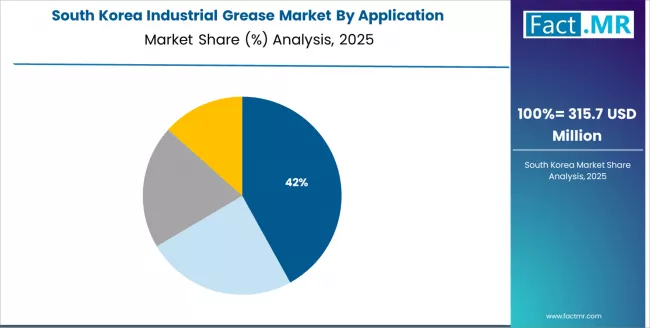
Industrial Grease Market South Korea Market Share Analysis By Application | Source: Fact.MR
South Korea's market demonstrates sophisticated implementation focused on advanced manufacturing technology and lubrication optimization, with documented integration of advanced grease systems, achieving 30% improvement in equipment performance across automotive and manufacturing facilities. The country maintains steady growth momentum with a CAGR of 2.5% through 2036, driven by manufacturing facilities' focus on industrial innovation and continuous improvement methodologies that align with international quality requirements applied to equipment operations. Major industrial areas, including Seoul, Busan, Ulsan, and Daegu, showcase advanced deployment of grease platforms where lubrication systems integrate seamlessly with existing manufacturing control systems and comprehensive maintenance management programs.
Key market characteristics:
- Manufacturing facilities and industrial centers are driving advanced grease requirements with focus on lubrication innovation and quality
- Quality management partnerships enabling 95% equipment compliance with comprehensive monitoring programs
- Technology collaboration between Korean companies and international grease providers is expanding market capabilities
- Focus on manufacturing innovation and continuous improvement methodologies
Japan Emphasizes Advanced Manufacturing Integration
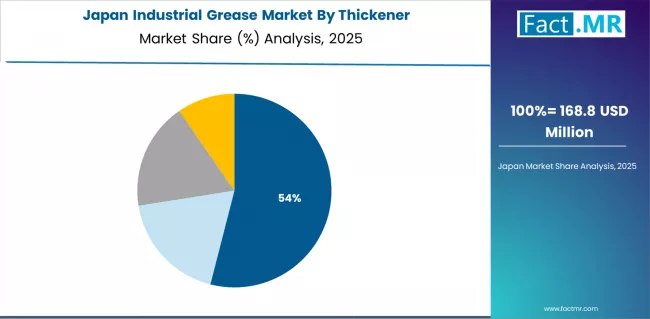
Industrial Grease Market Japan Market Share Analysis By Thickener | Source: Fact.MR
Japan's market demonstrates mature and technology-focused landscape, characterized by sophisticated integration of grease systems with existing manufacturing infrastructure across industrial facilities, automotive networks, and specialized production initiatives. Japan's focus on advanced manufacturing and quality standards drives demand for high-reliability grease solutions that support comprehensive industrial initiatives and operational compliance requirements in manufacturing operations. The market benefits from strong partnerships between international grease providers and domestic manufacturing leaders, creating comprehensive service ecosystems that prioritize system performance and technical training programs. Industrial centers in major manufacturing regions showcase advanced grease implementations where lubrication systems achieve 92% efficiency through integrated monitoring programs.
Europe Market Split by Country
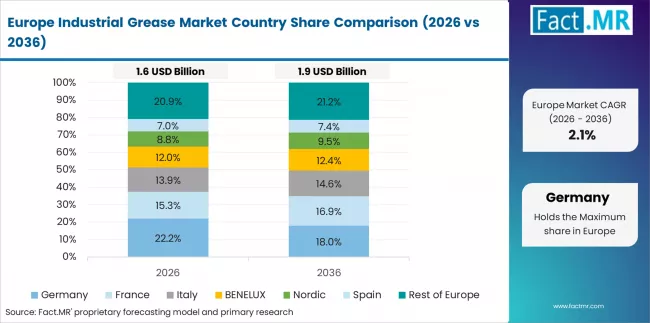
Industrial Grease Market Europe Country Market Share Analysis, 2026 & 2036 | Source: Fact.MR
The industrial grease market in Europe is projected to grow from USD 1.5 billion in Germany in 2026, maintaining a 23.0% market share, supported by its extensive specialized manufacturing infrastructure, advanced industrial facilities, and comprehensive grease networks serving major European markets.
The UK follows with USD 1.1 billion and a 17.0% share in 2026, driven by comprehensive manufacturing programs in major industrial regions implementing advanced industrial grease management systems. France holds USD 0.9 billion with a 13.5% share through the ongoing development of specialized industrial facilities and advanced grease networks. Italy commands USD 0.7 billion with a 10.5% share, while Spain accounts for USD 0.5 billion with a 8.0% share in 2026. The Rest of Europe region maintains USD 1.6 billion with a 24.5% collective share, attributed to increasing grease adoption in Nordic countries and emerging Eastern European industrial facilities implementing advanced lubrication programs.
Competitive Landscape of the Industrial Grease Market
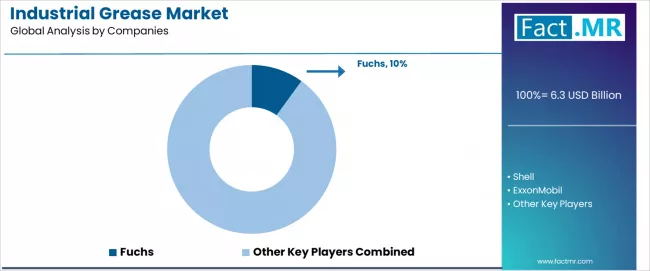
Industrial Grease Market Analysis By Company | Source: Fact.MR
The market features approximately 15-20 meaningful players with moderate concentration, where the top three companies control roughly 25-35% of global market share through established grease product portfolios and extensive industrial relationships. Competition centers on product performance, technical support, and formulation innovation rather than price competition alone.
Market leaders include Fuchs, Shell, and ExxonMobil, which maintain competitive advantages through comprehensive industrial grease solution portfolios, global distribution networks, and deep expertise in the lubrication and manufacturing sectors, creating high switching costs for customers. These companies leverage established industrial operator relationships and ongoing technical support services to defend market positions while expanding into adjacent lubrication and integrated maintenance applications.
Challengers encompass Chevron and BP, which compete through specialized grease formulations and strong regional presence in key industrial markets. Lubrication specialists, including TotalEnergies, Sinopec, and Petronas, focus on specific grease technologies or specialized applications, offering differentiated capabilities in thickener systems, additive technology, and application-specific solutions.
Regional players and emerging grease companies create competitive pressure through innovative formulations and rapid market deployment capabilities, particularly in high-growth markets including India and China, where local presence provides advantages in industrial operator support and regulatory compliance. Market dynamics favor companies that combine advanced grease technologies with comprehensive technical services that address the complete industrial lifecycle from product development through ongoing lubrication support and maintenance management.
Global Industrial Grease Market - Stakeholder Contribution Framework
Industrial grease solutions represent a critical lubrication technology that enables manufacturing operators, industrial facilities, and maintenance departments to enhance equipment performance and operational effectiveness without substantial infrastructure requirements, typically providing 85-95% lubrication efficiency rates comparable to conventional alternatives while improving equipment reliability. With the market projected to grow from USD 6.3 billion in 2025 to USD 8.7 billion by 2035 at a 3.3% CAGR, these solutions offer compelling advantages - superior equipment protection, enhanced operational efficiency, and maintenance optimization capabilities - making them essential for automotive manufacturing (growing segment), industrial operations (expanding adoption), and diverse manufacturing applications seeking reliable lubrication solutions. Scaling market penetration and grease capabilities requires coordinated action across industrial policy, performance standards, grease manufacturers, equipment technology providers, and research institutions.
How Governments Could Spur Local Production and Adoption?
- Industrial Development Programs: Include industrial grease capabilities in national manufacturing development initiatives, providing targeted funding for specialized industrial facilities in underserved regions and supporting local grease companies through innovation grants and development support.
- Tax Policy & R&D Support: Implement accelerated depreciation schedules for grease production equipment, provide tax incentives for companies investing in advanced manufacturing and lubrication technologies, and establish favorable research accounting standards that encourage grease adoption over conventional approaches.
- Regulatory Framework Development: Create streamlined grease registration processes across specialized and general industrial applications, establish clear performance testing frameworks for grease operation, and develop international harmonization protocols that facilitate cross-border grease trade.
- Skills Development & Training: Fund vocational programs for lubrication technicians, industrial specialists, and manufacturing professionals. Invest in technology transfer initiatives that bridge academic research with commercial grease development and equipment optimization systems.
- Market Access & Competition: Establish procurement policies that favor advanced grease solutions for government industrial applications, support small and medium manufacturing operations through preferential lending programs, and create regulatory environments that encourage innovation in lubrication technologies.
How Industry Bodies Could Support Market Development?
- Performance Standards & Certification: Define standardized performance metrics for grease systems across specialized, general, and integrated industrial applications, establish universal quality and performance protocols, and create certification programs for grease performance that industrial operators can rely on.
- Market Education & Best Practices: Lead messaging that demonstrates grease advantages, emphasizing improved equipment outcomes, enhanced operational effectiveness, and superior lubrication compatibility compared to conventional alternatives.
- Technology Integration Standards: Develop interoperability standards for grease systems, comprehensive equipment compatibility guidelines, and advanced manufacturing platforms, ensuring seamless integration across different industrial environments and lubrication requirements.
- Professional Development: Run certification programs for industrial practitioners, grease specialists, and technical service teams on optimizing grease performance, maintenance management, and advanced lubrication in competitive manufacturing markets.
How Manufacturers and Technology Players Could Strengthen the Ecosystem?
- Advanced Grease Development: Develop next-generation formulations with enhanced lubrication capabilities, improved thermal stability, and application-specific grease features that enhance equipment reliability while improving operational outcomes.
- Intelligence Platforms: Provide comprehensive grease software that integrates performance monitoring, application timing, predictive modeling, and maintenance optimization, enabling industrial operators to maximize system efficacy and operational efficiency.
- Service & Support Networks: Offer flexible support programs for industrial operations and manufacturing departments, including technical training options, lubrication consultation services, and performance optimization pathways that keep grease systems current with operational demands.
- Research & Development Networks: Build comprehensive R&D capabilities, collaborative grease innovation programs, and equipment development systems that ensure grease technologies maintain high performance rates and consistent quality across diverse industrial environments.
Key Players in the Industrial Grease Market
- Fuchs
- Shell
- ExxonMobil
- Chevron
- BP
- TotalEnergies
- Sinopec
- Petronas
- SKF
- Idemitsu
- JX Nippon
- Phillips 66
- Valvoline
- PetroChina
- ENEOS
Bibliography
- 1. NLGI (National Lubricating Grease Institute). (2024). NLGI grease production survey annual report. NLGI.
- 2. ASTM International. (2023). ASTM D4950: Standard classification and specification for automotive service greases. ASTM.
- 3. European Lubricants Industry Association. (2024). Lubricants market data and statistics. ELGI.
- 4. Ministry of Petroleum and Natural Gas, Government of India. (2024). Lubricants sector outlook report. MoPNG.
- 5. International Energy Agency. (2024). Wind energy capacity and installation outlook. IEA.
- 6. OECD. (2024). Manufacturing output and industrial activity statistics. Organisation for Economic Co-operation and Development.
This bibliography is provided for reader reference. The full Fact.MR report contains the complete reference list with primary research documentation.
This Report Addresses
- Market sizing and quantitative forecast metrics detailing total addressable demand for the Industrial Grease across all major end-use verticals from 2026 through 2036.
- Segmentation analysis evaluating adoption patterns across Thickener, Application, and End User categories to identify highest-return investment opportunities.
- Regional deployment intelligence comparing demand acceleration across Asia Pacific, North America, and Europe against baseline structural constraints.
- Regulatory compliance assessment identifying how evolving environmental standards, material safety mandates, and procurement specifications reshape demand allocation.
- Competitive landscape evaluation tracking consolidation activity, capacity investments, and technology differentiation strategies among leading and emerging market participants.
- Strategic capital guidance defining procurement thresholds, capacity scaling benchmarks, and supply chain risk factors relevant to manufacturers and investors.
- Supply chain vulnerability analysis isolating raw material concentration risks, logistics bottlenecks, and feedstock pricing pressures affecting margin sustainability.
- Custom data delivery formats encompassing interactive dashboards, raw Excel datasets, and comprehensive PDF narrative reports for integration into internal planning models.
Industrial Grease Market Definition
Industrial grease is a semi-solid lubricant consisting of a base oil, thickener, and performance additives, designed to provide lubrication and protection to mechanical components including bearings, gears, couplings, and slides under conditions where liquid lubricants cannot be retained. Greases are classified by thickener type, consistency grade (per NLGI classification), and performance characteristics including temperature range, load capacity, and water resistance.
Industrial Grease Market Inclusions
Market scope covers all industrial and automotive greases classified by thickener type (lithium, calcium, polyurea, and others), sold through OEM and aftermarket channels for use in manufacturing equipment, vehicles, construction machinery, and infrastructure maintenance. Both mineral oil-based and synthetic base oil greases are included.
Industrial Grease Market Exclusions
The scope excludes lubricating oils and hydraulic fluids that do not contain thickener systems, food-grade greases classified under food processing lubricants market reports, specialty greases for electronic components classified under electronics materials markets, and aerosol dry lubricant sprays.
Industrial Grease Market Research Methodology
- Primary Research: Fact.MR analysts conducted structured interviews with procurement leads, product managers, and operations directors across key manufacturing geographies to validate demand patterns and technology adoption timelines.
- Desk Research: Secondary data collection covered regulatory filings, government statistical databases, trade association publications, multilateral institution reports (OECD, World Bank), and peer-reviewed journals to ground market sizing assumptions.
- Market-Sizing and Forecasting: A hybrid bottom-up and top-down model was applied, combining production capacity data, end-use consumption benchmarks, and trade flow analysis with macroeconomic growth proxies to generate segment and regional forecasts.
- Data Validation and Update Cycle: Forecast outputs were cross-validated against publicly disclosed corporate guidance, capacity expansion announcements, and government procurement records. The model is subject to annual revision cycles tied to regulatory and industry reporting calendars.
Segmentation
Scope of the Report
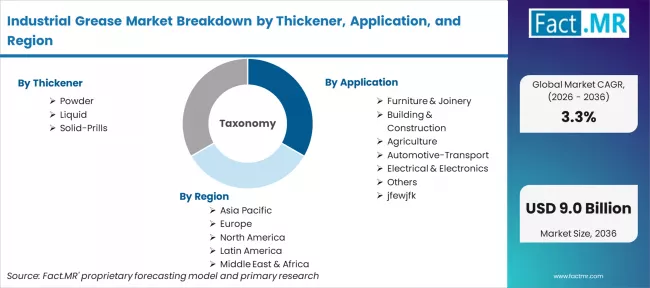
Industrial Grease Market Breakdown By Thickener, Application, And Region | Source: Fact.MR
| Metric | Value |
|---|---|
| Quantitative Units | USD 6.51 billion to USD 9.00 billion, at a CAGR of 3.30% |
| Market Definition | Industrial grease covers lithium, calcium, polyurea, and other thickener-based semi-solid lubricants used in automotive, industrial, and construction equipment lubrication across OEM and aftermarket channels. |
| Thickener Segmentation | Lithium, Calcium, Polyurea, Others |
| Application Segmentation | Automotive, Industrial, Construction, Others |
| End User Segmentation | OEM, Aftermarket |
| Regions Covered | North America, Latin America, Europe, East Asia, South Asia, Oceania, Middle East & Africa |
| Countries Covered | India, China, USA, Germany, South Korea, Japan, Mexico, and 40 plus countries |
| Key Companies Profiled | Fuchs, Shell, ExxonMobil, Chevron, BP, TotalEnergies, Sinopec, Petronas |
| Forecast Period | 2026 to 2036 |
| Approach | Hybrid bottom-up and top-down modeling anchored to publicly verified production, trade, and regulatory data |
Source: Fact.MR analysis. Updated Mar 30, 2026
Industrial Grease Market by Segments
-
Thickener:
- Lithium
- Calcium
- Polyurea
- Others
-
Application:
- Automotive
- Industrial
- Construction
- Others
-
End User:
- OEM
- Aftermarket
-
Region:
- Asia Pacific
- China
- Japan
- South Korea
- India
- Australia & New Zealand
- ASEAN
- Rest of Asia Pacific
- Europe
- Germany
- United Kingdom
- France
- Italy
- Spain
- Nordic
- BENELUX
- Rest of Europe
- North America
- United States
- Canada
- Mexico
- Latin America
- Brazil
- Chile
- Rest of Latin America
- Middle East & Africa
- Kingdom of Saudi Arabia
- Other GCC Countries
- Turkey
- South Africa
- Other African Union
- Rest of Middle East & Africa
- Asia Pacific
Frequently Asked Questions
How large is the Industrial Grease Market in 2026?
What will the Industrial Grease Market size reach by 2036?
What CAGR is forecast for the Industrial Grease Market from 2026 to 2036?
Which Thickener segment leads the Industrial Grease Market in 2026?
Which Application segment dominates the Industrial Grease Market?
Which country leads growth in the Industrial Grease Market?
What is included in the Industrial Grease Market report scope?
What is excluded from the Industrial Grease Market scope?
Who worked on this report


Preview the report firsthand - request a free sample
Free SampleGet the brochure for pricing and purchase details
Download PDF