- Market Value (2025): USD 1.2 Bn
- Estimated Value (2026): USD 1.3 Bn
- Forecast Value (2036): USD 3.8 Bn
- CAGR (2026-2036): 11.0%
What is the Inulin-FOS Pectin Blends Market forecast to be worth by 2036?
USD 1.3 billion in 2026 to USD 3.8 billion by 2036, at 11.0% CAGR.
- The Inulin-FOS Pectin Blends Market crossed a valuation of USD 1.2 billion in 2025.
- Demand is projected to increase from USD 1.3 billion in 2026 to USD 3.8 billion by 2036.
- The market is forecast to record an 11.0% CAGR from 2026 to 2036 as supplement brands and gummy manufacturers reformulate for fiber-bearing texture systems.
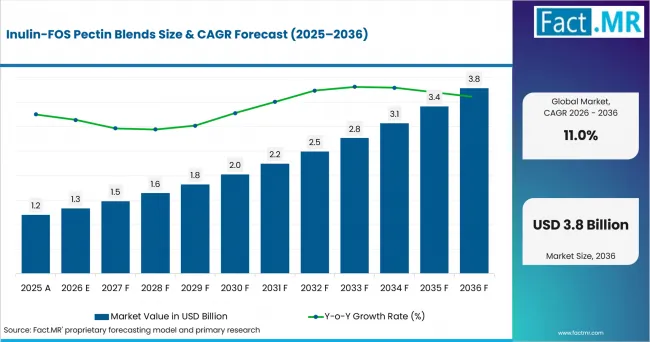
Inulin Fos Pectin Blends Value Analysis | Source: Fact.MR
What are the defining numbers behind Inulin-FOS Pectin Blends Market growth?
USD 2.4 billion absolute opportunity by 2036, led by citrus pectin, inulin enriched blends and supplements.
- Demand Drivers in the Market
- Supplement brands need soluble fiber systems that combine prebiotic support with clean dispersion in powders, capsules and sachet mixes.
- Gummy manufacturers need pectin-based gel systems that carry inulin or FOS without weakening bite or storage stability.
- Beverage developers need low-viscosity fiber blends that add body while limiting sediment and flavor masking in acidic formats.
- Dairy-alternative brands need water binding and texture stabilization as plant-based bases change protein and sugar behavior.
- Key Segments Analyzed
- By Pectin Base: Citrus pectin is projected to hold 29.0% share in 2026 due to established extraction scale and broad use in gummies, beverages and fruit systems.
- By Fiber Blend: Inulin enriched blends are anticipated to account for 36.0% share in 2026 because inulin helps formulators combine fiber content with mild sweetness and body.
- By Function: Prebiotic support is estimated to capture 31.0% share in 2026 as brands position soluble fiber blends around digestive wellness.
- By Application: Supplements are forecast to represent 37.0% share in 2026 owing to capsule, powder and gummy formats designed for measured fiber doses.
- Analyst Opinion at Fact.MR
- Shambhu Nath Jha, Principal Consultant at Fact.MR, states, “The commercial test for this market is not whether a blend contains fiber. The stronger question is whether the blend survives real processing conditions while keeping texture, taste and label clarity intact. Suppliers that combine pectin know-how with inulin and FOS formulation support are expected to gain better access to supplement and gummy accounts.”
- Strategic Implications
- Ingredient producers should document fiber content, gel strength and application stability together so product teams shorten reformulation trials.
- Supplement brands should select blends that support dose consistency across powders, gummies and chewable formats.
- Gummy manufacturers should test pH, solids and moisture behavior before replacing gelatin or sugar-heavy systems.
- Distributors should pair citrus and apple pectin grades with soluble-fiber guidance for local application labs.
China is projected to post 11.7% CAGR through 2036 as functional food formats and online food retail expand. France is anticipated to advance at 11.6% through fruit processing depth and pectin know-how. The USA is estimated to record 11.2% as supplements and food manufacturing support fiber-blend use. Germany is forecast to reach 11.0% through apple and citrus ingredient processing. Japan is expected to post 10.1% as health food and beverage makers balance fiber fortification with strict label control.
How does the Inulin-FOS Pectin Blends Market break down by segment?
Supplements lead applications at 37.0%; inulin enriched blends lead fiber blend at 36.0%.
Which Pectin Base dominates?
Citrus pectin is projected to hold 29.0% share in 2026.
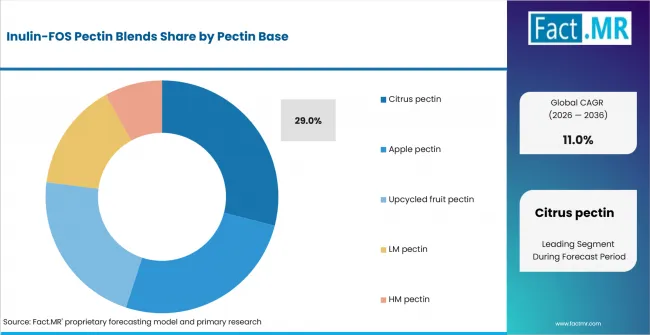
Inulin Fos Pectin Blends Analysis By Pectin Base | Source: Fact.MR
Citrus pectin leads within the pectin base segment because citrus peel streams give processors a scalable raw material base. Formulators also value citrus pectin for acid-set gels and fruit-forward flavor systems, which fit gummies, beverages and supplement formats.
What leads the Fiber Blend segment?
Inulin enriched blends are anticipated to account for 36.0% share in 2026.
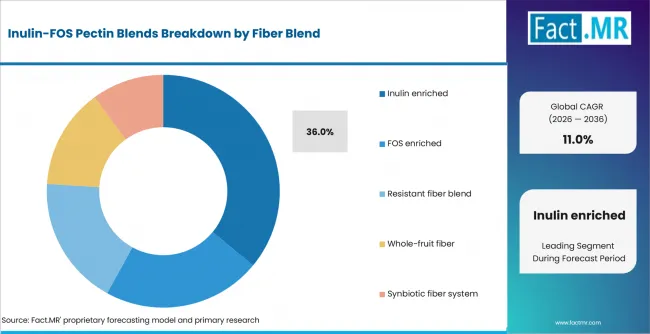
Inulin Fos Pectin Blends Analysis By Fiber Blend | Source: Fact.MR
Inulin enriched blends hold a stronger position because inulin contributes body and fiber while blending naturally with pectin functionality. It helps brands move beyond a single hydrocolloid decision and design a format around mouthfeel, fiber delivery and sweetness balance.
How does Function shape demand?
Prebiotic support is estimated to capture 31.0% share in 2026.
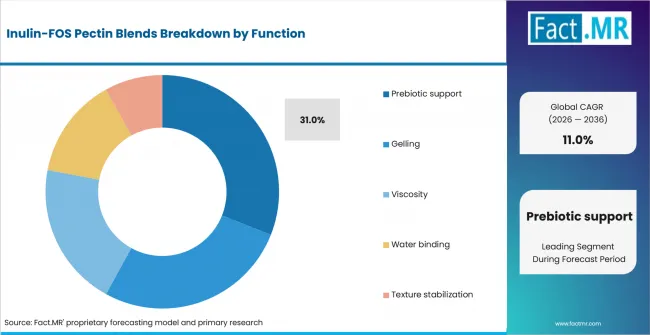
Inulin Fos Pectin Blends Analysis By Function | Source: Fact.MR
Prebiotic support leads by function because inulin and FOS already carry strong recognition among digestive-wellness formulators. Pectin adds texture and water management, giving brands a more practical way to put fiber claims into gummies, powders and drinkable systems.
What supports Supplements within Application?
Supplements are forecast to represent 37.0% share in 2026.
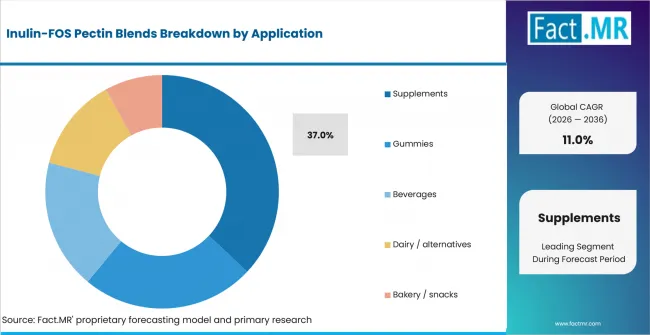
Inulin Fos Pectin Blends Analysis By Application | Source: Fact.MR
Supplements lead within applications because dosage and format flexibility are easier to communicate in capsules, powders and gummies. A pectin-linked soluble-fiber blend supports chew quality while still serving a measurable fiber purpose.
What is accelerating Inulin-FOS Pectin Blends Market adoption, and what is holding it back?
Demand is expected to rise through supplement formulation, pectin functionality and reduced-sugar texture needs. Growth is constrained by raw material variability and claim documentation.
| DRIVER | (~) % IMPACT ON CAGR | GEOGRAPHIC RELEVANCE | IMPACT TIMELINE |
|---|---|---|---|
| Prebiotic positioning in supplements and gummies | +1.6% | North America, Europe, East Asia | Short term (<= 2 years) |
| Citrus and apple pectin functionality in acidic systems | +1.2% | Europe, China, USA | Medium term (2-4 years) |
| Reduced-sugar texture needs in confectionery and beverages | +0.9% | Global | Medium term (2-4 years) |
| Application-lab support for customized blends | +0.7% | Global | Long term (>= 4 years) |
Opportunity Impact Analysis
| OPPORTUNITY | (~) % IMPACT ON CAGR | GEOGRAPHIC RELEVANCE | IMPACT TIMELINE |
|---|---|---|---|
| Synbiotic fiber systems for supplement brands | +1.2% | USA, Japan, Germany | Short term (<= 2 years) |
| Upcycled fruit pectin linked with fiber claims | +0.8% | Europe, China | Medium term (2-4 years) |
| Dairy-alternative and beverage stabilization | +0.6% | North America, East Asia | Long term (>= 4 years) |
Restraint Impact Analysis
| RESTRAINT | (~) % IMPACT ON CAGR | GEOGRAPHIC RELEVANCE | IMPACT TIMELINE |
|---|---|---|---|
| Raw material variability in fruit and chicory streams | -0.6% | Global | Short term (<= 2 years) |
| Claims and labeling documentation burden | -0.5% | USA, EU, Japan | Medium term (2-4 years) |
| Processing sensitivity in acidic or high-solids formats | -0.4% | Global | Long term (>= 4 years) |
Which countries are scaling the Inulin-FOS Pectin Blends Market through 2036?
- The country comparison spans 1.6 percentage points and forms a tight growth band across the forecast period.
- China remains 0.1 percentage point above France as online food retail and processed food profit recovery support functional formats.
- France remains 0.4 percentage point above the USA through fruit processing depth and pectin supply knowledge.
- The USA remains 0.2 percentage point above Germany as supplement formats and food manufacturing create repeat blend demand.
- Germany remains 0.9 percentage point above Japan through apple harvest recovery and hydrocolloid formulation activity.
- Japan closes the displayed range as health food, beverage and labeling discipline shape adoption.
Comparable CAGRs create different entry conditions because fruit inputs, supplement usage, food processing scale and label scrutiny vary by country.
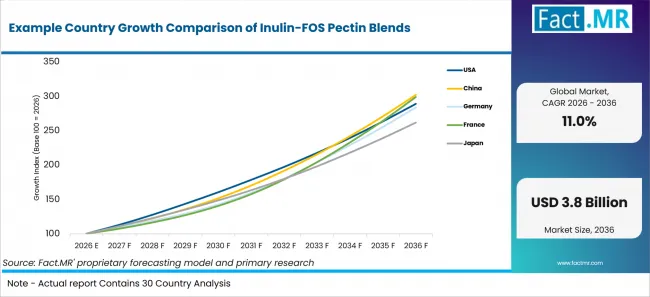
Example Country Growth Comparison Of Inulin Fos Pectin Blends | Source: Fact.MR
| Country | CAGR |
|---|---|
| China | 11.7% |
| France | 11.6% |
| United States | 11.2% |
| Germany | 11.0% |
| Japan | 10.1% |
What supports China adoption?
11.7% CAGR, supported by functional food retail and processed food manufacturing.
China’s National Bureau of Statistics reported that grain, oil and food retail sales by units above designated size reached 2,399.1 billion yuan in 2025. This large retail base supports inulin-FOS pectin blends across supplements, beverages and gummies where formulators need soluble-fiber positioning alongside controlled taste, texture and water-binding performance.
How is France developing demand?
11.6% CAGR, driven by fruit-processing depth and pectin formulation expertise.
Agreste estimated French table-apple production at 1.59 million tonnes as of November 2025. This fruit-processing base supports pectin availability and formulation expertise across gummies, confectionery, dairy alternatives and fruit preparations, where developers use pectin-linked fiber systems to manage gel structure, water binding and soluble-fiber positioning.
What supports USA growth?
11.2% CAGR, backed by supplement formats and food manufacturing scale.
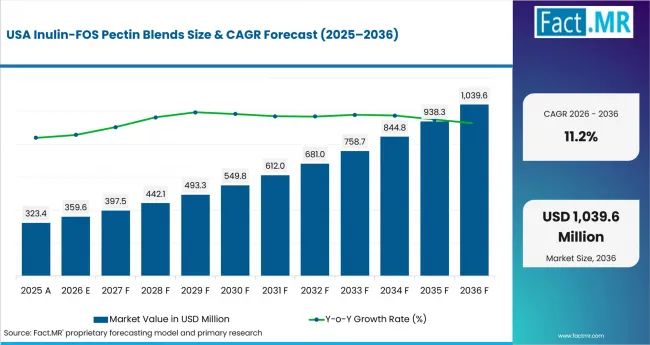
Inulin Fos Pectin Blends Country Value Analysis | Source: Fact.MR
USDA ERS reported inflation-adjusted U.S. food spending of USD 2.51 trillion in 2025. This large food market supports fiber-blend adoption across gummies, powders, beverages and other functional formats, where brands use inulin-FOS and pectin systems to improve dose control, mouthfeel and texture while supporting digestive-positioning strategies.
What is supporting Germany’s adoption?
11.0% CAGR, supported by apple inputs and functional food formulation.
Destatis reported that Germany harvested approximately 1.138 million tonnes of apples in 2025, including around 270,000 tonnes intended for processing or industrial use. German formulators use apple and citrus pectin systems in gummies, fruit preparations, supplements and dairy alternatives where controlled gel structure, fiber dosage and texture performance must be balanced.
How does Japan perform?
10.1% CAGR, led by health-food use and strict format control.
USDA FAS reported that Japan’s food-processing sector reached USD 174 billion in 2025, with health foods among the growing segments. This supports demand for pectin-FOS systems in supplements, chewable formats and beverages where formulators prioritize precise taste, texture, soluble-fiber delivery and disciplined functional positioning.
Who leads the Inulin-FOS Pectin Blends Market?
Tate & Lyle, including CP Kelco, is a prominent participant through its pectin and hydrocolloid capabilities. Its positioning is relevant where supplement, gummy and beverage formulators need soluble-fiber systems that combine gel control, mouthfeel, water binding and digestive-wellness positioning within the same formulation route.
Cargill also participates through food-texturizing and formulation capabilities, while Ingredion strengthens the competitive set across specialty ingredients and soluble-fiber applications. Their relevance is strongest where brands need fiber enrichment without compromising taste, viscosity, dispersion or processing stability across beverages, gummies and other functional foods.
BENEO and Cosucra complete the profiled supplier group, supporting the soluble-fiber side of the market and complementing pectin functionality in prebiotic and texture-focused formulations. These suppliers are relevant where developers need inulin- or FOS-linked systems that balance fiber delivery with sweetness, body and application-specific texture requirements.
Competition therefore centers on pectin expertise, soluble-fiber functionality, gel strength, mouthfeel, water binding, processing stability and application support. Suppliers that can combine pectin know-how with inulin and FOS formulation guidance are better positioned across supplements, gummies, beverages and dairy-alternative applications.
Which companies are the key providers?
Key companies include Tate & Lyle (including CP Kelco); Cargill; Ingredion; BENEO; Cosucra.
- Tate & Lyle (including CP Kelco)
- Cargill
- Ingredion
- BENEO
- Cosucra
Bibliography
- U.S. Department of Agriculture, Economic Research Service. (2026, June 1). Food prices and spending.
- U.S. Census Bureau. (2026, January 29). Monthly full report on manufacturers’ shipments, inventories and orders: November 2025 (Release No. CB 26-15 M3-2 (25)-11).
- U.S. Bureau of Labor Statistics. (2026, January 13). Consumer Price Index – December 2025 [News release].
- Won, N. Y., Ansai, N., Wambogo, E. A., & Ahluwalia, N. (2026, September 15). Fruit and vegetable consumption among adults: United States, August 2021–August 2023 (NCHS Data Brief No. 570). National Center for Health Statistics.
- National Bureau of Statistics of China. (2026a, January 20). Total retail sales of consumer goods in December 2025.
- National Bureau of Statistics of China. (2026b, January 28). Profit of industrial enterprises above the designated size in 2025.
- National Bureau of Statistics of China. (2026c, February 28). Statistical communiqué of the People’s Republic of China on the 2025 national economic and social development.
- Statistisches Bundesamt. (2025, December 19). Apfelernte 2025: Mit 1 138 000 Tonnen zweithöchste Ernte der vergangenen zehn Jahre [Apple harvest 2025: At 1,138,000 tonnes, the second-highest harvest of the past ten years].
- Statistisches Bundesamt. (2026, January 15). Wholesale prices in December 2025: +1.2% on December 2024.
- Institut national de la statistique et des études économiques. (2026, January 15). Further slowdown in annual average consumer prices in 2025: Price index – Annual average rates of change – year 2025 (Informations rapides No. 8).
- Mosny, E., Ramonet, M., & Wukovits, A. (2026, July 7). Second estimates for the 2025 agricultural accounts: Prices and volumes rebounded after the decline in 2024 (Insee Première No. 2116). Institut national de la statistique et des études économiques.
- Laurent, B., & Lousteau, M. (2025, November 14). Pomme. Une production de pommes en léger recul, des prix en baisse en début de campagne (Conjoncture – Infos Rapides No. 2025-148). Agreste.
- Aoki, S. (2026, April 1). Food processing ingredients annual (GAIN Report No. JA2026-0012). U.S. Department of Agriculture, Foreign Agricultural Service.
- Cargill. (2025, March 4). Cargill showcases full range of innovative food solutions at AAHAR 2025.
This Report Answers
- The report explains where inulin-FOS pectin blends are used across pectin base and fiber blend. It also covers function and application.
- Segment analysis identifies the leading subsegments and the reasons formulators prioritize them.
- Country analysis examines the listed markets and the food, fruit and supplement mechanisms supporting adoption.
- Competitive analysis reviews current providers across pectin, soluble fiber blends and natural hydrocolloid formulation.
- Application analysis assesses how texture, fiber dosage and label wording influence product development decisions.
What does the Inulin-FOS Pectin Blends Market cover?
The Inulin-FOS Pectin Blends Market covers ingredient systems that combine soluble fibers with pectin for texture, gel control and digestive-wellness positioning. Adjacent coverage includes inulin ingredients, dietary fiber ingredients and prebiotic fiber formats.
The assessment includes citrus and apple pectin bases, FOS enriched systems and whole-fruit fiber formats. Related formulation areas include food stabilizers, LM pectin systems and natural texture gums.
What is included in the scope?
The scope includes ingredient blends sold for supplements, gummies, beverages, dairy alternatives and bakery snacks. It covers pectin-linked fiber systems, including fruit waste pectins, citrus pectin inputs and citrus peel pectin.
It includes formulation support where inulin, FOS and pectin are combined for prebiotic support, gelling, viscosity, water binding or texture stabilization. More specific adjacent analysis includes precision prebiotic blends for targeted wellness applications.
What is excluded from the scope?
The scope excludes plain pectin sold without inulin or FOS, standalone inulin powder without pectin functionality, finished consumer supplements and pharmaceutical excipients outside food or supplement use.
The assessment excludes gelatin, carrageenan, starch systems and other hydrocolloids sold without an inulin-FOS pectin blend. It also excludes unprocessed agricultural feedstock trading.
How Was the Analysis Built?
The analysis draws on 120+ sources, 35+ company portfolios, 25+ countries, and more than 20 industry interviews.
- Primary Research: Primary research includes discussions with manufacturers, service providers, technology developers, distributors, end users, and subject-matter experts. These conversations examine purchasing priorities, product adoption, operational challenges, approval requirements, competitive positioning, and the factors that influence wider market acceptance.
- Desk Research: Desk research covers government statistics, regulatory publications, company filings, trade data, technical studies, industry associations, standards, public policy, and other authoritative sources. Every source used in the analysis is documented in the bibliography.
- Market Sizing and Forecasting: Market estimates combine historical performance, demand indicators, pricing and volume trends, segment shares, company participation, country-level growth, adoption patterns, investment activity, and barriers to market expansion.
- Data Validation and Update Cycle: Findings are validated by comparing primary interviews with public data, company activity, regulatory changes, trade patterns, and industry developments. Regular updates review new product launches, capacity changes, partnerships, approvals, and shifts in commercial adoption.
What is the report’s scope and coverage?
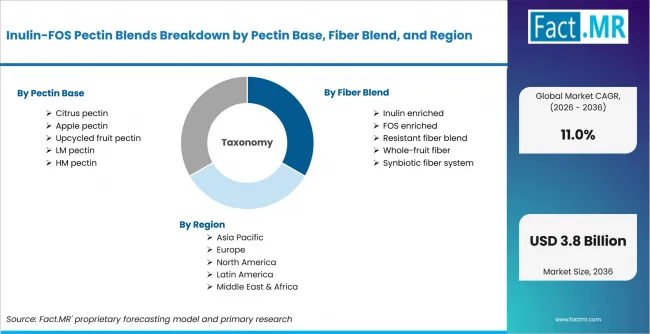
Inulin Fos Pectin Blends Breakdown By Pectin Base, Fiber Blend, And Region | Source: Fact.MR
| Attribute | Details |
|---|---|
| Quantitative Units | USD billion |
| Market Definition | Ingredient blends combining inulin, fructooligosaccharides and pectin for prebiotic support, gelling, viscosity, water binding and texture stabilization in food and supplement applications. |
| Pectin Base | Citrus pectin; Apple pectin; Upcycled fruit pectin; LM pectin; HM pectin |
| Fiber Blend | Inulin enriched; FOS enriched; Resistant fiber blend; Whole-fruit fiber; Synbiotic fiber system |
| Function | Prebiotic support; Gelling; Viscosity; Water binding; Texture stabilization |
| Application | Supplements; Gummies; Beverages; Dairy alternatives; Bakery snacks |
| Regions Covered | North America; Latin America; Western Europe; Eastern Europe; East Asia; South Asia & Pacific; Middle East & Africa |
| Countries Covered | China; France; United States; Germany; Japan |
| Key Companies Profiled | Tate & Lyle (including CP Kelco); Cargill; Ingredion; BENEO; Cosucra |
| Forecast Period | 2026 to 2036 |
| Approach | Hybrid top-down and bottom-up approach using food and supplement demand indicators; pectin base selection; soluble fiber use; application mix; country adoption; and provider portfolio review. |
How is the market segmented?
-
By Pectin Base
- Citrus pectin
- Apple pectin
- Upcycled fruit pectin
- LM pectin
- HM pectin
-
By Fiber Blend
- Inulin enriched
- FOS enriched
- Resistant fiber blend
- Whole-fruit fiber
- Synbiotic fiber system
-
By Function
- Prebiotic support
- Gelling
- Viscosity
- Water binding
- Texture stabilization
-
By Application
- Supplements
- Gummies
- Beverages
- Dairy alternatives
- Bakery snacks
-
By Region
- North America
- Latin America
- Western Europe
- Eastern Europe
- East Asia
- South Asia & Pacific
- Middle East & Africa