- Base Value(2026): 0.3 Bn
- Estimated Value(2026): 0.3 Bn
- Forecast Value (2036): 1.1 Bn
- CAGR (2026 - 2036): 14.3%
Precision Prebiotic Blends for Gut–Brain Axis Support Market Forecast and Outlook (2026-2036)
The global market for precision prebiotic blends targeting the gut-brain axis is entering a phase of exponential growth and scientific validation, projected to expand from USD 0.29 billion in 2026 to USD 1.12 billion by 2036, advancing at a remarkable 14.3% CAGR.
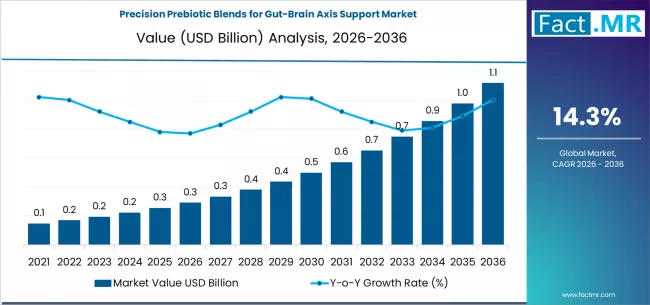
Precision Prebiotic Blends For Gut Brain Axis Support Market Market Value Analysis | Source: Fact.MR
Summary of Precision Prebiotic Blends for Gut-Brain Axis Support Market
- Market Snapshot
- Global precision prebiotic blends for gut-brain axis support market revenue stood at USD 0.29 billion in 2026 and is forecast to reach USD 1.12 billion by 2036.
- At a 14.3%CAGRfrom 2026 to 2036, this market is entering a phase of exponential growth driven by a pivotal shift in nutritional science toward targeting neurological outcomes through diet.
- Growth is propelled by escalating consumer awareness of the microbiome's role in mental well-being and demand for non-pharmaceutical solutions for stress, anxiety, and sleep.
- The market is transitioning from single-ingredient broad-spectrum prebiotics to sophisticated multi-fiberblends engineered to selectively nourish bacterial strains producing neuroactive metabolites.
- Demand and Growth Drivers
- Escalating consumer awareness and scientific interest in the microbiome's role in mental well-being, with growing prevalence of stress, anxiety, and sleep issues driving demand for food-as-medicine solutions.
- Supportive clinical research linking specific prebioticfibersto positive neurological outcomes throughSCFAand neurotransmitter precursor production is building a credible evidence base.
- The personalized nutrition movement creates a framework for these blends as configurable components of broader, AI-assisted wellnessprogrammes.
- Development of symbiotic-plus systems combining precision prebiotics with specific probiotic strains andpostbioticsfor enhanced and more predictable gut-brain efficacy.
- Application of artificial intelligence toanalyzemicrobiome data enabling personalized prebiotic blend recommendations based on individual gut microbiota composition.
- Product and Segment View
- Dairy/Alt-Dairy leads the Application segment with a 40.1% market share in 2026,leveragingthe established consumer association with gut health and the ideal pH-stable matrix for prebioticfibers.
- Inulin/FOS leads the Strain segment with a 40.1% share in 2026, valued for well-established safety profile, clinical history, cost-effective production scale, and foundational bifidogenic activity.
- Direct-to-B2B leads the Channel segment with a 65% share in 2026, reflecting the highly technical and proprietary nature of gut-brain product development requiring deep supplier-brand collaboration.
- Additional segments include Beverages, Bakery/Snacks, Meat/Alt-Meat applications;GOS, HMO, Resistant Starch strains; and Distributors, Online B2B, Contract Manufacturing channels.
- Geography and Competitive Outlook
- China (15.9%CAGR), Netherlands (15.4%), USA (14.8%), and Germany (14.2%) are the key growth countries highlighted on the webpage.
- East Asia, Western Europe, and North America are primary regional markets, driven by tech-forward wellness adoption, nutraceutical research ecosystems, and strongDTCwellness brand ecosystems.
- Market expansion is closely tied to regulatory approval of gut-brain health claims, clinical substantiation investments, and consumer education on the microbiome-mental health connection.
- Key companies active in this market include DSM-Firmenich, International Flavors & Fragrances (IFF), Kerry Group plc., ADM, Tate & Lyle, and Yakult Honsha.
Precision Prebiotic Blends for Gut-Brain Axis — At a Glance
| Attribute | Details |
|---|---|
| Market Value 2026 | USD 0.29 Billion |
| Market Value 2036 | USD 1.12 Billion |
| Absolute Dollar Opportunity 2026-2036 | USD 0.83 Billion |
| Total Growth 2026-2036 | 281% |
| CAGR2026-2036 | 14.3% |
| Growth Multiple | 3.8x |
| Key Demand Theme | Multi-fiberprecision prebiotic blends targeting gut-brain axis communication to support cognitive function, stress resilience, mood, and sleep through microbiome modulation |
| Leading Segment by Application (2026) | Dairy/Alt-Dairy |
| Application Segment Share (2026) | 40.1% |
| Leading Segment by Strain (2026) | Inulin/FOS |
| Strain Segment Share (2026) | 40.1% |
| Leading Segment by Channel (2026) | Direct-to-B2B |
| Channel Segment Share (2026) | 65% |
| Key Growth Regions | East Asia, Western Europe, North America |
| CountryCAGRs | China 15.9%, Netherlands 15.4%, USA 14.8%, Germany 14.2% |
| Top Companies | DSM-Firmenich,IFF, Kerry Group plc., ADM, Tate & Lyle, Yakult Honsha |
| Segmentation by Application | Dairy/Alt-Dairy, Beverages, Bakery/Snacks, Meat/Alt-Meat |
| Segmentation by Strain | Inulin/FOS,GOS, HMO, Resistant Starch |
| Segmentation by Channel | Direct-to-B2B, Distributors, Online B2B, Contract Manufacturing |
| Segmentation by Region | North America, Latin America, Western Europe, Eastern Europe, East Asia, South Asia & Pacific, MEA |
Source: Fact.MR analysis. Updated Apr 14, 2026
This trajectory is propelled by a pivotal shift in nutritional science, moving beyond general digestive health to targeting specific neurological and psychological outcomes through dietary modulation of the microbiome. The market's evolution is characterized by the transition from single-ingredient, broad-spectrum prebiotics to sophisticated, multi-fiber blends engineered with precision. These blends are designed to selectively nourish bacterial strains associated with the production of key neuroactive metabolites, such as short-chain fatty acids (SCFAs) like butyrate, and neurotransmitters including GABA and serotonin precursors. This specificity aims to influence cognitive function, stress response, mood, and sleep quality through the gut-brain communication network. The convergence of advanced metabolomics, AI-driven microbiome analysis, and clinical substantiation is enabling a new generation of targeted nutritional interventions, positioning these blends at the forefront of proactive mental wellness and cognitive support strategies within functional food and beverage formulation.
Category
| Category | Segments |
|---|---|
| Application | Dairy/Alt-Dairy, Beverages, Bakery/Snacks, Meat/Alt-Meat |
| Strain | Inulin/FOS, GOS, HMO, Resistant Starch |
| Channel | Direct-to-B2B, Distributors, Online B2B, Contract Manufacturing |
| Region | North America, Latin America, Western Europe, Eastern Europe, East Asia, South Asia & Pacific, MEA |
Source: Fact.MR analysis. Updated Apr 14, 2026
Segmental Analysis
By Application, Which Segment Demonstrates the Broadest Adoption?
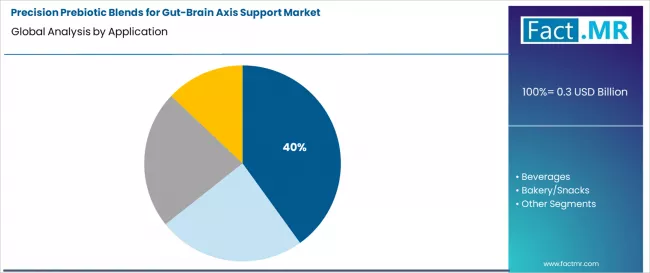
Precision Prebiotic Blends For Gut Brain Axis Support Market Analysis By Application | Source: Fact.MR
The dairy and alternative-dairy segment holds a leading 40% market share, serving as the ideal delivery vehicle for these functional blends. Dairy products like yogurts, kefir, and fermented drinks already carry a strong consumer association with probiotics and gut health, making them a logical and trusted platform for introducing advanced gut-brain axis benefits.
The matrix of dairy provides stability for the prebiotic fibers and can synergize with live cultures. In the plant-based dairy segment, these blends serve a dual purpose: providing the targeted health benefit while also often contributing to improved texture and mouthfeel, addressing formulation challenges common in alt-dairy products.
By Strain, Which Type Forms the Core of Most Formulations?
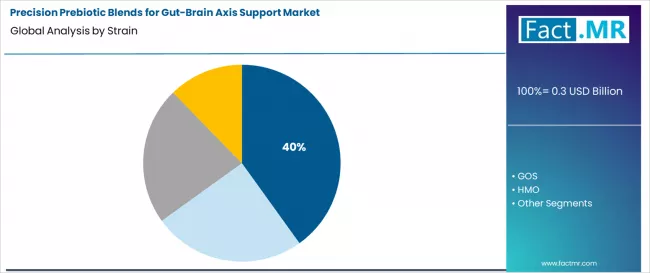
Precision Prebiotic Blends For Gut Brain Axis Support Market Analysis By Strain | Source: Fact.MR
Inulin and Fructooligosaccharides (FOS) lead the strain segment with a 40% share, valued for their well-established safety profile, clinical history, and cost-effective production scale. They serve as a foundational bifidogenic substrate in many precision blends. Their role is often to boost overall beneficial bacterial populations, creating a favorable environment for more specialized fibers within the blend to then act upon.
While newer, more targeted fibers like HMOs gain attention for their unique mechanisms, Inulin/FOS remain the workhorse ingredients due to their proven efficacy, regulatory acceptance across global markets, and versatility in food applications.
By Channel, How are Products Primarily Reaching End-Users?
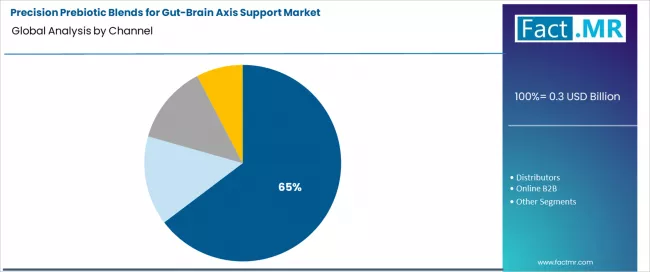
Precision Prebiotic Blends For Gut Brain Axis Support Market Analysis By Channel | Source: Fact.MR
Direct-to-B2B sales dominate the channel landscape with a 65% share, reflecting the highly technical and proprietary nature of product development. Creating effective precision blends requires deep collaboration between ingredient suppliers possessing microbiome science expertise and the R&D teams of food, beverage, and supplement brands.
This direct relationship is essential for navigating complex formulation challenges, ensuring blend stability in the final product matrix, and co-developing the clinical and marketing narratives required to substantiate gut-brain axis claims in a credible and compliant manner.
What are the Drivers, Restraints, and Key Trends of the Precision Prebiotic Blends for Gut–Brain Axis Support Market?
The primary market driver is the escalating consumer awareness and scientific interest in the microbiome's role in mental well-being. Growing prevalence of stress, anxiety, and sleep issues, coupled with a desire for non-pharmaceutical interventions, fuels demand for food-as-medicine solutions.
Supportive clinical research linking specific prebiotic fibers to positive neurological outcomes is gradually building the evidence base. Additionally, the personalized nutrition movement is creating a framework where these blends can be positioned as configurable components of broader wellness programs.
A significant market restraint is the high cost and complexity of scientific substantiation. Establishing clear cause-and-effect relationships between a specific fiber blend, a measurable shift in the gut microbiota, and a tangible cognitive or emotional outcome requires long-term, expensive human clinical trials.
Regulatory pathways for specific gut-brain health claims are nascent and inconsistent across regions, creating uncertainty for product labeling. Consumer education also remains a hurdle, as the concept is more complex than general digestive wellness.
Key trends include the development of symbiotic-plus systems that combine precision prebiotics with specific probiotic strains and postbiotics for enhanced and more predictable efficacy. There is a strong movement toward utilizing human milk oligosaccharides (HMOs) and other next-generation fibers for their targeted activity and potential cognitive benefits.
The application of artificial intelligence to analyze microbiome data is enabling the design of personalized prebiotic blend recommendations based on an individual's unique gut microbiota composition. Expansion into new application formats like ready-to-mix powders for beverages, gummies, and even savory snacks is broadening market reach beyond traditional dairy.
Analysis of the Precision Prebiotic Blends for Gut–Brain Axis Support Market by Key Countries
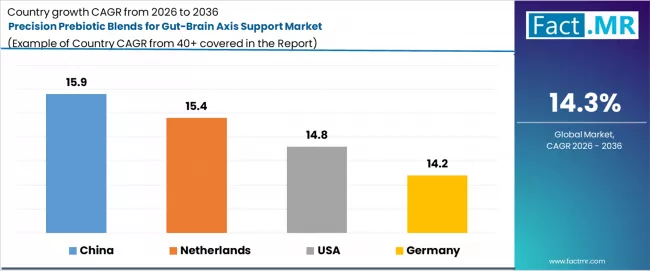
Precision Prebiotic Blends For Gut Brain Axis Support Market Cagr Analysis By Country | Source: Fact.MR
| Country | CAGR (2026-2036) |
|---|---|
| China | 15.9% |
| Netherlands | 15.4% |
| USA | 14.8% |
| Germany | 14.2% |
Source: Fact.MR analysis. Updated Apr 14, 2026
How is China's Tech-Forward Approach to Wellness Catalyzing Growth?
China's leading CAGR of 15.9% is driven by a massive, digitally-engaged consumer base that rapidly adopts health and wellness trends, particularly those intersecting traditional medicine concepts with modern science. The gut-brain axis concept resonates with holistic health principles.
Chinese companies are aggressively investing in microbiome research and digital health platforms that could integrate personalized prebiotic recommendations. The government's focus on innovation in biotechnology and functional foods provides a supportive environment for R&D and commercialization of advanced nutritional ingredients.
What is the Impact of the Netherlands' Concentrated Nutraceutical and Research Ecosystem?
The Netherlands' 15.4% CAGR is a function of its dense concentration of multinational food, ingredient, and nutrition science companies, alongside world-renowned research institutions specializing in gut microbiology and nutritional neuroscience. This cluster effect fosters rapid translation of academic research into commercial ingredient solutions.
The Dutch market is characterized by high B2B demand for clinically-backed, innovative ingredients from global brands headquartered or conducting R&D in the region, pushing suppliers to develop cutting-edge, evidence-based precision blends.
Why Does the USA's Consumer-Driven Mental Wellness Focus Sustain Demand?
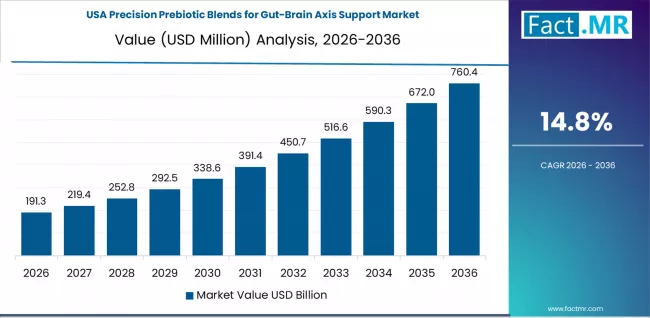
Precision Prebiotic Blends For Gut Brain Axis Support Market Country Value Analysis | Source: Fact.MR
The USA's 14.8% growth is fueled by a consumer market highly proactive about mental health and willing to invest in premium preventive and supportive solutions. The strong dietary supplement industry provides an immediate channel for these blends, while mainstream food and beverage companies are increasingly incorporating functional mental wellness benefits.
The trend is amplified by direct-to-consumer brands that use digital marketing to educate consumers on the gut-brain connection, creating pull-through demand for ingredients that enable these product claims.
How is Germany's Scientific Rigor and Regulatory Mindset Shaping the Market?
Germany's 14.2% CAGR reflects a market where claims must be backed by robust science. German consumers and manufacturers prioritize ingredients with a strong dossier of clinical research, preferably conducted within European populations.
This demand for validation favors established players with significant R&D resources and drives the development of highly studied, efficacious blends. The market advances methodically, with growth tied to the publication of positive clinical trials and the gradual acceptance of specific health claims by European food safety authorities.
Competitive Landscape of the Precision Prebiotic Blends for Gut–Brain Axis Support Market
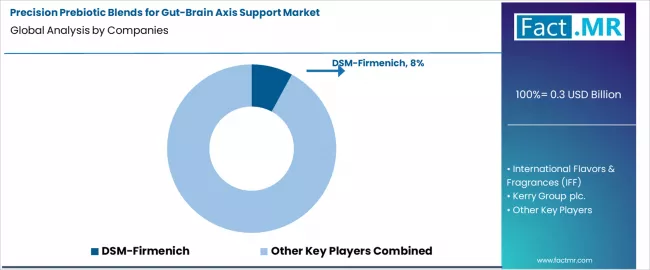
Precision Prebiotic Blends For Gut Brain Axis Support Market Analysis By Company | Source: Fact.MR
The competitive landscape features a blend of diversified ingredient giants, specialized nutrition science firms, and culturally established probiotic companies expanding into prebiotic synergy. Competition is intensifying around intellectual property related to specific fiber combinations, fermentation technologies for novel prebiotics like HMOs, and exclusive clinical data packages.
Success is increasingly dependent on establishing strategic partnerships with research hospitals and universities to generate compelling human study data. Companies are also competing to develop digital tools and services that accompany their ingredient offerings, such as microbiome testing kits or algorithms to predict individual responses to their blends, thereby transitioning from ingredient suppliers to solution providers in the personalized nutrition space.
Key Players in the Precision Prebiotic Blends for Gut–Brain Axis Support Market
- DSM-Firmenich
- International Flavors & Fragrances (IFF)
- Kerry Group plc.
- ADM
- Tate & Lyle
- Yakult Honsha
Segmentation
Scope of Report
| Items | Values |
|---|---|
| Quantitative Units | USD Billion |
| Application | Dairy/Alt-Dairy, Beverages, Bakery/Snacks, Meat/Alt-Meat |
| Strain | Inulin/FOS, GOS, HMO, Resistant Starch |
| Channel | Direct-to-B2B, Distributors, Online B2B, Contract Manufacturing |
| Key Countries | China, Netherlands, USA, Germany |
| Key Companies | DSM-Firmenich, International Flavors & Fragrances (IFF), Kerry Group plc., ADM, Tate & Lyle, Yakult Honsha |
| Additional Analysis | Mechanistic pathways of SCFA-mediated gut-brain communication; analysis of blend stability under different food processing conditions; regulatory evolution of psychological benefit claims for food; economic analysis of novel prebiotic (HMO) production scalability; comparative clinical efficacy studies of different fiber combinations; integration models with digital health and wellness platforms. |
Source: Fact.MR analysis. Updated Apr 14, 2026
Market by Segments
-
Application :
- Dairy/Alt-Dairy
- Beverages
- Bakery/Snacks
- Meat/Alt-Meat
-
Strain :
- Inulin/FOS
- GOS
- HMO
- Resistant Starch
-
Channel :
- Direct-to-B2B
- Distributors
- Online B2B
- Contract Manufacturing
-
Region :
-
North America
- USA
- Canada
-
Latin America
- Brazil
- Mexico
- Argentina
- Rest of Latin America
-
Western Europe
- Germany
- UK
- France
- Spain
- Italy
- Netherlands
- BENELUX
- Rest of Western Europe
-
Eastern Europe
- Russia
- Poland
- Czech Republic
- Rest of Eastern Europe
-
East Asia
- China
- Japan
- South Korea
- Rest of East Asia
-
South Asia & Pacific
- India
- ASEAN
- Australia
- Rest of South Asia & Pacific
-
MEA
- Saudi Arabia
- UAE
- Turkiye
- Rest of MEA
-
References
- Cryan, J. F., O'Riordan, K. J., Cowan, C. S. M., Sandhu, K. V., Bastiaanssen, T. F. S., Boehme, M., ... & Dinan, T. G. (2024). The microbiota-gut-brain axis. Physiological Reviews, 104(3), 1087-1105.
- Dahl, W. J., Rivero Mendoza, D., & Lambert, J. M. (2023). Diet, nutrients and the microbiome. Progress in Molecular Biology and Translational Science, 171, 237-263.
- Gibson, G. R., Hutkins, R., Sanders, M. E., Prescott, S. L., Reimer, R. A., Salminen, S. J., ... & Reid, G. (2023). Expert consensus document: The International Scientific Association for Probiotics and Prebiotics (ISAPP) consensus statement on the definition and scope of prebiotics. Nature Reviews Gastroenterology & Hepatology, 20(8), 491-502.
- Liu, R. T., Walsh, R. F. L., & Sheehan, A. E. (2024). Prebiotics and probiotics for depression and anxiety: A systematic review and meta-analysis of controlled clinical trials. Neuroscience & Biobehavioral Reviews, 158, 105561.
- O'Callaghan, A., & van Sinderen, D. (2023). Bifidobacteria and their role as members of the human gut microbiota. Frontiers in Microbiology, 14, 1127702.
- Sarkar, A., Lehto, S. M., Harty, S., Dinan, T. G., Cryan, J. F., & Burnet, P. W. J. (2023). Psychobiotics and the manipulation of bacteria-gut-brain signals. Trends in Neurosciences, 46(7), 581-599.
- Singh, R. K., Chang, H. W., Yan, D., Lee, K. M., Ucmak, D., Wong, K., ... & Liao, W. (2024). Influence of diet on the gut microbiome and implications for human health. Journal of Translational Medicine, 22(1), 145.
- Valles-Colomer, M., Falony, G., Darzi, Y., Tigchelaar, E. F., Wang, J., Tito, R. Y., ... & Raes, J. (2023). The neuroactive potential of the human gut microbiota in quality of life and depression. Nature Microbiology, 8(4), 623-632.
- Wang, H., & Zhao, J. (2024). The gut-brain axis in cognitive impairment and role of gut microbiota-derived metabolites. Food & Function, 15(9), 4581-4595.
- Zheng, D., Liwinski, T., & Elinav, E. (2023). Interaction between microbiota and immunity in health and disease. Cell Research, 33(6), 492-516.
Frequently Asked Questions
How big is the precision prebiotic blends for gut-brain axis support market in 2026?
What will be the size of precision prebiotic blends for gut-brain axis support market in 2036?
How much will be the precision prebiotic blends for gut-brain axis support market growth between 2026 and 2036?
What are the key product types in the precision prebiotic blends for gut-brain axis support market?
Which strain segment to contribute significant share in the precision prebiotic blends for gut-brain axis support market in 2026?
Who worked on this report


Preview the report firsthand - request a free sample
Free SampleGet the brochure for pricing and purchase details
Download PDF