- Market Value (2025): USD 720.8 Mn
- Estimated Value (2026): USD 786.1 Mn
- Forecast Value (2036): USD 1871.3 Mn
- CAGR (2026-2036): 9.1%
What is the Laser Cleaning Market forecast to be worth by 2036?
USD 786.1 million in 2026 to USD 1871.3 million by 2036, at a 9.1% CAGR.
- The laser cleaning market was valued at USD 720.8 million in 2025.
- According to Fact.MR analysis, market revenue is projected to grow from USD 786.1 million in 2026 to USD 1871.3 million by 2036 as more industrial sites introduce controlled, contact-free surface treatment.
- The projected 9.1% CAGR from 2026 to 2036 reflects cleaning needs within production lines and specialist maintenance work where treatment precision helps protect valuable surfaces.
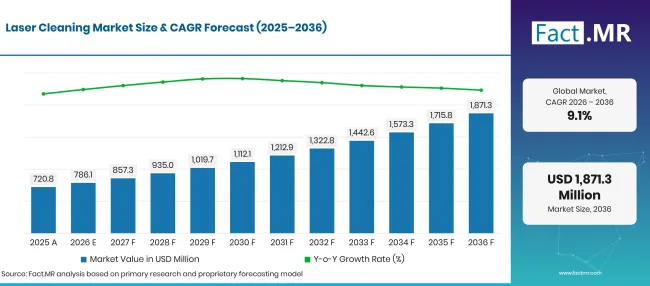
Laser Cleaning Market Forecast Global | Source: Fact.MR
| Year | Basis | Market Value (USD million) |
|---|---|---|
| 2025 | Actual | 720.8 |
| 2026 | Estimate | 786.1 |
| 2036 | Forecast | 1871.3 |
| CAGR 2026 to 2036 | Forecast period | 9.1% |
Source: Fact.MR analysis. Updated Nov 10, 2026
What are the defining numbers behind Laser Cleaning Market growth?
USD 1,085.2 million in additional market value by 2036, led by industrial cleaning and automotive applications.
- Demand Drivers in the Market
- Automotive manufacturers need clean and consistent metal surfaces before welding, bonding and coating. Laser systems can remove localized oxide layers and residues without mechanically rubbing the part, making them useful in repeated production steps where surface preparation must remain closely controlled.
- Electrical equipment manufacturers sometimes need to remove insulation from a small contact area while leaving nearby material in place. In June 2025, TRUMPF described an application in which its TruMark 5010 removes insulating varnish from copper winding pins before an electrical connection is made [2].
- Maintenance providers assess laser cleaning according to the time required and the risk of damaging the equipment beneath the residue. In March 2026, Laser Photonics announced a CleanTech deployment for engine maintenance at a Cummins facility [3], illustrating the role of targeted surface treatment in industrial servicing.
- Shipyards often need to prepare corroded surfaces around joints, fittings and difficult-to-reach areas. Laser Photonics described marine corrosion applications for its handheld CleanTech equipment in May 2025 [14].
- Key Segments Analyzed
- By Laser Type: Solid Laser is projected to account for 39.3% in 2026, reflecting interest in pulsed solid-state systems for controlled removal on metal surfaces.
- By Application: Industrial Usage is forecast to represent 42.3% in 2026, since production and equipment maintenance involve recurring preparation and residue-removal tasks.
- By Power: High Power is estimated to hold 45.3% in 2026 where area coverage and cycle time shape production equipment purchases.
- By End-User: Automotive is anticipated to account for 35.2% in 2026 as vehicle parts move through cleaning steps before bonding or joining.
- Analyst Opinion at Fact.MR
- Shambhu Nath Jha, Principal Consultant at Fact.MR, states, “For factory buyers, a successful demonstration is only the beginning of equipment qualification. The cleaning method must also fit the production cycle, protect the surrounding material and work within a safe enclosure.”
- Strategic Implications
- Laser equipment manufacturers should show the cleaning result on the customer’s actual substrate and document the energy settings used during trials.
- System integrators should plan extraction and beam protection around the whole work cell instead of treating them as optional accessories.
- Automotive manufacturers should compare the cost per treated part with existing cleaning methods, including extraction equipment, maintenance and the time needed to qualify each production process.
- Industrial maintenance providers should distinguish portable cleaning jobs from fixed automated installations because operator access changes the practical machine specification.
Brazil leads at 10.8% CAGR through 2036, followed by Japan at 9.8%, the UK at 9.0%, the USA at 8.5% and Germany at 6.6%.
How does the Laser Cleaning Market break down by segment?
Solid Laser: 39.3%; Industrial Usage: 42.3%; High Power: 45.3%; Automotive: 35.2% in 2026.
Which Laser Type dominates?
Solid Laser represents 39.3% of forecast 2026 sales.
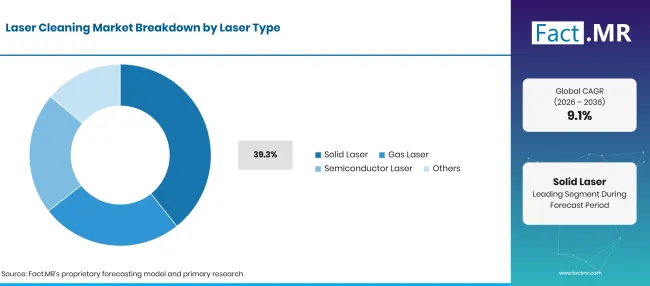
Laser Cleaning Market Breakdown Laser Type | Source: Fact.MR
| Laser Type | Share (2026) |
|---|---|
| Solid Laser (Leading segment) | 39.3% |
| Other segments combined | 60.7% |
| Total | 100.0% |
Source: Fact.MR analysis. Updated Nov 10, 2026
Solid-state cleaning equipment suits tasks where pulse control and a compact beam delivery system are useful. Fiber-based sources often form part of this category in commercial cleaning machines, though product names and laser classifications differ by supplier. Gas laser systems can serve certain surface tasks but carry different source and maintenance considerations. Commercial laser processing equipment includes separate treatment and cutting configurations for different production jobs.
What leads the Application segment?
Industrial Usage accounts for 42.3% of forecast 2026 demand.
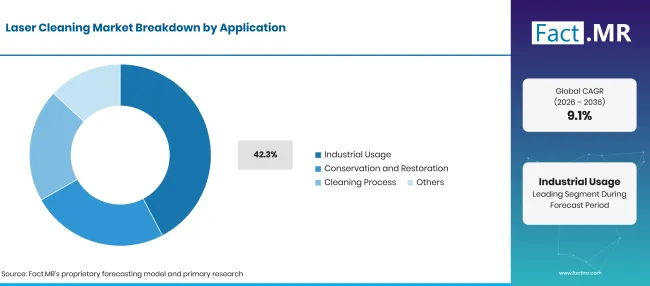
Laser Cleaning Market Breakdown Application | Source: Fact.MR
| Application | Share (2026) |
|---|---|
| Industrial Usage (Leading segment) | 42.3% |
| Other segments combined | 57.7% |
| Total | 100.0% |
Source: Fact.MR analysis. Updated Nov 10, 2026
Industrial laser cleaning removes oxides and process residues before downstream manufacturing. A controlled beam can treat a defined weld area without processing the whole component. Conservation work follows different priorities because the object may be irreplaceable. Repeated factory applications can also use robot-guided treatment paths.
How does Power shape sales?
High Power represents 45.3% of forecast 2026 value.
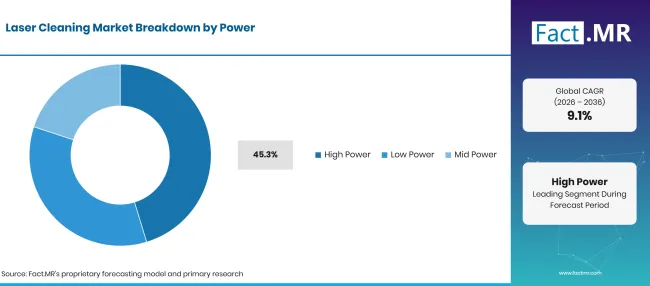
Laser Cleaning Market Breakdown Power | Source: Fact.MR
| Power | Share (2026) |
|---|---|
| High Power (Leading segment) | 45.3% |
| Other segments combined | 54.7% |
| Total | 100.0% |
Source: Fact.MR analysis. Updated Nov 10, 2026
High-power systems suit larger treatment areas where cycle time matters, although removal quality also depends on beam movement and the energy delivered to the surface. Mid-power equipment can be more appropriate for smaller work cells.
Which End-User leads adoption?
Automotive contributes 35.2% of forecast 2026 demand.
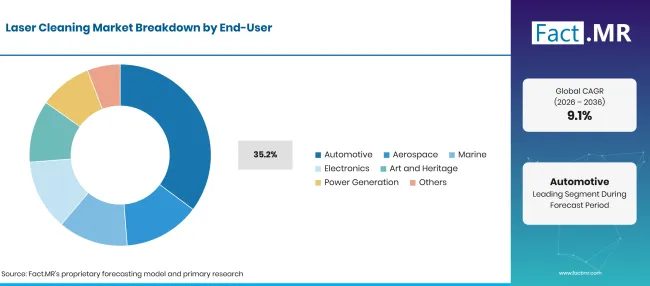
Laser Cleaning Market Breakdown End User | Source: Fact.MR
| End-User | Share (2026) |
|---|---|
| Automotive (Leading segment) | 35.2% |
| Other segments combined | 64.8% |
| Total | 100.0% |
Source: Fact.MR analysis. Updated Nov 10, 2026
Vehicle production involves controlled cleaning around welds and metal contact points. Surface preparation can be positioned before bonding or painting where residues would affect the following step. Aerospace facilities assess cleaning with strict attention to material and part documentation.
What is accelerating Laser Cleaning Market adoption, and what is holding it back?
Consistent surface preparation supports equipment adoption, while process qualification, operator safety and installation costs influence the timing of purchases.
Drivers Impact Analysis
| Driver | (~) % Impact on CAGR | Geographic Relevance | Impact Timeline |
|---|---|---|---|
| Automotive surface preparation requirements | +1.5% | North America, Western Europe, East Asia | Medium term (2–4 years) |
| Production-line automation | +1.2% | Global manufacturing hubs | Long term (4+ years) |
| Corrosion removal for industrial assets | +0.9% | Latin America, North America | Short term (up to 2 years) |
| Selective coating removal | +0.7% | Europe, Japan | Medium term (2–4 years) |
| Maintenance access for complex parts | +0.5% | Global | Medium term (2–4 years) |
Source: Fact.MR analysis. Updated Nov 10, 2026
Opportunity Impact Analysis
| Opportunity | (~) % Impact on CAGR | Geographic Relevance | Impact Timeline |
|---|---|---|---|
| Robotic cleaning cells for repeat parts | +0.9% | North America, East Asia | Medium term (2–4 years) |
| Precision cleaning before electrical joining | +0.7% | Germany, Japan | Long term (4+ years) |
| Portable marine maintenance units | +0.5% | Coastal industrial regions | Medium term (2–4 years) |
| Conservation-grade specialist services | +0.3% | Europe, North America | Long term (4+ years) |
Source: Fact.MR analysis. Updated Nov 10, 2026
Restraints Impact Analysis
| Restraint | (~) % Impact on CAGR | Geographic Relevance | Impact Timeline |
|---|---|---|---|
| Machine and integration capital cost | -0.8% | Global | Short term (up to 2 years) |
| Laser safety and fume capture requirements | -0.6% | North America, Europe | Short term (up to 2 years) |
| Surface qualification and cycle-time trials | -0.5% | Global automotive | Medium term (2–4 years) |
| Competition from established cleaning methods | -0.4% | Global | Medium term (2–4 years) |
Source: Fact.MR analysis. Updated Nov 10, 2026
Which countries are scaling the Laser Cleaning Market through 2036?
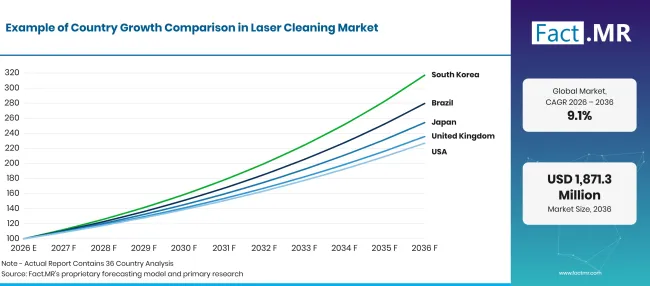
Laser Cleaning Market Growth Index | Source: Fact.MR
| Country | CAGR (2026 to 2036) |
|---|---|
| Brazil | 10.8% |
| Japan | 9.8% |
| United Kingdom | 9.0% |
| United States | 8.5% |
| Germany | 6.6% |
Source: Fact.MR analysis. Updated Nov 10, 2026
How is Brazil developing laser cleaning demand?
10.8% CAGR, linked to manufacturing renewal and industrial maintenance.
Brazil's laser cleaning outlook centers on repairs to operating machinery and the gradual use of automated surface preparation. Industrial production provides the first demand setting: the Brazilian Institute of Geography and Statistics reported in March 2026 that industry value added increased 1.4% in 2025 [6]. IBGE recorded a 1.2% monthly fall in industrial production during December 2025 in its February 2026 release [7].
How is Japan developing laser cleaning demand?
9.8% CAGR, associated with precise surface preparation and plant automation.
Japanese manufacturers assess laser cleaning as a controlled treatment for parts that move through tightly planned production lines. The International Federation of Robotics reported in September 2026 that Japan installed 36,219 industrial robots in 2025 [1]. Japan's Ministry of Economy, Trade and Industry reported in March 2026 that the industrial production index rose 4.3% from the previous month in January 2026 [12]. METI's February 2026 preliminary release recorded a 4.2% decline in the inventory ratio for January 2026 [13].
How is United Kingdom developing laser cleaning demand?
9.0% CAGR, shaped by industrial refurbishment and specialist manufacturing.
The United Kingdom offers laser cleaning applications across factory surface treatment and the care of equipment that remains in service for many years. The Society of Motor Manufacturers and Traders reported in January 2026 that UK factories built 764,715 cars and commercial vehicles during 2025 [8]. A separate SMMT release in April 2026 found that 45.7% of cars in use were more than ten years old during 2025 [9]. SMMT reported in February 2026 that vehicle production declined 13.6% year on year during January 2026 [10].
How is United States developing laser cleaning demand?
8.5% CAGR, supported by factory automation and equipment refurbishment.
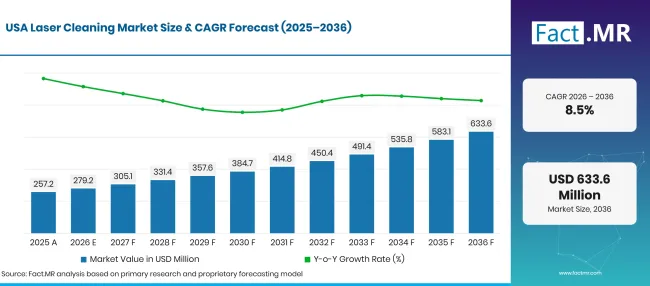
Laser Cleaning Market Forecast Usa | Source: Fact.MR
American laser cleaning customers range from factory engineering teams to industrial maintenance providers working on operating assets. The Bureau of Labor Statistics recorded 8.754 million production and nonsupervisory manufacturing employees in September 2026 [11]. The same BLS series recorded 8.795 million employees in September 2025, a comparison that provides a measure of workforce conditions rather than laser equipment sales.
How is Germany developing laser cleaning demand?
6.6% CAGR, reflecting process quality needs in established industrial plants.
German manufacturers tend to evaluate laser cleaning against established production standards and measured treatment quality. Germany Trade & Invest reported in September 2025 that 26,982 industrial robots were installed in Germany during 2024 [4]. In January 2026, the German automotive association VDA reported that domestic factories built approximately 4.15 million passenger cars during 2025 [17]. The Federal Statistical Office reported in February 2026 that Germany's industrial production fell 1.1% across 2025 compared with the previous year [5].
Who leads the Laser Cleaning Market?
The competitive field includes manufacturers of complete cleaning cells and companies that supply laser sources to equipment integrators.
TRUMPF demonstrates selective coating removal in electrical component production. Laserax offers laser cleaning workstations and robotic arrangements for metal treatment.
Coherent Corp. And IPG Photonics are relevant suppliers of industrial laser technology used within wider laser processing systems. Clean-Lasersysteme GmbH specializes in cleaning equipment. General Lasertronics Corporation and White Lion GmbH are additional specialist names in the competitive field.
Which companies are the key providers?
Key companies include TRUMPF GmbH, Coherent Corp., IPG Photonics, Clean-Lasersysteme GmbH, Laserax, Laser Photonics Corporation, General Lasertronics Corporation, and White Lion GmbH.
- TRUMPF GmbH
- Coherent Corp.
- IPG Photonics
- Clean-Lasersysteme GmbH
- Laserax
- Laser Photonics Corporation
- General Lasertronics Corporation
- White Lion GmbH
Bibliography
- [1] Germany Trade & Invest. (2025, September 29). Germany is Europe’s leading robotics nation.
- [2] TRUMPF. (2025, June 5). For a direct connection: TRUMPF laser removes insulating varnish.
- [3] Laser Photonics Corporation. (2026, March 13). Laser Photonics’ CleanTech successfully integrated into Cummins engine maintenance.
- [4] Germany Trade & Invest. (2025, September 29). Germany is Europe’s leading robotics nation.
- [5] Statistisches Bundesamt (Destatis). (2026, February 6). Production in December 2025: -1.9% on the previous month.
- [6] Instituto Brasileiro de Geografia e Estatística. (2026, March 3). PIB cresce 2,3% em 2025 e fecha o ano em R$ 12,7 trilhões.
- [7] Instituto Brasileiro de Geografia e Estatística. (2026, February 3). Produção industrial recua 1,2% em dezembro.
- [8] Office for National Statistics. (2026, March 13). Index of Production, UK: January 2026.
- [9] Department for Transport. (2026, April 29). Vehicle licensing statistics, United Kingdom: 2025.
- [10] Office for National Statistics. (2026, October 8). UK new vehicle registrations and production.
- [11] U.S. Bureau of Labor Statistics. (2026, October 2). Employment Situation: September 2026 – Employment of production and nonsupervisory employees by industry sector.
- [12] Ministry of Economy, Trade and Industry, Japan. (2026, March 19). Indices of Industrial Production: Revised Report for January 2026.
- [13] Ministry of Economy, Trade and Industry, Japan. (2026, February 27). Indices of Industrial Production: Preliminary Report for January 2026.
- [14] Laser Photonics Corporation. (2025, May 16). Laser Photonics’ CleanTech: Pioneering the fight against saltwater corrosion.
This Report Answers
- The report compares industrial production cleaning with smaller restoration applications and explains why process control matters for each.
- Laser type analysis considers system behavior and maintenance needs across different source configurations.
- Power analysis explains how work area and target cycle time affect machine selection.
- Country analysis compares production conditions in Brazil, Japan, the United Kingdom, the United States and Germany.
- Supplier analysis distinguishes integrated equipment vendors from laser-source manufacturers and specialist cleaning services.
What does the Laser Cleaning Market cover?
Laser cleaning systems remove unwanted surface material using controlled laser energy. The analysis includes fixed workstations and portable equipment used for metal preparation or restoration. It covers cleaning hardware integrated with existing handling systems when the primary task is material removal from a surface.
What is included in the scope?
Included applications range from rust removal on industrial assets to selective removal of oxide films and insulating coatings.
Industrial cleaning cells and maintenance-oriented systems are part of the equipment boundary. Laser processing applications include cutting and welding systems, which serve distinct equipment purposes.
What is excluded from the scope?
Laser cutters and welding machines used solely for joining or separating material fall outside this scope.
General engraving and marking systems are excluded unless sold and used for cleaning. Standalone abrasives and chemical stripping consumables are also outside the equipment revenue boundary. Laser marking for packaging serves a different purpose and is outside the cleaning-equipment revenue boundary.
How Was the Analysis Built?
The analysis draws on 120+ sources, 35+ company portfolios, 25+ countries, and more than 20 industry interviews.
- Primary Research: Primary research includes discussions with manufacturers, service providers, technology developers, distributors, end users, and subject-matter experts. These conversations examine purchasing priorities, product adoption, operational challenges, approval requirements, competitive positioning, and the factors that influence wider market acceptance.
- Desk Research: Desk research covers government statistics, regulatory publications, company filings, trade data, technical studies, industry associations, standards, public policy, and other authoritative sources. Every source used in the analysis is documented in the bibliography.
- Market Sizing and Forecasting: Market estimates combine historical performance, demand indicators, pricing and volume trends, segment shares, company participation, country-level growth, adoption patterns, investment activity, and barriers to market expansion.
- Data Validation and Update Cycle: Findings are validated by comparing primary interviews with public data, company activity, regulatory changes, trade patterns, and industry developments. Regular updates review new product launches, capacity changes, partnerships, approvals, and shifts in commercial adoption.
Segmentation
What is the report’s scope and coverage?
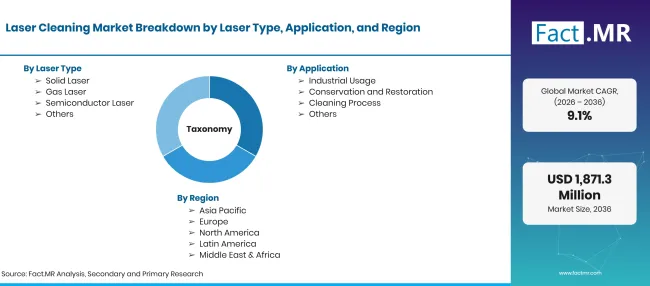
Laser Cleaning Market Taxonomy | Source: Fact.MR
| Attribute | Details |
|---|---|
| Quantitative Units | USD million |
| Market Definition | Equipment and systems that remove rust, oxides, paint or other unwanted surface layers with laser energy. Includes mobile and production-line cleaning configurations. |
| Laser Type | Solid Laser; Gas Laser; Semiconductor Laser; Others |
| Application | Industrial Usage; Conservation and Restoration; Cleaning Process; Others |
| Power | High Power; Low Power; Mid Power |
| End-User | Automotive; Aerospace; Marine; Electronics; Art and Heritage; Power Generation; Others |
| Regions Covered | North America; Latin America; Western Europe; Eastern Europe; East Asia; South Asia and Pacific; Middle East and Africa |
| Countries Covered | Germany; Brazil; United States; United Kingdom; Japan |
| Companies Profiled | TRUMPF GmbH, Coherent Corp., IPG Photonics, Clean-Lasersysteme GmbH, Laserax, Laser Photonics Corporation, General Lasertronics Corporation, and White Lion GmbH |
| Forecast Period | 2026 to 2036 |
| Approach | Application-based equipment demand, customer cycle-time requirements, source and integration costs, and examination of officially announced industrial applications |
Source: Fact.MR analysis. Updated Nov 10, 2026
How is the market segmented?
-
By Laser Type
- Solid Laser
- Gas Laser
- Semiconductor Laser
- Others
-
By Application
- Industrial Usage
- Conservation and Restoration
- Cleaning Process
- Others
-
By Power
- High Power
- Low Power
- Mid Power
-
By End-User
- Automotive
- Aerospace
- Marine
- Electronics
- Art and Heritage
- Power Generation
- Others
-
By Region
- North America
- Latin America
- Western Europe
- Eastern Europe
- East Asia
- South Asia and Pacific
- Middle East and Africa
Frequently Asked Questions
How big is the Laser Cleaning Market in 2026?
What is the CAGR of the Laser Cleaning Market from 2026 to 2036?
Which laser type leads the Laser Cleaning Market?
Which application leads the Laser Cleaning Market?
Who are the leading companies in the Laser Cleaning Market?
Who worked on this report


Preview the report firsthand - request a free sample
Free SampleGet the brochure for pricing and purchase details
Download PDF