- Market Value (2025): USD 480.0 Mn
- Estimated Value (2026): 510.0 Mn
- Forecast Value (2036): USD 880.0 Mn
- CAGR (2026-2036): 5.6%
What is the Low-Foam Wetting Agents Market forecast to be worth by 2036?
USD 510.0 million in 2026 to USD 880.0 million by 2036, a 5.6% CAGR.
- The low-foam wetting agents market passed USD 480.0 million in 2025 as early approval work advanced across wetting agents and coating additives. That work links laboratory wetting observations to storage, processing, and the surface result seen in production.
- Demand is set to add USD 370.0 million in incremental opportunity through 2036 as Acetylenicdiol and Paints find clearer use cases. Those use cases turn real when the chosen grade shortens the path to complete surface contact without adding foam that gets in the way of spray, recirculation, application, or rinsing.
- A 5.6% CAGR is forecast as biodegradability and wetting speed still sitatthe center of technical review.
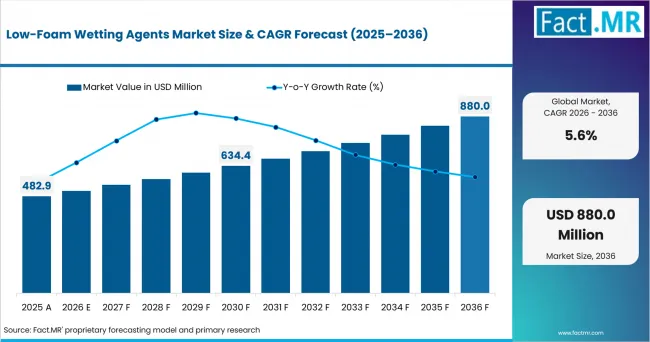
Low Foam Wetting Agents Market Market Value Analysis | Source: Fact.MR
What are the defining numbers behind Low-Foam Wetting Agents Market growth?
USD 370.0 million absolute opportunity by 2036, led by Waterborne coatings, which account for 52% share in 2026 and USD 265.2 million in value.
- Demand Drivers in the Market
- Acetylenicdiol is preferred because it spreads quickly, keeps foam low, and can be added without major changes to the existing process.
- Paint makers need wetting agents that help the coating spread evenly and produce a smooth finish without creating foam during mixing or application.
- Ultra-low-foam products are in demand in spray, circulation, and rinsing systems where excess foam can slow production and affect cleaning quality.
- In coating applications, low-foam wetting agents are judged by how evenly they cover the surface, how well they work with the formulation, and whether the final coating remains stable.
- Key Segments Analyzed
- Acetylenicdiol accounts for 29% of the market in 2026. Its lead comes from fast wetting, low foam, and easy use in existing formulations.
- Paintsrepresent 33% of demand in 2026. Even spreading is critical in this application because poor wetting quickly appears as patches, streaks, or surface defects.
- Ultra-low-foam products capture a 30% share in 2026. They are widely used in spray and circulation systems where foam can interrupt production and slow rinsing.
- Coatings make up 52% of the market in 2026, making them the largest end-use industry. The shift toward water-based coatings is increasing the need for products that improve coverage without adding foam.
- Metal leads the substrate segment with a 35% share in 2026. Wetting agents are important here because liquids can struggle to spread evenly across hard and smooth metal surfaces.
- Analyst Opinion at Fact.MR
- Fact.MR opines that in this market,real performance matters more than broad product claims. Acetylenicdiol creates value when it helps liquids spread quickly across difficult surfaces without causing excess foam during mixingor rinsing.A product must prove more than fast wetting in a laboratory test. It also needs to control foam, avoid residue, remain stable during storage, and perform consistently under normal production conditions. Wider use follows only when the same grade delivers reliable results throughout the full process.
- Strategic Implications
- Acetylenicdiol should be tested under normal production conditions. The trial should use the same formulation and substrate planned for regular use. It should also follow the usual mixing and application steps. This shows whether the product improves coverage without causing foam or residue problems.
- The approved grade and the newoptionshould be tested side by side. The same formulation and process should be used for both. The comparison should cover spreading, penetration, spraying, coating, circulation, and rinsing. This makes it easier to see whether the new grade offers a real improvement.
- Safety documents and test records should be prepared before review begins. Clear records help teams track the material, storage conditions, test method, andfinal result. They also make it easier to find the cause when wetting or foam performance changes.
How does the Low-Foam Wetting Agents Market break down by segment?
Acetylenicdiol leads Chemistry at29%,Paints lead Application at 33% in 2026.
Why does Acetylenicdiollead Chemistry?
Acetylenicdiol holds 29% share in 2026.
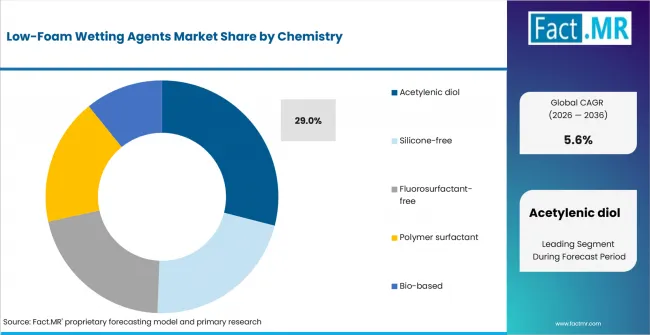
Low Foam Wetting Agents Market Analysis By Chemistry | Source: Fact.MR
Acetylenicdiol is often preferred because it can be added withlittle changeto the current process. Approval still depends on whether it remains stable after storage and use. Tests look at how well it mixes into the formulation, how quickly it reaches the surface, and whether it keeps foam under control during agitation or circulation.Other chemistriesremainuseful when cost or handling needs are different. Wider adoption depends on finding a product that improves wetting and continues to control foam during repeated use.
What keeps Paints ahead in Application?
Paints hold 33% share in 2026.
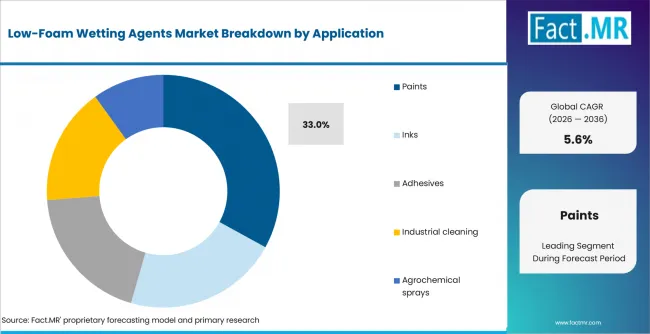
Low Foam Wetting Agents Market Analysis By Application | Source: Fact.MR
Paints lead because poor wetting is easy to seeinthe finished surface. Foam control also matters because excess foam can delay approval and affect coating quality.Inks and adhesives need even contact across the surface. Industrial cleaning products depend more on penetration and smooth rinsing. Agrochemical sprays must spread well during application.Across these uses, the product must wet the target quickly without creating foam that affects delivery or coverage.
Why does Ultra-low foamleadthe Foam Profile segment?
Ultra-low foam holds 30% share in 2026.
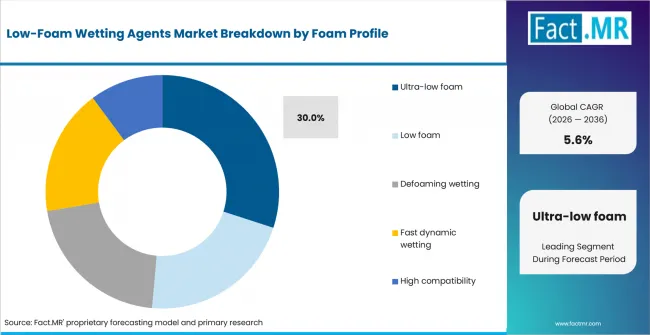
Low Foam Wetting Agents Market Analysis By Foam Profile | Source: Fact.MR
Ultra-low foam keeps its lead because normal operating trials can confirm its value, and approval can proceed without reworking the whole process. That said, the profile is not a stand-in for wetting performance. A candidate still has to establish fast contact and evenspreadingon the chosen substrate. Approval rests on stable results after storage and processing, and dispersion checks must be completed before wider rollout. Thepreferred profile keeps sprayand rinse behavior inside the operating window while still delivering the required wetting speed.
Why does Coatings lead the End-use Industry segment?
Coatings hold 52% share in 2026.
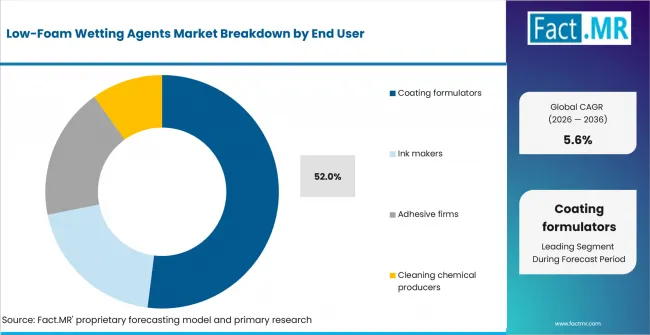
Low Foam Wetting Agents Market Analysis By End User | Source: Fact.MR
Coatings leadaswetting speed is critical in water-based formulations. The additive must keep the formulation stable and help it spread evenly across the surface. It must also support a smooth and consistent finish.
Approvalremainsstrict until the finished coating performs reliably. Other industries face similar challenges under different operating conditions. Repeat demand grows when the wetting agent works in the existing process without causing foam, residue, or compatibility problems.
What makes Metal the leading Substrate?
Metal holds 35% share in 2026.
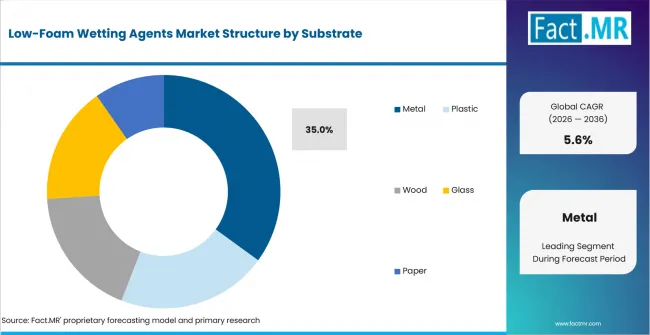
Low Foam Wetting Agents Market Analysis By Substrate | Source: Fact.MR
Metal stays ahead because its value can be checked through normal operating trials and the change burden is low. Testing can inspect contact, coverage, and the consistency of the applied or cleaned result, then repeat the comparison after storage and processing. Plastic and Glass can present difficult contact conditions. Wood and Paper bring penetration directly into the wetting brief. Contaminated surfaces sharpen the need to verify actual coverage rather than nominal coverage. Every substrate can shift the workable dose and foam response, so a good result on Metal cannot stand in for substrate-specific approval across the wider taxonomy.
What is accelerating Low-Foam Wetting Agents Market adoption, and what is holding it back?
Foam balance is what drives adoption forward, while qualification cost and process fit keep that momentum in check. The strongest gains show up where results can be verified quickly under the actual use sequence. The same evaluationhas toshowthe wetting gain does not come with excessive foam, residue, instability, or a change burden bigger than the benefit it delivers.
Drivers Impact Analysis
| DRIVER | (~) % IMPACT ON CAGR | GEOGRAPHIC RELEVANCE | IMPACT TIMELINE |
|---|---|---|---|
| Foam balance control inAcetylenicdiol | +0.8% | China and export markets | Medium term (2-4 years) |
| Biodegradability testing | +0.6% | Europe and North America | Short term (<= 2 years) |
| Waterborne coatings approval programs | +0.5% | Asia Pacific | Medium term (2-4 years) |
| Local support near application labs | +0.4% | Global | Long term (>= 4 years) |
Source: Fact.MR analysis. Updated Jul 15, 2026
- For China and export-oriented production, foam balance control inAcetylenicdiol carries a +0.8%CAGR impact over the medium term (2-4 years). Itturnsa general material need into an application-specific problem that shows up as contact, coverage, and foam response in the running formulation.
- Europe and North America see a +0.6%CAGR impact from biodegradability testing over the short term (2 years or less). Technical review gains a measurable reason toproceed, and application testing confirms that the grade still delivers fast wetting and compatible process behavior alongside it.
- In Asia Pacific, waterbornecoatingsapproval programs carry a +0.5%CAGR impact over the medium term (2-4 years). They tie the product to one visible pain point and carry the trial from dispersion through application intofinished-coating review.
- Local support near application labs carries a +0.4%global CAGR impact over the long term (4 years or more). Close assistance pays off when surface evidence can be tied to real savings or fewer rejected trials, and when a weak resulthas tobe traced back to dose, substrate, agitation, or formulation fit.
Opportunity Impact Analysis
| OPPORTUNITY | (~) % IMPACT ON CAGR | GEOGRAPHIC RELEVANCE | IMPACT TIMELINE |
|---|---|---|---|
| Grades tuned for Waterborne coatings | +0.5% | Global | Medium term (2-4 years) |
| Application labs for Paints | +0.4% | Asia Pacific and Europe | Short term (<= 2 years) |
| Rule-ready documentation | +0.4% | Europe and United Kingdom | Medium term (2-4 years) |
| Local cleaning-system trials | +0.3% | India and Brazil | Long term (>= 4 years) |
Source: Fact.MR analysis. Updated Jul 15, 2026
- Grades tuned for Waterborne coatings carry a +0.5%global CAGR impact over the medium term (2-4 years). The opportunity grows once process evidence can be repeated without specialhandlingand fast coverage stays uniform through the normal application sequence.
- Application labs for Paints carry a +0.4%CAGR impact in Asia Pacific and Europe over the short term (2 years or less). The opening widens when test notes can be reproduced within the same formulation, coating method, substrate review, and finished-goodscheck.
- Rule-ready documentation carries a +0.4%CAGR impact in Europe and the United Kingdom over the medium term (2-4 years). The opening strengthens when documentation links material records directly to wetting, foam, and compatibility observations that can be verified during review.
- India and Brazil gain a +0.3%CAGR impact from local cleaning-system trials over the long term (4 years or more). The opportunity improves when notes stay simple enough to verify through contact, agitation, recirculation, cleaning, and rinse evaluation.
Restraints Impact Analysis
| RESTRAINT | (~) % IMPACT ON CAGR | GEOGRAPHIC RELEVANCE | IMPACT TIMELINE |
|---|---|---|---|
| Qualification cost | -0.4% | Global production | Medium term (2-4 years) |
| Fit limits in Paints | -0.3% | Global | Short term (<= 2 years) |
| Documentation burden | -0.3% | Europe and North America | Medium term (2-4 years) |
| Scale-up risk | -0.2% | High-volume plants | Long term (>= 4 years) |
Source: Fact.MR analysis. Updated Jul 15, 2026
- Qualification cost drags on Global production with a -0.4%CAGR effect over the medium term (2-4 years). Even a small material change can create rework because storage, dispersion, wetting speed, foam response, substrate coverage, and finished quality must all be tested before an approved grade is replaced.
- Fit limits in Paints impose a -0.3%CAGR effect globally over the short term (2 years or less). Adoption stays cautious because running lines must remain protected, and a candidate that improves initial contact can still fall outside the process window during agitation, application, or drying preparation.
- In Europe and North America, documentation burden carries a -0.3%CAGR effect over the medium term (2-4 years). Material changes can touch cost and process stability, so incomplete records slow down agreement on whether a result isactually repeatable.
- At High-volume plants, scale-up risk carries a -0.2%CAGR effect over the long term (4 years or more). Fast switching stays limited because theprocessriskremainswith the operating site, and larger spray, recirculation, coating, or cleaning runshave to reproduce laboratory coverage without pushing foam higher.
What is the country-wise forecast on Low Foam Wetting Agents Market?
Germany records 6.4%, Brazil sits at 5.9%, and the United States comes in at 5.3%.
The regional analysis covers North America, Europe, Asia Pacific, Central and South America, and the Middle East and Africa. Growth through 2036 will depend on production activity, product availability, and the pace of product testing.Demand is stronger in countries where wetting agents can be tested under real operating conditions. Local trials show how a product performs during spraying, coating, cleaning, and rinsing. They also help companies respond faster when surface contamination, storage, dispersion, or foam affects performance.
.webp "Top Country Growth Comparison Low Foam Wetting Agents Market Cagr (2026 2036)")
Top Country Growth Comparison Low Foam Wetting Agents Market Cagr (2026 2036) | Source: Fact.MR
| COUNTRY | CAGR |
|---|---|
| Germany | 6.4% |
| Brazil | 5.9% |
| United States | 5.3% |
Source: Fact.MR analysis. Updated Jul 15, 2026
Why is Germany a focused qualification market?
Germany is expected to grow at a 6.4% CAGR through 2036
Supported by strong manufacturing activity and access to plant-level testing for wetting agents and coating additives. Laboratory trials help narrow the options by checking wetting speedand foam control, while production trials show whether the same performance holds once the product is applied to the actual substrate under normal operating conditions.
This is especially important in waterborne coatings, where even surface contact must remain stable through mixing and handling. Demand grows when one well-documented trialcan confirm storage stabilityand the uniformity of the finished coating.
Where does Brazil gain traction?
Brazil is forecast to grow at a 5.9% CAGR through 2036
Local manufacturing and plant-level testing keep technical support close to major production sites. This allows companies to test wetting agents in the same waterborne formulation and under the same operating conditions planned for regular use.The trial can show whether the product improves coverage or penetration without creating excess foam during mixing and circulation. Demand becomes more consistent when the same materialremainsstable after storage and processing and when both production and quality teams can rely on the approval record.
How does the United States support approval work?
The United States is expected to grow at a 5.3% CAGR through 2036
Local manufacturing and plant testing make it easier to move a wetting agent from laboratory review into regular production. Trials can firstidentifythe right dose and wetting response before checking how the product behaves during sprayingor rinsing under normal operating conditions.Demand becomes more dependable when the same grade continues to improve surface contact without creating residue or stability problems after scale-up. Clear technical records also help production and quality teams confirm that the approved result can be repeated within the same process window.
Who leads the Low-Foam Wetting Agents Market?
Evonik, BYK,Dow, BASF,Croda, andClariantare among the leading players. Competitive strength comes down to whether proof and technical support can carry a grade through qualification. The evidence that matters shows fast, uniform surface contact under the intended formulation and process conditions while keeping unwanted foam inside the acceptable operating range.
Competition centers on qualification support, product consistency, andsourcetransparency. Strong technical support makes trials reproducible across storageand rinse conditions. The commercial edge comes from evidence that can be repeated on operating lines, not from unsupported product claims.
Which companies are profiled?
- Evonik
- BYK
- Dow
- BASF
- Croda
- Clariant
Bibliography
- Regulation (EU) 2026/405 on detergents and surfactants.
- OECD Test No. 301: Ready Biodegradability.
- EPA Safer Choice Criteria for Surfactants
- EPA Safer Choice Criteria forDefoamers.
- European Commission EU Ecolabel for Paints and Varnishes.
- Government of India Annual Report 2025-26, Department of Chemicals and Petrochemicals.
- National Bureau of Statistics of China, 2025 Statistical Communique.
- German Federal Statistical Office, Industry and Manufacturing.
- IBGE, Brazilian Industrial Production, April 2026.
This Report Addresses
- The report provides strategic intelligence on the low-foam wetting agents market across Chemistry and Application choices, with attention to rapid surface coverage and the foam balance that allows high-speed aqueous processing to remain controlled.
- Segment analysis coversAcetylenicdiol and Paints as the 2026 share leaders. Ultra-low foam, Coatings, and Metal complete the leading segment view.
- Country analysis opens with China and India. Germany, Brazil, and the United States complete the regional view. It connects plant activity, product availability, and qualificationworkwith the ability to reproduce wetting performance under operating conditions.
- Competitive analysisprofilesEvonikand BYK followed by Dow, BASF,Croda, andClariant. The analysis focuses on these six companies and the evidencerequiredthrough formal approval.
- Use-case assessment covers Waterborne coatings and adjacent applications within Wetting Agents / Coating Additives. It examines contact, spreading, penetration, spray, recirculation, agitation, rinse behavior, coating or cleaning uniformity, low residue, and unwanted foam.
What does the Low-Foam Wetting Agents Market cover?
The market coversAcetylenicdiol, Paints, and Waterborne coatings used in defined commercial applications. The other listed chemistry, application, foam-profile, end-use industry, substrate, and regional routes come into scope when products arepurchasedfor the same low-foam wetting function.
Commercial value comes from the material's role inside wetting agents and coating additives, and from the application support needed for approval. Productshave toimprove substrate contact while minimizing foam in the stated waterborne paints, inks, adhesives, and cleaning systems. Value follows wetting speed and the ability to reproduce coverage and compatibility on the operating line.
Broad grades sit outside the boundary when the defined function is not the reason for purchase. A general surface-active material is not included unless it is sold to deliver low-foam wetting in a listed commercial application.
What is included in the scope?
The scope includes wetting agents engineered to improve substrate wetting while minimizing foam in waterborne paints, inks, adhesives, and cleaning systems.
Coverage spans Acetylenicdiol, Paints, and Waterborne coatings where the same function drives purchase, along with the other entries in the complete segmentation taxonomy.
Included activity covers grades that clear formal review and go on to repeat purchase. Application support falls within scope where it helpsestablishmaterial handling, storage and processing stability, wetting speed, surface coverage, foam balance, low residue, compatibility, and a repeatable result under the normal operating sequence.
What is excluded from the scope?
Parent products sit outside the scope unless they are sold specifically for the stated role in the low-foam wettingagentsmarket.
Equipment-only offerings also fall outside the boundary, since the purchased function comes from the wetting agent itself, even though mixers, spray units, recirculation systems, coating equipment, and cleaning equipment all shape the operating trial.
Commodity materials only enter the market when sold for a named application within the low-foam wettingagentscategory. A materialdoesn'tcross the boundary just because it could affect surfacecontact,inclusion depends on it being sold for the defined function.
How was the analysis built?
The market view combines sizing checks and company analysis with segment logic, country-level signals, and public evidence.
Market values, shares, growth rates, scope, and segmentation are assessed consistently while the analysis explains how operating trials turn wetting performance into repeat use.
- Primary Research
- Primary research covers formulation, procurement, distribution, application, production, and quality functions involved with wetting agents and coating additives. Discussion covers surface condition, wetting speed, contact and penetration, addition practice, agitation, spray, recirculation, rinse behavior, foam balance, storage, processing, low residue, compatibility, and finished uniformity.
- Desk Research
- Desk research gathers technical literature and public policy, then combines them withstandardsguidance, government data, and non-commercial references on safety or recycling. That material supports the market boundary, biodegradability context, country signals, competitive analysis, andthe waterborneapplications where the defined wetting function ispurchased.
- Market-Sizing and Forecasting
- The forecast combines the starting value and end value with growth rate, segment weight, company presence, and country signals. Market values, segment shares, country CAGRs, the forecast period, scope, and taxonomy are applied consistently, while qualification cost and process fit shape the pace of adoption.
- Data Validation and Update Cycle
- Forecast checks compare company coverage with public policy, country activity, and adoption barriers. Updates test whether a grade moves from laboratory wetting evidence into repeat commercial use, and whether storage, processing, scale-up, and documentation hold the approved surface and foam result steady.
Segmentation
What is the report's scope and coverage?
The report covers wetting agents engineered to improve substrate wetting while minimizing foam in waterborne paints, inks, adhesives, and cleaning systems. Coverage stays within the materialroleand the end uses that pay for that role in the low-foam wettingagentsmarket. It includes the gradeitselfand the application work needed toestablishfast contact, spreading or penetration, foam balance, compatibility, storage stability, process stability, low residue, and a uniform result under operating conditions.
| Attribute | Details |
|---|---|
| Quantitative Units | USD Million in 2026 to USD Million by 2036 at CAGR |
| Market Definition | Wetting agentsengineeredto improve substrate wetting while minimizing foam in waterborne paints, inks, adhesives, and cleaning systems. |
| Chemistry | Acetylenicdiol, Silicone-free,Fluorosurfactant-free, Polymer surfactant, Bio-based |
| Application | Paints, Inks, Adhesives, Industrial cleaning, Agrochemical sprays |
| Foam Profile | Ultra-low foam, Low foam,Defoamingwetting,Fastdynamic wetting, High compatibility |
| End-use Industry | Coatings, Inks, Adhesives, Cleaning Chemicals |
| Substrate | Metal, Plastic, Wood, Glass, Paper |
| Regions Covered | North America, Europe, Asia Pacific, Central and South America, MiddleEastand Africa |
| Countries Covered | Germany, Brazil, United States |
| Key Companies Profiled | Evonik, BYK, Dow, BASF,Croda,Clariant |
| Forecast Period | 2026 to 2036 |
| Approach | Hybrid top-down and bottom-up approach using Wetting Agents / Coating Additives, segment shares, country growth, competitive analysis, and technical validation |
Source: Fact.MR analysis. Updated Jul 15, 2026
How is the market segmented?
-
By Chemistry:
- Acetylenic diol
- Silicone-free
- Fluorosurfactant-free
- Polymer surfactant
- Bio-based
-
By Application:
- Paints
- Inks
- Adhesives
- Industrial cleaning
- Agrochemical sprays
-
By Foam Profile:
- Ultra-low foam
- Low foam
- Defoaming wetting
- Fast dynamic wetting
- High compatibility
-
By End Use
- Coating formulators
- Ink makers
- Adhesive firms
- Cleaning chemical producers
-
By Substrate
- Metal
- Plastic
- Wood
- Glass
- Paper
-
By Region
- North America
- United States
- Canada
- Europe
- Germany
- United Kingdom
- France
- Italy
- Spain
- Asia Pacific
- Japan
- South Korea
- Australia
- Central & South America
- Brazil
- Argentina
- Mexico
- Chile
- Middle East & Africa
- UAE
- Saudi Arabia
- South Africa
- North America
Frequently Asked Questions
Which Chemistry leads the Low-Foam Wetting Agents Market?
Which Application leads the Low-Foam Wetting Agents Market?
Which Foam Profile leads the Low-Foam Wetting Agents Market?
Which End-use Industry leads the Low-Foam Wetting Agents Market?
Coatings lead with 52% share in 2026. Demand links waterborne conversion to wetting speed and allows value to be tested without committing to a broad process change.
What is the primary driver in the Low-Foam Wetting Agents Market?
What is the main restraint in the Low-Foam Wetting Agents Market?
Why is Acetylenic diol important?
Why does testing continue in the Low-Foam Wetting Agents Market?
Who worked on this report


Preview the report firsthand - request a free sample
Free SampleGet the brochure for pricing and purchase details
Download PDF