The Low-Leaching Wood Preservative Chemicals Market is analyzed across its key product, application and end-use segments, with regional trends and demand outlook, forecast 2026 to 2036.
By Fact.MR Chemical & Materials DeskFact-checked under the Fact.MR editorial processUpdated
10 min read
Low-Leaching Wood Preservative Chemicals Market Forecast and Outlook 2026 to 2036
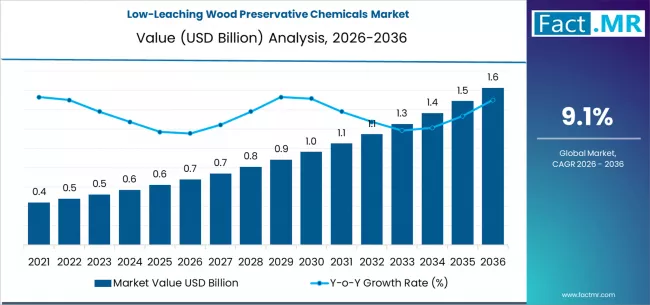
The low-leaching wood preservative chemicals market is likely to advance from USD 0.68 billion in 2026 to USD 1.62 billion by 2036, progressing at a 9.1% CAGR. Growth is driven by a critical reassessment of wood treatment technologies, balancing the essential need for durability against stringent new environmental and health standards aimed at reducing chemical migration into soil and groundwater.
Summary of Low-Leaching Wood Preservative Chemicals Market
Market Snapshot
Global low-leaching wood preservative chemicals market is valued at USD 0.68 billion in 2026 and is projected to reach USD 1.62 billion by 2036.
The market is expected to grow at aCAGRof 9.1% during 2026–2036.
Growth is driven by increasing emphasis on environmentally safer wood preservation technologies, reducing chemical leaching into soil and groundwater.
These chemicals are used to enhance wood durability while ensuring lower environmental impact and compliance with stricter safety regulations.
Demand and Growth Drivers
Rising regulatory pressure to limit toxic chemical leaching and environmental contamination is accelerating adoption of low-leaching preservative systems.
Increasing demand for durable and sustainable wood products in construction and outdoor applications is supporting market growth.
Growing awareness of health and ecological risks associated with traditional preservatives is shifting preference toward safer alternatives.
Expansion of outdoor construction, decking, and infrastructure applications is further driving demand for treated wood products.
Product and Segment View
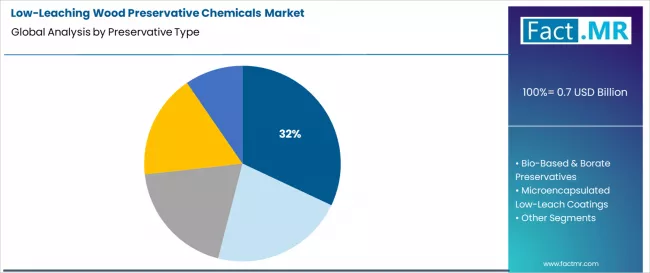
Copper organic wood preservatives (CA,CCA,ACQ) hold 32.0% share in 2026,emergingas the leading product type.
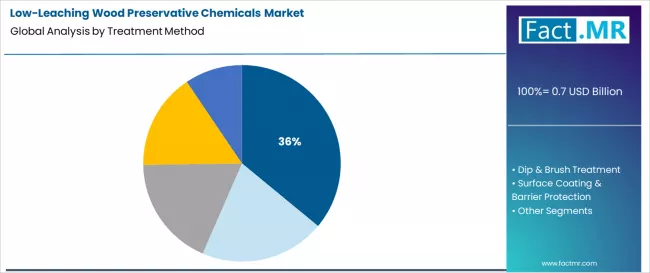
Pressure-treated wood (vacuum/vessel) accounts for 36.0% share in 2026,representingthe dominant treatment method.
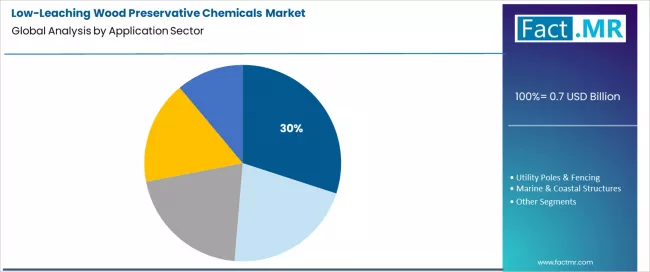
Outdoor construction and decking account for 30.0% of application share in 2026, positioning it as the leading application segment.
Product categories include:
Copper organic preservatives
Bio-based and borate preservatives
Microencapsulated low-leach coatings
Waterborne silicone and polymer sealants
Other low-leaching systems
Geography and Competitive Outlook
Market growth is driven globally by construction activity, sustainability trends, and regulatory frameworks favoring safer chemicals.
Adoption is increasing as industries prioritize eco-friendly materials and long-term durability in wood applications.
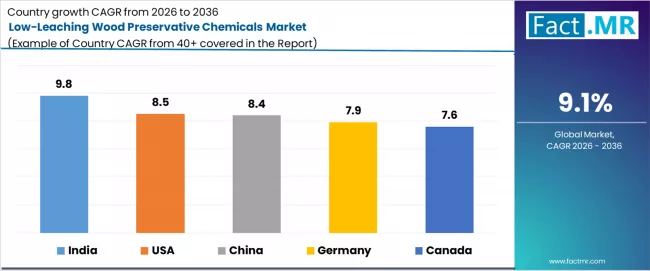
Key country growth rates include:
India (9.8%)
China (8.4%)
United States (8.5%)
Germany (7.9%)
Canada (7.6%)
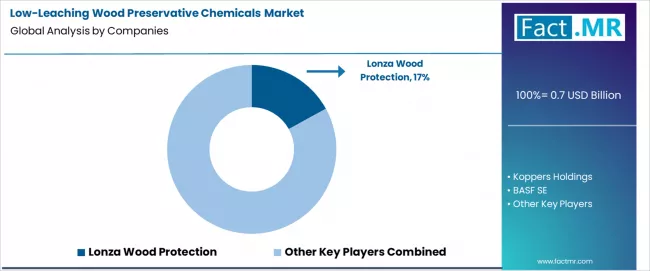
Key companiesoperatingin this market includeLonzaWood Protection,KoppersHoldings, BASF SE, Sika AG, andAkzoNobel.
Low-Leaching Wood Preservative Chemicals Market — At a Glance
North America, Europe, Asia Pacific, Latin America, MEA
These next-generation preservatives are engineered to provide robust protection against decay and insects while significantly minimizing the environmental footprint of treated wood throughout its service life. Copper organic wood preservatives, including formulations like copper azole and alkaline copper quat dominate the product landscape with a 32% market share, serving as the primary successors to older, more leachable chromated arsenicals. Pressure treatment within industrial vessels represents the leading application method, accounting for 36% of the market, as it ensures deep, uniform penetration essential for long-term performance. The outdoor construction and decking sector is the largest end-user, commanding a 30% share, where consumer demand for safer, durable outdoor living spaces intersects with regulatory compliance. Market evolution is being shaped by global regulatory actions restricting the use of biocides with high leaching potential, particularly in residential and aquatic environments. The industry’s response focuses on advanced chemical systems that lock active ingredients within the wood matrix. This technological shift addresses not only environmental safety but also extends product service life, reduces maintenance cycles, and supports the specification of wood in green building projects where material health is paramount.
Outdoor Construction & Decking, Utility Poles & Fencing, Marine & Coastal Structures, Furniture & Decorative Wood, Industrial & Structural Timber
Region
North America, Latin America, Western Europe, Eastern Europe, East Asia, South Asia & Pacific, MEA
Segmental Analysis
By Preservative Type, Which Chemistry Balances Efficacy and Environmental Goals?
Low Leaching Wood Preservative Chemicals Market Analysis By Preservative Type | Source: Fact.MR
Copper organic wood preservatives lead this segment with a 32% share. These systems, primarily copper azole and alkaline copper quaternary, have become the industry standard for ground-contact and exterior applications following the phasedown of chromated copper arsenate (CCA).
Their dominance is attributed to copper's proven fungicidal properties combined with organic co-biocides that offer insect resistance. Modern formulations are optimized through chelation and stabilization to reduce copper leaching, thereby meeting newer environmental guidelines while maintaining a decades-long service life.
By Treatment Method, Which Process Ensures Optimal Performance?
Pressure treatment in automated vessels is the foremost method, holding a 36% share. This industrial process forces preservative chemicals deep into the cellular structure of wood under vacuum and pressure cycles, achieving a uniform treatment that is impossible with surface methods.
For low-leaching chemistries, this deep penetration is crucial; it ensures the preservative is distributed within the wood, not just on the surface, which reduces the concentration of chemicals at the wood surface available for initial wash-off and enhances long-term retention.
By Application Sector, Where is Consumer and Regulatory Focus Highest?
Outdoor construction and decking represent the largest application sector, with a 30% share. This segment is highly sensitive to both consumer safety perceptions and environmental regulations, as treated wood is used in residential gardens, parks, and playgrounds.
The demand is for preservatives that prevent rot and insect damage for 20-30 years without raising concerns about chemical exposure to people, pets, or garden soil. This drives specification of low-leaching systems that carry certifications for residential use and have a favorable environmental profile.
What are the Drivers, Restraints, and Key Trends of the Market?
The primary market driver is the global regulatory shift, including EU Biocidal Products Regulation evaluations and US EPA re-registrations, which are phasing out preservatives with high toxicity or leaching potential. Increasing consumer awareness and demand for eco-friendly building materials, coupled with green building certification systems like LEED, further accelerate adoption.
The economic need to extend the lifecycle of wood in infrastructure, thereby reducing replacement costs and resource consumption, provides a strong value proposition for advanced, longer-lasting treatments. A significant restraint is the performance validation period required for new low-leach chemistries; proving decades of service life in the field takes time, slowing adoption for critical applications.
The higher initial cost of some advanced systems, such as microencapsulated coatings or thermally modified wood, can be a barrier in price-sensitive markets. Furthermore, the diversity of wood species and their varying permeability necessitates customized treatment protocols, adding complexity for chemical manufacturers and treaters aiming for consistent, reliable results.
Key trends include the rapid development of microencapsulation technologies that surround active ingredients in a polymer shell, allowing for controlled release over time and dramatically reducing initial leaching. There is growing innovation in non-biocidal systems, such as water-repellent silicone polymers and thermal modification, which alter the wood's cell structure to resist decay without relying on traditional biocides.
The market is also seeing a rise in hybrid treatment approaches, where low-leach preservatives are combined with waterborne sealants to create dual-action barrier systems for extreme exposure environments.
Analysis of the Low-Leaching Wood Preservative Chemicals Market by Key Countries
Low Leaching Wood Preservative Chemicals Market Cagr Analysis By Country | Source: Fact.MR
Country
CAGR (2026-2036)
India
9.80%
USA
8.50%
China
8.40%
Germany
7.90%
Canada
7.60%
What is Catalyzing India's High-Growth Trajectory?
A construction boom drives India’s leading CAGR of 9.80% in residential and public infrastructure, alongside a gradual shift towards standardized, durable building materials. Increasing urbanization and the growth of organized retail in home improvement are exposing consumers to higher-quality, treated wood products.
Nascent but tightening environmental norms are beginning to discourage older, unregulated treatments, creating space for modern, low-leach copper organic and borate-based preservatives in the market.
How do US Regulations and Consumer Preferences Interact?
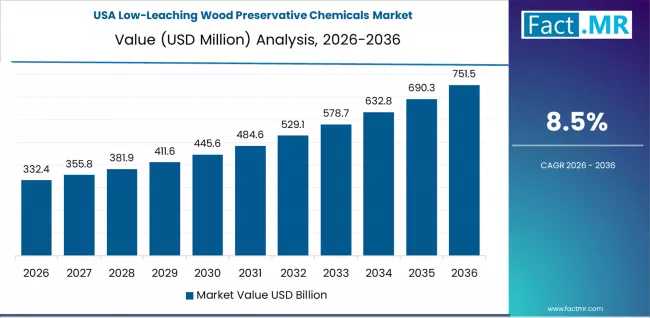
Low Leaching Wood Preservative Chemicals Market Country Value Analysis | Source: Fact.MR
A mature regulatory framework that has successfully transitioned the market away from CCA for most residential uses underpins the USA’s 8.50% growth. Current demand is driven by EPA regulations encouraging reduced leaching, state-level restrictions on certain chemicals, and strong consumer preference for green outdoor living products. The well-established pressure-treating industry is adept at adopting new chemistries, and the large DIY market is increasingly seeking certified, low-impact wood treatment options.
What is the Basis of China's Dual-Focused Demand?
China's 8.40% CAGR stems from its massive domestic construction activity and its role as a leading exporter of treated wood products. Domestically, rising quality standards for urban development and public works are fostering demand for longer-lasting, safer wood treatments.
For export, compliance with international regulations like the EU BPR is non-negotiable, driving Chinese treaters and chemical producers to innovate and adopt globally accepted low-leaching preservative systems to maintain market access.
Why is Germany a Center for High-Specification Innovation?
Germany's 7.90% growth reflects its position at the forefront of EU environmental regulation and its high engineering standards for construction materials. The stringent implementation of the Biocidal Products Regulation creates a market for preservatives with comprehensive environmental risk assessments.
German specifiers favor advanced, precisely engineered solutions such as microencapsulated treatments and modified wood for architectural applications, driving demand for premium, high-performance low-leach systems.
How does Canada's Forestry and Climate Shape the Market?
Canada's 7.60% growth is anchored in its vast forestry sector and harsh climatic conditions that demand robust wood protection. The need to preserve utility poles, railway ties, and marine timbers in wet, freezing environments is paramount.
The industry focuses on preservatives with proven low leaching to protect sensitive ecosystems, particularly in coastal and freshwater areas, while also investing in thermal modification and polymer-based treatments as value-added export products.
Competitive Landscape of the Low-Leaching Wood Preservative Chemicals Market
Low Leaching Wood Preservative Chemicals Market Analysis By Company | Source: Fact.MR
The competitive arena is consolidated among a few global specialty chemical companies with deep expertise in wood science and biocidal chemistry. Competition revolves around proprietary formulations, securing and maintaining regulatory approvals in key regions, and providing extensive technical support to network of treatment plants.
A key differentiator is the ability to offer a portfolio of solutions, from established copper organics to novel non-biocidal sealants, catering to diverse market segments and regulatory environments. Building strong partnerships with timber associations and achieving third-party certifications for environmental and safety performance are critical for market credibility and share.
Key Players in the Low-Leaching Wood Preservative Chemicals Market
Lonza Wood Protection
Koppers Holdings
BASF SE
Sika AG
AkzoNobel
Scope of Report
Items
Values
Quantitative Units
USD Billion
Preservative Type
Copper Organic, Bio-Based/Borate, Microencapsulated Coatings, Silicone/Polymer Sealants, Other Systems
Outdoor Construction & Decking, Utility Poles & Fencing, Marine Structures, Furniture, Industrial Timber
Key Countries
India, USA, China, Germany, Canada
Key Companies
Lonza Wood Protection, Koppers Holdings, BASF SE, Sika AG, AkzoNobel
Additional Analysis
Leaching test methodologies and environmental fate modeling; corrosion performance of low-leach preservatives on fasteners; lifecycle assessment of treated wood vs. alternative materials; regulatory pathways for biocidal product authorization; impact of wood species and moisture content on preservative fixation and retention.
Market by Segments
Preservative Type :
Copper Organic Wood Preservatives (CA, CCA, ACQ)
Bio-Based & Borate Preservatives
Microencapsulated Low-Leach Coatings
Waterborne Silicone & Polymer Sealants
Other Low-Leaching Preservative Systems
Treatment Method :
Pressure-Treated Wood (Vacuum/Vessel)
Dip & Brush Treatment
Surface Coating & Barrier Protection
Thermal & Modified Wood Treatment
Injection/Deep Penetration Treatments
Application Sector :
Outdoor Construction & Decking
Utility Poles & Fencing
Marine & Coastal Structures
Furniture & Decorative Wood
Industrial & Structural Timber
Region :
North America
USA
Canada
Latin America
Brazil
Mexico
Argentina
Rest of Latin America
Western Europe
Germany
UK
France
Spain
Italy
BENELUX
Rest of Western Europe
Eastern Europe
Russia
Poland
Czech Republic
Rest of Eastern Europe
East Asia
China
Japan
South Korea
Rest of East Asia
South Asia & Pacific
India
ASEAN
Australia
Rest of South Asia & Pacific
MEA
Saudi Arabia
UAE
Turkiye
Rest of MEA
Frequently Asked Questions
How big is the low-leaching wood preservative chemicals market in 2026?
The global low-leaching wood preservative chemicals market is estimated to be valued at USD 0.7 billion in 2026.
What will be the size of low-leaching wood preservative chemicals market in 2036?
The market size for the low-leaching wood preservative chemicals market is projected to reach USD 1.6 billion by 2036.
How much will be the low-leaching wood preservative chemicals market growth between 2026 and 2036?
The low-leaching wood preservative chemicals market is expected to grow at a 9.1% CAGR between 2026 and 2036.
What are the key product types in the low-leaching wood preservative chemicals market?
The key product types in low-leaching wood preservative chemicals market are copper organic wood preservatives (ca, cca, acq), bio-based & borate preservatives, microencapsulated low-leach coatings, waterborne silicone & polymer sealants and other low-leaching preservative systems.
Which treatment method segment to contribute significant share in the low-leaching wood preservative chemicals market in 2026?
In terms of treatment method, pressure-treated wood (vacuum/vessel) segment to command 36.0% share in the low-leaching wood preservative chemicals market in 2026.