- Base Value(2025): 12.7 Bn
- Estimated Value(2026): 13.2 Bn
- Forecast Value (2036): 19.8 Bn
- CAGR (2026 - 2036): 4.1%
Wooden Pallets Market Analysis and Forecast by Fact.MR
- The Wooden Pallets Market is expected to grow from USD 13.2 billion in 2026 to USD 19.8 billion by 2036, at a 4.1% CAGR.
- Driven by expanding e-commerce fulfillment and warehousing infrastructure, growing cold chain logistics requiring ISPM-15 treated pallets for international shipment, and rising demand for heat-treated and certified pallets that comply with phytosanitary standards across cross-border trade, with stringer wooden pallets accounting for 38.7% share.
- Warehousing and distribution contributing 43.5% share as logistics operators prioritize load capacity, cost efficiency, and supply chain compliance.
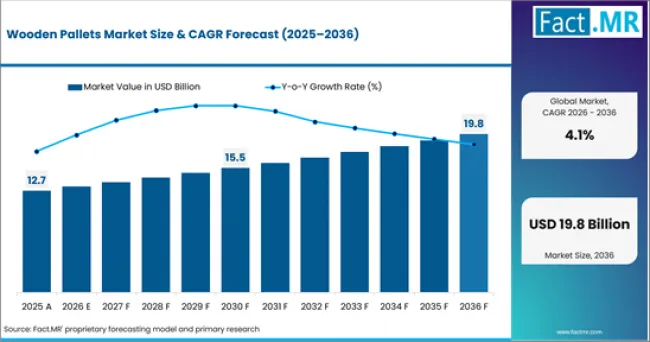
Wooden Pallets Market Value Analysis | Source: Fact.MR
Summary of Wooden Pallets Market
- Market Snapshot
- In 2025, the global Wooden Pallets Market was valued at approximately USD 12.7 billion.
- The market is estimated to reach USD 13.2 billion in 2026 and is projected to attain USD 19.8 billion by 2036.
- The market is likely to expand at a CAGR of 4.1% during the forecast period.
- The market is anticipated to create an absolute dollar opportunity of USD 6.5 billion between 2026 and 2036.
- Stringer wooden pallets account for 38.7% of product segment share in 2026.
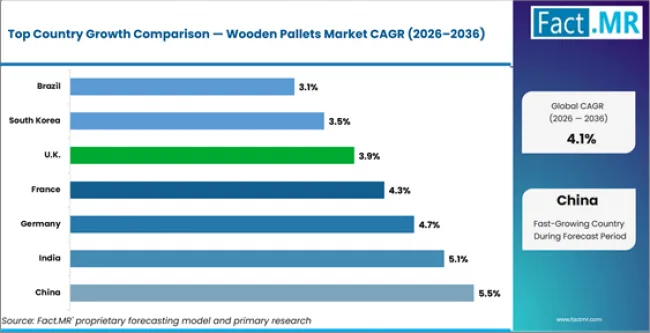
- China (5.6%) and India (5.2%) are the key growth markets during the forecast period.
- Demand and Growth Drivers
- E-commerce fulfillment center expansion is generating sustained demand for standard-sized wooden pallets compatible with automated storage and retrieval systems, conveyor handling, and truck loading dock operations.
- Cold chain logistics growth across food, pharmaceutical, and vaccine distribution requires ISPM-15 heat-treated wooden pallets that meet phytosanitary standards for international shipment without fumigation requirements.
- Cross-border trade volume expansion increases demand for EPAL and ISPM-15 compliant pallets that pass customs inspection without hold or treatment at destination ports.
- Pallet pooling and rental service models are growing as logistics operators shift from ownership to service-based pallet procurement that reduces capital expenditure and improves asset utilization.
- Sustainability certification programs for responsibly sourced timber are creating differentiated pallet products that support corporate ESG reporting for supply chain environmental impact.
- Geography and Competitive Outlook
- China at 5.6% reflects strong market fundamentals and expanding demand.
- India at 5.2% reflects strong market fundamentals and expanding demand.
- Germany at 4.8% reflects strong market fundamentals and expanding demand.
- Key players include 48forty Solutions, Herwood Inc., The Nelson Company, DNA Packaging Systems, Pallet USA, Kronus LTD.
- Analyst Opinion
- Shambhu Nath Jha, Principal Consultant at Fact.MR, says 'The wooden pallet market remains the foundational material handling unit of global logistics, with over 80% of goods in international trade moving on palletized loads at some point in the supply chain. The market is mature in North America and Europe but expanding in Asia Pacific and Latin America as warehousing infrastructure modernizes. Pallet pooling is the most significant business model shift, converting one-time pallet sales into recurring service revenue. ISPM-15 compliance and heat treatment requirements create a quality threshold that favors larger manufacturers with certified treatment capabilities over informal timber workshops.'
Key Growth Drivers, Constraints, and Opportunities
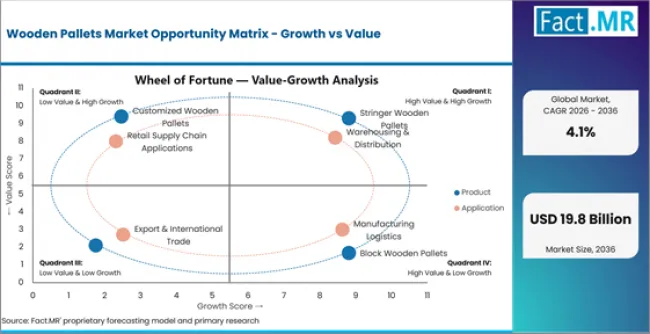
Wooden Pallets Market Opportunity Matrix Growth Vs Value | Source: Fact.MR
Key Factors Driving Growth
- Primary demand expansion driven by structural end-use trends creating sustained procurement requirements.
- Technology and process advancement expanding product capability and addressable market scope.
- Regulatory frameworks creating compliance-driven demand in key markets.
Key Market Constraints
- High initial investment and supply chain complexity create adoption barriers for smaller buyers.
- Raw material cost volatility creates procurement uncertainty for manufacturers on thin margins.
- Competitive pressure from alternative solutions compresses margins in the volume segment.
Key Opportunity Areas
- Automation and precision technology create premium product tiers commanding pricing advantages.
- Emerging market adoption represents large untapped demand as infrastructure and industry mature.
- Service-based and recurring delivery models extend vendor-customer relationships.
Segment-wise Analysis of the Wooden Pallets Market
- Stringer wooden pallets hold 38.7% of the product segment in 2026.
The wooden pallets market is segmented by product type, application, end use, technology, formulation, distribution channel, and region.
Which Product Segment Dominates the Wooden Pallets Market?
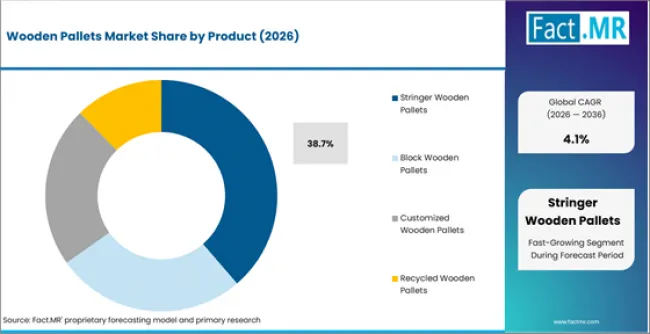
Wooden Pallets Market Analysis By Product | Source: Fact.MR
Stringer wooden pallets account for 38.7% of the product segment in 2026. Their leadership reflects broad applicability, established adoption, and alignment with primary buyer requirements.
Complementary product categories serve specialized requirements. The leading segment is expected to retain dominance through 2036.
Which Application Segment Dominates the Wooden Pallets Market?
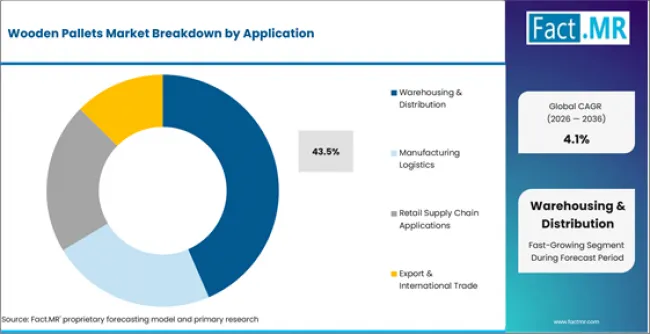
Wooden Pallets Market Analysis By Application | Source: Fact.MR
The leading application anchors demand through structural procurement activity from primary end-use categories, supported by regulatory frameworks and clear ROI justification.
Secondary applications contribute growing demand from emerging use cases. The leading application maintains its position as the core demand driver.
Which Trend is Shaping the Next Phase of Growth in the Wooden Pallets Market?
The most relevant evolution of business models in the wooden pallet market is represented by pallet pooling and rental service models. The traditional way of securing pallets is to buy them, use them for one or a few shipment cycles, and then get rid of them or recycle them. Pooling is a model offered by companies like CHEP and PECO Pallet that offer pallets as a service. The logistics operators rent pallets with a per-cycle charge, returning them to pool locations and paying for them based on usage instead of a capital price.
For pool operators the commercial impact is to turn one-time sales of pallets into recurring service revenue, and for logistics users it means less capital expenditure. Individual pallet users do not have the economic scale to provide pallet repair, quality management and reverse logistics that pallet pool operators can provide. Pooling helps improve average pallet lifecycle utilization, decrease waste and build a service infrastructure that enables standardized pallet quality across supply chains for the larger market.
Regional Outlook Across Key Markets
- China at 5.6% reflects expanding demand driven by regional fundamentals.
- India at 5.2% reflects expanding demand driven by regional fundamentals.
- Germany at 4.8% reflects expanding demand driven by regional fundamentals.
- Brazil at 4.4% reflects expanding demand driven by regional fundamentals.
.webp "Top Country Growth Comparison Wooden Pallets Market Cagr (2026 2036)")
Top Country Growth Comparison Wooden Pallets Market Cagr (2026 2036) | Source: Fact.MR
| Country | CAGR (%) |
|---|---|
| China | 5.6% |
| India | 5.2% |
| Germany | 4.8% |
| Brazil | 4.4% |
| USA | 3.9% |
Source: Fact.MR analysis. Updated Jun 13, 2026
Source: Fact MR (FMR) analysis, based on proprietary forecasting model and primary research.
Wooden Pallets Market Cagr Analysis By Country | Source: Fact.MR
Wooden Pallets Market Outlook in USA
Wooden Pallets Market Country Value Analysis | Source: Fact.MR
The installed base of pallet-dependent logistics infrastructure sustains the U.S. market at a 3.9% CAGR through 2036. The 48x40 inch GMA standard pallet dominates North American logistics, with over 2 billion pallets in circulation across the U.S. supply chain. Pallet recycling and pooling services from 48forty Solutions and CHEP are converting ownership-based procurement into service-based models that improve pallet utilization and reduce waste.
- Pallet pooling and recycling services are converting ownership-based procurement into recurring service relationships that improve asset utilization rates.
- E-commerce fulfillment center expansion by Amazon, Walmart, and third-party logistics providers sustains high-volume pallet procurement for automated warehouse operations.
Wooden Pallets Market Growth Assessment in China
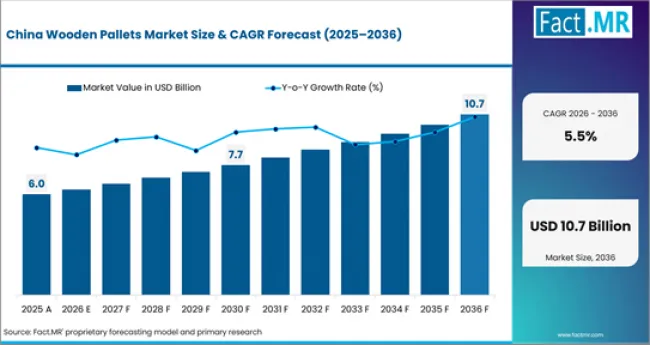
The market size of China’s manufacturing export economy and expanding domestic logistics infrastructure drove the CAGR of 5.6% through 2036. Chinese manufacturers supplying international trade customers requiring phytosanitary certification are increasingly following ISPM-15 treatment for export pallets. JD.com, Alibaba’s Cainiao and SF Express are building out domestic e-commerce logistics and this is driving an increasing pallet demand for warehouse and fulfillment operations.
- Growing demand for export pallets that are ISPM-15 heat treated in order to meet phytosanitary certification requirements of international customers for cross-border shipments.
- Continued pallet procurement for automated warehousing operations due to expansion of e-commerce logistics infrastructure across tier-1 and tier-2 cities.
Wooden Pallets Market Demand Trends in India
National Logistics Policy implementation and organized warehousing development are modernizing pallet-based material handling in India at a 5.2% CAGR through 2036. Transition from manual floor stacking to palletized storage in organized warehouses creates new demand from a logistics sector historically reliant on manual handling. PLI scheme incentives for food processing are expanding cold chain infrastructure that requires ISPM-15 treated pallets.
- National Logistics Policy implementation is driving transition from manual handling to palletized warehouse operations that create new pallet demand in organized logistics facilities.
- Cold chain infrastructure expansion under food processing PLI incentives requires ISPM-15 treated wooden pallets for temperature-controlled distribution networks.
Wooden Pallets Market Analysis in Germany
EU phytosanitary standards and EPAL certification requirements will drive the pallet specifications for the German and European logistics market at a CAGR of 4.8% through 2036. Euro pallets certified by EPAL are the standard handling unit in European supply chains, and their production and repair are subject to strict quality inspections and marking requirements. EU packaging waste regulations are promoting efforts to recycle pallets and extend their life cycle.
- EPAL certification standards include pallet production, repair and quality inspection along the whole European supply chain, bringing in compliance driven specification requirements.
- EU packaging waste regulations driving lifecycle extension through repair, recycling and pooling programmes, lowering volumes of single-use pallet disposal.
Wooden Pallets Market Opportunity in Brazil
Expanding agribusiness export volumes and growing organized retail logistics infrastructure support the Brazil pallet market at a 4.4% CAGR through 2036. Agricultural commodity exports including soybeans, coffee, and meat products require export-grade pallets meeting ISPM-15 standards for international shipment. Domestic timber availability from managed plantation sources supports local pallet production cost competitiveness.
- Agricultural export volume growth generates demand for ISPM-15 treated pallets compatible with international phytosanitary inspection requirements at destination ports.
- Domestic timber availability from eucalyptus and pine plantation sources supports cost-competitive pallet manufacturing for both domestic and export logistics applications.
Competitive Benchmarking and Company Positioning
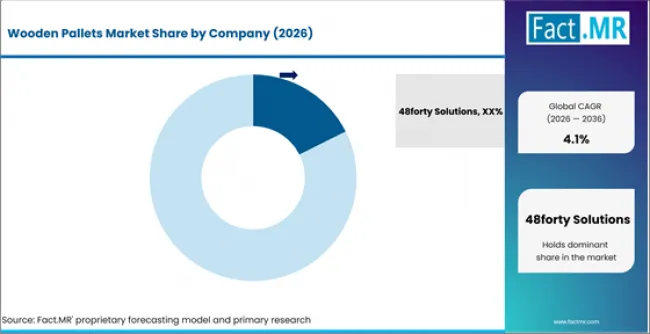
Wooden Pallets Market Analysis By Company | Source: Fact.MR
Wooden Pallets Market Analysis By Company
- 48forty Solutions, Herwood Inc., The Nelson Company are leaders with a strong presence and wide capabilities.
- DNA Packaging Systems, Pallet USA and Kronus LTD operate in some categories and regional markets.
- Technology capability and depth of customer relationships are key competitive differentiators.
At the top of the competitive landscape are scale and expertise, with 48forty Solutions and Herwood Inc. leading the way, while regional competitors plug specialized needs.
Technology evolution results in new requirements that favor providers with engineering resources and market access => increasing competition.
Key Companies in the Wooden Pallets Market
- 48forty Solutions, Herwood Inc., The Nelson Company, DNA Packaging Systems, Pallet USA are among the leading players.
- Kronus LTD, Litco International Inc., Kamps Inc., Nefab Group, CHEP compete across specific segments and markets.
Recent Industry Developments
- 48forty Solutions, Network Expansion, Pallet Recycling and Pooling (2025)
- 48forty Solutions expanded its pallet recycling and pooling network across additional U.S. distribution hubs, strengthening its position as the largest pallet recycler in North America and supporting growing demand for circular pallet supply chain services.
- CHEP, Sustainability Initiative, Responsible Forestry Sourcing (2025)
- CHEP continued expansion of its responsibly sourced timber procurement program, achieving additional FSC and PEFC certification milestones across its European and North American pallet pool operations.
- Nefab Group, Product Development, Engineered Wood Pallet Solutions (2025)
- Nefab Group advanced its engineered wood pallet product line with lightweight designs optimized for air freight and high-value electronics logistics, targeting weight-sensitive applications where standard pallets create excess shipping cost.
Leading Companies Shaping the Wooden Pallets Market
- 48forty Solutions
- Herwood Inc.
- The Nelson Company
- DNA Packaging Systems
- Pallet USA
- Kronus LTD
- Litco International Inc.
- Kamps Inc.
- Nefab Group
- CHEP
Sources and Research References
- 48forty Solutions. Product development and market activity updates.
- Herwood Inc.. Product development and market activity updates.
- The Nelson Company. Product development and market activity updates.
- Industry association statistics and regulatory documentation.
- Primary interviews with manufacturers, providers, end users, and partners.
This bibliography is provided for reader reference and is not exhaustive. The full report contains the complete reference list and detailed citations.
Key Questions This Report Addresses
- What is the current and future size of the Wooden Pallets Market?
- How fast is the Wooden Pallets Market expected to grow between 2026 and 2036?
- Which product type is likely to lead the market by 2026?
- Which application segment is expected to account for the highest demand?
- What factors are driving demand globally?
- How is technology evolution reshaping competitive dynamics?
- Why are China and India the fastest-growing markets?
- Which countries are projected to show the fastest growth through 2036?
- Who are the key companies active in the Wooden Pallets Market?
- How does Fact.MR estimate and validate the market forecast?
Wooden Pallets Market Definition
The wooden pallets market covers the core products, equipment, and services within the defined scope across global and regional markets.
Wooden Pallets Market Inclusions
- The scope covers global and regional market size and forecasts for 2026 to 2036 across product type, application, end use, technology, formulation, distribution channel, and region.
- It includes regional demand analysis based on primary demand drivers, regulatory frameworks, and end-use spending patterns.
- The report covers pricing analysis across major product categories and configurations.
Wooden Pallets Market Exclusions
- The scope excludes adjacent categories and general-purpose products not specifically designed for the defined market application.
- It excludes consulting and financial services not directly linked to market-specific procurement.
Wooden Pallets Market Research Methodology
- The methodology combines secondary research, primary interviews, and forecast modelling.
- It draws on 100+ secondary sources and benchmarks 40+ company portfolios.
- Market sizing covers 25+ countries through a demand-side model with top-down validation.
- Primary validation includes 20+ interviews across manufacturers, providers, end users, and partners.
- Final estimates go through cross-validation, procurement-cycle analysis, and sensitivity testing.
Segmentation
Scope of Analysis
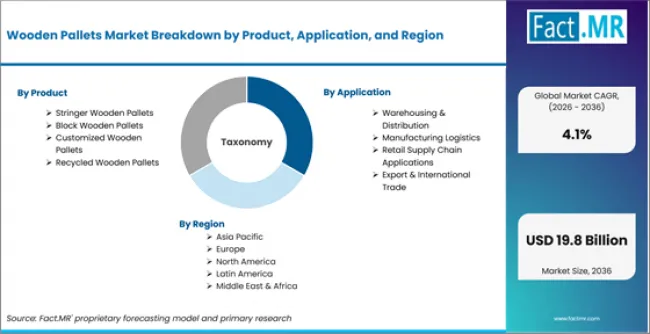
Wooden Pallets Market Breakdown By Product, Application, And Region | Source: Fact.MR
| Parameter | Details |
|---|---|
| Quantitative Units | USD 13.2 billion to USD 19.8 billion, at a CAGR of 4.1% |
| Market Definition | The Wooden Pallets Market covers the primary products and services within the defined scope. |
| Regions Covered | North America, Latin America, Europe, East Asia, South Asia and Pacific, Middle East and Africa |
| Countries Covered | China, India, Germany, Brazil, USA, 25 plus countries |
| Key Companies | 48forty Solutions, Herwood Inc., The Nelson Company, DNA Packaging Systems, Pallet USA, Kronus LTD, Litco International Inc., Kamps Inc., Nefab Group, CHEP |
| Forecast Period | 2026 to 2036 |
| Approach | Hybrid demand-side and top-down methodology with primary interviews and cross-validation |
Source: Fact.MR analysis. Updated Jun 13, 2026
Wooden Pallets Market Segmentation
-
Wooden Pallets Market Segmented by Product:
- Stringer Wooden Pallets
- Two Way Entry Stringer Pallets
- Standard Duty Stringer Pallets
- Heavy Duty Stringer Pallets
- Four Way Entry Stringer Pallets
- Notched Stringer Pallets
- Reinforced Stringer Pallets
- Two Way Entry Stringer Pallets
- Block Wooden Pallets
- Standard Block Pallets
- Open Deck Block Pallets
- Closed Deck Block Pallets
- Export Block Pallets
- ISPM 15 Certified Pallets
- Heat Treated Block Pallets
- Standard Block Pallets
- Customized Wooden Pallets
- Industry Specific Pallets
- Automotive Shipping Pallets
- Food Grade Wooden Pallets
- Dimension Customized Pallets
- Oversized Wooden Pallets
- Special Load Pallets
- Industry Specific Pallets
- Recycled Wooden Pallets
- Refurbished Pallets
- Repaired Distribution Pallets
- Reconditioned Industrial Pallets
- Remanufactured Pallets
- Multi Use Recycled Pallets
- High Strength Recycled Pallets
- Refurbished Pallets
- Stringer Wooden Pallets
-
Wooden Pallets Market Segmented by Application:
- Warehousing & Distribution
- Storage Operations
- Bulk Goods Storage
- Rack Storage Operations
- Distribution Operations
- Cross Docking Activities
- Order Fulfillment Operations
- Storage Operations
- Manufacturing Logistics
- Raw Material Handling
- Industrial Material Movement
- Component Storage Operations
- Finished Goods Handling
- Outbound Product Logistics
- Factory Warehouse Distribution
- Raw Material Handling
- Retail Supply Chain Applications
- Retail Distribution Centers
- Hypermarket Distribution Networks
- Regional Retail Warehouses
- E Commerce Fulfillment
- Parcel Fulfillment Operations
- Omnichannel Distribution Activities
- Retail Distribution Centers
- Export & International Trade
- Containerized Export Operations
- Port Logistics Applications
- International Freight Handling
- Cross Border Transportation
- Export Packaging Operations
- Global Distribution Networks
- Containerized Export Operations
- Warehousing & Distribution
-
Wooden Pallets Market Segmented by End Use:
- Logistics & Transportation Companies
- Third Party Logistics Providers
- Contract Logistics Operators
- Integrated Logistics Providers
- Freight & Distribution Companies
- Road Freight Operators
- Multimodal Distribution Providers
- Third Party Logistics Providers
- Manufacturing Industry
- Automotive Manufacturers
- Vehicle Assembly Facilities
- Auto Component Manufacturers
- Industrial Manufacturers
- Machinery Production Facilities
- Electrical Equipment Plants
- Automotive Manufacturers
- Retail & E Commerce Sector
- Retail Chains
- Supermarket Distribution Networks
- Department Store Warehouses
- Online Retailers
- E Commerce Fulfillment Centers
- Marketplace Distribution Hubs
- Retail Chains
- Food & Beverage Industry
- Food Processing Companies
- Packaged Food Manufacturers
- Frozen Food Producers
- Beverage Manufacturers
- Soft Drink Production Facilities
- Alcoholic Beverage Producers
- Food Processing Companies
- Logistics & Transportation Companies
-
Wooden Pallets Market Segmented by Technology:
- Automated Pallet Manufacturing Technology
- CNC Wood Processing Systems
- Precision Cutting Systems
- Automated Deck Board Processing
- Robotic Assembly Systems
- Automated Nailing Systems
- Robotic Pallet Construction Units
- CNC Wood Processing Systems
- Wood Treatment Technology
- Heat Treatment Systems
- ISPM 15 Compliance Treatment
- High Temperature Sterilization Systems
- Chemical Preservation Systems
- Anti Fungal Treatment Systems
- Moisture Protection Technologies
- Heat Treatment Systems
- Pallet Tracking Technology
- Barcode Tracking Systems
- Warehouse Identification Systems
- Inventory Management Tracking Platforms
- RFID Tracking Systems
- Real Time Pallet Monitoring
- Supply Chain Visibility Platforms
- Barcode Tracking Systems
- Structural Enhancement Technology
- Load Optimization Systems
- Reinforced Load Bearing Designs
- Heavy Duty Structural Configurations
- Durability Improvement Systems
- Impact Resistant Designs
- Extended Lifecycle Engineering
- Load Optimization Systems
- Automated Pallet Manufacturing Technology
-
Wooden Pallets Market Segmented by Formulation:
- Standard Wooden Pallet Configurations
- Open Deck Configurations
- Single Face Open Deck Pallets
- Double Face Open Deck Pallets
- Closed Deck Configurations
- Solid Deck Industrial Pallets
- Heavy Load Closed Deck Pallets
- Open Deck Configurations
- Treated Wooden Pallet Configurations
- Heat Treated Configurations
- Export Grade Heat Treated Pallets
- Sterilized Industrial Pallets
- Preservative Treated Configurations
- Weather Resistant Pallets
- Extended Life Wooden Pallets
- Heat Treated Configurations
- Reusable Pallet Configurations
- Multi Trip Configurations
- Industrial Reuse Pallets
- Distribution Network Reuse Pallets
- Repairable Configurations
- Replaceable Component Pallets
- Serviceable Wooden Pallets
- Multi Trip Configurations
- Heavy Duty Pallet Configurations
- High Load Capacity Designs
- Industrial Equipment Transport Pallets
- Bulk Material Handling Pallets
- Specialized Structural Designs
- Export Heavy Load Pallets
- Warehouse Rack Compatible Pallets
- High Load Capacity Designs
- Standard Wooden Pallet Configurations
-
Wooden Pallets Market Segmented by Distribution Channel:
- Direct Industrial Sales
- Manufacturer Direct Contracts
- Industrial Supply Agreements
- Long Term Logistics Contracts
- Enterprise Procurement Channels
- Manufacturing Procurement Programs
- Retail Distribution Contracts
- Manufacturer Direct Contracts
- Pallet Distributors
- Regional Distributors
- Warehouse Supply Distributors
- Industrial Packaging Suppliers
- National Distribution Networks
- Multi State Supply Networks
- Large Scale Distribution Providers
- Regional Distributors
- Pallet Rental & Pooling Providers
- Closed Loop Pooling Services
- Dedicated Customer Pooling Programs
- Industrial Returnable Pallet Services
- Open Loop Pooling Services
- Shared Logistics Pooling Networks
- Regional Pooling Operations
- Closed Loop Pooling Services
- Online B2B Platforms
- Industrial E Commerce Platforms
- Bulk Procurement Portals
- Packaging Marketplace Platforms
- Manufacturer Online Portals
- Direct Ordering Platforms
- Digital Supply Chain Portals
- Industrial E Commerce Platforms
- Direct Industrial Sales
-
Wooden Pallets Market by Region:
- North America
- USA
- Canada
- Mexico
- Latin America
- Brazil
- Chile
- Rest of Latin America
- Western Europe
- Germany
- UK
- Italy
- Spain
- France
- Nordic
- BENELUX
- Rest of Western Europe
- Eastern Europe
- Russia
- Poland
- Hungary
- Balkan & Baltic
- Rest of Eastern Europe
- East Asia
- China
- Japan
- South Korea
- South Asia and Pacific
- India
- ASEAN
- Australia & New Zealand
- Rest of South Asia and Pacific
- Middle East & Africa
- Kingdom of Saudi Arabia
- Other GCC Countries
- Turkiye
- South Africa
- Other African Union
- Rest of Middle East & Africa
- North America
Frequently Asked Questions
How big is the wooden pallets market in 2026?
What will be the size of wooden pallets market in 2036?
How much will be the wooden pallets market growth between 2026 and 2036?
What are the key product in the wooden pallets market?
Which application segment is expected to contribute significant share in the wooden pallets market in 2026?
Who worked on this report


Preview the report firsthand - request a free sample
Free SampleGet the brochure for pricing and purchase details
Download PDF