- Market Value (2025): USD 179.5 Mn
- Estimated Value (2026): USD 186.0 Mn
- Forecast Value (2036): USD 265.0 Mn
- CAGR (2026-2036): 3.6%
What is the Lubricant Colorant Dyes Market forecast to be worth by 2036?
USD 186.0 million in 2026 to USD 265.0 million by 2036, at 3.6% CAGR from 2026 to 2036.
- The lubricant colorant dyes market was valued at USD 179.5 million in 2025, showing steady demand before the forecast period.
- Demand is projected to rise from USD 186.0 million in 2026 to USD 265.0 million by 2036.
- The market is forecast to grow at a 3.6% CAGR from 2026 to 2036 as lubricant makers choose dyes that keep the color clear and do not affect product performance.
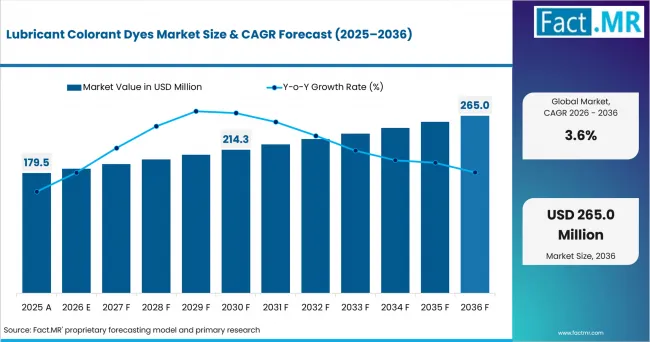
Lubricant Colorant Dyes Market Value Analysis | Source: Fact.MR
What are the defining numbers behind Lubricant Colorant Dyes Market growth?
USD 79.0 million absolute opportunity by 2036, led by Engine oils and Liquid concentrates within their respective segments.
- Demand Drivers in the Market
- Lubricant makers use color to tell similar oil grades apart and reduce filling errors in plants that handle many products.
- Engine oils and industrial oils use different base oils, so each dye must be tested in the final product before approval.
- Strong dye concentrates allow plant staff to add only a small amount. This helps protect the oil’s thickness, clarity, and additive performance.
- In Europe, lubricant companies prefer dye makers that provide clear product details, safety information, and proper records when a formulation changes.
- Key Segments Analyzed
- By Fluid Application: Engine oils are expected to hold 33.0% share in 2026 supported by broad grade portfolios and frequent batch-control needs.
- By Dye Delivery Form: Liquid concentrates are projected to account for 39.0% share in 2026 because metered addition and rapid dispersion suit high-throughput blending.
- By Color Requirement: Blue / green identifiers are anticipated to capture 27.0% share in 2026 since they create strong contrast in pale lubricant bases.
- By Buyer Type: Lubricant blenders are estimated to hold 34.0% share in 2026 as final shade approval stays closest to the finished-fluid formulation.
- By Performance Need: Thermal stability is forecast to account for 30.0% share in 2026 because color must survive blending heat, storage and equipment operating temperatures.
- Analyst Opinion at Fact.MR
- Shambhu Nath Jha, Senior Analyst at Fact.MR, states, “A lubricant dye is useful when it adds the required color without affecting oil clarity or additive performance. Dye makers that make testing and approval easier for lubricant producers are expected to gain more business than those that compete only on color.”
- Strategic Implications
- Dye makers are expected to group products by the type of lubricant and the conditions in which the dye performs well. Color Index names alone do not give enough guidance.
- Lubricant producers can use a smaller range of dye concentrates across several oil grades, but each concentrate has to be tested in every formula first.
- Additive companies have an opportunity to include approved color choices in the technical support they provide to customers in different regions.
- Distributors are likely to benefit from carrying fewer shades with clear product records. This becomes important when different base oils cause the final color to chan
API states in its February 2025 API 1509 document that the voluntary Engine Oil Licensing and Certification System explains how marketers license and display API engine-oil marks. The framework does not prescribe dye use, but it reinforces why engine-oil marketers protect grade identity and label consistency. Dye producers need to support that discipline without interfering with oil performance claims.
The United States is projected to record a 5.3% CAGR from 2026 to 2036 on a large branded-lubricant and aftermarket blending base. Germany is forecast to post a 5.1% CAGR from 2026 to 2036 through engineering-led formulation and close chemical-compliance scrutiny. France is expected to record a 5.0% CAGR from 2026 to 2036 as service fluids and industrial oils keep color coding in regular use. Japan is estimated to advance at a 4.9% CAGR from 2026 to 2036 where tight process control rewards low-variation concentrates. The United Kingdom is anticipated to post a 4.8% CAGR from 2026 to 2036 through aftermarket oils and marine lubricants.
How does the Lubricant Colorant Dyes Market break down by segment?
Engine oils lead at 33.0% by Fluid Application, while Liquid concentrates lead at 39.0% by Dye Delivery Form in 2026.
Why do engine oils lead the Fluid Application segment?
Engine oils hold 33.0% share in 2026.
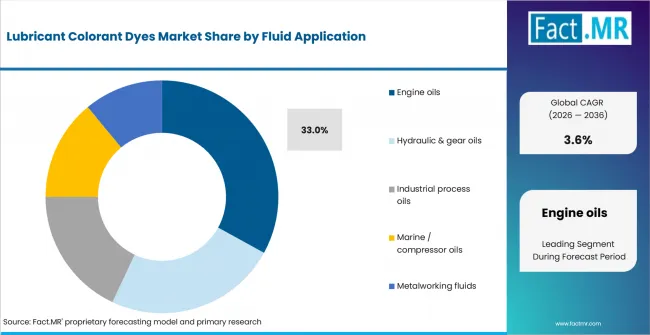
Lubricant Colorant Dyes Market Analysis By Fluid Application | Source: Fact.MR
Engine oils are projected to account for 33.0% share in 2026, supported by their use across many viscosity grades and product lines. Color helps lubricant makers separate one grade from another during blending, filling and servicing. The dye must stay clear and stable without affecting oil performance. Large production volumes and the need for easy product identification keep engine oils ahead of other fluid applications.
What makes liquid concentrates the leading Dye Delivery Form?
Liquid concentrates account for 39.0% share in 2026.
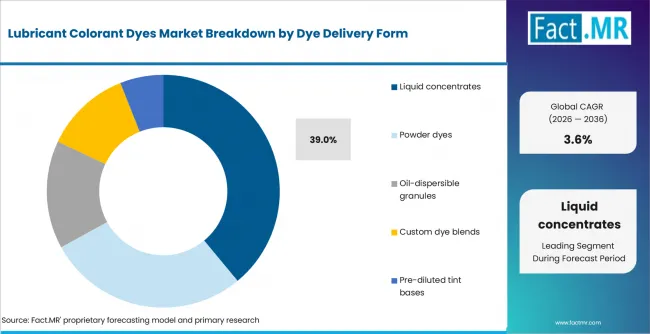
Lubricant Colorant Dyes Market Analysis By Dye Delivery Form | Source: Fact.MR
Liquid concentrates are estimated to capture 39.0% share in 2026. They can be added directly to blending tanks and usually mix faster than powder dyes. Plant staff can adjust the shade during larger production runs without preparing a separate solution. Lower dust levels also make handling cleaner. These practical advantages support their wider use in routine lubricant production and shade correction.
Why are blue and green the main Color Requirements?
Blue and green identifiers hold 27.0% share in 2026.
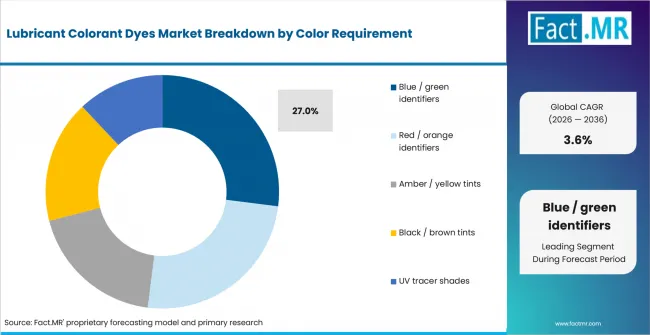
Lubricant Colorant Dyes Market Analysis By Color Requirement | Source: Fact.MR
Blue and green identifiers are forecast to represent 27.0% share in 2026, reflecting their strong contrast in transparent and lightly colored oils. These shades help users recognize different lubricant grades without making the fluid look cloudy or too dark. They also suit engine oils and specialty fluids where quick visual separation is useful. Clear visibility keeps blue and green ahead of other color groups.
What keeps lubricant blenders at the center of demand?
Lubricant blenders lead with 34.0% share in 2026.
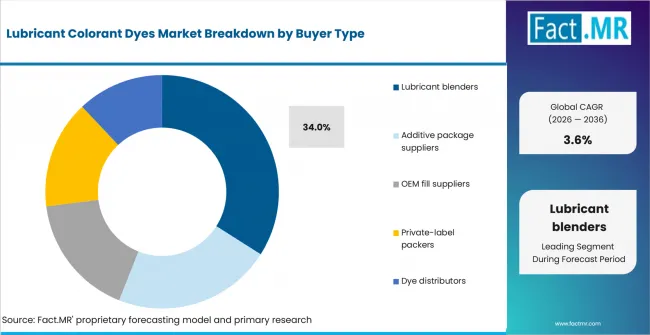
Lubricant Colorant Dyes Market Analysis By Buyer Type | Source: Fact.MR
Lubricant blenders are projected to lead with 34.0% share in 2026 as they control the final mix of base oil, additives and dye. Any color error can affect an entire production batch. Blenders therefore test shade strength, clarity and compatibility before wider use. Their direct role in product consistency, batch approval and final filling makes them the largest buyer group in this market.
Which Performance Need has the greatest influence on selection?
Thermal stability accounts for 30.0% share in 2026.
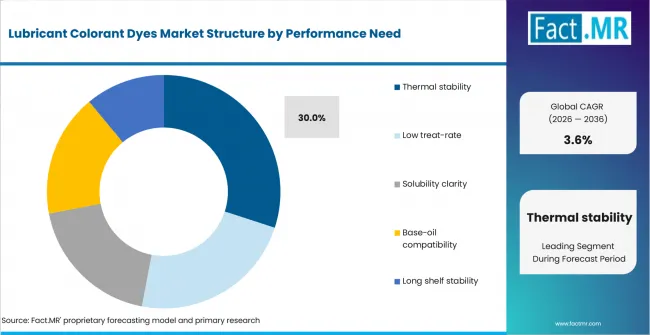
Lubricant Colorant Dyes Market Analysis By Performance Need | Source: Fact.MR
Thermal stability is forecast to hold 30.0% share in 2026 due to the need for color consistency during storage, blending and high-temperature use. A dye that fades or changes shade can make product identification less reliable even when the oil still works properly. Manufacturers therefore prefer dyes that retain their original appearance under heat. Stable color across changing temperatures gives thermal performance the strongest role in selection.
What is accelerating Lubricant Colorant Dyes Market adoption, and what is holding it back?
Grade differentiation and concentrate dosing are projected to accelerate adoption, while compatibility workload and shade drift restrain faster approval.
Drivers Impact Analysis
| DRIVER | (~) % IMPACT ON CAGR |
GEOGRAPHIC RELEVANCE | IMPACT TIMELINE |
|---|---|---|---|
| Grade differentiation | +0.5% | Global | Short term (<= 2 years) |
| Concentrate dosing | +0.5% | USA and Europe | Short term (<= 2 years) |
| Industrial lubricant expansion | +0.4% | Growth blending markets | Medium term (2-4 years) |
| Documented chemistry | +0.3% | European Union | Medium term (2-4 years) |
| Sustainable lubricant design | +0.3% | Europe and Japan | Long term (>= 4 years) |
Source: Fact.MR analysis. Updated Jul 17, 2026
- Grade differentiation: More lubricant variants are expected to increase the need for immediate identification inside plants and service channels.
- Concentrate dosing: Automated blending lines are projected to favor low-volume additives that meter predictably and disperse quickly.
- Industrial lubricant expansion: Wider hydraulic and process-oil portfolios are anticipated to create more formulation points for dyes.
- Documented chemistry: European documentation routines are expected to favor manufacturers with clear substance identity and change-control records.
- Sustainable lubricant design: Environmentally sensitive lubricant categories are forecast to keep attention on substances used in each finished formulation.
Opportunity Impact Analysis
| OPPORTUNITY | (~) % IMPACT ON CAGR |
GEOGRAPHIC RELEVANCE | IMPACT TIMELINE |
|---|---|---|---|
| Universal concentrate platforms | +0.3% | Global | Medium term (2-4 years) |
| UV tracer shades | +0.3% | USA and Germany | Medium term (2-4 years) |
| Regional sample programs | +0.2% | Emerging blending hubs | Short term (<= 2 years) |
| Color tolerance services | +0.2% | Japan and Europe | Long term (>= 4 years) |
Source: Fact.MR analysis. Updated Jul 17, 2026
- Universal concentrate platforms: Carrier systems that work across mineral and synthetic base oils are expected to reduce trial time for blenders.
- UV tracer shades: Fluorescent options are projected to support leak detection and fluid-path checks where normal visible color is insufficient.
- Regional sample programs: Local sample support is anticipated to help smaller blenders test shade strength before larger supply approvals.
- Color tolerance services: Measured shade support is forecast to help Japanese and European customers align visual checks with instrument readings.
Restraints Impact Analysis
| RESTRAINT | (~) % IMPACT ON CAGR |
GEOGRAPHIC RELEVANCE | IMPACT TIMELINE |
|---|---|---|---|
| Compatibility workload | -0.3% | Global | Short term (<= 2 years) |
| Color versus condition confusion | -0.2% | Global aftermarket | Medium term (2-4 years) |
| Regulatory substitution risk | -0.2% | European Union and USA | Long term (>= 4 years) |
| Shade drift | -0.1% | Hot-climate markets | Short term (<= 2 years) |
Source: Fact.MR analysis. Updated Jul 17, 2026
- Compatibility workload: Each dye must be checked against base oil, additive package and target shade before a blender accepts routine use.
- Color versus condition confusion: Aftermarket users sometimes read color as a fluid-condition signal, which forces marketers to explain product identity carefully.
- Regulatory substitution risk: Substance restrictions can require reformulation when a dye chemistry no longer fits the documentation route for a customer.
- Shade drift: Hot storage and longer distribution routes can shift color response, especially in pale fluids that show small visual changes quickly.
Which countries are scaling Lubricant Colorant Dyes Market fastest?
United States 5.3%; Germany 5.1%; France 5.0%; Japan 4.9%; United Kingdom 4.8%.
Regional analysis covers North America, Europe and Asia Pacific. Additional country coverage is considered through the wider forecast.
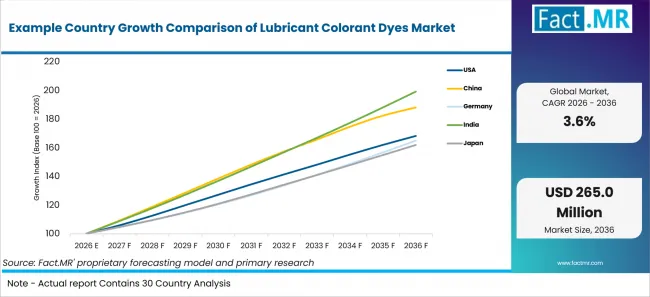
Example Country Growth Comparison Of Lubricant Colorant Dyes Market | Source: Fact.MR
| COUNTRY | CAGR |
|---|---|
| United States | 5.3% |
| Germany | 5.1% |
| France | 5.0% |
| Japan | 4.9% |
| United Kingdom | 4.8% |
Source: Fact.MR analysis. Updated Jul 17, 2026
What is driving United States growth from 2026 to 2036?
5.3% CAGR, supported by branded lubricants and aftermarket blending.
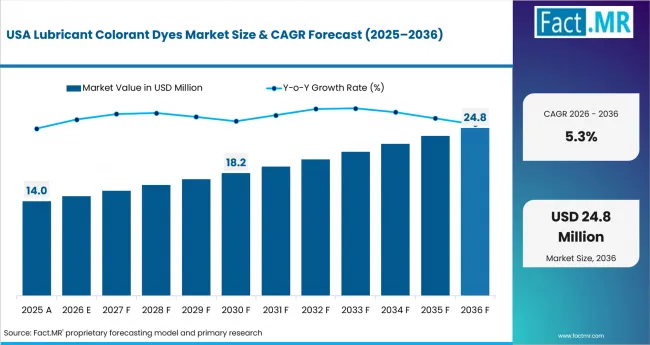
Lubricant Colorant Dyes Market Country Value Analysis | Source: Fact.MR
The United States has a large lubricant industry supported by vehicle servicing, petroleum use, and regional blending plants. The country used about 20.6 million barrels of petroleum per day in 2025, showing the large volume of products moving through its fuel and lubricant network. The market is projected to grow at a 5.3% CAGR through 2036 as lubricant makers use stable colors to separate engine-oil grades, private-label products, and service fluids.
How is Germany developing lubricant dye demand?
5.1% CAGR, driven by careful product testing and chemical rules.
Germany is projected to grow at a 5.1% CAGR because its automotive, machinery, and industrial sectors use oils that must meet steady quality standards. Choosing a dye involves more than finding the right color. Product staff also test heat resistance and oil clarity. They check whether the dye works properly with the additives in each oil. Ongoing industrial production is expected to create repeat demand for well-tested dye concentrates that give the same result during blending and filling.
What supports France in the Lubricant Colorant Dyes Market?
5.0% CAGR, backed by service fluids and industrial lubricant use.
France has a large vehicle repair and maintenance network that uses engine oils, transmission fluids, and other service products. INSEE reported more than 63,000 motor vehicle maintenance and repair businesses in its trade data. With so many service locations, clear product color helps workers identify oil grades and handle them correctly. Demand is forecast to rise at a 5.0% CAGR from 2026 to 2036 as lubricant makers keep colors consistent across mineral and synthetic oils.
Why does Japan reward low-variation concentrates?
4.9% CAGR, supported by close production control and steady color results.
Japan publishes monthly figures for the production, sales, and stock levels of lubricating oils. This shows how closely the country tracks its petroleum products. Lubricant makers therefore look for dye concentrates that produce almost the same color in every batch. The market is estimated to grow at a 4.9% CAGR through 2036 as specialty fluids and carefully managed production lines require accurate dye amounts and very little color change.
How does the United Kingdom perform in this market?
4.8% CAGR, led by aftermarket oils and marine lubricant distributors.
The United Kingdom has a well-established vehicle-service industry and a large marine supply network. Its registered trading fleet remains one of the larger national fleets in the world. More than 24,000 UK seafarers were also working at sea in 2025. These activities support demand for engine, hydraulic, and marine oils that require clear grade identification. The market is anticipated to grow at a 4.8% CAGR by 2036 as distributors handle several similar-looking fluids across ports and vehicle-service channels.
Who leads the Lubricant Colorant Dyes Market?
Solar Organics and Neelikon lead visible oil-soluble dye coverage, while FastColours and Pylam Products Company, Inc. support broader solvent-dye supply for oil-based systems.
Solar Organics offers oil-soluble dyes for engine oil, automatic transmission fluid, and grease. Neelikon also supplies dyes for oil-based products and provides information on how these dyes work in non-polar oils. FastColours supports lubricant dye customers through product samples, while Pylam Products Company, Inc. offers solvent dyes as part of its wider color range. These companies mainly compete on color strength, ease of mixing, and steady quality from one batch to the next.
Which companies are the key providers?
Solar Organics and Neelikon are key providers. FastColours and Pylam Products Company, Inc. are also profiled, while Organic Dyes and Pigments completes the company set.
- Solar Organics
- Neelikon Colours Global
- FastColours
- Organic Dyes and Pigments
- Pylam Products Company, Inc.
Bibliography
- American Chemistry Council. (2025, April 11). Petroleum additives product approval—Code of practice: April 2025 edition.
- Neelikon Colours Global. (2025, March 31). Understanding the difference between water-soluble dyes and oil-soluble dyes.
- ASTM International. (2024). Standard test method for ASTM color of petroleum products (ASTM color scale) (ASTM Standard No. D1500-24).
- Neelikon Colours Global. (2025, March 31). Understanding the difference between water-soluble dyes and oil-soluble dyes.
This Report Addresses
- The report provides strategic intelligence on lubricant colorant dyes across Fluid Application and Dye Delivery Form choices that shape blending approvals.
- Segment analysis covers Engine oils and Liquid concentrates as the share within the 2026 market.
- Regional outlook evaluates the United States and Germany alongside France, Japan and the United Kingdom within wider country coverage.
- Competitive analysis profiles Solar Organics and Neelikon alongside FastColours, Organic Dyes and Pigments and Pylam Products Company, Inc..
- Color assessment covers Blue / green identifiers and Red / orange identifiers across lubricant formulations that require different recognition cues.
- Performance assessment covers Thermal stability and Low treat-rate needs alongside Solubility clarity, Base-oil compatibility and Long shelf stability.
What does the Lubricant Colorant Dyes Market cover?
Oil-soluble dyes and prepared tint bases used to color lubricating-oil systems.
The Lubricant Colorant Dyes Market covers colorant systems designed to create or reinforce controlled shade in finished lubricants. Coverage includes oil-soluble dyes and delivery forms used in engine oils. It also covers hydraulic oils, marine lubricants and metalworking fluids.
The market differs from finished lubricants because commercial value comes from concentrated color function and formulation support. Base oils, additive packages and color-measurement instruments remain outside the boundary unless their principal commercial function is delivery of lubricant colorant dye.
What is included in the scope?
Lubricant dye systems used in oil-based formulations across blending and packaging environments.
The scope includes liquid concentrates and powder dyes alongside oil-dispersible granules, custom dye blends and pre-diluted tint bases. Coverage spans Engine oils and Hydraulic & gear oils alongside Industrial process oils, Marine / compressor oils and Metalworking fluids. Buyer Type coverage includes lubricant blenders and additive package suppliers. It also includes OEM fill suppliers, private-label packers and dye distributors.
What is excluded from the scope?
Finished lubricants and products whose primary function is not lubricant coloration are outside the scope.
The scope excludes base oils and additive packages. It also excludes general-purpose pigments, fuel markers and standalone diagnostic tracer kits. Packaging, color-measurement instruments and service-fluid retail revenue are also outside the market boundary.
How Was the Analysis Built?
The analysis draws on 120+ sources, 35+ company portfolios, 25+ countries, and more than 20 industry interviews.
- Primary Research: Primary research includes discussions with manufacturers, service providers, technology developers, distributors, end users, procurement teams, and subject-matter experts. These conversations examine purchasing priorities, product adoption, operational challenges, approval requirements, competitive positioning, and the factors that influence wider market acceptance.
- Desk Research: Desk research covers government statistics, regulatory publications, company filings, trade data, technical studies, industry associations, standards, public policy, and other authoritative sources. Every source used in the analysis is documented in the bibliography.
- Market Sizing and Forecasting: Market estimates combine historical performance, demand indicators, pricing and volume trends, segment shares, company participation, country-level growth, adoption patterns, investment activity, and barriers to market expansion.
- Data Validation and Update Cycle: Findings are validated by comparing primary interviews with public data, company activity, regulatory changes, trade patterns, and industry developments. Regular updates review new product launches, capacity changes, partnerships, approvals, procurement trends, and shifts in commercial adoption.
Segmentation
What is the report’s scope and coverage?
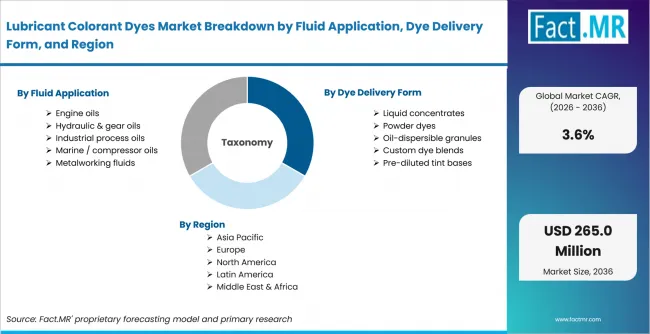
Lubricant Colorant Dyes Market Breakdown By Fluid Application, Dye Delivery Form, And Region | Source: Fact.MR
| Attribute | Details |
|---|---|
| Quantitative Units | USD Million in 2026 to USD Million by 2036 at CAGR |
| Market Definition | Oil-compatible soluble dyes and dye concentrates used to impart controlled color in lubricating-oil systems |
| Fluid Application | Engine oils; Hydraulic & gear oils; Industrial process oils; Marine / compressor oils; Metalworking fluids |
| Dye Delivery Form | Liquid concentrates; Powder dyes; Oil-dispersible granules; Custom dye blends; Pre-diluted tint bases |
| Color Requirement | Blue / green identifiers; Red / orange identifiers; Amber / yellow tints; Black / brown tints; UV tracer shades |
| Buyer Type | Lubricant blenders; Additive package suppliers; OEM fill suppliers; Private-label packers; Dye distributors |
| Performance Need | Thermal stability; Low treat-rate; Solubility clarity; Base-oil compatibility; Long shelf stability |
| Regions Covered | North America; Europe; Asia Pacific; Central and South America; Middle East and Africa |
| Countries Covered | United States; Germany; France; Japan; United Kingdom |
| Key Companies Profiled | Solar Organics; Neelikon Colours Global; FastColours; Organic Dyes and Pigments; Pylam Products Company, Inc. |
| Forecast Period | 2026 to 2036 |
| Approach | Hybrid top-down and bottom-up approach using lubricant blending activity; application shares; dye delivery forms; color requirements; treat-rate logic and company participation |
Source: Fact.MR analysis. Updated Jul 17, 2026
How is the market segmented?
-
By Fluid Application
- Engine oils
- Hydraulic & gear oils
- Industrial process oils
- Marine / compressor oils
- Metalworking fluids
-
By Dye Delivery Form
- Liquid concentrates
- Powder dyes
- Oil-dispersible granules
- Custom dye blends
- Pre-diluted tint bases
-
By Color Requirement
- Blue / green identifiers
- Red / orange identifiers
- Amber / yellow tints
- Black / brown tints
- UV tracer shades
-
By Buyer Type
- Lubricant blenders
- Additive package suppliers
- OEM fill suppliers
- Private-label packers
- Dye distributors
-
By Performance Need
- Thermal stability
- Low treat-rate
- Solubility clarity
- Base-oil compatibility
- Long shelf stability
-
By Region
- North America
- United States
- Europe
- Germany
- France
- United Kingdom
- Asia Pacific
- Japan
Frequently Asked Questions
Which Fluid Application leads the Lubricant Colorant Dyes Market?
Which Dye Delivery Form leads the market?
Which Color Requirement leads demand?
Which Buyer Type leads purchases?
Which Performance Need leads product selection?
Which country records the highest CAGR?
How does Germany perform in this market?
What is the primary driver in the market?
What is the main restraint in the market?
Who worked on this report


Preview the report firsthand - request a free sample
Free SampleGet the brochure for pricing and purchase details
Download PDF