- Base Value(2025): 44.1 Bn
- Estimated Value(2026): 46.7 Bn
- Forecast Value (2036): 80.7 Bn
- CAGR (2026 - 2036): 5.8%
Luxury Products for Kids Market Forecast By Fact.Mr
In 2025, the luxury products for kids market was valued at USD 44.1 billion. Based on Future Market Insights' analysis, demand for luxury products for kids is estimated to grow to USD 46.7 billion in 2026 and USD 80.7 billion by 2036. FMI projects a CAGR of 5.8% during the forecast period.
The absolute dollar growth from 2026 to 2036 is USD 34 billion. This growth is driven by increasing disposable incomes, rising parental spending on premium products, and growing interest in high-quality, branded items for children, including apparel, toys, and accessories. Expansion of e-commerce platforms and global luxury brands targeting the younger demographic further supports market growth. However, high product costs and economic fluctuations may limit adoption in certain regions.
China leads with a CAGR of 7.0%, driven by rising affluent households and increasing demand for branded kids’ products. India follows with 6.7%, supported by a growing middle class and higher parental spending on premium items. The USA grows at 5.6%, reflecting steady demand in established luxury and children’s product markets. Germany shows a CAGR of 5.3%, fueled by consumer preference for high-quality and safe products. The UK grows at 4.9%, supported by consistent demand in the premium children’s segment.
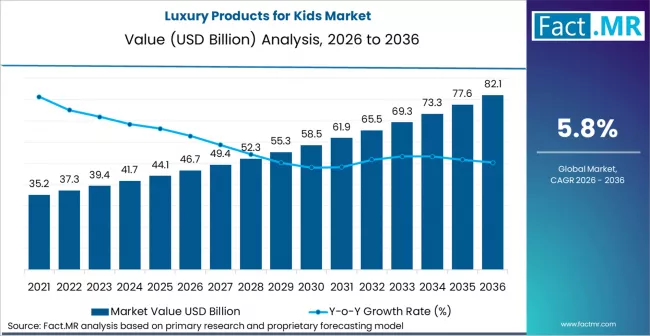
Luxury Products For Kids Market Market Value Analysis | Source: Fact.MR
Luxury Products for Kids Market
| Metric | Value |
|---|---|
| Estimated Value in (2026E) | USD 46.7 billion |
| Forecast Value in (2036F) | USD 80.7 billion |
| Forecast CAGR (2026 to 2036) | 5.8% |
Source: Fact.MR analysis. Updated Mar 12, 2026
Luxury Products for Kids Market Definition
The Luxury Products for Kids Market involves the manufacture and sale of high‑end, premium goods designed specifically for children, including fashion, accessories, toys, furniture, and lifestyle items that command elevated price points and perceived exclusivity.
Market Inclusions
This report covers global and regional market sizes for luxury products for kids over a defined forecast period, including product categories (apparel & accessories, toys & games, nursery furniture, premium gear), distribution channels (boutique retail, department stores, e‑commerce), and consumer segments.
Market Exclusions
The scope excludes mass‑market children’s products without luxury positioning, general baby and kids’ essentials sold at standard price points, and unrelated adult luxury goods.
Research Methodology
- Primary Research: Interviews were conducted with brand managers, luxury retailers, and consumer trend analysts.
- Desk Research: Data was sourced from industry reports, retail publications, and trade association statistics.
- Market‑Sizing and Forecasting: A hybrid model combining top‑down consumer spending forecasts with bottom‑up product sales and revenue data was used.
- Data Validation and Update Cycle: Findings were validated through expert review and aligned with recent production, adoption, and trade figures.
Summary of the Luxury Products for Kids Market
- Market Definition
- The Luxury Products for Kids Market involves the manufacture and sale of high-end, premium goods for children, including apparel, footwear, toys, strollers, and nursery furniture. Products are designed for infants, toddlers, and pre-schoolers, combining quality, safety, style, and brand prestige. The market encompasses boutique retail, department stores, and e-commerce channels that target affluent and aspirational consumers.
- Demand Drivers
- Rising disposable incomes and growing parental spending on premium children’s products.
- Increasing awareness of child safety, comfort, and quality in early childhood items.
- Expansion of e-commerce platforms and global luxury brands targeting the younger demographic.
- Growing preference for designer apparel, branded toys, and high-quality nursery furniture.
- Cultural and gifting trends that emphasize status and lifestyle signaling through children’s products.
- Key Segments Analyzed
- Product: Apparel & Footwear (50% share in 2026), Gear & Strollers, Nursery & Furniture.
- Target Group: Infants & Toddlers (60% share in 2026), Pre-schoolers.
- Geography: East Asia, South Asia, North America, Western Europe; China leads with CAGR of 7%, followed by India (6.7%), USA (5.6%), Germany (5.3%), and UK (4.9%).
- Analyst Opinion at Fact MR
- Shambhu Nath Jha, Principal Consultant, Fact MR, opines, “The luxury products for kids market is evolving from standard children’s goods to premium, brand-driven, and lifestyle-oriented offerings. Infants and toddlers represent the primary segment for high-end apparel, toys, and accessories. Brands that invest in quality, design exclusivity, and curated retail and e-commerce experiences can capture higher margins. Consumer preference for aspirational, safe, and stylish products defines the competitive landscape through 2036.”
- Strategic Implications/Executive Takeaways
- Expand luxury apparel, footwear, and nursery product offerings targeting infants and toddlers.
- Leverage e-commerce platforms and digital retail for global reach and brand visibility.
- Target high-growth regions such as China and India with rising affluent populations.
- Ensure adherence to safety, quality, and regulatory standards to enhance brand trust.
- Emphasize brand heritage, design exclusivity, and premium customer experience to differentiate from mass-market products.
- Methodology
- Primary Research: Interviews with brand managers, luxury retailers, and consumer trend analysts.
- Desk Research: Data sourced from industry reports, retail publications, and trade associations.
- Market Sizing & Forecasting: Hybrid model combining top-down consumer spending forecasts with bottom-up product sales and revenue data.
- Data Validation: Findings validated through expert review, adoption data, and proprietary Fact MR forecasting models.
Segmental Analysis
Luxury Products for Kids Market Analysis by Target Group
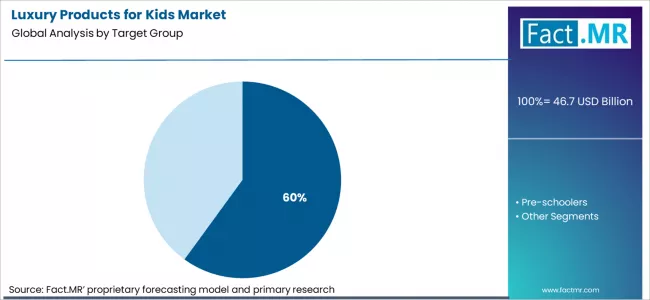
Luxury Products For Kids Market Analysis By Target Group | Source: Fact.MR
Market Overview: Infants and toddlers are expected to capture 60% of the market share by 2026. This age group is the primary focus for luxury kids’ products due to the high demand from parents seeking premium, safe, and stylish items for newborns and toddlers, including clothing, footwear, and accessories.
Demand Drivers:
- High Parental Spending on Early Childhood: Parents prioritize quality and safety for infants and toddlers, driving demand for premium and luxury products.
- Growing Awareness of Child Safety and Comfort: Luxury products often incorporate high-quality materials and ergonomic designs, appealing to safety-conscious parents.
- Lifestyle and Gifting Trends: Premium products for infants and toddlers are increasingly purchased as gifts or for social signaling, supporting market growth in this segment.
Luxury Products for Kids Market Analysis by Product
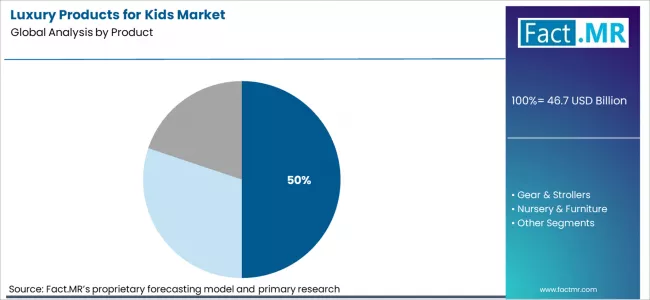
Luxury Products For Kids Market Analysis By Product | Source: Fact.MR
Market Overview: Apparel and footwear are projected to hold 50% of the market share by 2026. Luxury clothing and shoes for kids are popular for their quality, design, and brand value, making them a key category in the market for premium children’s products.
Demand Drivers:
- Premium Materials and Craftsmanship: Parents seek high-quality, comfortable, and durable apparel and footwear for their children, driving adoption of luxury brands.
- Fashion and Brand Appeal: Designer brands and aesthetically appealing products enhance consumer interest, particularly among affluent parents.
- Gift and Occasional Purchases: Luxury apparel and footwear are often purchased as gifts or for special occasions, supporting steady demand in this product category.
Luxury Products for Kids Market Drivers, Restraints, and Opportunities
FMR analysts observe that the luxury products for kids market is a growth‑aligned, lifestyle‑driven segment propelled by rising disposable incomes, premiumization of children’s lifestyle categories, and parental demand for high‑quality, safe, and branded products. Historically, basic kids’ goods dominated purchases; as affluent households and aspirational consumers expanded globally, structural demand emerged for premium apparel, toys, accessories, and experiences that signal status and elevated comfort. The 2026 valuation reflects this shift, with uptake tied to discretionary spending trends rather than essential children’s needs.
While standard mass‑market kids’ products remain large in volume, luxury and designer kids’ goods are gaining share because they deliver differentiated quality, brand prestige, and bespoke features that justify premium pricing. These high‑end items contribute to net market value growth even as overall unit volumes grow moderately with demographic and economic cycles. The market exists because affluent and aspirational segments prioritize perceived quality, uniqueness, and brand identity in children’s products, and regulatory safety and material standards shape premium positioning.
- Premiumization & Status Demand: Parents and gift purchasers choose luxury kids’ products to replace basic items with premium, branded alternatives that convey quality and status.
- Safety & Quality Standards: Stringent safety and material regulations push adoption of certified high‑end products that meet defined performance and health criteria.
- Regional Affluence Dynamics: In North America and Europe, established high‑income segments drive luxury kids’ uptake, while Asia‑Pacific shows rapid growth with expanding affluent populations.
Regional Analysis
The market analysis covers key global regions, including East Asia, South Asia, North America, and Western Europe. It is segmented geographically, with specific market dynamics for each region. The full report provides a detailed market attractiveness analysis.
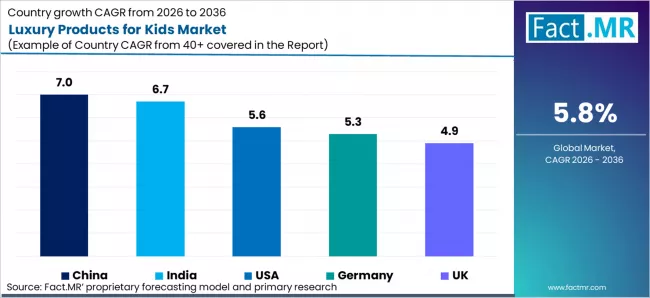
Luxury Products For Kids Market Cagr Analysis By Country | Source: Fact.MR
| Country | CAGR (2026-2036) |
|---|---|
| China | 7.0% |
| India | 6.7% |
| USA | 5.6% |
| Germany | 5.3% |
| United Kingdom | 4.9% |
Source: Fact.MR analysis. Updated Mar 12, 2026
Source: Fact MR (FMR) analysis, based on proprietary forecasting model and primary research
East Asia
China is the largest market, driven by growing disposable income, urban luxury retail expansion, and rising demand for premium children’s products. Key players include Disney China, Mattel, and LEGO Group.
- China: Demand for luxury products for kids in China is projected to rise at 7.0% CAGR through 2036. Growth is supported by expansion of premium retail stores (03-2025) and Disney China’s product line expansions (08-2025).
South Asia
India is a significant market, supported by increasing urban middle-class population, retail growth, and rising adoption of luxury children’s products.
- India: Demand for luxury products for kids in India is projected to rise at 6.7% CAGR through 2036. Growth is driven by government urban development programs (05-2025) and Mattel’s regional distribution expansion (09-2025).
North America
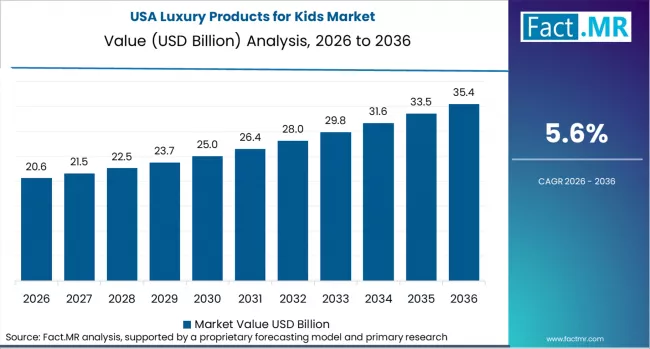
Luxury Products For Kids Market Country Value Analysis | Source: Fact.MR
The USA is a key market, supported by high disposable income, e-commerce penetration, and demand for premium children’s toys and apparel.
- USA: Demand for luxury products for kids in the U.S. is projected to rise at 5.6% CAGR through 2036. Growth is influenced by LEGO Group’s expansion of premium offerings (06-2025) and e-commerce channel development (09-2025).
Western Europe
Germany and the United Kingdom are major markets, driven by high-income households, retail penetration, and adoption of branded children’s products.
- Germany: Demand for luxury products for kids in Germany is projected to rise at 5.3% CAGR through 2036. Growth is supported by regional retail expansion (04-2025) and LEGO Group’s facility upgrades (08-2025).
- United Kingdom: Demand for luxury products for kids in the UK is projected to rise at 4.9% CAGR through 2036. Growth is influenced by premium retail initiatives (03-2025) and Disney UK’s regional product launches (07-2025).
Fact MR's analysis of the luxury products for kids market in East Asia, South Asia, North America, and Western Europe consists of country-wise assessments that include China, India, the USA, Germany, and the United Kingdom. Readers can find detailed trends, regulatory updates, and company-specific investments shaping market growth in these countries.
What is the Competitive Structure and Buyer Behavior in the Luxury Products for Kids Market?
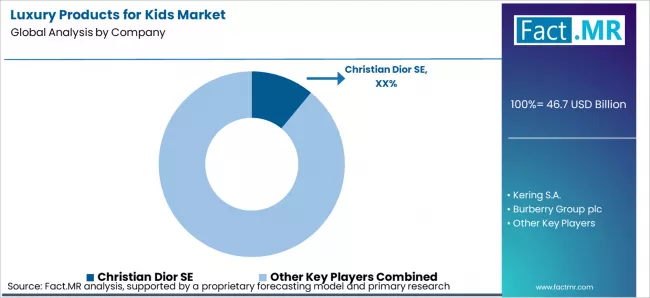
Luxury Products For Kids Market Analysis By Company | Source: Fact.MR
The luxury products for kids market is moderately concentrated, with leading high‑end fashion groups such as Christian Dior SE, Kering S.A., Burberry Group plc, Fendi S.r.l., and Dolce & Gabbana S.r.l. holding substantial share alongside prestigious and designer labels including Stella McCartney Limited, Balenciaga S.A., Moncler S.p.A., Ralph Lauren Corporation, and Thom Browne, Inc. The primary competitive variables are brand heritage, design exclusivity, material quality, and the perceived prestige associated with each label. Firms with strong brand equity, integrated global retail and e‑commerce networks, and multicultural marketing capabilities hold structural advantages, as they can sustain aspirational positioning, secure premium placement in flagship stores and boutiques, and drive consumer loyalty through curated lifestyle appeal.
High‑net‑worth individual buyers and affluent family shoppers exert significant leverage by comparing offerings across designers, evaluating perceived value, and prioritising brands that align with their lifestyle and social signalling preferences. To manage supplier dependency, these buyers often diversify their wardrobes across multiple luxury labels and emphasise brand reputation, craftsmanship, and exclusivity, which constrains individual suppliers’ pricing power. As a result, competition centers on delivering differentiated design, superior quality, and a compelling brand experience rather than on price alone.
Key Players of the Luxury Products for Kids Market
- Christian Dior SE
- Kering S.A.
- Burberry Group plc
- Fendi S.r.l.
- Stella McCartney Limited
- Balenciaga S.A.
- Moncler S.p.A.
- Dolce & Gabbana S.r.l.
- Ralph Lauren Corporation
- Thom Browne, Inc.
Report Scope
| Metric | Value |
|---|---|
| Quantitative Units | USD 46.7 billion (2026) to USD 80.7 billion (2036), at a CAGR of 5.8% |
| Market Definition | The luxury products for kids market includes global production, trade, and sales of high-end apparel, footwear, gear, strollers, and nursery furniture for infants, toddlers, and pre-schoolers. |
| Product Segmentation | Apparel & Footwear, Gear & Strollers, Nursery & Furniture |
| Target Group | Infants & Toddlers, Pre-schoolers |
| Key Companies Profiled | Christian Dior SE, Kering S.A., Burberry Group plc, Fendi S.r.l., Stella McCartney Limited, Balenciaga S.A., Moncler S.p.A., Dolce & Gabbana S.r.l., Ralph Lauren Corporation, Thom Browne, Inc. |
| Forecast Period | 2026 to 2036 |
| Approach | Hybrid top-down and bottom-up modeling validated through interviews with manufacturers and retailers, supported by trade data benchmarking and product capacity verification |
Source: Fact.MR analysis. Updated Mar 12, 2026
Bibliographies
- Business of Fashion. (2024). Why luxury brands are targeting Gen Alpha consumers. Business of Fashion.
- McKinsey & Company. (2024). The state of fashion 2024: Luxury sector outlook and emerging consumer segments. McKinsey & Company.
- Bain & Company. (2024). Luxury goods worldwide market study: Consumer behavior and growth trends. Bain & Company.
- Deloitte. (2024). Global powers of luxury goods: Reshaping the luxury industry. Deloitte.
- Vogue Business. (2025). How luxury brands are expanding into childrenswear and youth-focused fashion segments. Vogue Business.
- Financial Times. (2024). Luxury brands target younger consumers as global demand shifts. Financial Times.
- Harvard Business Review. (2023). How Gen Z and Gen Alpha are reshaping the luxury market. Harvard Business Review.
This report addresses
- Market intelligence enabling detailed assessment of leading countries, product categories, and target groups in the global Luxury Products for Kids Market.
- Market volume (revenue) estimates and 10-year revenue forecasts from 2026 to 2036, validated through consumer spending data, brand adoption rates, and retail expansion trends.
- Growth opportunity mapping across products (Apparel & Footwear, Gear & Strollers, Nursery & Furniture), target groups (Infants & Toddlers, Pre-schoolers), and regions.
- Segment and regional revenue forecasts by product type, target group, and geography, covering 40+ countries.
- Competition strategy analysis focusing on brand heritage, design exclusivity, material quality, and integrated retail and e-commerce networks, with major players including Christian Dior SE, Kering S.A., Burberry Group plc, Fendi S.r.l., Stella McCartney Limited, Balenciaga S.A., Moncler S.p.A., Dolce & Gabbana S.r.l., Ralph Lauren Corporation, and Thom Browne, Inc.
- Product, safety, and regulatory tracking aligned with child product standards, premium materials certification, and regional import regulations.
- Adoption dynamics emphasizing premium apparel, footwear, accessories, toys, strollers, and nursery furniture, particularly for infants and toddlers.
- Report delivery in PDF, Excel, PowerPoint, and interactive dashboard formats for executive, operational, and strategic planning use.
Segmentation
Luxury Products for Kids Market Key Segments
-
Product
- Apparel & Footwear
- Gear & Strollers
- Nursery & Furniture
-
Target Group
- Infants & Toddlers
- Pre-schoolers
-
Region
- North America
- USA
- Canada
- Mexico
- Europe
- Germany
- UK
- France
- Italy
- Spain
- Nordic Countries
- BENELUX
- Rest of Europe
- Asia Pacific
- China
- Japan
- South Korea
- India
- Australia
- Rest of Asia Pacific
- Latin America
- Brazil
- Argentina
- Rest of Latin America
- Middle East and Africa
- Kingdom of Saudi Arabia
- United Arab Emirates
- South Africa
- Rest of Middle East and Africa
- Other Regions
- Oceania
- Central Asia
- Other Markets
- North America
Frequently Asked Questions
How large is the demand for Luxury Products for Kids in the global market in 2026?
What will be the market size of Luxury Products for Kids in the global market by 2036?
What is the expected demand growth for Luxury Products for Kids in the global market between 2026 and 2036?
Which target group is expected to dominate the market?
Which region is expected to show the highest growth rate for Luxury Products for Kids?
How significant is the growth outlook for India in this market?
What is the growth outlook for the United States in the Luxury Products for Kids market?
What is the growth forecast for Germany in the Luxury Products for Kids market?
What is the growth forecast for the United Kingdom in the Luxury Products for Kids market?
Which company is identified as a leading player in the Luxury Products for Kids market?
What are Luxury Products for Kids used for?
What does the Luxury Products for Kids market include in this report?
How is the market forecast developed in this report?
What is meant by the Luxury Products for Kids market in this report?
Who worked on this report


Preview the report firsthand - request a free sample
Free SampleGet the brochure for pricing and purchase details
Download PDF