- Market Value (2025): USD 313.0 Bn
- Estimated Value (2026): USD 328.0 Bn
- Forecast Value (2036): USD 524.2 Bn
- CAGR (2026-2036): 4.8%
What is the Management Consulting Services Market forecast to be worth by 2036?
USD 328.0 billion in 2026 to USD 524.2 billion by 2036 at a 4.8% CAGR.
- The Management Consulting Services Market was valued at USD 313.0 billion in 2025.
- Demand is projected to increase from USD 328.0 billion in 2026 to USD 524.2 billion by 2036.
- The market is forecast to expand at a 4.8% CAGR from 2026 to 2036.
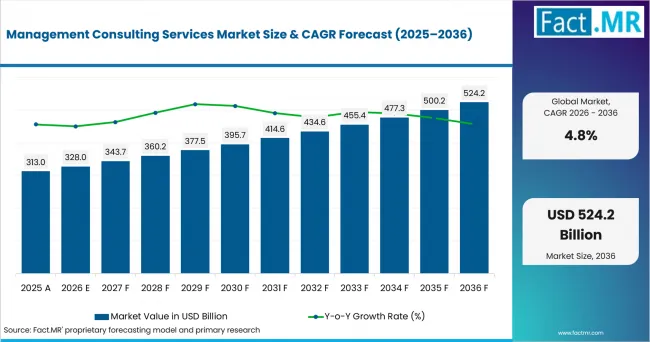
Management Consulting Services Market Value Analysis | Source: Fact.MR
What are the defining numbers behind Management Consulting Services Market growth?
An absolute opportunity of USD 196.2 billion is expected between 2026 and 2036.
- Demand Drivers in the Market
- Enterprise AI adoption is moving consulting work from technology selection toward operating-model redesign, governance, workflow change, and measurable implementation. OECD data show that 20.2% of firms used AI in 2025, up from 8.7% in 2023, creating a wider buyer base for transformation and change-management services.
- Digital programs increasingly require business-process redesign alongside software deployment. This expands demand for consulting around the digital transformation market, where clients need help linking technology investments to cost, service, control, and workforce outcomes.
- Cost pressure remains a recurring purchase trigger. The U.S. Bureau of Labor Statistics states that demand for management analysts is expected to increase as organizations seek to improve efficiency and control costs, which supports operational, performance, and restructuring engagements.
- Regulatory change creates demand for governance and implementation advice. The European Union introduced AI transparency obligations from August 2026, while sustainability-reporting requirements continue to change. Organizations need operating controls, accountability, data ownership, and reporting processes that can withstand regulatory review.
- Public-sector and regulated-industry buyers are using more structured procurement frameworks and outcome requirements. This favors consultancies that can define scope, transfer knowledge, and connect strategic recommendations to implementation rather than relying on open-ended advisory retainers.
- Key Segments Analyzed
- Operational Consulting accounts for 29.2% of Product in 2026 because process improvement, supply chain, and performance-management work is directly tied to productivity, cost control, and execution.
- BFSI accounts for 39.5% of End Use Industry in 2026 because banks, financial-services firms, and insurers require recurring support across regulation, digital transformation, operating risk, cost programs, and customer-process redesign.
- Analyst Opinion at Fact.MR
- Shambhu Nath Jha, Principal Consultant, Fact.MR, states, "Management consulting demand is shifting toward engagements where strategy, technology, organization, and execution have to move together. Buyers increasingly expect consultants to define the business case, redesign the operating model, support implementation, and demonstrate measurable outcomes rather than stop at recommendations."
- Strategic Implications
- Consultancies should tie project design to measurable operating metrics such as cycle time, cost-to-serve, working-capital improvement, service levels, control effectiveness, and implementation milestones.
- Technology-led programs require deeper capability around enterprise platforms and AI-enabled workflows. Advisory firms that can connect operating design with the agent-oriented enterprise resource planning market can participate in programs where process ownership, controls, and transaction execution are being redesigned together.
- Industry specialization matters because a bank, manufacturer, public agency, and pharmaceutical company face different regulatory, data, operating, and implementation constraints even when they buy similar strategy or transformation services.
- AI implementation creates an additional services layer around integration, monitoring, governance, and operating accountability. This increases overlap with the AI agent management services market as enterprise pilots move into production environments.
How does the Management Consulting Services Market break down by segment?
The market is segmented by Product and End Use Industry.
Why does Operational Consulting lead Product?
Operational Consulting is projected to account for a 29.2% share in 2026.
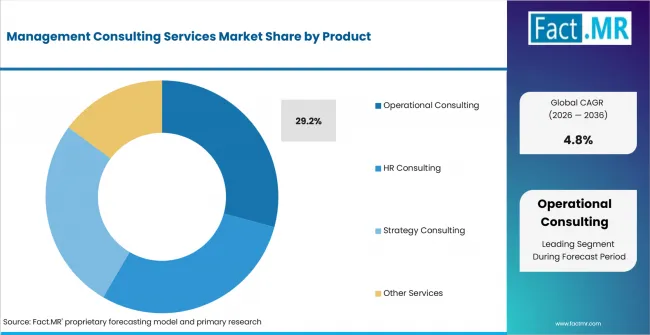
Management Consulting Services Market Analysis By Product | Source: Fact.MR
Operational Consulting leads because process improvement, supply chain, and performance management have direct links to cost, throughput, working capital, service levels, and execution risk. These projects are easier for buyers to connect to measurable operating outcomes than advisory work whose value appears only over a longer strategic horizon.
The category also benefits from technology-led process redesign. Companies often review workflows before automating, centralizing, or transferring activities, which creates a natural connection between consulting and the business process outsourcing (BPO) market. Consultants are therefore engaged to determine which processes should be standardized, automated, retained internally, or moved to external delivery models.
Process improvement consulting addresses recurring operating friction, supply chain consulting responds to sourcing and network complexity, and performance management consulting helps leadership translate strategic targets into operating measures. Together, these services remain relevant across manufacturing, BFSI, public-sector, energy, retail, and technology environments.
Why does BFSI lead End Use Industry?
BFSI is projected to account for a 39.5% share in 2026.
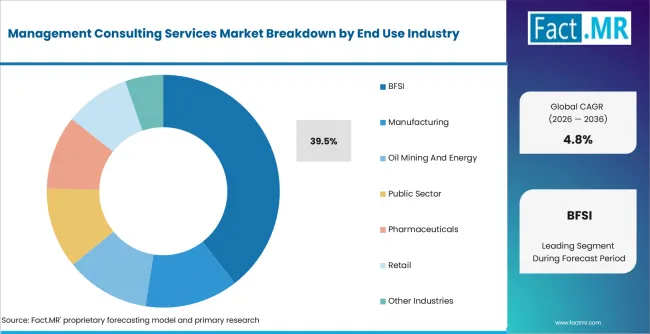
Management Consulting Services Market Analysis By End Use Industry | Source: Fact.MR
BFSI leads because banks, financial-services firms, and insurers operate with high regulatory intensity, large technology estates, extensive data requirements, and continuous pressure on cost, risk, customer experience, and capital allocation. Consulting engagements therefore span operating-model redesign, digital transformation, risk and compliance, workforce change, cost programs, and strategic portfolio decisions.
Insurance adds a specialized advisory layer covering claims, actuarial processes, regulatory change, digital core modernization, and operating risk. This creates direct overlap with the insurance consulting services market, while banking and financial-services buyers continue to fund broader transformation and productivity programs.
BFSI buyers also tend to procure multi-workstream programs because technology, process, controls, and organization design are interdependent. This supports larger engagements and recurring advisory relationships when regulatory deadlines, platform changes, mergers, or enterprise cost programs require coordinated execution.
What is accelerating Management Consulting Services Market adoption, and what is holding it back?
Demand is being accelerated by AI adoption and the need to translate technology spending into measurable business outcomes. The clearest opportunity is in implementation-heavy work. Clients increasingly need operating-model design, data and AI governance, change management, The main restraints are fee scrutiny, stronger internal strategy and transformation teams.
Drivers Impact Analysis
| Factor | (~) % Impact on CAGR | Geographic Relevance | Impact Timeline |
|---|---|---|---|
| Enterprise AI adoption and digital transformation | +1.6% | Global | Short term (<= 2 years) |
| Cost reduction and productivity programs | +1.4% | USA, Germany and UK | Short term (<= 2 years) |
| Regulatory and governance change | +1.1% | Germany, UK and USA | Medium term (2-4 years) |
| Restructuring and supply-chain redesign | +0.9% | Global | Medium term (2-4 years) |
| Demand for implementation-linked business outcomes | +0.6% | Global | Long term (>= 4 years) |
Source: Fact.MR analysis. Updated Sep 4, 2026
Opportunity Impact Analysis
| Factor | (~) % Impact on CAGR | Geographic Relevance | Impact Timeline |
|---|---|---|---|
| AI governance and operating-model implementation | +1.0% | USA, Germany and UK | Medium term (2-4 years) |
| Change management and workforce transition | +0.8% | Germany, Japan and USA | Medium term (2-4 years) |
| Outcome-linked and implementation-heavy engagements | +0.7% | Global | Long term (>= 4 years) |
| Industry-specialist transformation consulting | +0.5% | USA, Germany, UK and Japan | Long term (>= 4 years) |
Source: Fact.MR analysis. Updated Sep 4, 2026
Restraints Impact Analysis
| Factor | (~) % Impact on CAGR | Geographic Relevance | Impact Timeline |
|---|---|---|---|
| Consulting fee scrutiny and procurement pressure | -1.1% | Global | Short term (<= 2 years) |
| Stronger internal strategy and transformation teams | -0.9% | USA, UK and Germany | Short term (<= 2 years) |
| Automation of routine analysis and advisory work | -0.7% | Global | Medium term (2-4 years) |
| Competition from specialist firms and systems integrators | -0.5% | Global | Long term (>= 4 years) |
Source: Fact.MR analysis. Updated Sep 4, 2026
Which countries are scaling the Management Consulting Services Market through 2036?
- Germany: Enterprise and SME digitalization, AI adoption, regulatory change, and industrial transformation create demand for operational, strategy, technology, and organizational consulting.
- Brazil: Industrial productivity and digital-transformation programs are increasing the need for process redesign, technology adoption, operating-model support, and capability building.
- USA: Cost control, AI adoption, organizational change, and a deep professional-services buyer base support recurring demand across operational and strategic consulting.
- UK: Public-sector frameworks and private-sector transformation programs sustain demand, while tighter procurement controls increase pressure for clearly scoped, outcome-linked engagements.
- Japan: Corporate DX, legacy-system modernization, workforce change, and management reform support consulting demand, particularly where technology investment requires business-model and operating-process redesign.
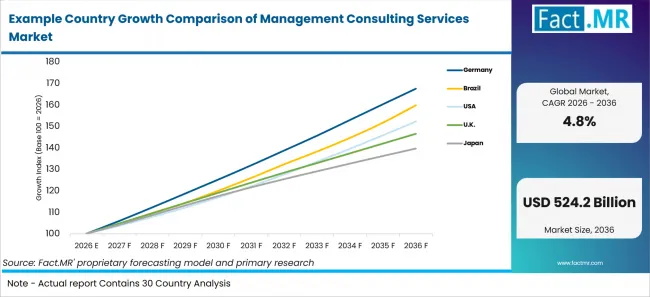
Example Country Growth Comparison Of Management Consulting Services Market | Source: Fact.MR
| Country | CAGR, 2026-2036 |
|---|---|
| Germany | 5.3% |
| Brazil | 4.8% |
| USA | 4.3% |
| UK | 3.9% |
| Japan | 3.4% |
Source: Fact.MR analysis. Updated Sep 4, 2026
What is driving Germany's growth through 2036?
Germany is forecast to expand at a 5.3% CAGR from 2026 to 2036.
Germany combines industrial transformation with a large SME base that is still moving through digital and organizational change. The Federal Ministry for Economic Affairs and Energy reports that the Mittelstand-Digital network reached around 360,000 companies from 2021 through the end of 2025, with the next phase placing additional emphasis on AI, digitalization, IT, and cybersecurity. This creates consulting demand around process redesign, technology roadmaps, organization change, data governance, and cyber-aware operating models.
European regulatory change adds another layer. AI transparency obligations began applying in August 2026, while sustainability-reporting requirements continue to evolve. German companies therefore need governance, reporting, controls, data ownership, and implementation support that connect regulatory requirements with operating processes rather than treating compliance as a standalone legal exercise.
What is driving Brazil's growth through 2036?
Brazil is forecast to expand at a 4.8% CAGR from 2026 to 2036.
Brazilian industrial policy is linking productivity with technology adoption. The Ministry of Development, Industry, Commerce and Services identifies digital transformation and productivity as priorities under Nova Industria Brasil and targets digital transformation of 25% of industrial companies in 2026 and 50% by 2033. Programs such as Brasil Mais Produtivo also provide individualized support to small and medium industrial and service companies.
What is driving the USA's growth through 2036?
The USA is forecast to expand at a 4.3% CAGR from 2026 to 2036.
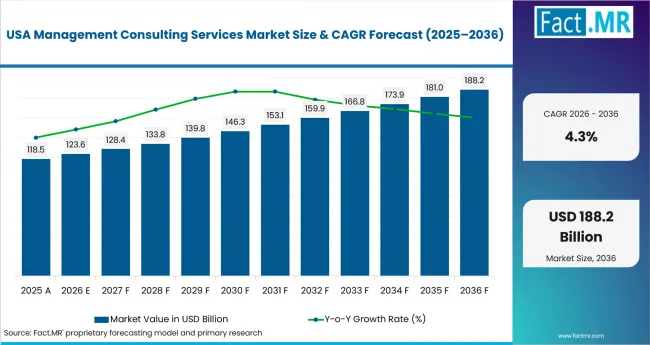
Management Consulting Services Market Country Value Analysis | Source: Fact.MR
The U.S. market is supported by a deep base of enterprises buying consulting across technology, finance, healthcare, manufacturing, government, and professional services. The Bureau of Labor Statistics projects employment of management analysts to grow 10% from 2025 to 2035 and explicitly links demand to organizations seeking greater efficiency and cost control. This supports recurring demand for operational consulting, performance improvement, restructuring, and transformation programs.
What is driving the UK's growth through 2036?
The UK is forecast to expand at a 3.9% CAGR from 2026 to 2036.
The UK public sector continues to procure management consulting through structured frameworks. Management Consultancy Framework Four covers business, strategy and policy, complex transformation, finance, HR, procurement and supply chain, health and social care, infrastructure, environment and sustainability, and restructuring and insolvency. This creates a defined route to market for consultancies across several of the same capabilities purchased by private-sector clients.
At the same time, government controls on consultancy spending have increased scrutiny of scope, pricing, and supplier performance. That limits open-ended advisory work but supports engagements with clearer deliverables, measurable outcomes, and knowledge transfer. Private-sector demand remains linked to digital transformation, productivity, regulatory change, and restructuring.
What is driving Japan's growth through 2036?
Japan is forecast to expand at a 3.4% CAGR from 2026 to 2036.
Japan is using digital transformation as a management issue rather than a technology-only program. METI's DX Stocks 2026 framework recognizes companies that build systems for DX, change business models and management practices, develop digital talent, and review performance. These requirements create demand for strategy, organization, process, technology, and change-management support.
Legacy-system modernization adds a second demand mechanism. METI's 2025 modernization report identified legacy systems as an obstacle to DX and emphasized the link between management involvement, IT visibility, and modernization. Consulting demand therefore concentrates on programs that connect system renewal with operating-model redesign, governance, workforce capability, and business priorities.
Who Leads the Management Consulting Services Market?
Key players in the Management Consulting Services Market include Accenture, Kearney, Aon plc, Bain & Company, Booz Allen Hamilton, Boston Consulting Group, CGI Inc., Cognizant, Deloitte, EY, KPMG International, McKinsey & Company, Mercer, PwC, Strategyn, Sia Partners, and DXC Technology.
Competition is shaped by industry expertise, senior advisory capability, implementation depth, technology partnerships, data and AI skills, geographic coverage, and the ability to deliver measurable operating outcomes. Strategy firms compete strongly in board-level and transformation mandates, while technology-enabled consultancies and systems integrators can extend engagements into implementation, managed change, and enterprise-platform work. HR specialists compete where organization design, workforce, compensation, and talent programs are central to the project.
A.T. Kearney adopted the Kearney name in 2020. DXC Technology was formed through the 2017 combination of Computer Sciences Corporation and Hewlett Packard Enterprise Services, and CSC no longer operates as a separate global consulting brand.
Which companies are the key providers?
Key Companies includes Accenture; Kearney; Aon plc; Bain & Company; Booz Allen Hamilton; Boston Consulting Group; CGI Inc.; Cognizant; DXC Technology; Deloitte; EY; KPMG International; McKinsey & Company; Mercer; PwC; Strategyn; Sia Partners
- Accenture
- Kearney
- Aon plc
- Bain & Company
- Booz Allen Hamilton
- Boston Consulting Group
- CGI Inc.
- Cognizant
- DXC Technology
- Deloitte
- EY
- KPMG International
- McKinsey & Company
- Mercer
- PwC
- Strategyn
- Sia Partners
Bibliography
- Organisation for Economic Co-operation and Development. (2026). AI use by individuals surges across the OECD as adoption by firms continues to expand. OECD.
- U.S. Bureau of Labor Statistics. (2026). Management Analysts: Occupational Outlook Handbook. U.S. Department of Labor.
- Federal Ministry for Economic Affairs and Energy. (2026). Promoting digitalisation in SMEs. Government of Germany.
- Ministry of Development, Industry, Commerce and Services. (2026). Innovation and Digital Transformation. Government of Brazil.
- Government Commercial Agency. (2026). Management Consultancy Framework Four (MCF4). UK Government.
- Cabinet Office and Crown Commercial Service. (2024). New controls across government to curb consultancy spend and strengthen procurement discipline. UK Government.
- Ministry of Economy, Trade and Industry. (2026). DX Stocks 2026, Noteworthy DX Companies 2026 and DX Platinum Companies 2026-2028 Selected. Government of Japan.
- Ministry of Economy, Trade and Industry. (2025). Comprehensive Report Compiled by the Legacy Systems Modernization Committee to Eliminate Legacy Systems. Government of Japan.
- European Commission. (2026). Guidelines on transparency obligations for providers and deployers of AI systems. European Commission.
- European Commission. (2026). Corporate sustainability reporting. European Commission.
- Kearney. (2026). Our Story. Kearney.
- Computer Sciences Corporation. (2017). DXC Technology Revealed as Name for Combined CSC and HPE Enterprise Services Business Following Merger Completion. U.S. Securities and Exchange Commission filing.
This Report Answers
- What is driving demand for management consulting services from 2026 to 2036?
- Why does Operational Consulting account for 29.2% of Product in 2026?
- Why does BFSI account for 39.5% of End Use Industry in 2026?
- How are AI, digital transformation, regulation, and cost pressure changing consulting engagements?
- How do Germany, Brazil, the USA, the UK, and Japan differ in their consulting-demand mechanisms?
- What limits consulting adoption and fee growth?
- Which current consulting firms compete across the market?
What does the Management Consulting Services Market cover?
The Management Consulting Services Market covers professional advisory and implementation services purchased to improve organizational performance within the defined Product and End Use Industry categories. Coverage includes operational consulting, HR consulting, strategy consulting, financial advisory consulting, information technology consulting, and sustainability consulting when these services are sold as management consulting engagements.
End-use coverage includes BFSI, Manufacturing, Oil Mining And Energy, Public Sector, Pharmaceuticals, Retail, and Other Industries. Revenue is attributed to consulting engagements rather than to the value of software, equipment, outsourced operations, or client payroll affected by the project.
What is included in the scope?
The scope includes Process Improvement Consulting, Supply Chain Consulting, Performance Management Consulting, Talent Management Consulting, Compensation And Benefits Consulting, Organizational Development Consulting, Corporate Strategy Consulting, Business Transformation Consulting, Market Strategy Consulting, Financial Advisory Consulting, Information Technology Consulting, and Sustainability Consulting.
The market includes advisory and implementation support purchased by banks, financial-services firms, insurers, manufacturers, oil and gas companies, mining companies, energy and utility organizations, government agencies, public institutions, pharmaceutical and biotechnology companies, retailers, healthcare organizations, telecommunications companies, information technology companies, and media and entertainment organizations.
What is excluded from the scope?
The market excludes standalone software subscriptions, cloud infrastructure, enterprise applications, staffing services, recruitment placement fees, legal services, statutory audit, tax-return preparation, engineering design, and outsourced business-process execution when these are purchased without a management consulting component.
Training, implementation, managed services, and technology work are included only when they form part of a consulting engagement within the defined service categories. Adjacent professional-services revenue is excluded when its principal commercial purpose falls outside management consulting.
How Was the Analysis Built?
The analysis combines service-market sizing with buyer, industry, policy, labor-market, procurement, regulatory, and company evidence relevant to management consulting demand.
- Primary Research: Relevant respondent groups include consulting practice leaders, engagement partners, enterprise strategy and transformation executives, operations leaders, HR leaders, procurement teams, digital and technology executives, finance leaders, and buyers in BFSI, manufacturing, public sector, pharmaceuticals, retail, energy, and related industries.
- Desk Research: Research uses government procurement frameworks, labor-market statistics, OECD technology-adoption data, digital-transformation policies, regulatory guidance, industrial-policy programs, official company information, and other authoritative public material relevant to consulting demand and delivery.
- Market Sizing and Forecasting: Sizing considers consulting engagement value, service mix, buyer spending patterns, transformation activity, implementation intensity, industry demand, country growth, and the balance between recurring advisory work and project-based engagements.
- Data Validation and Update Cycle: Market values, annual progression, segment shares, country growth rates, and company identities are checked for internal consistency. Company-status updates account for rebranding, mergers, and legacy corporate identities where these affect current market references.
Segmentation
What is the report's scope and coverage?
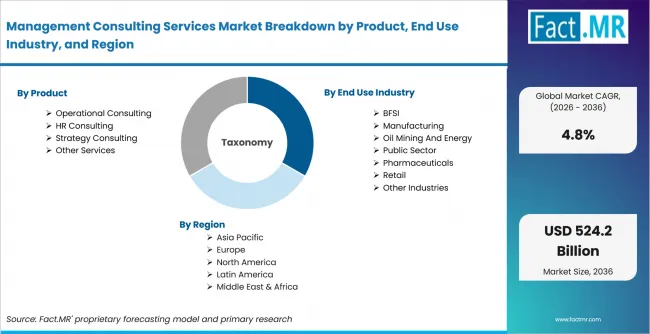
Management Consulting Services Market Breakdown By Product, End Use Industry, And Region | Source: Fact.MR
| Attribute | Details |
|---|---|
| Forecast Period | 2026-2036 |
| Historical Analysis | 2021-2025 |
| Market Value, 2025 | USD 313.0 billion |
| Market Value, 2026 | USD 328.0 billion |
| Market Value, 2036 | USD 524.2 billion |
| CAGR, 2026-2036 | 4.8% |
| Absolute Opportunity | USD 196.2 billion |
| Quantitative Units | Revenue in USD Billion; CAGR and market shares in % |
| Segment Categories | Product; End Use Industry |
| Country Analysis | Germany; Brazil; USA; UK; Japan |
| Key Companies | Accenture; Kearney; Aon plc; Bain & Company; Booz Allen Hamilton; Boston Consulting Group; CGI Inc.; Cognizant; DXC Technology; Deloitte; EY; KPMG International; McKinsey & Company; Mercer; PwC; Strategyn; Sia Partners |
Source: Fact.MR analysis. Updated Sep 4, 2026
How is the market segmented?
-
By Product:
- Operational Consulting
- Process Improvement Consulting
- Supply Chain Consulting
- Performance Management Consulting
- HR Consulting
- Talent Management Consulting
- Compensation And Benefits Consulting
- Organizational Development Consulting
- Strategy Consulting
- Corporate Strategy Consulting
- Business Transformation Consulting
- Market Strategy Consulting
- Other Services
- Financial Advisory Consulting
- Information Technology Consulting
- Sustainability Consulting
- Operational Consulting
-
By End Use Industry:
- BFSI
- Banking
- Financial Services
- Insurance
- Manufacturing
- Discrete Manufacturing
- Process Manufacturing
- Oil Mining And Energy
- Oil And Gas
- Mining
- Energy And Utilities
- Public Sector
- Government Agencies
- Public Institutions
- Pharmaceuticals
- Pharmaceutical Companies
- Biotechnology Companies
- Retail
- Offline Retail
- Online Retail
- Other Industries
- Healthcare
- Telecommunications
- Information Technology
- Media And Entertainment
- BFSI
-
By Region:
- North America
- Latin America
- Western Europe
- Eastern Europe
- East Asia
- South Asia and Pacific
- Middle East & Africa
Frequently Asked Questions
What is the Management Consulting Services Market value in 2026?
At what CAGR is the market projected to grow?
What is the projected market value by 2036?
Which Product leads the market?
Which End Use Industry leads the market?
Which country records the highest listed CAGR?
What is driving growth in the Management Consulting Services Market?
What is the main restraint?
Which companies are active in the Management Consulting Services Market?
Who worked on this report


Preview the report firsthand - request a free sample
Free SampleGet the brochure for pricing and purchase details
Download PDF