PR Management Market Size, Share, Growth and Forecast (2026 - 2036)

The PR Management Market is segmented by Service Type (Media Relations, Digital and Social Media Management, Crisis and Reputation Management, Influencer and Content Partnerships, Corporate and Executive Communications, Measurement and Analytics, Events and Experiential Communications), Deployment (In-house Solutions, Agency Outsourced Services, Hybrid Models), End User (Corporate Enterprises, Small and Medium Enterprises, Public Sector and Government, Nonprofit Organizations, Financial Institutions), Communication Channel (Earned Media, Social Media, Executive Communications, Investor Communications, Public Affairs), Organization Size (Large Enterprises, Mid-sized Enterprises, Small Enterprises), and Region. Forecast for 2026 to 2036.

Fact.MR analysis indicates that PR management demand is moving from campaign support toward reputation control and stakeholder response. Media relations are projected to lead by service type. Corporate enterprises are expected to dominate by end user during the forecast period.

PR Management Market Size, Market Forecast and Outlook By FactMR

The PR management market was valued at USD 79.3 billion in 2025. Demand is set to reach USD 84.3 billion in 2026 at a CAGR of 6.3% during the forecast period. Sustained spending takes the valuation to USD 155.3 billion through 2036 as enterprises treat reputation risk as a board-level communication priority.
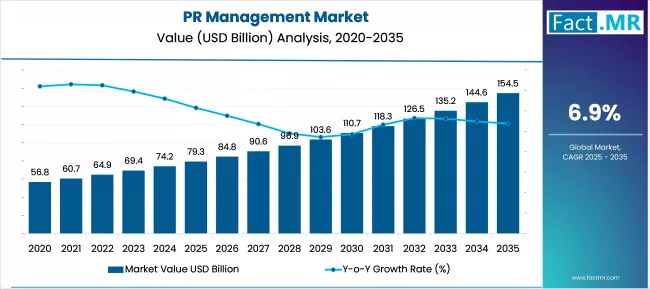
Pr Management Market Market Value Analysis

Metric Details
Industry Size (2026) USD 84.3 billion
Industry Value (2036) USD 155.3 billion
CAGR (2026 to 2036) 6.3%

Summary of PR Management Market

  • Market Definition
    • PR management covers service and platform spending used to protect reputation, manage media relationships, prepare crisis response, and guide stakeholder communication. Scope is defined by earned credibility, public trust, message discipline, and measurable communication outcomes.
  • Demand Drivers in the Market
    • Chief communication officers need faster monitoring to manage reputation exposure across digital and traditional media.
    • Investor relations heads need clearer message control as public companies face closer scrutiny.
    • Public affairs directors require coordinated response planning across policy, media, and stakeholder channels.
  • Key Segments Analyzed
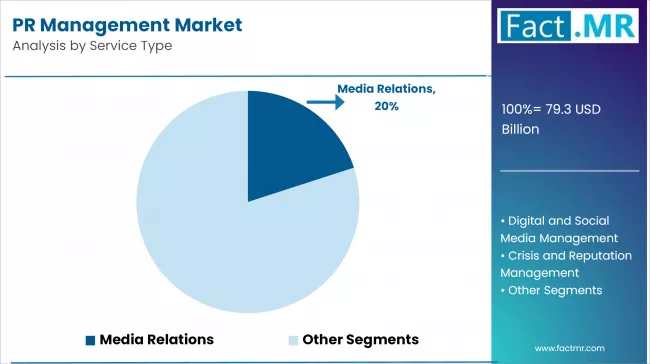
    • Media Relations: Media relations are expected to account for 20.0% share in 2026, as earned coverage remains central to credibility and public visibility.
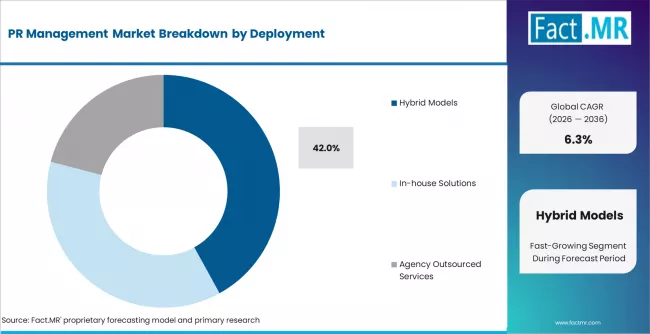
    • Hybrid Models: Hybrid models are projected to hold 42.0% share in 2026 as enterprises combine internal control with agency expertise.
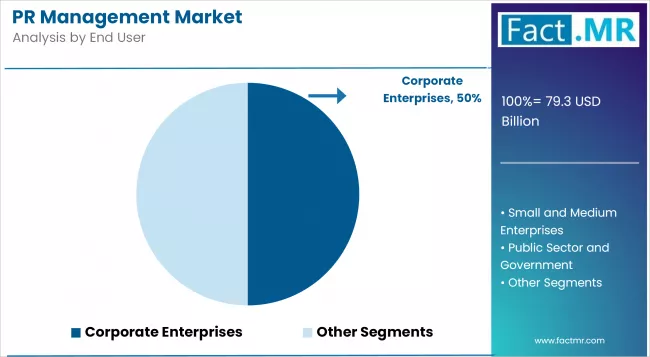
    • Corporate Enterprises: Corporate enterprises are estimated to account for 50.0% share in 2026 due to higher reputation exposure and wider stakeholder scrutiny.
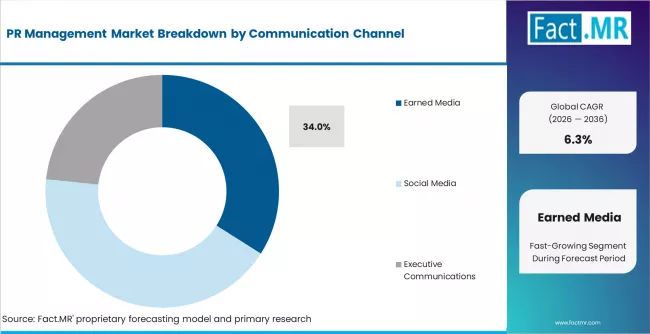
    • Earned Media: Earned media is likely to hold 34.0% share in 2026 as companies continue to value third-party credibility.
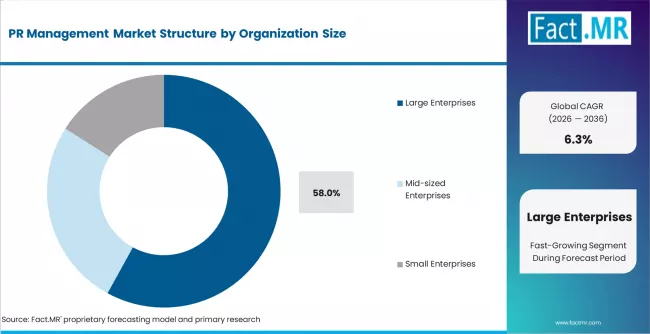
    • Large Enterprises: Large enterprises are projected to capture 58.0% share in 2026 because reputation risk is highest across multi-country operations.
    • Geography: China is forecast to grow at 8.5% CAGR through 2036, supported by platform-driven visibility and fast-moving consumer sentiment.
  • Analyst Opinion at Fact.MR
    • Shambhu Nath Jha, Senior Analyst at Fact.MR, states, “PR management is moving away from press coverage alone. Enterprises now need reputation systems that connect listening, response, executive messaging, and stakeholder trust. Service providers will gain when they can prove judgment under pressure and reporting that leadership can act on.”
  • Strategic Implications
    • Chief communication officers must connect PR reporting with reputation risk reviews to defend spending through 2036.
    • Agency practice leaders should combine media access with analytics to protect retainer quality.
    • Platform providers need clearer privacy controls as monitoring tools handle sensitive audience and media data.
  • Methodology
    • Fact.MR interviews communication leaders, agency heads, public affairs specialists, and platform buyers.
    • Research reviews trust barometers, media behavior studies, agency filings, privacy guidance, and communication industry publications.
    • Estimates use service intensity, enterprise adoption, platform spending, and regional communication complexity.
    • Forecasts are validated through buyer feedback, agency revenue signals, platform usage indicators, and regional media trends.

Communication heads are being pushed to decide between episodic media outreach and always-on reputation management. This change is visible across corporate communications, public affairs, investor relations, and crisis response. The 2025 Edelman Trust Barometer highlights weaker public trust and rising grievance, which makes communications planning more sensitive for large organizations. A practical point often missed is that more channels do not automatically create stronger PR outcomes. Buyers still need disciplined message control and credible spokesperson readiness.

The main inflection point arrives when PR reporting becomes usable for leadership review. Communication departments trigger this shift by connecting media coverage, sentiment tracking, and stakeholder response into one review cycle. Once this happens, PR management moves from activity reporting to reputation risk planning.

China is projected to record 8.5% CAGR through 2036 as digital platforms and social commerce increase brand visibility risk. The United States is likely to grow at 5.8% CAGR through enterprise reputation and investor communication demand. India is forecast to expand at 5.4% CAGR as digital-first companies and consumer brands increase PR spending. The UK is expected to post 4.8% CAGR as dense media activity and financial communication needs support agency demand. Germany is projected to grow at 4.6% CAGR as privacy rules and industrial brand reputation shape communication planning. Japan is forecast to post 4.3% CAGR as corporate governance and bilingual communication needs support steady spending. Brazil is likely to grow at 4.1% CAGR as consumer-facing companies require stronger crisis communication and public affairs support. Country variation depends on media structure, platform behavior, and enterprise communication maturity.

Segmental Analysis

PR Management Market Analysis by Service Type
Pr Management Market Analysis By Service Type

Media relations are projected to hold 20.0% share in 2026 as earned coverage remains the core credibility layer in PR management. Journalists, editors, and established publications still influence how corporate narratives are framed. Fact.MR analysis suggests that buyers choose media relations when public visibility must be credible rather than purely promotional. Digital and social media management has become necessary as reputation events spread quickly across online platforms. Crisis and reputation management gains priority when organizations face public scrutiny. Measurement and analytics help communication heads show results to leadership. Buyers that weaken media relationships may lose control when a high-pressure story breaks.

  • Newsroom Access: Strong media relationships help organizations present accurate context during public scrutiny.
  • Response Discipline: Crisis-linked media work reduces message confusion during fast-moving events.
  • Coverage Quality: Earned placements carry greater trust than paid visibility in sensitive situations.

PR Management Market Analysis by Deployment
Pr Management Market Analysis By Deployment

PR buyers are moving toward models that combine internal oversight with external support. In-house solutions give communication leaders control over message approvals and leadership access. Hybrid models are projected to account for 42.0% share in 2026 as enterprises keep strategic control while using agencies for reach and specialist execution. Agency outsourced services remain important for media relations and campaign support. Hybrid adoption grows when internal departments need extra capacity during launches or crises. This model helps buyers retain institutional knowledge without losing access to external networks. Poor deployment choices can create slow approvals and uneven response quality.

  • Control Balance: Hybrid models keep core messaging inside the enterprise and extend execution through agencies.
  • Capacity Flex: External support helps communication heads manage sudden media pressure.
  • Approval Flow: Clear ownership reduces delays during sensitive reputation events.

PR Management Market Analysis by End User
Pr Management Market Analysis By End User

Reputation exposure is highest among large corporate buyers with public brands and investor visibility. These organizations manage media attention across multiple stakeholder groups. Corporate enterprises are expected to account for 50.0% share in 2026 because they need structured communication support across executive visibility and crisis response. Small and medium enterprises use PR management for brand awareness and founder visibility. Public sector and government users focus on public information and trust-building. Nonprofit organizations depend on communication credibility for donor and advocacy goals. Financial institutions require careful messaging because trust and compliance sensitivity are high. Weak PR planning can turn routine issues into public reputation events.

  • Enterprise Exposure: Large companies need structured PR support across several external audiences.
  • Trust Protection: Financial institutions require disciplined messaging during service or policy changes.
  • Mission Credibility: Nonprofits depend on reputation clarity to support advocacy and funding.

PR Management Market Analysis by Communication Channel
Pr Management Market Analysis By Communication Channel

Earned media remains the most valued communication channel when credibility matters more than reach alone. Social media gives speed, but it can spread criticism before formal statements are ready. Executive communications and investor communications carry weight for listed companies and regulated sectors. Fact.MR estimates earned media to hold 34.0% share in 2026 because third-party coverage still anchors public legitimacy. Public affairs support organizations facing policy scrutiny. Social channels are growing as PR departments need faster response loops. Channel choice now depends on issue sensitivity and audience trust. Buyers that rely only on fast digital posts may struggle when credibility is questioned.

  • Credibility Layer: Earned media helps organizations build trust through independent coverage.
  • Executive Voice: Leadership communication matters when reputation risk reaches board level.
  • Policy Exposure: Public affairs channels support companies facing regulatory and civic scrutiny.

PR Management Market Analysis by Organization Size
Pr Management Market Analysis By Organization Size

Large enterprises face constant reputation risk because they operate across markets and stakeholder groups. They require media monitoring, executive communication support, crisis readiness, and measurement tools. Large enterprises are projected to hold 58.0% share in 2026 as PR spending becomes part of reputation governance. Mid-sized enterprises are increasing PR investments as they expand beyond local visibility. Small enterprises use PR selectively for launches, founder positioning, and investor attention. Large buyers often prefer providers that can serve multiple regions and still manage local nuance. Smaller buyers seek targeted support. A mismatch between organization size and service model can raise cost without improving communication control.

  • Reputation Scale: Large enterprises need coordinated messaging across geographies and functions.
  • Growth Visibility: Mid-sized companies use PR when expansion raises public attention.
  • Focused Support: Small enterprises rely on selective PR during launches and funding moments.

PR Management Market Drivers, Restraints, and Opportunities
Pr Management Market Opportunity Matrix Growth Vs Value

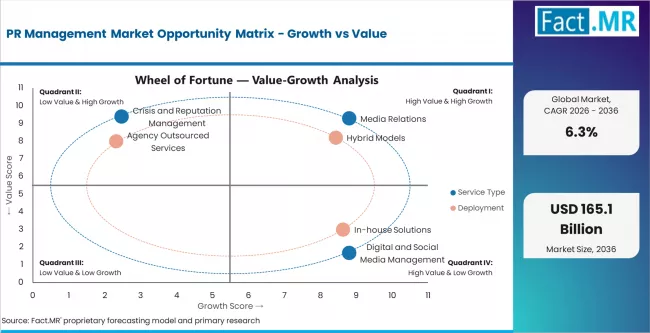
Public trust pressure is forcing communication leaders to treat PR as risk management rather than message distribution alone. Edelman’s 2025 Trust Barometer shows trust and grievance remain central business issues, which raises the need for credible communication planning. [1] News behavior is also changing as audiences move across platforms and fragmented information sources. The Reuters Institute’s Digital News Report 2025 notes weak engagement and trust challenges for traditional news media. [2] These conditions raise demand for media strategy, crisis preparation, and reputation analytics.

Measurement complexity remains the main restraint. PR outcomes are harder to connect with revenue than paid media results. Communication heads often need to explain why reputation, trust, and earned coverage deserve sustained spending. Privacy rules add another barrier because monitoring and targeting must respect user data requirements. The European Commission’s GDPR guidance keeps data protection central to digital communication activity. Providers that cannot explain compliant measurement may face slower adoption.

Opportunities in the PR Management Market

  • Trust Advisory: Enterprises need communication partners that can translate trust risk into leadership-ready action.
  • Crisis Simulation: Agencies can expand retainers by offering scenario planning and spokesperson preparation.
  • Privacy-Safe Analytics: Platform vendors can gain share by offering measurement tools with clear data controls.

Regional Analysis

Based on the regional analysis, the PR management market is segmented into North America, Latin America, Western Europe, Eastern Europe, East Asia, South Asia and Pacific, and Middle East and Africa across 40 plus countries.

Top Country Growth Comparison Pr Management Market Cagr (2026 2036)

Country CAGR (2026 to 2036)
China 8.5%
United States 5.8%
India 5.4%
UK 4.8%
Germany 4.6%
Japan 4.3%
Brazil 4.1%

Source: Fact.MR analysis, based on proprietary forecasting model and primary research
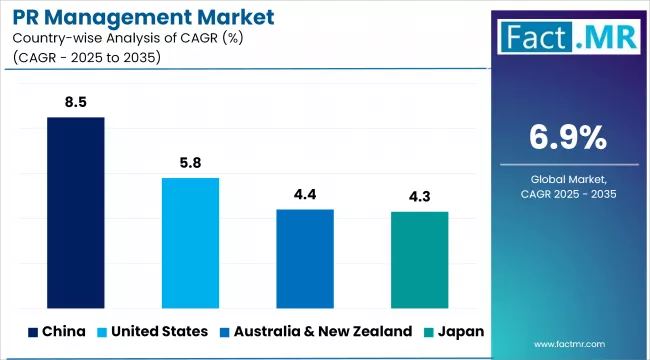
Pr Management Market Cagr Analysis By Country

East Asia PR Management Market Analysis

East Asia has a fast-moving communication environment where platform behavior changes reputation outcomes quickly. Brands need local media knowledge and digital response capability. Agencies in this region must understand public sentiment and platform governance. Corporate buyers seek support for consumer campaigns and cross-border reputation work. Media relations remain important, but social monitoring has become harder to separate from PR planning. Regional demand is strongest where consumer brands face high visibility and fast feedback cycles.

  • China: China is projected to record 8.5% CAGR from 2026 to 2036 as digital platforms increase the speed of reputation events. Brands need local response systems that understand platform norms and audience behavior. Social commerce and creator activity can amplify coverage and criticism. PR providers with platform-native content capability can gain stronger client retention. Slow response can allow negative narratives to spread before corrective messaging reaches the right audience.
  • Japan: Japan has a mature communication environment with strong emphasis on corporate governance and trusted media relationships. Established business media still carry high reputational weight. Corporate communication departments need bilingual messaging for investor relations and global brand visibility. Demand in Japan is forecast to grow at 4.3% CAGR through 2036. Agencies gain when they combine disciplined messaging with cross-border communication support. Weak message consistency can affect investor and stakeholder confidence.

North America PR Management Market Analysis
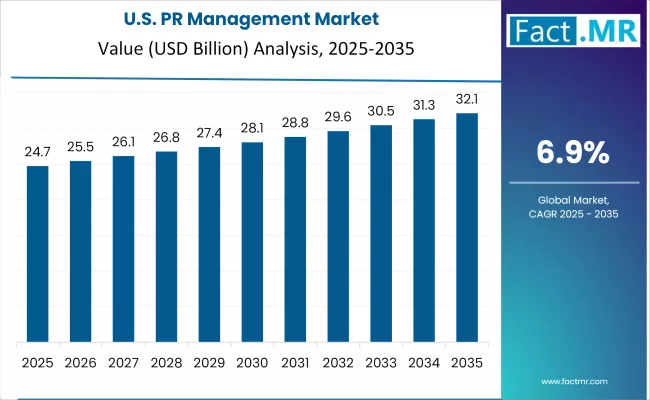
Pr Management Market Country Value Analysis

North America remains a large PR management base due to enterprise communication maturity and public company visibility. Corporate buyers invest in media relations, executive positioning, crisis preparation, and reputation analytics. Fact.MR analysis suggests that buyers in this region expect measurable outputs and leadership-ready reporting. Cision’s 2025 State of the Media Report highlights changing journalist expectations and the need for stronger PR-journalist partnerships. [4] These factors support continued demand for media relations and analytics-backed communication programs. Service providers compete through industry expertise and rapid response capacity.

  • United States: Corporate transparency and investor communication remain central to PR spending in the United States. Public companies face constant review from investors and media. Communication departments use monitoring tools and agency support to manage issue response. PR management demand in the United States is projected to expand at 5.8% CAGR by 2036. Providers with credible reporting and sector depth are better placed for enterprise accounts. Poor message control can raise reputation risk during public scrutiny.

South Asia and Pacific PR Management Market Analysis

South Asia and Pacific is becoming a more active PR management region as consumer brands, technology firms, and public-facing companies expand their digital presence. India is the main growth contributor because enterprises need reputation support across news media and social platforms. Fact.MR analysis suggests that PR buyers in this region value cost-effective agency support with strong local media reach. Digital monitoring is gaining importance as online conversations move quickly across languages and platforms. Regional growth depends on brand visibility, platform adoption, and corporate communication maturity.

  • India: India’s PR management demand is supported by fast-growing consumer brands, digital-first companies, and wider startup visibility. Companies need media relations and reputation support as online narratives move quickly across social platforms. PR management demand in India is projected to grow at 5.4% CAGR over the assessment period. Agencies with local-language media reach and digital listening capability can gain stronger client retention. Poor response planning can expose brands to fast-moving reputation issues.

Western Europe PR Management Market Analysis
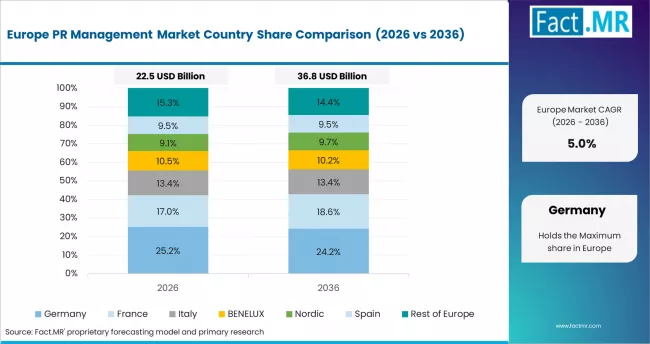
Pr Management Market Europe Country Market Share Analysis, 2026 & 2036

Western Europe places strong emphasis on privacy, public accountability, and stakeholder communication. Buyers require PR systems that can manage reputation without weakening data compliance. Fact.MR analysis indicates that privacy-first monitoring and public affairs support are central to regional demand. GDPR remains a defining rule for digital data handling in the region. [3] Corporate buyers want measurement, but they need it within clear data boundaries. Agencies compete through regulatory awareness and strong media relationships.

  • UK: The UK has a dense media environment and a strong base of corporate communication agencies. Public companies and financial institutions require investor messaging and crisis preparation. Service buyers place value on senior counsel and fast media handling. The UK is expected to expand at 4.8% CAGR through 2036. Growth remains supported by board-level attention to reputation risk and the need for credible public statements.
  • Germany: Germany’s PR management demand is tied to corporate accountability and industrial brand reputation. Buyers prefer careful messaging and documented communication processes. Privacy expectations shape digital monitoring practices. PR providers with public affairs depth and sector knowledge can hold stronger client relationships. Germany is projected to grow at 4.6% CAGR during 2026 to 2036 as enterprises keep communication work aligned with compliance and stakeholder trust.

Latin America PR Management Market Analysis

Latin America demand is supported by consumer-brand visibility, political sensitivity, and corporate reputation risk. Brazil leads the region because companies face active public debate across media and digital platforms. PR buyers remain cost-conscious, but they still need agencies that can manage crisis response and brand credibility. Regional agencies gain when they combine local media access with digital listening. Growth depends on enterprise communication spending and the need for faster response during public scrutiny.

  • Brazil: Brazil’s PR management demand is linked with consumer-facing industries, financial services, and public affairs activity. Brands need reputation support across traditional media and social platforms. Demand in Brazil is forecast to grow at 4.1% CAGR by 2036. Agencies with crisis communication skill and regional media relationships can improve client retention. Slow response can weaken brand credibility during public disputes.

Competitive Aligners for Market Players
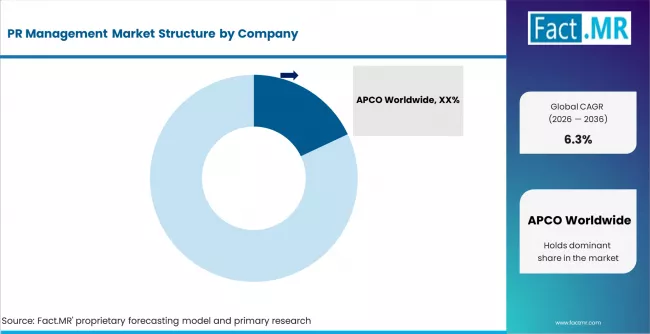
Pr Management Market Analysis By Company

The PR management market is moderately fragmented across global networks, independent agencies, specialist consultancies, and platform vendors. Large networks hold an advantage in cross-border mandates and enterprise accounts. Independent firms compete through senior counsel and sector specialization. Technology vendors gain where buyers want monitoring and measurement inside one workflow.

Competitive advantage depends on credibility, response speed, and reporting quality. Omnicom’s annual reports show its large communications and marketing services base, which supports its position in enterprise service work. [5] Publicis Groupe’s 2024 annual financial report highlights communication and digital transformation capabilities across its client model. [6] These large agency groups benefit when buyers seek integrated communication support.

Smaller agencies remain relevant because PR depends on relationships and judgment. They win where clients need senior attention or local market knowledge. Platform vendors compete where communication departments need listening, workflow, and analytics. Providers that combine human counsel with usable measurement are better placed as PR management moves closer to reputation governance.

Key Players in PR Management Market

  • APCO Worldwide
  • BlueFocus
  • Brunswick Group
  • Daniel J. Edelman Holdings Inc.
  • FINN Partners
  • FischerAppelt
  • FTI Consulting
  • Havas PR Global Collective
  • ICF International Inc.
  • Omnicom Group
  • Publicis Groupe
  • Real Chemistry
  • Sunny Side Up Inc.
  • Syneos Health

Bibliography

  • [1]. Edelman. (2025, January). 2025 Edelman Trust Barometer. Edelman.
  • [2]. Reuters Institute for the Study of Journalism. (2025, June 17). Digital News Report 2025. University of Oxford.
  • [3]. European Commission. (2025). Data protection under GDPR. European Commission.
  • [4]. Cision. (2025, May 7). Cision’s 2025 State of the Media Report reveals a tipping point for trust, technology and PR-journalist partnerships. Cision.
  • [5]. Omnicom Group Inc. (2025). 2024 annual report. Omnicom Group.
  • [6]. Publicis Groupe. (2025, May 27). 2024 annual financial report. Publicis Groupe.

This Report Addresses

  • Strategic intelligence on PR management demand across media relations, crisis communication, digital reputation, executive visibility, and stakeholder engagement globally.
  • Market forecast from USD 84.3 billion in 2026 to USD 155.3 billion by 2036 at a CAGR of 6.30%.
  • Growth opportunity mapping across China digital platform demand, United States enterprise reputation spending, and Japan corporate governance-linked communication needs.
  • Segment analysis by service type, deployment, end user, communication channel, and organization size.
  • Regional outlook covering East Asia platform-driven PR demand, North America enterprise communication maturity, and Western Europe privacy-focused monitoring.
  • Competitive analysis of APCO Worldwide, BlueFocus, Brunswick Group, Edelman, Omnicom Group, Publicis Groupe, and ICF International.
  • Service model assessment covering in-house solutions, agency outsourced services, and hybrid communication structures.
  • Report delivered through PDF, Excel datasets, and presentation formats, supported by primary interviews, communication budget analysis, agency activity checks, and platform adoption tracking.

PR Management Market Definition

The PR management market covers services, platforms, and advisory work used to manage public reputation, media relations, executive visibility, crisis response, stakeholder communication, and brand trust. The market is defined by its role in influencing earned reputation and external perception.

PR Management Market Inclusions

The scope includes media relations, digital and social media management, crisis and reputation management, influencer and content partnerships, corporate communications, executive communications, public affairs, investor communications, PR measurement, and analytics. Agency-led services, in-house solutions, hybrid models, and platform-enabled communication workflows are included when they support reputation management or earned communication outcomes.

PR Management Market Exclusions

The scope excludes pure advertising media buying, general creative production, unrelated marketing automation, internal HR communication tools, and social media posting tools without reputation tracking or PR workflow capability. Pure event management is excluded unless it is used for public positioning, executive visibility, crisis response, or stakeholder engagement. General consulting is excluded unless it directly supports PR management.

PR Management Market Research Methodology

  • Primary Research:Interviews with chief communication officers, media relations heads, public affairs directors, agency practice leads, and reputation analytics managers.
  • Desk Research:Review of agency disclosures, communication industry reports, trust studies, media usage studies, privacy rules, and company annual reports.
  • Market-Sizing and Forecasting:Forecasting uses enterprise communication budgets, agency service demand, platform adoption, end-user intensity, and regional digital media exposure.
  • Data Validation and Update Cycle:Forecasts are validated through buyer interviews, agency activity checks, enterprise communication spending signals, and media ecosystem indicators.

Scope of the Report

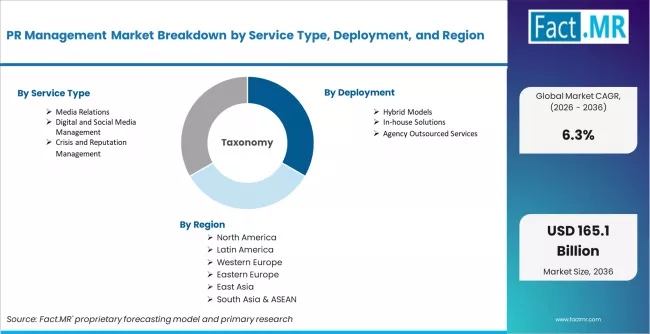
Pr Management Market Breakdown By Service Type, Deployment, And Region

Attribute Details
Quantitative Units USD 84.3 billion in 2026 to USD 155.3 billion by 2036, at a CAGR of 6.3%
Market Definition PR management services, platforms, and advisory support used for media relations, reputation management, crisis response, stakeholder communication, executive visibility, and communication analytics.
Service Type Media Relations, Digital and Social Media Management, Crisis and Reputation Management, Influencer and Content Partnerships, Corporate and Executive Communications, Measurement and Analytics, Events and Experiential Communications
Deployment In-house Solutions, Agency Outsourced Services, Hybrid Models
End User Corporate Enterprises, Small and Medium Enterprises, Public Sector and Government, Nonprofit Organizations, Financial Institutions
Communication Channel Earned Media, Social Media, Executive Communications, Investor Communications, Public Affairs
Organization Size Large Enterprises, Mid-sized Enterprises, Small Enterprises
Regions Covered North America, Latin America, Western Europe, Eastern Europe, East Asia, South Asia and Pacific, Middle East and Africa
Countries Covered United States, China, Japan, Germany, UK, and 40 plus countries
Key Companies Profiled APCO Worldwide, BlueFocus, Brunswick Group, Daniel J. Edelman Holdings Inc., FINN Partners, FischerAppelt, FTI Consulting, Havas PR Global Collective, ICF International Inc., Omnicom Group, Publicis Groupe, Real Chemistry, Sunny Side Up Inc., Syneos Health
Forecast Period 2026 to 2036
Approach Hybrid top-down and bottom-up model using enterprise communication spending, agency service demand, platform adoption, end-user intensity, and primary interviews with communication leaders.

PR Management Market Analysis by Segments

  • By Service Type:

    • Media Relations
    • Digital and Social Media Management
    • Crisis and Reputation Management
    • Influencer and Content Partnerships
    • Corporate and Executive Communications
    • Measurement and Analytics
    • Events and Experiential Communications
  • By Deployment:

    • In-house Solutions
    • Agency Outsourced Services
    • Hybrid Models
  • By End User:

    • Corporate Enterprises
    • Small and Medium Enterprises
    • Public Sector and Government
    • Nonprofit Organizations
    • Financial Institutions
  • By Communication Channel:

    • Earned Media
    • Social Media
    • Executive Communications
    • Investor Communications
    • Public Affairs
  • By Organization Size:

    • Large Enterprises
    • Mid-sized Enterprises
    • Small Enterprises
  • By Region:

    • North America
      • United States
      • Canada
    • Latin America
      • Brazil
      • Mexico
    • Western Europe
      • Germany
      • UK
      • France
      • Eastern Europe
      • Poland
      • Russia
      • East Asia
      • China
      • Japan
    • South Korea
      • South Asia and Pacific
      • India
      • ASEAN
      • Australia and New Zealand
    • Middle East and Africa
      • GCC
      • South Africa

- Frequently Asked Questions -

How large is the PR management market in 2025?

The PR management market was valued at USD 79.3 billion in 2025.

What is the expected value in 2026?

Demand is estimated to reach USD 84.3 billion in 2026.

What is the forecast value by 2036?

The market is forecast to reach USD 155.3 billion by 2036.

What CAGR is projected for 2026 to 2036?

Fact.MR projects a CAGR of 6.30% for the 2026 to 2036 forecast period.

Which service type leads demand?

Media relations lead with 20.0% share in 2026.

Which deployment model is expected to lead?

Hybrid models are projected to hold 42.0% share in 2026.

Which end user accounts for the highest share?

Corporate enterprises lead with 50.0% share in 2026.

Which communication channel leads the market?

Earned media is expected to lead with 34.0% share in 2026.

Which organization size leads demand?

Large enterprises are projected to hold 58.0% share in 2026.

Which country shows the fastest growth?

China is projected to grow at 8.5% CAGR through 2036.

Why are media relations still important?

Media relations remain important because earned coverage carries credibility during public scrutiny.

Why are hybrid models growing?

Hybrid models help enterprises keep internal control while using agencies for reach and specialist execution.

Why do corporate enterprises dominate demand?

Corporate enterprises face wider reputation risk across investors, media, employees, and customers.

What is the main restraint in this market?

Measurement complexity remains the main restraint because PR outcomes are harder to connect with revenue.

How does privacy regulation affect PR management?

Privacy rules affect monitoring and analytics by limiting how audience data can be collected and used.

Why is China growing faster?

China grows faster because platform-driven visibility creates frequent reputation events for brands.

What supports demand in the United States?

Enterprise reputation spending and investor communication needs support demand in the United States.

What supports demand in Japan?

Corporate governance and bilingual communication needs support steady demand in Japan.

What role does social media play?

Social media increases response speed needs and makes monitoring part of PR planning.

Why are analytics important in PR management?

Analytics help communication leaders explain earned coverage, sentiment, and response outcomes to leadership

What defines competition in this market?

Competition depends on media access, senior counsel, measurement quality, and crisis response capability.

Who are the leading companies?

Leading companies include APCO Worldwide, BlueFocus, Brunswick Group, Edelman, Omnicom Group, Publicis Groupe, and ICF International.

Table of Content

  1. Executive Summary
    • Global Market Outlook
    • Demand to side Trends
    • Supply to side Trends
    • Technology Roadmap Analysis
    • Analysis and Recommendations
  2. Market Overview
    • Market Coverage / Taxonomy
    • Market Definition / Scope / Limitations
  3. Research Methodology
    • Chapter Orientation
    • Analytical Lens and Working Hypotheses
      • Market Structure, Signals, and Trend Drivers
      • Benchmarking and Cross-market Comparability
      • Market Sizing, Forecasting, and Opportunity Mapping
    • Research Design and Evidence Framework
      • Desk Research Programme (Secondary Evidence)
        • Company Annual and Sustainability Reports
        • Peer-reviewed Journals and Academic Literature
        • Corporate Websites, Product Literature, and Technical Notes
        • Earnings Decks and Investor Briefings
        • Statutory Filings and Regulatory Disclosures
        • Technical White Papers and Standards Notes
        • Trade Journals, Industry Magazines, and Analyst Briefs
        • Conference Proceedings, Webinars, and Seminar Materials
        • Government Statistics Portals and Public Data Releases
        • Press Releases and Reputable Media Coverage
        • Specialist Newsletters and Curated Briefings
        • Sector Databases and Reference Repositories
        • Fact.MR Internal Proprietary Databases and Historical Market Datasets
        • Subscription Datasets and Paid Sources
        • Social Channels, Communities, and Digital Listening Inputs
        • Additional Desk Sources
      • Expert Input and Fieldwork (Primary Evidence)
        • Primary Modes
          • Qualitative Interviews and Expert Elicitation
          • Quantitative Surveys and Structured Data Capture
          • Blended Approach
        • Why Primary Evidence is Used
        • Field Techniques
          • Interviews
          • Surveys
          • Focus Groups
          • Observational and In-context Research
          • Social and Community Interactions
        • Stakeholder Universe Engaged
          • C-suite Leaders
          • Board Members
          • Presidents and Vice Presidents
          • R&D and Innovation Heads
          • Technical Specialists
          • Domain Subject-matter Experts
          • Scientists
          • Physicians and Other Healthcare Professionals
        • Governance, Ethics, and Data Stewardship
          • Research Ethics
          • Data Integrity and Handling
      • Tooling, Models, and Reference Databases
    • Data Engineering and Model Build
      • Data Acquisition and Ingestion
      • Cleaning, Normalisation, and Verification
      • Synthesis, Triangulation, and Analysis
    • Quality Assurance and Audit Trail
  4. Market Background
    • Market Dynamics
      • Drivers
      • Restraints
      • Opportunity
      • Trends
    • Scenario Forecast
      • Demand in Optimistic Scenario
      • Demand in Likely Scenario
      • Demand in Conservative Scenario
    • Opportunity Map Analysis
    • Product Life Cycle Analysis
    • Supply Chain Analysis
    • Investment Feasibility Matrix
    • Value Chain Analysis
    • PESTLE and Porter’s Analysis
    • Regulatory Landscape
    • Regional Parent Market Outlook
    • Production and Consumption Statistics
    • Import and Export Statistics
  5. Global Market Analysis 2021 to 2025 and Forecast, 2026 to 2036
    • Historical Market Size Value (USD Million) Analysis, 2021 to 2025
    • Current and Future Market Size Value (USD Million) Projections, 2026 to 2036
      • Y to o to Y Growth Trend Analysis
      • Absolute $ Opportunity Analysis
  6. Global Market Pricing Analysis 2021 to 2025 and Forecast 2026 to 2036
  7. Global Market Analysis 2021 to 2025 and Forecast 2026 to 2036, By Packaging Type
    • Introduction / Key Findings
    • Historical Market Size Value (USD Million) Analysis By Packaging Type , 2021 to 2025
    • Current and Future Market Size Value (USD Million) Analysis and Forecast By Packaging Type , 2026 to 2036
      • Corrugated Boxes
      • Liquid Packaging Cartons
      • Paper Bags & Sacks
      • Folding Boxes & Cases
      • Others
    • Y to o to Y Growth Trend Analysis By Packaging Type , 2021 to 2025
    • Absolute $ Opportunity Analysis By Packaging Type , 2026 to 2036
  8. Global Market Analysis 2021 to 2025 and Forecast 2026 to 2036, By Material
    • Introduction / Key Findings
    • Historical Market Size Value (USD Million) Analysis By Material, 2021 to 2025
    • Current and Future Market Size Value (USD Million) Analysis and Forecast By Material, 2026 to 2036
      • Corrugated Board
      • Kraft Paper
      • Molded Pulp
      • Specialty Paper
      • Others
    • Y to o to Y Growth Trend Analysis By Material, 2021 to 2025
    • Absolute $ Opportunity Analysis By Material, 2026 to 2036
  9. Global Market Analysis 2021 to 2025 and Forecast 2026 to 2036, By End User
    • Introduction / Key Findings
    • Historical Market Size Value (USD Million) Analysis By End User, 2021 to 2025
    • Current and Future Market Size Value (USD Million) Analysis and Forecast By End User, 2026 to 2036
      • Food & Beverages
      • Healthcare
      • Industrial
      • Others
    • Y to o to Y Growth Trend Analysis By End User, 2021 to 2025
    • Absolute $ Opportunity Analysis By End User, 2026 to 2036
  10. Global Market Analysis 2021 to 2025 and Forecast 2026 to 2036, By Printing Technology
    • Introduction / Key Findings
    • Historical Market Size Value (USD Million) Analysis By Printing Technology, 2021 to 2025
    • Current and Future Market Size Value (USD Million) Analysis and Forecast By Printing Technology, 2026 to 2036
      • Flexographic Printing
      • Digital Printing
      • Offset Printing
      • Gravure Printing
    • Y to o to Y Growth Trend Analysis By Printing Technology, 2021 to 2025
    • Absolute $ Opportunity Analysis By Printing Technology, 2026 to 2036
  11. Global Market Analysis 2021 to 2025 and Forecast 2026 to 2036, By Distribution Channel
    • Introduction / Key Findings
    • Historical Market Size Value (USD Million) Analysis By Distribution Channel, 2021 to 2025
    • Current and Future Market Size Value (USD Million) Analysis and Forecast By Distribution Channel, 2026 to 2036
      • B2B (Direct Supply to Manufacturers)
      • Retail/Converters
      • E-commerce Supply
    • Y to o to Y Growth Trend Analysis By Distribution Channel, 2021 to 2025
    • Absolute $ Opportunity Analysis By Distribution Channel, 2026 to 2036
  12. Global Market Analysis 2021 to 2025 and Forecast 2026 to 2036, By Region
    • Introduction
    • Historical Market Size Value (USD Million) Analysis By Region, 2021 to 2025
    • Current Market Size Value (USD Million) Analysis and Forecast By Region, 2026 to 2036
      • North America
      • Latin America
      • Western Europe
      • Eastern Europe
      • East Asia
      • South Asia and Pacific
      • Middle East & Africa
    • Market Attractiveness Analysis By Region
  13. North America Market Analysis 2021 to 2025 and Forecast 2026 to 2036, By Country
    • Historical Market Size Value (USD Million) Trend Analysis By Market Taxonomy, 2021 to 2025
    • Market Size Value (USD Million) Forecast By Market Taxonomy, 2026 to 2036
      • By Country
        • USA
        • Canada
        • Mexico
      • By Packaging Type
      • By Material
      • By End User
      • By Printing Technology
      • By Distribution Channel
    • Market Attractiveness Analysis
      • By Country
      • By Packaging Type
      • By Material
      • By End User
      • By Printing Technology
      • By Distribution Channel
    • Key Takeaways
  14. Latin America Market Analysis 2021 to 2025 and Forecast 2026 to 2036, By Country
    • Historical Market Size Value (USD Million) Trend Analysis By Market Taxonomy, 2021 to 2025
    • Market Size Value (USD Million) Forecast By Market Taxonomy, 2026 to 2036
      • By Country
        • Brazil
        • Chile
        • Rest of Latin America
      • By Packaging Type
      • By Material
      • By End User
      • By Printing Technology
      • By Distribution Channel
    • Market Attractiveness Analysis
      • By Country
      • By Packaging Type
      • By Material
      • By End User
      • By Printing Technology
      • By Distribution Channel
    • Key Takeaways
  15. Western Europe Market Analysis 2021 to 2025 and Forecast 2026 to 2036, By Country
    • Historical Market Size Value (USD Million) Trend Analysis By Market Taxonomy, 2021 to 2025
    • Market Size Value (USD Million) Forecast By Market Taxonomy, 2026 to 2036
      • By Country
        • Germany
        • UK
        • Italy
        • Spain
        • France
        • Nordic
        • BENELUX
        • Rest of Western Europe
      • By Packaging Type
      • By Material
      • By End User
      • By Printing Technology
      • By Distribution Channel
    • Market Attractiveness Analysis
      • By Country
      • By Packaging Type
      • By Material
      • By End User
      • By Printing Technology
      • By Distribution Channel
    • Key Takeaways
  16. Eastern Europe Market Analysis 2021 to 2025 and Forecast 2026 to 2036, By Country
    • Historical Market Size Value (USD Million) Trend Analysis By Market Taxonomy, 2021 to 2025
    • Market Size Value (USD Million) Forecast By Market Taxonomy, 2026 to 2036
      • By Country
        • Russia
        • Poland
        • Hungary
        • Balkan & Baltic
        • Rest of Eastern Europe
      • By Packaging Type
      • By Material
      • By End User
      • By Printing Technology
      • By Distribution Channel
    • Market Attractiveness Analysis
      • By Country
      • By Packaging Type
      • By Material
      • By End User
      • By Printing Technology
      • By Distribution Channel
    • Key Takeaways
  17. East Asia Market Analysis 2021 to 2025 and Forecast 2026 to 2036, By Country
    • Historical Market Size Value (USD Million) Trend Analysis By Market Taxonomy, 2021 to 2025
    • Market Size Value (USD Million) Forecast By Market Taxonomy, 2026 to 2036
      • By Country
        • China
        • Japan
        • South Korea
      • By Packaging Type
      • By Material
      • By End User
      • By Printing Technology
      • By Distribution Channel
    • Market Attractiveness Analysis
      • By Country
      • By Packaging Type
      • By Material
      • By End User
      • By Printing Technology
      • By Distribution Channel
    • Key Takeaways
  18. South Asia and Pacific Market Analysis 2021 to 2025 and Forecast 2026 to 2036, By Country
    • Historical Market Size Value (USD Million) Trend Analysis By Market Taxonomy, 2021 to 2025
    • Market Size Value (USD Million) Forecast By Market Taxonomy, 2026 to 2036
      • By Country
        • India
        • ASEAN
        • Australia & New Zealand
        • Rest of South Asia and Pacific
      • By Packaging Type
      • By Material
      • By End User
      • By Printing Technology
      • By Distribution Channel
    • Market Attractiveness Analysis
      • By Country
      • By Packaging Type
      • By Material
      • By End User
      • By Printing Technology
      • By Distribution Channel
    • Key Takeaways
  19. Middle East & Africa Market Analysis 2021 to 2025 and Forecast 2026 to 2036, By Country
    • Historical Market Size Value (USD Million) Trend Analysis By Market Taxonomy, 2021 to 2025
    • Market Size Value (USD Million) Forecast By Market Taxonomy, 2026 to 2036
      • By Country
        • Kingdom of Saudi Arabia
        • Other GCC Countries
        • Turkiye
        • South Africa
        • Other African Union
        • Rest of Middle East & Africa
      • By Packaging Type
      • By Material
      • By End User
      • By Printing Technology
      • By Distribution Channel
    • Market Attractiveness Analysis
      • By Country
      • By Packaging Type
      • By Material
      • By End User
      • By Printing Technology
      • By Distribution Channel
    • Key Takeaways
  20. Key Countries Market Analysis
    • USA
      • Pricing Analysis
      • Market Share Analysis, 2025
        • By Packaging Type
        • By Material
        • By End User
        • By Printing Technology
        • By Distribution Channel
    • Canada
      • Pricing Analysis
      • Market Share Analysis, 2025
        • By Packaging Type
        • By Material
        • By End User
        • By Printing Technology
        • By Distribution Channel
    • Mexico
      • Pricing Analysis
      • Market Share Analysis, 2025
        • By Packaging Type
        • By Material
        • By End User
        • By Printing Technology
        • By Distribution Channel
    • Brazil
      • Pricing Analysis
      • Market Share Analysis, 2025
        • By Packaging Type
        • By Material
        • By End User
        • By Printing Technology
        • By Distribution Channel
    • Chile
      • Pricing Analysis
      • Market Share Analysis, 2025
        • By Packaging Type
        • By Material
        • By End User
        • By Printing Technology
        • By Distribution Channel
    • Germany
      • Pricing Analysis
      • Market Share Analysis, 2025
        • By Packaging Type
        • By Material
        • By End User
        • By Printing Technology
        • By Distribution Channel
    • UK
      • Pricing Analysis
      • Market Share Analysis, 2025
        • By Packaging Type
        • By Material
        • By End User
        • By Printing Technology
        • By Distribution Channel
    • Italy
      • Pricing Analysis
      • Market Share Analysis, 2025
        • By Packaging Type
        • By Material
        • By End User
        • By Printing Technology
        • By Distribution Channel
    • Spain
      • Pricing Analysis
      • Market Share Analysis, 2025
        • By Packaging Type
        • By Material
        • By End User
        • By Printing Technology
        • By Distribution Channel
    • France
      • Pricing Analysis
      • Market Share Analysis, 2025
        • By Packaging Type
        • By Material
        • By End User
        • By Printing Technology
        • By Distribution Channel
    • India
      • Pricing Analysis
      • Market Share Analysis, 2025
        • By Packaging Type
        • By Material
        • By End User
        • By Printing Technology
        • By Distribution Channel
    • ASEAN
      • Pricing Analysis
      • Market Share Analysis, 2025
        • By Packaging Type
        • By Material
        • By End User
        • By Printing Technology
        • By Distribution Channel
    • Australia & New Zealand
      • Pricing Analysis
      • Market Share Analysis, 2025
        • By Packaging Type
        • By Material
        • By End User
        • By Printing Technology
        • By Distribution Channel
    • China
      • Pricing Analysis
      • Market Share Analysis, 2025
        • By Packaging Type
        • By Material
        • By End User
        • By Printing Technology
        • By Distribution Channel
    • Japan
      • Pricing Analysis
      • Market Share Analysis, 2025
        • By Packaging Type
        • By Material
        • By End User
        • By Printing Technology
        • By Distribution Channel
    • South Korea
      • Pricing Analysis
      • Market Share Analysis, 2025
        • By Packaging Type
        • By Material
        • By End User
        • By Printing Technology
        • By Distribution Channel
    • Russia
      • Pricing Analysis
      • Market Share Analysis, 2025
        • By Packaging Type
        • By Material
        • By End User
        • By Printing Technology
        • By Distribution Channel
    • Poland
      • Pricing Analysis
      • Market Share Analysis, 2025
        • By Packaging Type
        • By Material
        • By End User
        • By Printing Technology
        • By Distribution Channel
    • Hungary
      • Pricing Analysis
      • Market Share Analysis, 2025
        • By Packaging Type
        • By Material
        • By End User
        • By Printing Technology
        • By Distribution Channel
    • Kingdom of Saudi Arabia
      • Pricing Analysis
      • Market Share Analysis, 2025
        • By Packaging Type
        • By Material
        • By End User
        • By Printing Technology
        • By Distribution Channel
    • Turkiye
      • Pricing Analysis
      • Market Share Analysis, 2025
        • By Packaging Type
        • By Material
        • By End User
        • By Printing Technology
        • By Distribution Channel
    • South Africa
      • Pricing Analysis
      • Market Share Analysis, 2025
        • By Packaging Type
        • By Material
        • By End User
        • By Printing Technology
        • By Distribution Channel
  21. Market Structure Analysis
    • Competition Dashboard
    • Competition Benchmarking
    • Market Share Analysis of Top Players
      • By Regional
      • By Packaging Type
      • By Material
      • By End User
      • By Printing Technology
      • By Distribution Channel
  22. Competition Analysis
    • Competition Deep Dive
      • International Paper
        • Overview
        • Product Portfolio
        • Profitability by Market Segments (Product/Age /Sales Channel/Region)
        • Sales Footprint
        • Strategy Overview
          • Marketing Strategy
          • Product Strategy
          • Channel Strategy
      • Smurfit Kappa Group
      • WestRock
      • Mondi Group
      • DS Smith
      • Stora Enso
      • Oji Holdings
      • Nippon Paper Industries
      • Packaging Corporation of America
  23. Assumptions & Acronyms Used

List Of Table

  • Table 1: Global Market Value (USD Million) Forecast by Region, 2021 to 2036
  • Table 2: Global Market Value (USD Million) Forecast by Packaging Type, 2021 to 2036
  • Table 3: Global Market Value (USD Million) Forecast by Material, 2021 to 2036
  • Table 4: Global Market Value (USD Million) Forecast by End User, 2021 to 2036
  • Table 5: Global Market Value (USD Million) Forecast by Printing Technology, 2021 to 2036
  • Table 6: Global Market Value (USD Million) Forecast by Distribution Channel, 2021 to 2036
  • Table 7: North America Market Value (USD Million) Forecast by Country, 2021 to 2036
  • Table 8: North America Market Value (USD Million) Forecast by Packaging Type, 2021 to 2036
  • Table 9: North America Market Value (USD Million) Forecast by Material, 2021 to 2036
  • Table 10: North America Market Value (USD Million) Forecast by End User, 2021 to 2036
  • Table 11: North America Market Value (USD Million) Forecast by Printing Technology, 2021 to 2036
  • Table 12: North America Market Value (USD Million) Forecast by Distribution Channel, 2021 to 2036
  • Table 13: Latin America Market Value (USD Million) Forecast by Country, 2021 to 2036
  • Table 14: Latin America Market Value (USD Million) Forecast by Packaging Type, 2021 to 2036
  • Table 15: Latin America Market Value (USD Million) Forecast by Material, 2021 to 2036
  • Table 16: Latin America Market Value (USD Million) Forecast by End User, 2021 to 2036
  • Table 17: Latin America Market Value (USD Million) Forecast by Printing Technology, 2021 to 2036
  • Table 18: Latin America Market Value (USD Million) Forecast by Distribution Channel, 2021 to 2036
  • Table 19: Western Europe Market Value (USD Million) Forecast by Country, 2021 to 2036
  • Table 20: Western Europe Market Value (USD Million) Forecast by Packaging Type, 2021 to 2036
  • Table 21: Western Europe Market Value (USD Million) Forecast by Material, 2021 to 2036
  • Table 22: Western Europe Market Value (USD Million) Forecast by End User, 2021 to 2036
  • Table 23: Western Europe Market Value (USD Million) Forecast by Printing Technology, 2021 to 2036
  • Table 24: Western Europe Market Value (USD Million) Forecast by Distribution Channel, 2021 to 2036
  • Table 25: Eastern Europe Market Value (USD Million) Forecast by Country, 2021 to 2036
  • Table 26: Eastern Europe Market Value (USD Million) Forecast by Packaging Type, 2021 to 2036
  • Table 27: Eastern Europe Market Value (USD Million) Forecast by Material, 2021 to 2036
  • Table 28: Eastern Europe Market Value (USD Million) Forecast by End User, 2021 to 2036
  • Table 29: Eastern Europe Market Value (USD Million) Forecast by Printing Technology, 2021 to 2036
  • Table 30: Eastern Europe Market Value (USD Million) Forecast by Distribution Channel, 2021 to 2036
  • Table 31: East Asia Market Value (USD Million) Forecast by Country, 2021 to 2036
  • Table 32: East Asia Market Value (USD Million) Forecast by Packaging Type, 2021 to 2036
  • Table 33: East Asia Market Value (USD Million) Forecast by Material, 2021 to 2036
  • Table 34: East Asia Market Value (USD Million) Forecast by End User, 2021 to 2036
  • Table 35: East Asia Market Value (USD Million) Forecast by Printing Technology, 2021 to 2036
  • Table 36: East Asia Market Value (USD Million) Forecast by Distribution Channel, 2021 to 2036
  • Table 37: South Asia and Pacific Market Value (USD Million) Forecast by Country, 2021 to 2036
  • Table 38: South Asia and Pacific Market Value (USD Million) Forecast by Packaging Type, 2021 to 2036
  • Table 39: South Asia and Pacific Market Value (USD Million) Forecast by Material, 2021 to 2036
  • Table 40: South Asia and Pacific Market Value (USD Million) Forecast by End User, 2021 to 2036
  • Table 41: South Asia and Pacific Market Value (USD Million) Forecast by Printing Technology, 2021 to 2036
  • Table 42: South Asia and Pacific Market Value (USD Million) Forecast by Distribution Channel, 2021 to 2036
  • Table 43: Middle East & Africa Market Value (USD Million) Forecast by Country, 2021 to 2036
  • Table 44: Middle East & Africa Market Value (USD Million) Forecast by Packaging Type, 2021 to 2036
  • Table 45: Middle East & Africa Market Value (USD Million) Forecast by Material, 2021 to 2036
  • Table 46: Middle East & Africa Market Value (USD Million) Forecast by End User, 2021 to 2036
  • Table 47: Middle East & Africa Market Value (USD Million) Forecast by Printing Technology, 2021 to 2036
  • Table 48: Middle East & Africa Market Value (USD Million) Forecast by Distribution Channel, 2021 to 2036

List Of Figures

  • Figure 1: Global Market Pricing Analysis
  • Figure 2: Global Market Value (USD Million) Forecast 2021-2036
  • Figure 3: Global Market Value Share and BPS Analysis by Packaging Type, 2026 and 2036
  • Figure 4: Global Market Y-o-Y Growth Comparison by Packaging Type, 2026 to 2036
  • Figure 5: Global Market Attractiveness Analysis by Packaging Type
  • Figure 6: Global Market Value Share and BPS Analysis by Material, 2026 and 2036
  • Figure 7: Global Market Y-o-Y Growth Comparison by Material, 2026 to 2036
  • Figure 8: Global Market Attractiveness Analysis by Material
  • Figure 9: Global Market Value Share and BPS Analysis by End User, 2026 and 2036
  • Figure 10: Global Market Y-o-Y Growth Comparison by End User, 2026 to 2036
  • Figure 11: Global Market Attractiveness Analysis by End User
  • Figure 12: Global Market Value Share and BPS Analysis by Printing Technology, 2026 and 2036
  • Figure 13: Global Market Y-o-Y Growth Comparison by Printing Technology, 2026 to 2036
  • Figure 14: Global Market Attractiveness Analysis by Printing Technology
  • Figure 15: Global Market Value Share and BPS Analysis by Distribution Channel, 2026 and 2036
  • Figure 16: Global Market Y-o-Y Growth Comparison by Distribution Channel, 2026 to 2036
  • Figure 17: Global Market Attractiveness Analysis by Distribution Channel
  • Figure 18: Global Market Value (USD Million) Share and BPS Analysis by Region, 2026 and 2036
  • Figure 19: Global Market Y-o-Y Growth Comparison by Region, 2026 to 2036
  • Figure 20: Global Market Attractiveness Analysis by Region
  • Figure 21: North America Market Incremental Dollar Opportunity, 2026 to 2036
  • Figure 22: Latin America Market Incremental Dollar Opportunity, 2026 to 2036
  • Figure 23: Western Europe Market Incremental Dollar Opportunity, 2026 to 2036
  • Figure 24: Eastern Europe Market Incremental Dollar Opportunity, 2026 to 2036
  • Figure 25: East Asia Market Incremental Dollar Opportunity, 2026 to 2036
  • Figure 26: South Asia and Pacific Market Incremental Dollar Opportunity, 2026 to 2036
  • Figure 27: Middle East & Africa Market Incremental Dollar Opportunity, 2026 to 2036
  • Figure 28: North America Market Value Share and BPS Analysis by Country, 2026 and 2036
  • Figure 29: North America Market Value Share and BPS Analysis by Packaging Type, 2026 and 2036
  • Figure 30: North America Market Y-o-Y Growth Comparison by Packaging Type, 2026 to 2036
  • Figure 31: North America Market Attractiveness Analysis by Packaging Type
  • Figure 32: North America Market Value Share and BPS Analysis by Material, 2026 and 2036
  • Figure 33: North America Market Y-o-Y Growth Comparison by Material, 2026 to 2036
  • Figure 34: North America Market Attractiveness Analysis by Material
  • Figure 35: North America Market Value Share and BPS Analysis by End User, 2026 and 2036
  • Figure 36: North America Market Y-o-Y Growth Comparison by End User, 2026 to 2036
  • Figure 37: North America Market Attractiveness Analysis by End User
  • Figure 38: North America Market Value Share and BPS Analysis by Printing Technology, 2026 and 2036
  • Figure 39: North America Market Y-o-Y Growth Comparison by Printing Technology, 2026 to 2036
  • Figure 40: North America Market Attractiveness Analysis by Printing Technology
  • Figure 41: North America Market Value Share and BPS Analysis by Distribution Channel, 2026 and 2036
  • Figure 42: North America Market Y-o-Y Growth Comparison by Distribution Channel, 2026 to 2036
  • Figure 43: North America Market Attractiveness Analysis by Distribution Channel
  • Figure 44: Latin America Market Value Share and BPS Analysis by Country, 2026 and 2036
  • Figure 45: Latin America Market Value Share and BPS Analysis by Packaging Type, 2026 and 2036
  • Figure 46: Latin America Market Y-o-Y Growth Comparison by Packaging Type, 2026 to 2036
  • Figure 47: Latin America Market Attractiveness Analysis by Packaging Type
  • Figure 48: Latin America Market Value Share and BPS Analysis by Material, 2026 and 2036
  • Figure 49: Latin America Market Y-o-Y Growth Comparison by Material, 2026 to 2036
  • Figure 50: Latin America Market Attractiveness Analysis by Material
  • Figure 51: Latin America Market Value Share and BPS Analysis by End User, 2026 and 2036
  • Figure 52: Latin America Market Y-o-Y Growth Comparison by End User, 2026 to 2036
  • Figure 53: Latin America Market Attractiveness Analysis by End User
  • Figure 54: Latin America Market Value Share and BPS Analysis by Printing Technology, 2026 and 2036
  • Figure 55: Latin America Market Y-o-Y Growth Comparison by Printing Technology, 2026 to 2036
  • Figure 56: Latin America Market Attractiveness Analysis by Printing Technology
  • Figure 57: Latin America Market Value Share and BPS Analysis by Distribution Channel, 2026 and 2036
  • Figure 58: Latin America Market Y-o-Y Growth Comparison by Distribution Channel, 2026 to 2036
  • Figure 59: Latin America Market Attractiveness Analysis by Distribution Channel
  • Figure 60: Western Europe Market Value Share and BPS Analysis by Country, 2026 and 2036
  • Figure 61: Western Europe Market Value Share and BPS Analysis by Packaging Type, 2026 and 2036
  • Figure 62: Western Europe Market Y-o-Y Growth Comparison by Packaging Type, 2026 to 2036
  • Figure 63: Western Europe Market Attractiveness Analysis by Packaging Type
  • Figure 64: Western Europe Market Value Share and BPS Analysis by Material, 2026 and 2036
  • Figure 65: Western Europe Market Y-o-Y Growth Comparison by Material, 2026 to 2036
  • Figure 66: Western Europe Market Attractiveness Analysis by Material
  • Figure 67: Western Europe Market Value Share and BPS Analysis by End User, 2026 and 2036
  • Figure 68: Western Europe Market Y-o-Y Growth Comparison by End User, 2026 to 2036
  • Figure 69: Western Europe Market Attractiveness Analysis by End User
  • Figure 70: Western Europe Market Value Share and BPS Analysis by Printing Technology, 2026 and 2036
  • Figure 71: Western Europe Market Y-o-Y Growth Comparison by Printing Technology, 2026 to 2036
  • Figure 72: Western Europe Market Attractiveness Analysis by Printing Technology
  • Figure 73: Western Europe Market Value Share and BPS Analysis by Distribution Channel, 2026 and 2036
  • Figure 74: Western Europe Market Y-o-Y Growth Comparison by Distribution Channel, 2026 to 2036
  • Figure 75: Western Europe Market Attractiveness Analysis by Distribution Channel
  • Figure 76: Eastern Europe Market Value Share and BPS Analysis by Country, 2026 and 2036
  • Figure 77: Eastern Europe Market Value Share and BPS Analysis by Packaging Type, 2026 and 2036
  • Figure 78: Eastern Europe Market Y-o-Y Growth Comparison by Packaging Type, 2026 to 2036
  • Figure 79: Eastern Europe Market Attractiveness Analysis by Packaging Type
  • Figure 80: Eastern Europe Market Value Share and BPS Analysis by Material, 2026 and 2036
  • Figure 81: Eastern Europe Market Y-o-Y Growth Comparison by Material, 2026 to 2036
  • Figure 82: Eastern Europe Market Attractiveness Analysis by Material
  • Figure 83: Eastern Europe Market Value Share and BPS Analysis by End User, 2026 and 2036
  • Figure 84: Eastern Europe Market Y-o-Y Growth Comparison by End User, 2026 to 2036
  • Figure 85: Eastern Europe Market Attractiveness Analysis by End User
  • Figure 86: Eastern Europe Market Value Share and BPS Analysis by Printing Technology, 2026 and 2036
  • Figure 87: Eastern Europe Market Y-o-Y Growth Comparison by Printing Technology, 2026 to 2036
  • Figure 88: Eastern Europe Market Attractiveness Analysis by Printing Technology
  • Figure 89: Eastern Europe Market Value Share and BPS Analysis by Distribution Channel, 2026 and 2036
  • Figure 90: Eastern Europe Market Y-o-Y Growth Comparison by Distribution Channel, 2026 to 2036
  • Figure 91: Eastern Europe Market Attractiveness Analysis by Distribution Channel
  • Figure 92: East Asia Market Value Share and BPS Analysis by Country, 2026 and 2036
  • Figure 93: East Asia Market Value Share and BPS Analysis by Packaging Type, 2026 and 2036
  • Figure 94: East Asia Market Y-o-Y Growth Comparison by Packaging Type, 2026 to 2036
  • Figure 95: East Asia Market Attractiveness Analysis by Packaging Type
  • Figure 96: East Asia Market Value Share and BPS Analysis by Material, 2026 and 2036
  • Figure 97: East Asia Market Y-o-Y Growth Comparison by Material, 2026 to 2036
  • Figure 98: East Asia Market Attractiveness Analysis by Material
  • Figure 99: East Asia Market Value Share and BPS Analysis by End User, 2026 and 2036
  • Figure 100: East Asia Market Y-o-Y Growth Comparison by End User, 2026 to 2036
  • Figure 101: East Asia Market Attractiveness Analysis by End User
  • Figure 102: East Asia Market Value Share and BPS Analysis by Printing Technology, 2026 and 2036
  • Figure 103: East Asia Market Y-o-Y Growth Comparison by Printing Technology, 2026 to 2036
  • Figure 104: East Asia Market Attractiveness Analysis by Printing Technology
  • Figure 105: East Asia Market Value Share and BPS Analysis by Distribution Channel, 2026 and 2036
  • Figure 106: East Asia Market Y-o-Y Growth Comparison by Distribution Channel, 2026 to 2036
  • Figure 107: East Asia Market Attractiveness Analysis by Distribution Channel
  • Figure 108: South Asia and Pacific Market Value Share and BPS Analysis by Country, 2026 and 2036
  • Figure 109: South Asia and Pacific Market Value Share and BPS Analysis by Packaging Type, 2026 and 2036
  • Figure 110: South Asia and Pacific Market Y-o-Y Growth Comparison by Packaging Type, 2026 to 2036
  • Figure 111: South Asia and Pacific Market Attractiveness Analysis by Packaging Type
  • Figure 112: South Asia and Pacific Market Value Share and BPS Analysis by Material, 2026 and 2036
  • Figure 113: South Asia and Pacific Market Y-o-Y Growth Comparison by Material, 2026 to 2036
  • Figure 114: South Asia and Pacific Market Attractiveness Analysis by Material
  • Figure 115: South Asia and Pacific Market Value Share and BPS Analysis by End User, 2026 and 2036
  • Figure 116: South Asia and Pacific Market Y-o-Y Growth Comparison by End User, 2026 to 2036
  • Figure 117: South Asia and Pacific Market Attractiveness Analysis by End User
  • Figure 118: South Asia and Pacific Market Value Share and BPS Analysis by Printing Technology, 2026 and 2036
  • Figure 119: South Asia and Pacific Market Y-o-Y Growth Comparison by Printing Technology, 2026 to 2036
  • Figure 120: South Asia and Pacific Market Attractiveness Analysis by Printing Technology
  • Figure 121: South Asia and Pacific Market Value Share and BPS Analysis by Distribution Channel, 2026 and 2036
  • Figure 122: South Asia and Pacific Market Y-o-Y Growth Comparison by Distribution Channel, 2026 to 2036
  • Figure 123: South Asia and Pacific Market Attractiveness Analysis by Distribution Channel
  • Figure 124: Middle East & Africa Market Value Share and BPS Analysis by Country, 2026 and 2036
  • Figure 125: Middle East & Africa Market Value Share and BPS Analysis by Packaging Type, 2026 and 2036
  • Figure 126: Middle East & Africa Market Y-o-Y Growth Comparison by Packaging Type, 2026 to 2036
  • Figure 127: Middle East & Africa Market Attractiveness Analysis by Packaging Type
  • Figure 128: Middle East & Africa Market Value Share and BPS Analysis by Material, 2026 and 2036
  • Figure 129: Middle East & Africa Market Y-o-Y Growth Comparison by Material, 2026 to 2036
  • Figure 130: Middle East & Africa Market Attractiveness Analysis by Material
  • Figure 131: Middle East & Africa Market Value Share and BPS Analysis by End User, 2026 and 2036
  • Figure 132: Middle East & Africa Market Y-o-Y Growth Comparison by End User, 2026 to 2036
  • Figure 133: Middle East & Africa Market Attractiveness Analysis by End User
  • Figure 134: Middle East & Africa Market Value Share and BPS Analysis by Printing Technology, 2026 and 2036
  • Figure 135: Middle East & Africa Market Y-o-Y Growth Comparison by Printing Technology, 2026 to 2036
  • Figure 136: Middle East & Africa Market Attractiveness Analysis by Printing Technology
  • Figure 137: Middle East & Africa Market Value Share and BPS Analysis by Distribution Channel, 2026 and 2036
  • Figure 138: Middle East & Africa Market Y-o-Y Growth Comparison by Distribution Channel, 2026 to 2036
  • Figure 139: Middle East & Africa Market Attractiveness Analysis by Distribution Channel
  • Figure 140: Global Market - Tier Structure Analysis
  • Figure 141: Global Market - Company Share Analysis

PR Management Market