- Base Value(2025): 517.7 Mn
- Estimated Value(2026): 552.9 Mn
- Forecast Value (2036): 1068.5 Mn
- CAGR (2026 - 2036): 6.8%
Marine Enzymes Market Forecast and Outlook By Fact.MR
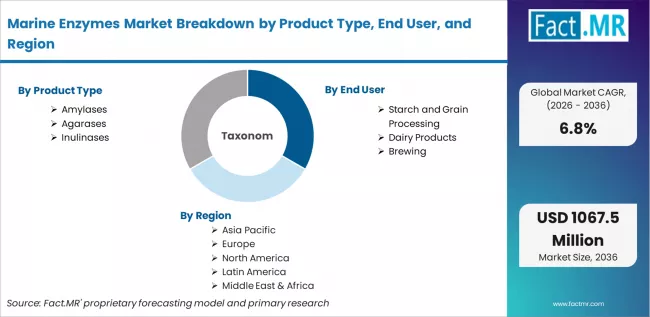
In 2025, the marine enzymes market was valued at USD 517.7 million. Based on Fact MR analysis, demand for marine enzymes is estimated to grow to USD 552.9 million in 2026 and USD 1,068.5 million by 2036. FMR projects a CAGR of 6.8% during the forecast period.
The absolute dollar growth from 2026 to 2036 is USD 515.6 million. This increase reflects steady expansion within the specialty enzyme segment rather than a major structural transformation of the broader biotechnology market. Marine derived enzymes are increasingly used in pharmaceutical research, food processing, nutraceutical production, and industrial biotechnology applications. Enzymes sourced from marine microorganisms and organisms are valued for their stability under extreme temperature and salinity conditions. Demand continues to grow as biotechnology companies explore marine biodiversity for new enzyme formulations. Growth remains moderated by high extraction and purification costs, limited availability of marine biological resources, and regulatory requirements governing marine bioprospecting activities.
China leads with a CAGR of 7.2%, supported by expanding biotechnology research capacity and increasing use of specialty enzymes in food processing and pharmaceutical development. India follows with a CAGR of 6.9%, reflecting growth in biopharmaceutical research and enzyme based industrial processing. Germany records a CAGR of 6.7%, driven by established biotechnology and life science research sectors. The United States shows a CAGR of 6.5%, supported by continued demand from pharmaceutical research and specialty chemical manufacturing. Japan records the slowest growth at 6.3%, reflecting a mature biotechnology sector where marine enzymes generate steady replacement demand. Regulatory oversight and high research costs act as structural constraints across these developed markets.
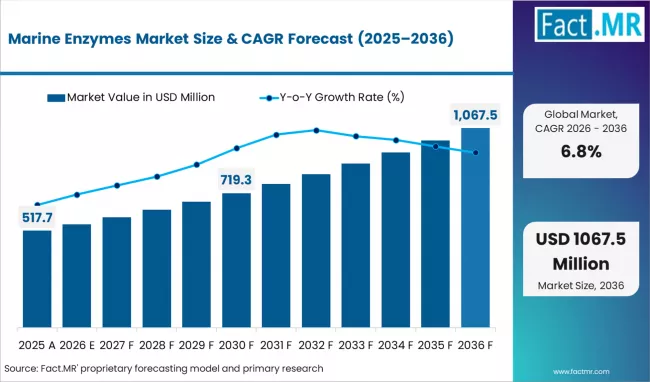
Marine Enzymes Market Market Value Analysis | Source: Fact.MR
Marine Enzymes Market
| Metric | Details |
|---|---|
| Industry Size (2026E) | USD 552.9 million |
| Industry Value (2036F) | USD 1,068.5 million |
| CAGR (2026 to 2036) | 6.8% |
Source: Fact.MR analysis. Updated Mar 17, 2026
Marine Enzymes Market Definition
The Marine Enzymes Market includes enzymes extracted from marine organisms such as fish, marine microorganisms, algae, and invertebrates. These enzymes act as biological catalysts that accelerate biochemical reactions in industrial and biological processes. Marine enzymes are valued for their stability under conditions such as high salt concentration, varying temperatures, and extreme environments. They are used in applications including pharmaceuticals, food processing, biotechnology, and industrial processing. Their primary function is to support biochemical reactions in manufacturing and research processes where conventional enzymes may show limited stability or activity.
Market Inclusions
This report covers global and regional market sizes for marine enzymes with forecast analysis for the study period. The market is segmented by enzyme type such as proteases, lipases, carbohydrases, and polymerases. Application segments include pharmaceuticals, food processing, biotechnology research, and industrial biocatalysis. End users include pharmaceutical manufacturers, biotechnology firms, food processing companies, and research laboratories. The report also evaluates pricing trends, production patterns, and selected trade flow analysis across major biotechnology and enzyme producing regions.
Market Exclusions
The report excludes enzymes derived from terrestrial plants, animals, or microbial fermentation that do not originate from marine organisms. Industrial enzyme products used strictly in detergents, textiles, or paper processing without marine origin are not included. The scope also excludes finished pharmaceutical products, dietary supplements, and food products containing enzymes as minor components. Marine biotechnology research projects that remain in laboratory development stages are outside the defined market scope.
Research Methodology
- Primary Research: Interviews were conducted with biotechnology researchers, enzyme manufacturers, pharmaceutical developers, and industrial biotechnology specialists.
- Desk Research: Public information was collected from biotechnology industry publications, academic journals, company reports, and international trade statistics.
- Market-Sizing and Forecasting: A hybrid model combining bottom up production analysis with top down demand assessment across biotechnology and industrial enzyme markets was applied.
- Data Validation and Update Cycle: Findings were cross verified using multiple biotechnology data sources and expert reviews, with periodic updates conducted as new market information becomes available.
Summary of the Marine Enzymes Market
- Market Definition
- The market comprises enzymes extracted from marine organisms such as microorganisms, algae, fish, and marine invertebrates. These enzymes function as biological catalysts that accelerate biochemical reactions in industrial processing, pharmaceutical research, food production, and biotechnology applications. Marine enzymes are valued for their stability under extreme environmental conditions including high salinity, temperature variation, and pressure.
- Demand Drivers
- Rising use of marine derived enzymes in pharmaceutical research and biotechnology laboratories.
- Increasing adoption of enzyme based processing methods in food manufacturing and fermentation industries.
- Growing exploration of marine biodiversity for novel enzyme formulations with specialized catalytic properties.
- Expansion of industrial biotechnology applications requiring enzymes that maintain activity in extreme processing environments.
- Key Segments Analyzed
- Product Type: Amylases represent about 28% share due to widespread use in starch hydrolysis and food processing applications.
- End User: Starch and grain processing accounts for roughly 12% share supported by enzymatic conversion of starch into fermentable sugars.
- Industrial Application: Marine enzymes are used across food processing, biotechnology research, pharmaceutical development, and industrial biocatalysis.
- Geography: China records the fastest expansion supported by increasing biotechnology research capacity and enzyme production activities.
- Analyst Opinion at Fact MR
- Shambhu Nath Jha, Principal Consultant, Fact MR, opines, "In this updated edition of the Marine Enzymes Market report, industry participants will observe that demand continues to rise as biotechnology companies explore marine organisms for specialized enzyme applications. Marine enzymes demonstrate stability in extreme environmental conditions that limit the effectiveness of conventional enzymes. Companies with advanced enzyme discovery platforms and biotechnology research capabilities will maintain stronger positions in the development of marine derived biocatalysts."
- Strategic Implications or Executive Takeaways
- Invest in marine biotechnology research programs focused on discovering enzymes from marine microorganisms and algae.
- Develop enzyme engineering technologies that improve catalytic efficiency and stability for industrial applications.
- Expand partnerships between biotechnology companies and research institutions engaged in marine bioprospecting.
- Strengthen regulatory compliance related to marine genetic resource utilization and international biodiversity agreements.
- Methodology
- Primary interviews conducted with biotechnology researchers, enzyme manufacturers, pharmaceutical developers, and industrial biotechnology specialists.
- Desk research based on biotechnology publications, academic research journals, company reports, and global trade statistics.
- Market sizing developed using a hybrid approach combining bottom up production analysis and top down demand assessment across biotechnology and industrial enzyme sectors.
- Findings validated through multiple biotechnology industry sources and expert consultations following Fact MR internal modeling standards.
Segmental Analysis
Marine Enzymes Market Analysis by Product Type
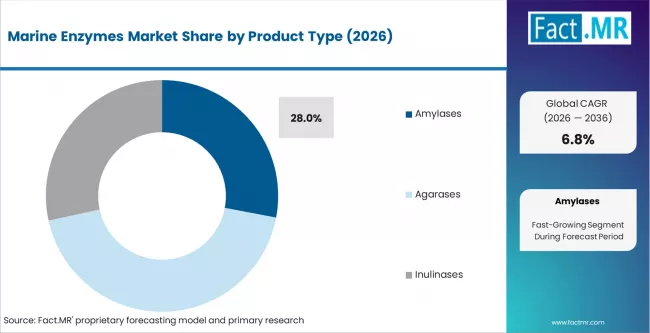
Marine Enzymes Market Analysis By Product Type | Source: Fact.MR
- Market Overview: Amylases are projected to account for around 28% share of the marine enzymes market by 2026. Marine derived amylase enzymes are utilized in industrial processing applications that require the breakdown of starch into simpler sugars. These enzymes are sourced from marine microorganisms that demonstrate stability in extreme environmental conditions such as varying temperature and salinity levels. Industrial processors value marine amylases for their catalytic efficiency and stability in complex processing environments. The enzymes are widely applied in food processing, fermentation, and starch hydrolysis processes used in industrial manufacturing.
- Demand Drivers:
- Industrial Starch Hydrolysis: Amylase enzymes are used to convert starch into fermentable sugars in food processing and fermentation industries.
- Marine Microbial Enzyme Stability: Marine sourced enzymes demonstrate functional stability in varied temperature and pH environments, supporting industrial processing efficiency.
- Food Processing Applications: Amylases are incorporated in food manufacturing processes such as baking and starch processing to improve ingredient functionality.
Marine Enzymes Market Analysis by End User
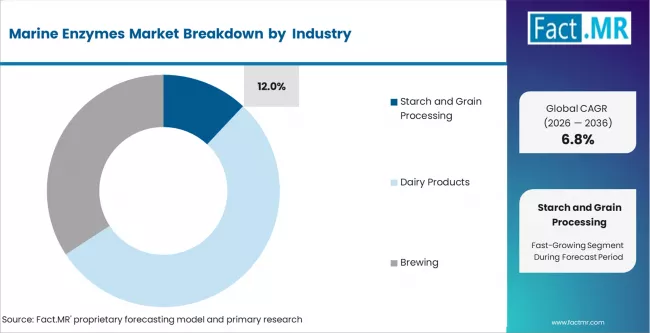
Marine Enzymes Market Analysis By End User | Source: Fact.MR
- Market Overview: Starch and grain processing is expected to represent approximately 12% share of the marine enzymes market in 2026. Marine enzymes are used in grain processing facilities to support the enzymatic breakdown of starch into glucose and other fermentable sugars. These processes are critical in the production of food ingredients, sweeteners, and fermentation products. Enzymatic processing enables manufacturers to increase processing efficiency while maintaining consistent product quality during grain and starch conversion processes.
- Demand Drivers:
- Grain Processing Operations: Marine enzymes are used in starch conversion processes during the production of glucose syrups and fermentation substrates.
- Food Ingredient Manufacturing: Starch processing facilities rely on enzymatic reactions to convert raw grain materials into functional food ingredients.
- Processing Efficiency Improvements: Enzyme based processing methods support improved conversion efficiency and product consistency within industrial starch processing operations.
Key Dynamics
Marine Enzymes Market Drivers, Restraints, and Opportunities
Fact MR analysis indicates that the marine enzymes market developed from biochemical research focused on extracting catalytic proteins from marine microorganisms, algae, and invertebrates. Early industrial interest centered on enzymes capable of functioning under extreme temperature, salinity, and pressure conditions found in marine environments. The current market valuation reflects the application of marine-derived enzymes in pharmaceuticals, biotechnology research, food processing, and industrial biocatalysis. Demand persists because marine enzymes exhibit functional stability in chemical environments where conventional terrestrial enzymes lose catalytic efficiency.
A structural shift is occurring as traditional enzyme sources derived from terrestrial microorganisms face limitations in specialized industrial applications requiring high tolerance to extreme processing conditions. Conventional enzymes remain widely used in large-volume industries such as detergents and food processing where cost efficiency remains the primary consideration. Marine-derived enzymes command higher production costs due to complex extraction processes, specialized fermentation systems, and regulatory approvals associated with novel biological materials. Even with smaller production volumes compared with traditional enzyme products, higher pricing associated with specialized marine biocatalysts supports gradual value expansion in the market.
- Biotechnology Research Demand: Pharmaceutical and biotechnology laboratories use marine enzymes in drug discovery, molecular diagnostics, and biochemical research applications.
- Marine Bioprospecting Regulation: International frameworks such as the Nagoya Protocol on Access and Benefit Sharing regulate the collection and commercial use of marine genetic resources.
- Asia Marine Biotechnology: Japan, South Korea, and China maintain active marine biotechnology research programs that explore ocean-derived enzymes for pharmaceutical and industrial biotechnology applications.
Regional Analysis
The market analysis covers key global regions, including East Asia, South Asia, North America, and Europe. It is segmented geographically, with specific market dynamics for each region. The full report provides a detailed market attractiveness analysis.
.webp "Top Country Growth Comparison Marine Enzymes Market Cagr (2026 2036)")
Top Country Growth Comparison Marine Enzymes Market Cagr (2026 2036) | Source: Fact.MR
| Country | CAGR (2026-2036) |
|---|---|
| China | 7.2% |
| India | 6.9% |
| Germany | 6.7% |
| USA | 6.5% |
| Japan | 6.3% |
Source: Fact.MR analysis. Updated Mar 17, 2026
Source: Fact MR (FMR) analysis, based on proprietary forecasting model and primary research
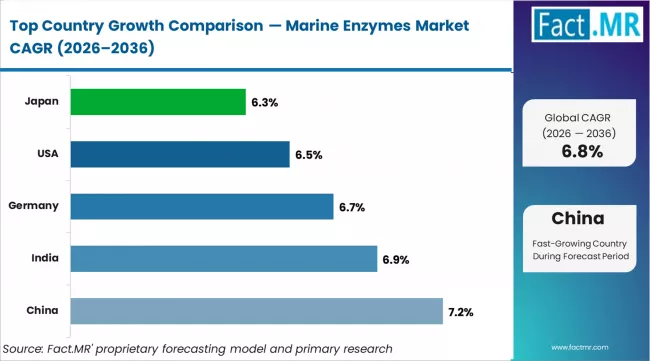
Marine Enzymes Market Cagr Analysis By Country | Source: Fact.MR
East Asia
China and Japan represent major markets supported by biotechnology research, pharmaceutical applications, and marine resource utilization. Key companies include Novozymes A/S, DuPont, and Amano Enzyme Inc..
- China: Demand for marine enzymes in China is projected to rise at 7.2% CAGR through 2036. Growth is supported by marine biotechnology research programs promoted by the Ministry of Science and Technology (03-2025) and expansion of enzyme production facilities by Novozymes A/S (08-2025).
- Japan: Demand for marine enzymes in Japan is projected to rise at 6.3% CAGR through 2036. Growth is supported by marine biotechnology innovation initiatives promoted by the Ministry of Economy, Trade and Industry (04-2025) and product development programs by Amano Enzyme Inc. (07-2025).
South Asia
India represents a growing market supported by biotechnology research, pharmaceutical manufacturing, and enzyme based industrial processes.
- India: Demand for marine enzymes in India is projected to rise at 6.9% CAGR through 2036. Growth is supported by marine biotechnology initiatives promoted by the Department of Biotechnology (05-2025) and expansion of enzyme ingredient production by DuPont (09-2025).
North America
Marine Enzymes Market Country Value Analysis | Source: Fact.MR
The USA represents a significant market supported by pharmaceutical research, enzyme technology development, and biotechnology innovation.
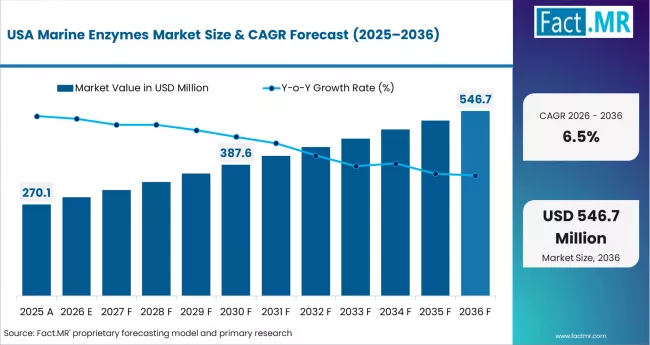
- USA: Demand for marine enzymes in the U.S. is projected to rise at 6.5% CAGR through 2036. Growth is supported by biotechnology research programs promoted by the National Institutes of Health (04-2025) and enzyme technology development initiatives by DuPont (08-2025).
Europe
Marine Enzymes Market Europe Country Market Share Analysis, 2026 & 2036 | Source: Fact.MR
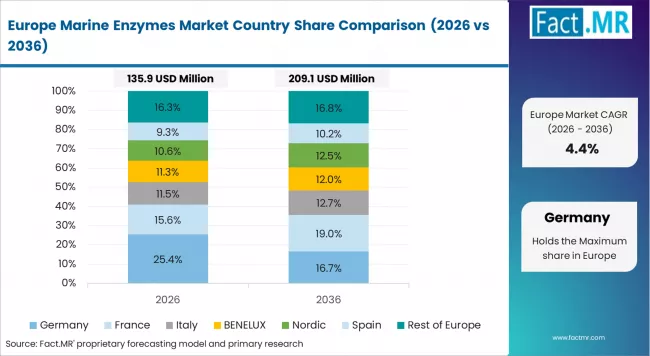
Germany represents an important market supported by pharmaceutical manufacturing, biotechnology research, and enzyme technology applications.
- Germany: Demand for marine enzymes in Germany is projected to rise at 6.7% CAGR through 2036. Growth is supported by biotechnology innovation programs promoted by the Federal Ministry of Education and Research (03-2025) and enzyme technology development by Novozymes A/S (07-2025).
Fact MR's analysis of the marine enzymes market in East Asia, South Asia, North America, and Europe consists of country-wise assessments that include China, India, Germany, the USA, and Japan. Readers can find detailed trends, regulatory updates, and company-specific investments shaping market growth in these countries.
Competitive Landscape
Marine Enzymes Market Analysis By Company | Source: Fact.MR
Competitive Structure and Buyer Dynamics in the Marine Enzymes Market
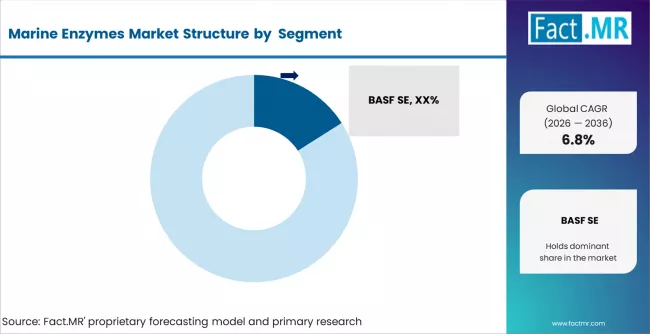
The competitive structure of the Marine Enzymes Market is moderately fragmented, with a combination of global biotechnology firms and specialized enzyme producers participating in supply. Major companies including BASF SE, DSM-Firmenich AG, Novonesis Group, and AB Enzymes GmbH maintain strong positions through established enzyme development capabilities and global ingredient distribution networks. These companies supply enzymes used across food processing, pharmaceuticals, nutraceuticals, and biotechnology applications. Additional participants such as Biocon Limited, Amano Enzyme Inc., Codexis, Inc., Advanced Enzyme Technologies Limited, and ArcticZymes Technologies ASA operate in specialized enzyme production segments, focusing on targeted biochemical applications derived from marine microorganisms. Competition in the market is primarily shaped by enzyme activity efficiency, stability across varying processing conditions, and the ability to deliver application specific enzyme solutions. Research capability and biotechnological expertise also influence competitive positioning within specialized enzyme markets.
Several companies maintain structural advantages through advanced biotechnology research platforms and proprietary enzyme development technologies. Firms such as Novonesis Group, BASF SE, and DSM-Firmenich AG benefit from extensive enzyme libraries and established fermentation infrastructure that supports large scale enzyme production. ArcticZymes Technologies ASA and Codexis, Inc. maintain specialized expertise in enzyme engineering and molecular optimization for biotechnology applications. Buyers in pharmaceutical manufacturing, food processing, and biotechnology research commonly maintain diversified sourcing strategies to reduce dependence on a single enzyme supplier. Procurement decisions typically evaluate enzyme activity performance, regulatory compliance, and consistency of supply. This purchasing behavior moderates supplier pricing leverage across the market. Companies offering patented enzyme technologies and specialized marine derived enzyme formulations retain moderate negotiating influence within high value application segments.
Key Players of the Marine Enzymes Market
- BASF SE
- DSM-Firmenich AG
- Novonesis Group
- Biocon Limited
- Amano Enzyme Inc.
- Codexis, Inc.
- Advanced Enzyme Technologies Limited
- ArcticZymes Technologies ASA
- AB Enzymes GmbH
Report Scope
Marine Enzymes Market Breakdown By Product Type, End User, And Region | Source: Fact.MR
| Metric | Value |
|---|---|
| Quantitative Units | USD 552.9 million (2026) to USD 1,068.5 million (2036), at a CAGR of 6.8% |
| Market Definition | The marine enzymes market includes production and application of enzymes derived from marine microorganisms, algae, and aquatic organisms used in food processing, pharmaceuticals, biotechnology, and industrial applications. |
| Product Type | Agarases, Amylases (Alpha Amylases, Glucoamylases, Pullulanase), Glucosidases, Inulinases, Proteases |
| End User Segmentation | Dairy Products, Brewing, Meat Products and Processing, Bakery and Confectionery, Baby Food or Infant Food, Oil and Fat Processing, Starch and Grain Processing, Fruits and Vegetable Processing, Cheese Making or Processing, Egg Products, Beverages, Dietary Supplements, Pharmaceutical Products, Personal Care Products, Animal Nutrition |
| Key Companies Profiled | BASF SE, DSM-Firmenich AG, Novonesis Group, Biocon Limited, Amano Enzyme Inc., Codexis, Inc., Advanced Enzyme Technologies Limited, ArcticZymes Technologies ASA, AB Enzymes GmbH |
| Forecast Period | 2026 to 2036 |
| Approach | Hybrid top-down and bottom-up market modeling validated through interviews with enzyme manufacturers and biotechnology firms, supported by production benchmarking, application demand analysis, and trade data evaluation. |
Source: Fact.MR analysis. Updated Mar 17, 2026
Bibliographies
- [1] Ministry of Science and Technology, China. (2025). Marine biotechnology research programs.
- [2] Department of Biotechnology, India. (2025). Marine biotechnology initiatives.
- [3] Federal Ministry of Education and Research, Germany. (2025). Biotechnology innovation programs.
- [4] National Institutes of Health, USA. (2025). Biotechnology research programs.
- [5] Ministry of Economy, Trade and Industry, Japan. (2025). Marine biotechnology innovation initiatives.
- [6] Novozymes A/S. (2025). Enzyme production facilities expansion.
- [7] Amano Enzyme Inc. (2025). Product development programs.
- [8] DuPont. (2025). Enzyme ingredient production expansion.
- [9] Nagoya Protocol Secretariat. (2023). Nagoya Protocol on Access and Benefit Sharing.
This Report Addresses
- Market size estimation and revenue forecasts for the Marine Enzymes Market from 2026 to 2036, supported by biotechnology research investment indicators and industrial enzyme production benchmarks.
- Growth opportunity mapping across agarases, amylases, glucosidases, inulinases, and proteases derived from marine microorganisms, algae, and aquatic organisms.
- Segment and regional revenue forecasts covering starch and grain processing, dairy products, brewing, meat processing, beverages, pharmaceuticals, dietary supplements, personal care products, and animal nutrition applications across biotechnology and food processing industries.
- Competition strategy assessment including enzyme engineering capability, biotechnology research platforms, and industrial enzyme production benchmarking among leading enzyme manufacturers and biotechnology firms.
- Regulatory and marine biotechnology governance analysis covering frameworks such as the Nagoya Protocol on Access and Benefit Sharing governing marine genetic resource utilization and enzyme development activities.
- Market report delivery in PDF, Excel, PPT, and interactive dashboard formats designed for biotechnology investment evaluation, enzyme technology procurement planning, and industrial biocatalyst application assessment.
- Supply chain vulnerability assessments identifying marine biological resource availability, enzyme fermentation capacity concentration, and biotechnology research infrastructure dependencies affecting marine enzyme production.
Segmentation
Marine Enzymes Market Key Segments
-
Product Type :
- Agarases
- Amylases
- Alpha Amylases
- Glucoamylases
- Pullulanase
- Glucosidases
- Inulinases
- Proteases
-
End User :
- Dairy Products
- Brewing
- Meat Products and Processing
- Bakery and Confectionery
- Baby Food or Infant Food
- Oil and Fat Processing
- Starch and Grain Processing
- Fruits and Vegetable Processing
- Cheese Making or Processing
- Egg Products
- Beverages
- Dietary Supplements
- Pharmaceutical Products
- Personal Care Products
- Animal Nutrition
-
Region :
- North America
- USA
- Canada
- Mexico
- Europe
- Germany
- UK
- France
- Italy
- Spain
- Nordic Countries
- BENELUX
- Rest of Europe
- Asia Pacific
- China
- Japan
- South Korea
- India
- Australia
- Rest of Asia Pacific
- Latin America
- Brazil
- Argentina
- Rest of Latin America
- Middle East and Africa
- Kingdom of Saudi Arabia
- United Arab Emirates
- South Africa
- Rest of Middle East and Africa
- Other Regions
- Oceania
- Central Asia
- Other Markets
- North America
Frequently Asked Questions
How large is the demand for Marine Enzymes in the global market in 2026?
What will be the market size of Marine Enzymes in the global market by 2036?
What is the expected demand growth for Marine Enzymes in the global market between 2026 and 2036?
Which Product Type Segment is poised to lead global demand by 2026?
Which Company is Identified as a Leading Participant in the Marine Enzymes Market?
What is Driving Marine Enzyme Demand in the United States?
What is the United States Growth Outlook in this Report?
Why is China an Important Market for Marine Enzymes?
What is the China Growth Outlook in this Report?
What Factors Support Marine Enzyme Demand in India?
What is the India Growth Outlook in this Report?
Why is Germany Considered an Important Market for Marine Enzymes?
What is the Germany Growth Outlook in this Report?
Why is Japan an Important Market for Marine Enzymes?
What is the Japan Growth Outlook in this Report?
What are Marine Enzymes and What are They Mainly Used For?
What does Marine Enzymes Market Mean in this Report?
What is Included in the Scope of this Marine Enzymes Market Report?
What is Excluded from the Scope of this Report?
What does Market Forecast Mean on this Page?
How is the Marine Enzymes Market Forecast Developed in this Report?
Who worked on this report


Preview the report firsthand - request a free sample
Free SampleGet the brochure for pricing and purchase details
Download PDF