- Market Value (2025): USD 158.5 Mn
- Estimated Value (2026): USD 179.3 Mn
- Forecast Value (2036): USD 614.1 Mn
- CAGR (2026-2036): 13.1%
What is the Metal-filled Polymer Filaments Market forecast to be worth by 2036?
USD 179.3 million in 2026 to USD 614.1 million by 2036, at 13.1% CAGR.
- The metal-filled polymer filaments market value stood at USD 158.5 million in 2025, driven by functional 3D printing filament use across prototyping and print-service channels.
- Demand is projected to increase from USD 179.3 million in 2026 to USD 614.1 million by 2036.
- The sector is forecast to record a 13.1% CAGR from 2026 to 2036 due to users comparing metal content and print repeatability before wider part adoption.
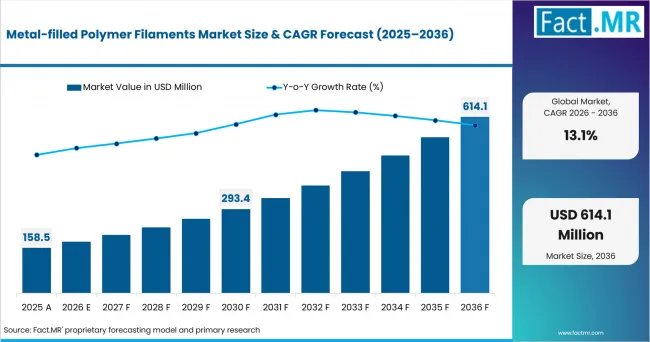
Metal Filled Polymer Filaments Market Market Value Analysis | Source: Fact.MR
What are the defining numbers behind Metal-filled Polymer Filaments Market growth?
USD 434.6 million absolute opportunity by 2036, led by PLA and consumer/hobbyist end use alongside prototyping applications.
- Demand Drivers in the Market
- Print bureaus need metal-like filament options keeping short jobs affordable across customer revisions and material trials.
- Engineering teams depend on shrinkage guidance making green-part dimensions easier to translate into finished metal outcomes.
- Service networks use printer compatibility linking hardened nozzles and finishing partners into one buying path.
- Training bodies require clearer material workflow depth helping technicians handle debinding and post-processing steps.
- Key Segments Analyzed
- By Metal filler: Copper-filled is expected to represent 29% share in 2026, reflected by metal-look prints and weighted prototype use.
- By Base polymer: PLA is projected to account for 46% share in 2026, influenced by accessible desktop printing and filled-filament compatibility.
- By Application: Prototyping is anticipated to hold 34% share in 2026, attributable to short-run trials and metal-like design validation.
- By End use: Consumer/hobbyist is estimated to capture 41% share in 2026, reinforced by desktop printing access and decorative metal-look parts.
- Analyst Opinion at Fact.MR
- Shambhu Nath Jha, Senior Analyst at Fact.MR, states, “Metal-filled polymer filaments have moved into a practical test phase. Demand is expected to favor suppliers proving powder loading and finishing paths. Users are projected to reward material partners reducing failed parts and explain sintering limits clearly.”
- Strategic Implications
- Filament producers are expected to publish powder-loading ranges and nozzle guidance across metal-filled product lines.
- Print service bureaus are likely to bundle printing and polishing into one order path.
- Printer makers are anticipated to improve hardened-nozzle compatibility for abrasive filled-filament users.
- Industrial users are estimated to test fixtures and weighted prototypes before qualifying repeated part families.
Raise3D stated in September 2025 reporting MetalFuse uses 2 BASF Ultrafuse metal filament grades, 17-4PH and 316L, showing how filament-based metal systems support small-batch metal part workflows. Product activity reflects customer interest in sinter and finish pathways inside one system.
India is projected to post 14.9% CAGR through 2036, led by additive manufacturing skills and metal-ceramic 3D printing programs. China is expected to record 14.2% CAGR by 2036, influenced by printer output gains and local hardware supply. Australia is anticipated to grow at 12.9% CAGR from 2026 to 2036, backed by advanced manufacturing skills planning. United Kingdom is estimated to hold 12.6% CAGR during the study period, strengthened by SME 3D printing adoption evidence. U.S. is forecast to record 12.4% CAGR between 2026 and 2036, reinforced by additive manufacturing project depth. Germany is likely to post 12.1% CAGR to 2036, guided by metal AM research use. Japan is expected to expand at 11.8% CAGR to 2036, driven by hard-material additive manufacturing research.
How does the Metal-filled Polymer Filaments Market break down by segment?
PLA is expected to dominate at 46%; Consumer/hobbyist is anticipated to lead at 41%.
What is likely to lead the metal filler segment?
Copper-filled is expected to represent 29% share in 2026.
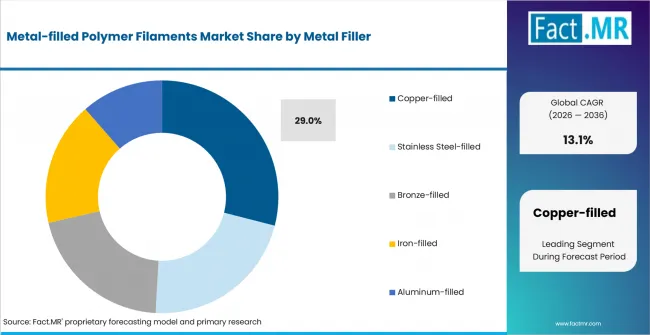
Metal Filled Polymer Filaments Market Analysis By Metal Filler | Source: Fact.MR
Copper-filled is set to represent 29% share in 2026, led by metal-look prototypes and decorative part demand. Stainless steel-filled follows through stronger functional trial use and sinterable part workflows. Bronze-filled and aluminum-filled materials support weighted prototypes, display objects and specialty surface finishes. colorFabb stated in February 2024 that copperfill and steelfill contain roughly 80% metal powder by weight, highlighting a measurable basis for metal-filled material selection.
What base polymer is anticipated to lead demand?
PLA is projected to account for 46% share in 2026.
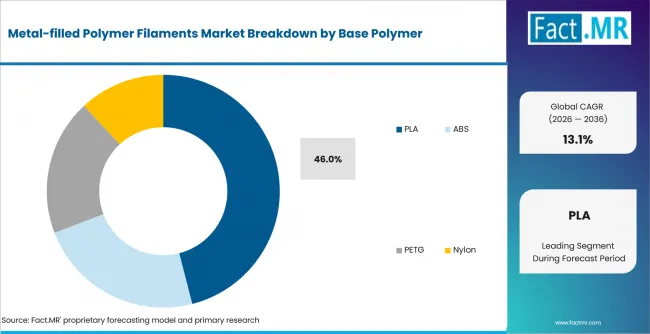
Metal Filled Polymer Filaments Market Analysis By Base Polymer | Source: Fact.MR
PLA is likely to represent 46% share in 2026, influenced by lower entry barriers and broad desktop compatibility. ABS follows through tougher trial parts and higher-temperature use. PETG supports users needing easier handling with improved durability. Nylon serves selected functional prototypes requiring higher toughness. Jignasu and co-authors reported in July 2024 noting Slice-100K contains more than 100,000 G-code files, reflecting the toolpath data depth supporting extrusion-based print control.
What is projected to lead the application segment?
Prototyping is anticipated to hold 34% share in 2026.
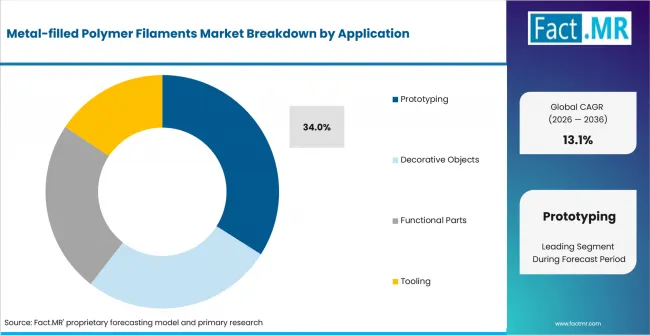
Metal Filled Polymer Filaments Market Analysis By Application | Source: Fact.MR
Prototyping is estimated to hold 34% share in 2026, attributable to short-run model validation and metal-like design trials. Decorative objects follow through hobby and display models. Functional parts and tooling support limited engineering use where users test fit and surface finish before qualification. Department for Business and Trade research published in August 2025 reporting Greater Manchester SME 3D printing adoption at 17.1%, compared with 11% across the national comparator group, showcasing small-firm use of print-based prototyping.
How is end use anticipated to shape demand?
Consumer/hobbyist is estimated to capture 41% share in 2026.
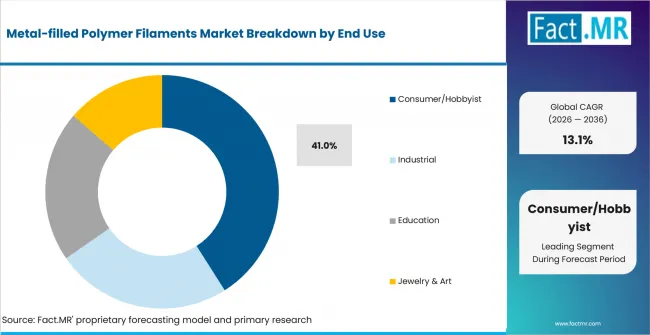
Metal Filled Polymer Filaments Market Analysis By End Use | Source: Fact.MR
Consumer/hobbyist is predicted to capture 41% share in 2026, reinforced by desktop printing access and decorative metal-look parts. Industrial follows through prototypes and service bureau projects. Education supports material training and design-to-part learning. Jewelry & Art uses metal-filled filaments for appearance-driven pieces and small-batch creative work. America Makes reported in January 2026 stating more than 11,000 individuals participated in education and workforce development activities during 2025, reinforcing broader user familiarity with additive manufacturing materials.
What is accelerating Metal-filled Polymer Filaments Market adoption, and what is holding it back?
Desktop metal-part trials drive it; sintering access and material-claim confusion restrain it.
Drivers Impact Analysis
| Driver | (~) % Impact on CAGR | Geographic Scope | Impact Timeline |
|---|---|---|---|
| Desktop metal-part trials | +0.8% | U.S., China, Europe | Medium term (2-4 years) |
| Cloud print-service ordering | +0.7% | U.S., United Kingdom, India | Short term (<= 2 years) |
| Slicing and shrinkage software | +0.6% | Global print-service hubs | Medium term (2-4 years) |
| Metal-loading transparency | +0.5% | Europe, U.S., Japan | Short term (<= 2 years) |
| Additive manufacturing training | +0.4% | U.S., India, Australia | Long term (>= 4 years) |
Source: Fact.MR analysis. Updated Jul 13, 2026
- Desktop metal-part trials: Metal-filled filaments reduce trial barriers for users comparing metal weight and sinterable outcomes. The Virtual Foundry stated in March 2026 claiming stainless steel grades typically require sintering temperatures from 1350 degrees C to 1450 degrees C. Demand is projected to favor users with furnace access or service partners, driven by controlled thermal-processing needs.
- Cloud print-service ordering: Cloud ordering helps users sinter and finish services without building a full cell. Arbabian reported in June 2025, additive manufacturing remains viable for selected supply chains even under higher per-unit costs. Service adoption is expected to expand as order platforms match small jobs with available printer capacity.
- Slicing and shrinkage software: Metal-filled workflows need more control than standard PLA since green parts change during furnace processing. Guidetti, Mukne, Rueppel, Balta, and Lygeros reported in March 2024 stating closed-loop extrusion force control improved repeatability across print speed and nozzle size. Software demand is anticipated to rise as users seek stable settings before repeat orders.
- Metal-loading transparency: Users compare metal loading before choosing aesthetic or sinterable material paths. colorFabb stated in February 2024, copperFill and steelFill contain roughly 80% metal powder by weight. Clear product claims are estimated to reduce wrong-use cases and failed expectations among first-time buyers.
- Additive manufacturing training: Training helps users understand nozzle wear and finish limits before production use. America Makes reported in January 2026, more than 11,000 individuals participated in education and workforce development activities during 2025. Workforce programs are forecast to support repeat use by technicians and print-service staff.
Opportunity Impact Analysis
| Opportunity | (~) % Impact on CAGR | Geographic Scope | Impact Timeline |
|---|---|---|---|
| Sintering-service bundles | +0.6% | U.S., Europe, Japan | Medium term (2-4 years) |
| Secure prototype workflows | +0.5% | U.S., United Kingdom, Germany | Medium term (2-4 years) |
| SME service packs | +0.4% | India, Australia, United Kingdom | Short term (<= 2 years) |
| High-density specialty parts | +0.3% | Japan, U.S., Germany | Long term (>= 4 years) |
Source: Fact.MR analysis. Updated Jul 13, 2026
- Sintering-service bundles: Service packs connect filament printing with debinding and sintering for users lacking furnaces. The Virtual Foundry stated in February 2026, sintering follows printing and debinding to produce a load-bearing solid. Bundled services are projected to reduce trial drop-off after early print tests.
- Secure prototype workflows: File-sensitive users need controlled print paths and audit trails. Dolgavin, Gatlin, Yung, and Yampolskiy reported in September 2025, one side-channel reconstruction test reached 7.02% false positives and 9.71% false negatives. Security-led workflow services are anticipated to gain attention in regulated design environments.
- SME service packs: SMEs need clear settings and finishing access before repeated orders. Department for Business and Trade research published in August 2025 reported, 77.7% of Greater Manchester SME adopters used 3D printing at low or moderate capacity. Service packs are estimated to help smaller firms move beyond one-off prints.
- High-density specialty parts: Dense metal-filled materials support shielding concepts and tactile prototypes. Protopasta stated in September 2025, metal filament history across its line spans 10+ years. Specialty pathways are forecast to influence functional filament trials involving weight and surface finish.
Restraints Impact Analysis
| Restraint | (~) % Impact on CAGR | Geographic Scope | Impact Timeline |
|---|---|---|---|
| Debinding and sintering access | -0.7% | Global | Medium term (2-4 years) |
| Abrasive filament wear | -0.5% | Desktop printer users | Short term (<= 2 years) |
| Conductivity misunderstanding | -0.4% | Online filament channels | Short term (<= 2 years) |
| Qualification burden | -0.3% | Industrial users | Long term (>= 4 years) |
Source: Fact.MR analysis. Updated Jul 13, 2026
- Debinding and sintering access: Sinterable filaments need furnace routes after printing. Raise3D stated in September 2025, its MetalFuse process uses BASF Ultrafuse 17-4PH and 316L filaments with catalytic debinding. Adoption is expected to slow for users lacking local finishing partners and material-specific furnace guidance.
- Abrasive filament wear: Metal-filled PLA grades place extra stress on nozzles and feed systems. colorFabb stated in 2026, steelFill uses high steel content and is abrasive to brass nozzles. Hardened nozzles are likely to become a basic purchasing requirement for regular users.
- Conductivity misunderstanding: Metal powder does not automatically create conductive printed parts. colorFabb stated in January 2024, copperFill is not electrically conductive since PLA/PHA controls the matrix behavior. Clear claim language is anticipated to reduce returns and wrong application choices.
- Qualification burden: Functional metal outcomes need repeatable shrinkage control and post-process records. Chen and co-authors reported in April 2024, metal sintering deformation varies from 25% to 50% depending on green-part porosity. Industrial adoption is forecast to favor users with test capacity and documented workflows.
How are country markets expected to scale Metal-filled Polymer Filaments Market demand?
India 14.9%; China 14.2%; Australia 12.9%; United Kingdom 12.6%; U.S. 12.4%.
Regional analysis covers North America, Latin America, Europe, East Asia, South Asia and Pacific, and Middle East and Africa.
.webp "Top Country Growth Comparison Metal Filled Polymer Filaments Market Cagr (2026 2036)")
Top Country Growth Comparison Metal Filled Polymer Filaments Market Cagr (2026 2036) | Source: Fact.MR
| Country | CAGR |
|---|---|
| India | 14.9% |
| China | 14.2% |
| Australia | 12.9% |
| United Kingdom | 12.6% |
| U.S. | 12.4% |
Source: Fact.MR analysis. Updated Jul 13, 2026
What is driving India's growth to 2036?
14.9% CAGR by 2036, supported by additive manufacturing skills and metal-ceramic 3D printing programs.
India combines lower-cost FFF printer use with public research and training activity across materials programs. Department of Science and Technology reported in its 2024-25 annual report stating 72 artisans were trained using 3D printing tools, supporting hands-on exposure for design-to-part workflows. Market in India is projected to record 14.9% CAGR through 2036 as smaller workshops test metal-filled filaments before investing in costlier metal AM systems.
How is China scaling metal-filled polymer filaments demand?
14.2% CAGR from 2026 to 2036, supported by printer output gains.
China's printer hardware base supports filament trials across prototyping, training, and service bureau work. National Bureau of Statistics of China reported in January 2026 claiming for the production of 3D printing devices having grown 52.5% in 2025, providing material suppliers a larger installed base to serve. Demand in China is expected to record 14.2% CAGR during the study period, due to equipment availability influencing wider filled-material testing.
What is likely to supports the Australia outlook?
12.9% CAGR between 2026 and 2036, backed by advanced manufacturing skills planning.
Australia links additive manufacturing with skills planning, equipment repair needs, and research-led production support. State Government of Victoria reported in April 2026 stating 2,200 new workers are expected in advanced manufacturing between 2025 and 2028, supporting a deeper labor base for printer and materials use. Sector in Australia is anticipated to post 12.9% CAGR during the forecast period, led by users testing metal-like materials near equipment repair and prototyping needs.
What underpins United Kingdom demand?
12.6% CAGR through 2036, reinforced by SME 3D printing adoption evidence.
United Kingdom demand reflects service bureaus and SME adoption support. Department for Business and Trade research published in August 2025 reported 17.1% 3D printing adoption among Greater Manchester SMEs, giving filament suppliers evidence of small-firm use. Sales in the United Kingdom is estimated to advance at 12.6% CAGR between 2026 and 2036, driven by smaller firms using external print services before internal investment.
How is the U.S. market expected to perform?
12.4% CAGR during the study period, supported by additive manufacturing project depth.
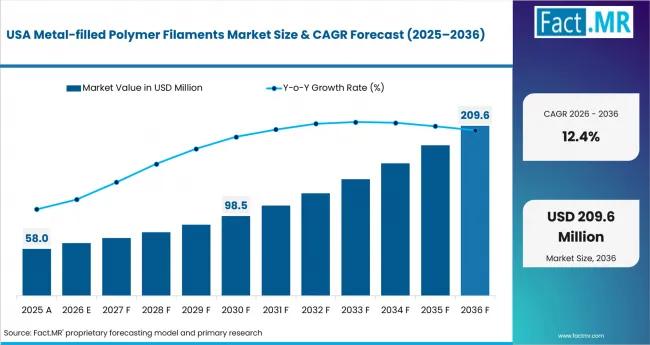
Metal Filled Polymer Filaments Market Country Value Analysis | Source: Fact.MR
U.S. demand is linked with industrial prototyping and service bureau networks. America Makes reported in January 2026 noting the institute uploaded more than 3,000 artifacts into its CORE repository, improving information access for additive manufacturing users. Industry in the United States is forecast to record 12.4% CAGR by 2036, backed by workforce programs promoting filled-filament handling and post-processing discipline.
What shapes Germany's outlook?
12.1% CAGR to 2036, influenced by metal additive research and precision component work.
Germany's outlook reflects research users and engineering teams testing metal AM for high-performance components. Zhang and co-authors reported in September 2025 noting metal 3D printing supported 2 accelerating structures and 1 cooling plate for GSI and FAIR work. Demand in Germany is likely to post 12.1% CAGR by 2036, guided by precision part validation and repeatability needs.
How is Japan positioned in metal-filled polymer filaments?
11.8% CAGR during the forecast period, supported by hard-material additive manufacturing research.
Japan's demand links precision manufacturing with materials research and small-batch engineering. Hiroshima University reported in February 2026 stating its WC-Co additive route produced hardness above 1400 HV, supporting interest in hard-material manufacturing routes. Market demand is expected to advance at 11.8% CAGR to 2036, guided by high-specification component trials and material qualification work.
Who leads the Metal-filled Polymer Filaments Market?
Direct filled-filament coverage is led by The Virtual Foundry and colorFabb, and Protopasta with Markforged strengthen metal-composite and bound-metal workflows.
Filamet maker The Virtual Foundry brings material depth for users seeking metal and ceramic filament workflows. colorFabb supports aesthetic metal-filled PLA/PHA materials based on copperFill and steelFill guidance. Protopasta adds metal composite PLA lines focused on steel and copper-style finishes.
Markforged supports bound powder filament systems led by Metal X and FX10 metal capability. Raise3D adds MetalFuse system coverage due to BASF Ultrafuse filament compatibility and catalytic debinding guidance. Competition is expected to focus on post-processing access and repeatable customer support.
What companies are profiled in the Metal-filled Polymer Filaments Market?
Direct filament providers The Virtual Foundry and colorFabb are profiled. Protopasta and Markforged are also profiled. Raise3D completes the company set.
- The Virtual Foundry
- colorFabb
- Protopasta
- Markforged
- Raise3D
Bibliography
- America Makes. (2026, January 12). America Makes highlights successes from 2025. America Makes.
- Arbabian, M. E. (2025, June 11). Strategic adoption of 3D printing in multi-product supply chains: Cost and capacity considerations. arXiv.
- colorFabb. (2024, January 9). Is your copperFill conductive? colorFabb Support.
- colorFabb. (2024, February 26). What percentage steel, bronze, or copper is your steelFill, bronzeFill, copperFill? colorFabb Support.
- colorFabb. (2026). steelFill: Metal-filled PLA filament with real steel powder. colorFabb.
- Department for Business and Trade. (2025, August 22). Factors affecting adoption of 3D printing by SMEs: The case of Greater Manchester. Government of the United Kingdom.
- Department of Science and Technology. (2025). Annual Report 2024-25. Government of India.
- Hiroshima University. (2026, February 6). Researchers find a way to 3D print one of industry's toughest materials. Hiroshima University.
- Jignasu, A., Marshall, K. O., Mishra, A. K., Rillo, L. N., Ganapathysubramanian, B., Balu, A., Hegde, C., & Krishnamurthy, A. (2024, July 4). Slice-100K: A multimodal dataset for extrusion-based 3D printing. arXiv.
- Markforged. (2026). Metal X metal 3D printing system. Markforged.
- National Bureau of Statistics of China. (2026, January 19). National economy pushed forward with innovation-led development and sustained stable growth. National Bureau of Statistics of China.
- Protoplant. (2025, September 1). Endless Exploration EX10: High Density Metal HTPLA. Protopasta.
- Raise3D. (2025, September 2). What is metal 3D printing: Process, types and principles. Raise3D.
- State Government of Victoria. (2026, April 13). Victorian Skills Plan for 2025 into 2026: Advanced manufacturing fact sheet. State Government of Victoria.
- The Virtual Foundry. (2026, February 25). Master metal sintering: Step-by-step guides for success. The Virtual Foundry.
- The Virtual Foundry. (2026, March 22). Filamet metal 3D printing FAQ: Processes, sintering and tips. The Virtual Foundry.
This Report Addresses
- Report provides strategic intelligence on metal-filled polymer filaments across metal filler and base polymer choices shaping print-service programs.
- Segment analysis covers PLA and consumer/hobbyist within the 2026 market structure.
- Regional outlook evaluates India and China alongside Australia, the United Kingdom, the U.S., Germany, and Japan.
- Competitive analysis profiles The Virtual Foundry and colorFabb alongside Protopasta, Markforged and Raise3D.
- Metal filler assessment covers copper-filled and stainless steel-filled materials across metal-look and functional print workflows.
- Application assessment covers prototyping and decorative objects alongside functional parts and tooling.
- End-use assessment covers consumer/hobbyist and Industrial use alongside education and jewelry & art.
What does the Metal-filled Polymer Filaments Market cover?
Copper-filled, stainless steel-filled, bronze-filled, iron-filled, and aluminum-filled polymer filaments used in FFF and FDM printing.
Metal-filled polymer filaments market covers polymer filaments containing metal powders or metal-like fillers used for desktop and service-bureau 3D printing. Coverage includes Copper-filled, Stainless Steel-filled, Bronze-filled, Iron-filled and Aluminum-filled filaments across PLA, ABS, PETG and Nylon base polymers.
Market coverage differs from full metal additive manufacturing since commercial demand centers on filled filaments used through extrusion-based printers. Metal powder bed fusion, standalone metal powders, and CNC-only metal parts remain outside scope unless linked to filament-based printing workflows.
What is included in the scope?
Metal-filled polymer filament systems used across prototyping, decorative objects, functional parts, and tooling.
Scope includes Copper-filled, Stainless Steel-filled, Bronze-filled, Iron-filled, and Aluminum-filled materials across PLA, ABS, PETG, and Nylon base polymers. Application coverage includes Prototyping, Decorative Objects, Functional Parts, and Tooling. End-use coverage includes Consumer/Hobbyist, Industrial, Education, and Jewelry & Art users.
What is excluded from the scope?
Loose metal powders, resin-only printing materials, and commodity plastic filaments are outside the scope.
Laser powder-bed fusion powders, binder-jet powders, resin-only additive systems, and standard PLA or ABS filaments are excluded. Metallic-color filaments without real metal content are excluded unless the product line includes metal powder or direct metal-filled material claims.
How was the analysis built?
120+ sources, 45+ company portfolios, 30+ countries, 20+ interviews.
- Primary Research:
- Primary research includes interviews with filament producers, print-service operators, printer resellers, sintering partners, application engineers, material distributors, and industrial users. It also includes input from lab managers, design teams, service bureau owners, and workshop supervisors involved in FFF and FDM printing workflows.
- Desk Research:
- Desk research reviews official additive manufacturing strategies, national manufacturing programs, company material pages, product support notes, technical papers, printer pages, and workflow studies. Official statistics offices, government agencies, research institutions, and company materials are reviewed to assess adoption, training, and product direction.
- Market-Sizing and Forecasting:
- Forecasting uses country CAGRs, segment shares, material-loading evidence, printer compatibility, service-bureau use, finishing access, and workflow adoption. Forecast models also assess sintering limits, abrasive-filament wear, software control, cloud ordering, and organization-size exposure.
- Data Validation and Update Cycle:
- Forecasts are validated through country evidence review, and technical interviews. Updates review material-claim changes, printer compatibility updates, official manufacturing releases, service workflow evidence, and company announcements to keep the market view aligned with active operating conditions.
Segmentation
What is the report's scope and coverage?
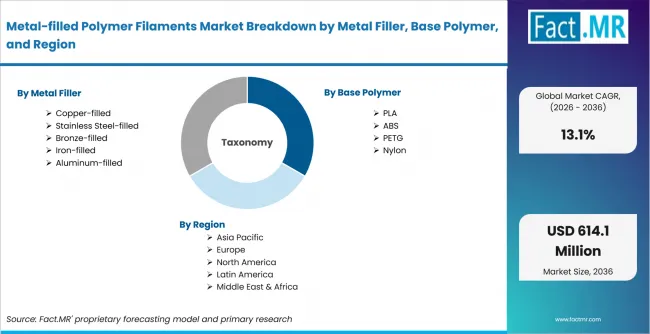
Metal Filled Polymer Filaments Market Breakdown By Metal Filler, Base Polymer, And Region | Source: Fact.MR
| Attribute | Details |
|---|---|
| Quantitative Units | USD million in 2026 to USD million by 2036 at CAGR |
| Market Definition | Metal-filled polymer filament materials and related workflows used in FFF and FDM printing for metal-look parts, weighted prototypes, and selected sinterable components |
| Metal Filler | Copper-filled; Stainless Steel-filled; Bronze-filled; Iron-filled; Aluminum-filled |
| Base Polymer | PLA; ABS; PETG; Nylon |
| Application | Prototyping; Decorative Objects; Functional Parts; Tooling |
| End Use | Consumer/Hobbyist; Industrial; Education; Jewelry & Art |
| Regions Covered | North America; Latin America; Europe; East Asia; South Asia and Pacific; Middle East and Africa |
| Countries Covered | India; China; Australia; United Kingdom; U.S.; Germany; Japan |
| Key Companies Profiled | The Virtual Foundry; colorFabb; Protopasta; Markforged; Raise3D |
| Forecast Period | 2026 to 2036 |
| Approach | Hybrid top-down and bottom-up approach using material-claim checks; additive manufacturing policy evidence; printer compatibility review; country CAGRs and service workflow validation |
Source: Fact.MR analysis. Updated Jul 13, 2026
How is the market segmented?
-
By Metal Filler:
- Copper-filled
- Stainless Steel-filled
- Bronze-filled
- Iron-filled
- Aluminum-filled
-
By Base Polymer:
- PLA
- ABS
- PETG
- Nylon
-
By Application:
- Prototyping
- Decorative Objects
- Functional Parts
- Tooling
-
By End Use:
- Consumer/Hobbyist
- Industrial
- Education
- Jewelry & Art
-
By Region:
- North America
- United States
- Canada
- Latin America
- Brazil
- Mexico
- Chile
- Peru
- Europe
- Germany
- United Kingdom
- France
- Italy
- Spain
- East Asia
- China
- Japan
- South Korea
- South Asia and Pacific
- India
- Australia
- Indonesia
- Middle East and Africa
- UAE
- Saudi Arabia
- South Africa
- North America
Frequently Asked Questions
What CAGR is projected for India?
How is China anticipated to perform?
What pace is estimated for Australia?
How is United Kingdom demand likely to expand?
What is expected to support the U.S. forecast?
How is Germany anticipated to perform in the forecast?
What driver has the central role in the market?
What restraint limits wider adoption?
Why are metal-filled polymer filaments used in functional 3D printing?
How do service bureaus affect adoption?
Who worked on this report


Preview the report firsthand - request a free sample
Free SampleGet the brochure for pricing and purchase details
Download PDF