Microbial Transplantation Kit Market

Microbial Transplantation Kit Market Analysis, By Product (Donor Screening Kits, Sample Collection Devices, Processing & Homogenization System, Filtration & Encapsulation Consumables, Cryopreservation Media & Transport Kits, and Sterile Delivery Kits), By Route of Administration, By Indication, By End User, and By Region- Market Insights 2025 to 2035

Filtration & Encapsulation Consumables Segment Is Projected To Grow At A CAGR Of 7.9%, Whereas Another Segment Donor Screening Kits Is Likely To Grow At 7.6%. In Terms Of Countries China Is Projected To Grow At 8.3%, Followed By UK At 8.2% And Germany To Grow At 7.8%

Microbial Transplantation Kit Market Outlook 2025 to 2035

The global microbial transplantation kit market is expected to reach USD 891.8 million by 2035, up from USD 461.9 million in 2025. During the forecast period 2025 to 2035, the industry is projected to expand at a CAGR of 6.8%.

The clinical development of microbiome therapeutics has established microbial transplantation kits as a part of the management of infectious diseases, especially of Clostridioides difficile and inflammatory bowel diseases. The standardized system of donor screening and encapsulation is being implemented rapidly in hospitals and biobanks and is steadily adopted throughout North America and Western Europe. The industry is booming now with regulatory clearance, such as FDA to clear Rebyota, and clinician confidence and visibility of reimbursement, together with alliances among diagnostic and biotech companies, is reinforcing the process scalability.

An increased interest in gut microbiome rehabilitation as a chronic disease treatment has increased the need to use oral administration routes, which decreases the reliance on invasive procedures. Several of the factors that have promoted efficiency in clinical laboratories are the quick automation of stool processing and cryopreservation, which has led to improved sample viability and turnaround time. This simultaneous development of GMP-approved centers, particularly in the U.S. and France, highlights the fact that the market is still in the process of abandoning experimental therapy and progressing to the regulated clinical practice.

Quick Stats for Microbial Transplantation Kit Market

  • Industry Value (2025): USD 461.9 Million
  • Projected Value (2035): USD 891.8 Million
  • Forecast CAGR (2025 to 2035): 6.8%
  • Leading Segment (2025): Donor Screening Kits (27.6% Market Share)
  • Fastest Growing Country (2025-2035): China (8.3% CAGR)
  • Top Key Players: Rebiotix, Finch Therapeutics, Seres Therapeutics, Crestovo LLC, and MicroBiome Therapeutics LLC
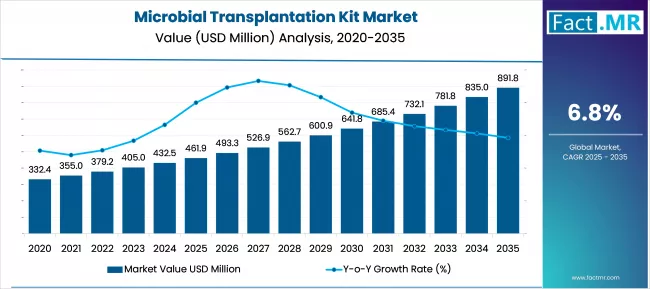
Microbial Transplantation Kit Market Market Value Analysis

The rise in partnerships between biotechnology developers and healthcare providers has shown that there will be continual growth in clinical trials. Accurate donor profiling and multi-omic is becoming part of transplant validation, gaining the attention of both private and government research funding organizations. Recently, there was a growing preference by hospitals towards modular kit systems that are traceable and controllable to guarantee compliance with international biosafety guidelines.

In spite of such positive achievements, the pricing differences, lack of donors, and the complicated regulatory control are some of the key obstacles. Differences in screening procedures across nations make it difficult to standardize globally and the interruption of the supply chains in terms of cold-chain logistics still affects the reliability of the procedures. These operational inefficiencies will be critical to fulfilling the growth momentum and wider clinical adoption in the near future.

What are the drivers of the microbial transplantation kit market?

The US, Germany, Japan, China, and the United Kingdom are in the process of pioneering, evolving, and bringing AI-enhanced microbial transplantation technology in the healthcare and biotech industries. With a growing medicine initiative and robust digital data management tools, the use of AI-based donor screening, microbiome sequencing analytics is rapidly expanding throughout hospital networks. The areas have strong biomedical R&D ecosystems, which can quickly prove the next-generation microbial transplantation kits and can easily incorporate the digital tools of microbiome profiling, compliance, and traceability.

Digitization of microbial transplantation processes such as real-time viability, predictive microbial compatibility modelling and cloud-based biosafety monitoring is transforming the way clinicians and scientists are undertaking gut microbial therapies. An increase in interest in personalized microbial treatment, an increase in clinical trials on metabolic and neurological diseases, and the application of machine learning in the mapping of microbiomes are likely to spur market growth in the next decade. Such developments are also in line with the wider global efforts to curb the abuse of antibiotics and enhance the gastrointestinal medical outcomes.

What are the regional trends of the microbial transplantation kit market?

Asia Pacific remains the epicenter of growth of microbial transplantation technology. China is increasing its production via national health innovation programs and large-scale investment in microbiome-based therapeutics producing GMP certified manufacturing facilities and developing superior donor screening networks. India is also emerging as one of the most important markets with governmental efforts to boost the biopharmaceutical manufacturing, increase the diagnostic capacity, and encourage the collaboration of the hospitals with the microbiome start-ups.

The European continent is transforming fast with stringent regulatory controls and sustainability-focused healthcare standards which incline towards the implementation of certified microbial transplantation kits. Germany and France have been at the forefront in terms of widespread R&D in accuracy microbiome medicines, clinical standardization, and automation of donor processing according to the EU biosafety regulation. The U.K. proves through adopting digitalized traceability, and AI-based donor-matching algorithms in clinical networks: making sure that compliance and therapeutic consistency are ensured. The high clinical trial ecosystem and attention to controlling the dependency on antibiotics in the region further promote the demand of the proven transplantation solutions.

The United States leads the way in innovations in microbiome science in North America. Combining AI-based donor screening and sophisticated encapsulation techniques has also enabled microbial transplantation to be more available and dependable in hospitals as well as research. Canada is also strengthening its presence by investing in bioinformatics and micro-microbial production facilities to cater to its local and export markets.

Middle East and Africa and the Latin America are slowly getting into the early adoption stage, which is backed by the increasing gastrointestinal disorders and medical tourism. Modernization of the healthcare system, combined with global cooperation and local alliances with biotech companies in Europe and Asia, will likely increase the number of standardized microbial transplantation kits in the nearest years.

What are the challenges and restraining factors of the microbial transplantation kit market?

The challenge of managing, preserving, and regulatory compliance related to the microbiome is what keeps microbial transplantation kits to large scale. To preserve microbial viability throughout the collection, processing, and storage of samples, there is a need of special infrastructure, GMO certified laboratories, and highly qualified staff. Such needs make them very expensive operations and large-scale standardization, and availability is challenging especially in the developing regions where clinical microbiome infrastructure is still in its infancy.

The approval of the microbial transplantation is still resource- and time-consuming. Every new product has to be biosafety-validated, ethically-certified by the donors, and pathogen-screened in accordance to country-specific requirements by agencies like the FDA, EMA and PMDA. These rigorous approval processes increase product launch time and costs on research and development. The absence of harmonized international laws also adds to the global commercialization predicament since the regional differences in the eligibility of donors, the sample transportation, and traceability of the data add logistical logjams to manufacturers.

There are also barriers to clinical acceptance that include low practitioner awareness and unreliable coverage of reimbursement. Numerous health providers are still wary of introducing microbial transplantation into the mainstream treatment plans because no long-term effectiveness data are available, and patient outcomes are inconsistent, and no common outcome measures are established. The inability to purchase and maintain sterile kits, cryopreservation media, and monitoring technologies is another issue that hospital in cost-sensitive markets have to struggle with because of limited budgets.

Country-Wise Insights
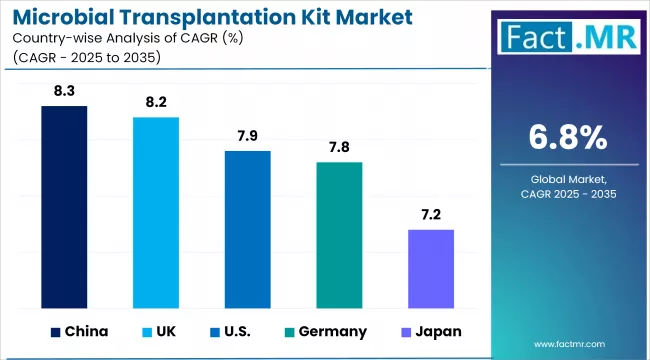
Microbial Transplantation Kit Market Cagr Analysis By Country

AI-Enabled Microbiome Analytics and GMP Expansion Accelerate Therapeutic Innovation in Japan

The market of microbial transplantation kits in Japan is driven by the fact that the high growth of AI-based microbiome analytics and the increase of Good Manufacturing Practice (GMP)-certified bioprocessing plants are rapidly advancing. The established clinical research system and regulatory similarity of the country with international biosafety regulations have promoted the adoption of automated donor screening. These technologies are allowing greater precision of matching donors and recipients, less contamination, and more overall reliability to therapeutic results.

The ongoing investment by the Japanese government in the digitalization of healthcare and the field of regenerative medicine under the framework of the so-called Healthcare Innovation Strategy has enhanced the pipeline of commercialization of the microbiome-based therapies, as well. The developed diagnostic ecosystem in the country and well-developed medical device industry is a good fertile land to expand microbial transplantation kits production and improve traceability throughout supply chains. These infrastructure improvements are expected to have a direct clinical benefit in clinical trials of gastrointestinal, metabolic and neurological disorders.

In the next few years, precision healthcare in Japan, with increased partnerships between research centers and pharmaceutical companies will keep the innovation going. Thus drive the market in the coming year.

AI-Enabled Microbiome Analytics and GMP Expansion Accelerate Therapeutic Innovation in Japan

The Japanese microbial transplantation kit market has been driven forward by fast progress in AI-based microbiome analytics and an increase in the number of Good Manufacturing Practice (GMP)-certified bioprocessing plants. The already developed clinical research system and regulatory harmonization with the international biosafety conditions in the country has urged hospitals and biotech companies to implement automated donor screening and AI-based microbial profiling into clinical practices. These technologies are making it possible to achieve increased precision in the matching of the donors and the recipient, lower risk of contamination, and enhance the overall therapeutic efficacy.

The pipeline of commercialization of microbiome-based therapies has also been supported by the sustained investment by the Japanese government in digitalization of its healthcare and regenerative medicine under the Healthcare Innovation Strategy. The well-established diagnostic ecosystem and high-tech medical device industry are the rich ground in the country to scale the production of microbial transplantation kits and improve the levels of traceability throughout the supply lines.

Innovation in Japan will be driven by the increased attention to precision healthcare in the next few years along with the emerging and increasing number of collaborations between research institutes and pharmaceutical companies.

Rising Clinical Adoption and Government-Backed Biotech Investment Fuel Market Growth in the United States

The United States is one of the most vibrant markets in microbial transplantation kits, which has been enhanced by strong clinical adoption of the kits and the sheer strength of the federal investment in biotechnology. The increased interest in microbiome therapy as therapy and especially in the treatment of Clostridioides difficile infections and inflammatory bowel diseases has stimulated the hospital adoption of standardized donor screening, encapsulation, and cryopreservation devices. The recent approvals by FDA of live biotherapeutic products have confirmed the regulatory route of the market and expedited business development.
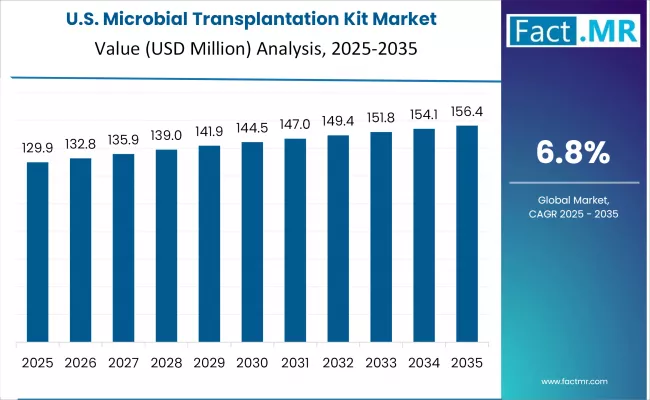
Microbial Transplantation Kit Market Country Value Analysis

The U.S.-based companies are spending big money on AI-powered microbial recognition systems and next-generation sequencing (NGS) devices that can support evidence-based and personalized transplantation processes. The emergence of special stool banks and good cold-chain logistics system also enhances efficiency of production and distribution in the country.

In future, the US will still be the leader in the global market due to its unrivaled R&D, expanding network of clinical trials and enabling reimbursement policies.

Category-Wise Analysis

AI-Powered Diagnostics and Genetic Profiling Cement Donor Screening Kits as the Cornerstone of Microbial Transplantation
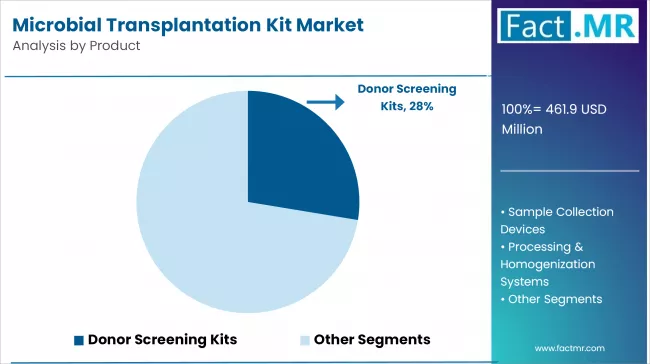
Microbial Transplantation Kit Market Analysis By Product

The category of the microbial transplantation kits is the most significant factor that influences the safety, regulatory and therapeutic success of microbial transplantation kits: the Donor Screening Kits part of the market is the most crucial one. Such kits use AI-enhanced diagnostic solutions, genetic sequencing methods, and multiplex pathogen panels which guarantee that the donor microbiota is tested on infectious, metabolic, and genetic anomalies prior to transplantation. They have become a part and parcel of routine clinical practices in hospitals and biobanks that require evidence-based and traceable methods of microbial selection.

Donor screening kits are approved by regulatory bodies (FDA and EMA) in both clinical and research practice as having to be included in quality assurance procedures. With the shift of microbiome-based therapeutics as a form of experimental therapy to an accepted source of medical therapy, the clinical credibility of validated donor screening infrastructure will provide a direct influence on physician confidence and patient outcome.

Non-Invasive Capsule Innovations and Precision Delivery Position Oral Route at the Forefront of Microbial Therapeutics
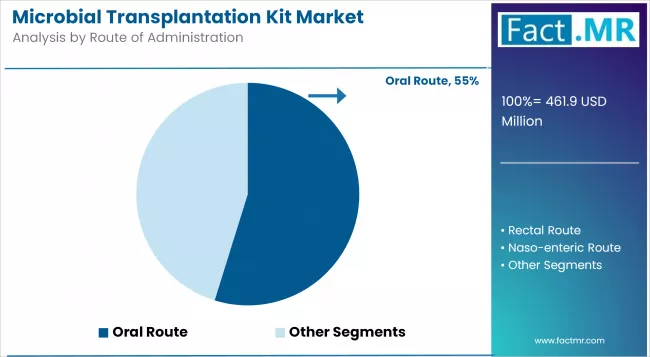
Microbial Transplantation Kit Market Analysis By Route Of Administration

Oral Route has become the most desirable and scalable microbial transplantation, due to its non-invasive administration, high-patient compliance and scalability to clinical mass implementation. The use of oral formulations (especially enteric-coated and freeze-dried capsules) maintains microbial viability whilst allowing specific delivery of the gastrointestinal tract, without triggering the discomfort and risk of procedures of colonoscopy or enema-based transplantation. The capsules can be easily administered to patients in clinics and greatly increase the availability of microbiome-based medicines to outpatient and distance care frameworks.

The increased need to use the oral transplantation solutions is supported by massive clinical validation particularly in Clostridioides difficile infection, inflammatory bowel disease, and metabolic disorders treatments. Pharma-industry partnerships have enhanced the further development of capsule design by the use of micro-encapsulation, time-regulated delivery, and AI-guided design toolkit. These technologies increase the therapeutic specificity of microbiota delivery, guaranteeing the reproducibility and the long-term effectiveness of such treatment in various patients. With the focus of healthcare systems on patient-friendly therapeutic approaches, oral administration has gained the center stage in both regulatory and research and development.

Competitive Analysis

Key players in the microbial transplantation kit market are Rebiotix, Finch Therapeutics, Seres Therapeutics, Crestovo LLC, MicroBiome Therapeutics LLC, Enterome Bioscience, MaaT Pharma SA, Ritter Pharmaceuticals, Second Genome, OpenBiome, Microbiotica Limited, CosmosID Inc., AOBiome, Synthetic Biologics Inc., and Osel Inc.

The Microbial Transplantation Kit Market is becoming more and more competitive with the rivalries focused on AI-driven donor screening systems, automated processing systems, cryopreservation systems, and online traceability systems. All these areas of innovation specify the extent to which the clinical outcomes may be optimized and biosafety and compliance are ensured. The proprietary assay designs, cloud-interconnected data monitoring as well as predictive profiling of microbials have emerged as the main points of differentiation that define the long-term competitive advantage. The solutions do not only improve the microbial viability and consistency but also make it possible to conduct quality control and provide therapeutic validation based on data in real time and across hospitals and research centers.

The established manufacturers are also finding unique collaborations with GMP-certified biomanufacturing facilities, academic research consortia, and clinical biobanks, which gives them a preferred supplier relationship in networks approved by the regulators. Alliances are desiring companies with intellectual property in high-tech microbial encapsulation, artificial intelligence compatible rating, and biosecure logistics systems. The incorporation of intelligent delivery systems, which involves microbial stability, assurance of sterility and digital records has been an order of the day with major enterprises aiming to comply with global standards of biosafety and clinical reproducibility.

The evolution of competitive positioning is taking the form of strategic alliances between biotech companies, diagnostics equipment vendors, and healthcare IT solution vendors. There is an evolution of the market towards application-specific, end-to-end microbial transplantation systems that have the potential to customize therapies to gastrointestinal, metabolic and neurological uses. Those companies that are using AI to match donors and recipients, microbial tracking, and automated homogenization among others are multiplying. Such a combination of automation, bioinformatics, and regulatory compliance is creating a new microbial transplantation solution ecosystem of value-added solutions, dominating companies that can strike a balance between innovation and clinical integrity.

Recent Development

  • In 2024, Finch Therapeutics successfully won a U.S. jury trial against Ferring Pharmaceuticals on patents involving fecal-transplant technology with the court finding that Ferring Rebyota therapy infringed on patents that were licensed to Finch by the University of Minnesota.

Fact.MR has provided detailed information about the price points of key manufacturers of Microbial Transplantation Kit Market positioned across regions, sales growth, production capacity, and speculative technological expansion, in the recently published report.

Methodology and Industry Tracking Approach

The 2025 microbial transplantation kit market report by Fact.MR is based on insights collected from 1,200 stakeholders across 12 countries, with a minimum of 75 respondents per country. Among the participants, 65% were end users including biopolymer converters, specialty chemical formulators, and FMCG sustainability teams while the remaining 35% included sourcing managers, R&D directors, environmental compliance leads, and bioeconomy consultants.

Data collection was conducted between July 2024 and June 2025, focusing on parameters such as monomer purity, conversion yield, cost per ton, end-use compatibility, feedstock availability, and regulatory alignment. A regionally weighted calibration model ensured balanced representation across North America, Europe, and Asia-Pacific.

The study triangulated over 95 validated sources, including patent databases, sustainability disclosures, process modeling datasets, and annual reports from monomer and biopolymer producers.

Fact.MR applied rigorous analytical tools such as multi-variable regression and scenario modeling to ensure data robustness. With continuous monitoring of the glass adhesives space since 2018, this report offers a comprehensive roadmap for firms seeking competitive advantage, innovation, and sustainable growth within the sector.

Segmentation of Microbial Transplantation Kit Market

  • By Product :

    • Donor Screening Kits
    • Sample Collection Devices
    • Processing & Homogenization Systems
    • Filtration & Encapsulation Consumables
    • Cryopreservation Media & Transport Kits
    • Sterile Delivery Kits
  • By Route of Administration :

    • Oral Route
    • Rectal Route
    • Naso-enteric Route
  • By Indication :

    • Gastrointestinal Disorders
    • Metabolic and Autoimmune Diseases
    • Neurological Disorders
    • Other
  • By End User :

    • Hospitals and Gastroenterology Clinics
    • Ambulatory Surgical Centers
    • Stool Banks and Biobanks
    • Academic and Research Institutes
    • Contract Manufacturing and CROs
  • By Region :

    • North America
    • Latin America
    • Western Europe
    • Eastern Europe
    • East Asia
    • South Asia & Pacific
    • Middle East & Africa

Table of Content

  1. Executive Summary
    • Global Market Outlook
    • Demand-side Trends
    • Supply-side Trends
    • Technology Roadmap Analysis
    • Analysis and Recommendations
  2. Market Overview
    • Market Coverage / Taxonomy
    • Market Definition / Scope / Limitations
  3. Market Background
    • Market Dynamics
      • Drivers
      • Restraints
      • Opportunity
      • Trends
    • Scenario Forecast
      • Demand in Optimistic Scenario
      • Demand in Likely Scenario
      • Demand in Conservative Scenario
    • Opportunity Map Analysis
    • Product Life Cycle Analysis
    • Supply Chain Analysis
    • Investment Feasibility Matrix
    • Value Chain Analysis
    • PESTLE and Porter’s Analysis
    • Regulatory Landscape
    • Regional Parent Market Outlook
    • Production and Consumption Statistics
    • Import and Export Statistics
  4. Global Market Analysis 2020-2024 and Forecast, 2025-2035
    • Historical Market Size Value (USD Million) & Units Analysis, 2020-2024
    • Current and Future Market Size Value (USD Million) & Units Projections, 2025-2035
      • Y-o-Y Growth Trend Analysis
      • Absolute $ Opportunity Analysis
  5. Global Market Pricing Analysis 2020-2024 and Forecast 2025-2035
  6. Global Market Analysis 2020-2024 and Forecast 2025-2035, By Product
    • Introduction / Key Findings
    • Historical Market Size Value (USD Million) & Units Analysis By Product, 2020-2024
    • Current and Future Market Size Value (USD Million) & Units Analysis and Forecast By Product, 2025-2035
      • Donor Screening Kits
      • Sample Collection Devices
      • Processing & Homogenization Systems
      • Filtration & Encapsulation Consumables
      • Cryopreservation Media & Transport Kits
      • Sterile Delivery Kits
    • Y-o-Y Growth Trend Analysis By Product, 2020-2024
    • Absolute $ Opportunity Analysis By Product, 2025-2035
  7. Global Market Analysis 2020-2024 and Forecast 2025-2035, By Route of Administration
    • Introduction / Key Findings
    • Historical Market Size Value (USD Million) & Units Analysis By Route of Administration, 2020-2024
    • Current and Future Market Size Value (USD Million) & Units Analysis and Forecast By Route of Administration, 2025-2035
      • Oral Route
      • Rectal Route
      • Naso-enteric Route
    • Y-o-Y Growth Trend Analysis By Route of Administration, 2020-2024
    • Absolute $ Opportunity Analysis By Route of Administration, 2025-2035
  8. Global Market Analysis 2020-2024 and Forecast 2025-2035, By Indication
    • Introduction / Key Findings
    • Historical Market Size Value (USD Million) & Units Analysis By Indication, 2020-2024
    • Current and Future Market Size Value (USD Million) & Units Analysis and Forecast By Indication, 2025-2035
      • Gastrointestinal Disorders
      • Metabolic and Autoimmune Diseases
      • Neurological Disorders
      • Other
    • Y-o-Y Growth Trend Analysis By Indication, 2020-2024
    • Absolute $ Opportunity Analysis By Indication, 2025-2035
  9. Global Market Analysis 2020-2024 and Forecast 2025-2035, By End User
    • Introduction / Key Findings
    • Historical Market Size Value (USD Million) & Units Analysis By End User, 2020-2024
    • Current and Future Market Size Value (USD Million) & Units Analysis and Forecast By End User, 2025-2035
      • Hospitals and Gastroenterology Clinics
      • Ambulatory Surgical Centers
      • Stool Banks and Biobanks
      • Academic and Research Institutes
      • Contract Manufacturing and CROs
    • Y-o-Y Growth Trend Analysis By End User, 2020-2024
    • Absolute $ Opportunity Analysis By End User, 2025-2035
  10. Global Market Analysis 2020-2024 and Forecast 2025-2035, By Region
    • Introduction
    • Historical Market Size Value (USD Million) & Units Analysis By Region, 2020-2024
    • Current Market Size Value (USD Million) & Units Analysis and Forecast By Region, 2025-2035
      • North America
      • Latin America
      • Western Europe
      • Eastern Europe
      • East Asia
      • South Asia and Pacific
      • Middle East & Africa
    • Market Attractiveness Analysis By Region
  11. North America Market Analysis 2020-2024 and Forecast 2025-2035, By Country
    • Historical Market Size Value (USD Million) & Units Trend Analysis By Market Taxonomy, 2020-2024
    • Market Size Value (USD Million) & Units Forecast By Market Taxonomy, 2025-2035
      • By Country
        • U.S.
        • Canada
        • Mexico
      • By Product
      • By Route of Administration
      • By Indication
      • By End User
    • Market Attractiveness Analysis
      • By Country
      • By Product
      • By Route of Administration
      • By Indication
      • By End User
    • Key Takeaways
  12. Latin America Market Analysis 2020-2024 and Forecast 2025-2035, By Country
    • Historical Market Size Value (USD Million) & Units Trend Analysis By Market Taxonomy, 2020-2024
    • Market Size Value (USD Million) & Units Forecast By Market Taxonomy, 2025-2035
      • By Country
        • Brazil
        • Chile
        • Rest of Latin America
      • By Product
      • By Route of Administration
      • By Indication
      • By End User
    • Market Attractiveness Analysis
      • By Country
      • By Product
      • By Route of Administration
      • By Indication
      • By End User
    • Key Takeaways
  13. Western Europe Market Analysis 2020-2024 and Forecast 2025-2035, By Country
    • Historical Market Size Value (USD Million) & Units Trend Analysis By Market Taxonomy, 2020-2024
    • Market Size Value (USD Million) & Units Forecast By Market Taxonomy, 2025-2035
      • By Country
        • Germany
        • U.K.
        • Italy
        • Spain
        • France
        • Nordic
        • BENELUX
        • Rest of Western Europe
      • By Product
      • By Route of Administration
      • By Indication
      • By End User
    • Market Attractiveness Analysis
      • By Country
      • By Product
      • By Route of Administration
      • By Indication
      • By End User
    • Key Takeaways
  14. Eastern Europe Market Analysis 2020-2024 and Forecast 2025-2035, By Country
    • Historical Market Size Value (USD Million) & Units Trend Analysis By Market Taxonomy, 2020-2024
    • Market Size Value (USD Million) & Units Forecast By Market Taxonomy, 2025-2035
      • By Country
        • Russia
        • Poland
        • Hungary
        • Balkan & Baltic
        • Rest of Eastern Europe
      • By Product
      • By Route of Administration
      • By Indication
      • By End User
    • Market Attractiveness Analysis
      • By Country
      • By Product
      • By Route of Administration
      • By Indication
      • By End User
    • Key Takeaways
  15. East Asia Market Analysis 2020-2024 and Forecast 2025-2035, By Country
    • Historical Market Size Value (USD Million) & Units Trend Analysis By Market Taxonomy, 2020-2024
    • Market Size Value (USD Million) & Units Forecast By Market Taxonomy, 2025-2035
      • By Country
        • China
        • Japan
        • South Korea
      • By Product
      • By Route of Administration
      • By Indication
      • By End User
    • Market Attractiveness Analysis
      • By Country
      • By Product
      • By Route of Administration
      • By Indication
      • By End User
    • Key Takeaways
  16. South Asia and Pacific Market Analysis 2020-2024 and Forecast 2025-2035, By Country
    • Historical Market Size Value (USD Million) & Units Trend Analysis By Market Taxonomy, 2020-2024
    • Market Size Value (USD Million) & Units Forecast By Market Taxonomy, 2025-2035
      • By Country
        • India
        • ASEAN
        • Australia & New Zealand
        • Rest of South Asia and Pacific
      • By Product
      • By Route of Administration
      • By Indication
      • By End User
    • Market Attractiveness Analysis
      • By Country
      • By Product
      • By Route of Administration
      • By Indication
      • By End User
    • Key Takeaways
  17. Middle East & Africa Market Analysis 2020-2024 and Forecast 2025-2035, By Country
    • Historical Market Size Value (USD Million) & Units Trend Analysis By Market Taxonomy, 2020-2024
    • Market Size Value (USD Million) & Units Forecast By Market Taxonomy, 2025-2035
      • By Country
        • Kingdom of Saudi Arabia
        • Other GCC Countries
        • Turkiye
        • South Africa
        • Other African Union
        • Rest of Middle East & Africa
      • By Product
      • By Route of Administration
      • By Indication
      • By End User
    • Market Attractiveness Analysis
      • By Country
      • By Product
      • By Route of Administration
      • By Indication
      • By End User
    • Key Takeaways
  18. Key Countries Market Analysis
    • U.S.
      • Pricing Analysis
      • Market Share Analysis, 2024
        • By Product
        • By Route of Administration
        • By Indication
        • By End User
    • Canada
      • Pricing Analysis
      • Market Share Analysis, 2024
        • By Product
        • By Route of Administration
        • By Indication
        • By End User
    • Mexico
      • Pricing Analysis
      • Market Share Analysis, 2024
        • By Product
        • By Route of Administration
        • By Indication
        • By End User
    • Brazil
      • Pricing Analysis
      • Market Share Analysis, 2024
        • By Product
        • By Route of Administration
        • By Indication
        • By End User
    • Chile
      • Pricing Analysis
      • Market Share Analysis, 2024
        • By Product
        • By Route of Administration
        • By Indication
        • By End User
    • Germany
      • Pricing Analysis
      • Market Share Analysis, 2024
        • By Product
        • By Route of Administration
        • By Indication
        • By End User
    • U.K.
      • Pricing Analysis
      • Market Share Analysis, 2024
        • By Product
        • By Route of Administration
        • By Indication
        • By End User
    • Italy
      • Pricing Analysis
      • Market Share Analysis, 2024
        • By Product
        • By Route of Administration
        • By Indication
        • By End User
    • Spain
      • Pricing Analysis
      • Market Share Analysis, 2024
        • By Product
        • By Route of Administration
        • By Indication
        • By End User
    • France
      • Pricing Analysis
      • Market Share Analysis, 2024
        • By Product
        • By Route of Administration
        • By Indication
        • By End User
    • India
      • Pricing Analysis
      • Market Share Analysis, 2024
        • By Product
        • By Route of Administration
        • By Indication
        • By End User
    • ASEAN
      • Pricing Analysis
      • Market Share Analysis, 2024
        • By Product
        • By Route of Administration
        • By Indication
        • By End User
    • Australia & New Zealand
      • Pricing Analysis
      • Market Share Analysis, 2024
        • By Product
        • By Route of Administration
        • By Indication
        • By End User
    • China
      • Pricing Analysis
      • Market Share Analysis, 2024
        • By Product
        • By Route of Administration
        • By Indication
        • By End User
    • Japan
      • Pricing Analysis
      • Market Share Analysis, 2024
        • By Product
        • By Route of Administration
        • By Indication
        • By End User
    • South Korea
      • Pricing Analysis
      • Market Share Analysis, 2024
        • By Product
        • By Route of Administration
        • By Indication
        • By End User
    • Russia
      • Pricing Analysis
      • Market Share Analysis, 2024
        • By Product
        • By Route of Administration
        • By Indication
        • By End User
    • Poland
      • Pricing Analysis
      • Market Share Analysis, 2024
        • By Product
        • By Route of Administration
        • By Indication
        • By End User
    • Hungary
      • Pricing Analysis
      • Market Share Analysis, 2024
        • By Product
        • By Route of Administration
        • By Indication
        • By End User
    • Kingdom of Saudi Arabia
      • Pricing Analysis
      • Market Share Analysis, 2024
        • By Product
        • By Route of Administration
        • By Indication
        • By End User
    • Turkiye
      • Pricing Analysis
      • Market Share Analysis, 2024
        • By Product
        • By Route of Administration
        • By Indication
        • By End User
    • South Africa
      • Pricing Analysis
      • Market Share Analysis, 2024
        • By Product
        • By Route of Administration
        • By Indication
        • By End User
  19. Market Structure Analysis
    • Competition Dashboard
    • Competition Benchmarking
    • Market Share Analysis of Top Players
      • By Regional
      • By Product
      • By Route of Administration
      • By Indication
      • By End User
  20. Competition Analysis
    • Competition Deep Dive
      • Rebiotix
        • Overview
        • Product Portfolio
        • Profitability by Market Segments (Product/Age /Sales Channel/Region)
        • Sales Footprint
        • Strategy Overview
      • Finch Therapeutics
      • Seres Therapeutics
      • Crestovo LLC
      • MicroBiome Therapeutics LLC
      • Enterome Bioscience
      • MaaT Pharma SA
      • Ritter Pharmaceuticals
      • Second Genome
      • OpenBiome
      • Microbiotica Limited
      • CosmosID Inc.
      • AOBiome
      • Synthetic Biologics Inc.
      • Osel Inc.
  21. Assumptions & Acronyms Used
  22. Research Methodology

List Of Table

  • Table 1: Global Market Value (USD Million) Forecast by Region, 2020 to 2035
  • Table 2: Global Market Units Forecast by Region, 2020 to 2035
  • Table 3: Global Market Value (USD Million) Forecast by Product, 2020 to 2035
  • Table 4: Global Market Units Forecast by Product, 2020 to 2035
  • Table 5: Global Market Value (USD Million) Forecast by Route of Administration, 2020 to 2035
  • Table 6: Global Market Units Forecast by Route of Administration, 2020 to 2035
  • Table 7: Global Market Value (USD Million) Forecast by Indication, 2020 to 2035
  • Table 8: Global Market Units Forecast by Indication, 2020 to 2035
  • Table 9: Global Market Value (USD Million) Forecast by End User, 2020 to 2035
  • Table 10: Global Market Units Forecast by End User, 2020 to 2035
  • Table 11: North America Market Value (USD Million) Forecast by Country, 2020 to 2035
  • Table 12: North America Market Units Forecast by Country, 2020 to 2035
  • Table 13: North America Market Value (USD Million) Forecast by Product, 2020 to 2035
  • Table 14: North America Market Units Forecast by Product, 2020 to 2035
  • Table 15: North America Market Value (USD Million) Forecast by Route of Administration, 2020 to 2035
  • Table 16: North America Market Units Forecast by Route of Administration, 2020 to 2035
  • Table 17: North America Market Value (USD Million) Forecast by Indication, 2020 to 2035
  • Table 18: North America Market Units Forecast by Indication, 2020 to 2035
  • Table 19: North America Market Value (USD Million) Forecast by End User, 2020 to 2035
  • Table 20: North America Market Units Forecast by End User, 2020 to 2035
  • Table 21: Latin America Market Value (USD Million) Forecast by Country, 2020 to 2035
  • Table 22: Latin America Market Units Forecast by Country, 2020 to 2035
  • Table 23: Latin America Market Value (USD Million) Forecast by Product, 2020 to 2035
  • Table 24: Latin America Market Units Forecast by Product, 2020 to 2035
  • Table 25: Latin America Market Value (USD Million) Forecast by Route of Administration, 2020 to 2035
  • Table 26: Latin America Market Units Forecast by Route of Administration, 2020 to 2035
  • Table 27: Latin America Market Value (USD Million) Forecast by Indication, 2020 to 2035
  • Table 28: Latin America Market Units Forecast by Indication, 2020 to 2035
  • Table 29: Latin America Market Value (USD Million) Forecast by End User, 2020 to 2035
  • Table 30: Latin America Market Units Forecast by End User, 2020 to 2035
  • Table 31: Western Europe Market Value (USD Million) Forecast by Country, 2020 to 2035
  • Table 32: Western Europe Market Units Forecast by Country, 2020 to 2035
  • Table 33: Western Europe Market Value (USD Million) Forecast by Product, 2020 to 2035
  • Table 34: Western Europe Market Units Forecast by Product, 2020 to 2035
  • Table 35: Western Europe Market Value (USD Million) Forecast by Route of Administration, 2020 to 2035
  • Table 36: Western Europe Market Units Forecast by Route of Administration, 2020 to 2035
  • Table 37: Western Europe Market Value (USD Million) Forecast by Indication, 2020 to 2035
  • Table 38: Western Europe Market Units Forecast by Indication, 2020 to 2035
  • Table 39: Western Europe Market Value (USD Million) Forecast by End User, 2020 to 2035
  • Table 40: Western Europe Market Units Forecast by End User, 2020 to 2035
  • Table 41: Eastern Europe Market Value (USD Million) Forecast by Country, 2020 to 2035
  • Table 42: Eastern Europe Market Units Forecast by Country, 2020 to 2035
  • Table 43: Eastern Europe Market Value (USD Million) Forecast by Product, 2020 to 2035
  • Table 44: Eastern Europe Market Units Forecast by Product, 2020 to 2035
  • Table 45: Eastern Europe Market Value (USD Million) Forecast by Route of Administration, 2020 to 2035
  • Table 46: Eastern Europe Market Units Forecast by Route of Administration, 2020 to 2035
  • Table 47: Eastern Europe Market Value (USD Million) Forecast by Indication, 2020 to 2035
  • Table 48: Eastern Europe Market Units Forecast by Indication, 2020 to 2035
  • Table 49: Eastern Europe Market Value (USD Million) Forecast by End User, 2020 to 2035
  • Table 50: Eastern Europe Market Units Forecast by End User, 2020 to 2035
  • Table 51: East Asia Market Value (USD Million) Forecast by Country, 2020 to 2035
  • Table 52: East Asia Market Units Forecast by Country, 2020 to 2035
  • Table 53: East Asia Market Value (USD Million) Forecast by Product, 2020 to 2035
  • Table 54: East Asia Market Units Forecast by Product, 2020 to 2035
  • Table 55: East Asia Market Value (USD Million) Forecast by Route of Administration, 2020 to 2035
  • Table 56: East Asia Market Units Forecast by Route of Administration, 2020 to 2035
  • Table 57: East Asia Market Value (USD Million) Forecast by Indication, 2020 to 2035
  • Table 58: East Asia Market Units Forecast by Indication, 2020 to 2035
  • Table 59: East Asia Market Value (USD Million) Forecast by End User, 2020 to 2035
  • Table 60: East Asia Market Units Forecast by End User, 2020 to 2035
  • Table 61: South Asia and Pacific Market Value (USD Million) Forecast by Country, 2020 to 2035
  • Table 62: South Asia and Pacific Market Units Forecast by Country, 2020 to 2035
  • Table 63: South Asia and Pacific Market Value (USD Million) Forecast by Product, 2020 to 2035
  • Table 64: South Asia and Pacific Market Units Forecast by Product, 2020 to 2035
  • Table 65: South Asia and Pacific Market Value (USD Million) Forecast by Route of Administration, 2020 to 2035
  • Table 66: South Asia and Pacific Market Units Forecast by Route of Administration, 2020 to 2035
  • Table 67: South Asia and Pacific Market Value (USD Million) Forecast by Indication, 2020 to 2035
  • Table 68: South Asia and Pacific Market Units Forecast by Indication, 2020 to 2035
  • Table 69: South Asia and Pacific Market Value (USD Million) Forecast by End User, 2020 to 2035
  • Table 70: South Asia and Pacific Market Units Forecast by End User, 2020 to 2035
  • Table 71: Middle East & Africa Market Value (USD Million) Forecast by Country, 2020 to 2035
  • Table 72: Middle East & Africa Market Units Forecast by Country, 2020 to 2035
  • Table 73: Middle East & Africa Market Value (USD Million) Forecast by Product, 2020 to 2035
  • Table 74: Middle East & Africa Market Units Forecast by Product, 2020 to 2035
  • Table 75: Middle East & Africa Market Value (USD Million) Forecast by Route of Administration, 2020 to 2035
  • Table 76: Middle East & Africa Market Units Forecast by Route of Administration, 2020 to 2035
  • Table 77: Middle East & Africa Market Value (USD Million) Forecast by Indication, 2020 to 2035
  • Table 78: Middle East & Africa Market Units Forecast by Indication, 2020 to 2035
  • Table 79: Middle East & Africa Market Value (USD Million) Forecast by End User, 2020 to 2035
  • Table 80: Middle East & Africa Market Units Forecast by End User, 2020 to 2035

List Of Figures

  • Figure 1: Global Market Units Forecast 2020 to 2035
  • Figure 2: Global Market Pricing Analysis
  • Figure 3: Global Market Value (USD Million) Forecast 2020 to 2035
  • Figure 4: Global Market Value Share and BPS Analysis by Product, 2025 and 2035
  • Figure 5: Global Market Y-o-Y Growth Comparison by Product, 2025 to 2035
  • Figure 6: Global Market Attractiveness Analysis by Product
  • Figure 7: Global Market Value Share and BPS Analysis by Route of Administration, 2025 and 2035
  • Figure 8: Global Market Y-o-Y Growth Comparison by Route of Administration, 2025 to 2035
  • Figure 9: Global Market Attractiveness Analysis by Route of Administration
  • Figure 10: Global Market Value Share and BPS Analysis by Indication, 2025 and 2035
  • Figure 11: Global Market Y-o-Y Growth Comparison by Indication, 2025 to 2035
  • Figure 12: Global Market Attractiveness Analysis by Indication
  • Figure 13: Global Market Value Share and BPS Analysis by End User, 2025 and 2035
  • Figure 14: Global Market Y-o-Y Growth Comparison by End User, 2025 to 2035
  • Figure 15: Global Market Attractiveness Analysis by End User
  • Figure 16: Global Market Value (USD Million) Share and BPS Analysis by Region, 2025 and 2035
  • Figure 17: Global Market Y-o-Y Growth Comparison by Region, 2025 to 2035
  • Figure 18: Global Market Attractiveness Analysis by Region
  • Figure 19: North America Market Incremental $ Opportunity, 2025 to 2035
  • Figure 20: Latin America Market Incremental $ Opportunity, 2025 to 2035
  • Figure 21: Western Europe Market Incremental $ Opportunity, 2025 to 2035
  • Figure 22: Eastern Europe Market Incremental $ Opportunity, 2025 to 2035
  • Figure 23: East Asia Market Incremental $ Opportunity, 2025 to 2035
  • Figure 24: South Asia and Pacific Market Incremental $ Opportunity, 2025 to 2035
  • Figure 25: Middle East & Africa Market Incremental $ Opportunity, 2025 to 2035
  • Figure 26: North America Market Value Share and BPS Analysis by Country, 2025 and 2035
  • Figure 27: North America Market Value Share and BPS Analysis by Product, 2025 and 2035
  • Figure 28: North America Market Y-o-Y Growth Comparison by Product, 2025 to 2035
  • Figure 29: North America Market Attractiveness Analysis by Product
  • Figure 30: North America Market Value Share and BPS Analysis by Route of Administration, 2025 and 2035
  • Figure 31: North America Market Y-o-Y Growth Comparison by Route of Administration, 2025 to 2035
  • Figure 32: North America Market Attractiveness Analysis by Route of Administration
  • Figure 33: North America Market Value Share and BPS Analysis by Indication, 2025 and 2035
  • Figure 34: North America Market Y-o-Y Growth Comparison by Indication, 2025 to 2035
  • Figure 35: North America Market Attractiveness Analysis by Indication
  • Figure 36: North America Market Value Share and BPS Analysis by End User, 2025 and 2035
  • Figure 37: North America Market Y-o-Y Growth Comparison by End User, 2025 to 2035
  • Figure 38: North America Market Attractiveness Analysis by End User
  • Figure 39: Latin America Market Value Share and BPS Analysis by Country, 2025 and 2035
  • Figure 40: Latin America Market Value Share and BPS Analysis by Product, 2025 and 2035
  • Figure 41: Latin America Market Y-o-Y Growth Comparison by Product, 2025 to 2035
  • Figure 42: Latin America Market Attractiveness Analysis by Product
  • Figure 43: Latin America Market Value Share and BPS Analysis by Route of Administration, 2025 and 2035
  • Figure 44: Latin America Market Y-o-Y Growth Comparison by Route of Administration, 2025 to 2035
  • Figure 45: Latin America Market Attractiveness Analysis by Route of Administration
  • Figure 46: Latin America Market Value Share and BPS Analysis by Indication, 2025 and 2035
  • Figure 47: Latin America Market Y-o-Y Growth Comparison by Indication, 2025 to 2035
  • Figure 48: Latin America Market Attractiveness Analysis by Indication
  • Figure 49: Latin America Market Value Share and BPS Analysis by End User, 2025 and 2035
  • Figure 50: Latin America Market Y-o-Y Growth Comparison by End User, 2025 to 2035
  • Figure 51: Latin America Market Attractiveness Analysis by End User
  • Figure 52: Western Europe Market Value Share and BPS Analysis by Country, 2025 and 2035
  • Figure 53: Western Europe Market Value Share and BPS Analysis by Product, 2025 and 2035
  • Figure 54: Western Europe Market Y-o-Y Growth Comparison by Product, 2025 to 2035
  • Figure 55: Western Europe Market Attractiveness Analysis by Product
  • Figure 56: Western Europe Market Value Share and BPS Analysis by Route of Administration, 2025 and 2035
  • Figure 57: Western Europe Market Y-o-Y Growth Comparison by Route of Administration, 2025 to 2035
  • Figure 58: Western Europe Market Attractiveness Analysis by Route of Administration
  • Figure 59: Western Europe Market Value Share and BPS Analysis by Indication, 2025 and 2035
  • Figure 60: Western Europe Market Y-o-Y Growth Comparison by Indication, 2025 to 2035
  • Figure 61: Western Europe Market Attractiveness Analysis by Indication
  • Figure 62: Western Europe Market Value Share and BPS Analysis by End User, 2025 and 2035
  • Figure 63: Western Europe Market Y-o-Y Growth Comparison by End User, 2025 to 2035
  • Figure 64: Western Europe Market Attractiveness Analysis by End User
  • Figure 65: Eastern Europe Market Value Share and BPS Analysis by Country, 2025 and 2035
  • Figure 66: Eastern Europe Market Value Share and BPS Analysis by Product, 2025 and 2035
  • Figure 67: Eastern Europe Market Y-o-Y Growth Comparison by Product, 2025 to 2035
  • Figure 68: Eastern Europe Market Attractiveness Analysis by Product
  • Figure 69: Eastern Europe Market Value Share and BPS Analysis by Route of Administration, 2025 and 2035
  • Figure 70: Eastern Europe Market Y-o-Y Growth Comparison by Route of Administration, 2025 to 2035
  • Figure 71: Eastern Europe Market Attractiveness Analysis by Route of Administration
  • Figure 72: Eastern Europe Market Value Share and BPS Analysis by Indication, 2025 and 2035
  • Figure 73: Eastern Europe Market Y-o-Y Growth Comparison by Indication, 2025 to 2035
  • Figure 74: Eastern Europe Market Attractiveness Analysis by Indication
  • Figure 75: Eastern Europe Market Value Share and BPS Analysis by End User, 2025 and 2035
  • Figure 76: Eastern Europe Market Y-o-Y Growth Comparison by End User, 2025 to 2035
  • Figure 77: Eastern Europe Market Attractiveness Analysis by End User
  • Figure 78: East Asia Market Value Share and BPS Analysis by Country, 2025 and 2035
  • Figure 79: East Asia Market Value Share and BPS Analysis by Product, 2025 and 2035
  • Figure 80: East Asia Market Y-o-Y Growth Comparison by Product, 2025 to 2035
  • Figure 81: East Asia Market Attractiveness Analysis by Product
  • Figure 82: East Asia Market Value Share and BPS Analysis by Route of Administration, 2025 and 2035
  • Figure 83: East Asia Market Y-o-Y Growth Comparison by Route of Administration, 2025 to 2035
  • Figure 84: East Asia Market Attractiveness Analysis by Route of Administration
  • Figure 85: East Asia Market Value Share and BPS Analysis by Indication, 2025 and 2035
  • Figure 86: East Asia Market Y-o-Y Growth Comparison by Indication, 2025 to 2035
  • Figure 87: East Asia Market Attractiveness Analysis by Indication
  • Figure 88: East Asia Market Value Share and BPS Analysis by End User, 2025 and 2035
  • Figure 89: East Asia Market Y-o-Y Growth Comparison by End User, 2025 to 2035
  • Figure 90: East Asia Market Attractiveness Analysis by End User
  • Figure 91: South Asia and Pacific Market Value Share and BPS Analysis by Country, 2025 and 2035
  • Figure 92: South Asia and Pacific Market Value Share and BPS Analysis by Product, 2025 and 2035
  • Figure 93: South Asia and Pacific Market Y-o-Y Growth Comparison by Product, 2025 to 2035
  • Figure 94: South Asia and Pacific Market Attractiveness Analysis by Product
  • Figure 95: South Asia and Pacific Market Value Share and BPS Analysis by Route of Administration, 2025 and 2035
  • Figure 96: South Asia and Pacific Market Y-o-Y Growth Comparison by Route of Administration, 2025 to 2035
  • Figure 97: South Asia and Pacific Market Attractiveness Analysis by Route of Administration
  • Figure 98: South Asia and Pacific Market Value Share and BPS Analysis by Indication, 2025 and 2035
  • Figure 99: South Asia and Pacific Market Y-o-Y Growth Comparison by Indication, 2025 to 2035
  • Figure 100: South Asia and Pacific Market Attractiveness Analysis by Indication
  • Figure 101: South Asia and Pacific Market Value Share and BPS Analysis by End User, 2025 and 2035
  • Figure 102: South Asia and Pacific Market Y-o-Y Growth Comparison by End User, 2025 to 2035
  • Figure 103: South Asia and Pacific Market Attractiveness Analysis by End User
  • Figure 104: Middle East & Africa Market Value Share and BPS Analysis by Country, 2025 and 2035
  • Figure 105: Middle East & Africa Market Value Share and BPS Analysis by Product, 2025 and 2035
  • Figure 106: Middle East & Africa Market Y-o-Y Growth Comparison by Product, 2025 to 2035
  • Figure 107: Middle East & Africa Market Attractiveness Analysis by Product
  • Figure 108: Middle East & Africa Market Value Share and BPS Analysis by Route of Administration, 2025 and 2035
  • Figure 109: Middle East & Africa Market Y-o-Y Growth Comparison by Route of Administration, 2025 to 2035
  • Figure 110: Middle East & Africa Market Attractiveness Analysis by Route of Administration
  • Figure 111: Middle East & Africa Market Value Share and BPS Analysis by Indication, 2025 and 2035
  • Figure 112: Middle East & Africa Market Y-o-Y Growth Comparison by Indication, 2025 to 2035
  • Figure 113: Middle East & Africa Market Attractiveness Analysis by Indication
  • Figure 114: Middle East & Africa Market Value Share and BPS Analysis by End User, 2025 and 2035
  • Figure 115: Middle East & Africa Market Y-o-Y Growth Comparison by End User, 2025 to 2035
  • Figure 116: Middle East & Africa Market Attractiveness Analysis by End User
  • Figure 117: Global Market - Tier Structure Analysis
  • Figure 118: Global Market - Company Share Analysis

- FAQs -

What was the Global Microbial Transplantation Kit Market Size Reported by Fact.MR for 2025?

The global microbial transplantation kit market was valued at USD 461.9 million in 2025.

Who are the Major Players Operating in the Microbial Transplantation Kit Market?

Prominent players in the market are Rebiotix, Finch Therapeutics, Seres Therapeutics, Crestovo LLC, MicroBiome Therapeutics LLC, Enterome Bioscience, MaaT Pharma SA, among others.

What is the Estimated Valuation of the Microbial Transplantation Kit Market in 2035?

The market is expected to reach a valuation of USD 891.8 million in 2035.

What Value CAGR did the Microbial Transplantation Kit Market Exhibit Over the Last Five Years?

The historic growth rate of the microbial transplantation kit market was 5.7% from 2020-2024.

Microbial Transplantation Kit Market