First Aid Kit Market Size, Share, Growth and Forecast (2026 - 2036)
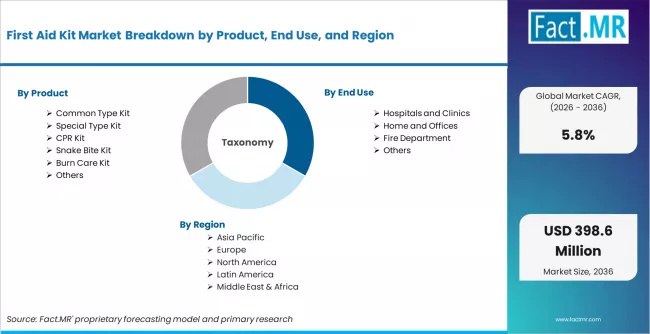
First Aid Kit Market is segmented by Product (Common Type Kit, Special Type Kit, CPR Kit, Snake Bite Kit, Burn Care Kit, Others), End Use (Hospitals and Clinics, Home and Offices, Fire Department, Others), Application (Emergency Care, Wound Care, Preventive Care, Disaster Management), and Region, with forecasts covering the period from 2026 to 2036.
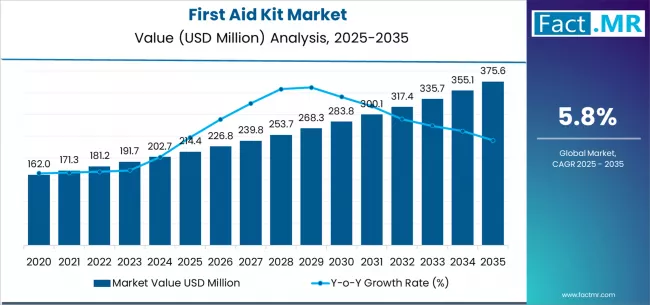
According to Fact.MR estimates, the global first aid kit Market was valued at USD 214.4 million in 2025. The market is projected to reach USD 226.8 million in 2026 and is expected to grow to USD 398.6 million by 2036, expanding at a CAGR of 5.8%. Common Type Kit is anticipated to account for 60.0% of the product segment in 2026, while Hospitals and Clinics is expected to remain the leading application with around 41.0% share.
First Aid Kit Market Analysis and Forecast by Fact.MR
- The global first aid kit market is estimated at USD 214.4 million in 2025 and is forecast to expand at a CAGR of 5.8% to reach USD 398.63 million by 2036.
- The market covers pre-assembled and customizable first aid kits designed for emergency care, wound management, and safety compliance across hospitals, clinics, workplaces, households, and public facilities.
- Product categories include common type kits, special type kits, CPR kits, burn care kits, and snake bite kits.
- Growth is shaped by expanding workplace safety regulations, growing household emergency preparedness awareness, increasing institutional compliance requirements, and rising adoption of smart and digitally integrated first aid solutions.
Summary of First Aid Kit Market
- Market Snapshot
- In 2025, the global First Aid Kit Market was valued at approximately USD 214.4 million.
- The market is estimated to reach USD 226.84 million in 2026 and is projected to attain USD 398.63 million by 2036.
- The first aid kit market is likely to expand at a CAGR of 5.8% during the forecast period.
- The market is anticipated to create an absolute dollar opportunity of USD 171.79 million between 2026 and 2036.
- Common Type Kit accounts for 60% of product share in 2026.
- India (6.7%) and China (6.3%) are the key growth markets during the forecast period.
- Demand and Growth Drivers
- Expanding workplace safety regulations and occupational health mandates are increasing institutional demand for compliant first aid kit products across industries.
- Growing household emergency preparedness awareness is driving consumer adoption of family and home-use first aid kits in both developed and emerging markets.
- Increasing demand from hospitals, clinics, and emergency departments for standardized trauma and wound care kits is supporting institutional product growth.
- Rising adoption of customizable and application-specific kits for industries such as construction, manufacturing, and transportation is expanding the addressable market.
- Growing interest in smart first aid kits with digital integration, guided assistance features, and connected device capabilities is creating premium product opportunities.
- Product and Segment View
- Common Type Kit accounts for 60% of the product segment in 2026, supported by strong adoption and proven market demand.
- Emergency Care represents 39% of the application segment in 2026, with demand shaped by core use-case prevalence.
- Kit Configuration accounts for 61% of the technology segment in 2026.
- Key segmentation includes:
- By Product: Common Type Kit, Special Type Kit, CPR Kit, Snake Bite Kit, Burn Care Kit, Others
- By End Use: Hospitals and Clinics, Home and Offices, Fire Department, Others
- By Application: Emergency Care, Wound Care, Preventive Care, Disaster Management
- By Technology: Kit Configuration, Smart First Aid Kits, Material Technology
- Geography and Competitive Outlook
- North America is a leading regional market supported by established institutional infrastructure, regulatory frameworks, and strong adoption of advanced products.
- Europe maintains steady demand shaped by regulatory standards, quality-focused procurement, and mature distribution channels.
- Asia Pacific is the fastest-growing region, with India and China leading through rising demand, expanding infrastructure, and growing awareness.
- India (6.7%) and China (6.3%) are the fastest-growing country markets during the forecast period.
- Key companies include Acme United Corporation, Certified Safety Manufacturing, Inc., Performance Health, UniFirst First Aid and Safety, Hartmann USA Inc., and others.
- Analyst Opinion
- Shambhu Nath Jha, Principal Consultant at Fact.MR, says 'The first aid kit market is moving beyond basic compliance toward value-added solutions that integrate digital guidance, condition-specific supplies, and customizable configurations. Workplace safety mandates remain the most reliable demand driver, but household adoption is accelerating as emergency preparedness awareness grows across both developed and emerging markets. The commercial differentiation is shifting from kit contents toward service models that include restocking, inspection, and digital integration. Companies offering managed first aid programs with regular replenishment and compliance tracking are building stronger institutional relationships than those relying on one-time product sales.'
Key Growth Drivers, Constraints, and Opportunities
Key Factors Driving Growth
- Expanding workplace safety regulations and occupational health mandates are increasing institutional demand for compliant first aid kit products across industries.
- Growing household emergency preparedness awareness is driving consumer adoption of family and home-use first aid kits in both developed and emerging markets.
- Increasing demand from hospitals, clinics, and emergency departments for standardized trauma and wound care kits is supporting institutional product growth.
Key Market Constraints
- Price sensitivity in consumer and small business segments constrains premium product adoption and limits average selling prices in competitive markets.
- Product shelf life and expiration management create recurring replacement costs that some buyers perceive as a barrier to maintaining fully stocked kits.
- Fragmented regulatory standards across countries complicate cross-border product standardization and increase compliance costs for multinational suppliers.
Key Opportunity Areas
- Development of managed first aid programs with restocking, compliance tracking, and inspection services creates recurring revenue models for institutional suppliers.
- Expansion of smart first aid kits with digital integration, AI-guided assistance, and connected monitoring creates premium product categories with higher margins.
- Growth in disaster preparedness and emergency response programs across government and institutional channels creates bulk procurement opportunities.
Segment-wise Analysis of the First Aid Kit Market
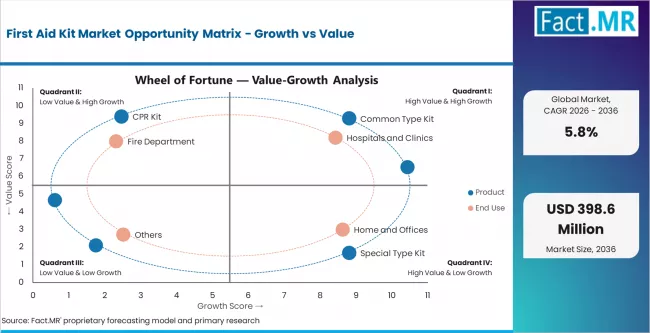
- Common Type Kit holds 60% of the product segment in 2026, supported by strong adoption and established demand patterns.
- Emergency Care represents 39% of the application segment in 2026, with demand shaped by core market drivers.
- Hospitals and Clinics holds 41% of the end use segment, with share expected to remain stable as the market evolves.
The first aid kit market is segmented by product, end use, application, technology, and region. Common Type Kit leads the product segment by value, while hospitals and clinics leads the end use segment. Growth across segments is shaped by evolving demand patterns, new product development, and distribution channel expansion.
Which Product Segment Dominates the First Aid Kit Market?
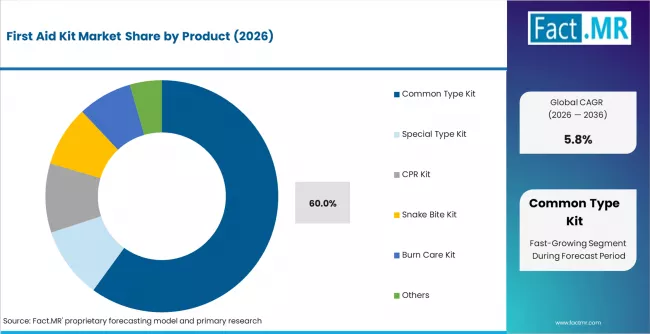
Common type kits are expected to account for 60% of the product segment in 2026. This leadership reflects the broad applicability of general purpose first aid kits across workplace, household, and institutional settings. Basic wound care kits, general purpose kits, and family first aid kits represent the primary sub-categories, with demand supported by regulatory compliance requirements and consumer safety awareness.
Special type kits, including trauma care, travel, and industrial safety variants, represent the second major product category. CPR kits, burn care kits, and snake bite kits serve specialized applications with more targeted demand. Common type kits are expected to maintain their dominant share through the forecast period due to their universal applicability and lower price points.
Which End Use Segment Dominates the First Aid Kit Market?
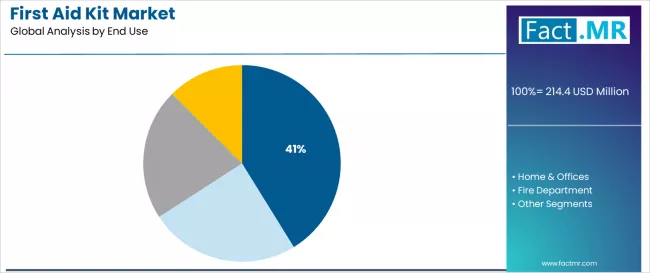
Hospitals and clinics are expected to hold 41% of the end use segment in 2026. Demand is shaped by the need for standardized emergency, outpatient, and surgical centre supplies that meet healthcare facility safety protocols. Emergency departments, outpatient facilities, and surgical centres represent the primary institutional buyers within this segment.
Home and office use represents the second major end use segment, with household kits and corporate office kits driving consumer and small business demand. Fire department and public facility applications serve specialized institutional requirements. The hospitals and clinics segment is expected to maintain its lead through consistent procurement cycles and regulatory compliance needs.
Which Application Segment Dominates the First Aid Kit Market?
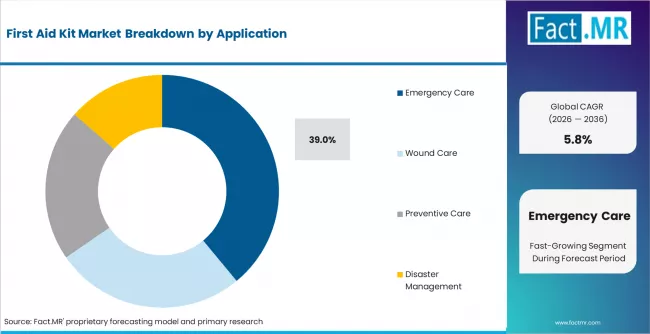
Emergency care is expected to account for 39% of the application segment in 2026. This includes trauma management, bleeding control, and fracture management applications that represent the core use case for first aid kit products. Demand is shaped by workplace accident response requirements, institutional safety protocols, and consumer emergency preparedness needs.
Wound care, including treatment of minor injuries, cuts, abrasions, and burns, represents the second major application. Preventive care and disaster management applications serve more specialized but growing demand channels. Emergency care is expected to remain the leading application as safety compliance requirements continue to expand.
Which Product Trend is Shaping the Next Phase of Growth in the First Aid Kit Market?
Smart first aid kits with digital integration features are emerging as the most significant product development trend in the market. These products incorporate connected devices, guided assistance systems, and digital monitoring capabilities that help users respond to emergencies with greater confidence and accuracy. Demand is being supported by institutional buyers seeking improved compliance tracking and by consumers interested in technology-enhanced safety products.
The shift toward smart kits reflects a broader trend of digital integration in safety and emergency preparedness products. Companies developing first aid kits with app-based guidance, automated inventory tracking, and IoT-connected monitoring are creating premium product tiers that command higher margins. While smart kits currently represent a small share of total volume, they are expected to gain traction as technology costs decrease and institutional adoption increases.
Regional Outlook Across Key Markets
.webp)
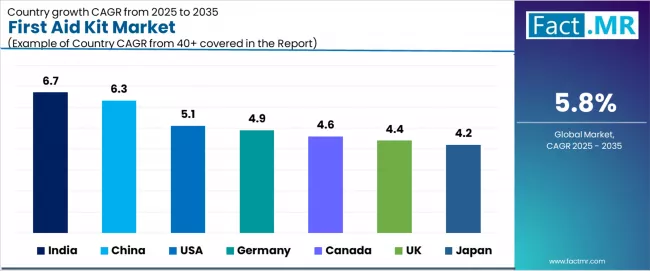
- India leads growth at 6.7%, supported by expanding workplace safety regulations, growing institutional safety compliance requirements, and rising household emergency preparedness awareness in urban areas.
- China follows at 6.3%, with growth shaped by industrial safety mandates, expanding healthcare facility infrastructure, and growing consumer adoption of household safety products.
- The USA at 5.1% reflects mature institutional demand with growth driven by workplace safety regulation updates, premium product adoption, and managed first aid service programs.
CAGR Table
| Country | CAGR (%) |
|---|---|
| India | 6.7% |
| China | 6.3% |
| USA | 5.1% |
| Germany | 4.9% |
| Canada | 4.6% |
| UK | 4.4% |
| Japan | 4.2% |
Source: Fact MR (FMR) analysis, based on proprietary forecasting model and primary research.
Market Outlook for First Aid Kits in the United States
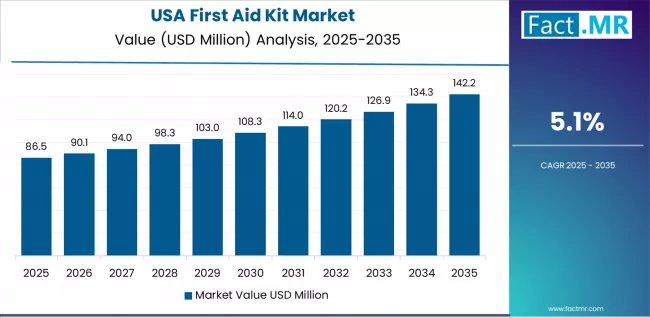
The USA first aid kit market is projected to grow at a CAGR of 5.1% through 2036. Demand is supported by workplace safety regulations, established institutional procurement channels, and growing adoption of managed first aid service programs with restocking and compliance tracking.
- Workplace safety regulations sustain institutional demand.
- Managed service programs create recurring revenue channels.
- Premium and smart kit adoption drives value growth.
First Aid Kit Demand Trends in India
The India first aid kit market is projected to grow at a CAGR of 6.7% through 2036. Growth is driven by expanding workplace safety mandates, growing industrial and construction sector safety compliance, and rising household emergency preparedness awareness.
- Workplace safety mandates expand institutional demand.
- Industrial sector growth drives compliance-based procurement.
- Household adoption is rising in urban and semi-urban areas.
China First Aid Kit Market Growth Assessment
The China first aid kit market is projected to grow at a CAGR of 6.3% through 2036. Growth reflects industrial safety mandates, expanding healthcare facility requirements, and growing consumer awareness of household safety preparedness.
- Industrial safety regulations drive institutional procurement.
- Healthcare facility expansion supports medical-grade kit demand.
- Consumer safety awareness is growing across urban populations.
Germany First Aid Kit Market Demand Analysis
The Germany first aid kit market is projected to grow at a CAGR of 4.9% through 2036. Demand is supported by stringent workplace safety standards, established institutional procurement infrastructure, and growing adoption of premium and application-specific kit variants.
- Stringent safety standards drive consistent institutional demand.
- Premium product adoption supports value growth.
- Established distribution channels ensure broad market access.
First Aid Kit Market Opportunity Outlook in Canada
The Canada first aid kit market is projected to grow at a CAGR of 4.6% through 2036. Growth is supported by workplace safety regulations, growing institutional compliance requirements, and steady consumer demand for household and outdoor first aid products.
- Workplace safety regulations sustain institutional procurement.
- Outdoor recreation creates demand for travel and portable kits.
- Institutional compliance requirements support regular replacement cycles.
Competitive Benchmarking and Company Positioning
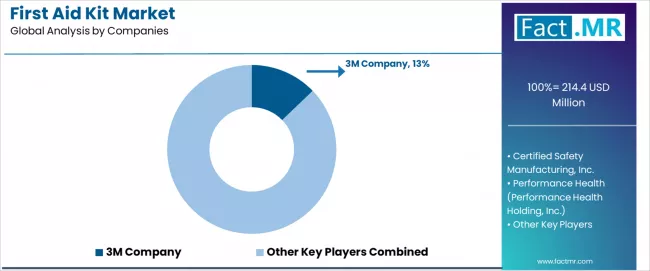
First Aid Kit Market Analysis By Company
- Acme United Corporation, Johnson and Johnson, 3M Company, and Honeywell hold strong positions in the first aid kit market through broad product portfolios, established institutional distribution networks, and recognized brand presence across workplace and consumer safety categories.
- Cintas Corporation, UniFirst First Aid and Safety, and Certified Safety Manufacturing compete through managed service programs, restocking solutions, and workplace compliance offerings that build long-term institutional relationships.
- Competition is shaped by the shift from one-time product sales toward recurring service models with compliance tracking and automated restocking. Companies offering integrated safety program management are building deeper institutional relationships than those competing solely on product pricing.
- Strategic priorities include developing smart and digitally integrated kit variants, expanding managed service and restocking programs, broadening application-specific product lines, and strengthening e-commerce and direct-to-consumer channels for household and small business segments.
Key Companies in the First Aid Kit Market
- Acme United Corporation, Certified Safety Manufacturing, Inc., Performance Health, UniFirst First Aid and Safety are among the leading players in the first aid kit market globally, supported by strong brand visibility, broad product portfolios, and established market positions.
- Hartmann USA Inc., MedTree Ltd., 3M Company hold established positions across specific segments and channels, supported by targeted products and growing market presence.
- Johnson and Johnson Services, Inc., Honeywell International Inc., Cintas Corporation, Dynamic Safety Pte. Ltd. compete through focused product offerings and niche strength in specific applications and regional markets.
Recent Industry Developments
- Acme United Corporation / Product Innovation / Portfolio Expansion (2025)
- Acme United expanded its first aid kit portfolio with updated compliance-ready workplace kits and enhanced consumer product lines across retail and e-commerce channels in North America.
- Cintas Corporation / Service Expansion / Managed Safety Programs (2025)
- Cintas continued expanding its managed first aid and safety services across commercial and industrial facilities, strengthening its position in the compliance-based institutional safety segment.
- Johnson and Johnson Services, Inc. / Consumer Product Update / Retail Distribution (2025)
- Johnson and Johnson updated its consumer first aid kit product lines with refreshed packaging and expanded retail distribution across pharmacy and mass retail channels in key markets.
Leading Companies Shaping the First Aid Kit Market
- Acme United Corporation
- Certified Safety Manufacturing, Inc.
- Performance Health
- UniFirst First Aid and Safety
- Hartmann USA Inc.
- MedTree Ltd.
- 3M Company
- Johnson and Johnson Services, Inc.
- Honeywell International Inc.
- Cintas Corporation
- Dynamic Safety Pte. Ltd.
Sources and Research References
- Occupational Safety and Health Administration (OSHA). Workplace first aid requirements and compliance guidelines.
- World Health Organization (WHO). Emergency care and first aid preparedness guidelines.
- Acme United Corporation. First aid kit product portfolio and distribution updates.
- Cintas Corporation. Managed safety service programs and institutional client data.
- Johnson and Johnson. Consumer first aid product portfolio and retail distribution.
- Primary interviews with manufacturers, institutional buyers, distributors, safety compliance officers, and retail channel partners.
This bibliography is provided for reader reference and is not exhaustive. The full report contains the complete reference list and detailed citations.
Key Questions This Report Addresses
- What is the current and future size of the First Aid Kit market?
- How fast is the First Aid Kit market expected to grow between 2026 and 2036?
- Which product type is likely to lead the market by 2026?
- Which end use segment is expected to account for the highest demand by 2026?
- What factors are driving demand for first aid kits globally?
- How are workplace safety regulations influencing market growth?
- Why is India emerging as the fastest-growing market?
- How are smart and digitally integrated kits shaping the product landscape?
- Which countries are projected to show the fastest growth through 2036?
- Who are the key companies active in the First Aid Kit market?
- How does Fact.MR estimate and validate the market forecast?
First Aid Kit Market Definition
The first aid kit market covers pre-assembled and customizable emergency care kits designed for wound management, trauma response, and safety compliance across hospitals, clinics, workplaces, households, and public facilities. It includes common type kits, special type kits, CPR kits, burn care kits, and snake bite kits across institutional and consumer channels.
First Aid Kit Market Inclusions
- The scope covers global and regional market size and forecasts for 2026 to 2036 across product type, end use, application, technology, and region.
- It includes regional demand analysis based on workplace safety regulations, institutional procurement patterns, consumer adoption rates, and healthcare facility requirements.
- The report includes pricing analysis across entry-level, mid-range, and premium products, covering kit contents, assembly costs, and distribution margins.
- It covers product development trends, regulatory compliance requirements, market drivers and constraints, and the competitive landscape of leading first aid product companies.
First Aid Kit Market Exclusions
- The scope excludes individual medical supplies and components sold outside of pre-assembled or branded first aid kit formats.
- It excludes advanced emergency medical equipment such as defibrillators, ventilators, and hospital-grade trauma supplies not packaged as portable first aid kits.
- The report excludes first aid training services, certification programs, and educational materials sold independently of kit products.
- It also excludes unbranded, bulk medical supply kits without retail or institutional branding and products sold exclusively through government military procurement channels.
First Aid Kit Market Research Methodology
- The methodology combines secondary research, primary interviews, and forecast modelling.
- It draws on 80+ secondary sources and benchmarks 35+ company product portfolios.
- Market sizing covers 30+ countries through a demand-side model, supported by top-down validation.
- Key inputs include workplace safety regulation data, institutional procurement volumes, consumer adoption rates, healthcare facility counts, and e-commerce penetration.
- The model cross-checks demand with product shipments, pricing trends, distribution channel data, and regulatory compliance timelines.
- Primary validation includes 20+ interviews across manufacturers, institutional buyers, distributors, safety compliance officers, and retail channel partners.
- Final estimates go through procurement cycle validation, regulatory impact analysis, and sensitivity testing.
Scope of Analysis

| Metric | Value |
|---|---|
| Quantitative Units | USD 226.84 million to USD 398.63 million, at a CAGR of 5.8% |
| Market Definition | The first aid kit market covers pre-assembled and customizable emergency care kits designed for wound management, trauma response, and safety compliance across hospitals, clinics, workplaces, households, and public facilities. It includes common type kits, special type kits, CPR kits, burn care kits, and snake bite kits across institutional and consumer channels. |
| Regions Covered | North America, Latin America, Europe, East Asia, South Asia and Pacific, Middle East and Africa |
| Countries Covered | India, China, USA, Germany, Canada, UK, Japan, 30 plus countries |
| Key Companies | Acme United Corporation, Certified Safety Manufacturing, Inc., Performance Health, UniFirst First Aid and Safety, Hartmann USA Inc., MedTree Ltd., 3M Company, Johnson and Johnson Services, Inc., Honeywell International Inc., Cintas Corporation, Dynamic Safety Pte. Ltd. |
| Forecast Period | 2026 to 2036 |
| Approach | Hybrid demand-side and top-down methodology built on country-level workplace safety regulation data, institutional procurement volumes, product benchmarking, pricing analysis, distribution channel validation, and primary interviews across manufacturers, institutional buyers, distributors, and safety compliance officers |
First Aid Kit Market Segmentation
-
First Aid Kit Market Segmented by Product:
- Common Type Kit
- Basic Wound Care Kits
- General Purpose Kits
- Family First Aid Kits
- Special Type Kit
- Trauma Care Kits
- Travel First Aid Kits
- Industrial Safety Kits
- CPR Kit
- Manual CPR Kits
- Automated External Defibrillator Kits
- Resuscitation Mask Kits
- Snake Bite Kit
- Venom Extraction Kits
- Compression Bandage Kits
- Anti Venom Support Kits
- Burn Care Kit
- Minor Burn Treatment Kits
- Advanced Burn Care Kits
- Hydrogel Based Kits
- Others
- Sports Injury Kits
- Military First Aid Kits
- Disaster Response Kits
- Common Type Kit
-
First Aid Kit Market Segmented by End Use:
- Hospitals and Clinics
- Emergency Departments
- Outpatient Facilities
- Surgical Centers
- Home and Offices
- Household Kits
- Corporate Office Kits
- Workplace Safety Kits
- Fire Department
- Fire Rescue Units
- Disaster Management Units
- Hazard Response Teams
- Others
- Schools and Educational Institutions
- Transportation Sector
- Public Facilities
- Hospitals and Clinics
-
First Aid Kit Market Segmented by Application:
- Emergency Care
- Trauma Management
- Bleeding Control
- Fracture Management
- Trauma Management
- Wound Care
- Minor Injuries
- Cuts and Abrasions
- Burn Treatment
- Minor Injuries
- Preventive Care
- Health Safety
- Infection Prevention
- First Response Preparedness
- Health Safety
- Disaster Management
- Emergency Response
- Natural Disasters
- Industrial Accidents
- Emergency Response
- Emergency Care
-
First Aid Kit Market Segmented by Technology:
- Kit Configuration
- Pre Assembled Kits
- Standard Kits
- Customized Kits
- Pre Assembled Kits
- Smart First Aid Kits
- Digital Integration
- Connected Devices
- Guided Assistance Systems
- Digital Integration
- Material Technology
- Advanced Materials
- Sterile Packaging
- Antimicrobial Materials
- Advanced Materials
- Kit Configuration
-
First Aid Kit Market by Region:
- North America
- USA
- Canada
- Mexico
- Latin America
- Brazil
- Chile
- Rest of Latin America
- Western Europe
- Germany
- UK
- Italy
- Spain
- France
- Nordic
- BENELUX
- Rest of Western Europe
- Eastern Europe
- Russia
- Poland
- Hungary
- Balkan & Baltic
- Rest of Eastern Europe
- East Asia
- China
- Japan
- South Korea
- South Asia and Pacific
- India
- ASEAN
- Australia & New Zealand
- Rest of South Asia and Pacific
- Middle East & Africa
- Kingdom of Saudi Arabia
- Other GCC Countries
- Turkiye
- South Africa
- Other African Union
- Rest of Middle East & Africa
- North America
- Frequently Asked Questions -
How big is the first aid kit market in 2025?
The global first aid kit market is estimated to be valued at USD 214.4 million in 2025.
What will be the size of the first aid kit market in 2036?
The market size for the first aid kit market is projected to reach USD 398.63 million by 2036.
How much will the first aid kit market grow between 2026 and 2036?
The first aid kit market is expected to grow at a 5.8% CAGR between 2026 and 2036.
What are the key product types in the first aid kit market?
The key product types include common type kits, special type kits, CPR kits, snake bite kits, burn care kits, and others including sports injury, military, and disaster response kits.
Which product type segment will contribute significant share in the first aid kit market in 2026?
In terms of product type, common type kits are expected to account for 60% share in the first aid kit market in 2026.
Which are the fastest-growing countries in the first aid kit market?
India (6.7%) and China (6.3%) are the fastest-growing countries in the first aid kit market during the forecast period.
Table of Content
- Executive Summary
- Global Market Outlook
- Demand to side Trends
- Supply to side Trends
- Technology Roadmap Analysis
- Analysis and Recommendations
- Market Overview
- Market Coverage / Taxonomy
- Market Definition / Scope / Limitations
- Research Methodology
- Chapter Orientation
- Analytical Lens and Working Hypotheses
- Market Structure, Signals, and Trend Drivers
- Benchmarking and Cross-market Comparability
- Market Sizing, Forecasting, and Opportunity Mapping
- Research Design and Evidence Framework
- Desk Research Programme (Secondary Evidence)
- Company Annual and Sustainability Reports
- Peer-reviewed Journals and Academic Literature
- Corporate Websites, Product Literature, and Technical Notes
- Earnings Decks and Investor Briefings
- Statutory Filings and Regulatory Disclosures
- Technical White Papers and Standards Notes
- Trade Journals, Industry Magazines, and Analyst Briefs
- Conference Proceedings, Webinars, and Seminar Materials
- Government Statistics Portals and Public Data Releases
- Press Releases and Reputable Media Coverage
- Specialist Newsletters and Curated Briefings
- Sector Databases and Reference Repositories
- Fact.MR Internal Proprietary Databases and Historical Market Datasets
- Subscription Datasets and Paid Sources
- Social Channels, Communities, and Digital Listening Inputs
- Additional Desk Sources
- Expert Input and Fieldwork (Primary Evidence)
- Primary Modes
- Qualitative Interviews and Expert Elicitation
- Quantitative Surveys and Structured Data Capture
- Blended Approach
- Why Primary Evidence is Used
- Field Techniques
- Interviews
- Surveys
- Focus Groups
- Observational and In-context Research
- Social and Community Interactions
- Stakeholder Universe Engaged
- C-suite Leaders
- Board Members
- Presidents and Vice Presidents
- R&D and Innovation Heads
- Technical Specialists
- Domain Subject-matter Experts
- Scientists
- Physicians and Other Healthcare Professionals
- Governance, Ethics, and Data Stewardship
- Research Ethics
- Data Integrity and Handling
- Primary Modes
- Tooling, Models, and Reference Databases
- Desk Research Programme (Secondary Evidence)
- Data Engineering and Model Build
- Data Acquisition and Ingestion
- Cleaning, Normalisation, and Verification
- Synthesis, Triangulation, and Analysis
- Quality Assurance and Audit Trail
- Market Background
- Market Dynamics
- Drivers
- Restraints
- Opportunity
- Trends
- Scenario Forecast
- Demand in Optimistic Scenario
- Demand in Likely Scenario
- Demand in Conservative Scenario
- Opportunity Map Analysis
- Product Life Cycle Analysis
- Supply Chain Analysis
- Investment Feasibility Matrix
- Value Chain Analysis
- PESTLE and Porter’s Analysis
- Regulatory Landscape
- Regional Parent Market Outlook
- Production and Consumption Statistics
- Import and Export Statistics
- Market Dynamics
- Global Market Analysis 2021 to 2025 and Forecast, 2026 to 2036
- Historical Market Size Value (USD Million) Analysis, 2021 to 2025
- Current and Future Market Size Value (USD Million) Projections, 2026 to 2036
- Y to o to Y Growth Trend Analysis
- Absolute $ Opportunity Analysis
- Global Market Pricing Analysis 2021 to 2025 and Forecast 2026 to 2036
- Global Market Analysis 2021 to 2025 and Forecast 2026 to 2036, By Product
- Introduction / Key Findings
- Historical Market Size Value (USD Million) Analysis By Product, 2021 to 2025
- Current and Future Market Size Value (USD Million) Analysis and Forecast By Product, 2026 to 2036
- Common Type Kit
- Basic Wound Care Kits
- General Purpose Kits
- Family First Aid Kits
- Special Type Kit
- Trauma Care Kits
- Travel First Aid Kits
- Industrial Safety Kits
- CPR Kit
- Manual CPR Kits
- Automated External Defibrillator Kits
- Resuscitation Mask Kits
- Snake Bite Kit
- Venom Extraction Kits
- Compression Bandage Kits
- Anti Venom Support Kits
- Burn Care Kit
- Minor Burn Treatment Kits
- Advanced Burn Care Kits
- Hydrogel Based Kits
- Others
- Sports Injury Kits
- Military First Aid Kits
- Disaster Response Kits
- Common Type Kit
- Y to o to Y Growth Trend Analysis By Product, 2021 to 2025
- Absolute $ Opportunity Analysis By Product, 2026 to 2036
- Global Market Analysis 2021 to 2025 and Forecast 2026 to 2036, By End Use
- Introduction / Key Findings
- Historical Market Size Value (USD Million) Analysis By End Use, 2021 to 2025
- Current and Future Market Size Value (USD Million) Analysis and Forecast By End Use, 2026 to 2036
- Hospitals and Clinics
- Emergency Departments
- Outpatient Facilities
- Surgical Centers
- Home and Offices
- Household Kits
- Corporate Office Kits
- Workplace Safety Kits
- Fire Department
- Fire Rescue Value (USD Million)s
- Disaster Management Value (USD Million)s
- Hazard Response Teams
- Others
- Schools and Educational Institutions
- Transportation Sector
- Public Facilities
- Hospitals and Clinics
- Y to o to Y Growth Trend Analysis By End Use, 2021 to 2025
- Absolute $ Opportunity Analysis By End Use, 2026 to 2036
- Global Market Analysis 2021 to 2025 and Forecast 2026 to 2036, By Application
- Introduction / Key Findings
- Historical Market Size Value (USD Million) Analysis By Application, 2021 to 2025
- Current and Future Market Size Value (USD Million) Analysis and Forecast By Application, 2026 to 2036
- Emergency Care
- Trauma Management
- Bleeding Control
- Fracture Management
- Wound Care
- Minor Injuries
- Cuts and Abrasions
- Burn Treatment
- Preventive Care
- Health Safety
- Infection Prevention
- First Response Preparedness
- Disaster Management
- Emergency Response
- Natural Disasters
- Industrial Accidents
- Emergency Care
- Y to o to Y Growth Trend Analysis By Application, 2021 to 2025
- Absolute $ Opportunity Analysis By Application, 2026 to 2036
- Global Market Analysis 2021 to 2025 and Forecast 2026 to 2036, By Technology
- Introduction / Key Findings
- Historical Market Size Value (USD Million) Analysis By Technology, 2021 to 2025
- Current and Future Market Size Value (USD Million) Analysis and Forecast By Technology, 2026 to 2036
- Kit Configuration
- Pre Assembled Kits
- Standard Kits
- Customized Kits
- Smart First Aid Kits
- Digital Integration
- Connected Devices
- Guided Assistance Systems
- Material Technology
- Advanced Materials
- Sterile Packaging
- Antimicrobial Materials
- Kit Configuration
- Y to o to Y Growth Trend Analysis By Technology, 2021 to 2025
- Absolute $ Opportunity Analysis By Technology, 2026 to 2036
- Global Market Analysis 2021 to 2025 and Forecast 2026 to 2036, By Region
- Introduction
- Historical Market Size Value (USD Million) Analysis By Region, 2021 to 2025
- Current Market Size Value (USD Million) Analysis and Forecast By Region, 2026 to 2036
- North America
- Latin America
- Western Europe
- Eastern Europe
- East Asia
- South Asia and Pacific
- Middle East & Africa
- Market Attractiveness Analysis By Region
- North America Market Analysis 2021 to 2025 and Forecast 2026 to 2036, By Country
- Historical Market Size Value (USD Million) Trend Analysis By Market Taxonomy, 2021 to 2025
- Market Size Value (USD Million) Forecast By Market Taxonomy, 2026 to 2036
- By Country
- USA
- Canada
- Mexico
- By Product
- By End Use
- By Application
- By Technology
- By Country
- Market Attractiveness Analysis
- By Country
- By Product
- By End Use
- By Application
- By Technology
- Key Takeaways
- Latin America Market Analysis 2021 to 2025 and Forecast 2026 to 2036, By Country
- Historical Market Size Value (USD Million) Trend Analysis By Market Taxonomy, 2021 to 2025
- Market Size Value (USD Million) Forecast By Market Taxonomy, 2026 to 2036
- By Country
- Brazil
- Chile
- Rest of Latin America
- By Product
- By End Use
- By Application
- By Technology
- By Country
- Market Attractiveness Analysis
- By Country
- By Product
- By End Use
- By Application
- By Technology
- Key Takeaways
- Western Europe Market Analysis 2021 to 2025 and Forecast 2026 to 2036, By Country
- Historical Market Size Value (USD Million) Trend Analysis By Market Taxonomy, 2021 to 2025
- Market Size Value (USD Million) Forecast By Market Taxonomy, 2026 to 2036
- By Country
- Germany
- UK
- Italy
- Spain
- France
- Nordic
- BENELUX
- Rest of Western Europe
- By Product
- By End Use
- By Application
- By Technology
- By Country
- Market Attractiveness Analysis
- By Country
- By Product
- By End Use
- By Application
- By Technology
- Key Takeaways
- Eastern Europe Market Analysis 2021 to 2025 and Forecast 2026 to 2036, By Country
- Historical Market Size Value (USD Million) Trend Analysis By Market Taxonomy, 2021 to 2025
- Market Size Value (USD Million) Forecast By Market Taxonomy, 2026 to 2036
- By Country
- Russia
- Poland
- Hungary
- Balkan & Baltic
- Rest of Eastern Europe
- By Product
- By End Use
- By Application
- By Technology
- By Country
- Market Attractiveness Analysis
- By Country
- By Product
- By End Use
- By Application
- By Technology
- Key Takeaways
- East Asia Market Analysis 2021 to 2025 and Forecast 2026 to 2036, By Country
- Historical Market Size Value (USD Million) Trend Analysis By Market Taxonomy, 2021 to 2025
- Market Size Value (USD Million) Forecast By Market Taxonomy, 2026 to 2036
- By Country
- China
- Japan
- South Korea
- By Product
- By End Use
- By Application
- By Technology
- By Country
- Market Attractiveness Analysis
- By Country
- By Product
- By End Use
- By Application
- By Technology
- Key Takeaways
- South Asia and Pacific Market Analysis 2021 to 2025 and Forecast 2026 to 2036, By Country
- Historical Market Size Value (USD Million) Trend Analysis By Market Taxonomy, 2021 to 2025
- Market Size Value (USD Million) Forecast By Market Taxonomy, 2026 to 2036
- By Country
- India
- ASEAN
- Australia & New Zealand
- Rest of South Asia and Pacific
- By Product
- By End Use
- By Application
- By Technology
- By Country
- Market Attractiveness Analysis
- By Country
- By Product
- By End Use
- By Application
- By Technology
- Key Takeaways
- Middle East & Africa Market Analysis 2021 to 2025 and Forecast 2026 to 2036, By Country
- Historical Market Size Value (USD Million) Trend Analysis By Market Taxonomy, 2021 to 2025
- Market Size Value (USD Million) Forecast By Market Taxonomy, 2026 to 2036
- By Country
- Kingdom of Saudi Arabia
- Other GCC Countries
- Turkiye
- South Africa
- Other African Union
- Rest of Middle East & Africa
- By Product
- By End Use
- By Application
- By Technology
- By Country
- Market Attractiveness Analysis
- By Country
- By Product
- By End Use
- By Application
- By Technology
- Key Takeaways
- Key Countries Market Analysis
- USA
- Pricing Analysis
- Market Share Analysis, 2025
- By Product
- By End Use
- By Application
- By Technology
- Canada
- Pricing Analysis
- Market Share Analysis, 2025
- By Product
- By End Use
- By Application
- By Technology
- Mexico
- Pricing Analysis
- Market Share Analysis, 2025
- By Product
- By End Use
- By Application
- By Technology
- Brazil
- Pricing Analysis
- Market Share Analysis, 2025
- By Product
- By End Use
- By Application
- By Technology
- Chile
- Pricing Analysis
- Market Share Analysis, 2025
- By Product
- By End Use
- By Application
- By Technology
- Germany
- Pricing Analysis
- Market Share Analysis, 2025
- By Product
- By End Use
- By Application
- By Technology
- UK
- Pricing Analysis
- Market Share Analysis, 2025
- By Product
- By End Use
- By Application
- By Technology
- Italy
- Pricing Analysis
- Market Share Analysis, 2025
- By Product
- By End Use
- By Application
- By Technology
- Spain
- Pricing Analysis
- Market Share Analysis, 2025
- By Product
- By End Use
- By Application
- By Technology
- France
- Pricing Analysis
- Market Share Analysis, 2025
- By Product
- By End Use
- By Application
- By Technology
- India
- Pricing Analysis
- Market Share Analysis, 2025
- By Product
- By End Use
- By Application
- By Technology
- ASEAN
- Pricing Analysis
- Market Share Analysis, 2025
- By Product
- By End Use
- By Application
- By Technology
- Australia & New Zealand
- Pricing Analysis
- Market Share Analysis, 2025
- By Product
- By End Use
- By Application
- By Technology
- China
- Pricing Analysis
- Market Share Analysis, 2025
- By Product
- By End Use
- By Application
- By Technology
- Japan
- Pricing Analysis
- Market Share Analysis, 2025
- By Product
- By End Use
- By Application
- By Technology
- South Korea
- Pricing Analysis
- Market Share Analysis, 2025
- By Product
- By End Use
- By Application
- By Technology
- Russia
- Pricing Analysis
- Market Share Analysis, 2025
- By Product
- By End Use
- By Application
- By Technology
- Poland
- Pricing Analysis
- Market Share Analysis, 2025
- By Product
- By End Use
- By Application
- By Technology
- Hungary
- Pricing Analysis
- Market Share Analysis, 2025
- By Product
- By End Use
- By Application
- By Technology
- Kingdom of Saudi Arabia
- Pricing Analysis
- Market Share Analysis, 2025
- By Product
- By End Use
- By Application
- By Technology
- Turkiye
- Pricing Analysis
- Market Share Analysis, 2025
- By Product
- By End Use
- By Application
- By Technology
- South Africa
- Pricing Analysis
- Market Share Analysis, 2025
- By Product
- By End Use
- By Application
- By Technology
- USA
- Market Structure Analysis
- Competition Dashboard
- Competition Benchmarking
- Market Share Analysis of Top Players
- By Regional
- By Product
- By End Use
- By Application
- By Technology
- Competition Analysis
- Competition Deep Dive
- Acme Value (USD Million)ed Corporation
- Overview
- Product Portfolio
- Profitability by Market Segments (Product/Age /Sales Channel/Region)
- Sales Footprint
- Strategy Overview
- Marketing Strategy
- Product Strategy
- Channel Strategy
- Certified Safety Manufacturing, Inc.
- Performance Health (Performance Health Holding, Inc.)
- UniFirst First Aid + Safety (a division of UniFirst Corporation)
- Hartmann USA Inc. (a PAUL HARTMANN AG company)
- MedTree Ltd.
- 3M Company
- Johnson & Johnson Services, Inc.
- Honeywell International Inc.
- Cintas Corporation
- Dynamic Safety Pte. Ltd.
- Acme Value (USD Million)ed Corporation
- Competition Deep Dive
- Assumptions & Acronyms Used
List Of Table
- Table 1: Global Market Value (USD Million) Forecast by Region, 2021 to 2036
- Table 2: Global Market Value (USD Million) Forecast by Product, 2021 to 2036
- Table 3: Global Market Value (USD Million) Forecast by End Use, 2021 to 2036
- Table 4: Global Market Value (USD Million) Forecast by Application, 2021 to 2036
- Table 5: Global Market Value (USD Million) Forecast by Technology, 2021 to 2036
- Table 6: North America Market Value (USD Million) Forecast by Country, 2021 to 2036
- Table 7: North America Market Value (USD Million) Forecast by Product, 2021 to 2036
- Table 8: North America Market Value (USD Million) Forecast by End Use, 2021 to 2036
- Table 9: North America Market Value (USD Million) Forecast by Application, 2021 to 2036
- Table 10: North America Market Value (USD Million) Forecast by Technology, 2021 to 2036
- Table 11: Latin America Market Value (USD Million) Forecast by Country, 2021 to 2036
- Table 12: Latin America Market Value (USD Million) Forecast by Product, 2021 to 2036
- Table 13: Latin America Market Value (USD Million) Forecast by End Use, 2021 to 2036
- Table 14: Latin America Market Value (USD Million) Forecast by Application, 2021 to 2036
- Table 15: Latin America Market Value (USD Million) Forecast by Technology, 2021 to 2036
- Table 16: Western Europe Market Value (USD Million) Forecast by Country, 2021 to 2036
- Table 17: Western Europe Market Value (USD Million) Forecast by Product, 2021 to 2036
- Table 18: Western Europe Market Value (USD Million) Forecast by End Use, 2021 to 2036
- Table 19: Western Europe Market Value (USD Million) Forecast by Application, 2021 to 2036
- Table 20: Western Europe Market Value (USD Million) Forecast by Technology, 2021 to 2036
- Table 21: Eastern Europe Market Value (USD Million) Forecast by Country, 2021 to 2036
- Table 22: Eastern Europe Market Value (USD Million) Forecast by Product, 2021 to 2036
- Table 23: Eastern Europe Market Value (USD Million) Forecast by End Use, 2021 to 2036
- Table 24: Eastern Europe Market Value (USD Million) Forecast by Application, 2021 to 2036
- Table 25: Eastern Europe Market Value (USD Million) Forecast by Technology, 2021 to 2036
- Table 26: East Asia Market Value (USD Million) Forecast by Country, 2021 to 2036
- Table 27: East Asia Market Value (USD Million) Forecast by Product, 2021 to 2036
- Table 28: East Asia Market Value (USD Million) Forecast by End Use, 2021 to 2036
- Table 29: East Asia Market Value (USD Million) Forecast by Application, 2021 to 2036
- Table 30: East Asia Market Value (USD Million) Forecast by Technology, 2021 to 2036
- Table 31: South Asia and Pacific Market Value (USD Million) Forecast by Country, 2021 to 2036
- Table 32: South Asia and Pacific Market Value (USD Million) Forecast by Product, 2021 to 2036
- Table 33: South Asia and Pacific Market Value (USD Million) Forecast by End Use, 2021 to 2036
- Table 34: South Asia and Pacific Market Value (USD Million) Forecast by Application, 2021 to 2036
- Table 35: South Asia and Pacific Market Value (USD Million) Forecast by Technology, 2021 to 2036
- Table 36: Middle East & Africa Market Value (USD Million) Forecast by Country, 2021 to 2036
- Table 37: Middle East & Africa Market Value (USD Million) Forecast by Product, 2021 to 2036
- Table 38: Middle East & Africa Market Value (USD Million) Forecast by End Use, 2021 to 2036
- Table 39: Middle East & Africa Market Value (USD Million) Forecast by Application, 2021 to 2036
- Table 40: Middle East & Africa Market Value (USD Million) Forecast by Technology, 2021 to 2036
List Of Figures
- Figure 1: Global Market Pricing Analysis
- Figure 2: Global Market Value (USD Million) Forecast 2021 to 2036
- Figure 3: Global Market Value Share and BPS Analysis by Product, 2026 and 2036
- Figure 4: Global Market Y-o-Y Growth Comparison by Product, 2026 to 2036
- Figure 5: Global Market Attractiveness Analysis by Product
- Figure 6: Global Market Value Share and BPS Analysis by End Use, 2026 and 2036
- Figure 7: Global Market Y-o-Y Growth Comparison by End Use, 2026 to 2036
- Figure 8: Global Market Attractiveness Analysis by End Use
- Figure 9: Global Market Value Share and BPS Analysis by Application, 2026 and 2036
- Figure 10: Global Market Y-o-Y Growth Comparison by Application, 2026 to 2036
- Figure 11: Global Market Attractiveness Analysis by Application
- Figure 12: Global Market Value Share and BPS Analysis by Technology, 2026 and 2036
- Figure 13: Global Market Y-o-Y Growth Comparison by Technology, 2026 to 2036
- Figure 14: Global Market Attractiveness Analysis by Technology
- Figure 15: Global Market Value (USD Million) Share and BPS Analysis by Region, 2026 and 2036
- Figure 16: Global Market Y-o-Y Growth Comparison by Region, 2026 to 2036
- Figure 17: Global Market Attractiveness Analysis by Region
- Figure 18: North America Market Incremental Dollar Opportunity, 2026 to 2036
- Figure 19: Latin America Market Incremental Dollar Opportunity, 2026 to 2036
- Figure 20: Western Europe Market Incremental Dollar Opportunity, 2026 to 2036
- Figure 21: Eastern Europe Market Incremental Dollar Opportunity, 2026 to 2036
- Figure 22: East Asia Market Incremental Dollar Opportunity, 2026 to 2036
- Figure 23: South Asia and Pacific Market Incremental Dollar Opportunity, 2026 to 2036
- Figure 24: Middle East & Africa Market Incremental Dollar Opportunity, 2026 to 2036
- Figure 25: North America Market Value Share and BPS Analysis by Country, 2026 and 2036
- Figure 26: North America Market Value Share and BPS Analysis by Product, 2026 and 2036
- Figure 27: North America Market Y-o-Y Growth Comparison by Product, 2026 to 2036
- Figure 28: North America Market Attractiveness Analysis by Product
- Figure 29: North America Market Value Share and BPS Analysis by End Use, 2026 and 2036
- Figure 30: North America Market Y-o-Y Growth Comparison by End Use, 2026 to 2036
- Figure 31: North America Market Attractiveness Analysis by End Use
- Figure 32: North America Market Value Share and BPS Analysis by Application, 2026 and 2036
- Figure 33: North America Market Y-o-Y Growth Comparison by Application, 2026 to 2036
- Figure 34: North America Market Attractiveness Analysis by Application
- Figure 35: North America Market Value Share and BPS Analysis by Technology, 2026 and 2036
- Figure 36: North America Market Y-o-Y Growth Comparison by Technology, 2026 to 2036
- Figure 37: North America Market Attractiveness Analysis by Technology
- Figure 38: Latin America Market Value Share and BPS Analysis by Country, 2026 and 2036
- Figure 39: Latin America Market Value Share and BPS Analysis by Product, 2026 and 2036
- Figure 40: Latin America Market Y-o-Y Growth Comparison by Product, 2026 to 2036
- Figure 41: Latin America Market Attractiveness Analysis by Product
- Figure 42: Latin America Market Value Share and BPS Analysis by End Use, 2026 and 2036
- Figure 43: Latin America Market Y-o-Y Growth Comparison by End Use, 2026 to 2036
- Figure 44: Latin America Market Attractiveness Analysis by End Use
- Figure 45: Latin America Market Value Share and BPS Analysis by Application, 2026 and 2036
- Figure 46: Latin America Market Y-o-Y Growth Comparison by Application, 2026 to 2036
- Figure 47: Latin America Market Attractiveness Analysis by Application
- Figure 48: Latin America Market Value Share and BPS Analysis by Technology, 2026 and 2036
- Figure 49: Latin America Market Y-o-Y Growth Comparison by Technology, 2026 to 2036
- Figure 50: Latin America Market Attractiveness Analysis by Technology
- Figure 51: Western Europe Market Value Share and BPS Analysis by Country, 2026 and 2036
- Figure 52: Western Europe Market Value Share and BPS Analysis by Product, 2026 and 2036
- Figure 53: Western Europe Market Y-o-Y Growth Comparison by Product, 2026 to 2036
- Figure 54: Western Europe Market Attractiveness Analysis by Product
- Figure 55: Western Europe Market Value Share and BPS Analysis by End Use, 2026 and 2036
- Figure 56: Western Europe Market Y-o-Y Growth Comparison by End Use, 2026 to 2036
- Figure 57: Western Europe Market Attractiveness Analysis by End Use
- Figure 58: Western Europe Market Value Share and BPS Analysis by Application, 2026 and 2036
- Figure 59: Western Europe Market Y-o-Y Growth Comparison by Application, 2026 to 2036
- Figure 60: Western Europe Market Attractiveness Analysis by Application
- Figure 61: Western Europe Market Value Share and BPS Analysis by Technology, 2026 and 2036
- Figure 62: Western Europe Market Y-o-Y Growth Comparison by Technology, 2026 to 2036
- Figure 63: Western Europe Market Attractiveness Analysis by Technology
- Figure 64: Eastern Europe Market Value Share and BPS Analysis by Country, 2026 and 2036
- Figure 65: Eastern Europe Market Value Share and BPS Analysis by Product, 2026 and 2036
- Figure 66: Eastern Europe Market Y-o-Y Growth Comparison by Product, 2026 to 2036
- Figure 67: Eastern Europe Market Attractiveness Analysis by Product
- Figure 68: Eastern Europe Market Value Share and BPS Analysis by End Use, 2026 and 2036
- Figure 69: Eastern Europe Market Y-o-Y Growth Comparison by End Use, 2026 to 2036
- Figure 70: Eastern Europe Market Attractiveness Analysis by End Use
- Figure 71: Eastern Europe Market Value Share and BPS Analysis by Application, 2026 and 2036
- Figure 72: Eastern Europe Market Y-o-Y Growth Comparison by Application, 2026 to 2036
- Figure 73: Eastern Europe Market Attractiveness Analysis by Application
- Figure 74: Eastern Europe Market Value Share and BPS Analysis by Technology, 2026 and 2036
- Figure 75: Eastern Europe Market Y-o-Y Growth Comparison by Technology, 2026 to 2036
- Figure 76: Eastern Europe Market Attractiveness Analysis by Technology
- Figure 77: East Asia Market Value Share and BPS Analysis by Country, 2026 and 2036
- Figure 78: East Asia Market Value Share and BPS Analysis by Product, 2026 and 2036
- Figure 79: East Asia Market Y-o-Y Growth Comparison by Product, 2026 to 2036
- Figure 80: East Asia Market Attractiveness Analysis by Product
- Figure 81: East Asia Market Value Share and BPS Analysis by End Use, 2026 and 2036
- Figure 82: East Asia Market Y-o-Y Growth Comparison by End Use, 2026 to 2036
- Figure 83: East Asia Market Attractiveness Analysis by End Use
- Figure 84: East Asia Market Value Share and BPS Analysis by Application, 2026 and 2036
- Figure 85: East Asia Market Y-o-Y Growth Comparison by Application, 2026 to 2036
- Figure 86: East Asia Market Attractiveness Analysis by Application
- Figure 87: East Asia Market Value Share and BPS Analysis by Technology, 2026 and 2036
- Figure 88: East Asia Market Y-o-Y Growth Comparison by Technology, 2026 to 2036
- Figure 89: East Asia Market Attractiveness Analysis by Technology
- Figure 90: South Asia and Pacific Market Value Share and BPS Analysis by Country, 2026 and 2036
- Figure 91: South Asia and Pacific Market Value Share and BPS Analysis by Product, 2026 and 2036
- Figure 92: South Asia and Pacific Market Y-o-Y Growth Comparison by Product, 2026 to 2036
- Figure 93: South Asia and Pacific Market Attractiveness Analysis by Product
- Figure 94: South Asia and Pacific Market Value Share and BPS Analysis by End Use, 2026 and 2036
- Figure 95: South Asia and Pacific Market Y-o-Y Growth Comparison by End Use, 2026 to 2036
- Figure 96: South Asia and Pacific Market Attractiveness Analysis by End Use
- Figure 97: South Asia and Pacific Market Value Share and BPS Analysis by Application, 2026 and 2036
- Figure 98: South Asia and Pacific Market Y-o-Y Growth Comparison by Application, 2026 to 2036
- Figure 99: South Asia and Pacific Market Attractiveness Analysis by Application
- Figure 100: South Asia and Pacific Market Value Share and BPS Analysis by Technology, 2026 and 2036
- Figure 101: South Asia and Pacific Market Y-o-Y Growth Comparison by Technology, 2026 to 2036
- Figure 102: South Asia and Pacific Market Attractiveness Analysis by Technology
- Figure 103: Middle East & Africa Market Value Share and BPS Analysis by Country, 2026 and 2036
- Figure 104: Middle East & Africa Market Value Share and BPS Analysis by Product, 2026 and 2036
- Figure 105: Middle East & Africa Market Y-o-Y Growth Comparison by Product, 2026 to 2036
- Figure 106: Middle East & Africa Market Attractiveness Analysis by Product
- Figure 107: Middle East & Africa Market Value Share and BPS Analysis by End Use, 2026 and 2036
- Figure 108: Middle East & Africa Market Y-o-Y Growth Comparison by End Use, 2026 to 2036
- Figure 109: Middle East & Africa Market Attractiveness Analysis by End Use
- Figure 110: Middle East & Africa Market Value Share and BPS Analysis by Application, 2026 and 2036
- Figure 111: Middle East & Africa Market Y-o-Y Growth Comparison by Application, 2026 to 2036
- Figure 112: Middle East & Africa Market Attractiveness Analysis by Application
- Figure 113: Middle East & Africa Market Value Share and BPS Analysis by Technology, 2026 and 2036
- Figure 114: Middle East & Africa Market Y-o-Y Growth Comparison by Technology, 2026 to 2036
- Figure 115: Middle East & Africa Market Attractiveness Analysis by Technology
- Figure 116: Global Market - Tier Structure Analysis
- Figure 117: Global Market - Company Share Analysis