- Base Value(2025): 180.3 Bn
- Estimated Value(2026): 196.8 Bn
- Forecast Value (2036): 482.3 Bn
- CAGR (2026 - 2036): 9.3%
Mobile Application Market Forecast By Fact.MR
In 2025, the mobile application market was valued at USD 180.3 billion. Based on Fact MR’s analysis, demand for mobile applications is estimated to grow to USD 196.8 billion in 2026 and USD 482.3 billion by 2036. FMR projects a CAGR of 9.3% during the forecast period.
The absolute dollar growth from 2026 to 2036 is USD 285.5 billion. This growth is driven by increasing smartphone penetration, rising consumer reliance on mobile apps for communication, entertainment, and e-commerce, and the adoption of AI and cloud technologies in app development. The proliferation of app-based services in emerging markets is further supporting market expansion. However, challenges such as app security concerns, platform fragmentation, and high competition could limit growth in certain regions.
India leads with a CAGR of 13.2%, driven by rapid smartphone adoption and the growth of digital services. China follows with 10.8%, supported by expanding mobile internet infrastructure and app usage. The USA grows at 8.9%, fueled by demand for mobile apps across e-commerce, social media, and enterprise solutions. Germany shows a CAGR of 7.4%, reflecting steady adoption of mobile applications for consumer and business use.
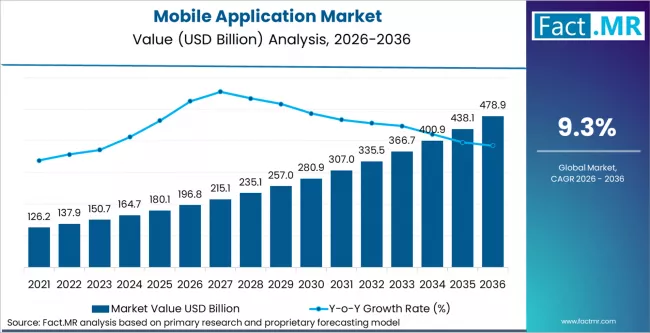
Mobile Application Market Market Value Analysis | Source: Fact.MR
Mobile Application Market
| Metric | Value |
|---|---|
| Estimated Value in (2026E) | USD 196.8 billion |
| Forecast Value in (2036F) | USD 482.3 billion |
| Forecast CAGR (2026 to 2036) | 9.3% |
Source: Fact.MR analysis. Updated Mar 10, 2026
Mobile Application Market Definition
The Mobile Application Market involves the development, distribution, and monetisation of software applications designed to run on smartphones, tablets, and other mobile devices to deliver services, entertainment, productivity, and utility functions to end users.
Market Inclusions
This report covers global and regional market sizes for mobile applications over a defined forecast period, including app categories (gaming, social, productivity, health & fitness, e‑commerce), platform segments (iOS, Android, other OS), distribution channels (app stores, enterprise distribution), and revenue models (paid downloads, in‑app purchases, subscriptions, advertising).
Market Exclusions
The scope excludes desktop and web applications not designed primarily for mobile platforms, mobile operating systems and hardware devices themselves, and general digital services not delivered through mobile apps.
Research Methodology
- Primary Research: Interviews were conducted with app developers, platform operators, and industry analysts.
- Desk Research: Data was sourced from industry reports, platform usage statistics, and trade association publications.
- Market‑Sizing and Forecasting: A hybrid model combining top‑down digital services adoption forecasts with bottom‑up download, usage, and revenue data was used.
- Data Validation and Update Cycle: Findings were validated through expert review and aligned with recent production, adoption, and revenue figures.
Summary of the Mobile Application Market
- Market Definition
- The Mobile Application Market encompasses software applications designed for smartphones, tablets, and other mobile devices, deployed across consumer, enterprise, and government use cases. The market includes gaming, social media, productivity, e-commerce, healthcare, and utility applications, delivered via app stores or enterprise distribution platforms.
- Demand Drivers
- Increasing smartphone penetration and mobile internet access worldwide.
- Rising consumer reliance on mobile apps for communication, entertainment, e-commerce, and productivity.
- Adoption of AI and cloud technologies enhancing app functionality and personalization.
- Expansion of app-based services in emerging markets supporting broader adoption.
- Growing demand for app-based solutions in enterprise mobility, finance, healthcare, and digital services.
- Key Segments Analyzed
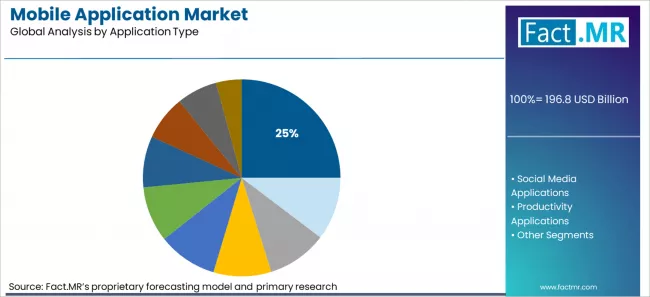
- Application Type: Gaming Applications (25% share in 2026), Social Media Applications, Productivity Applications, Entertainment Applications, E-commerce Applications, Educational Applications, Healthcare Applications, Financial Services Applications, Travel Applications, Utility Applications.
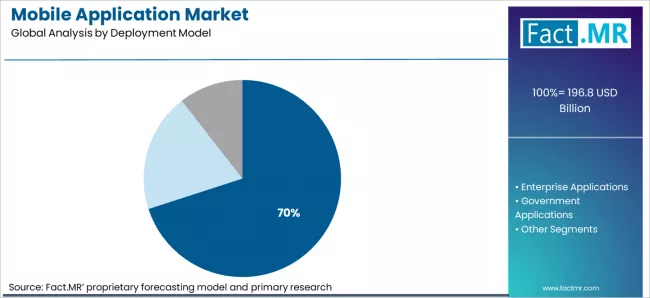
- Deployment Model: Consumer Applications (70% share in 2026), Enterprise Applications, Government Applications.
- Geography: South Asia, East Asia, North America, Europe; India leads at 13.2% CAGR, China 10.8%, USA 8.9%, Germany 7.4%.
- Analyst Opinion at Fact MR
- Shambhu Nath Jha, Principal Consultant, Fact MR, opines, 'In this updated edition of the Mobile Application Market report, industry participants will observe that value creation is shifting from basic utility apps toward integrated, AI-enabled, and cloud-supported mobile solutions. Mobile applications are no longer passive tools but active enablers of digital engagement, productivity, and commerce. Providers that invest in robust app ecosystems, cross-platform compatibility, and data-driven personalization will capture margin expansion beyond standard app offerings. The convergence of user experience, security compliance, and functionality defines the competitive landscape through 2036.'
- Strategic Implications/Executive Takeaways
- Focus on developing consumer apps that integrate AI, cloud, and analytics for personalized experiences.
- Expand gaming, social media, and e-commerce applications with monetization features such as subscriptions and in-app purchases.
- Target high-growth regions such as India and China with localized apps and mobile-first solutions.
- Ensure app security, privacy compliance, and interoperability across platforms.
- Enhance enterprise application offerings for productivity, finance, healthcare, and government sectors.
- Leverage platform ecosystems to drive downloads, engagement, and user retention.
- Methodology
- Primary Research: Interviews with app developers, platform operators, and industry analysts.
- Desk Research: Data sourced from industry reports, platform usage statistics, and trade publications.
- Market Sizing & Forecasting: Hybrid model combining top-down digital services adoption forecasts with bottom-up download, usage, and revenue data.
- Data Validation: Findings validated via expert review, adoption, and revenue figures; updated using proprietary Fact MR forecasting models.
Segmental Analysis
Mobile Application Market Analysis by Deployment Model
Mobile Application Market Analysis By Deployment Model | Source: Fact.MR
Market Overview: Consumer applications are expected to capture 70% of the market share by 2026. These applications are primarily designed for individual users and include gaming, social media, entertainment, e-commerce, and utility apps. Consumer-focused mobile apps dominate due to the rapid adoption of smartphones and increasing engagement with digital services for daily activities.
Demand Drivers:
- Rising Smartphone Penetration: Growing smartphone usage globally fuels the demand for consumer mobile applications across multiple sectors.
- Increasing Internet Accessibility: Expansion of high-speed mobile internet enables seamless usage of apps, supporting consumer app growth.
- Shift Toward Digital Lifestyle: Consumers are increasingly relying on mobile apps for entertainment, shopping, social interaction, and productivity, driving widespread adoption.
Mobile Application Market Analysis by Application Type
Mobile Application Market Analysis By Application Type | Source: Fact.MR
Market Overview: Gaming applications are projected to hold 25% of the market share by 2026. Mobile gaming continues to lead the application type segment due to high engagement, monetization potential, and the proliferation of smartphones and high-performance devices.
Demand Drivers:
- Growth of Casual and Hyper-Casual Games: Simple, engaging mobile games attract a wide user base, increasing downloads and usage.
- Monetization Opportunities: In-app purchases, ads, and subscriptions generate significant revenue, encouraging continuous development of gaming apps.
- Enhanced Mobile Hardware and Connectivity: Improved device performance and faster internet speeds enable immersive gaming experiences, boosting user adoption globally.
Mobile Application Market Drivers, Restraints, and Opportunities
FMR analysts observe that the mobile application market is a growth‑aligned, digital‑economy segment propelled by increasing smartphone penetration, faster networks (4G/5G), and expanding integration of apps into commerce, entertainment, and everyday life. Historically, basic utility and communication apps dominated usage; as digital services evolved, structural demand emerged for sophisticated apps that deliver personalized experiences, integrate AI/ML features, and support remote work, social interaction, and IoT connectivity. The 2026 valuation reflects this expansion, with adoption tied to ongoing digital transformation rather than legacy mobile content alone.
While demand for basic utility and social apps remains high, advanced applications combining cloud services, real‑time data, and immersive features (AR/VR) are gaining share. These higher‑engagement apps often support monetization through subscriptions, in‑app purchases, and enterprise services, contributing to net market value growth even as download volumes grow at moderate rates. The market exists because mobile apps are fundamental to digital interaction across consumer and business ecosystems.
- Digital Engagement Demand: Consumers and enterprises adopt advanced mobile apps that replace basic tools with feature‑rich, personalized services.
- Standards & Security Pressure: Privacy and app security standards push developers toward compliant platforms that meet defined data protection and performance criteria.
- Regional User Trends: In Asia‑Pacific and North America, strong smartphone adoption and digital service demand drive higher uptake of mobile applications compared with regions trailing in connectivity.
Regional Analysis
The market analysis covers key global regions, including South Asia, East Asia, North America, and Europe. It is segmented geographically, with specific market dynamics for each region. The full report provides a detailed market attractiveness analysis.
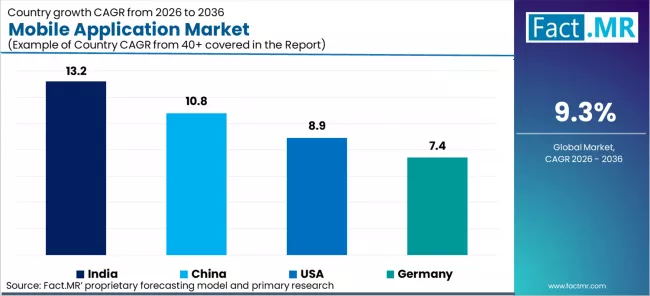
Mobile Application Market Cagr Analysis By Country | Source: Fact.MR
| Country | CAGR (2026-2036) |
|---|---|
| India | 13.2% |
| China | 10.8% |
| USA | 8.9% |
| Germany | 7.4% |
Source: Fact.MR analysis. Updated Mar 10, 2026
Source: Fact MR (FMR) analysis, based on proprietary forecasting model and primary research
South Asia
India is a leading market, supported by smartphone penetration, mobile internet adoption, and growth of app-based services in e-commerce, banking, and entertainment. Key players include Infosys, TCS, and Wipro.
- India: Demand for mobile applications in India is projected to rise at 13.2% CAGR through 2036. Growth is supported by government digital initiatives (03-2025) and Infosys’ expansion of mobile solutions for enterprises (08-2025).
East Asia
China is a major market, driven by increasing smartphone usage, digital payment adoption, and growth in app-based services across gaming, e-commerce, and education sectors.
- China: Demand for mobile applications in China is projected to rise at 10.8% CAGR through 2036. Growth is supported by government smart city programs (04-2025) and Tencent’s expansion of app development platforms (09-2025).
North America
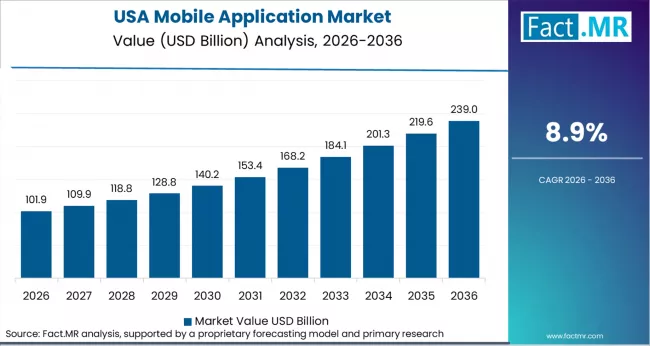
Mobile Application Market Country Value Analysis | Source: Fact.MR
The USA is a significant market, fueled by widespread smartphone adoption, enterprise mobility solutions, and demand for mobile apps in finance, healthcare, and e-commerce.
- USA: Demand for mobile applications in the U.S. is projected to rise at 8.9% CAGR through 2036. Growth is supported by federal digital infrastructure programs (05-2025) and Apple and Google’s expansion of app development platforms (08-2025).
Europe
Germany is a key market, driven by smartphone penetration, enterprise mobility adoption, and app usage in industrial, healthcare, and e-commerce sectors.
- Germany: Demand for mobile applications in Germany is projected to rise at 7.4% CAGR through 2036. Growth is supported by government digitalization initiatives (06-2025) and SAP’s expansion of mobile enterprise solutions (09-2025).
Fact MR's analysis of the mobile application market in South Asia, East Asia, North America, and Europe consists of country-wise assessments that include India, China, the USA, and Germany. Readers can find detailed trends, regulatory updates, and company-specific investments shaping market growth in these countries.
What is the Competitive Structure and Buyer Behavior in the Mobile Application Market?
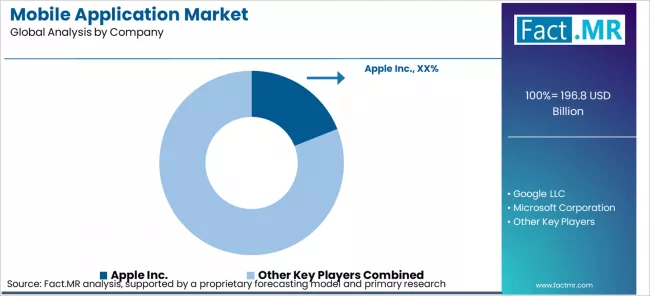
Mobile Application Market Analysis By Company | Source: Fact.MR
The mobile application market is moderately concentrated at the platform level, with major ecosystem providers such as Apple Inc., Google LLC, Microsoft Corporation, Meta Platforms, Inc., Amazon.com, Inc., Tencent Holdings Limited, ByteDance Ltd., Samsung Electronics Co., Ltd., Huawei Technologies Co., Ltd., Baidu, Inc., Alibaba Group Holding Limited, and Oracle Corporation capturing dominant share through their app stores, development frameworks, and platform services. The primary competitive variables are platform reach, developer tool support, app monetization capabilities, security and privacy features, and the richness of integrated services (cloud, analytics, payment). Firms that operate leading mobile ecosystems with extensive consumer bases and robust development ecosystems hold structural advantages because they can attract more developers, drive higher engagement, and deliver platform‑level features that are hard for smaller competitors to replicate.
Large enterprise and consumer app buyers exhibit significant leverage by choosing platforms based on user demographics, interoperability, and total cost of ownership for deployment and scaling. To manage dependency on any single platform, app developers often adopt cross‑platform development strategies and leverage open standards where possible, which limits individual platform providers’ pricing power on distribution fees and tooling costs. As a result, competition in the market centers on platform value delivered through ecosystem breadth, developer support, security, and seamless integration rather than on price alone.
Key Players of the Mobile Application Market
- Apple Inc.
- Google LLC
- Microsoft Corporation
- Meta Platforms, Inc.
- Amazon.com, Inc.
- Tencent Holdings Limited
- ByteDance Ltd.
- Samsung Electronics Co., Ltd.
- Huawei Technologies Co., Ltd.
- Baidu, Inc.
- Alibaba Group Holding Limited
- Oracle Corporation
Report Scope
| Metric | Value |
|---|---|
| Quantitative Units | USD 196.8 billion (2026) to USD 482.3 billion (2036), at a CAGR of 9.3% |
| Market Definition | The Mobile Application Market encompasses software applications designed for smartphones, tablets, and other mobile devices, deployed across consumer, enterprise, and government use cases. |
| Application Type | Gaming, Social Media, Productivity, Entertainment, E-commerce, Educational, Healthcare, Financial Services, Travel, Utility |
| Deployment Model | Consumer Applications, Enterprise Applications, Government Applications |
| Regions Covered | North America, Latin America, Europe, East Asia, South Asia, Oceania, Middle East & Africa |
| Countries Covered | United States, Canada, Mexico, Brazil, Germany, France, United Kingdom, Italy, Spain, China, India, Japan, South Korea, Australia, and additional regional markets |
| Key Companies Profiled | Apple Inc., Google LLC, Microsoft Corporation, Meta Platforms, Inc., Amazon.com, Inc., Tencent Holdings Limited, ByteDance Ltd., Samsung Electronics Co., Ltd., Huawei Technologies Co., Ltd., Baidu, Inc., Alibaba Group Holding Limited, Oracle Corporation |
| Forecast Period | 2026 to 2036 |
| Approach | Top-down and bottom-up market modeling validated via interviews with app developers, platform providers, and enterprise IT teams, combined with usage and deployment benchmarks. |
Source: Fact.MR analysis. Updated Mar 10, 2026
Bibliographies
- International Telecommunication Union. (2023). Measuring digital development: Facts and figures on mobile connectivity and digital services. International Telecommunication Union.
- Organisation for Economic Co-operation and Development. (2023). The mobile application economy and digital platform ecosystems. Organisation for Economic Co-operation and Development.
- World Bank. (2024). Digital economy and mobile technology adoption in emerging markets. World Bank.
- World Economic Forum. (2024). Digital platforms and mobile applications shaping the global digital economy. World Economic Forum.
- Apple Inc. (2024). Apple annual report: App Store ecosystem and digital services growth. Apple Inc.
- Alphabet Inc. (2024). Alphabet annual report: Android platform, Google Play ecosystem, and mobile services. Alphabet Inc.
- Meta Platforms, Inc. (2024). Meta annual report: Mobile platforms, digital advertising, and social media engagement. Meta Platforms, Inc.
This report addresses
- Market intelligence enabling a detailed assessment of leading countries, application types, and deployment models in the Mobile Application Market globally.
- Market volume (revenue) estimates and 10-year revenue forecasts from 2026 to 2036, validated through app download data, usage statistics, and digital services adoption trends.
- Growth opportunity mapping across application types (Gaming, Social Media, Productivity, Entertainment, E-commerce, Educational, Healthcare, Financial Services, Travel, Utility), deployment models (Consumer, Enterprise, Government), and regions.
- Segment and regional revenue forecasts by application type, deployment model, and geography, covering 40+ countries.
- Competition strategy analysis focusing on platform reach, developer ecosystem support, monetization capabilities, security standards, and integrated service offerings, including major players Apple Inc., Google LLC, Microsoft Corporation, Meta Platforms, Inc., Amazon.com, Inc., Tencent Holdings Limited, ByteDance Ltd., Samsung Electronics Co., Ltd., Huawei Technologies Co., Ltd., Baidu, Inc., Alibaba Group Holding Limited, and Oracle Corporation.
- Product, technology, and regulatory tracking aligned with mobile OS standards, app store policies, data privacy frameworks, and digital services guidelines.
- Adoption dynamics emphasizing consumer app engagement, enterprise mobility solutions, AI integration, cloud-based apps, and gaming application growth.
- Report delivery in PDF, Excel, PowerPoint, and interactive dashboard formats for executive, operational, and strategic planning use.
Segmentation
Mobile Application Market Key Segments
-
Application Type
- Gaming Applications
- Social Media Applications
- Productivity Applications
- Entertainment Applications
- E-commerce Applications
- Educational Applications
- Healthcare Applications
- Financial Services Applications
- Travel Applications
- Utility Applications
-
Deployment Model
- Consumer Applications
- Enterprise Applications
- Government Applications
-
Region
- North America
- USA
- Canada
- Mexico
- Europe
- Germany
- UK
- France
- Italy
- Spain
- Nordic Countries
- BENELUX
- Rest of Europe
- Asia Pacific
- China
- Japan
- South Korea
- India
- Australia
- Rest of Asia Pacific
- Latin America
- Brazil
- Argentina
- Rest of Latin America
- Middle East and Africa
- Kingdom of Saudi Arabia
- United Arab Emirates
- South Africa
- Rest of Middle East and Africa
- Other Regions
- Oceania
- Central Asia
- Other Markets
- North America
Frequently Asked Questions
How large is the demand for Mobile Applications in the global market in 2026?
What will be the market size of Mobile Applications in the global market by 2036?
What is the expected demand growth for Mobile Applications in the global market between 2026 and 2036?
Which deployment model is expected to dominate the market?
Which region is expected to show the highest growth rate for Mobile Applications?
How significant is the growth outlook for China in this market?
What is the growth outlook for the United States in the Mobile Applications market?
What is the growth forecast for Germany in the Mobile Applications market?
Which company is identified as a leading player in the Mobile Applications market?
What are Mobile Applications used for?
What does the Mobile Applications market include in this report?
How is the market forecast developed in this report?
What is meant by the Mobile Applications market in this report?
Who worked on this report


Preview the report firsthand - request a free sample
Free SampleGet the brochure for pricing and purchase details
Download PDF