The Mobile Surveillance Units Market is analyzed by type, including trailer-mounted [solar trailers, hybrid trailers and rapid deployment trailers], along with power source, and region, forecast 2026 to 2036.
By Fact.MR Technology DeskLead analyst:
Ganesh PaiPublished :
19 min read
Fact-checked under the Fact.MR editorial process
Mobile Surveillance Units Market Overview, Growth Outlook, and Forecast By Fact.MR
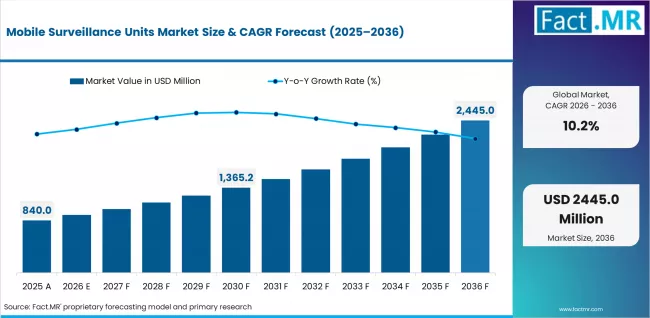
Mobile surveillance units market was valued at USD 840.0 million in 2025, and it is expected to grow at a CAGR of 10.2% to reach USD 2,445.0 million by 2036. Expanding at a CAGR of 10.2% during 2026–2036, the market is projected to grow approximately 2.6x, creating an absolute opportunity of around USD 1,519.3 million in 2036 compared to 2026.
Mobile Surveillance Units Market Market Value Analysis | Source: Fact.MR
Summary of the Mobile Surveillance Units Market
Market Snapshot
In 2025, the size of the global mobile surveillance units market was about USD 840.0 million.
The market is expected to grow from USD 925.7 million in 2026 to an estimated USD 2,445.0 million by 2036.
The mobile surveillance units market is expected to grow at a CAGR of 10.2% during the forecast period.
The market is expected to generate an absolute dollar opportunity of around USD 1,519.3 million from 2026 to 2036.
Construction holds a dominant position in the market in 2026 by the application segment, driven by strong demand from infrastructure projects and the need for temporary site security solutions.
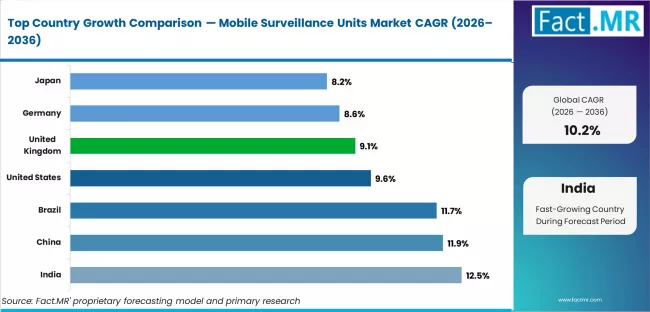
Key growth markets during the forecast period are India at 12.5%, Japan at 8.2%, and China at 11.9%, supported by rapid infrastructure development, increasing adoption of smart city initiatives, and rising demand for flexible and cost-effective surveillance solutions.
Demand and Growth Drivers
The market for mobile surveillance units is expected to be propelled by rising demand for flexible and easily deployable security solutions through construction sites, public areas, and transient locations.
The growth of the mobile security market is also being propelled by the growing construction and infrastructure projects, since temporary installation of mobile units is bringing a new level of cost effective and scalable site security.
There is an increasing emphasis on public safety and law enforcement modernization, driving demand for temporary surveillance, emergency response, and monitoring of high-risk areas.
The demand is rising due to increase in big and mass events or gatherings for mobile surveillance to monitor crowd and incident management.
Product and Segment View
Trailer-mounted systems lead type segment with a 50.8% share in 2026, driven by their widespread use in construction sites and temporary surveillance deployments.
Pole / Tower units follow with a 28.4% share, supported by increasing adoption in smart city projects and long-duration monitoring applications.
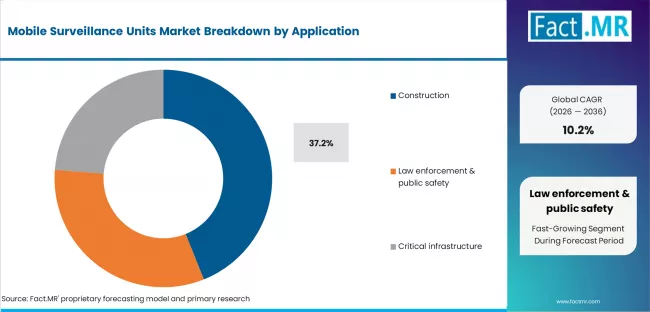
Construction dominates the application segment with a 37.2% share, fueled by growing infrastructure development and the need for site security solutions.
Law enforcement & public safety holds a 27.4% share, driven by rising demand for temporary surveillance and urban security monitoring.
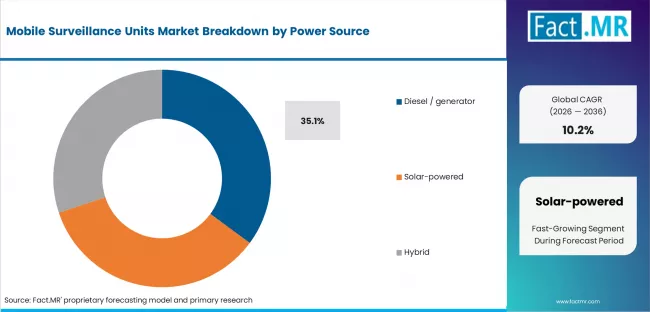
Diesel / generator-powered systems lead the power source segment with a 35.1% share, owing to their reliability in continuous and remote operations.
Solar-powered systems follow closely with a 34.8% share, driven by growing demand for energy-efficient and off-grid surveillance solutions.
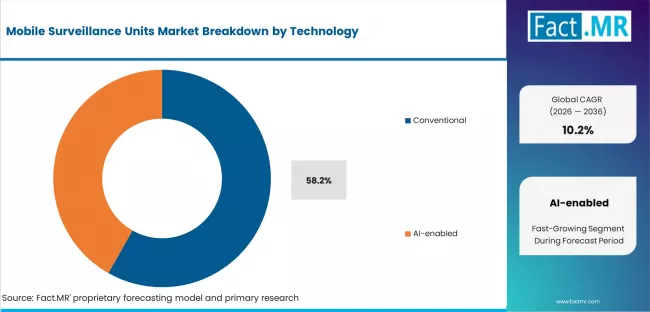
Conventional surveillance systems dominate the technology segment with a 58.2% share, supported by their established presence and cost-effectiveness.
Geography and Competitive Outlook
North America and Western Europe are considered developed markets with a high penetration of next generation surveillance technologies, strong presence of law enforcement applications, and good adoption of AI-enabled, integrated security solutions.
The market is moderately fragmented with the top players holding a considerable market share (around 50-55% of the whole market) and numerous regional players significantly ensuring niche as well as localized deployment.
Some of the top players in the market include Hikvision, Dahua Technology, Bosch Security Systems, Motorola Solutions, Axis Communications, Hanwha Vision, Vivotek, Teledyne FLIR, Zhejiang Uniview Technologies, and CP Plus among others.
Analyst Opinion
Shambhu Nath Jha, Principal Consultant at Fact.MR, says the market is set to grow strongly, driven by rising demand for flexible and rapid-deployment security solutions, expanding infrastructure projects, and increasing adoption of advanced surveillance technologies. “Growing need for temporary surveillance across construction sites, public events, and critical infrastructure is accelerating market adoption. Expansion of smart city initiatives, public safety modernization, and integration of AI-enabled video analytics is enhancing real-time monitoring, automation, and threat detection capabilities.
Mobile Surveillance Units Market — At a Glance
Attribute
Details
Market Value 2025
USD 840.0 Million
Market Value 2026
USD 925.7 Million
Market Value 2036
USD 2,445.0 Million
Absolute Dollar Opportunity
USD 1,519.3 Million
Total Growth
164.10%
CAGR
10.20%
Growth Multiple
2.6x
Key Demand Theme
Rising demand for temporary and rapid-deployment surveillance, infrastructure development, smart city initiatives, public safety modernization, and AI-enabled security solutions
Leading End User
Commercial
End User Share
56.80%
Leading Type
Trailer-mounted
Type Share
50.80%
Leading Power Source
Diesel / generator
Power Source Share
35.10%
Leading Technology
Conventional
Technology Share
58.20%
Leading Application
Construction
Application Share
37.20%
Key Growth Regions
East Asia, South Asia & Pacific, Middle East & Africa
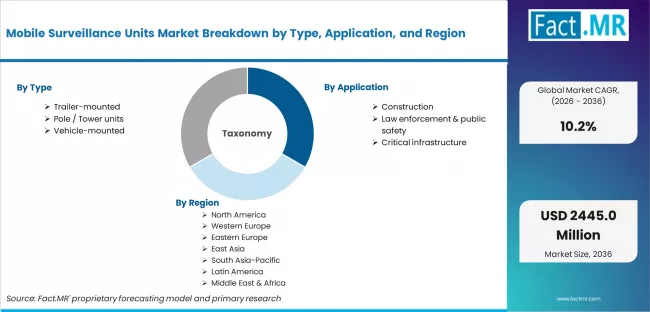
Trailer-mounted, Pole / Tower units, Vehicle-mounted
Segmentation by Power Source
Solar-powered, Hybrid, Diesel / generator
Segmentation by Technology
Conventional, AI-enabled
Segmentation by Application
Construction, Law enforcement & public safety, Events & crowd management, Critical infrastructure
Segmentation by End User
Government, Commercial
Segmentation by Region
North America, Latin America, East Asia, South Asia & Pacific, Western Europe, Eastern Europe, Middle East & Africa
Source: Fact.MR analysis. Updated May 6, 2026
Key Growth Drivers, Constraints, and Opportunities
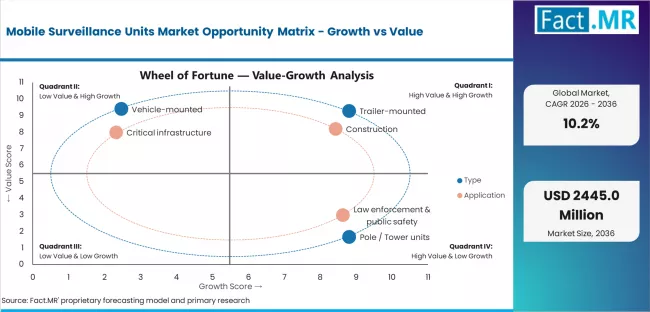
Mobile Surveillance Units Market Opportunity Matrix Growth Vs Value | Source: Fact.MR
Key Factors Driving Growth
The escalating development of construction and infrastructure is contributing to the demand for mobile surveillance units to be used in site protection, theft deterrent, and safety monitoring.
Growing emphasis on public safety and law enforcement modernization is contributing to increasing adoption of mobile surveillance in temporary monitoring, emergency response, and high-risk environments.
Increase in the number of large-scale events, concerts, and public gathering is driving the demand for temporary and rapid-deployment surveillance solutions.
The increasing adoption of smart city projects and urban surveillance schemes is spurring the deployment of mobile units to supplement the traditional surveillance network.
Growth Driver
Demand Impact
Time Horizon
Key Impact Area
Fact.MR Insight
Rapid expansion of construction and infrastructure projects
High
Short–Mid Term
Adoption acceleration
Increasing number of construction sites and infrastructure projects is driving strong demand for mobile surveillance units for site security, theft prevention, and safety monitoring.
Rising focus on public safety and law enforcement modernization
High
Short–Mid Term
Security enhancement & monitoring
Governments and law enforcement agencies are increasingly deploying mobile surveillance units for temporary monitoring, emergency response, and urban security management.
Growth in large-scale events and crowd gatherings
High
Short–Mid Term
Temporary deployment & utilization
Increasing number of concerts, sports events, and public gatherings is accelerating demand for rapid-deployment surveillance solutions with high utilization rates.
Advancements in AI-enabled video analytics and connectivity (4G/5G, cloud)
Medium-High
Mid–Long Term
Product innovation & system optimization
Integration of AI, real-time analytics, and cloud-based monitoring is enhancing surveillance efficiency, automation, and proactive threat detection capabilities.
Increasing adoption of solar-powered and energy-efficient systems
Medium
Short–Mid Term
Sustainability & remote deployment
Rising demand for off-grid and low-maintenance surveillance solutions is driving adoption of solar-powered and hybrid mobile surveillance units, especially in remote locations.
Source: Fact.MR analysis. Updated May 6, 2026
Key Market Constraints
Growing privacy concerns and regulatory scrutiny over surveillance deployments could restrain adoption, especially in public and residential areas.
The high cost of initial deployment and maintenance of mobile surveillance units can limit adoption by small and cost-conscious users.
Dependency on network connectivity and power supply may affect performance at remote or infrastructure-scarce sites.
Key Opportunity Areas
Rising demand for solar-powered and energy-efficient surveillance systems presents significant growth opportunities, especially in off-grid and remote deployments.
Expansion of rental and Surveillance-as-a-Service (SaaS) models is enabling wider adoption across commercial and temporary use cases.
Integration of AI, edge computing, and advanced analytics offers opportunities to enhance system capabilities and create value-added services.
Segment-wise Analysis of the Mobile Surveillance Units Market
Trailer-mounted units hold 50.8% of the type segment in 2026, driven by their widespread use in construction sites and temporary surveillance deployments due to ease of mobility, solar integration, and rapid setup capabilities.
Diesel / generator-powered systems account for 35.1% of the power source segment in 2026, supported by their reliability and ability to provide continuous power in remote and infrastructure-limited locations.
Conventional surveillance systems dominate the technology segment with a 58.2% share in 2026, owing to their cost-effectiveness and established adoption across commercial and government applications.
Construction leads the application segment with a 37.2% share in 2026, driven by increasing infrastructure development and the need for site security, theft prevention, and worker safety monitoring.
Conventional and diesel-based products hold sway in the market; however, the next few years will see a rising popularity of AI-enabled surveillance, solar-based products, and hybrids, which will be spurred by upticks in smart city projects, sustainability mandates, as well as advancements in real-time analytics and connectivity solutions.
Which Type Segment Topped the Mobile Surveillance Units Market?
Trailer-based systems are predicted to the mobile surveillance units market by 2026, accounting for 50.8% of the market value. This superiority is led due to their simple installation, portability and their applications in construction sites and temporary surveillance where quick instalment and flexibility are a must.
Which Application Segment Accounts for the Highest Share in the Market?
Mobile Surveillance Units Market Analysis By Application | Source: Fact.MR
Construction is forecast to be the largest application segment, accounting for 37.2% share in 2026. This is attributed to growth in infrastructure activities and demand for sustained monitoring of sites, theft control, and safety of workers in huge and far-flung project sites.
Which Power Source Segment Leads the Market?
Mobile Surveillance Units Market Analysis By Power Source | Source: Fact.MR
Diesel / generator-powered systems dominate with a 35.1% share in 2026, driven by their reliability and ability to provide uninterrupted power in remote and infrastructure-limited environments where grid connectivity is unavailable or inconsistent.
Which Technology Segment Holds the Largest Share in the Market?
Mobile Surveillance Units Market Analysis By Technology | Source: Fact.MR
Conventional surveillance systems hold the largest share at 58.2% in 2026, primarily due to their cost-effectiveness, established adoption, and suitability for a wide range of applications across both commercial and government sectors.
Which End-User Segment Leads the Market?
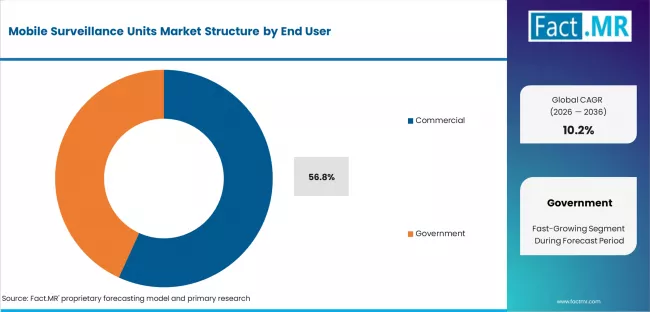
Mobile Surveillance Units Market Analysis By End User | Source: Fact.MR
Commercial end users account for the highest share at 56.8% in 2026, supported by strong demand from construction companies, event organizers, and industrial facilities requiring flexible, temporary, and scalable surveillance solutions.
Regional Outlook Across Key Markets
India is expected to grow at approximately 12.5%, emerging as the fastest-growing market due to rapid infrastructure development, increasing construction activities, and rising adoption of smart city initiatives. Growing demand for cost-effective and flexible surveillance solutions across urban and semi-urban areas is significantly driving the adoption of mobile surveillance units.
The United States remains a key market, projected to grow at around 9.6%, supported by strong demand from law enforcement, public safety modernization, and large-scale event surveillance. The increasing integration of AI-enabled analytics and cloud-based monitoring is further accelerating market growth.
Asia-Pacific is anticipated to witness the highest overall growth, with China growing at 11.9% due to expanding urban surveillance programs, infrastructure projects, and government-led security initiatives. Meanwhile, Japan is expected to grow at 8.2%, driven by advanced technology adoption, event security requirements, and smart city developments.
Europe is experiencing steady growth, with Germany projected at 8.6%, supported by industrial security needs and infrastructure monitoring. The United Kingdom is expected to grow at 9.1%, driven by increasing deployment in construction sites, events, and public safety applications.
Latin America is also emerging as a growth region, with Brazil expected to grow at 11.7%, supported by rising urban security concerns, infrastructure expansion, and demand for temporary surveillance solutions.
Top Country Growth Comparison Mobile Surveillance Units Market Cagr (2026 2036) | Source: Fact.MR
CAGR Table
Country
CAGR (%)
India
12.5%
Japan
8.2%
China
11.9%
Brazil
11.7%
United States
9.6%
United Kingdom
9.1%
Germany
8.6%
Source: Fact.MR analysis. Updated May 6, 2026
Source: Fact.MR (FMR) analysis, based on proprietary forecasting model and primary research.
Mobile Surveillance Units Market Cagr Analysis By Country | Source: Fact.MR
North America – The Advanced Security & Public Safety Hub
North America is an advanced market with high technological maturity, where the law enforcement modernization, event security, and commercial surveillance occupies a large proportion in the application in mobile surveillance units. The region is highly integrated in terms of AI-based analytics, cloud monitoring, and connected surveillance, with emphasis on operational efficiency and quick reaction.
U.S.: Demand is projected to grow at 9.6% CAGR through 2036, driven by public safety investments, large-scale events, and adoption of AI-enabled surveillance systems.
Canada: Expected to witness steady growth, supported by infrastructure monitoring needs and increasing focus on urban safety and smart city deployments.
Europe – The Regulated & Infrastructure Security Market
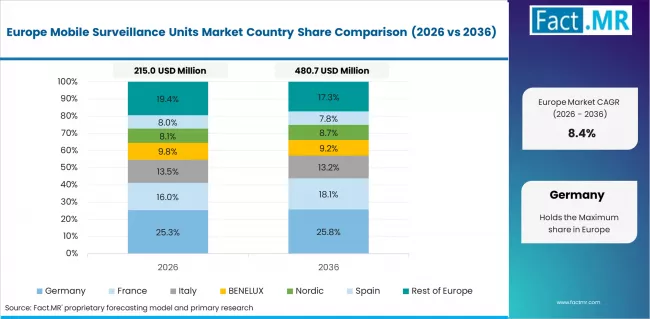
Mobile Surveillance Units Market Europe Country Market Share Analysis, 2026 & 2036 | Source: Fact.MR
Europe has tough privacy policies and high infrastructure security requirements, which promote the need for mobile surveillance solutions that are both efficient and compliant. The region has a strong focus on sustainable and short-term monitoring, especially in the areas of construction work and public events.
Germany: Expected to grow at 8.6% CAGR, supported by industrial security, infrastructure monitoring, and regulated deployment frameworks.
United Kingdom: Projected to expand at 9.1% CAGR, driven by construction activity, event security, and adoption of mobile surveillance solutions.
Asia-Pacific – The High-Growth Infrastructure & Smart City Engine
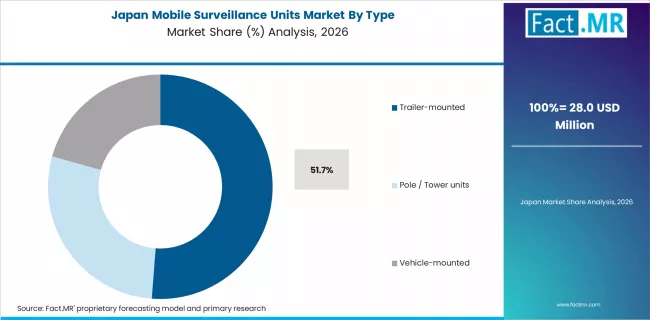
Mobile Surveillance Units Market Japan Market Share Analysis By Type | Source: Fact.MR
Asia-Pacific is an emerging region owing to rapid urbanization, infrastructure development and smart city projects. Governments and private organizations are bunking up in modular surveillance solutions for construction, public safety, and urban surveillance.
China: Expected to grow at 11.9% CAGR, supported by large-scale surveillance programs and infrastructure development.
Japan: Growth at 8.2% CAGR, driven by advanced technology adoption, event security, and smart city projects.
India: Leading growth at 12.5% CAGR, fueled by infrastructure expansion, smart city initiatives, and increasing demand for cost-effective surveillance solutions.
Latin America – The Emerging Urban Security Market
Latin America is a growing market with increasing urban security concerns, development of infrastructure, and an enhanced acceptance of temporary surveillance solutions. Investments in public security and event monitoring are on the rise.
Brazil: Expected to grow at 11.7% CAGR, supported by urban security needs, infrastructure projects, and demand for mobile surveillance systems.
Middle East & Africa – The Smart Infrastructure & Remote Surveillance Zone
The Middle East & Africa is an emerging region driven by smart city developments, large-scale infrastructure projects, and demand for surveillance in remote locations. The region emphasizes solar-powered and mobile surveillance solutions for off-grid and high-temperature environments.
UAE / Saudi Arabia (KSA): Demand is projected to grow steadily, supported by smart city investments, mega events, and infrastructure expansion.
Fact.MR’s analysis of the market highlights strong regional momentum, with Asia-Pacific emerging as the fastest-growing region, while North America and Europe lead in technology adoption and regulatory frameworks, shaping the global shift toward flexible, AI-enabled, and scalable surveillance solutions.
Competitive Benchmarking and Company Positioning
Leading Companies Shaping the Mobile Surveillance Units Market
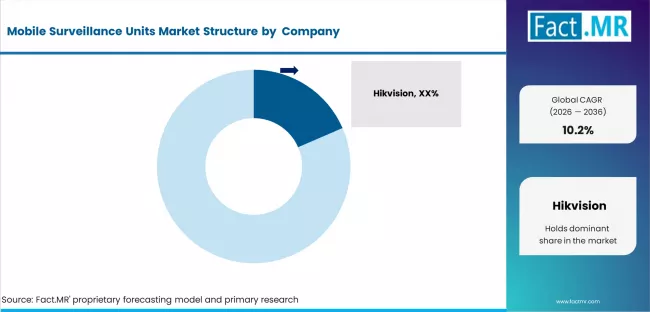
Mobile Surveillance Units Market Analysis By Company | Source: Fact.MR
Mobile surveillance units market is a mix of global surveillance giants and niche mobile solution providers. The key players such as Hikvision, Dahua Technology, Bosch, Motorola Solutions, Axis Communications together occupy and hold a lion’s share of around 50–55 % of the market. Factors such as AI enabled analytics, deployment flexibility, connectivity, energy efficiency, and total cost of ownership influence the competition.
Established brand at global level and large-scale regional players are offering integrated hardware and software solutions including cameras, video management system and analytics platform. This end-to-end capability is a competitive advantage, especially in large government and enterprise deployments.
Meanwhile niche vendors like WCCTV, LiveView Technologies and Pro-Vigil are making headway with mobile-first solutions, rental-based models, and rapid deployment capabilities. These providers are especially strong in construction, events and temporary surveillance applications.
Leading Companies Shaping the Mobile Surveillance Units Market
Hikvision
Dahua Technology
Bosch
Motorola Solutions
Axis Communications
Hanwha Vision
Vivotek
Teledyne FLIR
Zhejiang Uniview Technologies
CP Plus
Other prominent players
Recent Industry Developments
Hanwha Vision Launches T AI 5MP IR Mobile Camera for Complex Surveillance Needs (2025)
Hanwha Vision introduced the T AI 5MP IR Mobile Camera, specifically designed for complex and mobile surveillance environments such as transportation, law enforcement, and temporary monitoring setups. The solution enhances real-time video analytics, low-light performance, and durability, making it suitable for deployment in mobile surveillance units and vehicle-mounted systems.
Motorola Solutions Acquires Blue Eye for AI-Powered Remote Video Monitoring (2025)
Motorola Solutions acquired Blue Eye, a provider of AI-powered remote video monitoring services, to strengthen its cloud-based surveillance and analytics capabilities. This acquisition enhances Motorola’s ability to deliver integrated surveillance solutions, including real-time monitoring and incident detection for mobile and distributed security deployments.
Axis Communications Debuts Multisensory Surveillance Technologies at GSX 2025 (2025)
Axis Communications introduced advanced multisensory surveillance technologies at the Global Security Exchange (GSX) 2025, featuring AI-enabled cameras, radar systems, and integrated sensors. These innovations improve situational awareness and enable more efficient monitoring across complex environments, supporting next-generation mobile surveillance deployments.
Hanwha Vision Launches ConfigPro Tool for Centralized Device Management (2026)
Hanwha Vision unveiled ConfigPro, a centralized device management and configuration tool designed to simplify large-scale surveillance system deployment. The platform enhances operational efficiency by enabling streamlined setup, monitoring, and maintenance of multiple surveillance units, including mobile surveillance fleets.
Motorola Solutions Completes Acquisition of Silvus Technologies (2025)
Motorola Solutions completed the acquisition of Silvus Technologies to strengthen its wireless communication capabilities, particularly mobile ad-hoc networks (MANET). This enhances real-time video, data, and voice transmission, which is critical for mobile surveillance units operating in remote or dynamic environments
Sources and Research References
[1] Hanwha Vision, “T AI 5MP IR Mobile Camera: Designed for Complex Surveillance Needs,” 2025.
[2] Motorola Solutions, “Motorola Solutions acquires Blue Eye, leading provider of AI-powered enterprise remote video monitoring services,” 2025.
[3] Axis Communications, “Axis Communications debuts latest multisensory technologies for smarter security at the 2025 Global Security Exchange,” 2025.
[4] Hanwha Vision, “Hanwha Vision Unveils ConfigPro Tool for Centralized Device Management and Configuration,” 2025.
The mobile surveillance units market consists of mobile surveillance units and mobile SC among others, which can be adapted for temporary or mobile monitoring applications in various fields. These are the trailer-mounted, pole/tower, and vehicle-mounted systems that include cameras, sensors, connectivity along with power solutions including solar, hybrid, diesel. Conventional CCTV and AI-based analytics are combined for real-time viewing and detection of threats by the solutions. They are common in construction, law enforcement, events and critical infrastructure. Mobile surveillance units deliver scalable, cost-efficient and effective security solutions and enable smart city programs as well as modern security requirements with improved mobility, remote capabilities, and rapid deployment.
Mobile Surveillance Units Market Inclusions
The report presents a comprehensive analysis of the mobile surveillance units market on the global and regional levels with key players, market dynamics, demand drivers and impact of macro and microeconomics factors. The market is segmented by type, power source, technology, application, end users, and region. It also provides pricing trends, growth opportunities and demand for the construction, law enforcement, events and critical infrastructure segments. The study also highlights trends such as AI-enabled surveillance, solar-powered solutions, wireless communication, cloud-based monitoring as well as breaks in rapid deployment, smart city surveillance, and among others.
Mobile Surveillance Units Market Exclusions
The market does not include fixed or permanently established surveillance systems (e.g., traditional CCTV networks, centralized monitoring infrastructure) that are not portable or quickly deployable. Standalone surveillance modules like cameras, sensors, or software are also out of scope unless they are part of mobile units. The scope does not cover drones, body-worn cameras, or personal surveillance gadgets. General security and monitoring (and consulting) services that are not directly encoded on to MSU hardware are not included. In addition, vehicles or trailers lacking built-in surveillance system and power solutions are not considered in the scope of this market.
Mobile Surveillance Units Market Research Methodology
Primary Research: In-depth interviews were conducted with mobile surveillance unit manufacturers, security solution providers, system integrators, law enforcement agencies, construction firms, and event management companies across sectors such as public safety, infrastructure, and commercial security. These interactions helped capture insights on demand trends, technology adoption (AI, solar-powered systems), pricing, and deployment patterns of mobile surveillance units.
Desk Research: To validate market size, trends, and the competitive landscape, secondary sources such as company annual reports, investor presentations, product catalogs, industry databases, government publications, security industry journals, and white papers on surveillance technologies and smart cities were analyzed.
Market-Sizing and Forecasting: Market estimates were derived using a combination of bottom-up analysis (company revenues, unit deployments, product-level adoption) and top-down analysis (growth in infrastructure projects, public safety investments, smart city initiatives, and event security demand).
Data Validation and Update Cycle: All data points were validated through triangulation with industry experts and continuously refined based on technological advancements, regulatory developments, infrastructure investments, and macroeconomic trends impacting the mobile surveillance ecosystem.
Market Breakdown
Segmentation
Scope of Analysis
Mobile Surveillance Units Market Breakdown By Type, Application, And Region | Source: Fact.MR
Parameter
Details
Quantitative Units
USD 840.0 Million (2025) to USD 2,445.0 Million (2036), at a CAGR of 10.2%
Market Definition
The Mobile Surveillance Units Market covers portable, rapidly deployable surveillance systems including trailer-mounted, pole/tower, and vehicle-mounted units equipped with cameras, sensors, connectivity, and power systems (solar, hybrid, diesel). These solutions integrate conventional and AI-enabled technologies for real-time monitoring across applications such as construction, law enforcement, events, and critical infrastructure, focusing on flexibility, mobility, and rapid deployment.
Regions Covered
North America, Europe, Asia-Pacific, Latin America, Middle East & Africa
Countries Covered
USA, Canada, UK, Germany, China, Japan, India, Brazil, UAE, Saudi Arabia, and 20+ countries
Hybrid demand-side and top-down methodology based on growth in construction and infrastructure projects, public safety investments, event security demand, smart city initiatives, and adoption of AI-enabled and solar-powered surveillance systems, validated through primary interviews with manufacturers, system integrators, security agencies, construction firms, and event management companies across key regions.
Source: Fact.MR analysis. Updated May 6, 2026
Analysis by Type, Power Source, Technology, Application, End User, and Region
Mobile Surveillance Units Market by Type
Trailer-mounted
Solar trailers
Hybrid trailers
Rapid deployment trailers
Pole / Tower units
Fixed temporary towers
Telescopic mast systems
Portable lightweight units
Vehicle-mounted
Patrol vehicles
Command vans
Covert surveillance vehicles
Mobile Surveillance Units Market by Power Source
Solar-powered
Fully off-grid solar units
Solar + battery storage systems
Hybrid
Solar + generator
Solar + grid backup
Diesel / generator
Continuous generator-powered systems
Backup-only generator systems
Mobile Surveillance Units Market by Technology
Conventional
Basic CCTV monitoring
Remote live viewing
AI-enabled
Video analytics (motion, intrusion)
Facial recognition
License plate recognition (ANPR)
Mobile Surveillance Units Market by Application
Construction
Law enforcement & public safety
Events & crowd management
Critical infrastructure
Mobile Surveillance Units Market by End User
Government
Police departments
Municipal authorities
Defense & border security
Commercial
Construction companies
Event organizers
Industrial facilities
Mobile Surveillance Units Market by Region
North America
USA
Canada
Mexico
Latin America
Brazil
Chile
Rest of LATAM
East Asia
China
Japan
South Korea
Taiwan
South Asia & Pacific
India
Singapore
Australia
ASEAN
Western Europe
Germany
France
U.K.
Italy
Spain
BENELUX
Nordic
Rest of Western Europe
Eastern Europe
Poland
Hungary
Czech Republic
Balkan & Baltics
Rest of Eastern Europe
Middle East and Africa
Kingdom of Saudi Arabia
United Arab Emirates
South Africa
Rest of Middle East and Africa
Questions Answered
Frequently Asked Questions
How large is the demand for Mobile Surveillance Units in the global market in 2025?
Demand for the Mobile Surveillance Units Market is estimated to be valued at USD 840.0 million in 2025, driven by increasing adoption across construction sites, public safety, events, and infrastructure monitoring.
What will be the market size of Mobile Surveillance Units by 2036?
The market size is projected to reach USD 2,445.0 million by 2036, supported by growing demand for flexible and rapid-deployment surveillance solutions.
What is the expected demand growth between 2025 and 2036?
Demand is expected to grow at a CAGR of 10.2%, driven by rising infrastructure development, smart city initiatives, and adoption of AI-enabled surveillance systems.
Which type segment is expected to dominate the market?
Trailer-mounted units are expected to dominate, accounting for 50.8% share in 2026, due to their ease of deployment and widespread use in temporary surveillance applications.
Which power source segment is expected to dominate the market?
Diesel / generator-powered systems are expected to dominate, capturing 35.1% share in 2026, supported by their reliability in remote and continuous operations.
Which technology segment is expected to lead the market?
Conventional surveillance systems are expected to lead, holding 58.2% share in 2026, driven by their cost-effectiveness and established usage.
Which application segment is expected to dominate the market?
Construction is expected to dominate, with 37.2% share in 2026, fueled by increasing infrastructure development and site security requirements.
Which end-user segment is expected to lead the market?
Commercial users are expected to lead, accounting for 56.8% share in 2026, driven by demand from construction companies, event organizers, and industrial facilities.
Which regions are expected to drive growth in the market?
Asia-Pacific is expected to be the fastest-growing region, led by India, China, and Japan, driven by rapid urbanization, infrastructure expansion, and smart city initiatives.
Who are the key companies operating in the Mobile Surveillance Units Market?
.webp "Top Country Growth Comparison Mobile Surveillance Units Market Cagr (2026 2036)")