- Market Value (2025): USD 821.4 Mn
- Estimated Value (2026): USD 920.0 Mn
- Forecast Value (2036): USD 2857.0 Mn
- CAGR (2026-2036): 12.0%
What is the Multi-Texture Confectionery Blends Market forecast to be worth by 2036?
USD 920.0 million in 2026 to USD 2,857.0 million by 2036, implying a 12.0% CAGR.
- The Multi-Texture Confectionery Blends Market was valued at USD 821.4 million in 2025.
- Demand is projected from USD 920.0 million in 2026 to USD 2,857.0 million by 2036.
- The market is forecast to record a 12.0% CAGR from 2026 to 2036, supported by coating, bakery inclusion and filled-sweet applications.
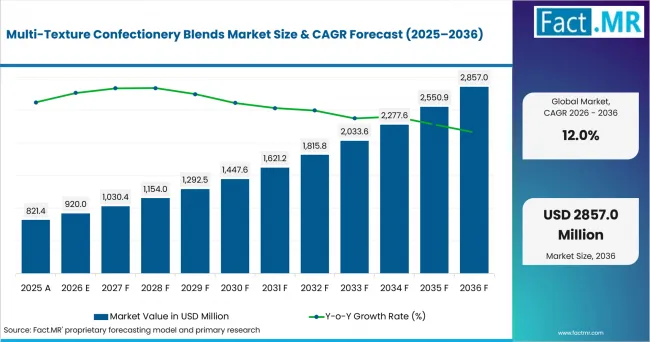
Multi Texture Confectionery Blends Market Value Analysis | Source: Fact.MR
What are the defining numbers behind Multi-Texture Confectionery Blends Market growth?
An absolute opportunity of USD 1,937.0 million is expected between 2026 and 2036.
- Demand Drivers in the Market
- Confectionery manufacturers need blends that set quickly and keep a clean bite because retail packs face longer ambient storage windows.
- Bakery brands need filling and coating systems that hold texture after baking, cooling and packing across shelf-stable formats.
- Snack producers need flexible coatings for bars, cereals and ice cream pieces as adjacent confectioneries category innovation shifts toward layered formats.
- USDA ERS reported in June 2026 that total U.S. food spending reached USD 2.51 trillion in 2025, comprising USD 1.10 trillion in food-at-home spending and USD 1.41 trillion in food-away-from-home spending.
- Cost pressure is keeping reformulation active. BLS reported on August 12, 2026 that U.S. sugar and sweets prices were 7.4% higher than a year earlier in July 2026.
- Key Segments Analyzed
- By Fat System: Lauric is expected to hold 38.0% share in 2026 because fast set and hard snap suit compound coatings used in bars and bakery pieces.
- By Function: Heat stability is projected to account for 41.0% share in 2026 as brands require texture retention during transport and display.
- By Application: Confectionery is anticipated to capture 37.0% share in 2026, supported by molded sweets, coated snacks and filled bars.
- By Form: Blocks are estimated to represent 36.0% share in 2026 owing to easier handling across industrial melting and dosing systems.
- Analyst Opinion at Fact.MR
- Shambhu Nath Jha, Principal Consultant at Fact.MR, states, "The commercial issue is no longer only chocolate flavor. Manufacturers are paying closer attention to how coatings break, how fillings release flavor and how blends behave after storage. Suppliers that combine fat crystallization control, cocoa application knowledge and line-trial support are expected to gain preference in this market."
- Strategic Implications
- Fat-system suppliers should document set time, bloom behavior and melt profile by application so manufacturers can compare lauric, non-lauric and blended systems clearly.
- Ingredient formulators should pair cocoa, fat and emulsifier knowledge because multi-layer sweets need consistent release from shell to center.
- Manufacturing teams should test block, flake, liquid and powdered forms on existing melting, pumping and depositing equipment before scale-up.
- Regional sales teams should build country-specific playbooks around sugar cost, chocolate standards and bakery channel needs.
The USA is projected to record 13.2% CAGR through 2036, supported by large packaged-food channels and rising sweet-good prices. Germany is expected to post 12.6% CAGR, led by chocolate manufacturing depth and wholesale confectionery price pressure. Japan is forecast to advance at 11.8% CAGR, shaped by compact bakery and sweet formats. France is anticipated to record 11.3% CAGR, supported by cocoa, chocolate and confectionery manufacturing activity. Brazil is estimated to post 10.8% CAGR, driven by sugarcane scale and price-sensitive confectionery production.
How does the Multi-Texture Confectionery Blends Market break down by segment?
Lauric leads Fat System at 38.0%; Heat stability leads Function at 41.0%.
Which Fat System dominates?
Lauric holds 38.0% share in 2026.
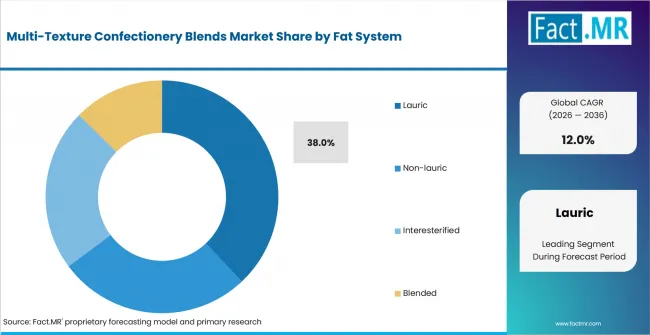
Multi Texture Confectionery Blends Market Analysis By Fat System | Source: Fact.MR
Lauric systems lead because they give fast set, hard bite and clean release in compound coatings. They suit confectionery pieces that need a crisp shell without full tempering complexity. Non-lauric systems remain relevant where cocoa butter compatibility is central to flavor and melt. Interesterified and blended systems serve manufacturers that need more precise fat-crystal behavior across fillings and coatings. The link with specialty fat and oil platforms is direct because confectionery blends rely on tailored fat structure rather than bulk oil performance.
What leads the Function segment?
Heat stability accounts for 41.0% share in 2026.
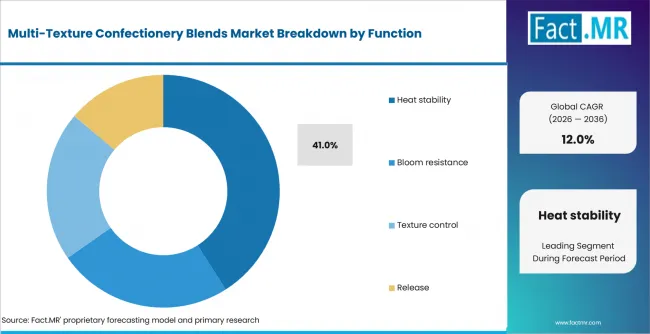
Multi Texture Confectionery Blends Market Analysis By Function | Source: Fact.MR
Heat stability leads because coatings and filled pieces often move through warm retail routes before reaching consumers. A blend that resists softening helps protect the outer shell and limits deformation in wrapped products. Bloom resistance follows closely where chocolate appearance is part of the value promise. Texture control and release functions are used when formulators need layered eating quality in bars, pralines and bakery sweets. AAK AB describes BARRIER FAT as a layer that helps control filling fat migration into chocolate coatings, showing why migration control is part of the functional brief.
How does Application shape demand?
Confectionery captures 37.0% share in 2026.
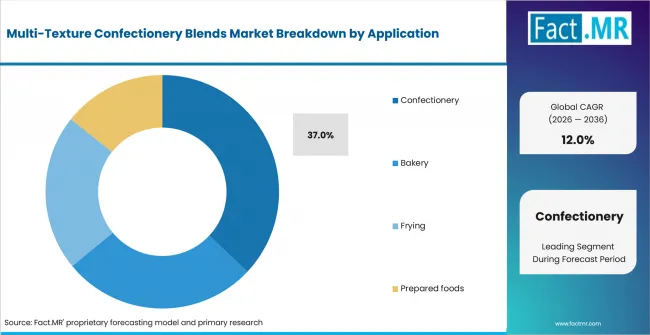
Multi Texture Confectionery Blends Market Analysis By Application | Source: Fact.MR
Confectionery leads because the market is built around bite, melt and flavor release in sweet products. Manufacturers use these blends in molded pieces, filled centers and coated snacks where one formulation must balance processing ease with sensory quality. Bakery applications are gaining room as brands add chocolate-style layers to biscuits, cakes and laminated snacks. Frying and prepared foods remain narrower uses where release and coating behavior matter. The application base connects with food processing ingredients because finished formats depend on fats, cocoa systems and texturizers working together.
What supports Blocks within Form?
Blocks represent 36.0% share in 2026.
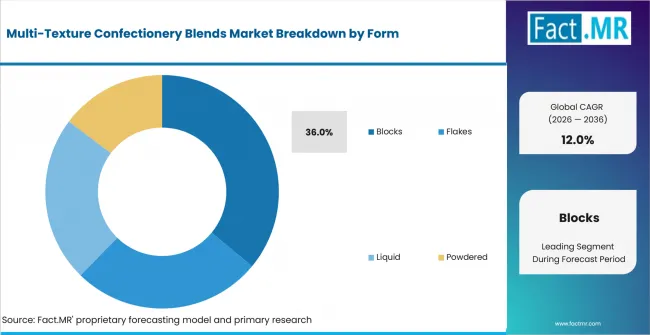
Multi Texture Confectionery Blends Market Analysis By Form | Source: Fact.MR
Blocks lead because industrial users can store, melt and meter them with familiar equipment. They work well for coating lines that need steady viscosity and repeatable cooling behavior. Flakes are used where fast melting or pre-measured handling helps smaller plants. Liquid formats suit continuous pumping systems, while powdered blends serve dry premixes and bakery applications. Cargill, Incorporated states that NextCoa formats are suited for inclusions, baked goods and coatings, which shows how form choice links directly to end-use processing.
How does Company participation shape demand?
Company participation is centered on fat systems, coatings, fillings and cocoa ingredient platforms.
Barry Callebaut AG, Puratos NV/SA, Cargill, Incorporated, AAK AB, ofi and Fuji Oil Co., Ltd. are active across adjacent capabilities that matter for multi-texture blends. Barry Callebaut AG offers compound coatings and fillings for confectionery, bakery and ice cream uses. Puratos NV/SA works through chocolate, filling and bakery systems for professional users. ofi launched three deZaan single-origin cocoa liquors in February 2026, designed to deliver distinct fine-flavor profiles with precision and consistency at scale. Fuji Oil Co., Ltd. develops vegetable fats for chocolate and hard butters, connecting the company to specialty triglycerides and compound chocolate formulation.
What is accelerating Multi-Texture Confectionery Blends Market adoption, and what is holding it back?
Heat-stable texture drives it; sensory validation restrains it.
Drivers Impact Analysis
| Driver | (~) % IMPACT ON CAGR | Geographic Relevance | Impact Timeline |
|---|---|---|---|
| Heat-stable compound coatings | +1.6% | USA, Germany, Brazil | Short term (<= 2 years) |
| Cocoa cost and formula flexibility | +1.4% | Global | Short term (<= 2 years) |
| Layered bakery and snack formats | +1.1% | USA, Japan, France | Medium term (2-4 years) |
| Bloom and fat-migration control | +0.9% | Europe, East Asia | Medium term (2-4 years) |
| Cocoa-free and cocoa-reduced alternatives | +0.7% | North America, Europe | Long term (>= 4 years) |
- Heat-stable compound coatings: Heat-stable blends are expected to gain adoption where confectionery products face warm transport and retail conditions. Manufacturers value systems that help preserve snap, gloss and coating integrity after distribution.
- Cocoa cost and formula flexibility: Cocoa and sugar cost pressure is expected to keep reformulation activity high. Compound coating systems give manufacturers more flexibility to adjust recipes while maintaining texture, appearance and processing performance.
- Layered bakery and snack formats: Bakery and snack brands are anticipated to use more coating and filling systems that create contrast between shell and center. Biscuits, wafers and filled pastries benefit from stable melt behavior and repeatable processing.
Opportunity Impact Analysis
| Opportunity | (~) % IMPACT ON CAGR | Geographic Relevance | Impact Timeline |
|---|---|---|---|
| Multi-layer bars and filled pieces | +1.2% | Global | Medium term (2-4 years) |
| Premium flavor control | +0.9% | Japan, France, Germany | Medium term (2-4 years) |
| Ambient bakery coatings | +0.8% | USA, Brazil | Short term (<= 2 years) |
| Clean-label and allergen-aware formats | +0.6% | North America, Europe | Long term (>= 4 years) |
- Multi-layer bars and filled pieces: The primary opportunity is concentrated in products that combine crisp shells with soft centers. Suppliers can support this need through application-specific blend libraries designed for controlled melt, texture contrast and filling stability.
- Premium flavor control: Premium confectionery programs need cocoa ingredients and fat systems that preserve flavor clarity, aroma release and texture across bars, pralines and filled products.
- Ambient bakery coatings: Ambient bakery coatings are expected to gain use where biscuits and sweet bakery products need chocolate-style appeal. Blocks and flakes suit plants that already melt coating materials and value straightforward handling.
Restraints Impact Analysis
| Restraint | (~) % IMPACT ON CAGR | Geographic Relevance | Impact Timeline |
|---|---|---|---|
| Sensory gap versus cocoa butter | -0.8% | Global | Short term (<= 2 years) |
| Qualification time on coating lines | -0.6% | USA, Europe, Japan | Medium term (2-4 years) |
| Input-price swings for sugar and fats | -0.5% | Global | Short term (<= 2 years) |
| Label and category positioning | -0.4% | Europe, Japan | Long term (>= 4 years) |
- Sensory gap versus cocoa butter: Sensory validation is expected to slow adoption where brands need familiar melt behavior, clean flavor release and premium eating quality. Premium confectionery applications have especially tight performance requirements.
- Qualification time on coating lines: Line qualification is anticipated to extend switching time because viscosity, flow and set behavior must match existing plant conditions. Trial batches can also interrupt normal production schedules.
- Input-price swings for sugar and fats: Changes in sugar and fat costs are expected to affect blend economics across confectionery, bakery and other sweet-goods applications, increasing the importance of formulation flexibility and cost control.
Which countries are scaling the Multi-Texture Confectionery Blends Market through 2036?
- The country comparison spans 2.4 percentage points across the forecast period.
- The USA remains 0.6 percentage point above Germany through packaged-food scale and sweet-good prices.
- Germany remains 0.8 percentage point above Japan through chocolate production depth.
- Japan remains 0.5 percentage point above France as compact bakery and snack formats support measured blend adoption.
- France remains 0.5 percentage point above Brazil through cocoa, chocolate and confectionery manufacturing activity.
- Brazil closes the displayed range through sugarcane supply, mass confectionery production and warm-route stability needs.
Comparable CAGRs create different entry conditions because demand is shaped by food manufacturing scale, confectionery pricing and retail climate.
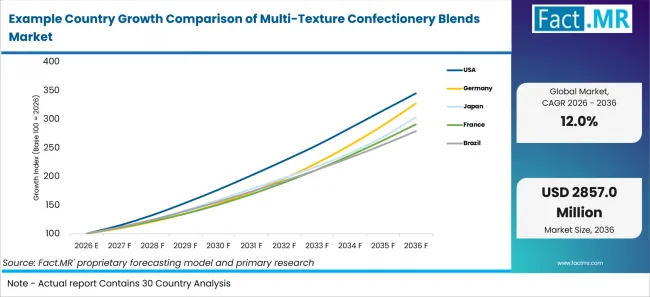
Example Country Growth Comparison Of Multi Texture Confectionery Blends Market | Source: Fact.MR
| Country | CAGR |
|---|---|
| USA | 13.2% |
| Germany | 12.6% |
| Japan | 11.8% |
| France | 11.3% |
| Brazil | 10.8% |
What supports USA adoption?
13.2% CAGR, supported by packaged-food scale and confectionery price pressure.
The USA has a large food channel where confectionery coatings and bakery inclusions can move across retail and foodservice products. USDA ERS reported in June 2026 that U.S. food spending reached USD 2.51 trillion in 2025. That scale supports blend trials for bars, snacks and bakery sweets where manufacturers want stable bite and lower rework. Lauric blocks and flakes are expected to remain practical choices for plants that need fast set and simple handling.
What supports Germany adoption?
12.6% CAGR, backed by chocolate production depth and blend-reformulation needs.
Germany is a high-volume chocolate manufacturing base with strong need for controlled coating behavior. Destatis reported in December 2025 that Germany produced 12.8 kilograms of chocolate per capita in 2024. This production depth gives fat-system suppliers a broad base for heat stability, bloom resistance and texture-control programs. Compound coatings and compound chocolate formats remain relevant where manufacturers need efficient processing and consistent sensory outcomes.
How does Japan perform?
11.8% CAGR, led by compact confectionery and bakery formats.
Japan is expected to use multi-texture blends in compact sweets, convenience bakery items and premium snack formats. The Statistics Bureau of Japan reported in January 2026 that the food consumer price index reached 125.8 in 2025. That price environment supports careful formula review while preserving texture quality. Powdered and flaked forms suit smaller batches where dosing precision and clean flavor release carry weight.
What supports France adoption?
11.3% CAGR, supported by cocoa, chocolate and sugar confectionery activity.
France combines premium pastry expectations with industrial confectionery output. INSEE’s turnover series for the manufacture of cocoa, chocolate and sugar confectionery, published on June 30, 2026, reports an index value of 147.76 for December 2025 (base 100 in 2021).
What supports Brazil adoption?
10.8% CAGR, shaped by sugarcane scale and warm-route stability needs.
Brazilian confectionery production is shaped by price-sensitive retail channels and warmer logistics. Conab reported in August 2026 that Brazil was expected to produce 42.89 million tonnes of sugar in the 2026/27 crop year. That supply base supports sweet-processing scale, while warm-route distribution raises demand for stable coatings. Lauric and blended systems are expected to fit mass sweets where hard set and shelf performance guide formula choices.
Who leads the Multi-Texture Confectionery Blends Market?
Barry Callebaut AG is active through compound coatings and fillings for confectionery, bakery and ice cream applications. Its portfolio covers texture, flavor release and bake stability.
Puratos NV/SA participates through bakery, patisserie, chocolate and filling solutions for professional users. Its August 2025 Innovation Centers support bakery, patisserie and chocolate professionals.
Cargill, Incorporated competes through coatings and NextCoa™ confectionery alternatives. AAK AB is active through chocolate and confectionery fats, including filling fats and cocoa butter alternatives. ofi participates through deZaan cocoa liquors. Fuji Oil Co., Ltd. adds vegetable fats for chocolate and hard butters for chocolate.
Competition is centered on application support, sensory reliability and the ability to connect fat system choice with process conditions. Suppliers that support plant trials are expected to gain stronger account positions.
Which companies are the key providers?
Key companies include Barry Callebaut AG; Puratos NV/SA; Cargill, Incorporated; AAK AB; ofi; and Fuji Oil Co., Ltd.
- Barry Callebaut AG
- Puratos NV/SA
- Cargill, Incorporated
- AAK AB
- ofi
- Fuji Oil Co., Ltd.
Bibliography
- AAK. (2025, October 24). AAK strengthens supply of specialty palm fractions.
- U.S. Bureau of Labor Statistics. (2026, August 12). Consumer Price Index—July 2026.
- Cargill. (2026, May 12). Cargill and Voyage Foods to bring NextCoa™ cocoa-free confectionery alternatives to North America.
- Companhia Nacional de Abastecimento. (2026, August 20). Nova estimativa de cana-de açúcar traz produção de 705,2 milhões de toneladas na safra 2026/27.
- Federal Statistical Office (Destatis). (2025, December 2). 12,8 Kilo Schokolade pro Kopf wurden 2024 produziert [12.8 kilograms of chocolate per capita were produced in 2024].
- Federal Statistical Office (Destatis). (2026, January 15). Wholesale prices in December 2025: +1.2% on December 2024.
- Institut national de la statistique et des études économiques. (2026, June 30). Indice de chiffre d'affaires - Marché intérieur et export - Fabrication de cacao, chocolat et de produits de confiserie (NAF rév. 2, niveau sous-classe, poste 10.82Z) (Série 010772877).
- ofi. (2026, February 2). ofi's deZaan brand launches single origin cocoa liquor range, advancing fine flavor consistency at scale.
- Statistics Bureau of Japan. (2026, January 23). Japan 2025 [Consumer Price Index Japan yearly average].
- Zeballos, E., & Sinclair, W. (2026, June 11). Total U.S. food spending reached $2.51 trillion in 2025. U.S. Department of Agriculture, Economic Research Service.
This Report Answers
- The report explains where multi-texture confectionery blends are used across fat system, function, application and form.
- Segment analysis identifies the leading subsegments and the reasons manufacturers prioritize them.
- Country analysis examines the listed markets and the food manufacturing mechanisms supporting blend adoption.
- Competitive analysis reviews current providers across compound coatings, confectionery fats, cocoa ingredients and filling systems.
- Application analysis assesses how bite, melt, release and heat stability influence supplier selection.
What does the Multi-Texture Confectionery Blends Market cover?
The Multi-Texture Confectionery Blends Market covers blends used to manage texture in confectionery and adjacent sweet applications. These products help control set, melt, release and bloom behavior.
The assessment covers lauric, non-lauric, interesterified and blended systems across confectionery, bakery, frying and prepared-food applications. It also considers blocks, flakes, liquids and powders.
What is included in the scope?
The scope includes confectionery blends used to create hard snap, soft centers, heat stability, bloom resistance and controlled release. It covers industrial blends used by manufacturers and contract producers.
It includes lauric and non-lauric fat systems, interesterified formulations, blended systems, compound coatings, filling fats and functional ingredient blends.
What is excluded from the scope?
The scope excludes finished retail confectionery products sold directly to consumers. It also excludes raw bulk vegetable oil and general bakery ingredients without coating or filling use.
General sweeteners, flavors, colors and packaging materials are outside the boundary without melt, set, release or bloom control.
How Was the Analysis Built?
The analysis draws on 120+ sources, 35+ company portfolios, 25+ countries, and more than 20 industry interviews.
- Primary Research: Primary research includes discussions with manufacturers, service providers, technology developers, distributors, end users, and subject-matter experts. These conversations examine purchasing priorities, product adoption, operational challenges, approval requirements, competitive positioning, and the factors that influence wider market acceptance.
- Desk Research: Desk research covers government statistics, regulatory publications, company filings, trade data, technical studies, industry associations, standards, public policy, and other authoritative sources. Every source used in the analysis is documented in the bibliography.
- Market Sizing and Forecasting: Market estimates combine historical performance, demand indicators, pricing and volume trends, segment shares, company participation, country-level growth, adoption patterns, investment activity, and barriers to market expansion.
- Data Validation and Update Cycle: Findings are validated by comparing primary interviews with public data, company activity, regulatory changes, trade patterns, and industry developments. Regular updates review new product launches, capacity changes, partnerships, approvals, and shifts in commercial adoption.
What is the report’s scope and coverage?
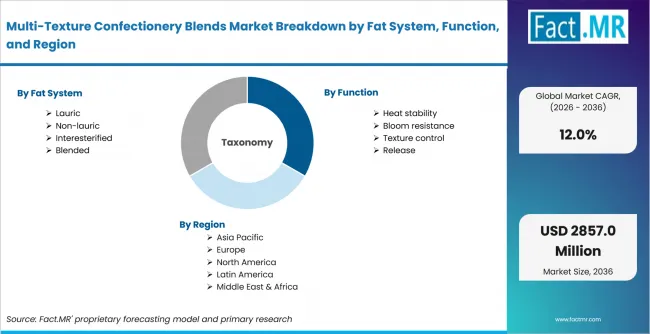
Multi Texture Confectionery Blends Market Breakdown By Fat System, Function, And Region | Source: Fact.MR
| Attribute | Details |
|---|---|
| Quantitative Units | USD million |
| Market Definition | Functional confectionery fat and ingredient blends used to create controlled bite, melt, release, bloom behavior and heat stability in sweet goods. |
| Fat System | Lauric; Non-lauric; Interesterified; Blended |
| Function | Heat stability; Bloom resistance; Texture control; Release |
| Application | Confectionery; Bakery; Frying; Prepared foods |
| Form | Blocks; Flakes; Liquid; Powdered |
| Regions Covered | North America; Latin America; Western Europe; Eastern Europe; East Asia; South Asia & Pacific; Middle East & Africa |
| Countries Covered | USA; Germany; Japan; France; Brazil |
| Key Companies Profiled | Barry Callebaut AG; Puratos NV/SA; Cargill, Incorporated; AAK AB; ofi; Fuji Oil Co., Ltd. |
| Forecast Period | 2026 to 2036 |
| Approach | Hybrid top-down and bottom-up approach using confectionery application demand, fat-system mix, function share, form share, country adoption and provider portfolio review. |
How is the market segmented?
-
By Fat System
- Lauric
- Non-lauric
- Interesterified
- Blended
-
By Function
- Heat stability
- Bloom resistance
- Texture control
- Release
-
By Application
- Confectionery
- Bakery
- Frying
- Prepared foods
-
By Form
- Blocks
- Flakes
- Liquid
- Powdered
-
By Region
- North America
- Latin America
- Western Europe
- Eastern Europe
- East Asia
- South Asia & Pacific
- Middle East & Africa