- Base Value(2025): 4 Bn
- Estimated Value(2026): 4.2 Bn
- Forecast Value (2036): 6.4 Bn
- CAGR (2026 - 2036): 4.1%
Newborn Jaundice Treatment Market Forecast 2026 to 2036
In 2025, the newborn jaundice treatment market was valued at USD 4 billion. Based on FMR's analysis, demand for newborn jaundice treatments is estimated to grow to USD 4.2 billion in 2026 and USD 6.4 billion by 2036. FMR projects a CAGR of 4.1% during the forecast period.
The absolute dollar growth from 2026 to 2036 is USD 2.2 billion. This growth is driven by the rising incidence of newborn jaundice, increasing awareness about early diagnosis, and advancements in phototherapy and other treatment modalities. Additionally, improving healthcare infrastructure and rising access to neonatal care in emerging markets contribute to the market's expansion. However, challenges such as the high cost of advanced treatments and healthcare disparities in certain regions may limit growth.
China leads with a CAGR of 5.5%, driven by its large population and growing healthcare access. India follows with a 5.1% CAGR, supported by improving neonatal care and increasing awareness of newborn jaundice. Germany grows at 4.7%, reflecting strong demand for advanced neonatal treatments in Europe. Brazil grows at 4.3%, fueled by rising healthcare investment and awareness in emerging markets. The USA shows growth at 3.9%, reflecting steady demand for neonatal treatments. The UK grows at 3.5%, while Japan experiences the slowest growth at 3.1%, driven by a mature market and established healthcare systems.
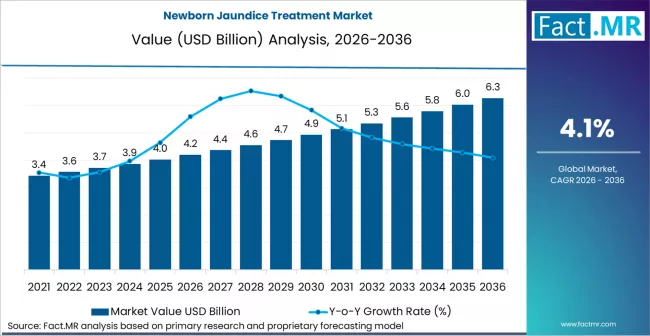
Newborn Jaundice Treatment Market Market Value Analysis | Source: Fact.MR
Newborn Jaundice Treatment Market
| Metric | Value |
|---|---|
| Estimated Value in (2026E) | USD 4.2 billion |
| Forecast Value in (2036F) | USD 6.4 billion |
| Forecast CAGR (2026 to 2036) | 4.1% |
Newborn Jaundice Treatment Market Definition
The Newborn Jaundice Treatment Market involves the development and sale of medical therapies and technologies used to manage jaundice in newborns, including phototherapy systems, bilirubin‑lowering medications, and diagnostic aids.
Market Inclusions
This report covers global and regional market sizes for newborn jaundice treatments over a defined forecast period, including treatment types (phototherapy devices, pharmacological agents), care settings (hospitals, clinics, neonatal units), and distribution channels.
Market Exclusions
The scope excludes general neonatal care products not specific to jaundice treatment, unrelated pediatric therapies, and diagnostic equipment not directly used for bilirubin measurement or treatment decision‑making.
Research Methodology
- Primary Research: Interviews were conducted with neonatologists, pediatric clinicians, and medical device specialists.
- Desk Research: Data was sourced from clinical reports, healthcare databases, and industry publications.
- Market‑Sizing and Forecasting: A hybrid model combining top‑down disease prevalence forecasts with bottom‑up treatment adoption and revenue data was used.
- Data Validation and Update Cycle: Findings were validated through expert review and aligned with recent treatment, usage, and production statistics.
Newborn Jaundice Treatment Market Overview
- Market Definition
- The Newborn Jaundice Treatment Market includes medical therapies and technologies used to manage jaundice in newborns. This involves phototherapy systems, bilirubin-lowering medications, and diagnostic aids used primarily in hospitals, clinics, and other healthcare settings.
- Market Dynamics
- Market Drivers:
- Increased Incidence of Newborn Jaundice: Rising awareness of early diagnosis and treatment is fueling demand for effective jaundice management.
- Advancements in Phototherapy Technologies: Innovations in phototherapy units, including LED-based systems, improve efficacy and patient comfort, contributing to market expansion.
- Improved Healthcare Access: Increased healthcare access, particularly in emerging markets, drives the demand for neonatal care and jaundice treatment.
- Market Restraints:
- High Treatment Costs: The cost of advanced treatment devices and ongoing maintenance may hinder adoption, particularly in price-sensitive regions.
- Healthcare Disparities: Variations in healthcare infrastructure across different regions can limit access to necessary treatment solutions in underserved areas.
- Market Drivers:
- Key Segments
- Device Type: Overhead phototherapy units are expected to dominate, with a 55.7% market share by 2026, due to their effectiveness in treating severe jaundice cases in hospitals.
- Application: Hospitals lead the market with 79.3% share, being the primary site for newborn jaundice treatments, given their access to specialized equipment and healthcare professionals.
- Growth by Region:
- China: Projected to grow at a CAGR of 5.5%, driven by large-scale healthcare investments and growing healthcare access.
- India: Expected growth at 5.1% CAGR, supported by improving neonatal care and rising awareness.
- Germany: Steady growth at 4.7% CAGR due to advanced healthcare infrastructure.
- Strategic Recommendations
- Invest in Emerging Markets: Companies should focus on expanding their footprint in emerging markets like India and China, where increasing healthcare infrastructure and awareness offer growth opportunities.
- Innovation in Phototherapy Devices: Continued innovation in LED-based and portable phototherapy units can enhance the efficacy and comfort of jaundice treatments, making them more appealing to healthcare providers.
- Cost-Effective Solutions: Offering more affordable and compact phototherapy solutions can help expand the market in regions with limited budgets.
- Research Methodology
- Primary Research: Interviews with neonatologists, pediatric clinicians, and medical device specialists.
- Desk Research: Data sourced from healthcare databases, clinical reports, and industry publications.
- Forecast Methodology: Combining top-down disease prevalence forecasts with bottom-up treatment adoption and revenue data.
Segmental Analysis
Newborn Jaundice Treatment Market Analysis by Device Type
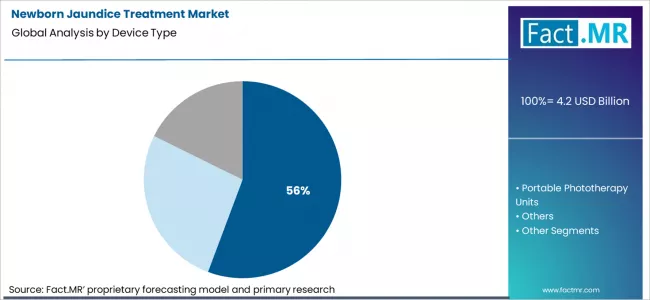
Newborn Jaundice Treatment Market Analysis By Device Type | Source: Fact.MR
- Market Overview: Overhead phototherapy units are projected to capture 55.7% of the market share by 2026. These units are widely used in the treatment of newborn jaundice due to their effectiveness in delivering the necessary light intensity over a larger area, which is essential for reducing bilirubin levels in newborns.
- Demand Drivers:
- Effectiveness and Coverage: Overhead phototherapy units provide more comprehensive coverage for newborns by shining light directly over the baby’s body. This makes them particularly effective in hospital settings where treatment must be administered continuously and efficiently to manage jaundice.
- Higher Light Intensity: These units are designed to deliver a higher intensity of light, ensuring faster and more effective treatment. This is crucial in treating moderate to severe cases of jaundice, where rapid bilirubin reduction is necessary to prevent complications.
- Established Use in Hospitals: Overhead phototherapy units are the standard in neonatal care and are already widely adopted in healthcare facilities due to their proven effectiveness in treating newborn jaundice.
Newborn Jaundice Treatment Market Analysis by Application
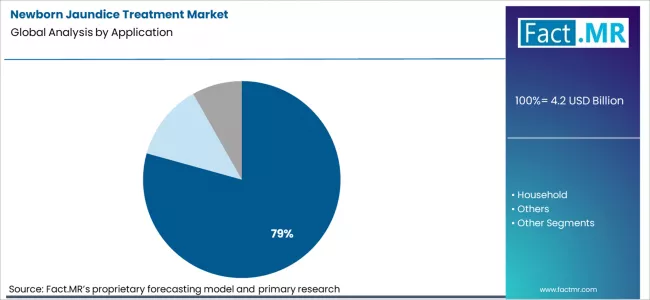
Newborn Jaundice Treatment Market Analysis By Application | Source: Fact.MR
- Market Overview: Hospitals are expected to account for 79.3% of the market share by 2026. The majority of newborn jaundice treatments occur in hospitals, where specialized equipment and trained healthcare professionals are available to monitor and manage the condition effectively.
- Demand Drivers:
- Advanced Treatment Facilities: Hospitals are the primary settings for managing newborn jaundice, especially in cases that require intensive phototherapy. The availability of overhead phototherapy units and specialized neonatal care units makes hospitals the preferred location for treatment.
- Increased Awareness and Healthcare Infrastructure: As awareness of neonatal jaundice increases and healthcare infrastructure improves, the demand for specialized treatments and equipment in hospitals rises, particularly in regions with improving maternal and child healthcare.
- Newborn Care Protocols: Hospitals often follow strict protocols for treating neonatal jaundice, ensuring that babies receive the correct type and intensity of phototherapy. This drives the ongoing demand for reliable phototherapy equipment and contributes to the dominance of hospital-based treatments in the market.
Newborn Jaundice Treatment Market Drivers, Restraints, and Opportunities
FMR analysts observe that the newborn jaundice treatment market is a growth‑aligned, care‑critical segment rooted in the prevalence of hyperbilirubinemia in neonates and the imperative to prevent bilirubin‑induced neurologic dysfunction. Historically, phototherapy has been the foundational standard of care, but structural demand expanded as screening protocols and neonatal care practices became more proactive, identifying jaundice earlier and increasing treatment uptake. The 2026 valuation reflects this baseline demand, supported by higher birth volumes, broader hospital access, and clinical guidelines that emphasize early intervention to reduce complications.
While traditional phototherapy devices remain widely used, advanced systems (e.g., LED‑based units with optimized wavelengths, fiberoptic blankets) and adjunct therapies (e.g., biliary elimination support) are gaining share in both hospital and ambulatory settings. These higher‑value treatment options contribute to net market value growth-even where patient volumes grow moderately-because they improve efficacy, patient comfort, and workflow efficiency. The market exists at its current size because neonatal care standards and preventive protocols drive near‑universal screening and treatment where jaundice risk is present.
- Clinical Guidelines & Standards: Protocols from pediatric and neonatology societies push early detection and treatment of hyperbilirubinemia, expanding demand for phototherapy and advanced treatment solutions.
- Treatment Innovation Demand: Advanced LED phototherapy systems and adjunct technologies that improve outcomes and ease of use are replacing older fluorescent lamp‑based devices.
- Regional Healthcare Access: In North America and Europe, strong hospital infrastructure and newborn screening programs support high uptake of optimized treatment systems, while emerging healthcare expansion in parts of Asia‑Pacific drives growing adoption.
Regional Analysis
The market analysis covers key global regions, including East Asia, South Asia, Western Europe, North America, and Brazil. It is segmented geographically, with specific market dynamics for each region. The full report provides a detailed market attractiveness analysis.
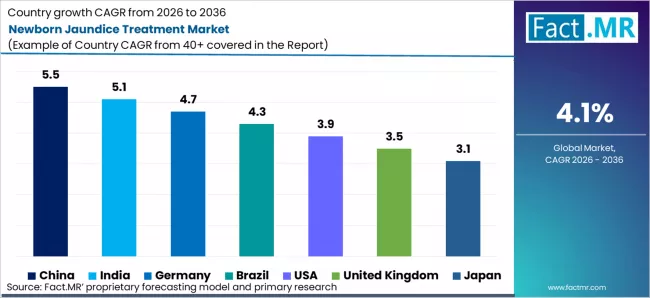
Newborn Jaundice Treatment Market Cagr Analysis By Country | Source: Fact.MR
| Country | CAGR (%) |
|---|---|
| China | 5.5% |
| India | 5.1% |
| Germany | 4.7% |
| Brazil | 4.3% |
| USA | 3.9% |
| United Kingdom | 3.5% |
| Japan | 3.1% |
Source: Fact MR (FMR) analysis, based on proprietary forecasting model and primary research.
East Asia:
In East Asia, China and Japan are leading the demand for newborn jaundice treatment, driven by rising awareness of neonatal health, improved healthcare infrastructure, and increasing incidences of newborn jaundice.
- China: Demand for newborn jaundice treatment in China is projected to rise at 5.5% CAGR through 2036. China’s large population, expanding healthcare infrastructure, and increasing awareness of neonatal conditions continue to fuel the growth of the newborn jaundice treatment market.
- Japan: Demand for newborn jaundice treatment in Japan is projected to rise at 3.1% CAGR through 2036. Japan’s strong healthcare system and focus on newborn health care contribute to steady market growth.
South Asia:
In South Asia, India leads the demand for newborn jaundice treatment, supported by a high birth rate and increasing access to healthcare services for newborns.
- India: Demand for newborn jaundice treatment in India is projected to rise at 5.1% CAGR through 2036. India’s high birth rate and increasing awareness of neonatal care contribute to robust growth in the newborn jaundice treatment market.
Western Europe:
In Western Europe, Germany and the United Kingdom are key markets for newborn jaundice treatment, driven by advanced healthcare systems, increasing awareness of early diagnosis, and the growing focus on infant health.
- Germany: Demand for newborn jaundice treatment in Germany is projected to rise at 4.7% CAGR through 2036. Germany’s strong healthcare infrastructure and focus on early-stage neonatal care continue to support demand for jaundice treatments.
- United Kingdom: Demand for newborn jaundice treatment in the UK is projected to rise at 3.5% CAGR through 2036. The UK’s robust healthcare system and focus on preventative healthcare for newborns contribute to steady growth in the market.
North America:
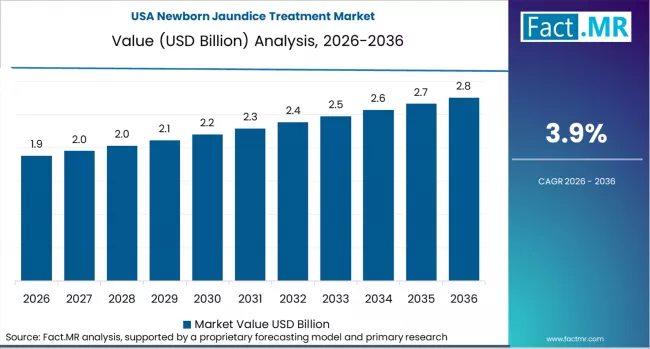
Newborn Jaundice Treatment Market Country Value Analysis | Source: Fact.MR
In North America, the USA remains a significant market for newborn jaundice treatment, driven by rising incidences of newborn jaundice, advancements in treatment technologies, and improved neonatal care practices.
- USA: Demand for newborn jaundice treatment in the U.S. is projected to rise at 3.9% CAGR through 2036. The USA’s advanced healthcare system and growing focus on early diagnosis and intervention continue to support the growth of the newborn jaundice treatment market.
Latin America:
In Latin America, Brazil is the leading market for newborn jaundice treatment, supported by a growing healthcare sector, rising neonatal care awareness, and increasing government health initiatives.
- Brazil: Demand for newborn jaundice treatment in Brazil is projected to rise at 4.3% CAGR through 2036. Brazil’s expanding healthcare infrastructure and growing awareness of neonatal jaundice treatments continue to drive market growth.
Fact MR's analysis of the Newborn Jaundice Treatment Market in East Asia, South Asia, Western Europe, North America, and Brazil consists of country-wise assessments that include China, India, Germany, Brazil, the USA, the United Kingdom, and Japan. Readers can find detailed trends, regulatory updates, and company-specific investments shaping the market’s growth in these countries.
How Are Key Players Competing in the Newborn Jaundice Treatment Market?
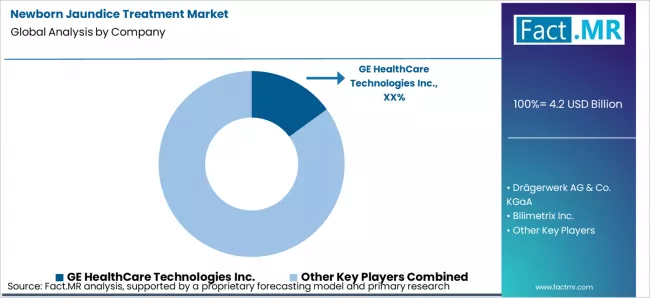
Newborn Jaundice Treatment Market Analysis By Company | Source: Fact.MR
In the newborn jaundice treatment market, GE HealthCare Technologies Inc. and Koninklijke Philips N.V. are at the forefront, providing innovative phototherapy solutions with advanced technology and broad market reach. Drägerwerk AG & Co. KGaA and Natus Medical Incorporated focus on delivering clinically effective and reliable devices, such as bilirubin measurement systems and light therapy units. Bilimetrix Inc. specializes in non-invasive jaundice testing and monitoring, offering products designed for easy integration in neonatal care settings. Atom Medical Corporation and Nice Neotech Medical Systems Pvt. Ltd. emphasize cost-effective and compact solutions for emerging markets, while TheraB Medical and Phoenix Medical Systems Pvt. Ltd. continue to innovate in phototherapy systems, strengthening their positions in developing regions. Ibis Medical Ltd. rounds out the competitive landscape, offering affordable and efficient devices tailored for newborn care.
Recent Industry Developments
- Dräger BiliPredics FDA Registration: Dräger expanded its neonatal portfolio in March 2025 with BiliPredics, an FDA-registered AI software solution that uses a cloud-based algorithm to forecast individual bilirubin progression up to 60 hours in advance.
- 2025 Canadian Paediatric Society (CPS) Guideline Update: In March 2025, the Canadian Paediatric Society released an updated position statement on the detection and management of hyperbilirubinemia, introducing universal screening requirements and raising the safety thresholds for initiating phototherapy.
- AAP Guideline Implementation and Safety Data: Clinical studies published in early 2026 confirmed that the rapid adoption of the 2022/2025 AAP guidelines has led to a 51% decrease in phototherapy sessions and a 35% reduction in readmissions without increasing cases of kernicterus
Key Players of the Newborn Jaundice Treatment Market
- GE HealthCare Technologies Inc.
- Drägerwerk AG & Co. KGaA
- Bilimetrix Inc.
- Koninklijke Philips N.V.
- Atom Medical Corporation
- Nice Neotech Medical Systems Pvt. Ltd.
- Natus Medical Incorporated
- TheraB Medical
- Phoenix Medical Systems Pvt. Ltd.
- Ibis Medical Ltd.
Report Scope
| Metric | Value |
|---|---|
| Quantitative Units | USD 4.2 billion (2026) to USD 6.4 billion (2036), at a CAGR of 4.1% |
| Market Definition | The Newborn Jaundice Treatment Market includes devices and treatments aimed at managing jaundice in newborns, such as phototherapy units, used in hospitals, households, and other healthcare settings. |
| By Device Type | Overhead Phototherapy Units, Portable Phototherapy Units, Others |
| By Application | Hospital, Household, Others |
| Regions Covered | North America, Latin America, Europe, East Asia, South Asia, Oceania, Middle East and Africa |
| Countries Covered | United States, Canada, Mexico, Brazil, Argentina, Germany, France, United Kingdom, Italy, Spain, China, India, Japan, South Korea, Indonesia, Australia, and 40+ countries |
| Key Companies Profiled | GE HealthCare Technologies Inc., Drägerwerk AG & Co. KGaA, Bilimetrix Inc., Koninklijke Philips N.V., Atom Medical Corporation, Nice Neotech Medical Systems Pvt. Ltd., Natus Medical Incorporated, TheraB Medical, Phoenix Medical Systems Pvt. Ltd., Ibis Medical Ltd. |
| Forecast Period | 2026 to 2036 |
| Approach | Hybrid top-down and bottom-up market modeling validated through primary interviews with manufacturers and supported by trade data benchmarking and market research. |
Bibliographies
- American Academy of Pediatrics. (2026, February). Clinical practice guideline: Management of hyperbilirubinemia in the newborn infant. American Academy of Pediatrics.
- Canadian Paediatric Society. (2025, March). Guidelines for detection and management of hyperbilirubinemia in newborn infants. Canadian Paediatric Society.
- U.S. Food and Drug Administration. (2024). Medical device classification and regulatory framework for neonatal phototherapy devices. U.S. Food and Drug Administration.
- World Health Organization. (2023). Newborn health and management of neonatal jaundice in resource-limited settings. World Health Organization.
- Atom Medical Corporation. (2024). Neonatal phototherapy systems for hyperbilirubinemia management. Atom Medical Corporation.
- Bilimetrix Inc. (2024). Non-invasive bilirubin measurement and neonatal jaundice monitoring systems. Bilimetrix Inc.
- Drägerwerk AG & Co. KGaA. (2024). Neonatal phototherapy and bilirubin monitoring solutions. Drägerwerk AG & Co. KGaA.
- GE HealthCare Technologies Inc. (2024). Phototherapy and neonatal care systems for newborn jaundice treatment. GE HealthCare Technologies Inc.
- Ibis Medical Equipment & Systems Pvt. Ltd. (2024). Phototherapy units for neonatal hyperbilirubinemia treatment in resource-limited settings. Ibis Medical Equipment & Systems Pvt. Ltd.
This report addresses:
- Market Intelligence enabling comprehensive assessment of leading countries and service segments across the Newborn Jaundice Treatment Market globally.
- Market Volume (Sales Units) estimates and 10-year revenue forecasts from 2026 to 2036, validated through manufacturer shipment data, channel partner surveys, and country-level demand modeling.
- Growth Opportunity Mapping across device types (overhead phototherapy units, portable phototherapy units, others), applications (hospitals, households, others), and regions.
- Segment and Regional Revenue Forecasts by device type, application, and geography across 40+ countries.
- Competition Strategy Analysis covering dealer network structure, recent developments, product portfolio, USPs, and market share analysis.
- Product and Regulatory Compliance Tracking aligned with payment and data protection standards and transaction security guidelines.
- Regulatory Impact Analysis addressing global market compliance, payment regulations, and evolving standards for self-service wellness solutions.
- Report Delivery in PDF, Excel, PowerPoint, and interactive dashboard formats for executive, procurement, and operational planning use.
Newborn Jaundice Treatment Market Key Segments
-
Device Type :
- Overhead Phototherapy Units
- Portable Phototherapy Units
- Others
-
Application :
- Hospital
- Household
- Others
-
Region :
- North America
- USA
- Canada
- Mexico
- Europe
- Germany
- UK
- France
- Italy
- Spain
- Nordic Countries
- BENELUX
- Rest of Europe
- Asia Pacific
- China
- Japan
- South Korea
- India
- Australia
- Rest of Asia Pacific
- Latin America
- Brazil
- Argentina
- Rest of Latin America
- Middle East and Africa
- Kingdom of Saudi Arabia
- United Arab Emirates
- South Africa
- Rest of Middle East and Africa
- Other Regions
- Oceania
- Central Asia
- Other Markets
- North America