Nonylphenol Market Size, Share, Growth and Forecast (2026 - 2036)
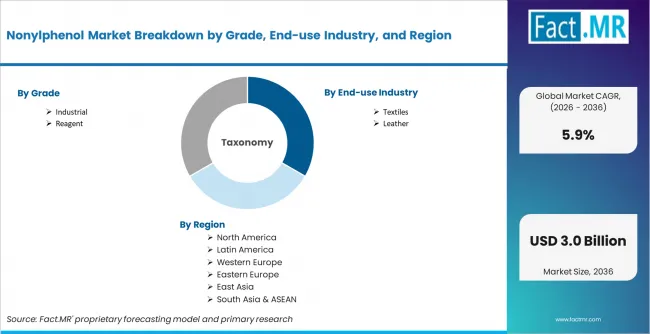
The Nonylphenol Market is segmented by Grade (Industrial, Reagent), End-use Industry (Chemicals, Textiles, Leather, Personal Care & Cosmetics, Food & Beverages, Agriculture), Application (Nonionic Surfactants, Resin Modifiers, Rubber Additives, Lubricant Additives, Agrochemical Formulations), Sales Channel (Direct Company Sales, Distributors & Traders, Retail Supply), Production Route (Propylene Trimer-based Alkylation, Bio-based Route), and Region. Forecast for 2026 to 2036.
Nonylphenol Market Size, Market Forecast and Outlook by Fact.MR
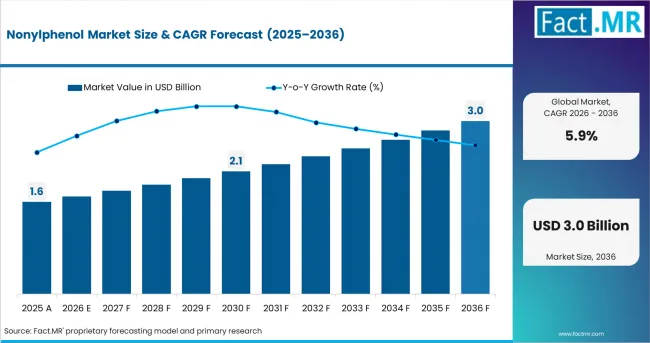
- The nonylphenol market was valued at USD 1.6 billion in 2025. Demand is estimated to reach USD 1.7 billion in 2026.
- The market is projected to record 5.9% CAGR from 2026 to 2036.
- Industrial surfactant production and resin modifier demand are forecast to lift the market to USD 3.0 billion by 2036 as regulated regions shift selectively toward alternatives and developing industrial bases continue using established chemistry.
| Metric | Details |
|---|---|
| Industry Size (2026) | USD 1.7 billion |
| Industry Value (2036) | USD 3.0 billion |
| CAGR (2026 to 2036) | 5.9% |
Summary of Nonylphenol Market
- Demand Drivers in the Market
- Industrial Surfactants: Chemical processors use nonylphenol to produce nonylphenol ethoxylates for wetting and emulsification in industrial formulations. Dow describes TERGITOL™ NP-10 as a nonionic surfactant used in paints and coatings and metalworking fluids. [2] This supports demand from formulators that need stable surface activity in cleaning and processing systems.
- Textile Processing: Textile chemical suppliers use nonylphenol derivatives to improve wetting and dispersion during fabric treatment. These materials help process chemicals spread evenly in dyeing and finishing baths. Suppliers with clear grade documentation and regulatory guidance can serve mills that still use legacy surfactant systems in controlled applications.
- Regulatory Substitution: Stricter chemical rules are pushing some formulators toward alternatives to alkylphenol ethoxylates. This limits growth for nonylphenol-based routes in regulated markets. It creates an opportunity for suppliers that offer compliant surfactants for coatings and industrial cleaning formulations.
- Key Segments Analyzed
- By Grade: Industrial grade is projected to record 66.4% share in 2026 as large-volume chemical processing uses require cost-effective material.
- By End-use Industry: Textiles lead because processing auxiliaries need wetting and dispersing performance, with the segment expected to hold 19.3% share in 2026.
- By Application: Nonionic surfactants are projected to account for 54.0% share in 2026 because nonylphenol ethoxylates remain the main downstream use.
- By Sales Channel: Direct company sales lead as bulk chemical users need documentation and supply continuity. The channel is estimated to hold 43.0% share in 2026.
- By Production Route: Propylene trimer-based alkylation is projected to account for 91.0% share in 2026 because established phenol alkylation routes support commercial supply.
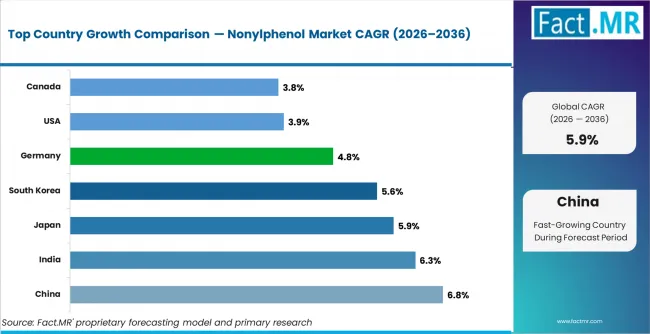
- By Geography: China nonylphenol demand is forecast to grow at 6.8% CAGR from 2026 to 2036 as chemical manufacturing and textile processing demand expand.
- Analyst Opinion at Fact.MR
- Shambhu Nath Jha, Senior Analyst at Fact.MR, states, “Nonylphenol demand is moving into a more selective phase. Producers must balance industrial performance with regulatory scrutiny and wastewater concerns. Suppliers that support controlled use, documentation, and substitution planning can protect demand in industrial accounts.”
- Strategic Implications
- Regulatory Control: Nonylphenol producers must track regional restrictions and end-use rules. Weak documentation can reduce access in regulated markets.
- Application Discipline: Surfactant and textile chemical suppliers need clear use boundaries for nonylphenol-based products. Controlled application can protect demand in industrial processes that still need specific wetting or resin performance.
- Substitution Planning: Formulators should compare nonylphenol-based products with non-APE alternatives. Reformulation support can help suppliers retain accounts in stricter markets.
Nonylphenol use is tied to nonionic surfactants and industrial processing aids. Fact.MR identifies industrial grade as the leading grade and textiles as a key end-use area. EPA says nonylphenol and nonylphenol ethoxylates are produced in large volumes and can enter aquatic environments through certain uses. [1] This keeps demand focused on applications that need performance control and regulatory documentation.
Chemical processors are narrowing use to applications that need specific surfactant or resin performance. Textile processors need wetting and dispersing support. Resin producers use alkylphenol chemistry in selected formulations. Cleaning product formulators face higher substitution pressure. Supplier service is important because documentation and safer-use guidance affect approval in regulated industrial accounts.
China is anticipated to grow at 6.8% CAGR from 2026 to 2036 as chemical manufacturing and textile processing demand support use. India is projected to record 6.3% CAGR during the forecast period as industrial surfactant and agrochemical formulation activity expands. Japan may register 5.9% CAGR through 2036 due to specialty chemical demand and textile processing auxiliaries. South Korea follows at 5.6% CAGR from 2026 to 2036 as surfactant and resin applications support demand. Germany records 4.8% CAGR during the forecast period as tighter chemical controls favor selective industrial use. United States demand is likely to rise at 3.9% CAGR through controlled industrial applications. Canada is forecast to post 3.8% CAGR from 2026 to 2036 as restrictions and substitution pressure limit faster growth.
Segmental Analysis
Nonylphenol Market Analysis by Grade
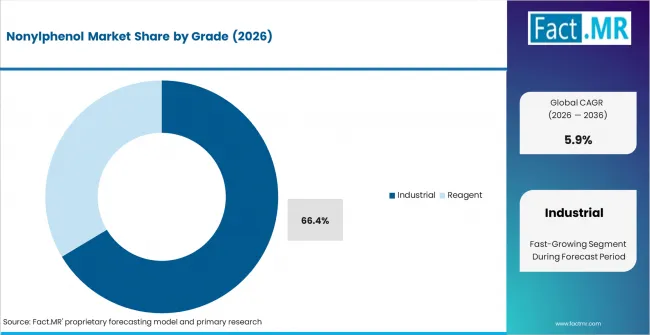
Industrial grade is projected to record 66.4% share in 2026. High-volume surfactant and resin production needs cost-effective material with steady commercial supply. Reagent grade serves laboratory testing and controlled research needs. DotaChem states that nonylphenol is used as a raw material for nonylphenol ethoxylates in surfactant production and can support epoxy-related resin and coating systems. [4]
- Bulk Processing: Industrial grade supports surfactant and resin production. Chemical processors need stable supply at commercial scale.
- Reagent Use: Reagent grade serves testing and research needs. Laboratories require smaller lots with tighter documentation.
- Quality Control: Grade selection affects downstream performance. Suppliers must match purity with formulation requirements.
Nonylphenol Market Analysis by End-use Industry
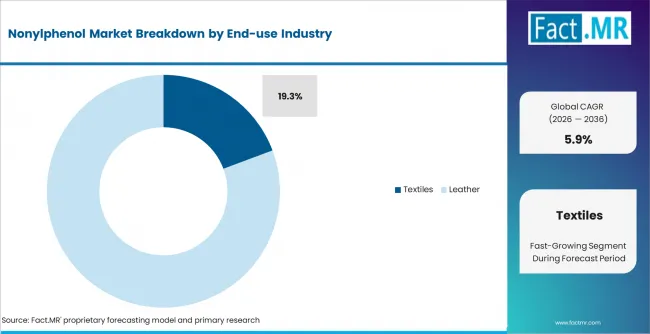
Textiles lead because nonylphenol-based surfactants help improve wetting and dispersion during dyeing and finishing. A 2025 RSC review states that alkylphenols and alkylphenol ethoxylates are used in textile processes as wetting agents and as emulsifying or dispersing agents for dyes and prints. [2] The textile segment is projected to hold 19.3% share in 2026 because mills use these auxiliaries to support even chemical distribution and smoother fabric treatment. Chemicals and leather applications continue using alkylphenol chemistry in selected industrial processes.
- Textile Wetting: Textile processors use nonylphenol derivatives for wetting and dispersion. Performance consistency supports dyeing and finishing quality.
- Chemical Use: Chemical processors use nonylphenol as an intermediate. Downstream production depends on stable phenolic feedstock.
- Leather Processing: Leather chemical suppliers use surfactant systems in cleaning and finishing. Regulatory pressure shapes supplier selection.
Nonylphenol Market Analysis by Application
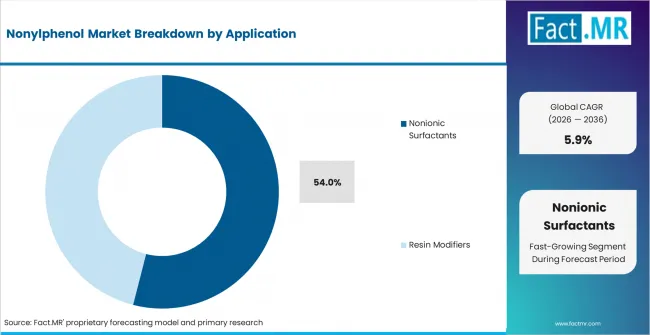
Nonionic surfactants are projected to account for 54.0% share in 2026 because nonylphenol ethoxylates remain the main downstream use for nonylphenol. These surfactants are used in industrial cleaning and emulsification systems. Resin modifiers and rubber additives serve smaller industrial applications. Lubricant additives and agrochemical formulations use nonylphenol chemistry for surface activity and formulation control.
- Surfactant Route: Nonionic surfactants absorb the largest nonylphenol volume. Formulators value wetting and emulsification performance.
- Resin Support: Resin modifier use supports selected industrial formulations. Producers need predictable chemical behavior.
- Agrochemical Formulation: Agrochemical products use surfactants for dispersion and spreading. Restrictions can shift demand toward safer alternatives.
Nonylphenol Market Analysis by Sales Channel
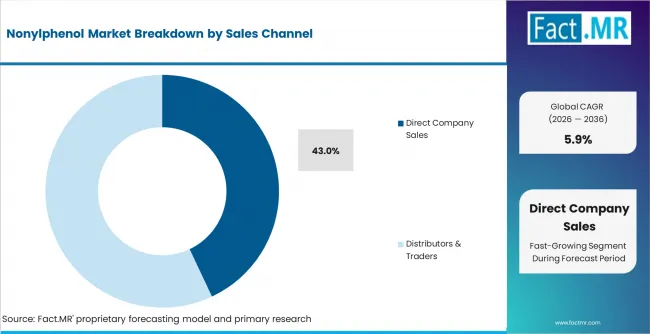
Direct company sales are estimated to hold 43.0% share in 2026 as large surfactant producers and resin manufacturers buy nonylphenol through contracted supply. This channel leads because major industrial accounts need technical documentation and consistent grade quality. Distributors and traders serve smaller formulation companies and regional accounts that need lower-volume supply. Retail supply remains limited since nonylphenol is an industrial chemical with handling and compliance requirements.
- Contract Supply: Direct company sales support bulk chemical users. Producers need predictable delivery and documentation.
- Distributor Reach: Distributors serve smaller formulators and regional users. Local stock helps manage shorter lead times.
- Retail Limits: Retail supply remains narrow. Handling controls and industrial use limit open-channel demand.
Nonylphenol Market Analysis by Production Route
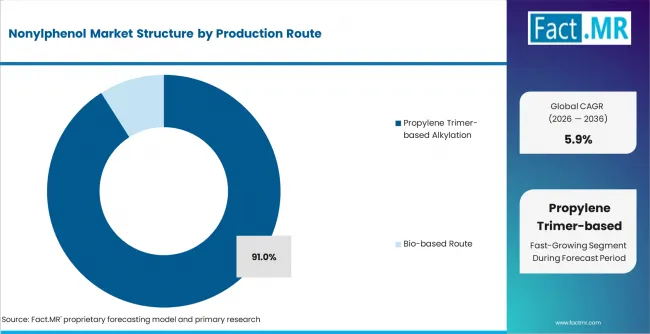
Propylene trimer-based alkylation is projected to account for 91.0% share in 2026. Established phenol alkylation routes support commercial-scale nonylphenol production. Bio-based routes remain limited because they are still early and selective. Carbon Minds’ chemical dataset, released through Climatiq in 2025, describes o-nonylphenol production through alkylation of phenol and propylene trimer. [3] Industrial producers depend on stable feedstock access and large-scale process economics.
- Established Route: Propylene trimer-based alkylation supports commercial nonylphenol supply. Industrial users need dependable output.
- Bio-based Route: Bio-based development supports sustainability positioning. Adoption depends on price and validated performance.
- Feedstock Exposure: Production route affects cost stability. Producers must manage phenol and olefin input risk.
Nonylphenol Market Drivers, Restraints, and Opportunities

Surfactant production and textile processing are the main growth drivers for nonylphenol. Nonylphenol ethoxylates are used as nonionic surfactants in paints, coatings, metalworking fluids, and textile auxiliaries. Demand continues in industrial applications that need wetting, emulsification, and dispersion performance.
Environmental and regulatory pressure remains the main restraint. Nonylphenol and nonylphenol ethoxylates can enter aquatic environments through certain industrial uses. This is pushing formulators toward biodegradable and non-APE alternatives in applications that can be reformulated without performance loss.
Opportunities in the Nonylphenol Market
- Controlled Industrial Use: Producers can focus on applications where nonylphenol performance is hard to replace. Clear documentation and safer handling practices can protect selective industrial demand.
- Textile Auxiliaries: Textile chemical suppliers can serve cost-sensitive wet processing markets. Nonylphenol derivatives remain useful where wetting and emulsification performance guide formulation choice.
- Alternative Portfolios: Suppliers can use non-APE surfactants to retain formulators facing restrictions. Biodegradable alternatives help protect accounts in regulated applications.
Regional Analysis
Based on regional analysis, the nonylphenol market is segmented into North America, Latin America, Western Europe, Eastern Europe, East Asia, South Asia and Pacific, and Middle East and Africa.
.webp)
Country CAGR (2026 to 2036)
| Country | CAGR |
|---|---|
| China | 6.8% |
| India | 6.3% |
| Japan | 5.9% |
| South Korea | 5.6% |
| Germany | 4.8% |
| United States | 3.9% |
| Canada | 3.8% |
Source: Fact.MR analysis, based on adjusted forecast model and primary research.
East Asia Nonylphenol Market Analysis
East Asia demand comes from textile processing and resin production. China leads through large chemical production capacity. Japan and South Korea create steady demand through specialty chemical and surfactant applications.
- China: China nonylphenol demand is forecast to grow at 6.8% CAGR from 2026 to 2036 as chemical manufacturing and textile processing expand. Local surfactant and resin producers benefit from large industrial production bases. Regulatory scrutiny is increasing across chemical use and wastewater discharge. Documented industrial applications continue to protect demand in controlled processing routes.
- Japan: Specialty chemical demand supports Japan nonylphenol use. Industrial users need controlled grades for surfactant and resin formulations. Japan is projected to record 5.9% CAGR from 2026 to 2036 as specialty formulation demand continues. Strict chemical controls are shifting use toward documented industrial applications with clear compliance records.
- South Korea: South Korea demand is tied to surfactant production and industrial additives. Producers use nonylphenol in selected chemical processing routes. The country is forecast to grow at 5.6% CAGR from 2026 to 2036 as industrial formulation demand supports steady use. Supplier acceptance requires strong documentation and wastewater control.
South Asia and Pacific Nonylphenol Market Analysis
South Asia and Pacific demand comes from textile production and industrial surfactant use. India is the main growth market because textile auxiliaries and industrial chemicals need cost-effective inputs.
- India: Textile auxiliaries and agrochemical formulations are increasing nonylphenol use in India. Chemical processors need cost-effective surfactant intermediates for industrial formulations. India is projected to record 6.3% CAGR from 2026 to 2036 as manufacturing and textile processing expand. Export-linked textile supply chains face substitution pressure. India grows through industrial formulation demand and cost-sensitive chemical processing.
Western Europe Nonylphenol Market Analysis
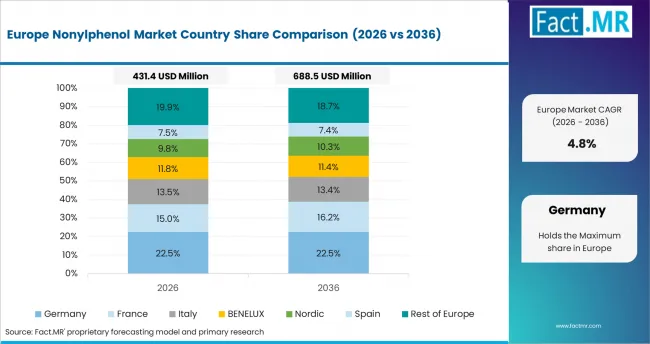
Western Europe demand is limited by chemical restrictions and substitution pressure. Germany remains the main industrial base. Growth is slower because many formulators have shifted to alternative surfactants in regulated applications.
- Germany: Germany is forecast to post 4.8% CAGR from 2026 to 2036 as chemical producers retain selective nonylphenol use in controlled industrial applications. EU chemical restrictions and textile limits keep substitution pressure high. Industrial users need clear documentation before supplier approval. Non-APE alternatives are gaining use in surfactant formulations.
North America Nonylphenol Market Analysis
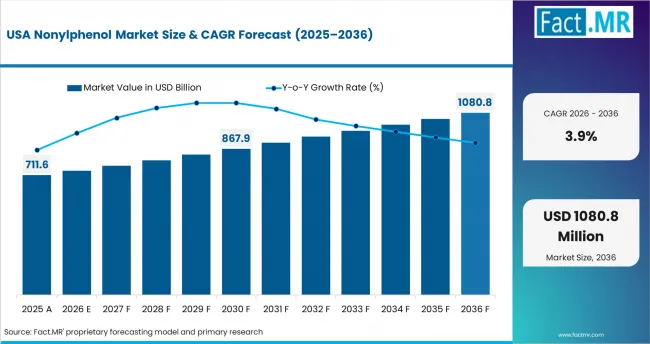
North America demand comes from controlled industrial applications. Growth is limited by environmental scrutiny and substitution. The United States leads because chemical manufacturing and specialty surfactant demand still require selective nonylphenol use.
- United States: United States demand comes from controlled industrial applications and chemical processing. The market is likely to rise at 3.9% CAGR from 2026 to 2036 as regulated applications stay selective. Producers need clear documentation and wastewater management support. The United States grows through chemical processing and controlled formulation demand.
- Canada: Canada is forecast to post 3.8% CAGR from 2026 to 2036 as industrial demand continues under tighter chemical management pressure. Users in industrial cleaning and formulation applications face closer reporting review as Environment and Climate Change Canada proposed lowering the NPRI reporting threshold for nonylphenol and its ethoxylates from 10.0 tonnes to 1.0 tonne. [5] Canada grows through limited industrial use and regulated chemical handling.
Competitive Aligners for Market Players
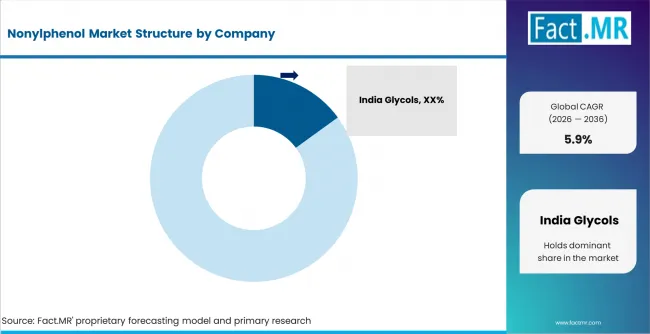
The nonylphenol market includes alkylphenol producers, surfactant suppliers, specialty chemical companies, and regional distributors. India Glycols, Dover Chemical Corporation, PCC Group, and Dow Chemical Company compete through production scale, grade documentation, application support, and regional access.
Competitive strength is tied to regulatory compliance and product portfolio balance. Suppliers that offer NPE-based surfactants need clear documentation for controlled industrial use. Companies offering non-APE alternatives can retain formulators that are shifting away from alkylphenol ethoxylates. Producers with legacy products and substitute surfactants are better placed to manage demand under stricter chemical rules.
Supplier position through 2036 will depend on controlled use support and reformulation capability. Textile processors need wetting and dispersing performance. Chemical producers need stable alkylphenol feedstock. Regulated industrial accounts need documentation and safer alternative options. Companies that support existing applications and reformulation needs can protect repeat demand.
Key Players in Nonylphenol Market
- India Glycols
- Dover Chemical Corporation
- PCC Group
- Dow Chemical Company
Bibliography
- [1]. U.S. Environmental Protection Agency. (2026, March 5). Nonylphenol (NP) and Nonylphenol Ethoxylates (NPEs). EPA.
- [2]. Gambino, I., Terzaghi, E., Baldini, E., Bergna, G., Palmisano, G., & Di Guardo, A. (2025). Microcontaminants and microplastics in water from the textile sector: A review and a database of physicochemical properties, use in the textile process, and ecotoxicity data for detected chemicals. Environmental Science: Processes & Impacts, 27, 297–319.
- [3]. Climatiq. (2025). O-nonylphenol made by alkylation of phenol and propylene trimer. [Emission factor; Carbon Minds cm.chemicals V2.02 dataset].
- [4] Nanjing Dotachem Co., Ltd. (2026, April 24). Dotachem Nonylphenol (NP): A key intermediate for industrial applications.
- [5] Environment and Climate Change Canada. (2025, April 1). Proposed changes in response to the National Pollutant Release Inventory Substance Review. Government of Canada.
This Report Addresses
- Strategic intelligence on nonylphenol demand across chemicals, textiles, leather, personal care, and agriculture.
- Growth opportunity mapping across China, India, Japan, and the United States.
- Segment analysis by grade, end-use industry, application, sales channel, and production route.
- Regional outlook covering industrial surfactant demand, textile processing, regulatory pressure, and substitution toward non-APE alternatives.
- Competitive analysis of India Glycols, PCC Group, and Dow Chemical Company.
- Product assessment covering industrial grade nonylphenol, reagent grade material, nonionic surfactants, and propylene trimer-based output.
- Report delivered through PDF, Excel datasets, and presentation formats.
- Primary interviews, supplier checks, and industrial formulation demand review support validation.
Nonylphenol Market Definition
The nonylphenol market covers industrial sales of alkylphenol chemicals used mainly as intermediates for nonionic surfactants and selected resin and agrochemical applications. The market differs from broader surfactant chemicals because it tracks nonylphenol and its direct industrial use before downstream formulation. It includes industrial and reagent grades sold to chemical processors and formulation suppliers.
Nonylphenol Market Inclusions
The scope includes industrial nonylphenol and reagent-grade nonylphenol used in rubber additives and laboratory applications. Direct company sales and distributor supply are included. Propylene trimer-based alkylation routes are counted when the output is sold as nonylphenol.
Nonylphenol Market Exclusions
The scope excludes alcohol ethoxylates and other non-APE surfactants unless they are discussed as substitutes. Finished detergents and downstream ethoxylates are excluded unless nonylphenol itself is sold as an input. Other alkylphenols such as octylphenol and dodecylphenol are outside scope.
Nonylphenol Market Research Methodology
- Primary Research
- Primary research includes interviews with surfactant production managers and textile chemical formulators. Resin additive suppliers and chemical distributors are covered separately. Supplier feedback supports grade and application validation.
- Desk Research
- Desk research reviews chemical safety pages and supplier product portals. Regulatory documents and product specification references support application boundary checks.
- Market-Sizing and Forecasting
- Forecasting uses grade demand and end-use adoption. Application demand is linked to nonionic surfactants and agrochemical formulation use.
- Data Validation and Update Cycle
- Forecasts are validated through supplier checks and distributor interviews. Regional assumptions are reviewed with chemical control updates and industrial formulation demand signals.
Scope of the Report

| Attribute | Details |
|---|---|
| Quantitative Units | USD 1.7 billion in 2026 to USD 3.0 billion by 2036 at 5.9% CAGR |
| Market Definition | Alkylphenol chemical used as an industrial intermediate for surfactants, resins, rubber additives, lubricant additives, and formulation chemicals. |
| Grade | Industrial , Reagent |
| End-use Industry | Chemicals , Textiles , Leather , Personal Care & Cosmetics , Food & Beverages , Agriculture |
| Application | Nonionic Surfactants , Resin Modifiers , Rubber Additives , Lubricant Additives , Agrochemical Formulations |
| Sales Channel | Direct Company Sales , Distributors & Traders , Retail Supply |
| Production Route | Propylene Trimer-based Alkylation , Bio-based Route |
| Regions Covered | North America , Latin America , Western Europe , Eastern Europe , East Asia , South Asia and Pacific , Middle East and Africa |
| Countries Covered | China , India , Japan , South Korea , Germany , United States , Canada |
| Key Companies Profiled | India Glycols , Dover Chemical Corporation , PCC Group , Dow Chemical Company |
| Forecast Period | 2026 to 2036 |
| Approach | Hybrid top-down and bottom-up model using grade demand, end-use adoption, application use, sales channel, production route, and supplier validation. |
Nonylphenol Market Analysis by Segments
-
By Grade:
- Industrial
- Reagent
-
By End-use Industry:
- Chemicals
- Textiles
- Leather
- Personal Care & Cosmetics
- Food & Beverages
- Agriculture
-
By Application:
- Nonionic Surfactants
- Resin Modifiers
- Rubber Additives
- Lubricant Additives
- Agrochemical Formulations
-
By Sales Channel:
- Direct Company Sales
- Distributors & Traders
- Retail Supply
-
By Production Route:
- Propylene Trimer-based Alkylation
- Bio-based Route
-
Region:
- North America
- United States
- Canada
- Europe
- Germany
- United Kingdom
- France
- Italy
- Spain
- Asia Pacific
- China
- Japan
- South Korea
- Taiwan
- Singapore
- Latin America
- Brazil
- Mexico
- Argentina
- Middle East & Africa
- GCC Countries
- South Africa
- Israel
- North America
- Frequently Asked Questions -
How large is the nonylphenol market in 2025?
The nonylphenol market was valued at USD 1.6 billion in 2025 based on the adjusted Fact.MR model.
What is the expected value of the nonylphenol market in 2026?
The nonylphenol market is estimated to reach USD 1.7 billion in 2026 after the forecast period adjustment.
What is the forecast value of the nonylphenol market by 2036?
The nonylphenol market is forecast to reach USD 3.0 billion by 2036 as industrial surfactant and textile chemical demand continues.
What CAGR is projected for the nonylphenol market from 2026 to 2036?
Fact.MR’s adjusted forecast projects 5.9% CAGR for the nonylphenol market from 2026 to 2036.
Which grade leads the nonylphenol market?
Industrial grade leads with 66.4% share in 2026 because bulk chemical processing needs cost-effective material.
Why does industrial grade lead nonylphenol demand?
Industrial grade leads because surfactant and resin producers need large-volume supply for downstream chemical production.
Which end-use industry leads the nonylphenol market?
Textiles lead with 19.3% share in 2026 because processing auxiliaries need wetting and dispersing performance.
Which application leads the nonylphenol market?
Nonionic surfactants lead with 54.0% share in 2026 because nonylphenol ethoxylates remain the main downstream route.
Which sales channel leads the nonylphenol market?
Direct company sales lead with 43.0% share in 2026 because bulk chemical users need supply continuity and documentation.
Which production route leads the nonylphenol market?
Propylene trimer-based alkylation leads with 91.0% share in 2026 because established phenol alkylation supports commercial supply.
Which country grows fastest in the nonylphenol market?
China is forecast to grow fastest at 6.8% CAGR from 2026 to 2036.
Why is India important in the nonylphenol market?
India is important because textile processing and industrial surfactant demand support cost-sensitive chemical use.
Why does Japan show steady growth in the nonylphenol market?
Japan grows through specialty chemical use and controlled industrial applications.
Why does Germany support nonylphenol demand?
Germany supports selective demand through chemical processing and documented industrial use.
Why does the United States support nonylphenol demand?
United States demand is supported by controlled industrial applications and chemical processing.
What drives nonylphenol market growth?
Industrial surfactant production and textile processing demand drive nonylphenol market growth.
What restrains nonylphenol market growth?
Environmental risk and regulatory scrutiny restrain growth because nonylphenol can enter aquatic environments.
How does nonylphenol support textile processing?
Nonylphenol derivatives support textile processing by improving wetting and dispersing performance.
How does nonylphenol support surfactant production?
Nonylphenol supports surfactant production as an intermediate for nonylphenol ethoxylates.
What is included in the nonylphenol market scope?
The scope includes industrial and reagent grade nonylphenol used in surfactants, resins, rubber additives, lubricants, and agrochemical formulations.
What is excluded from the nonylphenol market scope?
The scope excludes finished detergents, finished cosmetics, alcohol ethoxylates, octylphenol, and dodecylphenol.
How does Fact.MR forecast nonylphenol demand?
Fact.MR forecasts demand using grade demand, end-use adoption, application use, sales channel, production route, and supplier validation.
Table of Content
- Executive Summary
- Global Market Outlook
- Demand to side Trends
- Supply to side Trends
- Technology Roadmap Analysis
- Analysis and Recommendations
- Market Overview
- Market Coverage / Taxonomy
- Market Definition / Scope / Limitations
- Research Methodology
- Chapter Orientation
- Analytical Lens and Working Hypotheses
- Market Structure, Signals, and Trend Drivers
- Benchmarking and Cross-market Comparability
- Market Sizing, Forecasting, and Opportunity Mapping
- Research Design and Evidence Framework
- Desk Research Programme (Secondary Evidence)
- Company Annual and Sustainability Reports
- Peer-reviewed Journals and Academic Literature
- Corporate Websites, Product Literature, and Technical Notes
- Earnings Decks and Investor Briefings
- Statutory Filings and Regulatory Disclosures
- Technical White Papers and Standards Notes
- Trade Journals, Industry Magazines, and Analyst Briefs
- Conference Proceedings, Webinars, and Seminar Materials
- Government Statistics Portals and Public Data Releases
- Press Releases and Reputable Media Coverage
- Specialist Newsletters and Curated Briefings
- Sector Databases and Reference Repositories
- Fact.MR Internal Proprietary Databases and Historical Market Datasets
- Subscription Datasets and Paid Sources
- Social Channels, Communities, and Digital Listening Inputs
- Additional Desk Sources
- Expert Input and Fieldwork (Primary Evidence)
- Primary Modes
- Qualitative Interviews and Expert Elicitation
- Quantitative Surveys and Structured Data Capture
- Blended Approach
- Why Primary Evidence is Used
- Field Techniques
- Interviews
- Surveys
- Focus Groups
- Observational and In-context Research
- Social and Community Interactions
- Stakeholder Universe Engaged
- C-suite Leaders
- Board Members
- Presidents and Vice Presidents
- R&D and Innovation Heads
- Technical Specialists
- Domain Subject-matter Experts
- Scientists
- Physicians and Other Healthcare Professionals
- Governance, Ethics, and Data Stewardship
- Research Ethics
- Data Integrity and Handling
- Primary Modes
- Tooling, Models, and Reference Databases
- Desk Research Programme (Secondary Evidence)
- Data Engineering and Model Build
- Data Acquisition and Ingestion
- Cleaning, Normalisation, and Verification
- Synthesis, Triangulation, and Analysis
- Quality Assurance and Audit Trail
- Market Background
- Market Dynamics
- Drivers
- Restraints
- Opportunity
- Trends
- Scenario Forecast
- Demand in Optimistic Scenario
- Demand in Likely Scenario
- Demand in Conservative Scenario
- Opportunity Map Analysis
- Product Life Cycle Analysis
- Supply Chain Analysis
- Investment Feasibility Matrix
- Value Chain Analysis
- PESTLE and Porter’s Analysis
- Regulatory Landscape
- Regional Parent Market Outlook
- Production and Consumption Statistics
- Import and Export Statistics
- Market Dynamics
- Global Market Analysis 2021 to 2025 and Forecast, 2026 to 2036
- Historical Market Size Value (USD Million) Analysis, 2021 to 2025
- Current and Future Market Size Value (USD Million) Projections, 2026 to 2036
- Y to o to Y Growth Trend Analysis
- Absolute $ Opportunity Analysis
- Global Market Pricing Analysis 2021 to 2025 and Forecast 2026 to 2036
- Global Market Analysis 2021 to 2025 and Forecast 2026 to 2036, By Component
- Introduction / Key Findings
- Historical Market Size Value (USD Million) Analysis By Component , 2021 to 2025
- Current and Future Market Size Value (USD Million) Analysis and Forecast By Component , 2026 to 2036
- Solutions
- Services
- Solutions
- Y to o to Y Growth Trend Analysis By Component , 2021 to 2025
- Absolute $ Opportunity Analysis By Component , 2026 to 2036
- Global Market Analysis 2021 to 2025 and Forecast 2026 to 2036, By Deception Stack
- Introduction / Key Findings
- Historical Market Size Value (USD Million) Analysis By Deception Stack, 2021 to 2025
- Current and Future Market Size Value (USD Million) Analysis and Forecast By Deception Stack, 2026 to 2036
- Network Security
- Endpoint Security
- Data Security
- Network Security
- Y to o to Y Growth Trend Analysis By Deception Stack, 2021 to 2025
- Absolute $ Opportunity Analysis By Deception Stack, 2026 to 2036
- Global Market Analysis 2021 to 2025 and Forecast 2026 to 2036, By Deployment
- Introduction / Key Findings
- Historical Market Size Value (USD Million) Analysis By Deployment, 2021 to 2025
- Current and Future Market Size Value (USD Million) Analysis and Forecast By Deployment, 2026 to 2036
- Cloud
- On-premise
- Hybrid
- Cloud
- Y to o to Y Growth Trend Analysis By Deployment, 2021 to 2025
- Absolute $ Opportunity Analysis By Deployment, 2026 to 2036
- Global Market Analysis 2021 to 2025 and Forecast 2026 to 2036, By End User
- Introduction / Key Findings
- Historical Market Size Value (USD Million) Analysis By End User, 2021 to 2025
- Current and Future Market Size Value (USD Million) Analysis and Forecast By End User, 2026 to 2036
- Government
- BFSI
- Manufacturing
- Government
- Y to o to Y Growth Trend Analysis By End User, 2021 to 2025
- Absolute $ Opportunity Analysis By End User, 2026 to 2036
- Global Market Analysis 2021 to 2025 and Forecast 2026 to 2036, By Organization Size
- Introduction / Key Findings
- Historical Market Size Value (USD Million) Analysis By Organization Size, 2021 to 2025
- Current and Future Market Size Value (USD Million) Analysis and Forecast By Organization Size, 2026 to 2036
- Large Enterprises
- Small Enterprises
- Large Enterprises
- Y to o to Y Growth Trend Analysis By Organization Size, 2021 to 2025
- Absolute $ Opportunity Analysis By Organization Size, 2026 to 2036
- Global Market Analysis 2021 to 2025 and Forecast 2026 to 2036, By Security Function
- Introduction / Key Findings
- Historical Market Size Value (USD Million) Analysis By Security Function, 2021 to 2025
- Current and Future Market Size Value (USD Million) Analysis and Forecast By Security Function, 2026 to 2036
- Threat Detection
- Incident Response
- Threat Intelligence
- Threat Detection
- Y to o to Y Growth Trend Analysis By Security Function, 2021 to 2025
- Absolute $ Opportunity Analysis By Security Function, 2026 to 2036
- Global Market Analysis 2021 to 2025 and Forecast 2026 to 2036, By Region
- Introduction
- Historical Market Size Value (USD Million) Analysis By Region, 2021 to 2025
- Current Market Size Value (USD Million) Analysis and Forecast By Region, 2026 to 2036
- North America
- Latin America
- Western Europe
- Eastern Europe
- East Asia
- South Asia and Pacific
- Middle East & Africa
- Market Attractiveness Analysis By Region
- North America Market Analysis 2021 to 2025 and Forecast 2026 to 2036, By Country
- Historical Market Size Value (USD Million) Trend Analysis By Market Taxonomy, 2021 to 2025
- Market Size Value (USD Million) Forecast By Market Taxonomy, 2026 to 2036
- By Country
- USA
- Canada
- Mexico
- By Component
- By Deception Stack
- By Deployment
- By End User
- By Organization Size
- By Security Function
- By Country
- Market Attractiveness Analysis
- By Country
- By Component
- By Deception Stack
- By Deployment
- By End User
- By Organization Size
- By Security Function
- Key Takeaways
- Latin America Market Analysis 2021 to 2025 and Forecast 2026 to 2036, By Country
- Historical Market Size Value (USD Million) Trend Analysis By Market Taxonomy, 2021 to 2025
- Market Size Value (USD Million) Forecast By Market Taxonomy, 2026 to 2036
- By Country
- Brazil
- Chile
- Rest of Latin America
- By Component
- By Deception Stack
- By Deployment
- By End User
- By Organization Size
- By Security Function
- By Country
- Market Attractiveness Analysis
- By Country
- By Component
- By Deception Stack
- By Deployment
- By End User
- By Organization Size
- By Security Function
- Key Takeaways
- Western Europe Market Analysis 2021 to 2025 and Forecast 2026 to 2036, By Country
- Historical Market Size Value (USD Million) Trend Analysis By Market Taxonomy, 2021 to 2025
- Market Size Value (USD Million) Forecast By Market Taxonomy, 2026 to 2036
- By Country
- Germany
- UK
- Italy
- Spain
- France
- Nordic
- BENELUX
- Rest of Western Europe
- By Component
- By Deception Stack
- By Deployment
- By End User
- By Organization Size
- By Security Function
- By Country
- Market Attractiveness Analysis
- By Country
- By Component
- By Deception Stack
- By Deployment
- By End User
- By Organization Size
- By Security Function
- Key Takeaways
- Eastern Europe Market Analysis 2021 to 2025 and Forecast 2026 to 2036, By Country
- Historical Market Size Value (USD Million) Trend Analysis By Market Taxonomy, 2021 to 2025
- Market Size Value (USD Million) Forecast By Market Taxonomy, 2026 to 2036
- By Country
- Russia
- Poland
- Hungary
- Balkan & Baltic
- Rest of Eastern Europe
- By Component
- By Deception Stack
- By Deployment
- By End User
- By Organization Size
- By Security Function
- By Country
- Market Attractiveness Analysis
- By Country
- By Component
- By Deception Stack
- By Deployment
- By End User
- By Organization Size
- By Security Function
- Key Takeaways
- East Asia Market Analysis 2021 to 2025 and Forecast 2026 to 2036, By Country
- Historical Market Size Value (USD Million) Trend Analysis By Market Taxonomy, 2021 to 2025
- Market Size Value (USD Million) Forecast By Market Taxonomy, 2026 to 2036
- By Country
- China
- Japan
- South Korea
- By Component
- By Deception Stack
- By Deployment
- By End User
- By Organization Size
- By Security Function
- By Country
- Market Attractiveness Analysis
- By Country
- By Component
- By Deception Stack
- By Deployment
- By End User
- By Organization Size
- By Security Function
- Key Takeaways
- South Asia and Pacific Market Analysis 2021 to 2025 and Forecast 2026 to 2036, By Country
- Historical Market Size Value (USD Million) Trend Analysis By Market Taxonomy, 2021 to 2025
- Market Size Value (USD Million) Forecast By Market Taxonomy, 2026 to 2036
- By Country
- India
- ASEAN
- Australia & New Zealand
- Rest of South Asia and Pacific
- By Component
- By Deception Stack
- By Deployment
- By End User
- By Organization Size
- By Security Function
- By Country
- Market Attractiveness Analysis
- By Country
- By Component
- By Deception Stack
- By Deployment
- By End User
- By Organization Size
- By Security Function
- Key Takeaways
- Middle East & Africa Market Analysis 2021 to 2025 and Forecast 2026 to 2036, By Country
- Historical Market Size Value (USD Million) Trend Analysis By Market Taxonomy, 2021 to 2025
- Market Size Value (USD Million) Forecast By Market Taxonomy, 2026 to 2036
- By Country
- Kingdom of Saudi Arabia
- Other GCC Countries
- Turkiye
- South Africa
- Other African Union
- Rest of Middle East & Africa
- By Component
- By Deception Stack
- By Deployment
- By End User
- By Organization Size
- By Security Function
- By Country
- Market Attractiveness Analysis
- By Country
- By Component
- By Deception Stack
- By Deployment
- By End User
- By Organization Size
- By Security Function
- Key Takeaways
- Key Countries Market Analysis
- USA
- Pricing Analysis
- Market Share Analysis, 2025
- By Component
- By Deception Stack
- By Deployment
- By End User
- By Organization Size
- By Security Function
- Canada
- Pricing Analysis
- Market Share Analysis, 2025
- By Component
- By Deception Stack
- By Deployment
- By End User
- By Organization Size
- By Security Function
- Mexico
- Pricing Analysis
- Market Share Analysis, 2025
- By Component
- By Deception Stack
- By Deployment
- By End User
- By Organization Size
- By Security Function
- Brazil
- Pricing Analysis
- Market Share Analysis, 2025
- By Component
- By Deception Stack
- By Deployment
- By End User
- By Organization Size
- By Security Function
- Chile
- Pricing Analysis
- Market Share Analysis, 2025
- By Component
- By Deception Stack
- By Deployment
- By End User
- By Organization Size
- By Security Function
- Germany
- Pricing Analysis
- Market Share Analysis, 2025
- By Component
- By Deception Stack
- By Deployment
- By End User
- By Organization Size
- By Security Function
- UK
- Pricing Analysis
- Market Share Analysis, 2025
- By Component
- By Deception Stack
- By Deployment
- By End User
- By Organization Size
- By Security Function
- Italy
- Pricing Analysis
- Market Share Analysis, 2025
- By Component
- By Deception Stack
- By Deployment
- By End User
- By Organization Size
- By Security Function
- Spain
- Pricing Analysis
- Market Share Analysis, 2025
- By Component
- By Deception Stack
- By Deployment
- By End User
- By Organization Size
- By Security Function
- France
- Pricing Analysis
- Market Share Analysis, 2025
- By Component
- By Deception Stack
- By Deployment
- By End User
- By Organization Size
- By Security Function
- India
- Pricing Analysis
- Market Share Analysis, 2025
- By Component
- By Deception Stack
- By Deployment
- By End User
- By Organization Size
- By Security Function
- ASEAN
- Pricing Analysis
- Market Share Analysis, 2025
- By Component
- By Deception Stack
- By Deployment
- By End User
- By Organization Size
- By Security Function
- Australia & New Zealand
- Pricing Analysis
- Market Share Analysis, 2025
- By Component
- By Deception Stack
- By Deployment
- By End User
- By Organization Size
- By Security Function
- China
- Pricing Analysis
- Market Share Analysis, 2025
- By Component
- By Deception Stack
- By Deployment
- By End User
- By Organization Size
- By Security Function
- Japan
- Pricing Analysis
- Market Share Analysis, 2025
- By Component
- By Deception Stack
- By Deployment
- By End User
- By Organization Size
- By Security Function
- South Korea
- Pricing Analysis
- Market Share Analysis, 2025
- By Component
- By Deception Stack
- By Deployment
- By End User
- By Organization Size
- By Security Function
- Russia
- Pricing Analysis
- Market Share Analysis, 2025
- By Component
- By Deception Stack
- By Deployment
- By End User
- By Organization Size
- By Security Function
- Poland
- Pricing Analysis
- Market Share Analysis, 2025
- By Component
- By Deception Stack
- By Deployment
- By End User
- By Organization Size
- By Security Function
- Hungary
- Pricing Analysis
- Market Share Analysis, 2025
- By Component
- By Deception Stack
- By Deployment
- By End User
- By Organization Size
- By Security Function
- Kingdom of Saudi Arabia
- Pricing Analysis
- Market Share Analysis, 2025
- By Component
- By Deception Stack
- By Deployment
- By End User
- By Organization Size
- By Security Function
- Turkiye
- Pricing Analysis
- Market Share Analysis, 2025
- By Component
- By Deception Stack
- By Deployment
- By End User
- By Organization Size
- By Security Function
- South Africa
- Pricing Analysis
- Market Share Analysis, 2025
- By Component
- By Deception Stack
- By Deployment
- By End User
- By Organization Size
- By Security Function
- USA
- Market Structure Analysis
- Competition Dashboard
- Competition Benchmarking
- Market Share Analysis of Top Players
- By Regional
- By Component
- By Deception Stack
- By Deployment
- By End User
- By Organization Size
- By Security Function
- Competition Analysis
- Competition Deep Dive
- Acalvio Technologies, Inc.
- Overview
- Product Portfolio
- Profitability by Market Segments (Product/Age /Sales Channel/Region)
- Sales Footprint
- Strategy Overview
- Marketing Strategy
- Product Strategy
- Channel Strategy
- CounterCraft S.L.
- CYBERTRAP Software GmbH
- Allure Security Technology, Inc.
- Fortinet, Inc.
- Zscaler, Inc.
- Acalvio Technologies, Inc.
- Competition Deep Dive
- Assumptions & Acronyms Used
List Of Table
- Table 1: Global Market Value (USD Million) Forecast by Region, 2021 to 2036
- Table 2: Global Market Value (USD Million) Forecast by Component, 2021 to 2036
- Table 3: Global Market Value (USD Million) Forecast by Deception Stack, 2021 to 2036
- Table 4: Global Market Value (USD Million) Forecast by Deployment, 2021 to 2036
- Table 5: Global Market Value (USD Million) Forecast by End User, 2021 to 2036
- Table 6: Global Market Value (USD Million) Forecast by Organization Size, 2021 to 2036
- Table 7: Global Market Value (USD Million) Forecast by Security Function, 2021 to 2036
- Table 8: North America Market Value (USD Million) Forecast by Country, 2021 to 2036
- Table 9: North America Market Value (USD Million) Forecast by Component, 2021 to 2036
- Table 10: North America Market Value (USD Million) Forecast by Deception Stack, 2021 to 2036
- Table 11: North America Market Value (USD Million) Forecast by Deployment, 2021 to 2036
- Table 12: North America Market Value (USD Million) Forecast by End User, 2021 to 2036
- Table 13: North America Market Value (USD Million) Forecast by Organization Size, 2021 to 2036
- Table 14: North America Market Value (USD Million) Forecast by Security Function, 2021 to 2036
- Table 15: Latin America Market Value (USD Million) Forecast by Country, 2021 to 2036
- Table 16: Latin America Market Value (USD Million) Forecast by Component, 2021 to 2036
- Table 17: Latin America Market Value (USD Million) Forecast by Deception Stack, 2021 to 2036
- Table 18: Latin America Market Value (USD Million) Forecast by Deployment, 2021 to 2036
- Table 19: Latin America Market Value (USD Million) Forecast by End User, 2021 to 2036
- Table 20: Latin America Market Value (USD Million) Forecast by Organization Size, 2021 to 2036
- Table 21: Latin America Market Value (USD Million) Forecast by Security Function, 2021 to 2036
- Table 22: Western Europe Market Value (USD Million) Forecast by Country, 2021 to 2036
- Table 23: Western Europe Market Value (USD Million) Forecast by Component, 2021 to 2036
- Table 24: Western Europe Market Value (USD Million) Forecast by Deception Stack, 2021 to 2036
- Table 25: Western Europe Market Value (USD Million) Forecast by Deployment, 2021 to 2036
- Table 26: Western Europe Market Value (USD Million) Forecast by End User, 2021 to 2036
- Table 27: Western Europe Market Value (USD Million) Forecast by Organization Size, 2021 to 2036
- Table 28: Western Europe Market Value (USD Million) Forecast by Security Function, 2021 to 2036
- Table 29: Eastern Europe Market Value (USD Million) Forecast by Country, 2021 to 2036
- Table 30: Eastern Europe Market Value (USD Million) Forecast by Component, 2021 to 2036
- Table 31: Eastern Europe Market Value (USD Million) Forecast by Deception Stack, 2021 to 2036
- Table 32: Eastern Europe Market Value (USD Million) Forecast by Deployment, 2021 to 2036
- Table 33: Eastern Europe Market Value (USD Million) Forecast by End User, 2021 to 2036
- Table 34: Eastern Europe Market Value (USD Million) Forecast by Organization Size, 2021 to 2036
- Table 35: Eastern Europe Market Value (USD Million) Forecast by Security Function, 2021 to 2036
- Table 36: East Asia Market Value (USD Million) Forecast by Country, 2021 to 2036
- Table 37: East Asia Market Value (USD Million) Forecast by Component, 2021 to 2036
- Table 38: East Asia Market Value (USD Million) Forecast by Deception Stack, 2021 to 2036
- Table 39: East Asia Market Value (USD Million) Forecast by Deployment, 2021 to 2036
- Table 40: East Asia Market Value (USD Million) Forecast by End User, 2021 to 2036
- Table 41: East Asia Market Value (USD Million) Forecast by Organization Size, 2021 to 2036
- Table 42: East Asia Market Value (USD Million) Forecast by Security Function, 2021 to 2036
- Table 43: South Asia and Pacific Market Value (USD Million) Forecast by Country, 2021 to 2036
- Table 44: South Asia and Pacific Market Value (USD Million) Forecast by Component, 2021 to 2036
- Table 45: South Asia and Pacific Market Value (USD Million) Forecast by Deception Stack, 2021 to 2036
- Table 46: South Asia and Pacific Market Value (USD Million) Forecast by Deployment, 2021 to 2036
- Table 47: South Asia and Pacific Market Value (USD Million) Forecast by End User, 2021 to 2036
- Table 48: South Asia and Pacific Market Value (USD Million) Forecast by Organization Size, 2021 to 2036
- Table 49: South Asia and Pacific Market Value (USD Million) Forecast by Security Function, 2021 to 2036
- Table 50: Middle East & Africa Market Value (USD Million) Forecast by Country, 2021 to 2036
- Table 51: Middle East & Africa Market Value (USD Million) Forecast by Component, 2021 to 2036
- Table 52: Middle East & Africa Market Value (USD Million) Forecast by Deception Stack, 2021 to 2036
- Table 53: Middle East & Africa Market Value (USD Million) Forecast by Deployment, 2021 to 2036
- Table 54: Middle East & Africa Market Value (USD Million) Forecast by End User, 2021 to 2036
- Table 55: Middle East & Africa Market Value (USD Million) Forecast by Organization Size, 2021 to 2036
- Table 56: Middle East & Africa Market Value (USD Million) Forecast by Security Function, 2021 to 2036
List Of Figures
- Figure 1: Global Market Pricing Analysis
- Figure 2: Global Market Value (USD Million) Forecast 2021-2036
- Figure 3: Global Market Value Share and BPS Analysis by Component, 2026 and 2036
- Figure 4: Global Market Y-o-Y Growth Comparison by Component, 2026 to 2036
- Figure 5: Global Market Attractiveness Analysis by Component
- Figure 6: Global Market Value Share and BPS Analysis by Deception Stack, 2026 and 2036
- Figure 7: Global Market Y-o-Y Growth Comparison by Deception Stack, 2026 to 2036
- Figure 8: Global Market Attractiveness Analysis by Deception Stack
- Figure 9: Global Market Value Share and BPS Analysis by Deployment, 2026 and 2036
- Figure 10: Global Market Y-o-Y Growth Comparison by Deployment, 2026 to 2036
- Figure 11: Global Market Attractiveness Analysis by Deployment
- Figure 12: Global Market Value Share and BPS Analysis by End User, 2026 and 2036
- Figure 13: Global Market Y-o-Y Growth Comparison by End User, 2026 to 2036
- Figure 14: Global Market Attractiveness Analysis by End User
- Figure 15: Global Market Value Share and BPS Analysis by Organization Size, 2026 and 2036
- Figure 16: Global Market Y-o-Y Growth Comparison by Organization Size, 2026 to 2036
- Figure 17: Global Market Attractiveness Analysis by Organization Size
- Figure 18: Global Market Value Share and BPS Analysis by Security Function, 2026 and 2036
- Figure 19: Global Market Y-o-Y Growth Comparison by Security Function, 2026 to 2036
- Figure 20: Global Market Attractiveness Analysis by Security Function
- Figure 21: Global Market Value (USD Million) Share and BPS Analysis by Region, 2026 and 2036
- Figure 22: Global Market Y-o-Y Growth Comparison by Region, 2026 to 2036
- Figure 23: Global Market Attractiveness Analysis by Region
- Figure 24: North America Market Incremental Dollar Opportunity, 2026 to 2036
- Figure 25: Latin America Market Incremental Dollar Opportunity, 2026 to 2036
- Figure 26: Western Europe Market Incremental Dollar Opportunity, 2026 to 2036
- Figure 27: Eastern Europe Market Incremental Dollar Opportunity, 2026 to 2036
- Figure 28: East Asia Market Incremental Dollar Opportunity, 2026 to 2036
- Figure 29: South Asia and Pacific Market Incremental Dollar Opportunity, 2026 to 2036
- Figure 30: Middle East & Africa Market Incremental Dollar Opportunity, 2026 to 2036
- Figure 31: North America Market Value Share and BPS Analysis by Country, 2026 and 2036
- Figure 32: North America Market Value Share and BPS Analysis by Component, 2026 and 2036
- Figure 33: North America Market Y-o-Y Growth Comparison by Component, 2026 to 2036
- Figure 34: North America Market Attractiveness Analysis by Component
- Figure 35: North America Market Value Share and BPS Analysis by Deception Stack, 2026 and 2036
- Figure 36: North America Market Y-o-Y Growth Comparison by Deception Stack, 2026 to 2036
- Figure 37: North America Market Attractiveness Analysis by Deception Stack
- Figure 38: North America Market Value Share and BPS Analysis by Deployment, 2026 and 2036
- Figure 39: North America Market Y-o-Y Growth Comparison by Deployment, 2026 to 2036
- Figure 40: North America Market Attractiveness Analysis by Deployment
- Figure 41: North America Market Value Share and BPS Analysis by End User, 2026 and 2036
- Figure 42: North America Market Y-o-Y Growth Comparison by End User, 2026 to 2036
- Figure 43: North America Market Attractiveness Analysis by End User
- Figure 44: North America Market Value Share and BPS Analysis by Organization Size, 2026 and 2036
- Figure 45: North America Market Y-o-Y Growth Comparison by Organization Size, 2026 to 2036
- Figure 46: North America Market Attractiveness Analysis by Organization Size
- Figure 47: North America Market Value Share and BPS Analysis by Security Function, 2026 and 2036
- Figure 48: North America Market Y-o-Y Growth Comparison by Security Function, 2026 to 2036
- Figure 49: North America Market Attractiveness Analysis by Security Function
- Figure 50: Latin America Market Value Share and BPS Analysis by Country, 2026 and 2036
- Figure 51: Latin America Market Value Share and BPS Analysis by Component, 2026 and 2036
- Figure 52: Latin America Market Y-o-Y Growth Comparison by Component, 2026 to 2036
- Figure 53: Latin America Market Attractiveness Analysis by Component
- Figure 54: Latin America Market Value Share and BPS Analysis by Deception Stack, 2026 and 2036
- Figure 55: Latin America Market Y-o-Y Growth Comparison by Deception Stack, 2026 to 2036
- Figure 56: Latin America Market Attractiveness Analysis by Deception Stack
- Figure 57: Latin America Market Value Share and BPS Analysis by Deployment, 2026 and 2036
- Figure 58: Latin America Market Y-o-Y Growth Comparison by Deployment, 2026 to 2036
- Figure 59: Latin America Market Attractiveness Analysis by Deployment
- Figure 60: Latin America Market Value Share and BPS Analysis by End User, 2026 and 2036
- Figure 61: Latin America Market Y-o-Y Growth Comparison by End User, 2026 to 2036
- Figure 62: Latin America Market Attractiveness Analysis by End User
- Figure 63: Latin America Market Value Share and BPS Analysis by Organization Size, 2026 and 2036
- Figure 64: Latin America Market Y-o-Y Growth Comparison by Organization Size, 2026 to 2036
- Figure 65: Latin America Market Attractiveness Analysis by Organization Size
- Figure 66: Latin America Market Value Share and BPS Analysis by Security Function, 2026 and 2036
- Figure 67: Latin America Market Y-o-Y Growth Comparison by Security Function, 2026 to 2036
- Figure 68: Latin America Market Attractiveness Analysis by Security Function
- Figure 69: Western Europe Market Value Share and BPS Analysis by Country, 2026 and 2036
- Figure 70: Western Europe Market Value Share and BPS Analysis by Component, 2026 and 2036
- Figure 71: Western Europe Market Y-o-Y Growth Comparison by Component, 2026 to 2036
- Figure 72: Western Europe Market Attractiveness Analysis by Component
- Figure 73: Western Europe Market Value Share and BPS Analysis by Deception Stack, 2026 and 2036
- Figure 74: Western Europe Market Y-o-Y Growth Comparison by Deception Stack, 2026 to 2036
- Figure 75: Western Europe Market Attractiveness Analysis by Deception Stack
- Figure 76: Western Europe Market Value Share and BPS Analysis by Deployment, 2026 and 2036
- Figure 77: Western Europe Market Y-o-Y Growth Comparison by Deployment, 2026 to 2036
- Figure 78: Western Europe Market Attractiveness Analysis by Deployment
- Figure 79: Western Europe Market Value Share and BPS Analysis by End User, 2026 and 2036
- Figure 80: Western Europe Market Y-o-Y Growth Comparison by End User, 2026 to 2036
- Figure 81: Western Europe Market Attractiveness Analysis by End User
- Figure 82: Western Europe Market Value Share and BPS Analysis by Organization Size, 2026 and 2036
- Figure 83: Western Europe Market Y-o-Y Growth Comparison by Organization Size, 2026 to 2036
- Figure 84: Western Europe Market Attractiveness Analysis by Organization Size
- Figure 85: Western Europe Market Value Share and BPS Analysis by Security Function, 2026 and 2036
- Figure 86: Western Europe Market Y-o-Y Growth Comparison by Security Function, 2026 to 2036
- Figure 87: Western Europe Market Attractiveness Analysis by Security Function
- Figure 88: Eastern Europe Market Value Share and BPS Analysis by Country, 2026 and 2036
- Figure 89: Eastern Europe Market Value Share and BPS Analysis by Component, 2026 and 2036
- Figure 90: Eastern Europe Market Y-o-Y Growth Comparison by Component, 2026 to 2036
- Figure 91: Eastern Europe Market Attractiveness Analysis by Component
- Figure 92: Eastern Europe Market Value Share and BPS Analysis by Deception Stack, 2026 and 2036
- Figure 93: Eastern Europe Market Y-o-Y Growth Comparison by Deception Stack, 2026 to 2036
- Figure 94: Eastern Europe Market Attractiveness Analysis by Deception Stack
- Figure 95: Eastern Europe Market Value Share and BPS Analysis by Deployment, 2026 and 2036
- Figure 96: Eastern Europe Market Y-o-Y Growth Comparison by Deployment, 2026 to 2036
- Figure 97: Eastern Europe Market Attractiveness Analysis by Deployment
- Figure 98: Eastern Europe Market Value Share and BPS Analysis by End User, 2026 and 2036
- Figure 99: Eastern Europe Market Y-o-Y Growth Comparison by End User, 2026 to 2036
- Figure 100: Eastern Europe Market Attractiveness Analysis by End User
- Figure 101: Eastern Europe Market Value Share and BPS Analysis by Organization Size, 2026 and 2036
- Figure 102: Eastern Europe Market Y-o-Y Growth Comparison by Organization Size, 2026 to 2036
- Figure 103: Eastern Europe Market Attractiveness Analysis by Organization Size
- Figure 104: Eastern Europe Market Value Share and BPS Analysis by Security Function, 2026 and 2036
- Figure 105: Eastern Europe Market Y-o-Y Growth Comparison by Security Function, 2026 to 2036
- Figure 106: Eastern Europe Market Attractiveness Analysis by Security Function
- Figure 107: East Asia Market Value Share and BPS Analysis by Country, 2026 and 2036
- Figure 108: East Asia Market Value Share and BPS Analysis by Component, 2026 and 2036
- Figure 109: East Asia Market Y-o-Y Growth Comparison by Component, 2026 to 2036
- Figure 110: East Asia Market Attractiveness Analysis by Component
- Figure 111: East Asia Market Value Share and BPS Analysis by Deception Stack, 2026 and 2036
- Figure 112: East Asia Market Y-o-Y Growth Comparison by Deception Stack, 2026 to 2036
- Figure 113: East Asia Market Attractiveness Analysis by Deception Stack
- Figure 114: East Asia Market Value Share and BPS Analysis by Deployment, 2026 and 2036
- Figure 115: East Asia Market Y-o-Y Growth Comparison by Deployment, 2026 to 2036
- Figure 116: East Asia Market Attractiveness Analysis by Deployment
- Figure 117: East Asia Market Value Share and BPS Analysis by End User, 2026 and 2036
- Figure 118: East Asia Market Y-o-Y Growth Comparison by End User, 2026 to 2036
- Figure 119: East Asia Market Attractiveness Analysis by End User
- Figure 120: East Asia Market Value Share and BPS Analysis by Organization Size, 2026 and 2036
- Figure 121: East Asia Market Y-o-Y Growth Comparison by Organization Size, 2026 to 2036
- Figure 122: East Asia Market Attractiveness Analysis by Organization Size
- Figure 123: East Asia Market Value Share and BPS Analysis by Security Function, 2026 and 2036
- Figure 124: East Asia Market Y-o-Y Growth Comparison by Security Function, 2026 to 2036
- Figure 125: East Asia Market Attractiveness Analysis by Security Function
- Figure 126: South Asia and Pacific Market Value Share and BPS Analysis by Country, 2026 and 2036
- Figure 127: South Asia and Pacific Market Value Share and BPS Analysis by Component, 2026 and 2036
- Figure 128: South Asia and Pacific Market Y-o-Y Growth Comparison by Component, 2026 to 2036
- Figure 129: South Asia and Pacific Market Attractiveness Analysis by Component
- Figure 130: South Asia and Pacific Market Value Share and BPS Analysis by Deception Stack, 2026 and 2036
- Figure 131: South Asia and Pacific Market Y-o-Y Growth Comparison by Deception Stack, 2026 to 2036
- Figure 132: South Asia and Pacific Market Attractiveness Analysis by Deception Stack
- Figure 133: South Asia and Pacific Market Value Share and BPS Analysis by Deployment, 2026 and 2036
- Figure 134: South Asia and Pacific Market Y-o-Y Growth Comparison by Deployment, 2026 to 2036
- Figure 135: South Asia and Pacific Market Attractiveness Analysis by Deployment
- Figure 136: South Asia and Pacific Market Value Share and BPS Analysis by End User, 2026 and 2036
- Figure 137: South Asia and Pacific Market Y-o-Y Growth Comparison by End User, 2026 to 2036
- Figure 138: South Asia and Pacific Market Attractiveness Analysis by End User
- Figure 139: South Asia and Pacific Market Value Share and BPS Analysis by Organization Size, 2026 and 2036
- Figure 140: South Asia and Pacific Market Y-o-Y Growth Comparison by Organization Size, 2026 to 2036
- Figure 141: South Asia and Pacific Market Attractiveness Analysis by Organization Size
- Figure 142: South Asia and Pacific Market Value Share and BPS Analysis by Security Function, 2026 and 2036
- Figure 143: South Asia and Pacific Market Y-o-Y Growth Comparison by Security Function, 2026 to 2036
- Figure 144: South Asia and Pacific Market Attractiveness Analysis by Security Function
- Figure 145: Middle East & Africa Market Value Share and BPS Analysis by Country, 2026 and 2036
- Figure 146: Middle East & Africa Market Value Share and BPS Analysis by Component, 2026 and 2036
- Figure 147: Middle East & Africa Market Y-o-Y Growth Comparison by Component, 2026 to 2036
- Figure 148: Middle East & Africa Market Attractiveness Analysis by Component
- Figure 149: Middle East & Africa Market Value Share and BPS Analysis by Deception Stack, 2026 and 2036
- Figure 150: Middle East & Africa Market Y-o-Y Growth Comparison by Deception Stack, 2026 to 2036
- Figure 151: Middle East & Africa Market Attractiveness Analysis by Deception Stack
- Figure 152: Middle East & Africa Market Value Share and BPS Analysis by Deployment, 2026 and 2036
- Figure 153: Middle East & Africa Market Y-o-Y Growth Comparison by Deployment, 2026 to 2036
- Figure 154: Middle East & Africa Market Attractiveness Analysis by Deployment
- Figure 155: Middle East & Africa Market Value Share and BPS Analysis by End User, 2026 and 2036
- Figure 156: Middle East & Africa Market Y-o-Y Growth Comparison by End User, 2026 to 2036
- Figure 157: Middle East & Africa Market Attractiveness Analysis by End User
- Figure 158: Middle East & Africa Market Value Share and BPS Analysis by Organization Size, 2026 and 2036
- Figure 159: Middle East & Africa Market Y-o-Y Growth Comparison by Organization Size, 2026 to 2036
- Figure 160: Middle East & Africa Market Attractiveness Analysis by Organization Size
- Figure 161: Middle East & Africa Market Value Share and BPS Analysis by Security Function, 2026 and 2036
- Figure 162: Middle East & Africa Market Y-o-Y Growth Comparison by Security Function, 2026 to 2036
- Figure 163: Middle East & Africa Market Attractiveness Analysis by Security Function
- Figure 164: Global Market - Tier Structure Analysis
- Figure 165: Global Market - Company Share Analysis