On-Board Units Market Size, Share, Growth and Forecast (2026 - 2036)

The On-Board Units Market is segmented by Technology (Dedicated Short Range Communication, Global Navigation Satellite Systems), Connectivity (Cellular Networks, Wi-Fi, Bluetooth), and Application (Vehicle-to-Vehicle Communication, Vehicle-to-Infrastructure Communication, Vehicle-to-Pedestrian Communication). It is also segmented by Vehicle Type (Passenger Vehicles, Commercial Vehicles, Micromobility), Sales Channel (OEM Integration, Aftermarket Retrofit, Fleet Contracts), and Region. Forecast for 2026 to 2036.

Fact.MR states that on-board unit demand is moving toward connected vehicle systems used for tolling, traffic communication, and fleet data exchange. Automakers, fleet operators, and tolling agencies need OBUs that help vehicles communicate with roadside units and transport management networks.

On-Board Units Market Size, Market Forecast and Outlook by Fact.MR

  • The on-board units market was valued at USD 3.3 billion in 2025. Demand is estimated to reach USD 3.7 billion in 2026.
  • The market is projected to record 15.0% CAGR from 2026 to 2036.
  • Connected vehicle deployment and electronic tolling are forecast to lift the market to USD 15.1 billion by 2036 as vehicles shift toward real-time road communication.
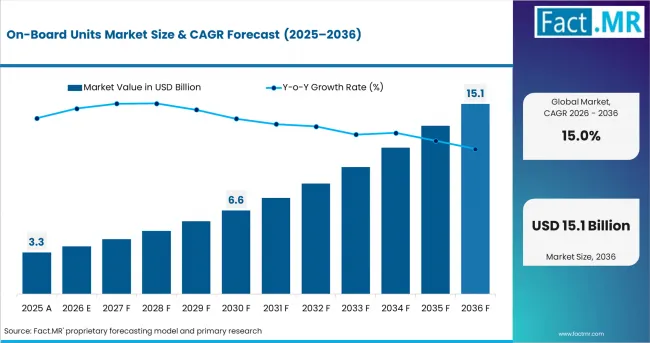
On Board Units Market Value Analysis

Metric Details
Industry Size (2026) USD 3.7 billion
Industry Value (2036) USD 15.1 billion
CAGR (2026 to 2036) 15.0%

Summary of On-Board Units Market

  • Demand Drivers in the Market
    • V2X Safety: Transport agencies need connected vehicle systems that improve road safety and traffic flow. USDOT released a national V2X deployment plan in August 2024 to support interoperable deployment. [1] This supports on-board unit demand because vehicles need devices that can receive alerts from roadside infrastructure at intersections and high-risk corridors.
    • Tolling Automation: Toll road operators need reliable on-board devices for automatic vehicle identification and payment. Q-Free announced its 50.0 millionth tolling transponder delivery in 2026. [2] This shows continued demand for OBUs that support faster lane movement and accurate account matching across managed highway networks.
    • Connected Fleets: Fleet operators need OBUs that support route alerts and signal priority across connected transport corridors. These systems help buses, emergency vehicles, and managed service fleets move through priority routes with better safety and traffic coordination.
  • Key Segments Analyzed
    • By Technology: DSRC is projected to reach 76.8% share in 2026 as tolling and V2X systems continue to use established short-range communication.
    • By Connectivity: Connected vehicle programs need communication beyond roadside readers. Cellular networks are expected to hold 48.0% share in 2026.
    • By Application: Vehicle-to-vehicle communication leads because safety alerts need direct exchange between nearby vehicles, with the segment projected to hold 57.6% share in 2026.
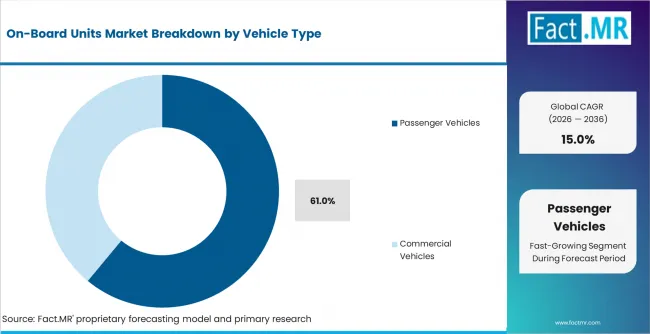
    • By Vehicle Type: Passenger vehicles lead as automakers integrate connected safety systems. The segment is estimated to account for 61.0% share in 2026.
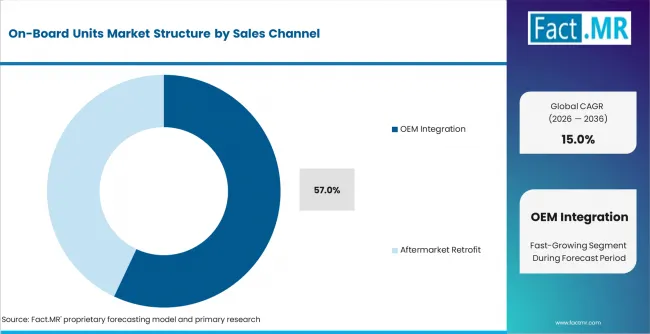
    • By Sales Channel: OEM integration is projected to account for 57.0% share in 2026 because factory-installed OBUs reduce retrofit complexity.
    • By Geography: China on-board unit demand is forecast to grow at 15.6% CAGR from 2026 to 2036 as electronics capacity and connected vehicle deployment expand.
  • Analyst Opinion at Fact.MR
    • Shambhu Nath Jha, Senior Analyst at Fact.MR, notes, “On-board unit demand is moving beyond tolling tags. Automakers and road operators need secure devices that can support V2X safety and infrastructure communication. Suppliers that prove interoperability, security, and long service life can protect repeat demand.”
  • Strategic Implications
    • Interoperability Proof: OBU suppliers need devices that work with existing DSRC systems and support C-V2X migration. Dual-mode capability reduces technology lock-in for transport operators.
    • Security Control: Device makers need secure certificate handling and reliable software update systems. Weak security can delay approval in safety-critical V2X programs.
    • Tolling Reliability: Tolling transponder suppliers need high read accuracy in dense radio environments. Device failure can affect revenue collection and traffic movement.

On-board unit use is increasing as tolling systems and road safety programs move toward connected vehicle communication. DSRC holds the strongest base because electronic tolling and early V2X deployments already depend on short-range vehicle-to-infrastructure communication.

Automakers need OBUs that support connected safety functions. Toll operators need reliable devices for automatic vehicle identification and payment. Public transport agencies use OBUs for signal priority and route alerts. Device suppliers must improve cybersecurity because secure data exchange is critical for road safety communication.

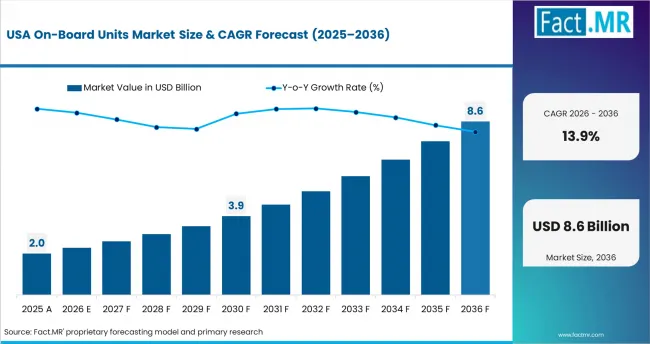
China is anticipated to grow at 15.6% CAGR from 2026 to 2036 as domestic electronics production and connected vehicle deployment expand. South Korea is projected to record 15.1% CAGR during the forecast period as smart mobility programs support OBU adoption. Japan may register 14.8% CAGR due to tolling upgrades and connected mobility investments. Germany is forecast to grow at 14.4% CAGR as C-ITS readiness and automotive electronics capability support deployment. United States demand is likely to rise at 13.9% CAGR as the USDOT V2X plan improves deployment clarity. France is projected to record 13.6% CAGR through ITS service expansion. The United Kingdom is forecast to post 13.4% CAGR by 2036 as tolling modernization and connected transport programs support adoption.

Segmental Analysis

On-Board Units Market Analysis by Technology
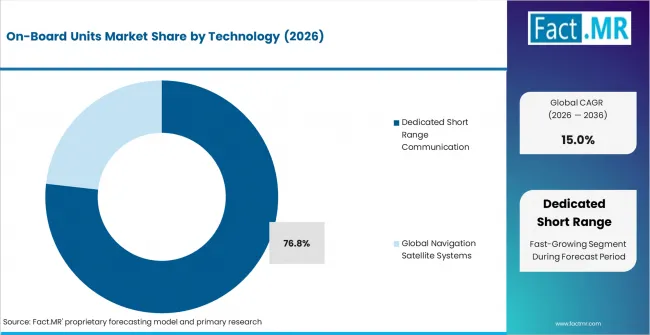
On Board Units Market Analysis By Technology

DSRC is projected to record 76.8% share in 2026 because tolling networks and early connected vehicle pilots already use short-range communication with roadside equipment. DSRC leads since road operators can deploy it across existing tolling and V2X infrastructure with lower integration risk. EN 15876:2025 covers conformity evaluation for on-board equipment and roadside equipment under the DSRC electronic fee collection interoperability profile. [3]

  • DSRC Base: DSRC supports tolling and direct safety communication. Road operators value proven roadside compatibility.
  • GNSS Role: GNSS units support distance-based charging and fleet positioning. Tolling agencies use them when route tracking is required.
  • Dual-Mode Shift: Dual-mode OBUs reduce transition risk. Automakers can support DSRC and C-V2X readiness in one device path.

On-Board Units Market Analysis by Connectivity
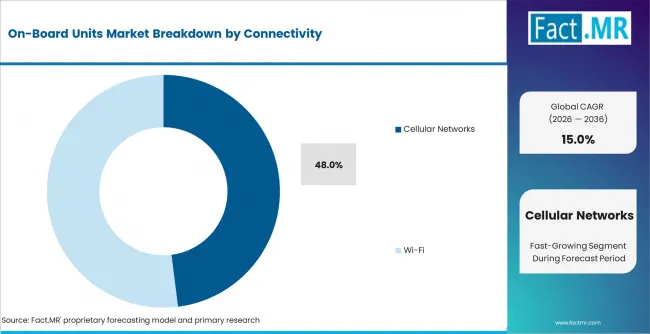
On Board Units Market Analysis By Connectivity

Connected vehicle programs need OBUs that communicate beyond roadside readers. Cellular networks are projected to hold 48.0% share in 2026 as C-V2X deployment and cloud-connected fleet programs expand. Cellular connectivity leads because fleet operators need remote device monitoring beyond toll plazas and pilot corridors. Wi-Fi supports software updates and local access. Bluetooth supports short-range pairing and diagnostics.

  • Wide-Area Links: Cellular networks support fleet monitoring and C-V2X communication. Operators gain visibility beyond fixed roadside units.
  • Local Updates: Wi-Fi supports service access and device updates. Maintenance staff can manage devices without constant wired access.
  • Pairing Support: Bluetooth supports short-range diagnostics. Fleet service units can simplify setup and troubleshooting.

On-Board Units Market Analysis by Application

On Board Units Market Analysis By Application

Vehicle-to-vehicle communication is projected to hold 57.6% share in 2026. Direct communication between nearby vehicles supports faster collision warnings and lane-change alerts. Vehicle-to-infrastructure communication supports tolling, signal priority, and roadside safety alerts. Vehicle-to-pedestrian communication is gaining attention as transport agencies focus on vulnerable road user protection. V2V holds the leading position because safety alerts need low-latency device-to-device messaging.

  • Vehicle Alerts: V2V communication supports collision and lane-change warnings. Automakers need reliable message exchange at driving speed.
  • Infrastructure Links: V2I communication supports tolling and signal priority. Transit agencies use it for corridor-level traffic movement.
  • Pedestrian Safety: V2P communication supports alerts for cyclists and pedestrians. Micromobility growth increases the need for device visibility.

On-Board Units Market Analysis by Vehicle Type
On Board Units Market Analysis By Vehicle Type

Passenger vehicles are estimated to account for 61.0% share in 2026 as automakers integrate connected safety and tolling devices at the factory level. High-volume car platforms create stronger scale than retrofit programs used in fleet vehicles. Commercial vehicles continue using OBUs for tolling, route monitoring, and fleet visibility. Passenger vehicles hold the leading position because factory-installed systems support wider deployment across new car models.

  • Car Integration: Passenger vehicles support the largest OBU volume base. Automakers can install devices during production.
  • Fleet Use: Commercial vehicles need tolling and route communication. Fleet operators value device reliability and maintenance access.
  • Micromobility Link: Compact OBUs can extend V2X to bicycles and scooters. City safety programs can use them for vulnerable road user alerts.

On-Board Units Market Analysis by Sales Channel
On Board Units Market Analysis By Sales Channel

OEM integration is projected to account for 57.0% share in 2026 as automakers install OBUs during vehicle production. Factory installation reduces setup work and improves antenna placement, software calibration, and security module integration. Aftermarket retrofit remains important for existing fleets and tolling programs. OEM integration leads because connected vehicle systems perform better when communication hardware is built into the vehicle design

  • Factory Fitment: OEM integration reduces retrofit work. Automakers can align OBU hardware with vehicle electronics.
  • Retrofit Demand: Aftermarket devices support fleets and existing tolling users. Transport operators can upgrade vehicles without replacing assets.
  • Fleet Contracts: Fleet supply supports buses and service vehicles. Contract programs help operators standardize devices across vehicles.

On-Board Units Market Drivers, Restraints, and Opportunities
On Board Units Market Opportunity Matrix Growth Vs Value

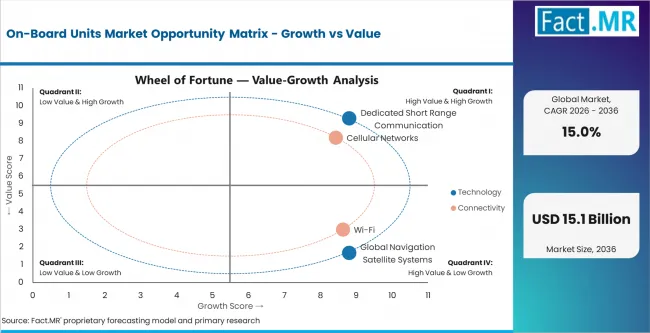
V2X deployment is a key demand driver for on-board units. Connected vehicle programs need in-vehicle devices that allow cars, buses, and service fleets to exchange alerts with roadside infrastructure. Road agencies are using these systems to improve intersection safety, corridor movement, and traffic response. This supports OBU demand because connected transport networks need trusted devices inside vehicles.

Technology transition risk remains a major restraint. DSRC is already used in tolling systems and early V2X projects. C-V2X is gaining attention in newer connected vehicle programs. Updated spectrum rules are pushing the market toward C-V2X technology. Device suppliers need OBUs that support interoperability, cybersecurity, and secure software updates across the vehicle lifecycle.

Opportunities in the On-Board Units Market

  • Transit Priority: City fleets can use OBUs to support bus signal priority and emergency vehicle preemption across connected corridors. Transit agencies can reduce delays at junctions and help ambulances receive faster route clearance. Growth depends on V2X-ready roadside units and common device rules that support wider deployment across urban networks.
  • Tolling Transponders: Toll road operators can upgrade DSRC tags to improve read accuracy and account matching. Newer transponders can support faster toll collection at higher lane speeds. Replacement cycles create an opportunity to move toward longer-life devices that reduce servicing needs across managed highways and open-road tolling systems.
  • Micromobility Safety: Cities can extend V2X safety features to bicycles and scooters as connected mobility programs expand. Compact OBUs can send location signals near intersections and crowded corridors. Transport agencies can use these devices to reduce collision risk between micromobility users and connected vehicles.

Regional Analysis

Based on regional analysis, the on-board units market is segmented into North America, Latin America, Europe, East Asia, South Asia and Pacific, and Middle East and Africa.

Top Country Growth Comparison On Board Units Market Cagr (2026 2036)

Country CAGR (2026 to 2036)

Country CAGR
China 15.6%
South Korea 15.1%
Japan 14.8%
Germany 14.4%
United States 13.9%
France 13.6%
United Kingdom 13.4%

Source: Fact.MR analysis, based on adjusted forecast model and primary research.

On Board Units Market Cagr Analysis By Country

East Asia On-Board Units Market Analysis

East Asia demand comes from electronics manufacturing and connected vehicle deployment. China leads through automotive scale and V2X infrastructure development. Japan and South Korea support adoption through tolling systems and smart mobility programs.

  • China: China on-board unit demand is forecast to grow at 15.6% CAGR by 2036 as domestic electronics production and connected vehicle programs expand. Local automakers can integrate OBUs into vehicle electronics at scale. Roadside infrastructure investment is supporting vehicle-to-infrastructure communication. China’s growth is tied to manufacturing depth and connected mobility deployment.
  • South Korea: South Korea demand is supported by smart mobility systems and connected road programs. Seoul and Busan can support connected transport pilots through dense road networks. The country is projected to record 15.1% CAGR from 2026 to 2036 as automotive electronics suppliers support OBU integration. Tolling and safety applications are creating recurring device demand.
  • Japan: Tolling reliability and connected mobility upgrades support Japan’s OBU demand. Japan may register 14.8% CAGR over the assessment period as automakers and toll operators need stable communication in dense urban corridors. Tokyo and Osaka are creating demand for signal priority and road safety alerts. Supplier acceptance depends on long service life, compact design, and reliable in-vehicle performance.

North America On-Board Units Market Analysis
On Board Units Market Country Value Analysis

North America demand is supported by V2X deployment planning and connected vehicle trials. The United States leads regional adoption through federal guidance and state-level road technology programs.

  • United States: United States demand is supported by V2X deployment planning and connected vehicle trials. USDOT’s 2024 V2X plan provides direction for nationwide implementation. Demand is likely to rise at 13.9% CAGR by 2036 as transport agencies seek interoperable safety messaging. Tolling modernization is creating another demand route for reliable in-vehicle devices.

Europe On-Board Units Market Analysis
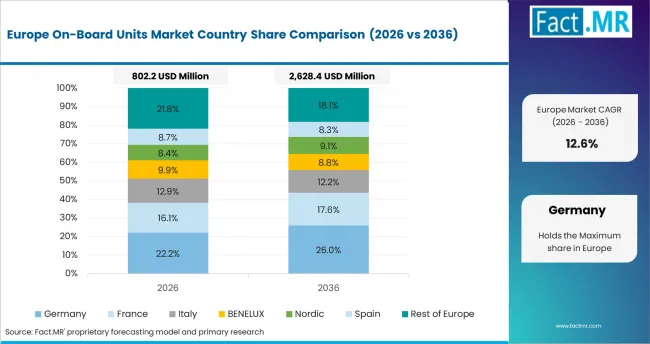
On Board Units Market Europe Country Market Share Analysis, 2026 & 2036

Europe demand reflects ITS policy, tolling maturity, and connected mobility planning. Germany leads through automotive electronics strength. France and the United Kingdom support adoption through road safety systems and tolling modernization.

  • Germany: Germany is forecast to post 14.4% CAGR by 2036 as automotive electronics capability and C-ITS readiness support OBU demand. European ITS policy supports interoperable road services across the region. German automakers and suppliers need devices that meet security and vehicle integration requirements. Tolling and connected safety programs are supporting steady demand.
  • France: Tolling and connected road services support OBU use in France. The country is projected to record 13.6% CAGR during the forecast period as motorway operators need reliable transponders and connected vehicle systems. Paris and Lyon are creating demand for urban traffic safety applications. European ITS policy supports cross-border device compatibility.
  • United Kingdom: Smart road and fleet communication programs support OBU demand in the United Kingdom. Transport authorities need devices that support alerts and infrastructure communication. Fleet operators can use OBUs for safety and route management. The country is forecast to post 13.4% CAGR through 2036 as smart mobility modernization expands. Supplier success will depend on cybersecurity, software updates, and long service support.

Competitive Aligners for Market Players
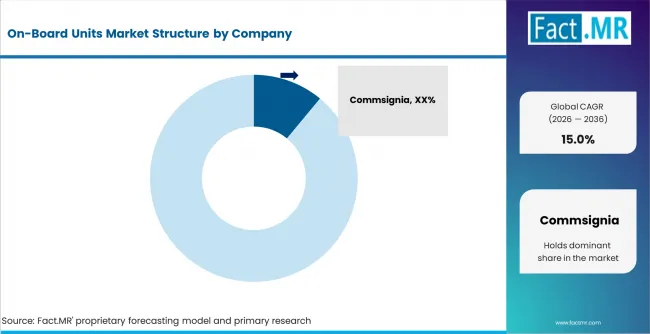
On Board Units Market Analysis By Company

The on-board units market includes V2X device suppliers, tolling transponder producers, automotive electronics companies, and connected transport technology providers. Commsignia, Danlaw Inc., Harman Automotive, Mitsubishi Electric Mobility Corporation, Movyon SpA, Q-Free ASA, Continental AG, and Unex Technology Corporation compete through device security, radio performance, software integration, and tolling reliability.

Competitive strength is increasingly tied to dual-mode capability and long service support. V2X on-board units that support both DSRC and C-V2X help transport agencies reduce technology transition risk. Secure firmware updates allow operators to manage device performance across longer vehicle lifecycles. Strong DSRC performance continues supporting tolling and roadside communication needs. Competition is shifting toward interoperability, cybersecurity, and reliable field performance.

Supplier position through 2036 will depend on security, compatibility, and service reliability. Automakers need OBUs that integrate cleanly with vehicle electronics. Toll operators need stable read accuracy across busy highway lanes. City transport agencies need devices that support signal priority and road safety alerts. Companies that combine radio performance with secure device management can protect repeat demand.

Key Players in On-Board Units Market

  • Commsignia
  • Danlaw Inc.
  • Harman Automotive
  • Mitsubishi Electric Mobility Corporation
  • Movyon SpA
  • Q-Free ASA
  • Continental AG
  • Unex Technology Corporation

Bibliography

  • [1]. U.S. Department of Transportation. (2024, August 16). USDOT releases National Deployment Plan for Vehicle-to-Everything technologies to reduce death and serious injuries on America’s roadways.
  • [2]. Q-Free ASA. (2026, March 25). Q-Free unveils next-generation OBU1010 transponder at Intertraffic Amsterdam.
  • [3] European Committee for Standardization. (2025). EN 15876:2025: Electronic fee collection: Evaluation of on-board and roadside equipment for conformity to EN 15509. CEN.
  • [4] Federal Communications Commission. (2024). Use of the 5.850-5.925 GHz band. Federal Register, 89(240), 100838–100856.
  • [5] European Telecommunications Standards Institute. (2024). Intelligent Transport Systems (ITS); LTE-V2X and NR-V2X access layer specification for Intelligent Transport Systems operating in the 5 GHz frequency band; Release 2 (ETSI EN 303 798 V2.1.1).

This Report Addresses

  • Strategic intelligence on on-board unit demand across tolling, V2X safety, fleet communication, and connected road applications.
  • Growth opportunity mapping across China, South Korea, the United States, and Germany.
  • Segment analysis by technology, connectivity, application, vehicle type, and sales channel.
  • Regional outlook covering V2X deployment planning, tolling modernization, automotive electronics depth, and ITS policy alignment.
  • Competitive analysis of Commsignia, Danlaw Inc., Q-Free ASA, Movyon SpA, and Unex Technology Corporation.
  • Product assessment covering DSRC OBUs, GNSS units, dual-mode V2X devices, and tolling transponders.
  • Report delivered through PDF, Excel datasets, and presentation formats.
  • Primary interviews, supplier checks, and connected vehicle demand review support validation.

Market Definition

The on-board units market covers in-vehicle devices that enable communication between vehicles and connected transport infrastructure. The market differs from general telematics because OBUs support safety messages and vehicle identification. It includes DSRC and GNSS-based devices used in connected transport systems.

On-Board Units Market Inclusions

The scope includes DSRC OBUs and connected vehicle communication devices. Cellular and Bluetooth connectivity are covered when they support OBU operation. OEM-installed and retrofit devices are counted when they enable V2V or V2I communication.

On-Board Units Market Exclusions

The scope excludes standalone infotainment systems and basic GPS trackers that do not support V2X or tolling communication. Roadside units are excluded unless supplied with on-board device programs. Smartphone-only road safety apps are outside scope because they are not embedded vehicle OBUs.

On-Board Units Market Research Methodology

  • Primary Research
    • Primary research includes interviews with automotive electronics managers and tolling system operators. Fleet technology heads and connected vehicle program managers are covered separately. Supplier feedback supports technology and application validation.
  • Desk Research
    • Desk research reviews V2X deployment plans and OBU product pages. Tolling device releases and ITS policy documents support validation.
  • Market-Sizing and Forecasting
  • Data Validation and Update Cycle
    • Forecasts are validated through supplier checks and automotive electronics interviews. Regional assumptions are reviewed with V2X policy updates and tolling deployment signals.

Scope of the Report

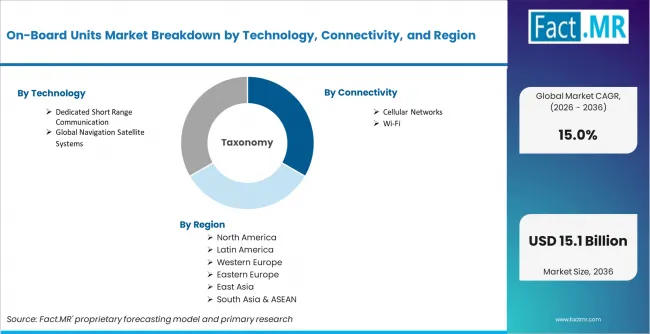
On Board Units Market Breakdown By Technology, Connectivity, And Region

Attribute Details
Quantitative Units USD 3.7 billion in 2026 to USD 15.1 billion by 2036 at 15.0% CAGR
Market Definition In-vehicle devices that support tolling, V2X safety, and communication with roadside infrastructure or nearby road users.
Technology Dedicated Short Range Communication , Global Navigation Satellite Systems
Connectivity Cellular Networks , Wi-Fi , Bluetooth
Application Vehicle-to-Vehicle Communication , Vehicle-to-Infrastructure Communication , Vehicle-to-Pedestrian Communication
Vehicle Type Passenger Vehicles , Commercial Vehicles , Micromobility
Sales Channel OEM Integration , Aftermarket Retrofit , Fleet Contracts
Regions Covered North America , Latin America , Europe , East Asia , South Asia and Pacific , Middle East and Africa
Countries Covered China , South Korea , Japan , Germany , United States , France , United Kingdom
Key Companies Profiled Commsignia , Danlaw Inc. , Harman Automotive , Mitsubishi Electric Mobility Corporation , Movyon SpA , Q-Free ASA , Continental AG , Unex Technology Corporation
Forecast Period 2026 to 2036
Approach Hybrid top-down and bottom-up model using technology demand, connectivity adoption, application use, vehicle type, sales channel, and supplier validation.

On-Board Units Market Analysis by Segments

  • By Technology:

    • Dedicated Short Range Communication
    • Global Navigation Satellite Systems
  • By Connectivity:

    • Cellular Networks
    • Wi-Fi
    • Bluetooth
  • By Application:

    • Vehicle-to-Vehicle Communication
    • Vehicle-to-Infrastructure Communication
    • Vehicle-to-Pedestrian Communication
  • By Vehicle Type:

    • Passenger Vehicles
    • Commercial Vehicles
    • Micromobility
  • By Sales Channel:

    • OEM Integration
    • Aftermarket Retrofit
    • Fleet Contracts
  • Region:

    • North America
      • United States
      • Canada
    • Europe
      • Germany
      • United Kingdom
      • France
      • Italy
      • Spain
    • Asia Pacific
      • China
      • Japan
      • South Korea
      • Taiwan
      • Singapore
    • Latin America
      • Brazil
      • Mexico
      • Argentina
    • Middle East & Africa
      • GCC Countries
      • South Africa
      • Israel

- Frequently Asked Questions -

How large is the on-board units market in 2025?

The on-board units market was valued at USD 3.3 billion in 2025 based on the adjusted Fact.MR model.

What is the expected value of the on-board units market in 2026?

The on-board units market is estimated to reach USD 3.7 billion in 2026 after the forecast period adjustment.

What is the forecast value of the on-board units market by 2036?

The on-board units market is forecast to reach USD 15.1 billion by 2036 as V2X and tolling adoption expand.

What CAGR is projected for the on-board units market from 2026 to 2036?

Fact.MR’s adjusted forecast projects 15.0% CAGR for the on-board units market from 2026 to 2036.

Which technology leads the on-board units market?

DSRC leads with 76.8% share in 2026 because tolling and V2X systems use established short-range communication.

Why does DSRC lead on-board unit demand?

DSRC leads because tolling operators and connected vehicle pilots already use roadside-compatible short-range communication.

Which connectivity type leads the on-board units market?

Cellular networks lead with 48.0% share in 2026 because connected fleets need wide-area communication.

Which application leads the on-board units market?

Vehicle-to-vehicle communication leads with 57.6% share in 2026 because safety alerts need direct exchange between nearby vehicles.

Which vehicle type leads the on-board units market?

Passenger vehicles lead with 61.0% share in 2026 because factory integration creates high-volume connected vehicle deployment.

Which sales channel leads the on-board units market?

OEM integration leads with 57.0% share in 2026 because factory-installed devices reduce retrofit complexity.

Which country grows fastest in the on-board units market?

China is forecast to grow fastest at 15.6% CAGR from 2026 to 2036.

Why is South Korea important in the on-board units market?

South Korea is important because smart mobility systems and vehicle electronics capability support OBU integration.

Why does Japan show strong growth in the on-board units market?

Japan grows through tolling reliability needs and connected mobility upgrades across dense road corridors.

Why does Germany support on-board unit demand?

Germany supports demand through automotive electronics strength and ITS policy alignment across Europe.

Why does the United States support on-board unit demand?

United States demand is supported by USDOT’s V2X deployment plan and connected road investment.

What drives on-board units market growth?

V2X safety deployment and tolling automation drive demand for on-board units.

What restrains on-board units market growth?

Technology transition risk restrains growth because DSRC and C-V2X systems require interoperability planning.

How do on-board units support tolling?

On-board units support tolling by identifying vehicles and enabling electronic payment without stopping traffic.

How do on-board units support V2X safety?

On-board units support V2X safety by exchanging road alerts between vehicles and infrastructure.

What is included in the on-board units market scope?

The scope includes DSRC OBUs, GNSS units, C-V2X-ready devices, tolling transponders, and retrofit V2X units.

What is excluded from the on-board units market scope?

The scope excludes standalone GPS trackers, infotainment systems, roadside units, and smartphone-only road safety apps.

How does Fact.MR forecast on-board unit demand?

Fact.MR forecasts demand using technology demand, connectivity adoption, application use, vehicle type, sales channel, and supplier validation.

Table of Content

  1. Executive Summary
    • Global Market Outlook
    • Demand to side Trends
    • Supply to side Trends
    • Technology Roadmap Analysis
    • Analysis and Recommendations
  2. Market Overview
    • Market Coverage / Taxonomy
    • Market Definition / Scope / Limitations
  3. Research Methodology
    • Chapter Orientation
    • Analytical Lens and Working Hypotheses
      • Market Structure, Signals, and Trend Drivers
      • Benchmarking and Cross-market Comparability
      • Market Sizing, Forecasting, and Opportunity Mapping
    • Research Design and Evidence Framework
      • Desk Research Programme (Secondary Evidence)
        • Company Annual and Sustainability Reports
        • Peer-reviewed Journals and Academic Literature
        • Corporate Websites, Product Literature, and Technical Notes
        • Earnings Decks and Investor Briefings
        • Statutory Filings and Regulatory Disclosures
        • Technical White Papers and Standards Notes
        • Trade Journals, Industry Magazines, and Analyst Briefs
        • Conference Proceedings, Webinars, and Seminar Materials
        • Government Statistics Portals and Public Data Releases
        • Press Releases and Reputable Media Coverage
        • Specialist Newsletters and Curated Briefings
        • Sector Databases and Reference Repositories
        • Fact.MR Internal Proprietary Databases and Historical Market Datasets
        • Subscription Datasets and Paid Sources
        • Social Channels, Communities, and Digital Listening Inputs
        • Additional Desk Sources
      • Expert Input and Fieldwork (Primary Evidence)
        • Primary Modes
          • Qualitative Interviews and Expert Elicitation
          • Quantitative Surveys and Structured Data Capture
          • Blended Approach
        • Why Primary Evidence is Used
        • Field Techniques
          • Interviews
          • Surveys
          • Focus Groups
          • Observational and In-context Research
          • Social and Community Interactions
        • Stakeholder Universe Engaged
          • C-suite Leaders
          • Board Members
          • Presidents and Vice Presidents
          • R&D and Innovation Heads
          • Technical Specialists
          • Domain Subject-matter Experts
          • Scientists
          • Physicians and Other Healthcare Professionals
        • Governance, Ethics, and Data Stewardship
          • Research Ethics
          • Data Integrity and Handling
      • Tooling, Models, and Reference Databases
    • Data Engineering and Model Build
      • Data Acquisition and Ingestion
      • Cleaning, Normalisation, and Verification
      • Synthesis, Triangulation, and Analysis
    • Quality Assurance and Audit Trail
  4. Market Background
    • Market Dynamics
      • Drivers
      • Restraints
      • Opportunity
      • Trends
    • Scenario Forecast
      • Demand in Optimistic Scenario
      • Demand in Likely Scenario
      • Demand in Conservative Scenario
    • Opportunity Map Analysis
    • Product Life Cycle Analysis
    • Supply Chain Analysis
    • Investment Feasibility Matrix
    • Value Chain Analysis
    • PESTLE and Porter’s Analysis
    • Regulatory Landscape
    • Regional Parent Market Outlook
    • Production and Consumption Statistics
    • Import and Export Statistics
  5. Global Market Analysis 2021 to 2025 and Forecast, 2026 to 2036
    • Historical Market Size Value (USD Million) Analysis, 2021 to 2025
    • Current and Future Market Size Value (USD Million) Projections, 2026 to 2036
      • Y to o to Y Growth Trend Analysis
      • Absolute $ Opportunity Analysis
  6. Global Market Pricing Analysis 2021 to 2025 and Forecast 2026 to 2036
  7. Global Market Analysis 2021 to 2025 and Forecast 2026 to 2036, By Technology
    • Introduction / Key Findings
    • Historical Market Size Value (USD Million) Analysis By Technology , 2021 to 2025
    • Current and Future Market Size Value (USD Million) Analysis and Forecast By Technology , 2026 to 2036
      • Dedicated Short Range Communication
      • Global Navigation Satellite Systems
    • Y to o to Y Growth Trend Analysis By Technology , 2021 to 2025
    • Absolute $ Opportunity Analysis By Technology , 2026 to 2036
  8. Global Market Analysis 2021 to 2025 and Forecast 2026 to 2036, By Connectivity
    • Introduction / Key Findings
    • Historical Market Size Value (USD Million) Analysis By Connectivity, 2021 to 2025
    • Current and Future Market Size Value (USD Million) Analysis and Forecast By Connectivity, 2026 to 2036
      • Cellular Networks
      • Wi-Fi
      • Bluetooth
    • Y to o to Y Growth Trend Analysis By Connectivity, 2021 to 2025
    • Absolute $ Opportunity Analysis By Connectivity, 2026 to 2036
  9. Global Market Analysis 2021 to 2025 and Forecast 2026 to 2036, By Application
    • Introduction / Key Findings
    • Historical Market Size Value (USD Million) Analysis By Application, 2021 to 2025
    • Current and Future Market Size Value (USD Million) Analysis and Forecast By Application, 2026 to 2036
      • Vehicle-to-Vehicle Communication
      • Vehicle-to-Infrastructure Communication
      • Vehicle-to-Pedestrian Communication
    • Y to o to Y Growth Trend Analysis By Application, 2021 to 2025
    • Absolute $ Opportunity Analysis By Application, 2026 to 2036
  10. Global Market Analysis 2021 to 2025 and Forecast 2026 to 2036, By Vehicle Type
    • Introduction / Key Findings
    • Historical Market Size Value (USD Million) Analysis By Vehicle Type, 2021 to 2025
    • Current and Future Market Size Value (USD Million) Analysis and Forecast By Vehicle Type, 2026 to 2036
      • Passenger Vehicles
      • Commercial Vehicles
      • Micromobility
    • Y to o to Y Growth Trend Analysis By Vehicle Type, 2021 to 2025
    • Absolute $ Opportunity Analysis By Vehicle Type, 2026 to 2036
  11. Global Market Analysis 2021 to 2025 and Forecast 2026 to 2036, By Sales Channel
    • Introduction / Key Findings
    • Historical Market Size Value (USD Million) Analysis By Sales Channel, 2021 to 2025
    • Current and Future Market Size Value (USD Million) Analysis and Forecast By Sales Channel, 2026 to 2036
      • OEM Integration
      • Aftermarket Retrofit
      • Fleet Contracts
    • Y to o to Y Growth Trend Analysis By Sales Channel, 2021 to 2025
    • Absolute $ Opportunity Analysis By Sales Channel, 2026 to 2036
  12. Global Market Analysis 2021 to 2025 and Forecast 2026 to 2036, By Region
    • Introduction
    • Historical Market Size Value (USD Million) Analysis By Region, 2021 to 2025
    • Current Market Size Value (USD Million) Analysis and Forecast By Region, 2026 to 2036
      • North America
      • Latin America
      • Western Europe
      • Eastern Europe
      • East Asia
      • South Asia and Pacific
      • Middle East & Africa
    • Market Attractiveness Analysis By Region
  13. North America Market Analysis 2021 to 2025 and Forecast 2026 to 2036, By Country
    • Historical Market Size Value (USD Million) Trend Analysis By Market Taxonomy, 2021 to 2025
    • Market Size Value (USD Million) Forecast By Market Taxonomy, 2026 to 2036
      • By Country
        • USA
        • Canada
        • Mexico
      • By Technology
      • By Connectivity
      • By Application
      • By Vehicle Type
      • By Sales Channel
    • Market Attractiveness Analysis
      • By Country
      • By Technology
      • By Connectivity
      • By Application
      • By Vehicle Type
      • By Sales Channel
    • Key Takeaways
  14. Latin America Market Analysis 2021 to 2025 and Forecast 2026 to 2036, By Country
    • Historical Market Size Value (USD Million) Trend Analysis By Market Taxonomy, 2021 to 2025
    • Market Size Value (USD Million) Forecast By Market Taxonomy, 2026 to 2036
      • By Country
        • Brazil
        • Chile
        • Rest of Latin America
      • By Technology
      • By Connectivity
      • By Application
      • By Vehicle Type
      • By Sales Channel
    • Market Attractiveness Analysis
      • By Country
      • By Technology
      • By Connectivity
      • By Application
      • By Vehicle Type
      • By Sales Channel
    • Key Takeaways
  15. Western Europe Market Analysis 2021 to 2025 and Forecast 2026 to 2036, By Country
    • Historical Market Size Value (USD Million) Trend Analysis By Market Taxonomy, 2021 to 2025
    • Market Size Value (USD Million) Forecast By Market Taxonomy, 2026 to 2036
      • By Country
        • Germany
        • UK
        • Italy
        • Spain
        • France
        • Nordic
        • BENELUX
        • Rest of Western Europe
      • By Technology
      • By Connectivity
      • By Application
      • By Vehicle Type
      • By Sales Channel
    • Market Attractiveness Analysis
      • By Country
      • By Technology
      • By Connectivity
      • By Application
      • By Vehicle Type
      • By Sales Channel
    • Key Takeaways
  16. Eastern Europe Market Analysis 2021 to 2025 and Forecast 2026 to 2036, By Country
    • Historical Market Size Value (USD Million) Trend Analysis By Market Taxonomy, 2021 to 2025
    • Market Size Value (USD Million) Forecast By Market Taxonomy, 2026 to 2036
      • By Country
        • Russia
        • Poland
        • Hungary
        • Balkan & Baltic
        • Rest of Eastern Europe
      • By Technology
      • By Connectivity
      • By Application
      • By Vehicle Type
      • By Sales Channel
    • Market Attractiveness Analysis
      • By Country
      • By Technology
      • By Connectivity
      • By Application
      • By Vehicle Type
      • By Sales Channel
    • Key Takeaways
  17. East Asia Market Analysis 2021 to 2025 and Forecast 2026 to 2036, By Country
    • Historical Market Size Value (USD Million) Trend Analysis By Market Taxonomy, 2021 to 2025
    • Market Size Value (USD Million) Forecast By Market Taxonomy, 2026 to 2036
      • By Country
        • China
        • Japan
        • South Korea
      • By Technology
      • By Connectivity
      • By Application
      • By Vehicle Type
      • By Sales Channel
    • Market Attractiveness Analysis
      • By Country
      • By Technology
      • By Connectivity
      • By Application
      • By Vehicle Type
      • By Sales Channel
    • Key Takeaways
  18. South Asia and Pacific Market Analysis 2021 to 2025 and Forecast 2026 to 2036, By Country
    • Historical Market Size Value (USD Million) Trend Analysis By Market Taxonomy, 2021 to 2025
    • Market Size Value (USD Million) Forecast By Market Taxonomy, 2026 to 2036
      • By Country
        • India
        • ASEAN
        • Australia & New Zealand
        • Rest of South Asia and Pacific
      • By Technology
      • By Connectivity
      • By Application
      • By Vehicle Type
      • By Sales Channel
    • Market Attractiveness Analysis
      • By Country
      • By Technology
      • By Connectivity
      • By Application
      • By Vehicle Type
      • By Sales Channel
    • Key Takeaways
  19. Middle East & Africa Market Analysis 2021 to 2025 and Forecast 2026 to 2036, By Country
    • Historical Market Size Value (USD Million) Trend Analysis By Market Taxonomy, 2021 to 2025
    • Market Size Value (USD Million) Forecast By Market Taxonomy, 2026 to 2036
      • By Country
        • Kingdom of Saudi Arabia
        • Other GCC Countries
        • Turkiye
        • South Africa
        • Other African Union
        • Rest of Middle East & Africa
      • By Technology
      • By Connectivity
      • By Application
      • By Vehicle Type
      • By Sales Channel
    • Market Attractiveness Analysis
      • By Country
      • By Technology
      • By Connectivity
      • By Application
      • By Vehicle Type
      • By Sales Channel
    • Key Takeaways
  20. Key Countries Market Analysis
    • USA
      • Pricing Analysis
      • Market Share Analysis, 2025
        • By Technology
        • By Connectivity
        • By Application
        • By Vehicle Type
        • By Sales Channel
    • Canada
      • Pricing Analysis
      • Market Share Analysis, 2025
        • By Technology
        • By Connectivity
        • By Application
        • By Vehicle Type
        • By Sales Channel
    • Mexico
      • Pricing Analysis
      • Market Share Analysis, 2025
        • By Technology
        • By Connectivity
        • By Application
        • By Vehicle Type
        • By Sales Channel
    • Brazil
      • Pricing Analysis
      • Market Share Analysis, 2025
        • By Technology
        • By Connectivity
        • By Application
        • By Vehicle Type
        • By Sales Channel
    • Chile
      • Pricing Analysis
      • Market Share Analysis, 2025
        • By Technology
        • By Connectivity
        • By Application
        • By Vehicle Type
        • By Sales Channel
    • Germany
      • Pricing Analysis
      • Market Share Analysis, 2025
        • By Technology
        • By Connectivity
        • By Application
        • By Vehicle Type
        • By Sales Channel
    • UK
      • Pricing Analysis
      • Market Share Analysis, 2025
        • By Technology
        • By Connectivity
        • By Application
        • By Vehicle Type
        • By Sales Channel
    • Italy
      • Pricing Analysis
      • Market Share Analysis, 2025
        • By Technology
        • By Connectivity
        • By Application
        • By Vehicle Type
        • By Sales Channel
    • Spain
      • Pricing Analysis
      • Market Share Analysis, 2025
        • By Technology
        • By Connectivity
        • By Application
        • By Vehicle Type
        • By Sales Channel
    • France
      • Pricing Analysis
      • Market Share Analysis, 2025
        • By Technology
        • By Connectivity
        • By Application
        • By Vehicle Type
        • By Sales Channel
    • India
      • Pricing Analysis
      • Market Share Analysis, 2025
        • By Technology
        • By Connectivity
        • By Application
        • By Vehicle Type
        • By Sales Channel
    • ASEAN
      • Pricing Analysis
      • Market Share Analysis, 2025
        • By Technology
        • By Connectivity
        • By Application
        • By Vehicle Type
        • By Sales Channel
    • Australia & New Zealand
      • Pricing Analysis
      • Market Share Analysis, 2025
        • By Technology
        • By Connectivity
        • By Application
        • By Vehicle Type
        • By Sales Channel
    • China
      • Pricing Analysis
      • Market Share Analysis, 2025
        • By Technology
        • By Connectivity
        • By Application
        • By Vehicle Type
        • By Sales Channel
    • Japan
      • Pricing Analysis
      • Market Share Analysis, 2025
        • By Technology
        • By Connectivity
        • By Application
        • By Vehicle Type
        • By Sales Channel
    • South Korea
      • Pricing Analysis
      • Market Share Analysis, 2025
        • By Technology
        • By Connectivity
        • By Application
        • By Vehicle Type
        • By Sales Channel
    • Russia
      • Pricing Analysis
      • Market Share Analysis, 2025
        • By Technology
        • By Connectivity
        • By Application
        • By Vehicle Type
        • By Sales Channel
    • Poland
      • Pricing Analysis
      • Market Share Analysis, 2025
        • By Technology
        • By Connectivity
        • By Application
        • By Vehicle Type
        • By Sales Channel
    • Hungary
      • Pricing Analysis
      • Market Share Analysis, 2025
        • By Technology
        • By Connectivity
        • By Application
        • By Vehicle Type
        • By Sales Channel
    • Kingdom of Saudi Arabia
      • Pricing Analysis
      • Market Share Analysis, 2025
        • By Technology
        • By Connectivity
        • By Application
        • By Vehicle Type
        • By Sales Channel
    • Turkiye
      • Pricing Analysis
      • Market Share Analysis, 2025
        • By Technology
        • By Connectivity
        • By Application
        • By Vehicle Type
        • By Sales Channel
    • South Africa
      • Pricing Analysis
      • Market Share Analysis, 2025
        • By Technology
        • By Connectivity
        • By Application
        • By Vehicle Type
        • By Sales Channel
  21. Market Structure Analysis
    • Competition Dashboard
    • Competition Benchmarking
    • Market Share Analysis of Top Players
      • By Regional
      • By Technology
      • By Connectivity
      • By Application
      • By Vehicle Type
      • By Sales Channel
  22. Competition Analysis
    • Competition Deep Dive
      • Commsignia
        • Overview
        • Product Portfolio
        • Profitability by Market Segments (Product/Age /Sales Channel/Region)
        • Sales Footprint
        • Strategy Overview
          • Marketing Strategy
          • Product Strategy
          • Channel Strategy
      • Danlaw Inc.
      • Harman Automotive
      • Mitsubishi Electric Mobility Corporation
      • Movyon SpA
      • Q-Free ASA
      • Continental AG
  23. Assumptions & Acronyms Used

List Of Table

  • Table 1: Global Market Value (USD Million) Forecast by Region, 2021 to 2036
  • Table 2: Global Market Value (USD Million) Forecast by Technology, 2021 to 2036
  • Table 3: Global Market Value (USD Million) Forecast by Connectivity, 2021 to 2036
  • Table 4: Global Market Value (USD Million) Forecast by Application, 2021 to 2036
  • Table 5: Global Market Value (USD Million) Forecast by Vehicle Type, 2021 to 2036
  • Table 6: Global Market Value (USD Million) Forecast by Sales Channel, 2021 to 2036
  • Table 7: North America Market Value (USD Million) Forecast by Country, 2021 to 2036
  • Table 8: North America Market Value (USD Million) Forecast by Technology, 2021 to 2036
  • Table 9: North America Market Value (USD Million) Forecast by Connectivity, 2021 to 2036
  • Table 10: North America Market Value (USD Million) Forecast by Application, 2021 to 2036
  • Table 11: North America Market Value (USD Million) Forecast by Vehicle Type, 2021 to 2036
  • Table 12: North America Market Value (USD Million) Forecast by Sales Channel, 2021 to 2036
  • Table 13: Latin America Market Value (USD Million) Forecast by Country, 2021 to 2036
  • Table 14: Latin America Market Value (USD Million) Forecast by Technology, 2021 to 2036
  • Table 15: Latin America Market Value (USD Million) Forecast by Connectivity, 2021 to 2036
  • Table 16: Latin America Market Value (USD Million) Forecast by Application, 2021 to 2036
  • Table 17: Latin America Market Value (USD Million) Forecast by Vehicle Type, 2021 to 2036
  • Table 18: Latin America Market Value (USD Million) Forecast by Sales Channel, 2021 to 2036
  • Table 19: Western Europe Market Value (USD Million) Forecast by Country, 2021 to 2036
  • Table 20: Western Europe Market Value (USD Million) Forecast by Technology, 2021 to 2036
  • Table 21: Western Europe Market Value (USD Million) Forecast by Connectivity, 2021 to 2036
  • Table 22: Western Europe Market Value (USD Million) Forecast by Application, 2021 to 2036
  • Table 23: Western Europe Market Value (USD Million) Forecast by Vehicle Type, 2021 to 2036
  • Table 24: Western Europe Market Value (USD Million) Forecast by Sales Channel, 2021 to 2036
  • Table 25: Eastern Europe Market Value (USD Million) Forecast by Country, 2021 to 2036
  • Table 26: Eastern Europe Market Value (USD Million) Forecast by Technology, 2021 to 2036
  • Table 27: Eastern Europe Market Value (USD Million) Forecast by Connectivity, 2021 to 2036
  • Table 28: Eastern Europe Market Value (USD Million) Forecast by Application, 2021 to 2036
  • Table 29: Eastern Europe Market Value (USD Million) Forecast by Vehicle Type, 2021 to 2036
  • Table 30: Eastern Europe Market Value (USD Million) Forecast by Sales Channel, 2021 to 2036
  • Table 31: East Asia Market Value (USD Million) Forecast by Country, 2021 to 2036
  • Table 32: East Asia Market Value (USD Million) Forecast by Technology, 2021 to 2036
  • Table 33: East Asia Market Value (USD Million) Forecast by Connectivity, 2021 to 2036
  • Table 34: East Asia Market Value (USD Million) Forecast by Application, 2021 to 2036
  • Table 35: East Asia Market Value (USD Million) Forecast by Vehicle Type, 2021 to 2036
  • Table 36: East Asia Market Value (USD Million) Forecast by Sales Channel, 2021 to 2036
  • Table 37: South Asia and Pacific Market Value (USD Million) Forecast by Country, 2021 to 2036
  • Table 38: South Asia and Pacific Market Value (USD Million) Forecast by Technology, 2021 to 2036
  • Table 39: South Asia and Pacific Market Value (USD Million) Forecast by Connectivity, 2021 to 2036
  • Table 40: South Asia and Pacific Market Value (USD Million) Forecast by Application, 2021 to 2036
  • Table 41: South Asia and Pacific Market Value (USD Million) Forecast by Vehicle Type, 2021 to 2036
  • Table 42: South Asia and Pacific Market Value (USD Million) Forecast by Sales Channel, 2021 to 2036
  • Table 43: Middle East & Africa Market Value (USD Million) Forecast by Country, 2021 to 2036
  • Table 44: Middle East & Africa Market Value (USD Million) Forecast by Technology, 2021 to 2036
  • Table 45: Middle East & Africa Market Value (USD Million) Forecast by Connectivity, 2021 to 2036
  • Table 46: Middle East & Africa Market Value (USD Million) Forecast by Application, 2021 to 2036
  • Table 47: Middle East & Africa Market Value (USD Million) Forecast by Vehicle Type, 2021 to 2036
  • Table 48: Middle East & Africa Market Value (USD Million) Forecast by Sales Channel, 2021 to 2036

List Of Figures

  • Figure 1: Global Market Pricing Analysis
  • Figure 2: Global Market Value (USD Million) Forecast 2021-2036
  • Figure 3: Global Market Value Share and BPS Analysis by Technology, 2026 and 2036
  • Figure 4: Global Market Y-o-Y Growth Comparison by Technology, 2026 to 2036
  • Figure 5: Global Market Attractiveness Analysis by Technology
  • Figure 6: Global Market Value Share and BPS Analysis by Connectivity, 2026 and 2036
  • Figure 7: Global Market Y-o-Y Growth Comparison by Connectivity, 2026 to 2036
  • Figure 8: Global Market Attractiveness Analysis by Connectivity
  • Figure 9: Global Market Value Share and BPS Analysis by Application, 2026 and 2036
  • Figure 10: Global Market Y-o-Y Growth Comparison by Application, 2026 to 2036
  • Figure 11: Global Market Attractiveness Analysis by Application
  • Figure 12: Global Market Value Share and BPS Analysis by Vehicle Type, 2026 and 2036
  • Figure 13: Global Market Y-o-Y Growth Comparison by Vehicle Type, 2026 to 2036
  • Figure 14: Global Market Attractiveness Analysis by Vehicle Type
  • Figure 15: Global Market Value Share and BPS Analysis by Sales Channel, 2026 and 2036
  • Figure 16: Global Market Y-o-Y Growth Comparison by Sales Channel, 2026 to 2036
  • Figure 17: Global Market Attractiveness Analysis by Sales Channel
  • Figure 18: Global Market Value (USD Million) Share and BPS Analysis by Region, 2026 and 2036
  • Figure 19: Global Market Y-o-Y Growth Comparison by Region, 2026 to 2036
  • Figure 20: Global Market Attractiveness Analysis by Region
  • Figure 21: North America Market Incremental Dollar Opportunity, 2026 to 2036
  • Figure 22: Latin America Market Incremental Dollar Opportunity, 2026 to 2036
  • Figure 23: Western Europe Market Incremental Dollar Opportunity, 2026 to 2036
  • Figure 24: Eastern Europe Market Incremental Dollar Opportunity, 2026 to 2036
  • Figure 25: East Asia Market Incremental Dollar Opportunity, 2026 to 2036
  • Figure 26: South Asia and Pacific Market Incremental Dollar Opportunity, 2026 to 2036
  • Figure 27: Middle East & Africa Market Incremental Dollar Opportunity, 2026 to 2036
  • Figure 28: North America Market Value Share and BPS Analysis by Country, 2026 and 2036
  • Figure 29: North America Market Value Share and BPS Analysis by Technology, 2026 and 2036
  • Figure 30: North America Market Y-o-Y Growth Comparison by Technology, 2026 to 2036
  • Figure 31: North America Market Attractiveness Analysis by Technology
  • Figure 32: North America Market Value Share and BPS Analysis by Connectivity, 2026 and 2036
  • Figure 33: North America Market Y-o-Y Growth Comparison by Connectivity, 2026 to 2036
  • Figure 34: North America Market Attractiveness Analysis by Connectivity
  • Figure 35: North America Market Value Share and BPS Analysis by Application, 2026 and 2036
  • Figure 36: North America Market Y-o-Y Growth Comparison by Application, 2026 to 2036
  • Figure 37: North America Market Attractiveness Analysis by Application
  • Figure 38: North America Market Value Share and BPS Analysis by Vehicle Type, 2026 and 2036
  • Figure 39: North America Market Y-o-Y Growth Comparison by Vehicle Type, 2026 to 2036
  • Figure 40: North America Market Attractiveness Analysis by Vehicle Type
  • Figure 41: North America Market Value Share and BPS Analysis by Sales Channel, 2026 and 2036
  • Figure 42: North America Market Y-o-Y Growth Comparison by Sales Channel, 2026 to 2036
  • Figure 43: North America Market Attractiveness Analysis by Sales Channel
  • Figure 44: Latin America Market Value Share and BPS Analysis by Country, 2026 and 2036
  • Figure 45: Latin America Market Value Share and BPS Analysis by Technology, 2026 and 2036
  • Figure 46: Latin America Market Y-o-Y Growth Comparison by Technology, 2026 to 2036
  • Figure 47: Latin America Market Attractiveness Analysis by Technology
  • Figure 48: Latin America Market Value Share and BPS Analysis by Connectivity, 2026 and 2036
  • Figure 49: Latin America Market Y-o-Y Growth Comparison by Connectivity, 2026 to 2036
  • Figure 50: Latin America Market Attractiveness Analysis by Connectivity
  • Figure 51: Latin America Market Value Share and BPS Analysis by Application, 2026 and 2036
  • Figure 52: Latin America Market Y-o-Y Growth Comparison by Application, 2026 to 2036
  • Figure 53: Latin America Market Attractiveness Analysis by Application
  • Figure 54: Latin America Market Value Share and BPS Analysis by Vehicle Type, 2026 and 2036
  • Figure 55: Latin America Market Y-o-Y Growth Comparison by Vehicle Type, 2026 to 2036
  • Figure 56: Latin America Market Attractiveness Analysis by Vehicle Type
  • Figure 57: Latin America Market Value Share and BPS Analysis by Sales Channel, 2026 and 2036
  • Figure 58: Latin America Market Y-o-Y Growth Comparison by Sales Channel, 2026 to 2036
  • Figure 59: Latin America Market Attractiveness Analysis by Sales Channel
  • Figure 60: Western Europe Market Value Share and BPS Analysis by Country, 2026 and 2036
  • Figure 61: Western Europe Market Value Share and BPS Analysis by Technology, 2026 and 2036
  • Figure 62: Western Europe Market Y-o-Y Growth Comparison by Technology, 2026 to 2036
  • Figure 63: Western Europe Market Attractiveness Analysis by Technology
  • Figure 64: Western Europe Market Value Share and BPS Analysis by Connectivity, 2026 and 2036
  • Figure 65: Western Europe Market Y-o-Y Growth Comparison by Connectivity, 2026 to 2036
  • Figure 66: Western Europe Market Attractiveness Analysis by Connectivity
  • Figure 67: Western Europe Market Value Share and BPS Analysis by Application, 2026 and 2036
  • Figure 68: Western Europe Market Y-o-Y Growth Comparison by Application, 2026 to 2036
  • Figure 69: Western Europe Market Attractiveness Analysis by Application
  • Figure 70: Western Europe Market Value Share and BPS Analysis by Vehicle Type, 2026 and 2036
  • Figure 71: Western Europe Market Y-o-Y Growth Comparison by Vehicle Type, 2026 to 2036
  • Figure 72: Western Europe Market Attractiveness Analysis by Vehicle Type
  • Figure 73: Western Europe Market Value Share and BPS Analysis by Sales Channel, 2026 and 2036
  • Figure 74: Western Europe Market Y-o-Y Growth Comparison by Sales Channel, 2026 to 2036
  • Figure 75: Western Europe Market Attractiveness Analysis by Sales Channel
  • Figure 76: Eastern Europe Market Value Share and BPS Analysis by Country, 2026 and 2036
  • Figure 77: Eastern Europe Market Value Share and BPS Analysis by Technology, 2026 and 2036
  • Figure 78: Eastern Europe Market Y-o-Y Growth Comparison by Technology, 2026 to 2036
  • Figure 79: Eastern Europe Market Attractiveness Analysis by Technology
  • Figure 80: Eastern Europe Market Value Share and BPS Analysis by Connectivity, 2026 and 2036
  • Figure 81: Eastern Europe Market Y-o-Y Growth Comparison by Connectivity, 2026 to 2036
  • Figure 82: Eastern Europe Market Attractiveness Analysis by Connectivity
  • Figure 83: Eastern Europe Market Value Share and BPS Analysis by Application, 2026 and 2036
  • Figure 84: Eastern Europe Market Y-o-Y Growth Comparison by Application, 2026 to 2036
  • Figure 85: Eastern Europe Market Attractiveness Analysis by Application
  • Figure 86: Eastern Europe Market Value Share and BPS Analysis by Vehicle Type, 2026 and 2036
  • Figure 87: Eastern Europe Market Y-o-Y Growth Comparison by Vehicle Type, 2026 to 2036
  • Figure 88: Eastern Europe Market Attractiveness Analysis by Vehicle Type
  • Figure 89: Eastern Europe Market Value Share and BPS Analysis by Sales Channel, 2026 and 2036
  • Figure 90: Eastern Europe Market Y-o-Y Growth Comparison by Sales Channel, 2026 to 2036
  • Figure 91: Eastern Europe Market Attractiveness Analysis by Sales Channel
  • Figure 92: East Asia Market Value Share and BPS Analysis by Country, 2026 and 2036
  • Figure 93: East Asia Market Value Share and BPS Analysis by Technology, 2026 and 2036
  • Figure 94: East Asia Market Y-o-Y Growth Comparison by Technology, 2026 to 2036
  • Figure 95: East Asia Market Attractiveness Analysis by Technology
  • Figure 96: East Asia Market Value Share and BPS Analysis by Connectivity, 2026 and 2036
  • Figure 97: East Asia Market Y-o-Y Growth Comparison by Connectivity, 2026 to 2036
  • Figure 98: East Asia Market Attractiveness Analysis by Connectivity
  • Figure 99: East Asia Market Value Share and BPS Analysis by Application, 2026 and 2036
  • Figure 100: East Asia Market Y-o-Y Growth Comparison by Application, 2026 to 2036
  • Figure 101: East Asia Market Attractiveness Analysis by Application
  • Figure 102: East Asia Market Value Share and BPS Analysis by Vehicle Type, 2026 and 2036
  • Figure 103: East Asia Market Y-o-Y Growth Comparison by Vehicle Type, 2026 to 2036
  • Figure 104: East Asia Market Attractiveness Analysis by Vehicle Type
  • Figure 105: East Asia Market Value Share and BPS Analysis by Sales Channel, 2026 and 2036
  • Figure 106: East Asia Market Y-o-Y Growth Comparison by Sales Channel, 2026 to 2036
  • Figure 107: East Asia Market Attractiveness Analysis by Sales Channel
  • Figure 108: South Asia and Pacific Market Value Share and BPS Analysis by Country, 2026 and 2036
  • Figure 109: South Asia and Pacific Market Value Share and BPS Analysis by Technology, 2026 and 2036
  • Figure 110: South Asia and Pacific Market Y-o-Y Growth Comparison by Technology, 2026 to 2036
  • Figure 111: South Asia and Pacific Market Attractiveness Analysis by Technology
  • Figure 112: South Asia and Pacific Market Value Share and BPS Analysis by Connectivity, 2026 and 2036
  • Figure 113: South Asia and Pacific Market Y-o-Y Growth Comparison by Connectivity, 2026 to 2036
  • Figure 114: South Asia and Pacific Market Attractiveness Analysis by Connectivity
  • Figure 115: South Asia and Pacific Market Value Share and BPS Analysis by Application, 2026 and 2036
  • Figure 116: South Asia and Pacific Market Y-o-Y Growth Comparison by Application, 2026 to 2036
  • Figure 117: South Asia and Pacific Market Attractiveness Analysis by Application
  • Figure 118: South Asia and Pacific Market Value Share and BPS Analysis by Vehicle Type, 2026 and 2036
  • Figure 119: South Asia and Pacific Market Y-o-Y Growth Comparison by Vehicle Type, 2026 to 2036
  • Figure 120: South Asia and Pacific Market Attractiveness Analysis by Vehicle Type
  • Figure 121: South Asia and Pacific Market Value Share and BPS Analysis by Sales Channel, 2026 and 2036
  • Figure 122: South Asia and Pacific Market Y-o-Y Growth Comparison by Sales Channel, 2026 to 2036
  • Figure 123: South Asia and Pacific Market Attractiveness Analysis by Sales Channel
  • Figure 124: Middle East & Africa Market Value Share and BPS Analysis by Country, 2026 and 2036
  • Figure 125: Middle East & Africa Market Value Share and BPS Analysis by Technology, 2026 and 2036
  • Figure 126: Middle East & Africa Market Y-o-Y Growth Comparison by Technology, 2026 to 2036
  • Figure 127: Middle East & Africa Market Attractiveness Analysis by Technology
  • Figure 128: Middle East & Africa Market Value Share and BPS Analysis by Connectivity, 2026 and 2036
  • Figure 129: Middle East & Africa Market Y-o-Y Growth Comparison by Connectivity, 2026 to 2036
  • Figure 130: Middle East & Africa Market Attractiveness Analysis by Connectivity
  • Figure 131: Middle East & Africa Market Value Share and BPS Analysis by Application, 2026 and 2036
  • Figure 132: Middle East & Africa Market Y-o-Y Growth Comparison by Application, 2026 to 2036
  • Figure 133: Middle East & Africa Market Attractiveness Analysis by Application
  • Figure 134: Middle East & Africa Market Value Share and BPS Analysis by Vehicle Type, 2026 and 2036
  • Figure 135: Middle East & Africa Market Y-o-Y Growth Comparison by Vehicle Type, 2026 to 2036
  • Figure 136: Middle East & Africa Market Attractiveness Analysis by Vehicle Type
  • Figure 137: Middle East & Africa Market Value Share and BPS Analysis by Sales Channel, 2026 and 2036
  • Figure 138: Middle East & Africa Market Y-o-Y Growth Comparison by Sales Channel, 2026 to 2036
  • Figure 139: Middle East & Africa Market Attractiveness Analysis by Sales Channel
  • Figure 140: Global Market - Tier Structure Analysis
  • Figure 141: Global Market - Company Share Analysis

On-Board Units Market