- Market Value (2025): USD 417.8 Bn
- Estimated Value (2026): USD 445.0 Bn
- Forecast Value (2036): USD 1,150 Bn
- CAGR (2026-2036): 10.0%
What is the Paper Masking Tapes Market forecast to be worth by 2036?
USD 4.9 billion by 2036 at a 4.4% CAGR.
- The paper masking tapes market reached USD 3.1 billion in 2025.
- Demand is projected to increase from USD 3.2 billion in 2026 to USD 4.9 billion by 2036.
- The market is forecast to expand at a 4.4% CAGR from 2026 to 2036.
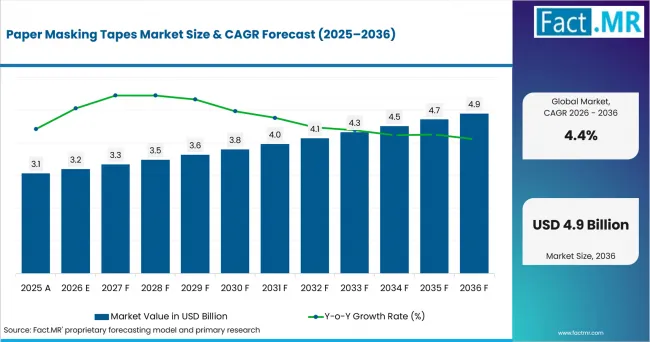
Paper Masking Tapes Market Value Analysis | Source: Fact.MR
What are the defining numbers behind Paper Masking Tapes Market growth?
An absolute opportunity of USD 1.7 billion is expected between 2026 and 2036.
- Demand Drivers in the Market
- Automotive paint operations create recurring masking demand because body shops and vehicle plants must protect adjacent surfaces while producing controlled paint edges. 3M states that paper-backed automotive masking tape is designed to resist lifting and curling, conform around irregular surfaces and remove cleanly after painting, which makes tape performance directly relevant to rework rates and finish quality.
- Industrial coating operations require temporary protection through wet coating, spray painting, powder coating and related surface-finishing processes. tesa identifies these as common industrial fields for masking tapes and notes the need for clean removal and reliable use at elevated temperatures, supporting specification-based demand beyond general-purpose household painting.
- Vehicle production keeps automotive masking a sizeable application base. VDA data show 82.5 million passenger cars produced worldwide in 2025, including 4.15 million in Germany, 2.50 million in Brazil, about 10.0 million in the USA and 7.21 million in Japan. Each assembly and repair ecosystem supports recurring consumption in paint preparation, refinishing and component protection.
- Construction repair and maintenance sustains demand from contractors and commercial painting services. The UK Office for National Statistics reported that repair and maintenance output grew 2.1% in the three months to May 2026, with non-housing repair and maintenance up 3.0%, illustrating the continuing workflow in which temporary masking is consumed during repainting and refurbishment.
- Tape qualification is becoming more performance-specific as users compare peel adhesion, clean removal and backing behaviour on different surfaces. ISO 29862:2024 standardizes methods for measuring peel adhesion of self-adhesive tapes, reinforcing the role of measurable adhesive performance in industrial purchasing and quality control.
- Key Segments Analyzed
- Rubber Based Adhesive accounts for 51.7% of the Adhesive System segment in 2026, supported by fast initial tack and dependable holding on common painting and industrial surfaces.
- Painting And Coating holds 46.8% of the Application segment in 2026 because temporary masking is embedded in paint preparation, overspray control and edge definition.
- Industrial Manufacturing represents 39.2% of the End Use segment in 2026 as repetitive coating and finishing operations require predictable masking performance at production scale.
- Standard Paper Backing accounts for 44.6% of the Backing Material segment in 2026 because crepe-paper constructions combine hand tearability with conformability around edges and contours.
- Direct Sales holds 58.1% of the Distribution Channel segment in 2026 as large manufacturers and professional users often qualify tape specifications directly with suppliers before recurring purchase.
- Analyst Opinion at Fact.MR
- Shambhu Nath Jha, Principal Consultant at Fact.MR, states, “Paper masking tape remains a process consumable rather than a discretionary accessory in paint-intensive workflows. Buyers assess whether a tape holds through the coating cycle, follows contours and removes without residue. Suppliers that prove performance on the customer’s actual surface and temperature conditions can build repeat demand across automotive, industrial and commercial painting accounts.”
- Strategic Implications
- Suppliers should position products by paint system, surface and temperature window because masking failure can create rework that costs more than the tape itself.
- Industrial buyers should qualify tape on representative substrates before standardizing a SKU across plants, especially where fresh paint, plastics or high-temperature bake cycles are involved.
- Backing design should be matched to geometry. Creped paper supports curved and irregular masking, while flatter or reinforced constructions are better suited to straight edges and tougher handling.
- Direct-sales teams should focus technical support on automotive paint shops, coating lines and commercial painters where repeat consumption can justify specification work and inventory agreements.
How does the Paper Masking Tapes Market break down by segment?
The market is segmented by Adhesive System, Application, End Use, Backing Material and Distribution Channel.
Why does Rubber Based Adhesive lead Adhesive System?
Rubber Based Adhesive is projected to account for a 51.7% share in 2026.
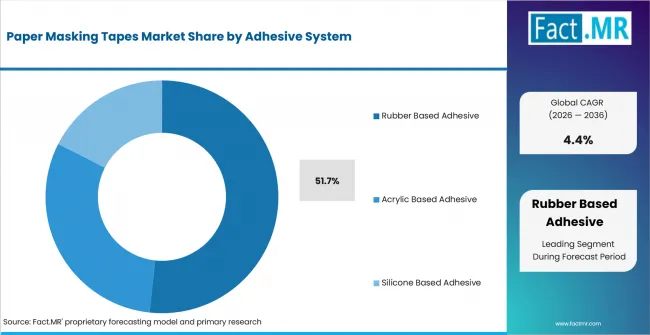
Paper Masking Tapes Market Analysis By Adhesive System | Source: Fact.MR
Rubber-based systems lead because masking work usually requires immediate grip after hand application. Fast tack helps tape stay in place around edges and contours before paint or coating is applied, reducing the need for repeated pressing or repositioning.
The segment also fits high-volume general masking where users need predictable holding power and clean removal at a controlled cost. Solvent-based and hot-melt rubber variants allow suppliers to tune adhesion and temperature resistance for different industrial conditions.
This aligns with the wider performance logic of adhesive tapes, where rubber systems remain relevant for fast initial grip in masking and sealing applications.
Why does Painting And Coating lead Application?
Painting And Coating is projected to account for a 46.8% share in 2026.
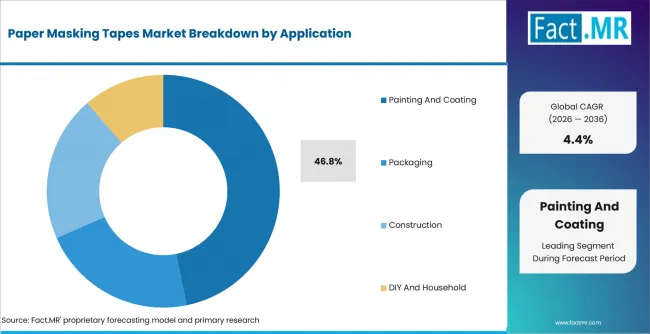
Paper Masking Tapes Market Analysis By Application | Source: Fact.MR
Painting and coating lead because masking tape was designed to create temporary boundaries during surface finishing. The tape protects adjacent material from overspray and helps painters produce defined edges, then must release without damaging the underlying finish.
3M describes automotive masking tapes as compatible with waterborne and solvent paint systems, while tesa identifies spray painting and powder coating among common industrial masking applications. These workflows consume tape repeatedly because masking is removed after each job or coating cycle.
The category also overlaps with the broader paper tapes market, where masking is a primary use case for paper-backed pressure-sensitive formats.
Why does Industrial Manufacturing lead End Use?
Industrial Manufacturing is projected to account for a 39.2% share in 2026.
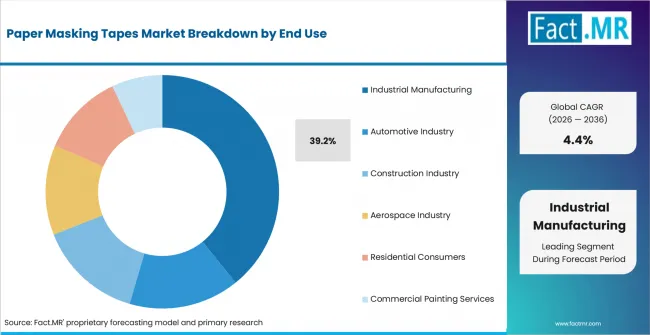
Paper Masking Tapes Market Analysis By End Use | Source: Fact.MR
Industrial manufacturing leads because coating, finishing and temporary protection occur repeatedly on standardized parts. Production users therefore consume masking tape as a process input rather than buying it only for occasional maintenance.
Manufacturers also place tighter requirements on clean removal, edge sharpness and resistance to heat or coating solvents. A tape that lifts or leaves residue can interrupt finishing and add cleaning or repainting work, which shifts purchasing toward qualified products and dependable supply.
Demand connects with the wider adhesives & sealants ecosystem because industrial users increasingly specify bonding and masking materials by process performance rather than by generic tape type.
Why does Standard Paper Backing lead Backing Material?
Standard Paper Backing is projected to account for a 44.6% share in 2026.
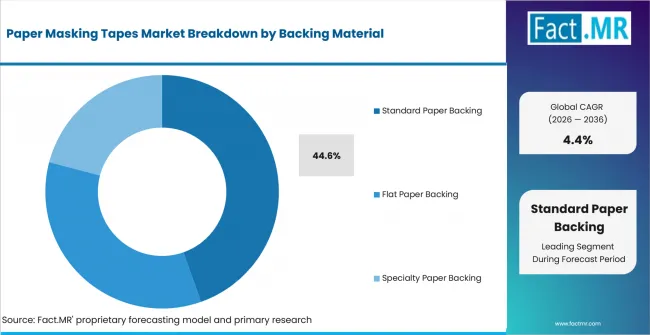
Paper Masking Tapes Market Analysis By Backing Material | Source: Fact.MR
Standard paper backing leads because crepe paper combines conformability with hand tearability. Painters can follow curves and irregular edges without cutting tools, while the backing remains stiff enough to guide placement and produce a controlled boundary.
3M notes that crepe-paper automotive tape conforms to curved and irregular surfaces and can be torn by hand. These characteristics reduce application time in body shops and general painting while keeping the product easy to remove after the coating step.
Backing choice also affects peel behaviour and removal. ISO 29862:2024 provides standardized peel-adhesion methods for self-adhesive tapes, supporting more consistent comparison when professional users qualify paper-backed formats.
Why does Direct Sales lead Distribution Channel?
Direct Sales is projected to account for a 58.1% share in 2026.
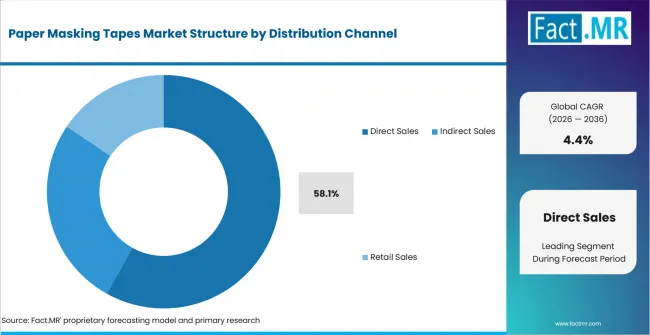
Paper Masking Tapes Market Analysis By Distribution Channel | Source: Fact.MR
Direct sales lead because large automotive and industrial customers frequently qualify tape against specific surfaces, paint chemistries and temperature cycles. Supplier engineers can support trials, recommend adhesive or backing variants and agree recurring supply once performance is approved.
This purchasing model reduces substitution risk after qualification because changing tape can require another validation cycle. Indirect sales remain important for hardware stores, industrial suppliers and smaller painting contractors that value local availability and mixed-SKU purchasing.
The qualification model resembles other pressure-sensitive adhesives applications, where substrate compatibility and tested adhesion influence supplier selection.
What is accelerating Paper Masking Tapes Market adoption, and what is holding it back?
Growth is supported by recurring automotive and industrial painting, construction repair work and specification-led masking, while commoditization, material-cost pressure and application failures limit switching and margin expansion.
Drivers Impact Analysis
| Factor | (~) % Impact on CAGR | Geographic Relevance | Impact Timeline |
|---|---|---|---|
| Automotive painting and refinishing throughput | +0.8% | Germany; Brazil; USA; Japan | Short term (≤ 2 years) |
| Industrial coating and surface-finishing activity | +0.7% | Global | Short term (≤ 2 years) |
| Construction repair and commercial repainting | +0.6% | USA; UK; Germany | Medium term (2–4 years) |
| Demand for clean removal and controlled paint edges | +0.5% | Global | Medium term (2–4 years) |
| Direct technical qualification with industrial users | +0.4% | Germany; USA; Japan | Long term (≥ 4 years) |
Source: Fact.MR analysis. Updated Aug 24, 2026
Opportunity Impact Analysis
| Factor | (~) % Impact on CAGR | Geographic Relevance | Impact Timeline |
|---|---|---|---|
| High-temperature and multi-bake masking tapes | +0.5% | Germany; USA; Japan | Medium term (2–4 years) |
| UV-resistant acrylic masking formats | +0.4% | USA; UK; Germany | Medium term (2–4 years) |
| Specialty backing for curves and surface protection | +0.3% | Global | Medium term (2–4 years) |
| Regional converting and private-label supply | +0.2% | Brazil; USA; UK | Long term (≥ 4 years) |
Source: Fact.MR analysis. Updated Aug 24, 2026
Restraints Impact Analysis
| Factor | (~) % Impact on CAGR | Geographic Relevance | Impact Timeline |
|---|---|---|---|
| Low-cost commoditized masking alternatives | -0.5% | Global | Short term (≤ 2 years) |
| Residue, lift or surface incompatibility risk | -0.4% | Automotive and industrial markets | Short term (≤ 2 years) |
| Paper, rubber and adhesive input-cost pressure | -0.3% | Global | Medium term (2–4 years) |
| Substitution by film or liquid masking in selected jobs | -0.2% | Specialty industrial applications | Long term (≥ 4 years) |
Source: Fact.MR analysis. Updated Aug 24, 2026
Which countries are scaling the Paper Masking Tapes Market through 2036?
- Germany: Domestic passenger-car production reached 4.15 million units in 2025, up 2%, sustaining a large automotive painting and refinishing ecosystem where temperature resistance and clean removal matter.
- Brazil: Passenger-car production rose to about 2.50 million units in 2025, 5% above 2024, expanding the volume of vehicle and supplier operations that use masking during paint preparation and finishing.
- USA: Vehicle production remained close to 10.0 million units in 2025, while construction spending continues across residential and nonresidential work. Together these activities support recurring tape demand from body shops, contractors and industrial users.
- UK: Construction output grew 1.8% in 2025, and repair and maintenance continued to contribute materially to activity in 2026. Repainting and refurbishment work supports professional masking-tape consumption beyond new construction.
- Japan: Passenger-car production reached about 7.21 million units in 2025, while national construction investment planning continues to cover substantial building and civil-engineering activity, supporting industrial and contractor use of masking tapes.
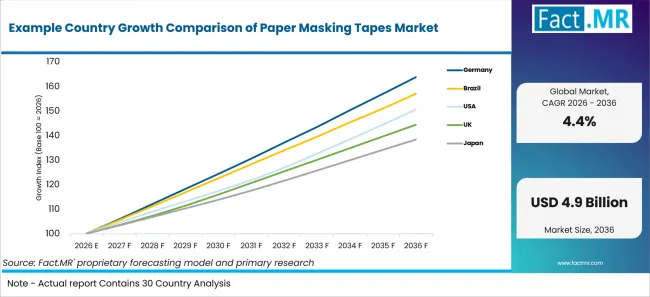
Example Country Growth Comparison Of Paper Masking Tapes Market | Source: Fact.MR
Country CAGR (2026-2036)
| Country | CAGR, 2026–2036 |
|---|---|
| Germany | 5.1% |
| Brazil | 4.6% |
| USA | 4.2% |
| UK | 3.7% |
| Japan | 3.3% |
Source: Fact.MR analysis. Updated Aug 24, 2026
What is driving Germany’s growth through 2036?
Germany is forecast to expand at a 5.1% CAGR from 2026 to 2036.
Germany combines automotive production with a broad industrial coating base. VDA reported 4.15 million passenger cars produced domestically in 2025, creating recurring masking requirements across OEM paint shops, component suppliers and refinishing operations.
The country also has a high share of electric-car output, but the masking requirement remains tied to paint and surface finishing rather than powertrain type. Suppliers that support bake-cycle resistance, precise paint edges and clean removal can serve both conventional and electric vehicle platforms.
What is driving Brazil’s growth through 2036?
Brazil is forecast to expand at a 4.6% CAGR from 2026 to 2036.
Brazil’s vehicle production increased to approximately 2.50 million passenger cars in 2025, about 5% above the previous year according to VDA’s international production data. Rising output increases masking consumption across assembly paint shops and supplier finishing lines.
Demand also extends to repair and repainting because masking tape is a single-use consumable in most paint jobs. Local converting and distribution can therefore benefit from recurring professional use even when vehicle production growth varies year to year.
What is driving the USA’s growth through 2036?
The USA is forecast to expand at a 4.2% CAGR from 2026 to 2036.
The USA combines a large automotive base with extensive construction and maintenance activity. VDA recorded nearly 10.0 million passenger cars produced in the country in 2025, while the U.S. Census Bureau continues to track construction spending across residential, commercial and public projects.
This creates two distinct demand pools. Automotive users require predictable paint masking and clean removal, while contractors and maintenance teams use paper masking tapes for temporary protection during repainting, sealing and surface preparation.
What is driving the UK’s growth through 2036?
The UK is forecast to expand at a 3.7% CAGR from 2026 to 2036.
Repair and maintenance provide a recurring consumption base for paper masking tapes. ONS reported that repair and maintenance output increased 2.1% in the three months to May 2026, including 3.0% growth in non-housing repair and maintenance.
Professional painters and contractors repeatedly consume tape while protecting trim, glass and adjacent surfaces. Demand therefore depends less on a single building cycle and more on the continuing flow of refurbishment and maintenance work.
What is driving Japan’s growth through 2036?
Japan is forecast to expand at a 3.3% CAGR from 2026 to 2036.
Japan produced about 7.21 million passenger cars in 2025, maintaining a large base of automotive coating and refinishing activity. Precision manufacturing also supports masking applications where edge quality and residue-free removal are important.
The Ministry of Land, Infrastructure, Transport and Tourism continues to publish annual construction-investment outlooks, indicating an established building and infrastructure workflow that supports contractor demand for temporary masking and surface-protection materials.
Who Leads the Paper Masking Tapes Market?
3M Company, Avery Dennison Corporation, Nitto Denko Corporation, Scapa Group plc, CMS Group of Companies, TOYOCHEM Co. Ltd., CCT Tapes, K.L. & Ling, Bolex (Shenzhen) Adhesive Products Co. Ltd., Intertape Polymer Group, Inc., Advance Tapes International Ltd., Rinrei Co., Ltd., Furuto Industrial Co., Ltd, Shenzhen KHJ Technology Co., Ltd, Vibac Group S.p.a., and MEXIM ADHESIVE TAPES PVT. LTD.
3M’s position is supported by a broad automotive masking portfolio spanning general-purpose crepe-paper tapes, precision masking and higher-temperature products. Its current product information emphasizes conformability, clean removal, paint-system compatibility and resistance to lifting or curling, which align closely with the main purchasing criteria in professional masking.
Avery Dennison, Nitto Denko, TOYOCHEM, CCT Tapes and other suppliers compete through adhesive formulation, coating consistency and regional converting. Intertape Polymer Group remains an established tape supplier but has been privately owned by Clearlake Capital since 2022.
Scapa Group plc appears in the supplied company list as a legacy name. SWM completed its acquisition of Scapa in April 2021, and the business now sits within the Mativ organization following the later SWM-Neenah combination. The legacy name is retained below to preserve the supplied company set.
Competition depends on initial tack, clean removability, conformability and resistance to heat or paint solvents. Technical support can influence repeat business because professional users often test tape on the actual surface and coating system before approving a recurring purchase.
Adjacent innovation in cell-to-pack tapes shows how application-specific tape engineering is expanding across industrial markets, although battery fixation sits outside this paper masking tape scope.
Which companies are the key providers?
Key companies profiled include 3M Company; Avery Dennison Corporation; Nitto Denko Corporation; Scapa Group plc; CMS Group of Companies; TOYOCHEM Co. Ltd.; CCT Tapes; K.L. & Ling; Bolex (Shenzhen) Adhesive Products Co. Ltd.; Intertape Polymer Group, Inc.; Advance Tapes International Ltd.; Rinrei Co., Ltd.; Furuto Industrial Co., Ltd.; Shenzhen KHJ Technology Co., Ltd.; Vibac Group S.p.a.; and MEXIM ADHESIVE TAPES PVT. LTD.
- 3M Company
- Avery Dennison Corporation
- Nitto Denko Corporation
- Scapa Group plc
- CMS Group of Companies
- TOYOCHEM Co. Ltd.
- CCT Tapes
- K.L. & Ling
- Bolex (Shenzhen) Adhesive Products Co. Ltd.
- Intertape Polymer Group, Inc.
- Advance Tapes International Ltd.
- Rinrei Co., Ltd.
- Furuto Industrial Co., Ltd
- Shenzhen KHJ Technology Co., Ltd
- Vibac Group S.p.a.
- MEXIM ADHESIVE TAPES PVT. LTD
Bibliography
- 3M Company. (2026). 3M Automotive Masking Tape 2308. 3M.
- 3M Company. (2026). 3M Precision Masking Tape. 3M.
- tesa SE. (2026). Tape Solutions: Industrial Paint Jobs and Surface Protection Tapes. tesa.
- International Organization for Standardization. (2024). ISO 29862:2024 Self-Adhesive Tapes: Determination of Peel Adhesion Properties. ISO.
- German Association of the Automotive Industry (VDA). (2026). Automobile Production: 2025 Annual Figures. VDA.
- Office for National Statistics. (2026). Construction Output in Great Britain: May 2026. UK Government.
- Office for National Statistics. (2026). Construction Output in Great Britain: December 2025. UK Government.
- U.S. Census Bureau. (2026). Value of Construction Put in Place. U.S. Department of Commerce.
- Ministry of Land, Infrastructure, Transport and Tourism, Japan. (2025). Construction Investment Outlook for FY2025. Government of Japan.
- Mativ Holdings, Inc. (2021). SWM International Completes Acquisition of Scapa Group Plc. Mativ.
- Clearlake Capital Group. (2022). Clearlake Capital Completes Acquisition of Intertape Polymer Group. Clearlake Capital Group.
This Report Answers
- Which paper masking tape applications create recurring professional demand?
- How do adhesive system and backing material affect masking performance?
- Which end users and channels shape supplier qualification and repeat purchasing?
- How does demand differ across Germany, Brazil, the USA, the UK and Japan?
- Which companies compete across industrial, automotive and professional masking applications?
What does the Paper Masking Tapes Market cover?
The Paper Masking Tapes Market covers finished pressure-sensitive tapes that use paper as the principal backing and are designed for temporary masking, paint-line definition, surface protection, temporary sealing and related tasks.
Revenue includes products sold for industrial manufacturing, automotive work, construction, aerospace, residential use and commercial painting services across the supplied adhesive, backing and distribution categories.
What is included in the scope?
The scope includes rubber-based, acrylic-based and silicone-based adhesive systems supplied on standard, flat and specialty paper backings. It covers masking used in painting and coating, packaging, construction and DIY or household work.
End-use coverage includes industrial manufacturing, automotive, construction, aerospace, residential consumers and commercial painting services. Sales through direct supplier relationships, indirect industrial channels and retail outlets are included where the product meets the supplied masking-tape definition.
What is excluded from the scope?
The scope excludes non-paper masking films, liquid masking compounds and protective films sold without a paper backing. Packaging tapes, medical tapes, electrical tapes and structural bonding tapes are outside the market when they are not sold for the supplied paper masking applications.
Bulk pressure-sensitive adhesive resins, release coatings and paper stock sold separately are also excluded because the market counts finished masking-tape products rather than upstream raw materials.
How Was the Analysis Built?
The analysis draws on more than 120 sources, over 35 company portfolios and more than 20 industry interviews across at least 25 countries.
- Primary Research: Interviews with tape manufacturers, adhesive formulators, coating-line managers, automotive refinishing specialists, industrial distributors and commercial painting contractors examine product qualification, removal performance and purchasing priorities.
- Desk Research: The review covers automotive production, construction and repair activity, tape-performance standards, supplier technical literature and company disclosures. External evidence is used to explain demand mechanisms without replacing the supplied market controls.
- Market Sizing and Forecasting: Estimates combine tape consumption in painting and coating, industrial production, automotive refinishing, construction work, backing and adhesive mix, channel structure and country-level demand patterns.
- Data Validation and Update Cycle: Findings are cross-checked against company activity, official production indicators and application-level interviews. Updates consider changes in vehicle output, construction activity, coating processes, material costs and supplier ownership
Segmentation
What is the report's scope and coverage?
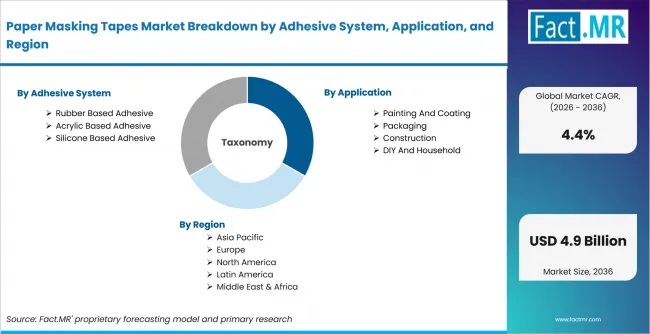
Paper Masking Tapes Market Breakdown By Adhesive System, Application, And Region | Source: Fact.MR
| Attribute | Details |
|---|---|
| Quantitative Units | USD billion |
| Market Definition | Paper-backed pressure-sensitive masking tapes sold for temporary masking, painting, coating, protection and related covered uses |
| Segments Covered | Adhesive System; Application; End Use; Backing Material; Distribution Channel |
| Regions Covered | North America; Latin America; Europe; East Asia; South Asia and Pacific; Middle East and Africa |
| Countries Covered | Germany; Brazil; USA; UK; Japan |
| Key Companies Profiled | 3M Company; Avery Dennison Corporation; Nitto Denko Corporation; Scapa Group plc; CMS Group of Companies; and others |
| Forecast Period | 2026 to 2036 |
| Base Year | 2025 |
| Market Value, 2026 | USD 3.2 billion |
| Market Value, 2036 | USD 4.9 billion |
| CAGR, 2026-2036 | 4.4% |
| Absolute Opportunity | USD 1.7 billion |
| Approach | Hybrid top-down and bottom-up approach using application consumption, adhesive and backing mix, end-use demand, channel structure and country-level validation |
Source: Fact.MR analysis. Updated Aug 24, 2026
How is the market segmented?
-
By Adhesive System:
- Rubber Based Adhesive
- Solvent Based Rubber Adhesive
- Hot Melt Rubber Adhesive
- Acrylic Based Adhesive
- UV Resistant Acrylic Adhesive
- High Durability Acrylic Adhesive
- Silicone Based Adhesive
- Specialty Surface Adhesive
- Industrial Grade Silicone Adhesive
- Rubber Based Adhesive
-
By Application:
- Painting And Coating
- Automotive Painting
- Industrial Coating
- Packaging
- Edge Reinforcement
- Temporary Sealing
- Construction
- Surface Protection
- Painting Preparation
- DIY And Household
- Home Painting
- Craft Applications
- Painting And Coating
-
By End Use:
- Industrial Manufacturing
- Automotive Industry
- Construction Industry
- Aerospace Industry
- Residential Consumers
- Commercial Painting Services
-
By Backing Material:
- Standard Paper Backing
- Light Crepe Paper
- Heavy Crepe Paper
- Flat Paper Backing
- Reinforced Paper Base
- Specialty Paper Backing
- Standard Paper Backing
-
By Distribution Channel:
- Direct Sales
- Indirect Sales
- Hardware Stores
- Industrial Suppliers
- Retail Sales
-
By Region:
- North America
- Latin America
- Western Europe
- Eastern Europe
- East Asia
- South Asia and Pacific
- Middle East & Africa
Frequently Asked Questions
What is the Paper Masking Tapes Market value in 2026?
At what CAGR is the market projected to grow?
What is the projected market value by 2036?
Which Adhesive System leads the market?
Which Application leads the market?
Which End Use leads the market?
Which Backing Material leads the market?
Which Distribution Channel leads the market?
Which country records the highest listed CAGR?
Which companies are included in the market assessment?
Who worked on this report


Preview the report firsthand - request a free sample
Free SampleGet the brochure for pricing and purchase details
Download PDF