- Market Value (2025): USD 265.4 Mn
- Estimated Value (2026): USD 279.4 Mn
- Forecast Value (2036): USD 467.9 Mn
- CAGR (2026-2036): 5.3%
What is the Passive Sonobuoy Market forecast to be worth by 2036?
USD 279.44 million in 2026 to USD 467.91 million by 2036, at a 5.3% CAGR.
- As per Fact.MR the passive sonobuoy market at USD 265.4 million in 2025, immediately ahead of a stronger replenishment and modernization phase.
- Spending is forecast to advance from USD 279.4 million in 2026 to USD 467.9 million by 2036 as anti-submarine patrol intensity and distributed undersea sensing increase.
- A 5.3% CAGR is expected through 2036. The expansion is tied to recurring training consumption, stock replenishment, and wider deployment of networked acoustic fields from maritime patrol aircraft, helicopters, ships, and unmanned platforms.
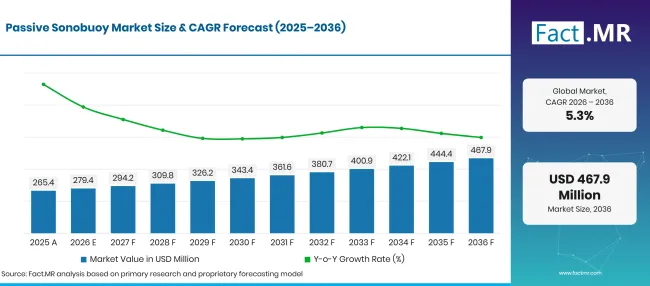
Factmr Passive Sonobuoy Market Forecast Global | Source: Fact.MR
| Year | Basis | Market Value (USD million) |
|---|---|---|
| 2025 | Actual | 265.4 |
| 2026 | Estimate | 279.4 |
| 2036 | Forecast | 467.9 |
| CAGR 2026 to 2036 | Forecast period | 5.3% |
Source: Fact.MR analysis. Updated Oct 19, 2026
What are the defining numbers behind Passive Sonobuoy Market growth?
The forecast represents USD 188.47 million in additional annual market value by 2036. Directional passive systems account for most of the value because localization and bearing information matter more in contested-water operations than simple acoustic detection.
- Demand Drivers in the Market
- Global naval commands are expanding maritime patrol aircraft inventories and sonobuoy flight stores to counter stealthy diesel-electric and nuclear submarine activity across contested ocean corridors. Ultra Maritime secured a USD 49 million Other Transaction Agreement with the U.S. Navy to accelerate engineering development of Q62 next-generation sonobuoys [1]. Military operators prioritize passive acoustic systems that listen for subtle cavitation and machinery noise without transmitting active acoustic pings that could alert adversary submarines.
- Naval aviation wings require extended-endurance sonobuoys capable of monitoring choke points across vast maritime exclusive economic zones during multi-day surveillance missions. Ultra Maritime received a USD 99 million U.S. Navy agreement for Q53H sonobuoy production and operational inventory replenishment [2]. Military procurement teams focus on high-fidelity hydrophone arrays that discriminate biophonic ocean noise from true submarine propulsion signatures.
- Allied defense partnerships and bilateral maritime pacts drive coordinated sonobuoy co-production and inventory interoperability initiatives across the Indo-Pacific and Atlantic theaters. Ultra Maritime signed a defense co-production agreement with Bharat Dynamics Limited to manufacture U.S.-specification airborne sonobuoys in India to support maritime patrol fleets [3]. Standardized acoustic communication channels allow multinational naval task forces to share real-time undersea contact tracks during joint naval exercises.
- Rapid advancements in multi-static acoustic data processing enable maritime patrol crews to combine passive acoustic signals across widely dispersed sonobuoy patterns. The UK Ministry of Defence and Defence Innovation highlighted the operational deployment of the Anti-Submarine Warfare Spearhead programme to process multiple sonobuoy channels simultaneously on Merlin Mk2 helicopters [4]. Upgraded processing suites allow acoustic operators to track quiet undersea contacts with superior triangulation accuracy.
- Key Segments Analyzed
- Directional Frequency Analysis and Recording buoys dominate value because the operator needs bearing and spectral information to classify and localize a contact. Omnidirectional passive buoys remain useful for lower-cost search barriers and cueing, particularly when forces need to cover a wider area before concentrating assets.
- Airborne deployment holds 67.9% of 2026 demand because patrol aircraft and maritime helicopters can seed a search pattern quickly across a large operating area. Shipborne and autonomous deployment widen persistence, but airborne platforms remain the fastest way to investigate a time-sensitive submarine contact.
- Defense accounts for 72.3% of 2026 demand, reflecting fleet exercises, operational readiness, and the consumable nature of deployed buoys. Civil and research use remains smaller but technically important in marine-mammal monitoring, ocean acoustics, seismic work, and environmental observation.
- Naval forces represent 64.1% of 2026 end-user demand because sonobuoy inventories are tied directly to anti-submarine training cycles and wartime stock requirements. Research institutions and commercial survey users purchase more selectively and usually optimize for measurement quality rather than tactical response speed.
- Analyst Opinion at Fact.MR
- Shambhu Nath Jha, Lead Consultant at Fact.MR, states, “Passive sonobuoy modernization is shifting toward digitized multi-sensor arrays and autonomous aerial deployment. Naval forces can no longer rely on single-channel analog hydrophones against modern quiet submarine hulls. Sonobuoy manufacturers that successfully integrate onboard digital beamforming, secure VHF and satellite data links, and extended-life seawater batteries will dominate defense procurement contracts as allied navies rebuild their anti-submarine warfare inventories.”
- Strategic Implications
- Naval defense agencies are accelerating testing of unmanned and autonomous aerial platforms configured to dispense and monitor passive sonobuoys across maritime choke points. The UK Ministry of Defence launched the Proteus autonomous rotary testbed to validate automated sonobuoy deployment and data relay capabilities for naval anti-submarine operations [5].
- Defense contractors are hardening sonobuoy radio telemetry links against electronic jamming and spoofing, utilizing frequency-hopping algorithms and digital data encryption. Secure transmission protocols ensure that acoustic tracking streams remain protected while being relayed to overhead maritime patrol aircraft and combat information centers.
- Acoustic sensor developers are integrating miniaturized vector sensors and multi-element hydrophone strings that deploy to specific depth zones based on ocean thermal layering. Thermal layer penetration enables acoustic arrays to detect submarine signatures hidden beneath surface thermoclines and shadow zones.
- Naval logistics commands are establishing multi-year framework agreements to ensure sonobuoy manufacturing lines maintain high surge capacity during heightened geopolitical tensions. Continuous inventory rotation programs guarantee that ready-service sonobuoy stocks remain fresh and functionally reliable across carrier strike groups.
Germany is projected to grow at a 6.7% CAGR, while Brazil registers 6.1%, driven by naval modernization and South Atlantic maritime patrol expansion. The United States advances at 5.5%, supported by large-scale P-8A Poseidon patrol operations and Indo-Pacific fleet deployments. The United Kingdom rises at 4.9%, backed by carrier strike group protection and North Atlantic anti-submarine commitments. Japan records 4.4%, sustained by continuous maritime patrol missions across East Asian island chains.
How does the Passive Sonobuoy Market break down by segment?
Directional 60.3%; Defense 72.3%; Airborne 67.9%; Naval Forces 64.1% in 2026.
Which Type dominates?
Directional holds 60.3% share in 2026.
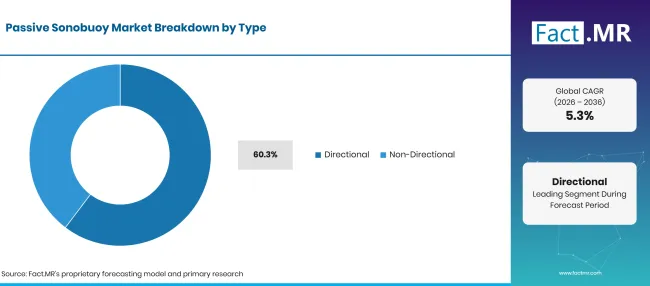
Factmr Passive Sonobuoy Market Breakdown Type | Source: Fact.MR
| Type | Share (2026) |
|---|---|
| Directional (Leading segment) | 60.3% |
| Other segments combined | 39.7%* |
| Total | 100.0% |
Source: Fact.MR analysis. Updated Oct 19, 2026
Directional passive sonobuoys command the leading market share because they provide essential azimuth bearing data needed to establish accurate target track lines. Directional Frequency Analysis and Recording (DIFAR) sonobuoys utilize orthogonal velocity sensor pairs and omnidirectional hydrophones to calculate the directional bearing of detected acoustic signatures. Non-directional sonobuoys serve lower-cost barrier search roles, establishing acoustic detection gates across narrow straits before directional units are launched to localize the contact. Fact.MR market reviews assessing the sonobuoy market and anti-submarine warfare market highlight the accelerating preference for multi-channel directional acoustic buoys. Technical insights from the underwater acoustic sensor market confirm that digital bearing precision remains the primary purchase benchmark for naval procurement authorities.
What leads the Application segment?
Defense accounts for 72.3% share in 2026.
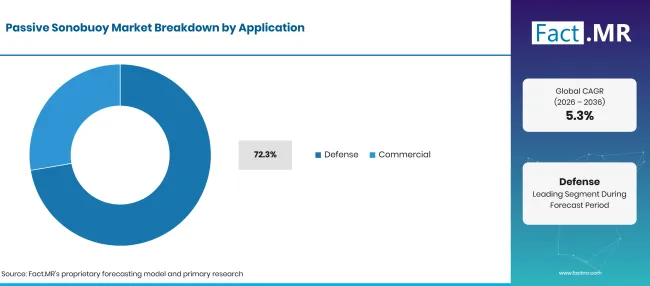
Factmr Passive Sonobuoy Market Breakdown Application | Source: Fact.MR
| Application | Share (2026) |
|---|---|
| Defense (Leading segment) | 72.3% |
| Other segments combined | 27.7%* |
| Total | 100.0% |
Source: Fact.MR analysis. Updated Oct 19, 2026
Military defense applications represent the dominant purchasing segment, driven by annual defense training expenditures, perimeter patrols, and strategic anti-submarine warfare stockpiling. Naval defense forces maintain high-readiness stores across frontline air stations and guided-missile destroyers. Commercial and scientific research applications utilize passive sonobuoys to conduct marine mammal acoustic monitoring, seismic geophysical surveys, and oceanic noise mapping. Fact.MR evaluations of the maritime patrol aircraft market and the airborne sonar systems market illustrate how defense air wings coordinate sonobuoy operations with broader multi-domain sensor suites.
How does Deployment mode shape demand?
Airborne represents 67.9% share in 2026.
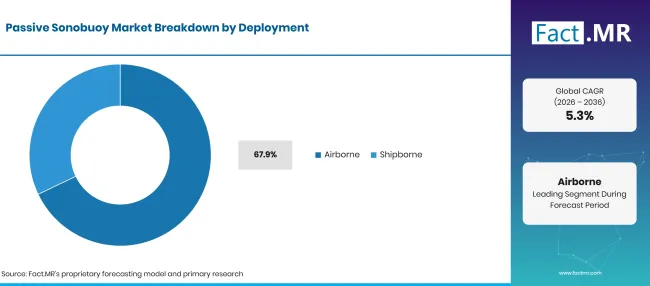
Factmr Passive Sonobuoy Market Breakdown Deployment | Source: Fact.MR
| Deployment | Share (2026) |
|---|---|
| Airborne (Leading segment) | 67.9% |
| Other segments combined | 32.1%* |
| Total | 100.0% |
Source: Fact.MR analysis. Updated Oct 19, 2026
Airborne deployment accounts for more than two-thirds of total sonobuoy consumption as fixed-wing maritime patrol aircraft (such as the Boeing P-8A Poseidon and Kawasaki P-1) and maritime helicopters (such as the MH-60R Seahawk and AW101 Merlin) deploy dozens of buoys per operational sortie. Aircraft can rapid-drop sonobuoy patterns across hundreds of square miles of ocean within minutes. Shipborne launchers installed on frigates and destroyers deploy sonobuoys via pneumatic mortars to investigate submarine contacts detected beyond hull-mounted sonar ranges.
What is accelerating Passive Sonobuoy Market adoption, and what is holding it back?
Rising global undersea naval competition, expanding maritime patrol aircraft fleets, and heightened sub-surface perimeter vigilance drive steady market expansion. High unit procurement costs for multi-sensor directional arrays, limited single-use operational life, and strict radio frequency spectrum allocation rules pose operational hurdles.
Drivers Impact Analysis
| DRIVER | (~) % IMPACT ON CAGR | GEOGRAPHIC RELEVANCE | IMPACT TIMELINE |
|---|---|---|---|
| Maritime patrol aircraft fleet expansions | +1.1% | North America, East Asia, Europe | Short term (<= 2 years) |
| Undersea critical infrastructure protection | +0.9% | Europe, North America | Medium term (2–4 years) |
| Modern quiet diesel-electric submarine tracking | +0.8% | Global | Medium term (2–4 years) |
| Multi-static cooperative sonar processing | +0.7% | NATO, Indo-Pacific | Medium term (2–4 years) |
| Autonomous aerial sonobuoy deployment systems | +0.5% | Europe, USA | Long term (>= 4 years) |
Source: Fact.MR analysis. Updated Oct 19, 2026
Opportunity Impact Analysis
| OPPORTUNITY | (~) % IMPACT ON CAGR | GEOGRAPHIC RELEVANCE | IMPACT TIMELINE |
|---|---|---|---|
| Digitized broadband hydrophone array integration | +0.9% | Global | Short term (<= 2 years) |
| Deep-ocean variable depth acoustic sensors | +0.7% | USA, Europe | Medium term (2–4 years) |
| Extended-life lithium seawater battery cells | +0.6% | Global | Medium term (2–4 years) |
| International co-production defense partnerships | +0.5% | Indo-Pacific, South Asia | Long term (>= 4 years) |
Source: Fact.MR analysis. Updated Oct 19, 2026
Restraints Impact Analysis
| RESTRAINT | (~) % IMPACT ON CAGR | GEOGRAPHIC RELEVANCE | IMPACT TIMELINE |
|---|---|---|---|
| Single-use expendable operational economics | -0.8% | Global | Short term (<= 2 years) |
| Supply chain delays in specialized piezoelectric sensors | -0.6% | North America, Europe | Medium term (2–4 years) |
| Telemetry RF bandwidth congestion in busy littoral waters | -0.5% | Europe, East Asia | Medium term (2–4 years) |
| Harsh maritime recovery environmental regulations | -0.3% | Europe, North America | Long term (>= 4 years) |
Source: Fact.MR analysis. Updated Oct 19, 2026
Which countries are scaling the Passive Sonobuoy Market through 2036?
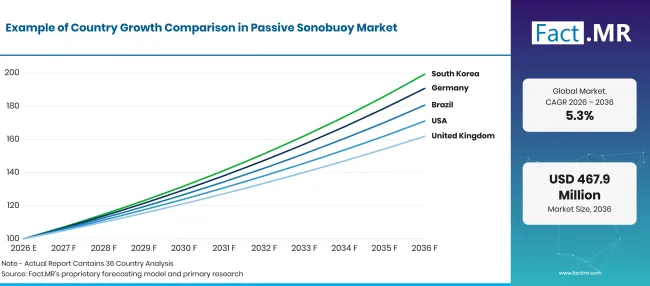
Factmr Passive Sonobuoy Market Growth Index | Source: Fact.MR
| Country | CAGR (2026–2036) |
|---|---|
| Germany | 6.7% |
| Brazil | 6.1% |
| United States | 5.5% |
| United Kingdom | 4.9% |
| Japan | 4.4% |
Source: Fact.MR analysis. Updated Oct 19, 2026
Why is Germany pacing European sonobuoy procurement?
6.7% CAGR, driven by modern maritime patrol aircraft procurement, Baltic Sea surveillance requirements, and North Atlantic Treaty commitments.
The German Navy is modernizing its airborne maritime surveillance fleet with advanced P-8A Poseidon maritime patrol aircraft, requiring substantial initial stocks and recurring replenishment of passive directional sonobuoys. German defense planners prioritize acoustic surveillance across Baltic and North Sea littoral waters to protect critical undersea energy cables and telecommunications infrastructure. Expanding defense budgets support increased exercise allocations for air-dropped acoustic detection arrays.
How is Brazil expanding South Atlantic sonobuoy operations?
6.1% CAGR, propelled by Blue Amazon offshore surveillance, submarine force modernization, and maritime patrol aircraft upgrades.
The Brazilian Navy and Air Force deploy passive sonobuoys to monitor South Atlantic sea lanes and protect vital pre-salt offshore oil and gas platforms. Modernization of maritime patrol aircraft and procurement of modern anti-submarine helicopters generate steady demand for reliable directional sonobuoys. Regional defense exercises emphasize undersea surveillance interoperability across South American maritime borders.
What sustains high-volume sonobuoy procurement in the United States?
5.5% CAGR, supported by extensive global maritime patrol operations, continuous naval flight training, and strategic carrier strike group defense.
The United States Navy operates the world's largest inventory of maritime patrol aircraft and shipborne anti-submarine helicopters, consuming tens of thousands of passive sonobuoys annually in operational training and forward-deployed surveillance. Defense authorization bills prioritize multi-year sonobuoy industrial base stability to prevent production bottlenecks during international crises. High operational tempo across the Western Pacific and North Atlantic ensures consistent multi-million-dollar procurement contracts.
Why is the United Kingdom expanding anti-submarine surveillance?
4.9% CAGR, shaped by North Atlantic submarine defense corridors, carrier strike group protection, and Merlin helicopter acoustic upgrades.
The Royal Navy and Royal Air Force maintain intensive anti-submarine patrols across the Greenland-Iceland-UK gap to protect national deterrent submarines and allied surface fleets. Significant investments in Merlin Mk2 acoustic processing systems and P-8A Poseidon operations sustain recurring demand for high-performance passive sonobuoys. British defense technology centers actively test autonomous platforms to extend acoustic sensor coverage across northern waters.
How is Japan maintaining steady sonobuoy deployment?
4.4% CAGR, influenced by regional maritime perimeter protection, island chain surveillance, and indigenous patrol aircraft operations.
The Japan Maritime Self-Defense Force maintains an extensive fleet of Kawasaki P-1 and P-3C maritime patrol aircraft conducting daily surveillance across vital maritime transit straits. Japanese defense planners mandate large-scale domestic reserves of passive directional sonobuoys to detect and track submarine movements along surrounding oceanic trenches. Rigorous naval training exercises ensure continuous rotation and procurement of modern acoustic sonobuoy stocks.
Who leads the Passive Sonobuoy Market?
Ultra Electronics commands the leading global market position through its Ultra Maritime division, supplying the majority of U.S. Navy and Royal Navy sonobuoy inventories and pioneering advanced directional acoustic sensors. Thales Group and General Dynamics Mission Systems provide integrated airborne acoustic processing suites, digital signal analyzers, and naval combat system interfaces. Lockheed Martin Corporation and RTX Corporation engineer advanced maritime patrol platforms, airborne sonar integration packages, and multi-sensor surveillance processors.
L3Harris Technologies and Northrop Grumman Corporation manufacture ruggedized telemetry communications, underwater acoustic arrays, and automated launcher mechanisms. BAE Systems and Kongsberg Gruppen supply specialized naval electronics, sonar systems, and maritime patrol integration hardware. Rafael Advanced Defense Systems delivers specialized coastal acoustic surveillance and autonomous naval defense systems. Marine acoustic devices market illustrates how acoustic sensor integration dictates defense market leadership.
Which companies are the key providers?
Key companies include Ultra Electronics; Thales Group; General Dynamics Mission Systems; Lockheed Martin Corporation; RTX Corporation; L3Harris Technologies; Northrop Grumman Corporation; BAE Systems; Kongsberg Gruppen; and Rafael Advanced Defense Systems.
- Ultra Electronics
- Thales Group
- General Dynamics Mission Systems
- Lockheed Martin Corporation
- RTX Corporation
- L3Harris Technologies
- Northrop Grumman Corporation
- BAE Systems
- Kongsberg Gruppen
- Rafael Advanced Defense Systems
Bibliography
- [1] Ultra Maritime. (2024, June 25). U.S. Navy Q62 next-gen sonobuoy other transaction agreement valued at $49 million awarded to Ultra Maritime.
- [2] Ultra Maritime. (2024, September 18). Ultra Maritime receives $99 million other transaction agreement from U.S. Navy for Q53H sonobuoys.
- [3] Ultra Maritime. (2025, February 12). Ultra Maritime signs agreement with Bharat Dynamics Limited for co-production of sonobuoys in India.
- [4] UK Defence Innovation & Ministry of Defence. (2024, March 14). UKDI: ASW Spearhead enhances Merlin and sonar capabilities through rapid innovation.
- [5] UK Defence Innovation & Ministry of Defence. (2025, November 5). UKDI: Three naval testbeds transform defence innovation for autonomous anti-submarine warfare.
This Report Answers
- The report evaluates technical capabilities across directional DIFAR hydrophone arrays and non-directional acoustic sensors.
- Application analysis explains why defense naval forces account for over seven-tenths of annual sonobuoy procurement spending.
- Country-level evaluations explore the drivers enabling Germany and Brazil to achieve faster growth rates in anti-submarine surveillance.
- Deployment assessments review operational advantages of airborne dispensing over shipborne pneumatic launch systems.
- Competitive profiling benchmarks sonobuoy production capacity, hydrophone sensitivity ratings, and government contract backlogs among leading defense contractors.
What does the Passive Sonobuoy Market cover?
The market encompasses expendable oceanographic and defense acoustic sensors designed to listen passively for underwater noise emitted by submarines, surface vessels, and marine environments. It tracks directional and omnidirectional sonobuoys deployed from fixed-wing maritime patrol aircraft, naval helicopters, and surface warships. The analysis incorporates related Fact.MR evaluations of naval defense electronics and underwater acoustics.
What is included in the scope?
The scope covers factory-packaged passive sonobuoy units, calibrated hydrophone sensor payloads, descent stabilization parachutes, and integrated radio frequency transmitters sold to naval defense forces and scientific agencies.
Revenues reflect manufacturer delivery values under government procurement contracts and foreign military sales. Development prototypes delivered under valid defense transaction agreements are included in market totals.
What is excluded from the scope?
The scope excludes active echo-ranging sonobuoys that emit acoustic pings to locate targets, bathythermograph buoys measuring only water temperature profiles, and moored seafloor hydrophone networks.
Specialized aircraft interior acoustic processing computers and helicopter dipping sonar reels are excluded from sonobuoy product totals. Military flight operating costs and naval ordnance disposal fees are outside the report boundary.
How Was the Analysis Built?
The analysis draws on 120+ sources, 35+ company portfolios, 25+ countries, and more than 20 industry interviews.
- Primary Research: Primary research includes discussions with manufacturers, service providers, technology developers, distributors, end users, and subject-matter experts. These conversations examine purchasing priorities, product adoption, operational challenges, approval requirements, competitive positioning, and the factors that influence wider market acceptance.
- Desk Research: Desk research covers government statistics, regulatory publications, company filings, trade data, technical studies, industry associations, standards, public policy, and other authoritative sources. Every source used in the analysis is documented in the bibliography.
- Market Sizing and Forecasting: Market estimates combine historical performance, demand indicators, pricing and volume trends, segment shares, company participation, country-level growth, adoption patterns, investment activity, and barriers to market expansion.
- Data Validation and Update Cycle: Findings are validated by comparing primary interviews with public data, company activity, regulatory changes, trade patterns, and industry developments. Regular updates review new product launches, capacity changes, partnerships, approvals, and shifts in commercial adoption.
Segmentation
What is the report’s scope and coverage?
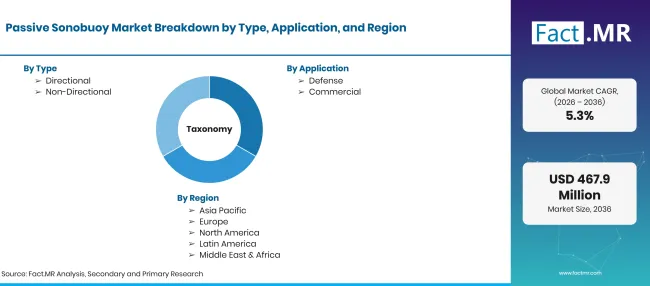
Factmr Passive Sonobuoy Market Taxonomy | Source: Fact.MR
| Attribute | Details |
|---|---|
| Quantitative Units | USD million |
| Market Definition | Expendable acoustic listening devices deployed in oceanic environments to detect, track, and localize underwater acoustic signatures. |
| Type | Directional; Non-Directional |
| Application | Defense; Commercial |
| Deployment | Airborne; Shipborne |
| End-User | Naval Forces; Maritime Patrol Aircraft; Research Institutions; Others |
| Regions Covered | North America; Latin America; Western Europe; Eastern Europe; East Asia; South Asia & Pacific; Middle East & Africa |
| Countries Covered | Germany; Brazil; United States; United Kingdom; Japan |
| Companies Profiled | Ultra Electronics; Thales Group; General Dynamics; Lockheed Martin; RTX; L3Harris; Northrop Grumman; BAE Systems; Kongsberg; Rafael |
| Forecast Period | 2026 to 2036 |
| Approach | Analysis of defense ministry procurement budgets, naval aviation flight hours, public contract award registers, and interviews with naval systems integrators |
Source: Fact.MR analysis. Updated Oct 19, 2026
How is the market segmented?
-
By Type
- Directional
- Non-Directional
-
By Application
- Defense
- Commercial
-
By Deployment
- Airborne
- Shipborne
-
By End-User
- Naval Forces
- Maritime Patrol Aircraft
- Research Institutions
- Others
-
By Region
- North America
- Latin America
- Western Europe
- Eastern Europe
- East Asia
- South Asia & Pacific
- Middle East & Africa
Frequently Asked Questions
How big is the passive sonobuoy market in 2026?
What is the CAGR from 2026 to 2036?
Which type leads?
Which application leads?
Which companies participate in passive sonobuoys?
Who worked on this report


Preview the report firsthand - request a free sample
Free SampleGet the brochure for pricing and purchase details
Download PDF