- Market Value (2025): USD 625.2 Mn
- Estimated Value (2026): USD 690.0 Mn
- Forecast Value (2036): USD 1850.0 Mn
- CAGR (2026-2036): 10.4%
What is the PFAS-free textile repellents market forecast to be worth by 2036?
USD 690.0 million in 2026 to USD 1,850.0 million by 2036, a 10.4% CAGR.
- The market surpassed a value of USD 625.2 million in 2025 as textile finishers moved through the early approval process for PFAS-free repellents and fluorine-free textile finishes.
- Demand is projected to increase USD 690.0 million to USD 1,850.0 million by 2036 as mills gain confidence in water repellency technologies and expand the use of PFAS-free finishes.
- The market is forecast to record a 10.4% CAGR as brands and manufacturers continue to evaluate performance, compliance, and production suitability.
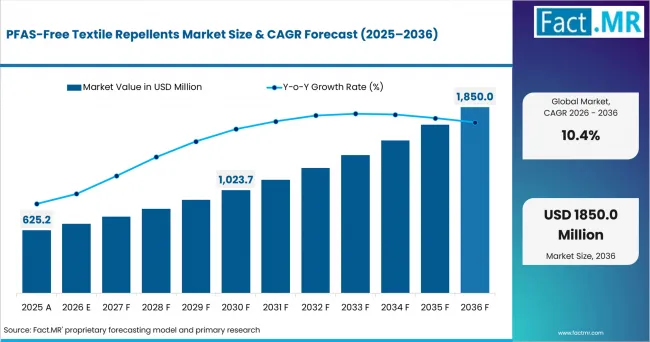
Pfas Free Textile Repellents Market Market Value Analysis | Source: Fact.MR
What are the defining numbers behind PFAS-free textile repellents market growth?
The USD 1,160.0 million absolute opportunity through 2036 is led by outdoor apparel.
- Demand Drivers in the Market
- More companies are using silicone-based finishes because they can work with existing production processes. Their use is increasing as manufacturers look for practical PFAS-free alternatives.
- Many mills prefer these finishes because they can often be introduced without major changes to production lines.
- Demand is growing in applications where companies want a balance between water repellency and ease of processing.
- Key Segments Analyzed
- By Function: Water repellency accounts for 30% share in 2026. It remains the leading function because it is widely used across textile applications.
- By Chemistry: Silicone represents 28% share in 2026. Its use is growing as companies look for PFAS-free textile finishing options.
- By Textile Type: Outdoor apparel holds 41% share in 2026. It remains the leading textile type due to strong demand for water-repellent clothing.
- By Application Method: Pad-dry-cure captures 35% share in 2026. It remains widely used because it fits well with existing textile finishing operations.
- By End User: Textile mills contribute 36% share in 2026. They lead the market because they play a central role in applying and testing textile finishes.
- Analyst Opinion at Fact.MR
- Shambhu Nath Jha, Senior Analyst at Fact.MR, states, “Companies want textile finishes that are easy to test and can deliver reliable results in production. Performance remains the main focus, especially in outdoor apparel applications. Suppliers that provide clear guidance and help customers during product trials are more likely to succeed in the market.”
- Strategic Implications
- Reliable water repellency remains an important requirement when companies evaluate PFAS-free textile finishes.
- New finishes should be tested on existing fabrics to ensure they can deliver consistent performance during normal production conditions.
- Clear test records are important because they help mills and brands compare results and support product approval decisions.
- China is expected to remain an important growth market, supported by increasing use of PFAS-free textile finishes.
- Brands and textile mills should agree on performance expectations early in the evaluation process to avoid issues after the product reaches the market.
Germany is anticipated to expand at an 11.9% CAGR from 2026 to 2036. Brazil is forecast to register a 10.9% CAGR during the forecast period. The United States is expected to post a 9.8% CAGR by 2036.
How does the PFAS-free textile repellents market break down by segment?
Water repellency leads with 30% share by function segment, Silicone accounts for 28% by chemistry.
Why does Water repellency lead the Function segment?
Water repellency holds 30% share in 2026.
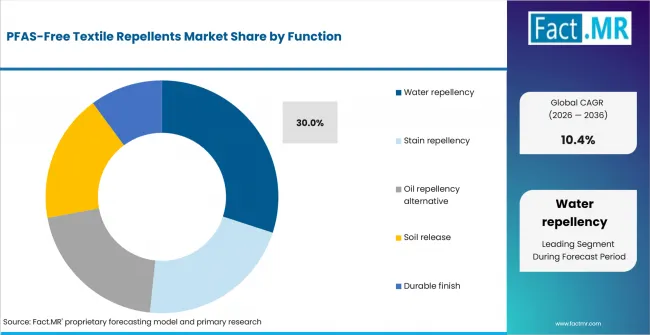
Pfas Free Textile Repellents Market Analysis By Function | Source: Fact.MR
Water repellency leads because it is one of the most common requirements in textile finishing. Companies use these finishes to help fabrics resist water during daily use. Performance after washing remains an important consideration when products are evaluated. Stain repellency, oil repellency alternatives, soil release, and durable finishes are also used in applications with different performance needs.
How does Silicone Shape Chemistry selection?
Silicone accounts for 28% share in 2026.
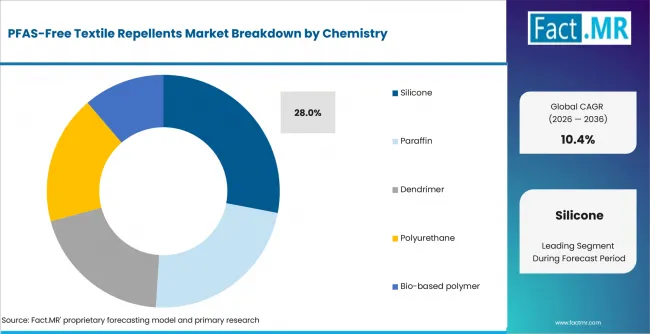
Pfas Free Textile Repellents Market Analysis By Chemistry | Source: Fact.MR
Many textile manufacturers already have experience working with silicone-based finishes, which supports their strong market position. Chemistry is used across a wide range of fabrics and end-use applications.
What keeps Outdoor apparel ahead in Textile Type?
Outdoor apparel leads with 41% share in 2026.
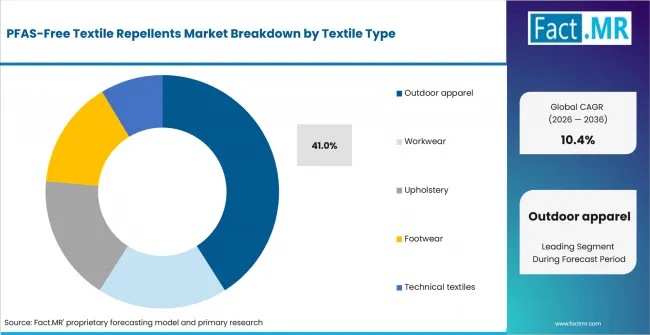
Pfas Free Textile Repellents Market Analysis By Textile Type | Source: Fact.MR
Outdoor apparel holds the largest share of the market at 41% in 2026. Manufacturers want fabrics that stay water-resistant and continue to perform well after regular washing. They also prefer solutions that can be added to existing production processes without significant changes. Workwear, footwear, upholstery, and technical textiles are also important markets, although each application has different performance needs.
Why is Pad-dry-cure central to Application Method demand?
Pad-dry-cure holds 35% share in 2026.
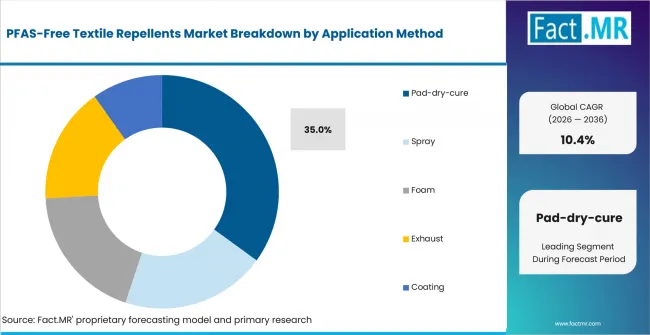
Pfas Free Textile Repellents Market Analysis By Application Method | Source: Fact.MR
It is widely used because it fits good with existing textile finishing operations. Manufacturers prefer this method because it can be integrated into current production processes with minimal disruption. Spray, foam, exhaust, and coating methods are also used where different fabric types or performance requirements are involved.
Why do Textile mills control the End User qualification gate?
Textile mills account for 36% share in 2026.
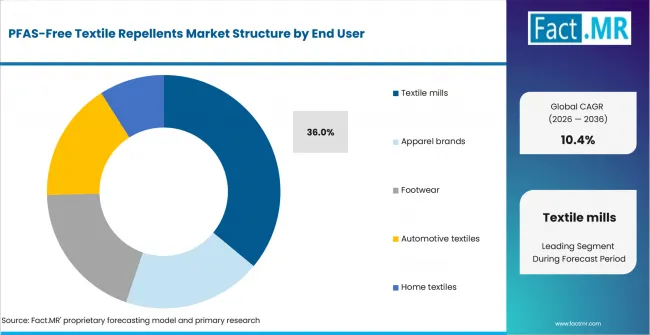
Pfas Free Textile Repellents Market Analysis By End User | Source: Fact.MR
They play an important role because they are responsible for applying and testing PFAS-free textile finishes. Mills need to make sure the finish provides the required level of water repellency and works well during production. Apparel brands, footwear companies, automotive textile manufacturers, and home textile producers all have their own performance expectations. Because mills are directly involved in product trials and production, they often take the lead in deciding whether a new finish is suitable for regular use.
What is accelerating PFAS-free textile repellents market adoption and what is holding it back?
PFAS restrictions and demand for PFAS-free textile finishes support market growth. Product testing costs and production-related challenges may slow adoption.
Drivers Impact Analysis
| DRIVER | (~) % IMPACT ON CAGR | GEOGRAPHIC RELEVANCE | IMPACT TIMELINE |
|---|---|---|---|
| PFAS persistence control in Water repellency | +0.8% | China and export suppliers | Medium term (2-4 years) |
| Water discharge testing | +0.6% | Europe and North America | Short term (<= 2 years) |
| Outdoor apparel approval programs | +0.5% | Asia Pacific | Medium term (2-4 years) |
| Local support near textile finishers | +0.4% | Global | Long term (>= 4 years) |
Source: Fact.MR analysis. Updated Jul 15, 2026
- PFAS persistence control in water repellency: PFAS restrictions are encouraging companies to look for alternative textile finishes. This is increasing interest in PFAS-free products that can provide water repellency.
- Water discharge testing: Many textile manufacturers test products to meet wastewater and environmental requirements. PFAS-free finishes can benefit when they help companies meet these expectations while maintaining fabric performance.
- Outdoor apparel approval programs: Outdoor apparel brands continue to evaluate PFAS-free finishes for jackets and other water-resistant clothing. Products that meet performance expectations can see broader use across outdoor apparel applications.
- Local support near textile finishers: Local technical support helps manufacturers during product testing and production. It can help solve application issues more quickly and reduce delays during product evaluation.
Opportunity Impact Analysis
| OPPORTUNITY | (~) % IMPACT ON CAGR | GEOGRAPHIC RELEVANCE | IMPACT TIMELINE |
|---|---|---|---|
| Grades tuned for Outdoor apparel | +0.5% | Global | Medium term (2-4 years) |
| Application labs for Silicone | +0.4% | Asia Pacific and Europe | Short term (<= 2 years) |
| Rule-ready documentation | +0.4% | Europe and United Kingdom | Medium term (2-4 years) |
| Local trials with surface treatment buyers | +0.3% | India and Brazil | Long term (>= 4 years) |
Source: Fact.MR analysis. Updated Jul 15, 2026
- Grades tuned for outdoor apparel: This opportunity grows when a finish is developed for specific outdoor clothing applications rather than promoted as a general-purpose product. Companies want fabrics that maintain water resistance, comfort, and performance after repeated washing.
- Application labs for silicone: Many textile manufacturers prefer to see real test results before introducing a new finish. Testing facilities can provide practical information on how a product performs on different fabrics and under different production conditions.
- Rule-ready documentation: Product reviews often require technical information, test results, and compliance records. Keeping this information clear and organized can make the review process easier.
- Local trials with surface treatment users: Local trials help compare laboratory results with actual production conditions. They can highlight issues early and help companies understand how a product performs during regular manufacturing.
Restraints Impact Analysis
| RESTRAINT | (~) % IMPACT ON CAGR | GEOGRAPHIC RELEVANCE | IMPACT TIMELINE |
|---|---|---|---|
| Qualification cost | -0.4% | Global processors | Medium term (2-4 years) |
| Fit limits in Silicone | -0.3% | Global | Short term (<= 2 years) |
| Documentation burden | -0.3% | Europe and North America | Medium term (2-4 years) |
| Scale-up risk | -0.2% | High-volume plants | Long term (>= 4 years) |
Source: Fact.MR analysis. Updated Jul 15, 2026
- Qualification cost: New products need testing before they can be used. This takes time and money, which can slow product changes.
- Fit limits in silicone: Silicone finishes may not work well for every fabric. Some products need additional adjustments before they can be used.
- Documentation burden: Companies need product information and test records before making decisions. Missing information can cause delays.
Which countries are scaling the PFAS-free textile repellents market fastest?
Germany 11.9%, Brazil 10.9%, and the United States 9.8%.
.webp "Top Country Growth Comparison Pfas Free Textile Repellents Market Cagr (2026 2036)")
Top Country Growth Comparison Pfas Free Textile Repellents Market Cagr (2026 2036) | Source: Fact.MR
| COUNTRY | CAGR |
|---|---|
| Germany | 11.9% |
| Brazil | 10.9% |
| United States | 9.8% |
Source: Fact.MR analysis. Updated Jul 15, 2026
What makes Germany an important qualification market?
11.9% CAGR, backed by local textile production and product testing.
Germany records an 11.9% CAGR from 2026 to 2036 as textile companies increase the use of PFAS-free finishes. Local mills are testing these products before placing large orders. Companies that provide clear results on fabric feel, water resistance, wear, and production use are expected to receive more repeat orders.
Where does Brazil gain traction in the trial cycle?
10.9% CAGR, driven by local textile production and product testing.
Brazil records a 10.9% CAGR through 2036. Textile companies are testing fluorine-free finishes before regular use. The tests check water resistance and fabric feel. They also check durability and ease of use. Local testing helps companies fix problems before large orders are placed.
How does demand in the United States connect brands and suppliers?
9.8% CAGR, supported by local textile production and product testing.
The United States records a 9.8% CAGR by 2036. Textile companies are using more fluorine-free finishes. These products are tested before regular production. The tests check water resistance and fabric feel. They also check strength after repeated use. Growth may stay gradual because some products need several trials before approval.
Who leads the PFAS-free textile repellents market?
Archroma and Rudolf Group are key participants in the market. HeiQ, Tanatex, and Chemours also have a presence across fluorine-free textile finish applications.
Archroma and Rudolf Group offer textile finishes that support water resistance and fabric performance. HeiQ also serves textile applications with a range of fluorine-free products.
Tanatex and Chemours are also part of the market. Competition is supported by product quality, steady results, and clear product records. Companies that help mills move from product testing to regular production are likely to be better positioned.
Which companies are the key providers?
Archroma and RUDOLF Group are key providers. HeiQ and TANATEX Chemicals are also profiled. CHT Germany GmbH completes the company set.
- Archroma
- Rudolf Group
- HeiQ
- Tanatex Chemicals
- CHT Germany GmbH
How is the market segmented?
-
By Function
- Water repellency
- Stain repellency
- Oil repellency alternative
- Soil release
- Durable finish
-
By Chemistry
- Silicone
- Paraffin
- Dendrimer
- Polyurethane
- Bio-based polymer
-
By Textile Type
- Outdoor apparel
- Workwear
- Upholstery
- Footwear
- Technical textiles
-
By Application Method
- Pad-dry-cure
- Spray
- Foam
- Exhaust
- Coating
-
By End User
- Textile mills
- Apparel brands
- Footwear
- Automotive textiles
- Home textiles
-
By Region
- North America
- United States
- Canada
- Europe
- Germany
- United Kingdom
- France
- Italy
- Spain
- Asia Pacific
- Japan
- South Korea
- Australia
- Latin America
- Brazil
- Argentina
- Mexico
- Chile
- Middle East & Africa
- UAE
- Saudi Arabia
- South Africa
- North America
Bibliography
- Department of Chemicals and Petrochemicals. (2025, December 22). Chemical and petrochemical statistics at a glance 2025. Ministry of Chemicals and Fertilizers, Government of India.
- Department of Chemicals and Petrochemicals. (2026, February 6). Annual report 2025–26. Ministry of Chemicals and Fertilizers, Government of India.
- European Commission. (2025, June 18). Study highlights positive environmental impacts of increasing textile-to-textile recycling rates in the EU.
- European Commission. (2025, October 16). Revised Waste Framework Directive enters into force to boost circularity of textile sector and slash food waste.
- European Environment Agency. (2025, March 26). Circularity of the EU textiles value chain in numbers.
- U.S. Department of Energy. (2025, January 9). Charting the path: An Energy Earthshots Initiative report.
- U.S. Environmental Protection Agency. (2025, September 2). Research on per- and polyfluoroalkyl substances (PFAS).
- U.S. Environmental Protection Agency. (2025, September 30). PFAS explained.
- ZDHC Foundation. (2025, October 28). Wastewater and sludge guidelines (Version 2).
This Report Addresses
- The report provides market information across Function and Chemistry choices.
- Regional outlook covers China and India with Germany, Brazil, and the United States as additional growth countries.
- Competitive analysis profiles Archroma and Rudolf Group followed by HeiQ, TANATEX Chemicals, and CHT Germany GmbH.
- Use-case assessment covers outdoor apparel and other applications in PFAS-free textile repellents and fluorine-free finishes.
- The market outlook considers textile production, product testing, country growth patterns, fabric performance, and approval needs across key applications.
What does the PFAS-free textile repellents market cover?
The market covers water repellency, silicone chemistry, and outdoor apparel used in commercial applications.
It includes PFAS-free finishes used to protect textiles from water, oil, and stains. Market demand depends on fabric performance, ease of use, and approval requirements. The scope excludes general textile chemicals that are not used for PFAS-free water, oil, or stain repellency.
What is included in the scope?
The scope includes PFAS-free finishes that protect textiles from water, oil, and stains.
Coverage includes Water Repellency, Silicone, and Outdoor Apparel where companies use these products for the same purpose.The market includes finishes used on clothing, footwear, workwear, home textiles, and other fabric products. Only products that pass testing and move into regular production are included in the scope.
What is excluded from the scope?
Products that do not provide water, oil, or stain resistance on textiles are excluded from the market.
Machinery, production equipment, and other hardware are also not included. Basic raw materials remain outside the scope unless they are sold for a listed PFAS-free textile repellent use. A product is included only when it is made, tested, and approved for the specific textile application covered in this study and used in regular commercial production.
How was the analysis built?
120+ sources, 35+ company portfolios, 25+ countries, and 20+ industry interviews.
- Primary Research: Primary research reflects discussions with companies, product makers, distributors, textile mills, and testing staff working with PFAS-free textile repellents and fluorine-free finishes.
- Desk Research: Desk research reviews government information, technical reports, industry data, wastewater rules, chemical safety guidance, PFAS restrictions, and textile production trends.
- Market-Sizing and Forecasting: Forecasting combines starting value, end value, growth rate, segment share, company presence, country trends, product demand, pricing, and limits to wider use.
- Data Validation and Update Cycle: Forecast checks compare market activity with government rules, country trends, textile production, product testing, approval needs, and known limits. The update cycle reviews whether products are moving from trial use to regular production.
Segmentation
What is the report's scope and coverage?
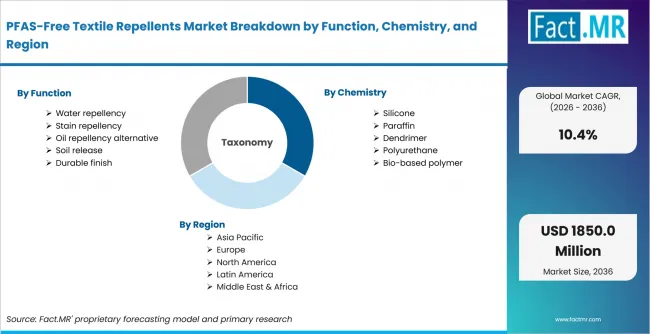
Pfas Free Textile Repellents Market Breakdown By Function, Chemistry, And Region | Source: Fact.MR
| Attribute | Details |
|---|---|
| Quantitative Units | USD Million in 2026 to USD Million by 2036 at CAGR |
| Market Definition | Durable water, oil, and stain repellents for textiles formulated without PFAS/fluorinated chemistries. |
| Function | Water repellency, Stain repellency, Oil repellency alternative, Soil release, Durable finish |
| Chemistry | Silicone, Paraffin, Dendrimer, Polyurethane, Bio-based polymer |
| Textile Type | Outdoor apparel, Workwear, Upholstery, Footwear, Technical textiles |
| Application Method | Pad-dry-cure, Spray, Foam, Exhaust, Coating |
| End User | Textile mills, Apparel brands, Footwear, Automotive textiles, Home textiles |
| Regions Covered | North America, Europe, Asia Pacific, Central and South America, Middle East and Africa |
| Countries Covered | Germany, Brazil, United States |
| Key Companies Profiled | Archroma, Rudolf Group, HeiQ, Tanatex, CHT Germany GmbH |
| Forecast Period | 2026 to 2036 |
| Approach | Hybrid top-down and bottom-up approach using Textile Repellents / Fluorine-Free Finishes, segment shares, country growth, supplier mapping, and technical validation |
Source: Fact.MR analysis. Updated Jul 15, 2026
Frequently Asked Questions
Which Function leads the PFAS-free textile repellents market?
Which Chemistry leads the PFAS-free textile repellents market?
Which End User leads the PFAS-free textile repellents market?
What is the main restraint in the PFAS-free textile repellents market?
Why is Water Repellency important?
Why do companies continue testing PFAS-free textile repellents?
Who worked on this report


Preview the report firsthand - request a free sample
Free SampleGet the brochure for pricing and purchase details
Download PDF