- Base Value(2024): Bn
- Estimated Value(2025): 0.4 Bn
- Forecast Value (2035): 0.7 Bn
- CAGR (2025 - 2035): 6.50%
Textile Enzymes Market Market Size, Market Forecast and Outlook By Fact.MR
The textile enzymes market was valued at USD Billion 1.80 in 2025, projected to reach USD Billion 1.92 in 2026, and is forecast to expand to USD Billion 3.60 by 2036 at a 6.50% CAGR. Expanding end-use application requirements, tightening performance specifications, and growing adoption across industrial and commercial sectors are driving sustained procurement growth globally.
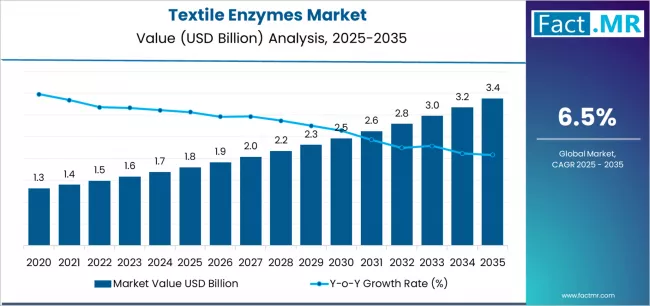
Textile Enzymes Market Market Value Analysis | Source: Fact.MR
Summary of Textile Enzymes Market Market
-
Market Overview
-
The market is valued at USD Billion 1.80 in 2025 and is projected to reach USD Billion 3.60 by 2036.
-
The industry is expected to grow at a 6.50% CAGR from 2026 to 2036, creating an incremental opportunity of USD Billion 1.68.
-
The market is a performance-driven category where product quality specifications, application-specific qualification, and supply chain reliability define competitive positioning across primary end-use sectors.
-
-
Demand and Growth Drivers
-
Demand is sustained by expanding cotton processing application requirements that specify cellulase enzymes product configurations for performance-critical operations.
-
Tightening regulatory and quality standards across major consuming industries are driving specification upgrades toward higher-performance product grades.
-
Growing adoption in emerging application segments is creating incremental demand channels beyond traditional end-use categories.
-
Supply chain reliability and product consistency requirements are consolidating procurement toward qualified suppliers with demonstrated manufacturing capabilities.
-
-
Product and Segment View
-
The textile enzymes market encompasses specialized products serving multiple industrial and commercial end-use applications with differentiated specifications.
-
The market is segmented by Enzyme Type (Cellulase Enzymes, Amylase Enzymes, Pectinase Enzymes, Protease Enzymes, Other Enzyme Configurations) and Application Sector (Cotton Processing, Denim Finishing, Wool Treatment, Synthetic Fiber Processing, Others).
-
Cellulase Enzymes leads by Enzyme Type with 38.4% share in 2026.
-
Cotton Processing leads by Application Sector with 45.2% share in 2026.
-
Scope includes all product variants and grades within the defined market, while excluding raw material feedstock valuations, downstream finished product pricing, and processing equipment.
-
-
Geography and Competitive Outlook
-
The global market spans all major manufacturing and consuming regions, with regional dynamics shaped by local regulatory frameworks and end-use industry concentration.
-
Competition is shaped by production capability, application expertise, and regulatory compliance, with key players including Novozymes A/S, DuPont de Nemours Inc, BASF SE, DSM-Firmenich AG, Advanced Enzyme Technologies Limited, Kemin Industries Inc.
-
Supply chain positioning and customer qualification credentials determine procurement allocation across tier-1 and tier-2 supplier categories.
-
-
Analyst Opinion at Fact.MR
-
Shambhu Nath Jha, Principal Consultant at Fact.MR, opines: 'In my analysis, I have observed that procurement decisions in the textile enzymes market increasingly depend on application-specific performance documentation and supply chain reliability credentials rather than per-unit pricing alone. Suppliers investing in technical service capabilities and quality consistency documentation hold procurement advantages over commodity-positioned competitors.'
-
-
Strategic Implications / Executive Takeaways
-
Manufacturers must invest in application-specific performance testing and qualification data to secure procurement positions with tier-1 end-use customers.
-
Procurement teams should evaluate total cost of ownership including product performance benefits and supply reliability rather than unit material pricing alone.
-
Companies must monitor regulatory developments across key consuming markets to anticipate specification changes and reformulation requirements.
-
Textile Enzymes Market Market Key Takeaways
| Metric | Details |
|---|---|
| Industry Size (2026) | USD Billion 1.92 |
| Industry Value (2036) | USD Billion 3.60 |
| CAGR (2026 to 2036) | 6.50% |
Source: Fact.MR analysis. Updated Apr 2, 2026
Source: Fact.MR, 2026
The absolute dollar expansion of USD Billion 1.68 between 2026 and 2036 reflects structural demand growth across multiple independent consumption channels. As per Fact.MR, Cellulase Enzymes maintains category leadership at 38.4% share, supported by established performance characteristics and cost-effectiveness advantages across primary application segments.
Fact.MR analysis indicates that Cotton Processing applications command 45.2% of end-use demand, driven by specification requirements that favour established product formulations. The competitive landscape features both global multinational suppliers and specialized regional manufacturers competing on technical performance, application expertise, and supply chain reliability.
Why is the Textile Enzymes Market Growing?
Market expansion is being supported by the increasing global emphasis on textile modernization standards and the corresponding shift toward bio-catalytic processing systems that can provide superior functionality capabilities while meeting user requirements for enhanced environmental compatibility and cost-effective operation solutions. Modern textile operators are increasingly focused on incorporating enzyme systems that can enhance processing efficiency while satisfying demands for consistent, precisely controlled bio-catalytic conditions and optimized operational protocols. Textile enzymes' proven ability to deliver operational excellence, processing benefits, and diverse application possibilities makes them essential components for manufacturing-focused establishments and processing-focused textile professionals.
The growing focus on environmental compliance and operational efficiency is driving demand for high-performance enzyme systems that can support distinctive processing outcomes and comprehensive bio-catalytic management across textile environments, cotton processing installations, and premium synthetic fiber systems. User preference for enzymes that combine functional excellence with environmental intelligence is creating opportunities for innovative implementations in both traditional and emerging textile applications. The rising influence of bio-processing technologies and advanced enzyme design is also contributing to increased adoption of intelligent bio-catalytic solutions that can provide authentic operational benefits and reliable performance characteristics.
At the regulatory level, environmental codes provide compliance frameworks for enzyme applications, with specific requirements for bio-processing systems already established. Local environmental authorities note high rates of enzyme adoption and bio-catalytic upgrade integration, which is evidence of a mature, efficiency-driven implementation process. Regional regulations like water conservation mandates and chemical reduction requirements make operational efficiency and environmental design obligations explicit for textile operators and enzyme manufacturers.
Segmental Analysis
The market is segmented by enzyme type, application sector, fabric type, processing stage, and region. By enzyme type, the market is divided into cellulase enzymes, amylase enzymes, pectinase enzymes, protease enzymes, and other enzyme configurations. Based on application sector, the market is categorized into cotton processing, denim finishing, wool treatment, synthetic fiber processing, and other sector categories. By fabric type, the market includes cotton fabrics, synthetic fabrics, blended fabrics, wool fabrics, and other fabric platforms. By processing stage, the market encompasses pre-treatment, dyeing, finishing, washing, and other processing services. Regionally, the market is divided into Asia Pacific, North America, Europe, Latin America, Middle East & Africa, and other regions.
By Enzyme Type, Which Segment Holds the Dominant Market Share?
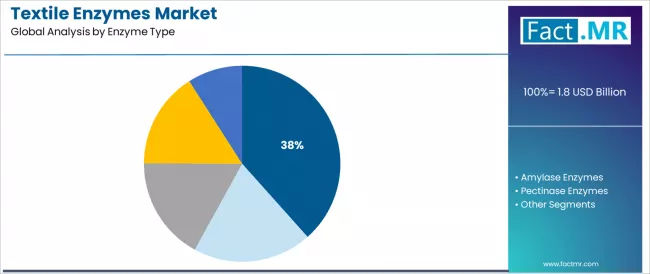
Textile Enzymes Market Analysis By Enzyme Type | Source: Fact.MR
The cellulase enzymes segment is projected to account for 38.4% of the textile enzymes market in 2025, reaffirming its position as the leading enzyme technology. Textile professionals and facility managers increasingly utilize cellulase enzyme systems for their superior bio-catalytic characteristics, established functionality standards, and essential performance in diverse textile applications across multiple processing sectors.
Cellulase enzymes' proven performance characteristics and established reliability directly address user requirements for comprehensive fabric modification and optimal processing precision in cotton and denim applications. This technology segment forms the foundation of modern textile processing patterns, as it represents the enzyme type with the greatest application versatility and established compatibility across multiple textile systems.
- Institutional investments in advanced textile technology and operational optimization continue to strengthen adoption among processing-focused users.
- With textile operators prioritizing fabric quality reliability and processing efficiency consistency, cellulase enzyme systems align with both operational objectives and environmental requirements, making them the central component of comprehensive textile processing strategies.
By Application Sector, Which Segment Registers the Highest Share?
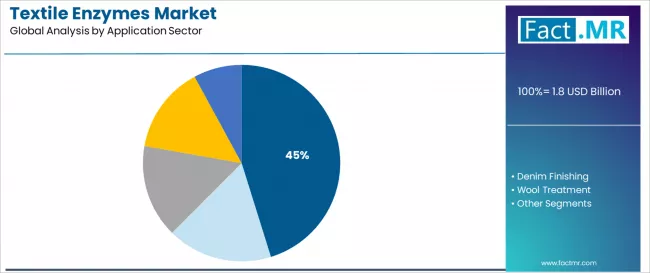
Textile Enzymes Market Analysis By Application Sector | Source: Fact.MR
Cotton processing applications are projected to represent 45.2% of the textile enzymes market in 2025, underscoring their critical role as the primary application sector for performance-focused users seeking superior operational benefits and enhanced processing credentials. Cotton facility users and textile operators prefer cotton processing applications for their established processing requirements, proven operational demand, and ability to maintain exceptional performance while supporting versatile enzyme coverage during diverse cotton activities.
Positioned as essential applications for processing-focused facility managers, cotton processing offerings provide both operational excellence and efficiency optimization advantages. The segment is supported by continuous improvement in enzyme technology and the widespread availability of established performance standards that enable processing assurance and premium positioning at the facility level.
- Cotton facility users are optimizing enzyme selections to support sector-specific applications and comprehensive processing strategies.
- As enzyme technology continues to advance and facilities seek efficient operational methods, cotton processing applications will continue to drive market growth while supporting processing performance and operational optimization strategies.
What are the Drivers, Restraints, and Key Trends of the Textile Enzymes Market?
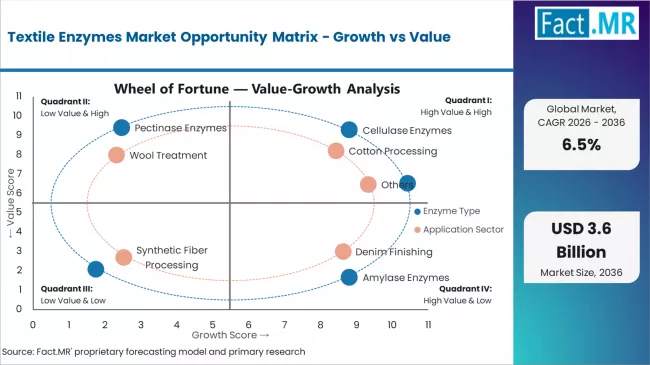
Textile Enzymes Market Opportunity Matrix Growth Vs Value | Source: Fact.MR
The textile enzymes market is advancing rapidly due to increasing textile modernization adoption and growing need for bio-catalytic processing solutions that emphasize superior performance across manufacturing segments and processing applications. The market faces challenges, including competition from chemical processing alternatives, enzyme cost considerations, and technical compatibility factors affecting adoption rates. Innovation in enzyme technology enhancement and advanced bio-catalytic systems continues to influence market development and expansion patterns.
Expansion of Environmental Compliance and Efficiency-Based Applications
The growing adoption of textile enzymes with environmental processing and efficiency optimization is enabling users to develop operational strategies that provide distinctive processing benefits while commanding intelligent resource management and enhanced environmental characteristics. Environmental compliance applications provide superior resource efficiency consistency while allowing more advanced operational optimization features across various textile categories. Users are increasingly recognizing the operational advantages of efficiency positioning for comprehensive facility management outcomes and technology-integrated processing processes.
Integration of Advanced Bio-Catalytic Technology and Processing-Optimization Systems
Modern textile enzyme manufacturers are incorporating advanced bio-catalytic processing, real-time efficiency optimization capabilities, and intelligent enzyme systems to enhance processing effectiveness, improve operational performance, and meet facility demands for connected processing solutions. These systems improve processing effectiveness while enabling new applications, including automated bio-catalytic programs and predictive efficiency protocols. Advanced technology integration also allows users to support operational optimization positioning and processing management beyond traditional enzyme performance requirements.
Analysis of the Textile Enzymes Market by Key Country
.webp "Top Country Growth Comparison Textile Enzymes Market Cagr (2026 2036)")
Top Country Growth Comparison Textile Enzymes Market Cagr (2026 2036) | Source: Fact.MR
| Country | CAGR (2025 to 2035) |
|---|---|
| China | 7.8% |
| India | 7.2% |
| Germany | 5.6% |
| Brazil | 6.7% |
| USA | 6.1% |
| UK | 5.3% |
| South Korea | 6.9% |
Source: Fact.MR analysis. Updated Apr 2, 2026
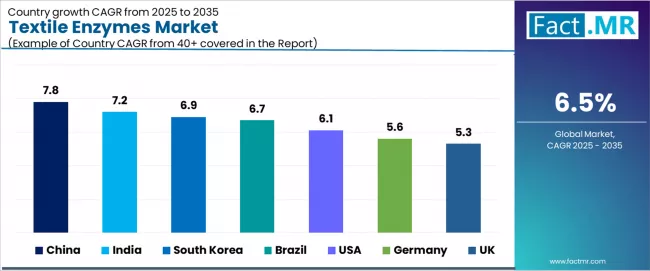
Textile Enzymes Market Cagr Analysis By Country | Source: Fact.MR
The textile enzymes market is experiencing robust growth globally, with China leading at a 7.8% CAGR through 2035, driven by the expanding textile manufacturing initiatives, growing textile modernization requirements, and increasing adoption of bio-catalytic processing systems. India follows at 7.2%, supported by rising textile industry investment, expanding cotton processing development programs, and growing acceptance of modern enzyme technologies. South Korea shows growth at 6.9%, emphasizing established textile industry standards and comprehensive processing development. Brazil records 6.7%, focusing on textile modernization and operational optimization. The USA demonstrates 6.1% growth, prioritizing advanced enzyme technologies and bio-catalytic optimization. Germany shows growth at 5.6%, emphasizing established textile industry standards and comprehensive enzyme development. The UK demonstrates 5.3% growth, prioritizing advanced bio-catalytic technologies and operational optimization.
The report covers an in-depth analysis of 40+ countries; seven top-performing countries are highlighted below.
Why Does China Lead Global Market Growth?
Revenue from textile enzymes consumption and sales in China is projected to exhibit exceptional growth with a CAGR of 7.8% through 2035, driven by the country's rapidly expanding textile manufacturing sector, favorable government policies toward processing modernization, and initiatives promoting bio-catalytic technologies across major textile regions. China's position as a global textile manufacturing hub and increasing focus on textile standardization are creating substantial demand for high-quality enzymes in both domestic and export markets. Major enzyme manufacturers and technology distributors are establishing comprehensive processing capabilities to serve growing demand and emerging textile opportunities.
- Established textile culture and expanding processing consciousness are driving demand for textile enzymes across manufacturing facilities, industrial developments, and comprehensive textile systems throughout Chinese textile markets.
- Strong infrastructure development and modernization initiatives are supporting the rapid adoption of premium enzyme systems among processing-focused institutions seeking to meet evolving operational standards and environmental requirements.
Why Does India Demonstrate Strong Market Potential?
Revenue from textile enzymes products in India is expanding at a CAGR of 7.2%, supported by rising textile industry investment, growing processing consciousness, and expanding technology distributor capabilities. The country's developing textile infrastructure and increasing investment in bio-catalytic technologies are driving demand for textile enzymes across both traditional and modern textile applications. International enzyme companies and domestic distributors are establishing comprehensive operational networks to address growing market demand for high-performance enzyme devices and efficient processing solutions.
- Rising industrial development and expanding textile capabilities are creating opportunities for enzyme adoption across textile projects, modern manufacturing developments, and distributor companies throughout major Indian textile regions.
- Growing textile industry awareness initiatives and processing technology advancement are driving the adoption of specialized enzyme products and services among facility users seeking to enhance their operational performance and meet increasing environmental reliability demand.
Why Does South Korea Demonstrate Considerable Expansion?
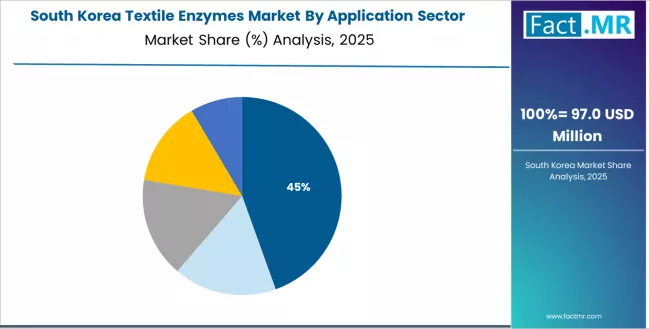
Textile Enzymes Market South Korea Market Share Analysis By Application Sector | Source: Fact.MR
Revenue from textile enzymes products in South Korea is projected to grow at a CAGR of 6.9% through 2035, supported by the country's expanding textile industry standards, established government regulations, and leadership in processing technology implementation. South Korea's advanced textile development standards and strong support for innovative enzyme systems are creating steady demand for both traditional and advanced bio-catalytic enzyme varieties. Leading enzyme manufacturers and specialty distributors are establishing comprehensive operational strategies to serve both domestic markets and growing regional opportunities.
- Advanced technology capabilities and established textile-focused markets are driving demand for premium enzyme systems across textile facilities, manufacturing operations, and comprehensive processing companies seeking superior performance profiles and operational innovation.
- Strong textile industry culture and regulatory development are supporting the adoption of innovative enzyme technology among users prioritizing operational reliability and bio-catalytic precision in textile applications.
Why Does Brazil Show Significant Growth?
Revenue from textile enzymes products in Brazil is projected to grow at a CAGR of 6.7% through 2035, driven by the country's emphasis on textile industry modernization, processing infrastructure development growth, and growing enzyme distributor capabilities. Brazilian facility users and textile establishments consistently seek efficiency-focused enzyme systems that enhance operational performance and support modernization excellence for both traditional and modern textile applications. The country's position as a Latin American textile leader continues to drive innovation in specialized enzyme applications and operational performance standards.
- Expanding textile culture and growing processing markets are driving demand for industrial enzyme systems across facility consumers, textile providers, and efficiency-focused distributors seeking superior operational control and distinctive performance profiles.
- Increasing focus on operational efficiency and facility modernization systems is supporting the adoption of specialty enzyme varieties among users and distributors seeking authentic Brazilian textile-focused products in regional markets with established processing expertise.
What Factors Underpin USA Textile Enzymes Market Growth?
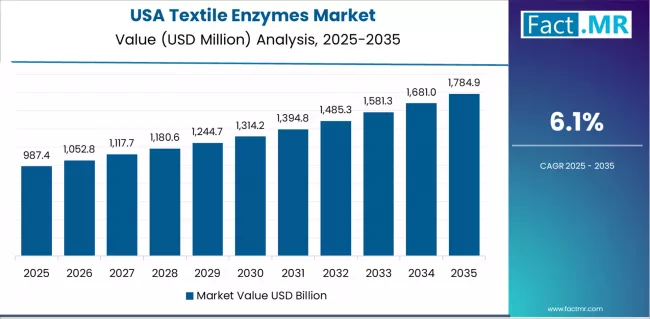
Textile Enzymes Market Country Value Analysis | Source: Fact.MR
Revenue from textile enzymes products in the USA is projected to grow at a CAGR of 6.1% through 2035, supported by the country's emphasis on textile technology advancement, operational optimization, and advanced processing system integration requiring efficient enzyme solutions. American facility users and textile-focused establishments prioritize performance reliability and operational precision, making specialized enzyme systems essential components for both traditional and modern textile applications. The country's comprehensive textile technology leadership and advancing operational patterns support continued market expansion.
- Advanced textile technology capabilities and growing precision operational management are driving demand for enzyme systems across specialty applications, modern textile formats, and technology-integrated processing programs serving domestic markets with increasing performance requirements.
- Strong focus on operational optimization and performance excellence is encouraging users and distributors to adopt enzyme solutions that support operational objectives and meet American quality standards for textile applications.
Why Does Germany Show Steady Growth?
Revenue from textile enzymes products in Germany is projected to grow at a CAGR of 5.6% through 2035, supported by established textile standards, expanding facility markets, and emphasis on operational efficiency across textile and manufacturing sectors. German facility users and textile professionals prioritize quality performance and operational consistency, creating steady demand for premium enzyme solutions. The country's comprehensive market development and established textile performance practices support continued advancement in specialized applications.
- Established facility markets and expanding textile industry are driving demand for quality enzyme systems across textile operations, manufacturing facilities, and professional textile companies throughout German processing regions.
- Strong emphasis on quality standards and operational efficiency is supporting the adoption of premium enzyme varieties among users seeking proven performance and established textile credentials in facility applications.
Why Does UK Show Strong Growth?
Revenue from textile enzymes products in the UK is projected to grow at a CAGR of 5.3% through 2035, supported by the country's emphasis on operational precision, textile excellence, and advanced technology integration requiring efficient enzyme solutions. British facility users and textile-focused establishments prioritize technical performance and operational precision, making specialized enzyme systems essential components for both traditional and modern textile applications. The country's comprehensive textile leadership and advancing precision patterns support continued market expansion.
- Advanced precision textile technology capabilities and growing technical operational applications are driving demand for enzyme systems across specialty textile applications, modern precision formats, and technology-integrated processing programs serving domestic markets with increasing quality requirements.
- Strong focus on technical precision and textile excellence is encouraging users and distributors to adopt enzyme solutions that support operational objectives and meet British precision standards for textile applications.
Europe Market Split by Country
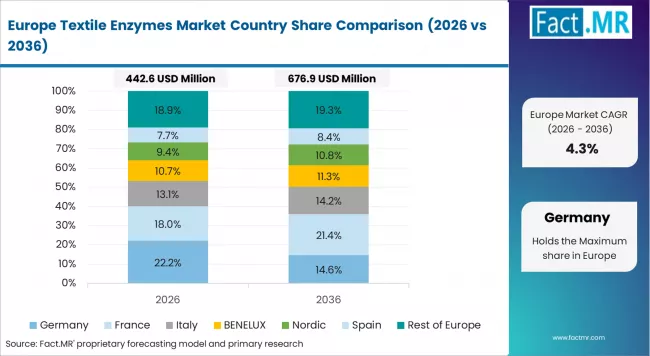
Textile Enzymes Market Europe Country Market Share Analysis, 2026 & 2036 | Source: Fact.MR
The Europe textile enzymes market is projected to grow from USD 0.4 billion in 2025 to USD 0.7 billion by 2035, recording a CAGR of 5.6% over the forecast period. Germany leads the region with a 41.2% share in 2025, moderating slightly to 40.8% by 2035, supported by its strong textile industry traditions and demand for premium, precision-manufactured enzyme solutions. The UK follows with 24.8% in 2025, easing to 24.4% by 2035, driven by a mature textile market and emphasis on operational efficiency and quality performance. France accounts for 16.3% in 2025, rising to 16.7% by 2035, reflecting steady adoption of advanced enzyme technologies and operational optimization. Italy holds 7.9% in 2025, expanding to 8.2% by 2035 as textile modernization and specialty textile applications grow. Spain contributes 4.6% in 2025, growing to 4.9% by 2035, supported by expanding facility development and textile performance awareness modernization. The Nordic countries rise from 2.8% in 2025 to 2.9% by 2035 on the back of strong textile consciousness and advanced operational methodologies. BENELUX remains at 2.1% share across both 2025 and 2035, reflecting mature, efficiency-focused textile markets.
Competitive Landscape of the Textile Enzymes Market
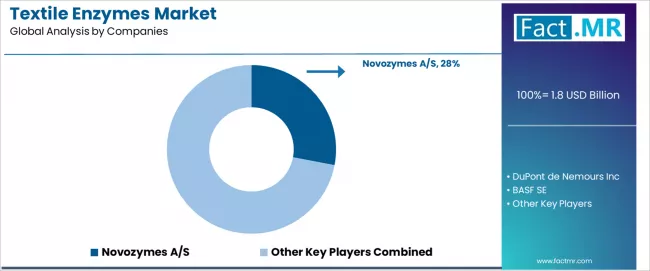
Textile Enzymes Market Analysis By Company | Source: Fact.MR
The textile enzymes market is characterized by competition among established biotechnology companies, specialized enzyme manufacturers, and integrated textile solution providers. Companies are investing in advanced enzyme technologies, specialized bio-catalytic platforms, product innovation capabilities, and comprehensive distribution networks to deliver consistent, high-quality, and reliable enzyme systems. Innovation in bio-catalytic processing, enzymatic efficiency, and textile-focused product development is central to strengthening market position and customer satisfaction.
Novozymes A/S leads the market with 28% share with a strong focus on bio-catalytic innovation and comprehensive textile solutions, offering industrial and commercial systems with emphasis on performance excellence and biotechnology heritage. DuPont de Nemours Inc provides integrated textile processing with a focus on textile market applications and precision enzyme networks. BASF SE delivers comprehensive textile technology solutions with a focus on commercial positioning and operational efficiency. DSM-Firmenich AG specializes in comprehensive enzyme technologies with an emphasis on textile applications. Advanced Enzyme Technologies Limited focuses on comprehensive textile enzymes with advanced bio-catalytic design and premium positioning capabilities.
Key Players in the Textile Enzymes Market
- Novozymes A/S
- DuPont de Nemours Inc
- BASF SE
- DSM-Firmenich AG
- Advanced Enzyme Technologies Limited
- Kemin Industries Inc
- Dyadic International Inc
- Enzyme Solutions Inc
- AB Enzymes GmbH
- Rossari Biotech Limited
- Tex Biosciences Inc
- Creative Enzymes Inc
- Refnol Resins and Chemicals Limited
- Maps Enzymes Limited
- Sunson Industry Group Co Limited
Bibliography
- Relevant industry regulatory authority. (2025). Industry guidance and standards documentation.
- International trade association. (2025). Market statistics and industry annual report.
- International standards organization. (2025). Product specification and testing standards.
- Leading industry participant. (2025). Annual report and public filings.
- Government statistical agency. (2025). Production and trade statistics database.
- This bibliography is provided for reader reference. The full Fact.MR report contains the complete reference list with primary research documentation.
This Report Addresses
- Market sizing and quantitative forecast metrics detailing consumption across enzyme type and application sector segments globally through 2036.
- Enzyme Type analysis comparing adoption rates and evaluating performance differentials across product categories.
- Application Sector intelligence evaluating demand trajectories across leading application segments.
- Regulatory compliance assessment analyzing specification standard impacts on procurement decisions.
- Competitive posture evaluation tracking manufacturer capability investments and market positioning strategies.
- Supply chain intelligence identifying sourcing dynamics and pricing trends across major consuming regions.
- Custom data delivery formats encompassing interactive dashboards, raw Excel datasets, and comprehensive PDF narrative reports.
Textile Enzymes Market Market Definition
The textile enzymes market encompasses the production, distribution, and consumption of specialized products serving defined industrial, commercial, and consumer applications globally. Products within this category are manufactured to specific quality, purity, and performance standards required by downstream end-use specifications.
Textile Enzymes Market Market Inclusions
Market scope includes all product types and grades within the textile enzymes market consumed across defined end-use applications globally. Forecast coverage spans 2026 to 2036 across enzyme type and application sector segments.
Textile Enzymes Market Market Exclusions
The scope excludes raw material feedstock valuations prior to processing, downstream finished end-use product pricing, and manufacturing equipment used in production processes.
Textile Enzymes Market Market Research Methodology
Primary Research: Analysts conducted interviews with end-use manufacturers, procurement directors, and product development managers across key consuming industries.
Desk Research: Data collection aggregated regulatory databases, trade association statistics, and publicly filed company annual reports from major market participants.
Market-Sizing and Forecasting: Baseline values derive from a bottom-up aggregation of product shipment volumes by type and application, applying end-use consumption growth rates and market penetration projections.
Data Validation and Update Cycle: Projections are cross-validated against industry production statistics, trade flow data, and quarterly pricing benchmarks from recognized industry sources.
Segmentation
Scope of the Report
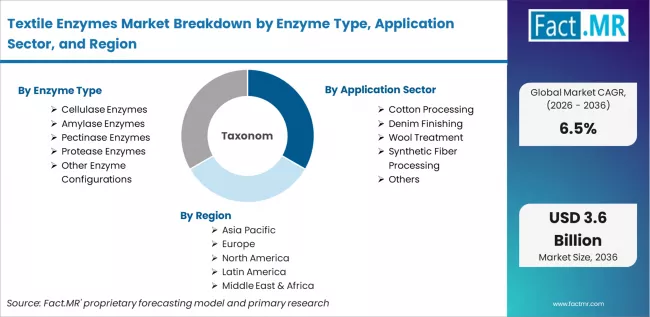
Textile Enzymes Market Breakdown By Enzyme Type, Application Sector, And Region | Source: Fact.MR
| Metric | Value |
|---|---|
| Quantitative Units | USD Billion 1.92 to USD Billion 3.60, at a CAGR of 6.50% |
| Market Definition | The Textile Enzymes Market encompasses all defined product types and grades across end-use applications globally. |
| Enzyme Type Segmentation | Cellulase Enzymes, Amylase Enzymes, Pectinase Enzymes, Protease Enzymes, Other Enzyme Configurations |
| Application Sector Segmentation | Cotton Processing, Denim Finishing, Wool Treatment, Synthetic Fiber Processing, Others |
| Regions Covered | North America, Latin America, Europe, East Asia, South Asia, Oceania, Middle East & Africa |
| Key Companies Profiled | Novozymes A/S, DuPont de Nemours Inc, BASF SE, DSM-Firmenich AG, Advanced Enzyme Technologies Limited, Kemin Industries Inc, Dyadic International Inc, Enzyme Solutions Inc |
| Forecast Period | 2026 to 2036 |
| Approach | Forecasting models apply a bottom-up methodology starting from product consumption volumes, projecting growth based on end-use demand trends, regulatory conversion timelines, and market penetration rates. |
Source: Fact.MR analysis. Updated Apr 2, 2026
Textile Enzymes Market by Segments
-
Enzyme Type :
- Cellulase Enzymes
- Amylase Enzymes
- Pectinase Enzymes
- Protease Enzymes
- Other Enzyme Configurations
-
Application Sector :
- Cotton Processing
- Denim Finishing
- Wool Treatment
- Synthetic Fiber Processing
- Others
-
Fabric Type :
- Cotton Fabrics
- Synthetic Fabrics
- Blended Fabrics
- Wool Fabrics
- Other Fabric Platforms
-
Processing Stage :
- Pre-treatment
- Dyeing
- Finishing
- Washing
- Other Processing Services
-
Region :
- Asia Pacific
- China
- India
- Japan
- South Korea
- Australia
- Rest of Asia Pacific
- North America
- USA
- Canada
- Mexico
- Europe
- Germany
- UK
- France
- Italy
- Spain
- Nordic Countries
- BENELUX
- Rest of Europe
- Latin America
- Brazil
- Argentina
- Rest of Latin America
- Middle East & Africa
- Kingdom of Saudi Arabia
- United Arab Emirates
- South Africa
- Rest of Middle East & Africa
- Other Regions
- Oceania
- Central Asia
- Other Markets
- Asia Pacific
Frequently Asked Questions
How large is the textile enzymes market in 2026?
What will be the market size by 2036?
What is the expected CAGR between 2026 and 2036?
Which enzyme type is poised to lead in 2026?
Which application sector leads in 2026?
What is driving market growth?
What is the textile enzymes market?
Who worked on this report


Preview the report firsthand - request a free sample
Free SampleGet the brochure for pricing and purchase details
Download PDF