- Forecast Value (2035): 1501.2 Mn
- CAGR (2035): 6.1%
Pressure Calibration Equipment Market Outlook 2025 to 2035
The Pressure Calibration Equipment Market is forecasted to grow from USD 830.4 Million in 2025 to USD 1,501.2 Million by 2035, growing at a CAGR of 6.1%. Widely used in aerospace, energy, and industrial sectors, calibration tools ensure accuracy and compliance in pressure-based instrumentation.
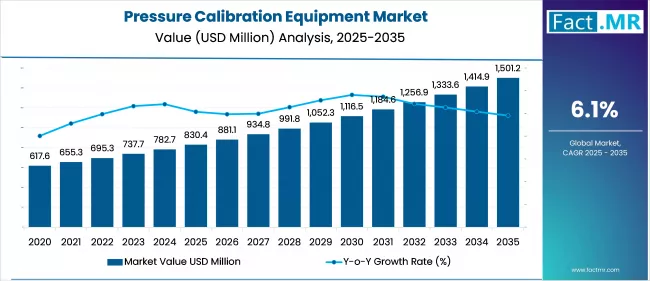
Pressure Calibration Equipment Market Value Analysis | Source: Fact.MR
| Metric | Value |
|---|---|
| Pressure Calibration Equipment Market Estimated Value in (2025 E) | USD 830.4 million |
| Pressure Calibration Equipment Market Forecast Value in (2035 F) | USD 1501.2 million |
| Forecast CAGR (2025 to 2035) | 6.1% |
Source: Fact.MR analysis. Updated Aug 18, 2025
According to latest research study by Fact.MR, the pressure calibration equipment market is anticipated to witness a convenient growth rate of more than 6% during assessment period. The high demand from the chemical industries for pressure measurement and vessel safety is likely to drive the market in next couple of years.
In addition to this, the growing demand from other end use industries such as automotive, oil & gas and pharmaceutical is likely to provide an upward trend to the demand across the globe.
| Countries | CAGR |
|---|---|
| U.S. | 6.5% |
| Germany | 6.2% |
| Japan | 6.0% |
| China | 5.8% |
Source: Fact.MR analysis. Updated Aug 18, 2025
What is Driving Demand for Pressure Calibration Equipment?
The growing pharmaceutical and healthcare industry is likely to provide abundant opportunities to manufactures across the globe. Since pressure calibration devices are extensively used for pressure measurement which controls the operational flexibility of any process.
The evolving demand from chemical industries for R&D and vessel pressure measurement is projected to account for noteworthy demand in upcoming years.
The versatility of the product is a foremost reason, which utilizes a convenient amount of pressure calibration equipment in various industries such as automotive, pharmaceutical, scientific laboratories, aerospace and oil & gas industries. Due to high utilization from these industries, the production volume is anticipated to surge by 2X during the forecast period.
The growing laboratories are attributed to providing a promising stance to the manufacturers in near future. Since the application such as industrial safety and maintenance is likely to give a positive impact to the utilization of pressure calibration devices.
Additionally, the expanding automobile and aviation industries across the globe is attributed to generating noteworthy demand from the manufacturer’s end.
Global Overview of Pressure Calibration Equipment
North America region accounts for the highest demand for pressure calibration equipment due to the presence of large manufacturing, chemical and automotive sectors. This region is likely to provide numerous aspects due to high investment in the R&D sector.
Due to the presence of a large pharmaceutical market, Europe is likely to generate a plethora of opportunities for manufacturers across the globe. Due to this market scenario, Europe is expected to hold a significant market share of the global market and is likely to be a lucrative market during the forecast period.
Due to rapid industrialization, the Asia Pacific region is likely to hold the noteworthy demand for pressure calibration devices, which will lead to provide a promising stance to investors. Moreover, intensifying online retail in countries such as India, China, Singapore and Australia is projected to create convenient demand in upcoming years.
In addition to this, the chemical sector is associated with the utilization of a variety of equipment for pressure measurement. In any chemical process ideal conditions of temperature, concentration and salinity have to be maintained and it is directly related to pressure. Due to this fact, the application in chemical industries has witnessed numerous opportunities in historical years and likely to observed same growth rate during forecast period across all the prominent region.
North America Market Outlook
North America currently accounts for a majority of the demand. Since, increasing government investment in R&D and healthcare infrastructure is projected to give a positive outlook to the expansion of the laboratories, providing a promising stance for investors in this region. The demand for calibration equipment is anticipated to be surge from other end-use industries such as chemical, electrical and oil& gas industry during the period of forecast.
Segmental Analysis
Automatic pressure calibration equipment is anticipated to be a lucrative avenue from the consumer’s end since it does not require any human effort for pressure reading calibration. The optimistic trend towards automation is likely to give a positive impact on the utilization of automatic gadgets across the globe.
Moreover, the low-pressure range (>10 psi) equipment are likely to witness an optimistic growth rate from the industrial laborites whether high-pressure rating (500-1000 psi) calibration equipment is expected to be a lucrative avenue from the industrial applications.
Who are the Key Manufacturers and Suppliers of Pressure Calibration Equipment?
Some of the leading manufacturers and suppliers of Pressure Calibration Equipment include
- Additel
- Ametek
- Ashcroft
- Condec
- Crystal Engineering
- DH-Budenberg
- Druck
- Dwyer Instruments
- Fluke Calibration
- IKM Instrutek
- Keller
- Martel Electronics
- Mensor
- PIE Practical Instrument Electronics
- Setra
- Transmille
- WIKA
- Yokogawa
Leading manufacturers across the globe are highly focused on improving the versatility of the product, making it useful to other applications as well. Additionally, key manufacturers are spending a momentous amount on R&D for improving the accuracy of pressure calibration equipment.
The rising interest in automatic machinery is anticipated to provide abundant aspects for developing a variety of product range for satisfying the consumers demand globally.
Pressure Calibration Equipment Market Report Highlights
- Detailed overview of parent market
- Changing market dynamics in the industry
- In-depth market segmentation
- Historical, current and projected market size in terms of volume and value
- Recent industry trends and developments
- Competitive landscape
- Strategies of key players and products offered
- Potential and niche segments, geographical regions exhibiting promising growth
- A neutral perspective on market performance
- Must-have information for market players to sustain and enhance their market footprint
Segmentation
Key Segments
-
By Pressure Measurement Range
- <10 Psi
- 10-100 Psi
- 100-200 Psi
- 200-500 Psi
- 500-1000 Psi
- >1000 Psi
-
By Operation
- Automatic
- Manual
- Others
-
By Application
- Turbines
- Wind Power
- Maintenance
- Compressor unit
- Industrial Safety
- Others
-
By End Use Industries
- Chemical Industry
- Pharmaceutical Industry
- Automotive Industry
- Aviation Industry
- Scientific Laboratories
- Oil & Gas Industry
- Others
-
By Distribution Channel
- Offline
- Specialty Stores
- Multi-brand Stores
- Retail Sales
- Distributor Sales
- Online
- E-commerce Websites
- Company-owned Websites
- Offline
-
By Region
- North America
- US & Canada
- Latin America
- Brazil, Mexico, Argentina & Rest of Latin America
- Europe
- Germany, France, Italy, Spain, U.K., Benelux, Russia, and Rest of Europe
- East Asia
- China, Japan, South Korea
- South Asia
- India, Thailand, Malaysia, Indonesia and Rest of South Asia
- Oceania
- Australia and New Zealand
- Middle East and Africa
- GCC Countries, Turkey, South Africa, and Rest of Middle East & Africa
- North America
The report is a compilation of first-hand information, qualitative and quantitative assessment by industry analysts, inputs from industry experts and industry participants across the value chain. The report provides in-depth analysis of parent market trends, macro-economic indicators and governing factors along with market attractiveness as per segments. The report also maps the qualitative impact of various market factors on market segments and geographies.
NOTE: Although care has been taken to maintain the highest levels of accuracy in reports, recent market/vendor-specific changes may take time to reflect in the analysis.
Who worked on this report


Preview the report firsthand - request a free sample
Free SampleGet the brochure for pricing and purchase details
Download PDF