The Promotional & Seasonal Peak Logistics Planning Platforms Market is analyzed by platform function, including demand forecasting & peak planning and capacity planning & allocation, and region, forecast 2026 to 2036.
By Fact.MR Consumer Goods DeskLead analyst:
Ayush RajPublished :
13 min read
Fact-checked under the Fact.MR editorial process
Summary of Promotional & Seasonal Peak Logistics Planning Platforms Market
Market Definition
Market covers AI-driven SaaS and on-premise platforms enabling enterprises to plan and execute supply chain capacity, workforce, inventory, and transport operations for promotional events and seasonal demand peaks globally.
Demand Drivers
Rising frequency of large-scale retail promotional events is compelling enterprises to invest in dedicated AI-native planning platforms beyond general ERP capabilities.
India's fast-growing festive e-commerce sector, anchored by Diwali sales and flash sale cycles, is accelerating adoption of cloud-based peak planning tools among domestic and global retailers.
Cloud-first digital transformation in retail and FMCG is driving enterprises away from on-premise legacy planning systems toward scalable SaaS platforms with integrated peak scenario modelling.
Key Segments Analyzed
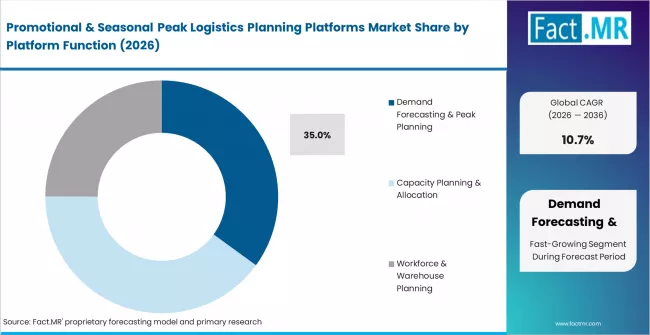
By Platform Function: Demand Forecasting & Peak Planning holds 35% share in 2026, driven by AI-powered SKU-level forecasting for promotional and seasonal demand spikes.
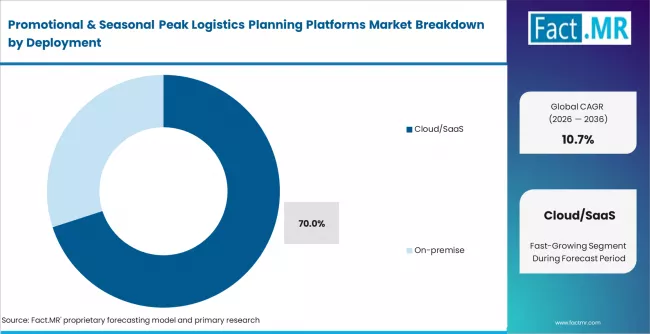
By Deployment: Cloud/SaaS platforms dominate at 70% share in 2026, aligned with enterprise preference for scalable, subscription-based logistics planning infrastructure.
By End Use: Retail & E-commerce leads at 50% share in 2026, reflecting the highest concentration of promotional peak planning demand across both physical and digital retail channels.
Analyst Opinion at FACT.MR
Shambhu Nath Jha, Principal Consultant at Fact.MR, opines, ‘CXOs will find that competitive differentiation in peak logistics planning is no longer defined by forecasting accuracy alone. It increasingly depends on how quickly platforms can convert event-level demand signals into coordinated warehouse, workforce, and transportation capacity decisions within a unified, integrated system.’
Strategic Implications
Invest in AI-native demand forecasting capabilities that integrate promotional calendar inputs with real-time inventory and transport capacity signals.
Strengthen platform partnerships with last-mile and transportation visibility providers to extend peak planning from the warehouse to the final delivery node.
Develop modular deployment architectures that allow mid-market retailers to adopt peak planning incrementally without full ERP replacement.
Methodology
Market sizing based on platform subscription revenues and licensing fee benchmarks validated against disclosed vendor financials.
Data incorporates Blue Yonder FY2024 earnings, SAP IBP 2024 disclosures, and IDC MarketScape Supply Chain Planning 2024 assessments.
Forecasts incorporate festive commerce growth curves, cloud adoption rates, and regional retail digitization benchmarks from primary interviews.
The market is expected to generate an absolute dollar opportunity of USD 5.8 billion over the forecast period. Growth is transformational and driven by rising promotional events and adoption of AI-native planning platforms. Integration complexity with legacy ERP systems remains a constraint. High implementation costs continue to limit adoption among mid-market retailers.
Enterprise buyers are consolidating logistics planning spend onto unified SaaS platforms. These platforms support multi-event and multi-horizon planning. Blue Yonder, SAP, and Manhattan Associates are strengthening positions through AI enhancements and partnerships. Long-term SaaS-based contracts are becoming standard across North American and European retail supply chains managing multiple peak cycles.
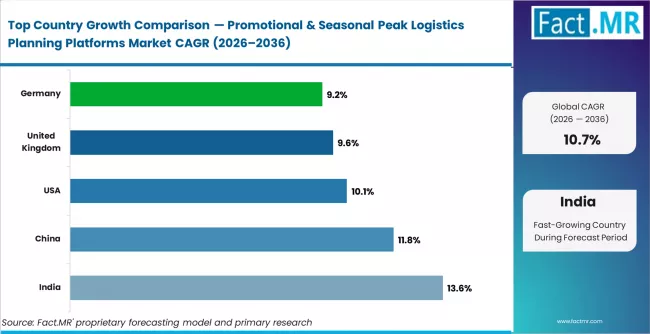
Regionally, India leads with 13.6% CAGR, driven by festive commerce and AI planning adoption. China follows at 11.8%, supported by integrated commerce-logistics ecosystems. The United States records 10.1% CAGR with sustained planning investments. The United Kingdom grows at 9.6%, supported by grocery and omnichannel maturity. Germany registers 9.2% CAGR, driven by supply chain digitization in retail and manufacturing.
Segmental Analysis
Promotional & Seasonal Peak Logistics Planning Platforms Market Analysis by Platform Function
Promotional & Seasonal Peak Logistics Planning Platforms Market Analysis By Platform Function | Source: Fact.MR
Based on FACT.MR's analysis, Demand Forecasting & Peak Planning holds 35% share in 2026. This function drives all downstream capacity and logistics decisions. Accurate forecasts are essential for warehouse, labour, and transport planning.
Blue Yonder Platform Investment: Blue Yonder enhanced AI and ML forecasting in its 2024 releases. Cloud TMS shipments scaled from 10 million to 45 million monthly. Growth reflects rising demand for integrated planning and execution. [3]
SAP IBP Promotional Planning Development: SAP expanded its IBP application for trade promotion planning. The platform links demand planning with logistics execution. General availability is expected in Q1 2026. [1]
Transportation Surge Planning Adoption Trend: project44 reported USD 210.1 million revenue in 2024. Growth is driven by real-time visibility and AI-based disruption management. Platforms are enabling scalable surge handling during peak periods. [4]
Based on FACT.MR's analysis, Cloud/SaaS platforms hold 70% share in 2026. Cloud enables scalable compute capacity during peak planning cycles. SaaS also supports real-time collaboration across stakeholders.
Blue Yonder SaaS Revenue Expansion: Blue Yonder achieved 14.2% SaaS growth with strong retention rates. Its cloud platform supports planning and warehouse execution. This is critical for peak operations.
project44 Cloud-Native Peak ScalingCapability: project44 processes large-scale data with high uptime and fast API response. Its architecture supports elastic scaling during peak demand. The company exceeded 550 enterprise customers in 2024.
On-Premise Retention in Regulated Industries: On-premise deployments hold ~30% share in 2026. Adoption persists in regulated sectors with strict data requirements. Compliance and data residency constraints limit cloud migration.
Drivers, Restraints, and Opportunities
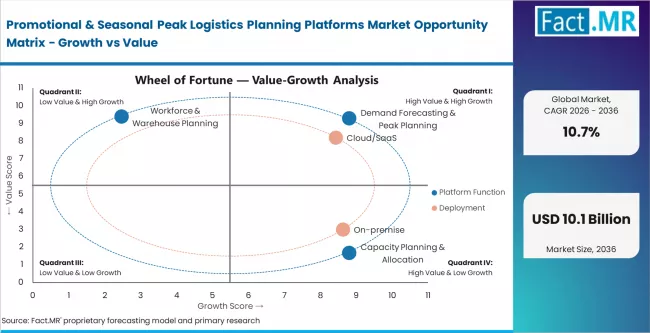
Promotional & Seasonal Peak Logistics Planning Platforms Market Opportunity Matrix Growth Vs Value | Source: Fact.MR
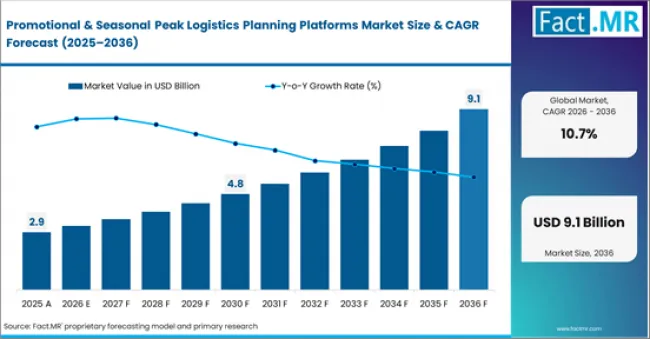
FACT.MR analysts observe that the promotional and seasonal peak logistics planning platforms market has evolved into a strategic enterprise software segment. Valued at USD 2.9 billion in 2025, the market reflects long-standing seasonal logistics challenges now codified into dedicated platforms.
Standalone forecasting tools are losing share. Enterprises are consolidating planning onto integrated platforms. These platforms connect demand modelling, inventory positioning, warehouse capacity, and carrier booking. Cloud SaaS platforms dominate due to scalability and lower upfront cost. On-premise deployments remain limited to regulated industries.
AI-Driven Forecasting Replacing Statistical Models: SAP was recognised in IDC MarketScape 2024 for AI-based demand planning. Enterprises are replacing statistical models with AI forecasting. External signals like weather, traffic, and promotions are now integrated into planning. [5]
Festive Commerce Expansion in Emerging Markets: India’s e-commerce GMV reached USD 14 billion in FY2025, driven by festive events. Flipkart and Amazon India are investing in AI logistics planning. Demand spikes can reach 5x baseline levels. This is accelerating platform adoption across sellers and logistics partners. [2]
SaaS Platform Consolidation Driving Ecosystem Switching: Blue Yonder reported USD 1.36 billion revenue in FY2024 with 14.2% SaaS growth. Platform-based integration is increasing deal sizes and reducing standalone tool usage. Mid-tier vendors face pressure to integrate or exit.
Regional Analysis
The promotional and seasonal peak logistics planning platforms market is assessed across North America, Europe, Asia Pacific, Latin America, and Middle East and Africa, covering over 30 countries differentiated by retail promotional event intensity, e-commerce penetration, logistics platform adoption maturity, and enterprise digitization investment levels. The full report offers market attractiveness analysis by region and country.
Top Country Growth Comparison Promotional & Seasonal Peak Logistics Planning Platforms Market Cagr (2026 2036) | Source: Fact.MR
Country
CAGR (2026 to 2036)
United States
10.1%
China
11.8%
United Kingdom
9.6%
Germany
9.2%
India
13.6%
Source: Fact.MR analysis. Updated May 7, 2026
Source: Fact.MR (FACT.MR) analysis, based on proprietary forecasting model and primary research
Promotional & Seasonal Peak Logistics Planning Platforms Market Cagr Analysis By Country | Source: Fact.MR
North America Promotional & Seasonal Peak Logistics Planning Platforms Market Analysis
Promotional & Seasonal Peak Logistics Planning Platforms Market Country Value Analysis | Source: Fact.MR
North America represents the largest revenue base. The region benefits from high promotional event density and strong enterprise software adoption. Black Friday and Cyber Monday drive multi-month planning cycles. Blue Yonder, Manhattan Associates, and SAP lead with integrated platforms and established client bases.
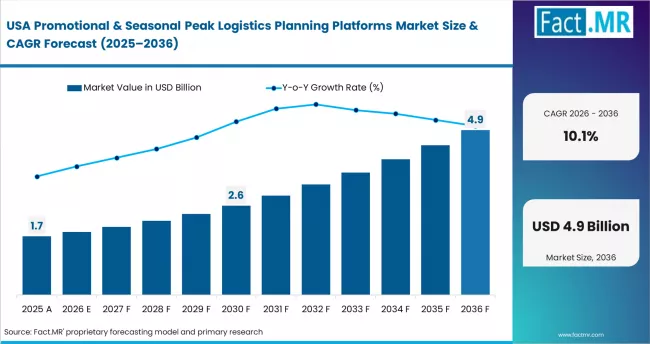
United States: Advanced software penetration supports 10.1% CAGR through 2036. The promotional calendar includes Black Friday, Cyber Monday, Prime Day, and Back-to-School cycles. Retailers manage four to six peak events annually. Blue Yonder scaled its Cloud WMS platform in 2024, with task volumes rising significantly. SAP was recognized as a Leader in multiple IDC MarketScape assessments. Growth is driven by complex multi-cycle planning needs.
FACT.MR's analysis in North America covers United States, Canada, and Mexico. It includes platform adoption benchmarks, event planning data, and deployment trends.
Asia Pacific is the fastest-growing region. Growth is driven by China’s integrated ecosystem and India’s festive commerce expansion. Platforms are managing large-scale promotional events with AI-driven planning.
China: Integrated infrastructure supports 11.8% CAGR through 2036. Alibaba Group and JD.com operate proprietary peak planning systems. These systems integrate inventory, transport, and fulfillment. Government investment supports logistics digitization. Adoption is driven by ecosystem scale and platform integration.
India: Festive commerce drives 13.6% CAGR through 2036. E-commerce GMV reached ~USD 14 billion in FY2025 with strong growth. Flipkart Minutes and Amazon India investments are scaling logistics planning tools. SAP introduced cloud-based solutions to support supply chain modernization. Adoption is driven by high demand volatility and rapid event cycles.
FACT.MR's Asia Pacific analysis covers China, India, Japan, South Korea, ASEAN, and ANZ. It includes adoption trends, AI deployment data, and investment benchmarks.
Europe Promotional & Seasonal Peak Logistics Planning Platforms Market Analysis
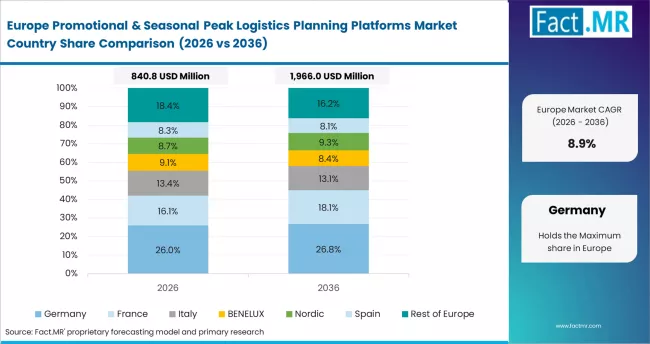
Promotional & Seasonal Peak Logistics Planning Platforms Market Europe Country Market Share Analysis, 2026 & 2036 | Source: Fact.MR
Europe is a compliance-driven and mature retail market. Grocery and seasonal cycles drive structured planning demand. GDPR and EU regulations influence platform procurement. SAP and Blue Yonder dominate through ERP integration.
United Kingdom: Mature retail infrastructure supports 9.6% CAGR through 2036. Grocery retailers use AI forecasting to improve stock and reduce waste. Sainsbury's has adopted advanced demand planning platforms. Multi-channel peak events create strong demand for integrated systems.
Germany: Strong digitization supports 9.2% CAGR through 2036. SAP leads enterprise adoption. IDC recognition reinforces its market position. Retailers are integrating forecasting with capacity planning to meet compliance standards.
FACT.MR's Europe analysis covers Germany, France, United Kingdom, Italy, Spain, and Rest of Europe. It includes compliance impact, adoption data, and investment benchmarks.
Competitive Aligners for Market Players
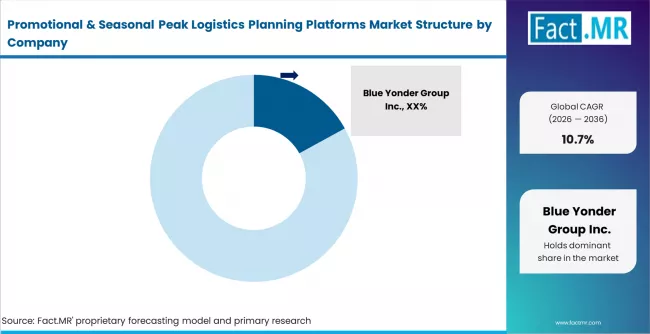
Promotional & Seasonal Peak Logistics Planning Platforms Market Analysis By Company | Source: Fact.MR
Market players are aligning competition around integrated, AI-driven planning platforms rather than standalone tools. Vendors that unify demand forecasting, inventory positioning, warehouse capacity, workforce scheduling, and transport planning within a single system are gaining clear advantage. Platforms such as Blue Yonder, SAP, and Manhattan Associates are leading by offering end-to-end peak planning capabilities.
A key competitive aligner is AI-native forecasting and scenario modeling. Vendors embedding machine learning for demand sensing, what-if simulations, and real-time adjustments are outperforming traditional planning tools. This enables enterprises to respond dynamically to promotional spikes and reduce forecast error during high-volatility periods.
Another differentiator is platform scalability and cloud architecture. SaaS-based platforms allow retailers to scale compute capacity during peak planning cycles without infrastructure constraints. Cloud-native systems also enable real-time collaboration across retailers, suppliers, and logistics partners, which is critical during multi-event peak seasons. Ecosystem integration is becoming equally important. Vendors that offer seamless connectivity with ERP, WMS, and transportation systems are reducing implementation friction. Pre-built integrations and API-first design are helping platforms expand faster across enterprise environments.
Vertical specialization is also emerging as a competitive lever. Platforms tailored for grocery, fashion, or FMCG peak cycles deliver stronger ROI than generic solutions. Vendors that embed industry-specific workflows and compliance features are gaining procurement preference.
Finally, contract structure and pricing models are evolving. Long-term SaaS contracts with usage-based scaling are becoming standard. Vendors that demonstrate measurable ROI in reducing stockouts, improving service levels, and optimizing capacity utilization are securing larger, multi-year enterprise deals.
Key Players
Blue Yonder Group Inc.
Manhattan Associates Inc.
SAP SE
Oracle Corporation
Shopify Inc.
Amazon.com Inc.
Descartes Systems Group Inc.
project44 Inc.
Promotional & Seasonal Peak Logistics Planning Platforms Market by Segments
By Platform Function:
Demand Forecasting & Peak Planning
Capacity Planning & Allocation
Workforce & Warehouse Planning
Transportation Surge Planning
By Deployment:
Cloud/SaaS Platforms
On-premise
By End Use:
Retail & E-commerce
FMCG/CPG
Fashion & Apparel
Electronics
Others
By Region:
North America
United States
Canada
Mexico
Latin America
Brazil
Argentina
Chile
Rest of Latin America
Western Europe
Germany
United Kingdom
France
Italy
Spain
Nordic Countries
BENELUX
Rest of Western Europe
Eastern Europe
Poland
Hungary
Rest of Eastern Europe
East Asia
China
Japan
South Korea
South Asia and Pacific
India
ASEAN
Australia and New Zealand
Rest of South Asia and Pacific
Middle East and Africa
Kingdom of Saudi Arabia
UAE
Turkey
South Africa
Rest of Middle East and Africa
Bibliography
[1] SAP. 2025. Integrated Business Planning (IBP) Promotional Planning Application Expansion Brief. Walldorf: SAP SE.
[3] Blue Yonder. 2024. Annual Report and Platform Performance Highlights. Scottsdale: Blue Yonder Group Inc.
[4] project44. 2024. Movement Platform Revenue and Performance Report. Chicago: project44 Inc.
[5] IDC MarketScape. 2024. Worldwide Supply Chain Planning Vendor Assessment Report. Framingham: International Data Corporation.
This Report Addresses
Market sizing and quantitative forecast metrics detailing global and regional expenditure on promotional and seasonal peak logistics planning platforms through 2036.
Segmentation analysis evaluating adoption patterns across platform function, deployment model, and end-use categories and their respective sub-segments.
Regional deployment intelligence comparing growth trajectories, promotional event intensity, and competitive dynamics across North America, Europe, Asia Pacific, Latin America, and Middle East & Africa.
Regulatory compliance assessment analysing how data residency mandates, EU supply chain due diligence requirements, and India digital commerce policies shape platform procurement decisions.
Competitive landscape evaluation tracking market structure, platform integration depth, and AI forecasting capability strategies among leading vendors.
Strategic investment guidance defining the platform function prioritisation, geographic expansion, and ecosystem partnership strategies for market positioning through the forecast period.
Pricing and technology trend analysis identifying SaaS consolidation, AI agent automation, and modular deployment economics affecting per-platform revenues.
Custom data delivery formats encompassing interactive dashboards, raw Excel datasets, and comprehensive PDF narrative reports.
The market covers software platforms that enable retailers, FMCG producers, and logistics operators to plan, model, and execute supply chain operations during promotional campaigns and seasonal demand peaks.
Covers global and regional forecasts from 2026 to 2036. Includes platform function, deployment model, and end-use segmentation. Applications across retail, e-commerce, FMCG, fashion, and electronics are addressed. Includes cloud SaaS and on-premise deployments, promotional event planning benchmarks, and AI forecasting adoption trends.
Excludes general-purpose ERP planning modules not specifically configured for promotional or seasonal peak scenarios. Omits standalone transportation management systems and warehouse management platforms without peak planning integration. Also excludes logistics consultancy services and non-software peak management solutions.
Promotional & Seasonal Peak Logistics Planning Platforms Market Research Methodology
Primary Research:Interviews with retail supply chain executives, logistics platform buyers, FMCG planning managers, and software vendors across North America, Europe, and Asia Pacific.
Desk Research:Analysis of earnings disclosures from Blue Yonder, SAP, Manhattan Associates, and project44, alongside IDC MarketScape assessments and industry analyst publications from 2024 to 2025.
Market-Sizing and Forecasting:Hybrid top-down and bottom-up model using platform subscription revenues, per-module licensing fees, and end-user penetration rates disaggregated by function, deployment, and region.
Data Validation and Update Cycle:Validated through vendor revenue reports, enterprise procurement data, and expert interviews. Updated on a rolling basis as platform releases and partnership disclosures are announced.
Market Breakdown
Segmentation
Scope of Report
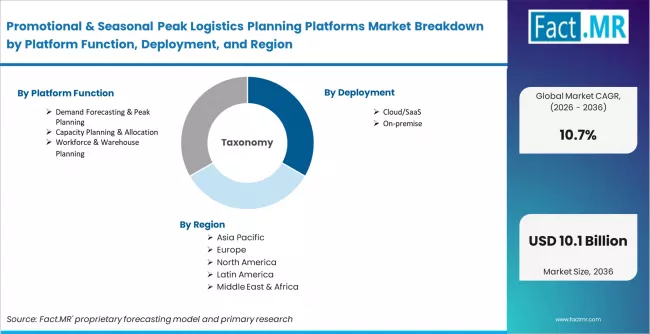
Promotional & Seasonal Peak Logistics Planning Platforms Market Breakdown By Platform Function, Deployment, And Region | Source: Fact.MR
Attribute
Details
Quantitative Units
USD 3.3 billion (2026) to USD 9.1 billion (2036), at a CAGR of 10.7%
Market Definition
Software platforms enabling retailers, FMCG producers, and logistics operators to forecast, plan, and execute supply chain operations during promotional events and seasonal demand peaks globally.
Promotional calendar-driven demand modelling, warehouse capacity allocation, workforce surge scheduling, carrier booking for peak events, and seasonal inventory positioning across global supply chains.
Key Companies Profiled
Blue Yonder, Manhattan Associates, SAP, Oracle, Shopify, Amazon, Descartes Systems Group, project44
Forecast Period
2026 to 2036
Approach
Hybrid top-down and bottom-up model using platform subscription revenues, licensing fee benchmarks, end-user penetration rates, and primary interviews with supply chain planning executives and platform vendors.
Source: Fact.MR analysis. Updated May 7, 2026
Questions Answered
Frequently Asked Questions
How large is the promotional and seasonal peak logistics planning platforms market in 2026?
The market is estimated to be valued at USD 3.3 billion in 2026.
What will the market size be by 2036?
The market is projected to reach USD 9.1 billion by 2036.
What is the expected CAGR between 2026 and 2036?
The market is expected to grow at a CAGR of 10.7% between 2026 and 2036.
Which platform function segment is poised to lead in 2026?
Demand Forecasting & Peak Planning accounts for approximately 35% of market share in 2026, making it the leading sub-segment by platform function.
Which deployment model dominates the market?
Cloud/SaaS platforms hold approximately 70% share in 2026.
Which country is the fastest-growing market?
India is projected to grow at a CAGR of 13.6% during 2026 to 2036.
What is the scope of this report?
The report covers market sizing, segmentation by platform function, deployment, and end use, regional analysis across 30+ countries, competitive landscape evaluation, and regulatory impact assessment for 2026 to 2036.
What methodology does Fact.MR use for this forecast?
Fact.MR applies a hybrid top-down and bottom-up methodology, cross-validated against primary research interviews, vendor financial disclosures, and independent industry analyst publications including IDC MarketScape assessments.
What is driving growth in this market?
Growth is driven by rising frequency of promotional events, AI-native platform consolidation, and rapid festive e-commerce adoption in India and China.
Who are the major players in this market?
Key players include Blue Yonder, Manhattan Associates, SAP, Oracle, Descartes Systems Group, and project44.
.webp "Top Country Growth Comparison Promotional & Seasonal Peak Logistics Planning Platforms Market Cagr (2026 2036)")