- Estimated Value(2026): 86.32 Bn
- Forecast Value (2036): 127.77 Bn
- CAGR (2026 - 2036): 4.0%
Bath and Shower Toiletries Market Size, Market Forecast and Outlook By FACT.MR
The bath and shower toiletries market is projected to reach USD 86.32 Billion in 2026 and expand to USD 127.77 Billion by 2036, growing at a 4.0% CAGR during the forecast period. FACT.MR analysis attributes this trajectory to converging demand forces including evolving consumer behaviour, regulatory developments, and technology-driven category evolution across both developed and emerging markets. The absolute dollar expansion of USD 41.45 billion over the forecast decade reflects both volume growth in underpenetrated emerging markets and value growth through premiumisation in mature markets.
As per FACT.MR estimates, the structural growth drivers embedded in this market extend beyond cyclical consumption trends. Regulatory frameworks governing product formulation, channel compliance requirements, and sustainability-linked consumer expectations are reshaping competitive parameters for established incumbents and new market entrants alike. Capital allocation decisions by leading brand owners are increasingly directed toward reformulation programmes, digital channel capability, and geographic footprint expansion that align with forecast demand concentration.
Among key markets, India expands at a 5.6% CAGR through 2036, with Rising urban disposable income, premiumisation of personal care routines, and expansion of modern trade and e-commerce distribution driving shift from commodity bar soap to premium shower gel formats. Japan expands at a 5.2% CAGR through 2036, with Deeply embedded bathing culture, premium onsen-inspired ingredient formulations, and ageing demographic driving sustained demand for therapeutic bath additives and high-performance shower products. USA expands at a 3.8% CAGR through 2036, with Post-pandemic wellness trend sustaining interest in aromatherapy bath products and natural ingredient formulations, with clean beauty certification requirements from major retailers influencing reformulation investment. UK expands at a 3.7% CAGR through 2036, with UK Plastic Packaging Tax implemented in April 2022 accelerating transition to solid shampoo bars and concentrated shower products, with Boots and Superdrug expanding dedicated solid toiletries sections.
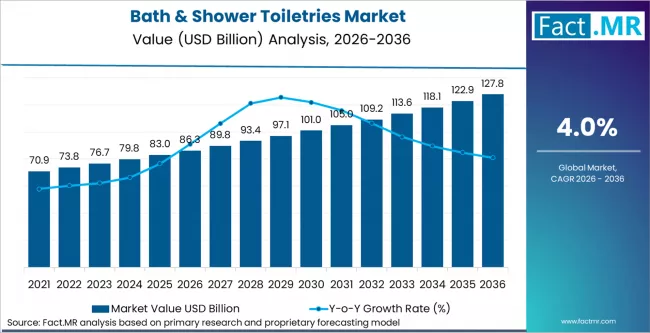
Bath & Shower Toiletries Market Market Value Analysis | Source: Fact.MR
Bath and Shower Toiletries Market Key Takeaways
| Metric | Details |
|---|---|
| Industry Size (2026) | USD 86.32 Billion |
| Industry Value (2036) | USD 127.77 Billion |
| CAGR (2026-2036) | 4.0% |
Source: Fact.MR analysis. Updated Mar 12, 2026
Bath and Shower Toiletries Market Definition
The Bath and Shower Toiletries encompasses shower products, liquid bath products, bath additives, bar soaps, other product types products sold through retail and direct channels for personal or professional use. The market boundary covers finished consumer goods sold through both offline and online retail channels globally, excluding raw material supply and contract manufacturing without brand attribution.
Bath and Shower Toiletries Market Inclusions
Market scope covers finished bath and shower toiletries products across all product type formats including shower products, liquid bath products, bath additives, bar soaps, other product types. Distribution channel analysis spans supermarkets/hypermarkets, specialty stores, online channels, and other retail formats. Regional coverage encompasses North America, Europe, Asia Pacific, Latin America, and Middle East and Africa.
Bath and Shower Toiletries Market Exclusions
Professional and institutional supply channels operating outside consumer retail are excluded from market valuation. Raw ingredient and chemical precursor trade, white-label contract manufacturing volumes without branded consumer sales attribution, and prescription or pharmacy-only regulated product categories fall outside analytical boundaries.
Bath and Shower Toiletries Market Research Methodology
- Primary Research: FACT.MR analysts conducted structured interviews with brand managers, category buyers, regulatory affairs leads, and distribution executives across 40 countries to validate adoption drivers and competitive positioning.
- Desk Research: Secondary data aggregation drew from company annual reports, regulatory agency publications, trade association statistics, and government consumer expenditure surveys.
- Market-Sizing and Forecasting: A hybrid top-down and bottom-up methodology applies category-specific consumption benchmarks, channel penetration rates, and regulatory adoption curves to generate country-level forecasts aggregated to global totals.
- Data Validation and Update Cycle: Forecasts are cross-validated against publicly reported category revenue from leading brand owners and retailer sales disclosures, with annual update cycles incorporating new market entrant data.
Summary of Bath and Shower Toiletries Market
- Bath and Shower Toiletries Market Definition
- The Bath and Shower Toiletries covers shower products, liquid bath products, bath additives, bar soaps, other product types sold to end consumers through retail and direct-to-consumer channels, with segmentation by product type, form, sales channel, and geography.
- Demand Drivers in the Market
- Rising consumer spending on personal care and lifestyle products across emerging markets, where urbanisation and income growth are creating new consumer cohorts entering formal retail channels for the first time.
- Regulatory and sustainability requirements compelling established manufacturers to reformulate product lines and invest in certified alternatives that meet evolving compliance standards in major markets.
- Digital commerce and social media-driven discovery accelerating product trial, reducing brand switching friction, and enabling direct-to-consumer brands to compete with established players at lower capital cost.
- Key Segments Analyzed in the FACT.MR Report
- Shower Products leads the Product Type segment with 29.0% share in 2026, driven by established consumer adoption and continued product innovation.
- Solid dominates the Form segment with 51.0% share in 2026, reflecting established distribution infrastructure and consumer purchasing patterns.
- India leads regional growth at a 5.6% CAGR through 2036, driven by rising urban disposable income, premiumisation of personal care routines.
- Analyst Opinion at FACT.MR
- FACT.MR analysts observe that the bath and shower toiletries market is at an inflection point where structural demand growth from emerging markets is converging with premiumisation and sustainability-driven value growth in mature markets. Brand owners that can simultaneously address affordability requirements in high-growth emerging markets and compliance-driven reformulation demands in mature regulated markets will capture disproportionate share of the USD 127.77 USD Billion market opportunity by 2036. The competitive advantage in this market is shifting from distribution scale to formulation differentiation, regulatory intelligence, and digital channel capability.
- Strategic Implications / Executive Takeaways
- Brand owners should prioritise geographic expansion into high-CAGR emerging markets including India and Japan where category penetration remains below developed market benchmarks.
- Reformulation investment toward certified natural, sustainable, or compliant variants is a prerequisite for maintaining premium retail shelf placement in regulatory-active markets including the UK, Germany, and France.
- Digital commerce capability including social commerce integration, direct-to-consumer subscription models, and influencer partnership programmes are necessary competitive requirements rather than optional growth levers.
Bath and Shower Toiletries Market Drivers, Restraints, and Opportunities
FACT.MR analysts observe that the bath and shower toiletries market is shaped by a combination of structural demand growth, regulatory compliance investment, and channel transformation dynamics that interact differently across geographic markets. The most significant driver is the expansion of consumer markets in Asia Pacific and Latin America, where rising disposable income is creating new product category adoption among consumers entering formal retail channels for the first time.
The primary restraint is input cost volatility from commodity price fluctuations affecting formulation costs, combined with regulatory reformulation requirements that necessitate capital investment without guaranteed volume return. Market participants managing both cost pressure and compliance investment simultaneously face margin compression risk unless they can extract premium pricing through certified product differentiation.
- Sustainability Compliance Requirements: Extended Producer Responsibility regulations across the EU, UK, and Canada mandate packaging reduction, recyclability, and refill format development, compelling manufacturers to invest in product format innovation beyond conventional single-use packaging.
- Digital Commerce Channel Expansion: Social commerce platforms including TikTok Shop, Douyin, and Instagram Shopping are compressing the purchase decision timeline and enabling direct-to-consumer brands to acquire customers without traditional retail distribution investment.
- Emerging Market Category Development: India's 5.6% CAGR and Japan's 5.2% CAGR represent genuine category expansion rather than share redistribution, as new consumer cohorts enter product categories for the first time driven by urbanisation and income growth.
What are the regional trends of bath & shower toiletries market?
The United States and Europe are leading in product variety and high-end absorption ranking, along with consumer preference for organic, dermatologist-tested, and cruelty-free compositions. In the U.S., UK, and Germany, per capita spending is extensive and remains steady as brand awareness and a shift towards hygienic habits are high. In such markets, seasonal launches also influence trends, and so do gender exclusive lines.
The Asia Pacific region, with its high population, increasing income and personal hygiene awareness, is becoming a notable market. Higher consumption is being witnessed in countries such as China, India and Indonesia, where middle-class consumers are seeking both affordable and aspirational quality. A specific product development angle is formed by the popularity of herbal and Ayurvedic ingredients in the region.
The use of international brands is increasing in Latin America and the Middle East & Africa, although price sensitivity remains. These regions are emerging with better accessibility in bath & shower products due to the growth in the cities, and retail presence, and the younger consumers are shaping demand in trend-oriented bath and shower products.
Regional Analysis
Based on regional segmentation, the Bath and Shower Toiletries Market is analysed across North America, Latin America, Europe, East Asia, South Asia, Oceania, and Middle East and Africa. The full FACT.MR report provides market attractiveness analysis, country-level forecasts, and competitive landscape assessment for each region.
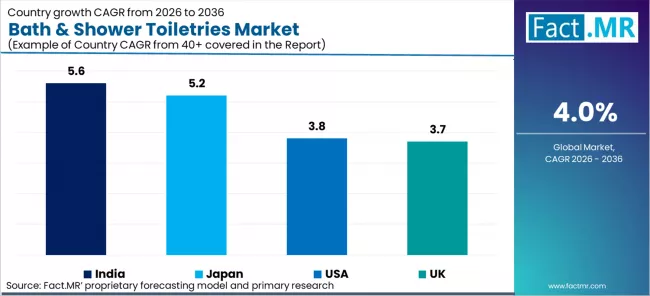
Bath & Shower Toiletries Market Cagr Analysis By Country | Source: Fact.MR
| Country | CAGR (2026 to 2036) |
|---|---|
| India | 5.6% |
| Japan | 5.2% |
| USA | 3.8% |
| UK | 3.7% |
Source: Fact.MR analysis. Updated Mar 12, 2026
Source: Future Market Insights (FMI) analysis, based on proprietary forecasting model and primary research
Asia Pacific Bath and Shower Toiletries Market Analysis
Asia Pacific represents the highest-growth region in the bath and shower toiletries market, led by India at 5.6% CAGR. Greenfield market development in South and Southeast Asia, combined with digital commerce infrastructure that bypasses traditional retail barriers, creates a distinct demand profile compared to mature Western markets.
India
India: Demand for bath and shower toiletries products in India is projected to expand at a 5.6% CAGR through 2036. Rising urban disposable income, premiumisation of personal care routines, and expansion of modern trade and e-commerce distribution driving shift from commodity bar soap to premium shower gel formats. The market structure in India reflects a combination of domestic brand competition and multinational investment, with distribution strategies adapted to local retail infrastructure and regulatory compliance requirements. FMI analysts assess India as a priority market for capacity investment given its above-average growth trajectory within the global forecast.
Japan
Japan: Demand for bath and shower toiletries products in Japan is projected to expand at a 5.2% CAGR through 2036. Deeply embedded bathing culture, premium onsen-inspired ingredient formulations, and ageing demographic driving sustained demand for therapeutic bath additives and high-performance shower products. The market structure in Japan reflects a combination of domestic brand competition and multinational investment, with distribution strategies adapted to local retail infrastructure and regulatory compliance requirements. FMI analysts assess Japan as a priority market for capacity investment given its above-average growth trajectory within the global forecast.
FACT.MR's analysis of the Bath and Shower Toiletries in Asia Pacific encompasses country-level assessments for India, China, Japan, South Korea, Indonesia, Australia, and the broader ASEAN region with detailed channel and segment data.
North America Bath and Shower Toiletries Market Analysis
North America represents a mature but value-accretive market for bath and shower toiletries products, where premium formulation, sustainability certification, and digital commerce capability are the primary competitive differentiators. Major multinational brand owners headquartered in the US maintain significant domestic manufacturing and distribution infrastructure.
USA
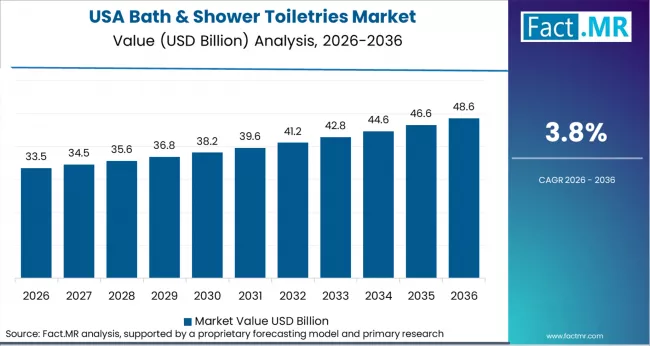
Bath & Shower Toiletries Market Country Value Analysis | Source: Fact.MR
USA: The bath and shower toiletries in USA is projected to grow at a 3.8% CAGR through 2036. Post-pandemic wellness trend sustaining interest in aromatherapy bath products and natural ingredient formulations, with clean beauty certification requirements from major retailers influencing reformulation investment. Regulatory requirements from the FDA, EPA, and state-level agencies provide the compliance framework within which product formulations must operate. Retailers including Walmart, Target, CVS Health, and Walgreens continue to raise sustainability and ingredient transparency requirements for supplier qualification.
FACT.MR's North America analysis includes the United States, Canada, and Mexico with detailed channel, pricing tier, and product format breakdowns.
Europe Bath and Shower Toiletries Market Analysis
European markets are characterised by strong regulatory oversight through EU cosmetics regulation, Extended Producer Responsibility packaging mandates, and consumer preference for certified sustainable formulations. Germany, France, and the UK represent the largest market value concentrations, with Nordic and Benelux markets delivering above-average premiumisation rates.
UK
UK: Demand in UK is forecast to grow at a 3.7% CAGR through 2036. UK Plastic Packaging Tax implemented in April 2022 accelerating transition to solid shampoo bars and concentrated shower products, with Boots and Superdrug expanding dedicated solid toiletries sections. EU Cosmetics Regulation 1223/2009 and its ongoing amendment cycle govern ingredient restrictions, labelling, and safety assessment requirements. Retailers including DM, Rossmann, Boots, and Carrefour are expanding their own-label certified natural ranges, intensifying competition for branded manufacturers on premium shelf placement.
FACT.MR's European regional assessment covers Germany, UK, France, Italy, Spain, Benelux, and the Nordic markets with regulatory compliance analysis and retailer strategy mapping.
Category-Wise Analysis
Bath and Shower Toiletries Market Analysis by Product Type
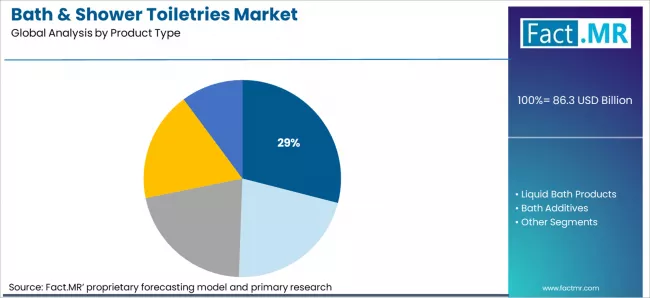
Bath & Shower Toiletries Market Analysis By Product Type | Source: Fact.MR
Based on FACT.MR analysis, Shower Products capture 29.0% of bath and shower toiletries market revenue in 2026. The global transition from bar soap to liquid and gel shower formats continues at a consistent pace across developing markets, supported by consumer preference for moisturising actives, dermatologist-tested formulations, and personal care ingredient transparency. Shower gel and body wash categories attract higher average selling prices than bar soap equivalents, generating revenue mix improvement even in markets with modest volume growth.
- Dove Reformulation Programme: Unilever's 2023 sustainability report disclosed that its Dove brand completed a global reformulation of its shower gel range to incorporate at least 50% recycled plastic packaging by end-2023, while simultaneously expanding the Dove Beauty Bar solid format range in response to consumer demand for plastic-reduction alternatives.
- Dermatologically Certified Positioning: The International Dermal Institute's 2024 consumer research, published through Dermalogica's corporate communications, documented that dermatologist-tested claim labelling on shower products increased purchase intent by 34% among sensitive skin consumers, prompting mass-market brands including Nivea and Cetaphil to expand dermatological certification programmes.
- UK Solid Toiletries Market: Lush Cosmetics' 2023 annual impact report disclosed that naked packaging-free solid shampoo and shower product sales exceeded 6 million units in the UK alone, validating the commercial scale of the solid toiletries transition driven by the UK Plastic Packaging Tax and consumer plastic reduction demand.
Bath and Shower Toiletries Market Analysis by Form
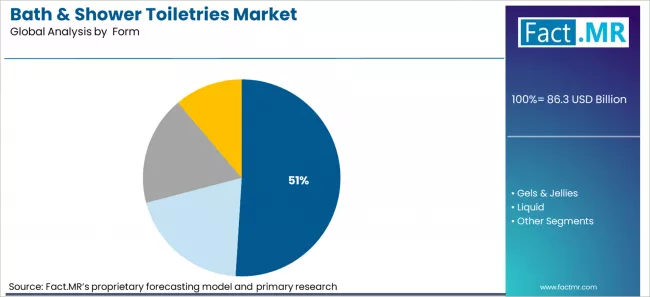
Bath & Shower Toiletries Market Analysis By Form | Source: Fact.MR
Solid format bath and shower products account for 51.0% of market revenue by form in 2026 per FACT.MR estimates. Solid bar formats maintain market leadership due to their extended product lifespan, lower unit cost, and growing appeal as a sustainable packaging alternative to single-use plastic bottles. The natural soap and artisanal bar segment has generated premium price points within the solid category, attracting independent brand entrants and driving category value growth.
- Plastic Tax Regulatory Impact: The UK Plastic Packaging Tax, effective April 2022, applies a GBP 210.82 per tonne charge on plastic packaging containing less than 30% recycled content, directly incentivising mass-market brands including Radox and Original Source to accelerate solid format and concentrated refill product launches.
- Concentrated Format Development: Procter and Gamble's 2024 sustainability report disclosed the expansion of its Herbal Essences bio:renew concentrated shampoo and conditioner bars across 15 new markets, reducing plastic packaging by 50% per consumer use versus standard bottle formats and addressing retail shelf-space efficiency requirements.
- Artisanal Soap Category Expansion: Etsy's 2023 seller data disclosed that handmade soap listings exceeded 2.8 million active products globally, with natural and artisanal bar soap representing the single largest health and beauty subcategory on the platform, indicating significant consumer interest in premium solid format alternatives.
Competitive Aligners for Market Players
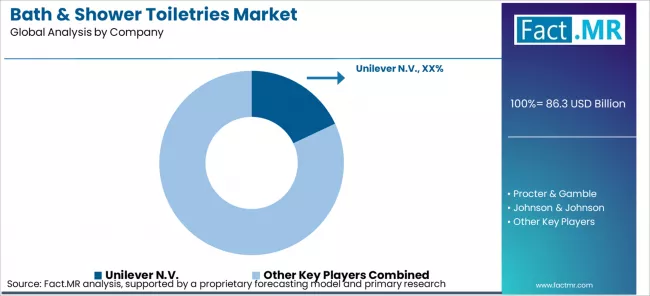
Bath & Shower Toiletries Market Analysis By Company | Source: Fact.MR
The competitive structure of the bath and shower toiletries market reflects high concentration at the global brand level, where multinationals including Unilever N.V., Procter and Gamble Co., Johnson and Johnson Services Inc., Colgate-Palmolive Company collectively manage diversified brand portfolios across multiple price tiers and geographic markets. Market concentration at the global level coexists with significant fragmentation at local and regional scales, where domestic brands and direct-to-consumer entrants compete effectively in specific channels and consumer segments.
Structural competitive advantages accrue to players with vertically integrated manufacturing, global ingredient procurement scale, and established retail distribution relationships that provide cost efficiency and speed-to-market advantages over newer entrants. Digital commerce has reduced the distribution advantage of traditional incumbents, enabling smaller brands to build consumer bases at a fraction of the capital cost historically required for national market entry.
As per FACT.MR estimates, the next competitive frontier is formulation science differentiation, where proprietary active ingredient combinations, clinically validated efficacy claims, and sustainability-certified ingredient sourcing will determine premium positioning and retail buyer support. Players investing in R&D capability and regulatory affairs infrastructure will be best positioned to navigate the tightening compliance environment in European and North American markets.
Recent Developments
- Unilever N.V. portfolio expansion (2024): Unilever N.V. announced expansion of its sustainability-certified product ranges in European and North American markets, incorporating recycled packaging and reformulated certified-natural actives to align with retailer sustainability procurement requirements.
- Procter and Gamble Co. digital commerce investment (2024): Procter and Gamble Co. disclosed increased digital commerce investment including social commerce partnerships and direct-to-consumer platform development to capture emerging market consumer cohorts bypassing traditional retail channels.
Methodology and Industry Tracking Approach
Fact.MR had scheduled the market survey of the Bath & Shower Toiletries market in 2025 across 21 countries in 4,560 certified stakeholders. The respondents are experts in the eco-friendly designs such as sustainable surfactant chemistry, pH balanced botanical formulation, biodegradable design, nontoxic fragrance stabilization and green label packaging.
They included 80 or more experts’ country to country and the majority are pioneers in both eco-centric product development, particularly in microbiome-friendly cleansers and water-saving rinse-off systems.
Activity monitored between June 2024 and May 2025 showed a steep rise in the refillable and solid-format toiletries, a boom in algae-based cleansing grounds and the rise in the use of bio-fermented plant oils with minimal packaging footprint. Outstanding investment flowed into AI-disabled ingredient tracking, co-manufacturing locally-based communities and zero-waste vanity packages, and promising activity in emerging economies supported decentralized and circular hygiene.
Fact.MR has been tracking this field since 2018, with common themes that proliferate there being regulatory harmonization, shelf-life logistics on natural formulations, and hyper-personalized body care now in line with clean-label trends, carbon-efficient production, and sensorial longevity.
Key Players in Bath and Shower Toiletries Market
- Unilever N.V.
- Procter and Gamble Co.
- Johnson and Johnson Services Inc.
- Colgate-Palmolive Company
- The Himalaya Drug Company
- Avon Products Inc.
- Bentley Laboratories plc
- Sebapharma GmbH and Co. KG
- The Hain Celestial Group Inc.
- ITC Limited
Bibliography
- HM Revenue and Customs. (2022). Plastic packaging tax: Technical guidance and rate schedule. UK Government.
- European Commission. (2024). Packaging and packaging waste regulation: Personal care sector compliance requirements. Official Journal of the EU.
- Cosmetics Europe. (2024). European cosmetics industry facts and figures 2024: Bath and shower product category data. Cosmetics Europe.
- World Bank. (2024). Urban consumer expenditure and personal care product access in emerging economies. World Bank Development Report.
- United Nations Environment Programme. (2024). Single-use plastics: A roadmap for sustainability in the consumer goods sector. UNEP.
- Organisation for Economic Co-operation and Development. (2024). Extended producer responsibility schemes: Packaging sector impact assessment. OECD Publishing.
This Report Addresses
- Market sizing and quantitative forecast metrics detailing bath and shower toiletries revenue projections from USD 86.32 USD Billion in 2026 to USD 127.77 USD Billion by 2036.
- Segmentation analysis mapping adoption patterns across product type formats and identifying leading sub-segments by revenue share and growth velocity.
- Regional deployment intelligence comparing high-growth emerging markets including India and Japan against mature market dynamics in North America and Europe.
- Regulatory compliance assessment analysing how evolving ingredient restrictions, packaging mandates, and sustainability certification requirements affect product development and market entry strategies.
- Competitive landscape evaluation profiling key players including Unilever N.V., Procter and Gamble Co., Johnson and Johnson Services Inc., Colgate-Palmolive Company and assessing their strategic positioning, geographic footprint, and product portfolio composition.
- Channel strategy intelligence comparing traditional retail, e-commerce, and direct-to-consumer distribution models and quantifying their respective revenue contributions across key markets.
- Investment opportunity mapping identifying priority geographies, consumer segments, and product format gaps for market entry or portfolio expansion decisions.
- Custom data delivery formats encompassing PDF narrative reports, interactive dashboards, raw Excel datasets, and presentation-ready PowerPoint files.
Segmentation
Scope of the Report
| Metric | Value |
|---|---|
| Quantitative Units | USD 86.32 USD Billion to USD 127.77 USD Billion, at a CAGR of 4.0% |
| Market Definition | The Bath and Shower Toiletries encompasses shower products, liquid bath products, bath additives, bar soaps, other product types products sold to end consumers through retail and direct-to-consumer channels globally. |
| Product Type Segmentation | Shower Products, Liquid Bath Products, Bath Additives, Bar Soaps, Other Product Types |
| Form Segmentation | Solid, Gels and Jellies, Liquid, Others |
| Regions Covered | North America, Latin America, Europe, East Asia, South Asia, Oceania, Middle East and Africa |
| Countries Covered | India, Japan, USA, UK, and 40 plus countries |
| Key Companies Profiled | Unilever N.V., Procter and Gamble Co., Johnson and Johnson Services Inc., Colgate-Palmolive Company, The Himalaya Drug Company, Avon Products Inc., Bentley Laboratories plc, Sebapharma GmbH and Co. KG, The Hain Celestial Group Inc., ITC Limited |
| Forecast Period | 2026 to 2036 |
| Approach | Hybrid top-down and bottom-up modelling starting from country-level consumption benchmarks with channel penetration and regulatory adoption curves applied |
Source: Fact.MR analysis. Updated Mar 12, 2026
Bath and Shower Toiletries Market Analysis by Segments
-
Product Type :
- Shower Products
- Liquid Bath Products
- Bath Additives
- Bar Soaps
- Other Product Types
-
Form :
- Solid
- Gels and Jellies
- Liquid
- Others
-
Sales Channel :
- Supermarkets/Hypermarkets
- Specialty Stores
- Online Channels
- Convenience Stores
- Others
-
Region :
- North America
- Latin America
- Europe
- East Asia
- South Asia
- Oceania
- Middle East and Africa
Frequently Asked Questions
How large is the Bath and Shower Toiletries Market in 2026?
What will the Bath and Shower Toiletries Market be worth by 2036?
What is the expected CAGR for the Bath and Shower Toiletries Market between 2026 and 2036?
Which Product Type is poised to lead global sales by 2026?
What is the leading Form in the Bath and Shower Toiletries Market?
Which country shows the highest growth rate in the Bath and Shower Toiletries Market?
What is Japan's growth outlook in the Bath and Shower Toiletries Market?
What does the Bath and Shower Toiletries Market cover?
What is excluded from the Bath and Shower Toiletries Market scope?
How does FACT.MR build and validate the Bath and Shower Toiletries Market forecast?
Who worked on this report


Preview the report firsthand - request a free sample
Free SampleGet the brochure for pricing and purchase details
Download PDF