The Rinse Aid and Drying Agents Market is analyzed across its key product, application and end-use segments, with the study covering market dynamics, regional trends and demand outlook, forecast 2026 to 2036.
By Fact.MR Consumer Goods DeskFact-checked under the Fact.MR editorial processUpdated
10 min read
Rinse Aid and Drying Agents Market Forecast and Outlook 2026 to 2036
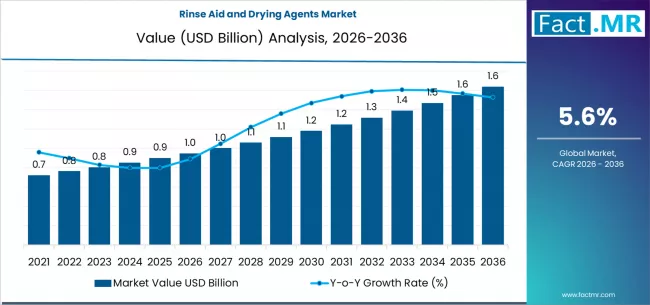
The global rinse aid and drying agents market is projected to expand from USD 0.95 billion in 2026 to USD 1.64 billion by 2036, representing a compound annual growth rate (CAGR) of 5.6% during the forecast period. This growth trajectory translates to a total market expansion of 72.6% over the ten-year period. The low-temp machine rinse aids segment is anticipated to capture 34.0% of the market share in 2026.
Rinse Aid And Drying Agents Market Market Value Analysis | Source: Fact.MR
Summary of Rinse Aid and Drying Agents Market
Market Snapshot
Global rinse aid and drying agents market revenue stood at USD 0.95 billion in 2026 and is forecast to reach USD 1.64 billion by 2036.
At a 5.6% CAGR from 2026 to 2036, this market is set to expand ~1.7x in value, adding USD 0.69 billion in absolute opportunity.
Growth is being driven by increasing demand from commercial kitchens and institutional foodservice operations.
Rinse aids and drying agents are critical for improving dishwashing efficiency, ensuring streak-free drying, andmaintaininghygiene standards.
Demand and Growth Drivers
Expansion of commercial kitchens and foodservice establishments is accelerating demand.
Increasing focus on operational efficiency and faster dishwashing cycles is supporting adoption.
Growth in hospitality and institutional sectors is expanding the addressable market.
Need for solutions that provide:
Spot-free and streak-free drying
Reduced drying time
Improved dishwashing efficiency
Compatibility with automated dishwashing systems
Increasing penetration of automated dishwashing systems is further driving demand.
Product and Segment View
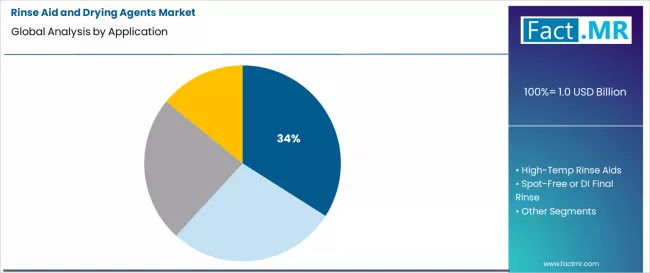
Low-Temp Machine Rinse Aids hold 34.0% of segment share in 2026,emergingas the leading segment.
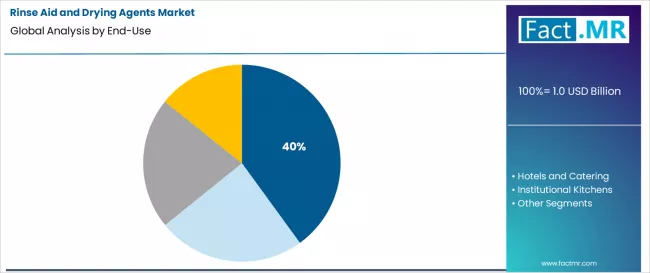
Restaurants account for 40.0% of end-use share in 2026, positioning them as the dominant segment.
Key product categories include:
Low-temperature machine rinse aids
High-temperature machine rinse aids
Drying agents for automated dishwashing systems
Specialty formulations
Others
Geography and Competitive Outlook
Growth is supported across North America, Europe, and Asia Pacific, aligned with foodservice industry expansion.
Key growth markets and CAGR: USA (5.7%), South Korea (5.6%), UK (5.2%), Germany (5.0%), Japan (4.8%).
Market expansion is closely tied to:
Growth in hospitality and foodservice sectors
Adoption of automated dishwashing systems
Increasing hygiene and efficiency standards
Key companies active in this marketinclude:Ecolab,Solenis, Procter & Gamble, Unilever Professional, Henkel.
Rinse Aid and Drying Agents Market - At a Glance
Attribute
Details
Market Value 2026
USD 0.95 billion
Market Value 2036
USD 1.64 billion
Absolute Dollar Opportunity 2026–2036
USD 0.69 billion
Total Growth 2026–2036
72.6%
CAGR 2026–2036
5.6%
Growth Multiple
~1.7x
Key Demand Theme
Increasing demand for efficient, automated dishwashing and drying solutions in foodservice
Leading Segment by Type (2026)
Low-Temp Machine Rinse Aids
Segment Share (2026)
34.0%
Leading Segment by End Use (2026)
Restaurants
Segment Share (2026)
40.0%
Key Growth Regions
North America, Europe, Asia Pacific
Country CAGRs
USA 5.7%, South Korea 5.6%, UK 5.2%, Germany 5.0%, Japan 4.8%
North America, Latin America, Europe, Asia Pacific, MEA
Low-temperature machine rinse aids provide commercial dishwashing operations with enhanced drying performance and spot prevention capabilities while maintaining cost-effective operation parameters across diverse foodservice environments. These formulations deliver consistent results in high-volume washing applications where energy efficiency and operational reliability remain critical factors. Restaurants are expected to account for 40.0% of the rinse aid and drying agents market in 2026, reflecting the segment's dominant position in commercial dishwashing applications. Restaurant operations require reliable drying solutions that support rapid table turnover and maintain presentation standards while managing operational costs. The combination of high-volume dishwashing requirements and stringent cleanliness standards drives consistent demand for specialized rinse aid formulations across quick-service, casual dining, and fine dining establishments.
Category
Category
Segments
Application
Low-Temp Machine Rinse Aids; High-Temp Rinse Aids; Spot-Free or DI Final Rinse; Glassware Drying Agents
Undercounter; Hood-Type; Conveyor or Flight-Type; Glasswashers and Other
End-Use
Restaurants; Hotels and Catering; Institutional Kitchens; Food Processing and Other
Region
North America; Europe; Asia Pacific; Latin America; Middle East & Africa
Segmental Analysis
By Application, Which Segment Holds the Dominant Share in the Rinse Aid and Drying Agents Market?
Rinse Aid And Drying Agents Market Analysis By Application | Source: Fact.MR
The low-temp machine rinse aids segment leads the market with a 34% share. Commercial kitchen operators and facility managers increasingly adopt low-temperature rinse aid systems for their operational efficiency and consistent drying performance across varied washing cycles.
Equipment investments in advanced low-temperature dishwashing systems continue to drive adoption among cost-conscious foodservice operations seeking energy efficiency optimization.
Foodservice professionals prioritize consistent drying results and operational reliability, making low-temp rinse aids the preferred choice for high-volume washing applications requiring predictable performance standards.
By End-Use, Which Segment Registers the Highest Share in the Rinse Aid and Drying Agents Market?
Rinse Aid And Drying Agents Market Analysis By End Use | Source: Fact.MR
Restaurants dominate the end-use segment with 40.0% market share, reflecting their position as the primary application sector for commercial dishwashing operations requiring reliable drying solutions and presentation quality maintenance. Restaurant operators and kitchen managers select rinse aid products based on performance consistency and operational cost considerations.
Restaurant operators optimize product selections to meet high-volume washing requirements while maintaining consistent presentation standards across service periods.
The foodservice industry's continued expansion and emphasis on operational efficiency drive sustained demand for specialized rinse aid formulations that support rapid table turnover and cost management objectives.
What are the Drivers, Restraints, and Key Trends of the Rinse Aid and Drying Agents Market?
Drivers: Expanding foodservice sector and increasing emphasis on operational efficiency drive consistent adoption of specialized drying solutions across commercial dishwashing applications.
Restraint: Price sensitivity among smaller foodservice operations and the availability of generic alternatives limit premium product penetration in cost-conscious market segments.
Trend 1: Development of concentrated formulations that reduce packaging costs and storage requirements while maintaining performance standards.
Trend 2: Integration of bio-based chemistry platforms supporting environmental compliance requirements and operator preference for sustainable formulations.
Analysis of the Rinse Aid and Drying Agents Market by Key Country
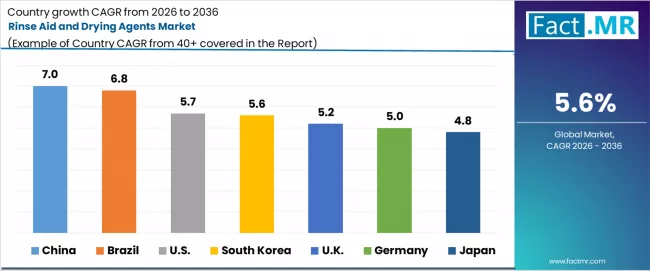
Rinse Aid And Drying Agents Market Cagr Analysis By Country | Source: Fact.MR
Country
CAGR (2026 to 2036)
China
7.0%
Brazil
6.8%
USA
5.7%
South Korea
5.6%
UK
5.2%
Germany
5.0%
Japan
4.8%
The report covers an in-depth analysis of 40+ countries; top-performing countries are highlighted below.
What Opportunities Can Rinse Aid and Drying Agents Manufacturers Expect in China?
Rinse Aid And Drying Agents Market Country Value Analysis | Source: Fact.MR
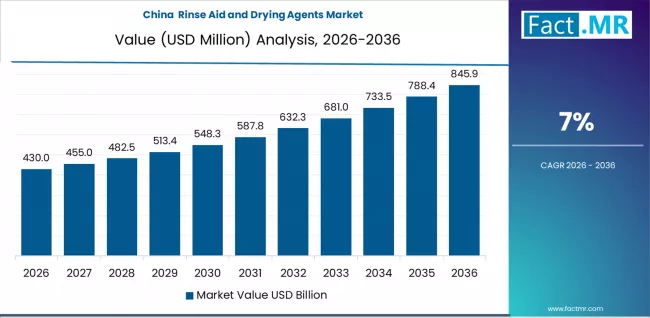
Revenue from rinse aid and drying agents consumption in China is projected to exhibit robust growth with a CAGR of 7.0% through 2036, supported by rapid foodservice sector expansion, urbanization trends, and increasing adoption of commercial dishwashing equipment across hospitality and institutional sectors.
Growing restaurant industry and expanding hotel capacity create sustained demand for commercial dishwashing solutions and specialized drying agents across major urban markets.
Rising quality standards and operational efficiency requirements among foodservice operators drive adoption of premium rinse aid formulations that deliver consistent performance and cost optimization benefits.
What is the Brazilian Rinse Aid and Drying Agents Market Size?
Revenue from rinse aid and drying agents products in Brazil is projected to expand at a CAGR of 6.8%, driven by foodservice sector growth, tourism industry development, and increasing commercial kitchen installations across hospitality and institutional segments.
Expanding hotel and restaurant capacity alongside rising consumer dining frequency create opportunities for specialized dishwashing solution providers across traditional and emerging market segments.
Growing awareness of operational efficiency benefits and product performance advantages support adoption of advanced rinse aid formulations among quality-focused establishments.
What is the USA Rinse Aid and Drying Agents Market Size?
Revenue from rinse aid and drying agents products in the USA is projected to grow at a CAGR of 5.7% through 2036, supported by the country's established foodservice infrastructure, emphasis on operational efficiency, and continued expansion of commercial kitchen applications requiring reliable drying solutions.
Advanced commercial dishwashing technology adoption and growing emphasis on cost efficiency drive demand for specialized rinse aid systems across diverse foodservice applications.
Strong focus on operational performance and labor optimization encourages continued adoption of premium drying agent formulations that support productivity objectives.
What Challenges Do Rinse Aid and Drying Agents Manufacturers Face in South Korea?
Revenue from rinse aid and drying agents products in South Korea is projected to grow at a CAGR of 5.6% through 2036, supported by established foodservice markets, quality standards emphasis, and growing commercial kitchen modernization across hospitality sectors.
Established restaurant industry and expanding hotel capacity drive steady demand for reliable dishwashing solutions and specialized drying formulations across urban markets.
Strong emphasis on operational efficiency and quality maintenance supports adoption of premium rinse aid products among performance-focused establishments.
What is the UK Rinse Aid and Drying Agents Market Size?
Revenue from rinse aid and drying agents products in the UK is projected to grow at a CAGR of 5.2% through 2036, supported by the country's established hospitality sector, operational efficiency emphasis, and continued modernization of commercial dishwashing applications.
Advanced commercial kitchen infrastructure and growing emphasis on cost efficiency drive demand for specialized rinse aid systems across foodservice applications.
Strong focus on operational performance and quality maintenance encourages adoption of premium drying agent formulations that support productivity and presentation standards.
What is the German Rinse Aid and Drying Agents Market Size?
Revenue from rinse aid and drying agents products in Germany is projected to grow at a CAGR of 5.0% through 2036, supported by the country's commitment to operational excellence, established commercial infrastructure, and growing investment in advanced dishwashing technology.
Strong industrial base and emphasis on operational efficiency create consistent demand for specialized rinse aid systems across foodservice and institutional applications.
Focus on technology advancement and operational optimization supports adoption of premium formulations among establishments seeking competitive advantages and cost management benefits.
What Challenges Do Japanese Rinse Aid and Drying Agents Manufacturers Face?
Revenue from rinse aid and drying agents products in Japan is projected to grow at a CAGR of 4.8% through 2036, supported by the country's emphasis on quality standards, established foodservice infrastructure, and continued modernization of commercial dishwashing applications requiring specialized drying solutions.
Advanced commercial kitchen technology and growing emphasis on operational precision drive demand for specialized rinse aid systems across hospitality and institutional sectors.
Strong focus on quality maintenance and operational efficiency encourages adoption of premium drying agent formulations that support presentation standards and cost optimization objectives.
Competitive Landscape of the Rinse Aid and Drying Agents Market
Rinse Aid And Drying Agents Market Analysis By Company | Source: Fact.MR
The rinse aid and drying agents market features competition among established chemical companies, specialized dishwashing solution providers, and integrated foodservice equipment manufacturers. Companies invest in advanced chemistry development, specialized formulation platforms, and comprehensive distribution networks to deliver consistent, high-performance drying solutions.
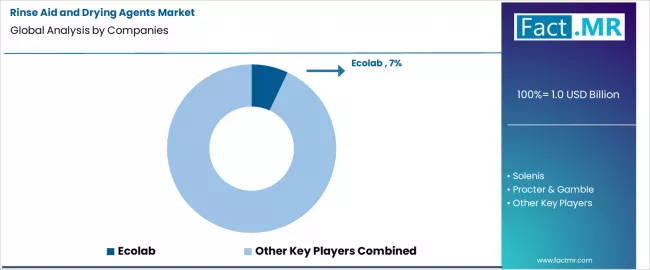
Market participants include Ecolab, Solenis, Procter & Gamble, Unilever Professional, and Henkel, offering commercial and institutional systems with emphasis on operational efficiency and performance reliability. Ecolab provides integrated dishwashing solutions with focus on foodservice applications and comprehensive support services.
Key Players in the Rinse Aid and Drying Agents Market
Ecolab
Solenis
Procter & Gamble
Unilever Professional
Henkel
Kao Corporation
Reckitt
Spartan Chemical
Betco
Zep
Bibliography
International Foodservice Cleaning Chemicals Council. (2025). Rinse aid and drying agents for commercial dishwashing: Market outlook, formulation trends, and operational efficiency performance (2026-2036). IFCCC Publications.
Global Institutional Cleaning Research Institute. (2024). Low-temperature machine rinse aids and drying formulations: Chemistry platforms, performance benchmarks, and application standards. GICRI Reports.
Foodservice Sanitation Solutions Forum. (2025). Commercial rinse aid adoption across restaurant and hospitality kitchens: Market segmentation and regional growth analysis. FSSF.
Sustainable Cleaning Chemistry Association. (2024). Bio-based and concentrated rinse aid formulations for institutional dishwashing: Environmental compliance and lifecycle performance. SCCA.
Advanced Dishwashing Formulation Consortium. (2025). Next-generation rinse aid and drying agent systems: Technology evolution, cost optimization, and market evaluation. ADFC.
Scope of the Report
Items
Values
Quantitative Units (2026)
USD 0.95 Billion
Application
Low-Temp Machine Rinse Aids, High-Temp Rinse Aids, Spot-Free or DI Final Rinse, Glassware Drying Agents
Undercounter, Hood-Type, Conveyor or Flight-Type, Glasswashers and Other
End-Use
Restaurants, Hotels and Catering, Institutional Kitchens, Food Processing and Other
Regions Covered
North America, Europe, Asia Pacific, Latin America, Middle East & Africa
Countries Covered
China, Brazil, U.S., South Korea, Europe, U.K., Germany, Japan, and other countries
Key Companies Profiled
Ecolab, Solenis, Procter & Gamble, Unilever Professional, Henkel, and other leading chemical companies
Additional Attributes
Dollar sales by application, chemistry, dishmachine type, end-use, and region; regional demand trends, competitive landscape, technological advancements in dishwashing chemistry, formulation optimization initiatives, cost efficiency programs, and premium product development strategies
Rinse Aid and Drying Agents Market by Segments
Application :
Low-Temp Machine Rinse Aids
High-Temp Rinse Aids
Spot-Free or DI Final Rinse
Glassware Drying Agents
Chemistry :
Nonionic Surfactant Systems
Polymer Wetting Agents
Acidic Neutralizers
Bio-Based Blends
Other Chemistries
Dishmachine Type :
Undercounter
Hood-Type
Conveyor or Flight-Type
Glasswashers and Other
End-Use :
Restaurants
Hotels and Catering
Institutional Kitchens
Food Processing and Other
Region :
North America
USA
Canada
Mexico
Europe
Germany
UK
France
Italy
Spain
Nordic Countries
BENELUX
Rest of Europe
Asia Pacific
China
Japan
South Korea
India
Australia
Rest of Asia Pacific
Latin America
Brazil
Argentina
Rest of Latin America
Middle East and Africa
Kingdom of Saudi Arabia
United Arab Emirates
South Africa
Rest of Middle East and Africa
Other Regions
Oceania
Central Asia
Other Markets
Frequently Asked Questions
How big is the rinse aid and drying agents market in 2026?
The global rinse aid and drying agents market is estimated to be valued at USD 1.0 billion in 2026.
What will be the size of rinse aid and drying agents market in 2036?
The market size for the rinse aid and drying agents market is projected to reach USD 1.6 billion by 2036.
How much will be the rinse aid and drying agents market growth between 2026 and 2036?
The rinse aid and drying agents market is expected to grow at a 5.6% CAGR between 2026 and 2036.
What are the key product types in the rinse aid and drying agents market?
The key product types in rinse aid and drying agents market are low-temp machine rinse aids, high-temp rinse aids , spot-free or di final rinse and glassware drying agents .
Which end-use segment to contribute significant share in the rinse aid and drying agents market in 2026?
In terms of end-use, restaurants segment to command 40.0% share in the rinse aid and drying agents market in 2026.