- Market Value (2025): USD 451.8 Mn
- Estimated Value (2026): USD 482.5 Mn
- Forecast Value (2036): USD 931.6 Mn
- CAGR (2026-2036): 6.8%
What is the Candle Making Kit Market forecast to be worth by 2036?
USD 482.5 million in 2026 to USD 931.6 million by 2036 at 6.8% CAGR.
- The candle making kit market reached USD 451.8 million in 2025 as DIY gifting and home-decor activity kept starter kits visible across online craft channels.
- Demand is projected to increase from USD 482.5 million in 2026 to USD 931.6 million by 2036.
- The market is forecast to record a 6.8% CAGR from 2026 to 2036.
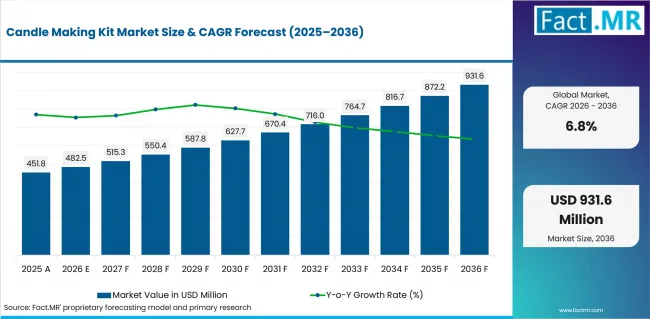
Candle Making Kit Market Value Analysis | Source: Fact.MR
What are the defining numbers behind Candle Making Kit Market growth?
USD 449.1 million absolute opportunity by 2036, led by Beginner Candle Making Kits and Soy Wax alongside Online Retail and Personal Use.
- Demand Drivers in the Market
- Beginner kits reduce the number of separate supply decisions for first-time users. Retailers are expected to favor bundles that show the customer what to melt and what to pour first.
- Soy wax gives the kit a simple material story for home fragrance use. Clear wick guidance is expected to reduce poor first-pour results and encourage refill purchases.
- Online retail gives small brands room to show pack contents through images and short videos. This route is expected to help shoppers compare beginner packs before checkout.
- Personal-use occasions create steady demand when customers buy kits for hobby time or seasonal gifts. Simple safety language is expected to lower hesitation before purchase.
- Key Segments Analyzed
- By Kit Type: Beginner Candle Making Kits are projected to hold 39.8% share in 2026 as they lower the entry barrier for first-time makers.
- By Wax Type: Soy Wax is expected to hold 38.7% share in 2026 where shoppers want a familiar home-fragrance material.
- By Distribution Channel: Online Retail is anticipated to hold 34.3% share in 2026 since kits are easy to compare through reviews and pack images.
- By Application: Personal Use is estimated to hold 34.0% share in 2026 when customers treat candle making as a hobby or gift activity.
- By End User: Adults are forecast to hold 34.8% share in 2026 because purchase responsibility and hot-wax handling remain adult-led.
- Analyst Opinion at Fact.MR
- Shambhu Nath Jha, Sr. Consultant at Fact.MR, states, “Candle making kits are expected to compete on ease of use and repeat safety confidence instead of ingredient count alone. Brands that make wax choice and wick guidance easy to understand are better placed to win beginner and gift-led customers.”
- Strategic Implications
- Retailers can list starter kits and refill packs separately. This makes product comparison easier for customers.
- Brands need to show the wax type clearly on the pack. Simple burning instructions can also improve first-time use.
- Investors can assess UK and USA growth through online reach and refill purchases. Demand for paraffin wax and wax dyes may support repeat sales.
The USA is projected to record an 8.8% CAGR from 2026 to 2036, followed by Canada at 7.8%, the UK at 6.8%, Germany at 5.8%, and France at 4.8%.
How does the Candle Making Kit Market break down by segment?
Beginner Candle Making Kits are expected to lead Kit Type at 39.8% share in 2026. Soy Wax is projected to lead Wax Type at 38.7% share in 2026.
Why do Beginner Candle Making Kits lead the Kit Type segment?
Beginner Candle Making Kits are projected to account for 39.8% share in 2026.
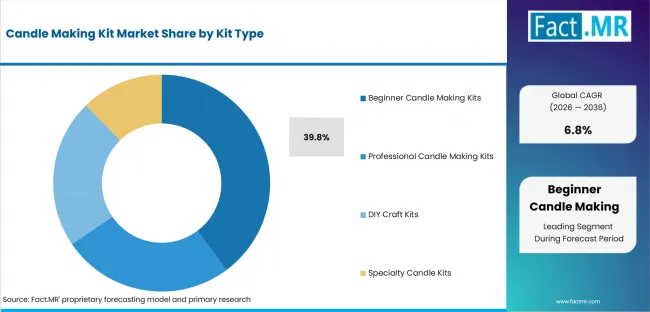
Candle Making Kit Market Analysis By Kit Type | Source: Fact.MR
First-time buyers often prefer a complete kit that removes the need to choose each material separately. Soy Wax and Beeswax Candle Kits appeal to customers with specific material or gifting preferences. Paraffin Wax Candle Kits remain relevant for shoppers focused on price and familiar burning performance. Hydrocarbon waxes also support lower-cost packs using petroleum-based inputs.
Why does Soy Wax lead Wax Type?
Soy Wax is expected to account for 38.7% share in 2026.
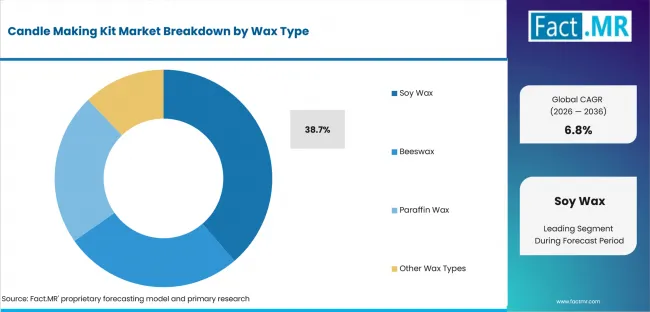
Candle Making Kit Market Analysis By Wax Type | Source: Fact.MR
Its simple product story and beginner-friendly image keep Soy Wax ahead in the category. Natural and blended options allow brands to serve different budgets. Container Soy Wax fits kits built around jars and decorative vessels. Paraffin colorant dyes add more shade choices for seasonal and themed candle projects.
Why does Online Retail lead Distribution Channel?
Online Retail is anticipated to account for 34.3% share in 2026.
Customers can compare kit contents, prices and reviews more easily online. Marketplaces give beginner packs wider visibility, while brand websites help sellers promote refill wax and fragrance oils. Clear art-supply packaging and product images also make digital listings easier to understand.
Why does Personal Use lead Application?
Personal Use is estimated to account for 34.0% share in 2026.
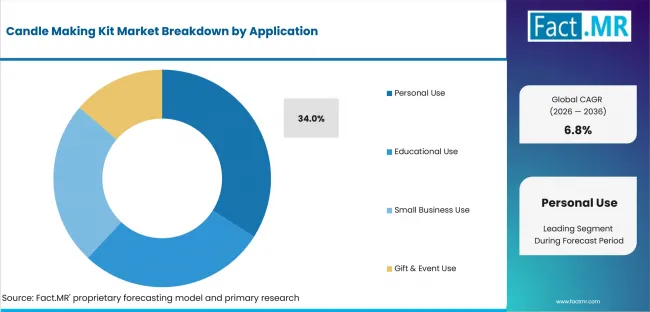
Candle Making Kit Market Analysis By Application | Source: Fact.MR
Candle making is commonly purchased as a hobby, home activity or handmade gift project. Finished candles can also support decoration needs, which keeps Hobby Crafting and Home Decoration closely linked. Essential oils and fragrance products encourage users to try new scents and repeat the activity.
Why do Adults lead the End User segment?
Adults are forecast to account for 34.8% share in 2026.
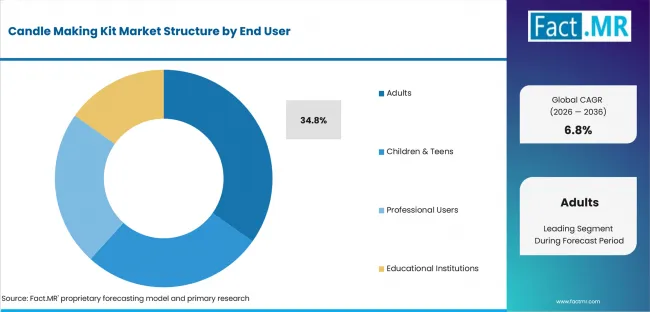
Candle Making Kit Market Analysis By End User | Source: Fact.MR
Melting wax and mixing fragrances require careful handling, making adults the main user group. Hobbyists and DIY Enthusiasts often purchase refills after using their first kit. Home Crafters create further demand through repeated projects. Industrial wax remains outside this segment unless it is repacked for small-scale consumer use.
What is accelerating Candle Making Kit Market adoption, and what is holding it back?
Demand is likely to grow through easy beginner kits and strong interest in soy wax. Growth may be limited by cheaper private-label products and changing wax prices.
Drivers Impact Analysis
| DRIVER | QUALITATIVE IMPACT | GEOGRAPHIC RELEVANCE | IMPACT TIMELINE |
|---|---|---|---|
| Beginner candle making kits specification pull | High | UK, USA | Short term (<= 2 years) |
| Soy wax repeat-use occasion | High | USA and Canada | Short term (<= 2 years) |
| UK route-to-market activity | Moderate | UK and Germany | Medium term (2-4 years) |
| Online retail packaging and shelf conversion | Moderate | USA, Canada, France | Medium term (2-4 years) |
Source: Fact.MR analysis. Updated Jul 29, 2026
- Beginner candle making kits specification pull: Starter packs are expected to lift demand when customers want a complete first-pour solution. Clear instructions and enough material for visible results make the kit easier to approve as a gift or hobby purchase.
- Soy wax repeat-use occasion: Soy Wax is expected to support repeat buying where customers connect material choice with home fragrance and personal comfort. Better wick guidance and melting instructions reduce the risk of poor first-use outcomes.
- UK route-to-market activity: UK demand is expected to improve when retailers position kits around gifting and home-decor occasions. Brands gain when product pages explain pack contents and safety requirements in plain language.
- Online retail packaging and shelf conversion: Online Retail is anticipated to raise kit visibility through pack images and reviews. Stronger packaging copy gives customers a faster route from browsing to purchase.
Opportunity Impact Analysis
| OPPORTUNITY | QUALITATIVE IMPACT | GEOGRAPHIC RELEVANCE | IMPACT TIMELINE |
|---|---|---|---|
| Soy wax occasion-led assortments | Moderate | UK and USA | Medium term (2-4 years) |
| Private-label partnerships | Moderate | USA and Germany | Medium term (2-4 years) |
| Beginner candle making kits bundle formats | Selective | Canada and France | Long term (>= 4 years) |
Source: Fact.MR analysis. Updated Jul 29, 2026
- Soy wax occasion-led assortments: Retailers are expected to build stronger gifting ranges when kits are grouped by scent and event. This gives brands a route to sell refill wax and fragrance oils after the first box is used.
- Private-label partnerships: Store brands are expected to use candle kits to offer controlled price points without asking shoppers to buy each input separately. Brands that document wax type and wick fit are expected to win more repeat listings.
- Beginner candle making kits bundle formats: Multi-pour boxes are expected to appeal to customers who want more than a one-time craft item. Better bundling is expected to turn first-use success into follow-on purchases of wax and vessels.
Restraints Impact Analysis
| RESTRAINT | QUALITATIVE IMPACT | GEOGRAPHIC RELEVANCE | IMPACT TIMELINE |
|---|---|---|---|
| Private-label competition and changing discretionary spending for beginner candle making kits | High | UK and USA | Short term (<= 2 years) |
| Price sensitivity around soy wax | Moderate | USA and Canada | Medium term (2-4 years) |
| Slow conversion where beginner candle making kits lack customer-side validation | Selective | Germany and France | Medium term (2-4 years) |
Source: Fact.MR analysis. Updated Jul 29, 2026
- Private-label competition and changing discretionary spending for beginner candle making kits: Lower-priced packs are expected to pressure branded kits when customers treat the product as an occasional hobby purchase. Brands need clearer differences in instructions and refill support to defend value.
- Price sensitivity around soy wax: Conversion slows when shoppers compare soy kits against cheaper wax alternatives without seeing a clear benefit. Brands are expected to explain burn behavior and material fit before asking customers to pay more.
- Slow conversion where beginner candle making kits lack customer-side validation: Retailers hesitate when kit contents and safety language are not clear. Weak documentation extends listing review and reduces confidence in repeat sales.
Which countries are scaling Candle Making Kit Market fastest?
The USA records the highest listed CAGR at 8.8%, followed by Canada at 7.8%, the UK at 6.8%, Germany at 5.8%, and France at 4.8% from 2026 to 2036. The four-percentage-point spread shows materially different growth rates across the five markets.
- The UK records a 6.8% CAGR. Beginner kits fit gift-led craft buying and online discovery, while clear labels and simple first-use instructions support conversion.
- The USA leads the comparison at 8.8% CAGR. Brand websites and marketplaces give soy wax kits and other beginner products direct routes to online shoppers.
- Germany records a 5.8% CAGR. Compliance-minded retail channels favor clear product information and safe-handling instructions.
- Canada ranks second at 7.8% CAGR. Online access, reliable pack information and service availability support personal-use and gift purchases across a broad geography.
- France records the lowest listed CAGR at 4.8%. Design-led home fragrance and craft retail remain the main routes for kit positioning.
These CAGRs create different market-entry conditions across the five countries. Deployment timing depends on retail placement and online proof. Brand readiness depends on making the first candle-making attempt feel simple and safe.
The full report provides country-level CAGR analysis across North America, Latin America, Europe, East Asia, South Asia and Oceania, and the Middle East and Africa.
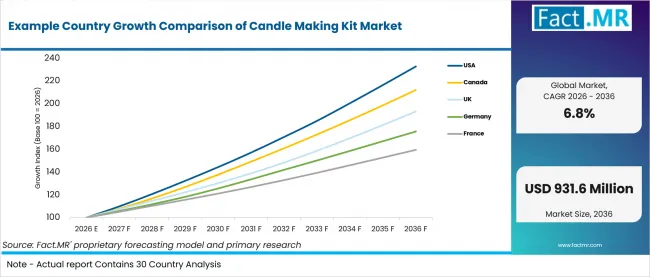
Example Country Growth Comparison Of Candle Making Kit Market | Source: Fact.MR
| Country | CAGR (2026-2036) |
|---|---|
| UK | 6.8% |
| USA | 8.8% |
| Germany | 5.8% |
| Canada | 7.8% |
| France | 4.8% |
Source: Fact.MR analysis. Updated Jul 29, 2026
What supports UK adoption?
The UK is projected to record a 6.8% CAGR from 2026 to 2036.
Gift purchases and hobby browsing create a strong entry point in the UK. Beginner kits gain attention when buyers can quickly understand the wax type, included tools and first-pour steps. Branded products may face pressure when private-label kits offer similar instructions and refill value.
How is USA scaling demand?
The USA is projected to record an 8.8% CAGR from 2026 to 2036.
In the USA, shoppers often compare kits online before choosing a product. Soy wax supports demand through personal-use candles and home fragrance projects. Brands can improve repeat sales by offering clear instructions, refill options and better support than lower-priced marketplace competitors.
What is driving Germany’s growth from 2026 to 2036?
Germany is projected to record a 5.8% CAGR from 2026 to 2036.
German retailers are likely to favor kits that explain contents, safety steps and handling requirements clearly. This reduces review effort and makes beginner products easier to approve. Premium kits may take longer to sell when customers cannot see a clear difference in quality or value.
How is Canada developing demand?
Canada is projected to record a 7.8% CAGR from 2026 to 2036.
Canada’s large retail geography increases the role of online sales. Customers can choose scents, wax types and container styles without visiting a store. Brands that maintain refill stock and provide dependable customer support are better placed to encourage repeat purchases.
How does France perform?
France is projected to record a 4.8% CAGR from 2026 to 2036.
France gains from candle kits that look suitable for gifting and home decoration. Adult buyers often place more value on scent choice, neat packaging and finished appearance. Demand may weaken when ready-made candles seem more convenient than completing the candle-making process at home.
Who leads the Candle Making Kit Market?
Makesy and Candle Science, LLC (CandleScience) stand out through broad candle-making supplies and beginner-friendly kit options, while CraftZee and Village Craft and Candle Inc. (Village Craft & Candle) add strength across gift-led and hobby-focused products.
Makesy serves home crafters with wax, fragrance, vessels and bundled project supplies. CandleScience supports beginners and small makers through candle-making kits, supplies and learning resources. CraftZee focuses on ready-to-use craft kits designed for simple home projects. Village Craft & Candle adds wax, wicks, scents and candle-making tools for hobby and small-batch users. Together, these companies cover starter purchases, repeat supplies and more advanced project needs.
Between 2026 and 2036, market rivalry is likely to center on kit simplicity, packaging quality and refill availability. Buyers may also compare wax choice, scent variety, safety guidance and the amount of material included in each box. Brands that help customers complete the first candle successfully and continue with later projects may secure stronger sales through online stores, craft retailers and direct brand websites.
Which companies are the key providers?
Key companies include Makesy; CraftZee; Candle Science, LLC (CandleScience); Village Craft and Candle Inc. (Village Craft & Candle).
- Makesy
- CraftZee
- Candle Science, LLC (CandleScience)
- Village Craft and Candle Inc. (Village Craft & Candle)
Bibliography
This Report Answers
- The report provides strategic intelligence on the Candle Making Kit Market across Kit Type and Wax Type choices that shape starter kit demand.
- Segment analysis covers Beginner Candle Making Kits and Soy Wax as the share leaders within the 2026 market.
- Country outlook compares the USA, Canada, UK, Germany and France and explains their different channel and positioning requirements.
- Competitive analysis profiles Makesy, CraftZee, CandleScience and Village Craft & Candle.
- Channel assessment covers Online Retail and brand websites. Offline craft stores and wholesale routes complete the route-to-market view.
What does the Candle Making Kit Market cover?
Candle making kits cover bundled supplies used to make candles at home. They are used in craft settings and small commercial trials.
The Candle Making Kit Market covers beginner and specialty kit formats sold through online and offline channels. Soy wax, beeswax and paraffin wax kits remain part of the scope. Coverage extends to wax and containers when these items are sold as a bundled kit. Educational and small-business use are included when the kit is purchased for direct candle-making activity.
The market differs from finished candle sales since commercial value comes from the bundled making experience. Adjacent colorants and fragrance inputs are included only when they are sold inside the kit or as direct refills. Unrelated wax trading and finished candles remain outside the boundary unless they directly support kit use.
What is included in the scope?
Candle making kits are used by adults and hobbyists. DIY enthusiasts, home crafters and educational institutions remain in scope when they buy bundled kits.
The scope includes Kit Type and Wax Type alongside Distribution Channel, Application and End User. Coverage spans Beginner Candle Making Kits and Soy Wax Candle Kits. Beeswax and Paraffin Wax Candle Kits complete the material-led view. Online Retail and Brand Websites remain in scope when the transaction is tied to a packaged candle-making kit.
What is excluded from the scope?
Finished candles and unrelated craft products remain outside the scope of this market.
The scope excludes bulk wax not sold as part of a kit. General fragrance oils outside candle-making use and standalone home-decor products are excluded. Equipment sold only for industrial candle production is excluded unless it is packaged as a starter or small-business kit. Company revenue without a clear connection to candle-making kits or direct refill supplies is excluded.
How Was the Analysis Built?
The analysis combines primary interviews with desk research, company portfolios, regulatory material and country-level demand indicators.
- Primary Research: Primary research includes discussions with manufacturers and distributors. Service providers, end users and subject-matter experts are included where they review kit buying behavior. These conversations examine purchasing priorities and product adoption. They review pricing pressure and the factors that influence wider market acceptance.
- Desk Research: Desk research covers government statistics and regulatory publications. Company filings, trade data and industry associations support the desk review. Technical studies and standards are used only when they clarify product scope. Selected sources used for the public page are documented in the bibliography.
- Market Sizing and Forecasting: Market estimates combine historical performance and demand indicators. Pricing trends, segment shares and company participation are reviewed against country-level growth. Adoption patterns and market barriers are tested before the forecast is finalized.
- Evidence Review: Findings are validated by comparing primary interviews with public data and company activity. Regulatory changes and trade patterns are checked before final use. Regular updates review product launches and capacity changes. Partnerships and procurement trends are reviewed when they affect commercial adoption.
Segmentation
What is the report’s scope and coverage?
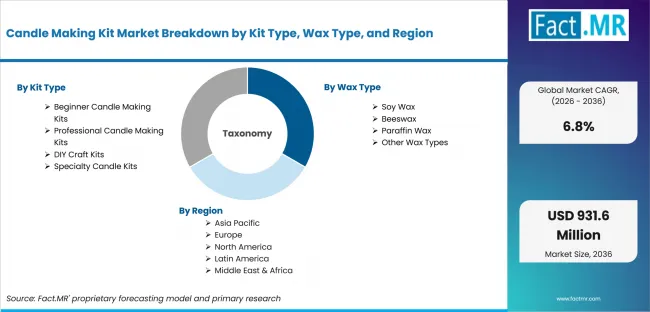
Candle Making Kit Market Breakdown By Kit Type, Wax Type, And Region | Source: Fact.MR
| Attribute | Details |
|---|---|
| Quantitative Units | USD 482.5 million in 2026 to USD 931.6 million by 2036 at 6.8% CAGR |
| Market Definition | Boxed candle-making bundles sold for personal use, gifting, home decoration, education and small business use where wax, wicks, vessels, fragrances, dyes, tools and instructions are purchased as a kit |
| Kit Type | Beginner Candle Making Kits; Soy Wax Candle Kits; Beeswax Candle Kits; Paraffin Wax Candle Kits; Professional Candle Making Kits; Multi-mold Kits; Advanced Fragrance Kits; Business Starter Kits; DIY Craft Kits; Home Decor Candle Kits; Gift-making Kits; Seasonal Candle Kits; Specialty Candle Kits; Aromatherapy Candle Kits; Sculptural Candle Kits; Eco-friendly Candle Kits |
| Wax Type | Soy Wax; Natural Soy Wax; Blend Soy Wax; Container Soy Wax; Beeswax; Organic Beeswax; Filtered Beeswax; Rolled Beeswax Sheets; Paraffin Wax; Fully Refined Paraffin; Semi-refined Paraffin; Pillar Wax; Other Wax Types; Coconut Wax; Palm Wax; Gel Wax |
| Distribution Channel | Online Retail; E-commerce Marketplaces; Brand Websites; Craft Supply Websites; Offline Retail; Arts & Crafts Stores; Department Stores; Hobby Stores; Specialty Stores; Candle Supply Stores; DIY Craft Boutiques; Home Decor Stores; Wholesale; Bulk Suppliers; Distributors; Educational Supply Vendors |
| Application | Personal Use; Hobby Crafting; Home Decoration; Family Activities; Educational Use; Schools; Art Workshops; Training Institutes; Small Business Use; Home-based Businesses; Etsy Sellers; Craft Entrepreneurs; Gift & Event Use; Corporate Gifts; Party Favors; Wedding Favors |
| End User | Adults; Hobbyists; DIY Enthusiasts; Home Crafters; Children & Teens; STEM Learning; School Projects; Art & Craft Activities; Professional Users; Artisans; Small Manufacturers; Candle Studios; Educational Institutions; Schools; Colleges; Community Centers |
| Regions Covered | North America; Latin America; Europe; East Asia; South Asia and Oceania; Middle East and Africa |
| Countries Covered | 30+ countries, including UK, USA, Germany, Canada, and France |
| Key Companies Profiled | Makesy; CraftZee; Candle Science, LLC (CandleScience); Village Craft and Candle Inc. (Village Craft & Candle) |
| Forecast Period | 2026 to 2036 |
| Approach | Hybrid top-down and bottom-up approach using candle kit demand; wax type mix; kit bundle formats; online retail activity; gift-led purchases; home-decor use; educational and hobby use; company portfolio review; country adoption patterns and channel evidence |
Source: Fact.MR analysis. Updated Jul 29, 2026
How is the market segmented?
-
By Kit Type:
- Beginner Candle Making Kits
- Soy Wax Candle Kits
- Beeswax Candle Kits
- Paraffin Wax Candle Kits
- Professional Candle Making Kits
- Multi-mold Kits
- Advanced Fragrance Kits
- Business Starter Kits
- DIY Craft Kits
- Home Decor Candle Kits
- Gift-making Kits
- Seasonal Candle Kits
- Specialty Candle Kits
- Aromatherapy Candle Kits
- Sculptural Candle Kits
- Eco-friendly Candle Kits
-
By Wax Type:
- Soy Wax
- Natural Soy Wax
- Blend Soy Wax
- Container Soy Wax
- Beeswax
- Organic Beeswax
- Filtered Beeswax
- Rolled Beeswax Sheets
- Paraffin Wax
- Fully Refined Paraffin
- Semi-refined Paraffin
- Pillar Wax
- Other Wax Types
- Coconut Wax
- Palm Wax
- Gel Wax
-
By Distribution Channel:
- Online Retail
- E-commerce Marketplaces
- Brand Websites
- Craft Supply Websites
- Offline Retail
- Arts & Crafts Stores
- Department Stores
- Hobby Stores
- Specialty Stores
- Candle Supply Stores
- DIY Craft Boutiques
- Home Decor Stores
- Wholesale
- Bulk Suppliers
- Distributors
- Educational Supply Vendors
-
By Application:
- Personal Use
- Hobby Crafting
- Home Decoration
- Family Activities
- Educational Use
- Schools
- Art Workshops
- Training Institutes
- Small Business Use
- Home-based Businesses
- Etsy Sellers
- Craft Entrepreneurs
- Gift & Event Use
- Corporate Gifts
- Party Favors
- Wedding Favors
-
By End User:
- Adults
- Hobbyists
- DIY Enthusiasts
- Home Crafters
- Children & Teens
- STEM Learning
- School Projects
- Art & Craft Activities
- Professional Users
- Artisans
- Small Manufacturers
- Candle Studios
- Educational Institutions
- Schools
- Colleges
- Community Centers
-
By Region:
- North America
- Latin America
- Europe
- East Asia
- South Asia and Oceania
- Middle East and Africa
Frequently Asked Questions
Which Kit Type leads the market?
Which Wax Type leads the market?
Which Distribution Channel leads the market?
Which Application leads the market?
Which End User leads the market?
Which country records the highest listed CAGR?
What is the primary driver in this market?
What is the main restraint?
Why do adults lead demand?
Who worked on this report


Preview the report firsthand - request a free sample
Free SampleGet the brochure for pricing and purchase details
Download PDF