- Market Value (2025): USD 528.5 Mn
- Estimated Value (2026): USD 630.0 Mn
- Forecast Value (2036): USD 3648.4 Mn
- CAGR (2026-2036): 19.2%
What is the Seaweed Barrier Coatings Market forecast to be worth by 2036?
USD 630.0 million in 2026 to USD 3648.4 million by 2036, at a 19.2% CAGR.
- The market is valued at USD 528.5 million in 2025.
- Demand is projected to increase from USD 630.0 million in 2026 to USD 3648.4 million by 2036.
- The market is forecast to record a 19.2% CAGR from 2026 to 2036 as packaging developers qualify marine-derived coating systems for food-contact, barrier and fiber-based applications.
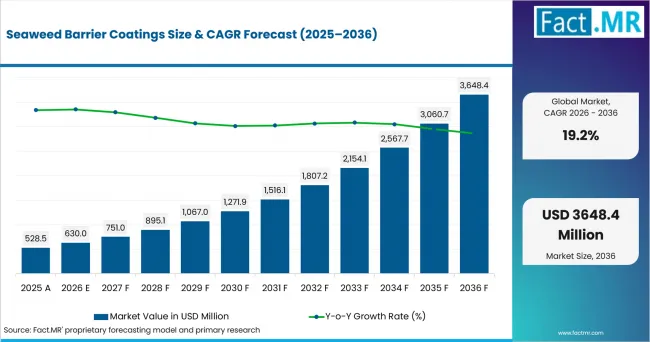
Seaweed Barrier Coatings Value Analysis | Source: Fact.MR
What are the defining numbers behind Seaweed Barrier Coatings Market growth?
The market is projected to create an absolute dollar opportunity of USD 3,018.4 million between 2026 and 2036.
- Demand Drivers in the Market
- Paper and molded-fiber packaging need functional surface layers when the base substrate cannot provide enough oxygen, grease or moisture protection on its own.
- Food-contact requirements keep coating composition and migration safety central when seaweed-derived materials are used on packaging that touches food.
- European packaging rules are increasing pressure to pair bio-based material choices with credible end-of-life performance rather than relying on renewable feedstock claims alone.
- Marine biotechnology and seaweed-processing research are widening the feedstock base for alginate and other polysaccharides that can be adapted for film-forming or coating applications.
- Key Segments Analyzed
- By Seaweed Polymer: Alginate accounts for 34.0% share in 2026, supported by its film-forming properties and suitability for bio-based coating development.
- By Barrier Function: Oxygen barrier holds 31.0% share in 2026 as coated paper and fiber formats need added protection against gas transfer.
- By Substrate: Paper accounts for 41.0% share in 2026, reflecting the need to add barrier performance to fiber-based packaging surfaces.
- By End-use: Food packaging holds 43.0% share in 2026 because food-contact applications create the broadest use case for functional seaweed-derived coating systems.
- Analyst Opinion at Fact.MR
- Shambhu Nath Jha, Senior Consultant, Fact.MR, notes that seaweed coatings will be judged less by their renewable origin and more by whether they can deliver stable barrier performance on commercial packaging lines. The strongest adoption path is likely to emerge where a coating can improve oxygen or grease resistance without creating a new problem in sealing, food-contact qualification or end-of-life treatment. He adds that paper and molded-fiber formats provide a practical route to scale because the substrate already has a clear packaging role and often needs a functional surface layer. Suppliers that can control feedstock variability while documenting coating performance will be better positioned as packaging buyers move from pilot projects to repeatable production.
- Strategic Implications
- Coating developers should validate barrier performance on the intended paper or fiber substrate because porosity and surface structure can materially change coating behavior.
- Food-packaging suppliers need food-contact evidence for the finished coating system rather than relying on the natural origin of the polymer as a safety claim.
- European converters should assess seaweed coatings against the recovery route of the finished package, since bio-based content does not by itself establish recyclability or compostability.
- Feedstock partnerships with marine and aquaculture ecosystems can improve supply visibility, but consistency in polymer quality will remain important for industrial coating performance.
The UK is forecast to grow at 18.3% CAGR from 2026 to 2036, the USA at 20.7%, France at 20.2%, Germany at 17.2% and Japan at 18.7%. Growth conditions differ across marine feedstock capability, food-contact approval, packaging regulation and the technical maturity of bio-based coating development.
How does the Seaweed Barrier Coatings Market break down by segment?
The Seaweed Barrier Coatings Market is segmented by Seaweed Polymer into Alginate, Carrageenan, Agar, Ulvan and Hybrid seaweed polysaccharides; by Barrier Function into Oxygen, Grease / oil, Moisture, Aroma and Heat-seal / combined; by Substrate into Paper, Molded fiber, Cellulose film, Edible film and Other; and by End-use into Food packaging, Foodservice, Fresh produce, Confectionery and Other.
Which Seaweed Polymer dominates?
Alginate holds 34.0% share in 2026.
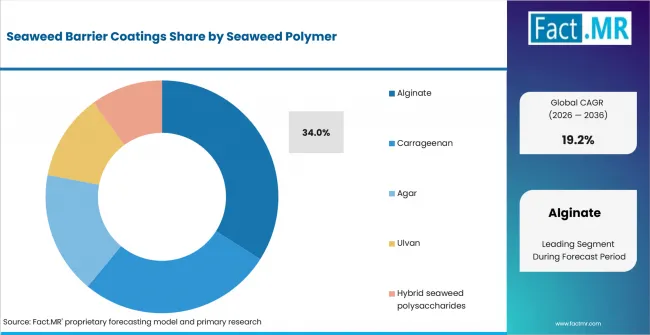
Seaweed Barrier Coatings Analysis By Seaweed Polymer | Source: Fact.MR
Alginate leads the Seaweed Polymer category as a film-forming polysaccharide that can be adapted for coating and biofilm applications. Current public research on seaweed-derived biopolymers reinforces the broader push toward renewable packaging materials, while commercial success still depends on coating consistency and compatibility with the selected substrate.
Which Barrier Function dominates?
Oxygen barrier holds 31.0% share in 2026.
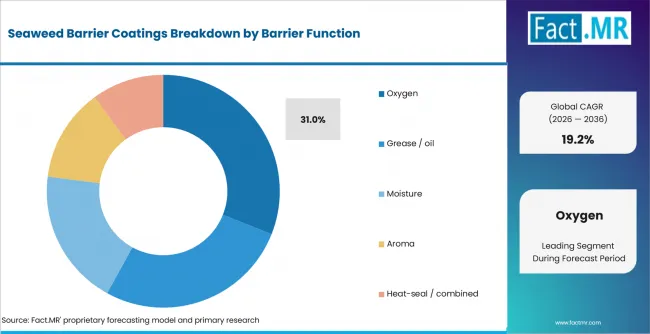
Seaweed Barrier Coatings Analysis By Barrier Function | Source: Fact.MR
Oxygen barrier leads the functional mix because many fiber-based food packs need added protection against gas transfer. Fraunhofer IVV's work on bio-based coatings and permeation analysis shows why barrier performance must be measured on the finished coating-substrate system rather than inferred from polymer chemistry alone.
Which Substrate leads demand?
Paper accounts for 41.0% share in 2026.
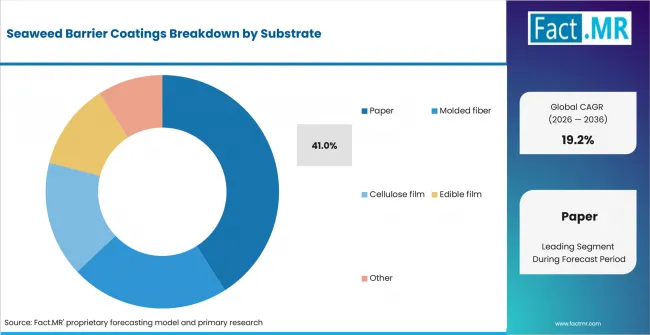
Seaweed Barrier Coatings Analysis By Substrate | Source: Fact.MR
Paper leads substrate demand because its surface often needs an additional functional layer for food and beverage applications. Seaweed-derived coatings offer a route to add barrier performance while keeping the base package fiber-rich, provided coating behavior remains compatible with converting and the intended end-of-life pathway.
Which End-use leads demand?
Food packaging holds 43.0% share in 2026.
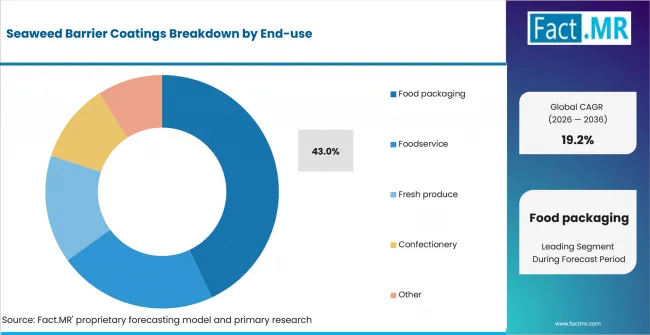
Seaweed Barrier Coatings Analysis By End Use | Source: Fact.MR
Food packaging leads End-use demand because barrier coatings are most valuable where oxygen, grease, aroma or moisture can affect product quality. Food-contact regulation also makes this segment more demanding, since the coating must satisfy safety requirements in addition to functional performance.
What is accelerating Seaweed Barrier Coatings Market adoption, and what is holding it back?
Fiber-based packaging conversion, food-contact qualification and interest in marine-derived polymers support adoption; feedstock variability and end-of-life verification can slow scale-up.
Drivers Impact Analysis
| DRIVER | (~) % IMPACT ON CAGR | GEOGRAPHIC RELEVANCE | IMPACT TIMELINE |
|---|---|---|---|
| Fiber-based packaging conversion | +2.4% | Europe, Global | Short term (<= 2 years) |
| Food-contact qualification for bio-based coatings | +2.0% | USA, EU, Japan | Short term (<= 2 years) |
| Marine-biopolymer development | +1.6% | UK, France, Japan | Medium term (2-4 years) |
| Packaging eco-design requirements | +1.1% | EU | Medium term (2-4 years) |
- Fiber-based packaging conversion: Paper and molded-fiber formats often need an additional barrier layer for food-contact applications. Seaweed-derived coatings can address this performance gap where the finished structure remains compatible with the intended recovery route.
- Food-contact qualification: FDA and EFSA frameworks keep substances that contact food within a safety assessment boundary. Seaweed origin does not remove the need to evaluate the finished coating for its intended use.
- Marine-biopolymer development: Public marine research in the UK and France, together with Japanese seaweed and food-industry policy, supports a broader feedstock and processing base for seaweed-derived polymers.
- Packaging eco-design requirements: Regulation (EU) 2025/40 applies from 12 August 2026 and places greater emphasis on packaging design, material efficiency and high-quality recovery outcomes.
Opportunity Impact Analysis
| OPPORTUNITY | (~) % IMPACT ON CAGR | GEOGRAPHIC RELEVANCE | IMPACT TIMELINE |
|---|---|---|---|
| Paper and molded-fiber barrier coatings | +2.1% | Europe, Global | Short term (<= 2 years) |
| High-performance oxygen-barrier systems | +1.7% | Global | Medium term (2-4 years) |
| Food-contact and edible coating applications | +1.3% | USA, EU, Japan | Medium term (2-4 years) |
| Regional seaweed feedstock integration | +0.9% | UK, France, Japan | Long term (>= 4 years) |
- Paper and molded-fiber coatings: Fiber substrates provide a clear route to scale because they already serve food and foodservice applications but often need improved grease, oxygen or moisture resistance.
- Oxygen-barrier systems: Seaweed polysaccharides can be developed for film-forming applications where oxygen transmission is a critical package-performance parameter.
- Food-contact and edible coatings: Direct-contact uses create a higher qualification burden, but they also widen the application space for coatings based on food-compatible marine polymers.
- Regional feedstock integration: Stronger links between seaweed cultivation, polymer extraction and coating formulation can improve supply visibility and reduce dependence on long-distance raw-material chains.
Restraints Impact Analysis
| RESTRAINT | (~) % IMPACT ON CAGR | GEOGRAPHIC RELEVANCE | IMPACT TIMELINE |
|---|---|---|---|
| Moisture sensitivity and performance trade-offs | -1.2% | Global | Short term (<= 2 years) |
| Food-contact qualification burden | -0.9% | USA, EU, Japan | Medium term (2-4 years) |
| Feedstock consistency and polymer variability | -0.7% | UK, France, Japan | Medium term (2-4 years) |
| Recovery-route and claim verification | -0.5% | Europe | Long term (>= 4 years) |
- Moisture sensitivity: Bio-based polysaccharide coatings can require formulation work to maintain barrier performance under humid or wet conditions, particularly when the package itself encounters water or refrigerated storage.
- Food-contact qualification: A coating used on food packaging must meet the relevant safety requirements for its intended use, which can lengthen material qualification and restrict rapid substitution.
- Feedstock consistency: Natural raw materials can vary by species, growing conditions and processing route. Industrial coating applications need polymer specifications that remain stable from batch to batch.
- Recovery-route verification: A renewable coating does not automatically establish recyclability or compostability. Buyers still need evidence that the finished package fits the intended collection and treatment system.
Which countries are scaling Seaweed Barrier Coatings Market through 2036?
- UK: 18.3% CAGR, supported by marine science capability and growing interest in seaweed-derived packaging materials.
- USA: 20.7% CAGR, with food-contact qualification acting as a central gate for packaging adoption.
- France: 20.2% CAGR, supported by marine biotechnology research and access to algal biomass expertise.
- Germany: 17.2% CAGR, with bio-based coating development and packaging-performance validation shaping scale-up.
- Japan: 18.7% CAGR, supported by an established seaweed-processing base and food-industry applications.
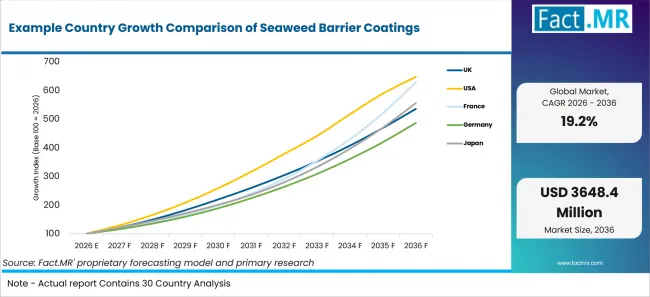
Example Country Growth Comparison Of Seaweed Barrier Coatings | Source: Fact.MR
| Country | CAGR |
|---|---|
| UK | 18.3% |
| USA | 20.7% |
| France | 20.2% |
| Germany | 17.2% |
| Japan | 18.7% |
What supports UK adoption?
18.3% CAGR through 2036, supported by marine research and feedstock credibility.
The UK market is forecast to expand at 18.3% CAGR from 2026 to 2036. CEFAS provides a public marine-science base across biodiversity, aquaculture and seafood safety. That capability strengthens the feedstock and environmental evidence needed as seaweed-derived materials move into packaging applications.
What supports USA growth?
20.7% CAGR through 2036, shaped by food-contact qualification.
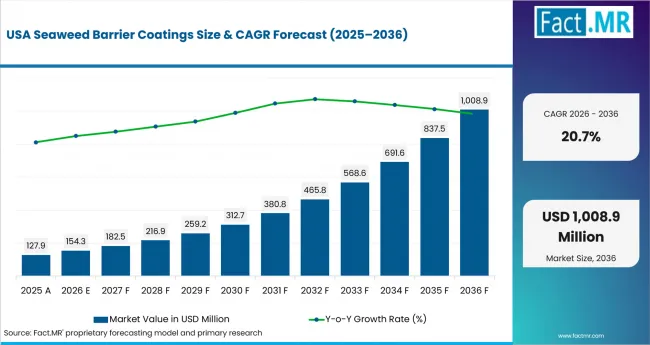
Seaweed Barrier Coatings Country Value Analysis | Source: Fact.MR
The USA market is forecast to expand at 20.7% CAGR from 2026 to 2036. FDA oversight of food-contact substances keeps coating composition and intended use central to market entry. Seaweed-derived chemistry therefore needs to meet the same safety expectations applied to other food-contact materials.
How is France scaling demand?
20.2% CAGR through 2036, supported by marine biotechnology and algal research.
France is forecast to expand at 20.2% CAGR from 2026 to 2036. IFREMER's work across marine biodiversity, aquaculture and biotechnology provides a research base relevant to algal biomass and seaweed-derived materials. This supports upstream capability while packaging adoption still depends on coating performance and compliance.
What supports Germany adoption?
17.2% CAGR through 2036, shaped by bio-based coating development and technical validation.
Germany is forecast to expand at 17.2% CAGR from 2026 to 2036. Fraunhofer IVV works on bio-based coatings, barrier layers on paper and bioplastics, permeation analysis and recyclable packaging. That technical infrastructure is directly relevant to validating seaweed-derived coatings for commercial packaging use.
What supports Japan growth?
18.7% CAGR through 2036, supported by seaweed-processing capability and food-industry applications.
Japan is forecast to expand at 18.7% CAGR from 2026 to 2036. The Ministry of Agriculture, Forestry and Fisheries provides the policy and standards context for fisheries and the food industry. Japan's established seaweed-processing base gives the market a practical connection between feedstock availability and food-packaging applications.
Who leads the Seaweed Barrier Coatings Market?
Notpla, Sway and Kelpi are among the companies developing seaweed-derived materials for packaging and coating applications. Competition is shaped by polymer extraction, coating performance, substrate compatibility and the ability to support food-contact or end-of-life claims with appropriate evidence.
Oceanium, Cargill and Algaia also participate in seaweed-derived ingredients or material platforms relevant to the broader supply chain. Supplier positioning depends on whether marine feedstock can be converted into repeatable coating performance at industrial scale.
Which companies are the key providers?
Key companies include Notpla, Sway, Kelpi, Oceanium, Cargill and Algaia.
- Notpla
- Sway
- Kelpi
- Oceanium
- Cargill
- Algaia
Bibliography
- Centre for Environment, Fisheries and Aquaculture Science (CEFAS).
- U.S. Food and Drug Administration. Food Ingredients & Packaging.
- U.S. Department of Agriculture, Agricultural Research Service.
- IFREMER, French Research Institute for Exploitation of the Sea.
- Fraunhofer Institute for Process Engineering and Packaging IVV.
- Japan Ministry of Agriculture, Forestry and Fisheries.
- European Commission, Directorate-General for Environment. Packaging and Packaging Waste.
- CORDIS. PlantSea.
- European Food Safety Authority. Food Contact Materials.
- DIN. Circular Economy and Material Standardization.
- Food and Agriculture Organization of the United Nations.
This Report Answers
- The report explains Seaweed Barrier Coatings Market demand across Seaweed Polymer, Barrier Function, Substrate and End-use.
- Segment analysis identifies the leading category within each segment and explains the technical reasons supporting adoption.
- Country analysis examines the UK, USA, France, Germany and Japan and the mechanisms influencing coating qualification and scale-up.
- Competitive analysis reviews leading seaweed-material and coating participants without disclosing company market shares.
- Regulatory analysis covers food-contact requirements, packaging design and end-of-life considerations relevant to coated food packaging.
- The forecast covers 2026 to 2036 across the defined market segments and country markets.
What does the Seaweed Barrier Coatings Market cover?
The Seaweed Barrier Coatings Market covers coatings based on seaweed-derived polymers that are applied to packaging substrates to improve oxygen, grease, moisture, aroma or combined barrier performance.
The market includes formulations based on alginate, carrageenan, agar, ulvan and hybrid seaweed polysaccharides used on paper, molded fiber, cellulose film, edible film and other packaging substrates. Food packaging, foodservice, fresh produce and confectionery applications are included where the coating forms part of the functional package structure.
What is included in the scope?
The scope includes seaweed-derived barrier coatings used on the defined substrates and end-use categories, including food-contact applications where the coating forms part of the finished packaging system.
Barrier functions include oxygen, grease or oil, moisture, aroma and heat-seal or combined performance. The assessment also covers marine-derived polymer systems used as surface layers or film-forming coatings where seaweed chemistry provides the primary functional basis.
What is excluded from the scope?
The scope excludes seaweed ingredients sold solely for food, pharmaceutical or cosmetic use, as well as packaging materials that do not use a seaweed-derived coating layer.
Standalone seaweed cultivation, raw biomass trading and extraction equipment are outside the market boundary. Conventional petroleum-based barrier coatings and bio-based coatings whose primary polymer is not seaweed-derived are excluded as separate markets.
How Was the Analysis Built?
The analysis covers market size, segment structure, country growth, marine feedstock context, food-contact requirements, packaging regulation and technical coating performance.
- Primary Research: Research inputs consider coating qualification, substrate performance, food-contact requirements, converting behavior and adoption barriers across relevant industry participants.
- Desk Research: Public evidence includes national marine research, food-contact regulation, bio-based coating research, EU packaging rules, public seaweed and aquaculture context, and standardization.
- Market Sizing and Forecasting: The assessment covers market value, segment structure, country growth and the operating factors influencing adoption from 2026 to 2036.
- Data Validation and Update Cycle: Findings are reviewed against regulatory developments, public research, marine-feedstock conditions and company participation where relevant to competitive analysis.
What is the report’s scope and coverage?
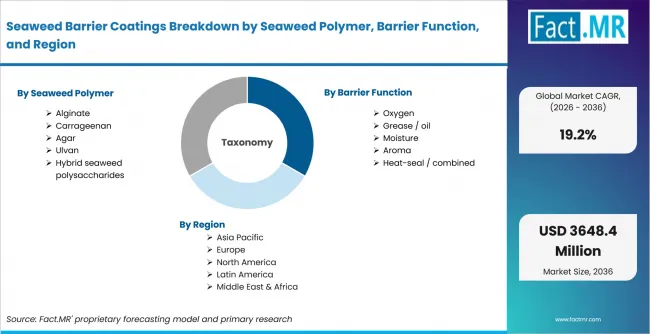
Seaweed Barrier Coatings Breakdown By Seaweed Polymer, Barrier Function, And Region | Source: Fact.MR
| Attribute | Details |
|---|---|
| Quantitative Units | USD million |
| Market Definition | Seaweed-derived coatings applied to packaging substrates to provide oxygen, grease, moisture, aroma or combined barrier performance. |
| Seaweed Polymer | Alginate; Carrageenan; Agar; Ulvan; Hybrid seaweed polysaccharides |
| Barrier Function | Oxygen; Grease / oil; Moisture; Aroma; Heat-seal / combined |
| Substrate | Paper; Molded fiber; Cellulose film; Edible film; Other |
| End-use | Food packaging; Foodservice; Fresh produce; Confectionery; Other |
| Regions Covered | North America; Latin America; Western Europe; Eastern Europe; East Asia; South Asia & Pacific; Middle East & Africa |
| Countries Covered | UK; USA; France; Germany; Japan |
| Key Companies Profiled | Notpla; Sway; Kelpi; Oceanium; Cargill; Algaia |
| Forecast Period | 2026 to 2036 |
| Approach | Market sizing, segment analysis and country growth assessment, with coverage of marine feedstock, food-contact regulation, packaging design and coating-performance requirements. |
How is the market segmented?
-
By Seaweed Polymer
- Alginate
- Carrageenan
- Agar
- Ulvan
- Hybrid seaweed polysaccharides
-
By Barrier Function
- Oxygen
- Grease / oil
- Moisture
- Aroma
- Heat-seal / combined
-
By Substrate
- Paper
- Molded fiber
- Cellulose film
- Edible film
- Other
-
By End-use
- Food packaging
- Foodservice
- Fresh produce
- Confectionery
- Other
-
By Region
- North America
- Latin America
- Western Europe
- Eastern Europe
- East Asia
- South Asia & Pacific
- Middle East & Africa