High-Barrier PCR Film Market for Meat & Frozen Foods
The High-Barrier PCR Film Market for Meat & Frozen Foods Market is analyzed across its key product, application and end-use segments, with regional trends and demand outlook, forecast 2026 to 2036.
By Fact.MR Chemical & Materials DeskLead analyst:
S.N. JhaPublished :
Updated :
11 min read
Fact-checked under the Fact.MR editorial process
High-Barrier PCR Film Market for Meat & Frozen Foods Forecast and Outlook 2026 to 2036
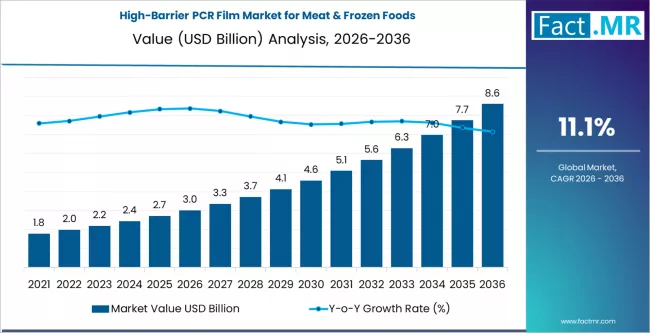
The high-barrier PCR film market for meat & frozen foods is likely to be valued at USD 3 billion in 2026 and is expected to reach USD 8.6 billion by 2036, growing at a CAGR of 11.1%. The market presents notable upside potential, with growing consumer and regulatory demand for sustainable packaging solutions.
High Barrier Pcr Film Market For Meat & Frozen Foods Market Value Analysis | Source: Fact.MR
Summary of High-Barrier PCR Film Market for Meat & Frozen Foods
Market Snapshot
Global high-barrier PCR film market for meat & frozen foods revenue stood atUSD 3 billion in 2026and is forecast to reachUSD 8.6 billion by 2036.
Ata11.1% CAGR from 2026 to 2036, this market is set to expand~2.9x in value, addingUSD 5.6 billion in absolute opportunity.
Growth is driven by increasing demand forsustainable, high-performance food packaging solutionsthatmaintainproduct integrity and shelf life.
High-barrier PCR films are becoming acritical packaging material for cold chain and protein-based food applications, balancing recyclability with barrier performance.
Demand and Growth Drivers
Rising consumer preference forsustainable food packagingis a primary growth driver.
Increasing regulatory pressure forrecyclable and food-safe packaging materialsis accelerating adoption.
Growth inmeat and frozen food consumption and cold-chainlogisticsis supporting market expansion.
Need forextended shelf life and improved barrier performanceis reinforcing demand.
Advancements inmulti-layer film technology and coating-based barrier systemsare improving product functionality.
Product and Segment View
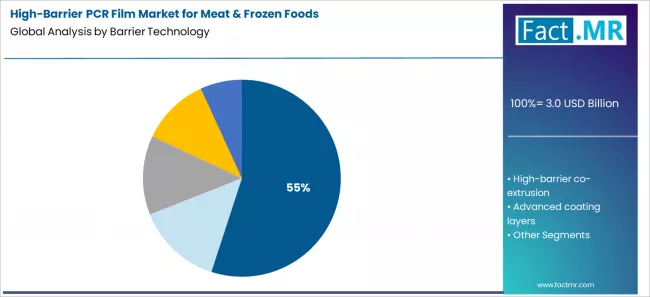
EVOH and coating-based barrier films hold 55% of technology share in 2026,emergingas the dominant segment due to superior oxygen and moisture barrier properties.
Key technology categories include:
EVOH-based barrier films
Coating-based barrier films
Multi-layer PCR structures
Hybrid barrier systems
Key application areas include:
Meat packaging
Frozen food packaging
Processed protein packaging
Cold chain food packaging
Geography and Competitive Outlook
Asia Pacific is the leading growth region, driven by expanding food processing and packaged food consumption.
Market expansion is closely tied tofood safety regulations, sustainability mandates, and packaging innovation requirements.
Key challenges includeproduction scaling, integration into existing packaging lines, and cost volatility of raw materials.
North America, Latin America, Western Europe, Eastern Europe, EastAsia, South Asia & Pacific, MEA
Source: Fact.MR analysis. Updated May 6, 2026
However, execution risks remain, particularly in scaling production capabilities for high-barrier films that meet stringent food safety standards. Adoption friction is also evident as manufacturers must navigate the costs and technical complexities of incorporating PCR films into existing packaging lines. Economic sensitivity adds another layer of uncertainty, as fluctuations in raw material costs or consumer spending could influence demand patterns. While the market’s growth prospects are positive, companies will need to carefully manage the balance between innovation, cost efficiency, and regulatory compliance to ensure long-term success without overextending resources. The path forward will require precision in both operational execution and market alignment.
Category
Category
Segments
End-Use
Fresh and frozen meat; Processed meat and poultry; Premium frozen foods; Mass frozen foods; Frozen food exports; Meat exports
North America; Europe; Asia Pacific; Latin America; Middle East & Africa
Source: Fact.MR analysis. Updated May 6, 2026
Segmental Analysis
What Is the Impact of Barrier Technology on the High-Barrier PCR Film Market for Meat & Frozen Foods?
High Barrier Pcr Film Market For Meat & Frozen Foods Analysis By Barrier Technology | Source: Fact.MR
In the high-barrier PCR film market for meat and frozen foods, barrier technology plays a crucial role in determining the film's effectiveness in preserving product quality and extending shelf life. EVOH and coating-based barriers lead the market with a 55% share, offering superior protection against oxygen and moisture, which are key factors in preserving the freshness and safety of meat and frozen food products. As consumers increasingly demand longer-lasting and sustainable packaging solutions, the adoption of EVOH and coating-based barriers will remain dominant, ensuring the preservation of food while minimizing environmental impact.
How Does Film Structure Influence the High-Barrier PCR Film Market for Meat & Frozen Foods?
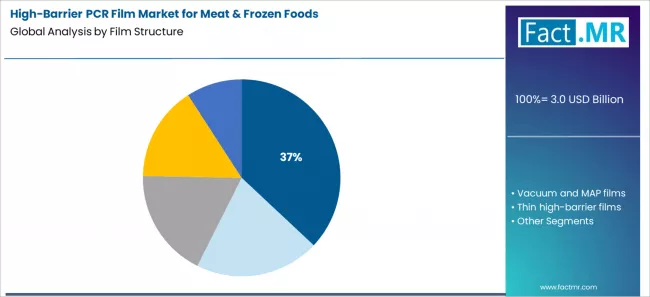
High Barrier Pcr Film Market For Meat & Frozen Foods Analysis By Film Structure | Source: Fact.MR
Film structure significantly affects the performance and versatility of high-barrier PCR films, with multi-layer barrier films holding a 37% share. These films are designed with multiple layers to provide enhanced protection against external factors such as air and light, ensuring the integrity of meat and frozen food products during storage and transport. Multi-layer films are highly effective in maintaining freshness and preventing spoilage, making them a preferred choice for packaging in the meat and frozen foods sector. As demand for high-quality, sustainable packaging solutions grows, the use of multi-layer barrier films will continue to expand in the market.
What are the Principal Drivers, Constraints, and Evolving Dynamics of the High Barrier PCR Film Market for Meat and Frozen Foods?
Growth in the high barrier PCR film market for meat and frozen foods is linked to demand for packaging that preserves product quality while incorporating recycled content. Retailers and food processors seek films that provide moisture and oxygen barriers suitable for chilled and frozen products. Specifications for food contact materials have shaped selection of post consumer recycled (PCR) resins and barrier layers that meet regulatory requirements.
Variability in PCR feedstock affects barrier performance and clarity of films. Some converters report challenges achieving consistent seal strength when high PCR content is used. Processing conditions that suit virgin polymers do not always translate to PCR blends. Work on improving resin purification and developing tailored barrier coatings is under way. Partnerships between resin suppliers and film manufacturers aim to expand high PCR film options that meet performance criteria for meat and frozen food packaging.
Analysis of the High-Barrier PCR Film Market for Meat & Frozen Foods by Key Country
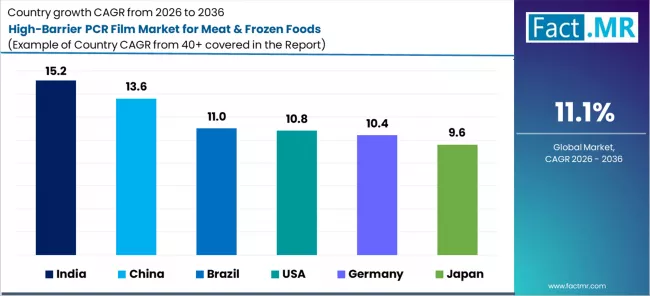
High Barrier Pcr Film Market For Meat & Frozen Foods Cagr Analysis By Country | Source: Fact.MR
Country
CAGR (2026–2036)
Germany
10.4%
USA
10.8%
Japan
9.6%
China
13.6%
India
15.2%
Brazil
11%
Source: Fact.MR analysis. Updated May 6, 2026
The report covers an in-depth analysis of 40+ countries; top-performing countries are highlighted below.
What is the Growth Outlook for High-Barrier PCR Film for Meat & Frozen Foods in Germany?
Germany’s high-barrier PCR film market for meat and frozen foods is projected to grow at a CAGR of 10.4% from 2026 to 2036. Germany’s robust food packaging industry and strong emphasis on sustainability are driving the demand for high-barrier films made from post-consumer recycled (PCR) materials. With increasing consumer demand for eco-friendly packaging solutions and government policies promoting recycling, the market for these films is expected to expand steadily, particularly as the food sector seeks to reduce environmental impact while maintaining product quality.
How is the High-Barrier PCR Film Market for Meat & Frozen Foods Performing in the USA?
The USA’s high-barrier PCR film market for meat and frozen foods is expected to grow at a CAGR of 10.8% from 2026 to 2036. The USA’s increasing focus on sustainability in packaging, along with rising consumer demand for environmentally responsible products, is driving the adoption of high-barrier PCR films in the food industry. As packaging regulations become stricter and the need for efficient, sustainable packaging solutions grows, the market for these films is set to expand, particularly in the meat and frozen food sectors, which require long shelf life and excellent protection.
What is the Market Outlook for High-Barrier PCR Film for Meat & Frozen Foods in Japan?
Japan’s high-barrier PCR film market for meat and frozen foods is forecast to grow at a CAGR of 9.6% from 2026 to 2036. Japan has long been a leader in sustainable packaging practices, and the growing demand for environmentally friendly materials in food packaging is driving the adoption of high-barrier PCR films. The country’s strong regulatory framework and consumer preference for recyclable packaging solutions are expected to support steady growth in the market. However, Japan’s growth rate may be slightly slower compared to other regions due to a more mature market.
What is the Growth Potential for High-Barrier PCR Film for Meat & Frozen Foods in China?
China is projected to see significant growth in the high-barrier PCR film market for meat and frozen foods, with a projected CAGR of 13.6% from 2026 to 2036. China’s rapidly expanding food processing industry, combined with its growing focus on sustainability, is driving the demand for high-barrier PCR films in packaging. The adoption of recycled materials in food packaging is increasing due to stricter environmental regulations and rising consumer awareness. As the market for sustainable packaging solutions expands, China is poised to become a key player in the high-barrier PCR film market.
What is the Demand for High-Barrier PCR Film for Meat & Frozen Foods in India?
India’s high-barrier PCR film market for meat and frozen foods is set to grow at a robust CAGR of 15.2% from 2026 to 2036. India’s growing food processing sector, particularly in the meat and frozen foods categories, is driving the need for packaging solutions that ensure product freshness while minimizing environmental impact. As the demand for sustainable packaging grows, the adoption of high-barrier PCR films is expected to rise. Government initiatives to promote recycling and sustainability, coupled with increased consumer awareness, will support rapid growth in the market for these films.
What is the Market Expansion Outlook for High-Barrier PCR Film for Meat & Frozen Foods in Brazil?
Brazil’s high-barrier PCR film market for meat and frozen foods is projected to grow at a CAGR of 11% from 2026 to 2036. Brazil’s food packaging industry is increasingly focused on sustainability, and the demand for high-barrier PCR films is rising as companies seek eco-friendly alternatives for meat and frozen food packaging. With government support for recycling initiatives and growing consumer preference for recyclable materials, the market for these films is set to expand steadily. As Brazil strengthens its recycling infrastructure, the adoption of high-barrier PCR films in the food sector will continue to grow.
How is Competition Structured in the HighBarrier PCR Film Market for Meat & Frozen Foods?
Competition in the high barrier PCR film market for meat and frozen foods is defined by barrier performance, PCR content levels, and compliance with food safety standards. Mondi and Berry Global compete with broad packaging portfolios that combine high oxygen and moisture barriers with substantial recycled content. Sealed Air and Amcor focus on multi layer film systems designed to extend shelf life while maintaining processability on existing packaging lines.
Toppan and Mitsubishi Chemical Packaging emphasize advanced coating and extrusion technologies that bolster barrier properties. Zijiang and Greatview position their offerings through cost effective high barrier films tailored to regional processing requirements. Competitive differentiation arises from validated barrier data, food contact certification records, and the ability to meet rigorous industry quality audits. Buyers assess suppliers based on film clarity, seal integrity, and capacity to deliver consistent performance across batch volumes.
Key Players of the High-Barrier PCR Film Market for Meat & Frozen Foods
Mondi
Berry Global
Toppan
Zijiang
Sealed Air
Amcor
Mitsubishi Chemical Packaging
Greatview
Bibliographies
European Food Safety Authority. (2023). Safety assessment of recycled plastics for food contact materials. EFSA Journal.
Food and Agriculture Organization of the United Nations. (2023). Packaging for frozen foods: Barrier performance, material selection, and food safety considerations. FAO.
U.S. Food and Drug Administration. (2024). Guidance for industry: Use of recycled plastics in food packaging. FDA.
Packaging Technology and Science. (2024). Integration of post-consumer recycled polymers in high-barrier food packaging films.
International Organization for Standardization. (2023). ISO 22000 and ISO 18601: Packaging, food safety management, and sustainability requirements. ISO.
Market Breakdown
Segmentation
Scope of the Report
Items
Values
Quantitative Units (2026)
USD Billion
End-use
Fresh and frozen meat, Processed meat and poultry, Premium frozen foods, Mass frozen foods, Frozen food exports, Meat exports
Dollar revenue by end-use, film structure, material, and barrier technology; regional demand trends, competitive landscape, technological advancements in high-barrier PCR films, and innovations in frozen food packaging
Source: Fact.MR analysis. Updated May 6, 2026
High-Barrier PCR Film Market for Meat & Frozen Foods Key Segments
End-use :
Fresh and frozen meat
Processed meat and poultry
Premium frozen foods
Mass frozen foods
Frozen food exports
Meat exports
Film Structure :
Multi-layer barrier films
Vacuum and MAP films
Thin high-barrier films
Barrier laminates
Others
Material :
PCR-PE or PCR-PET
PCR-PE
PCR-PET
Others
Barrier Technology :
EVOH and coating-based barriers
High-barrier co-extrusion
Advanced coating layers
Cost-optimized barriers
Others
Region :
North America
USA
Canada
Mexico
Europe
Germany
UK
France
Italy
Spain
Nordic Countries
BENELUX
Rest of Europe
Asia Pacific
China
Japan
South Korea
India
Australia
Rest of Asia Pacific
Latin America
Brazil
Argentina
Rest of Latin America
Middle East and Africa
Kingdom of Saudi Arabia
United Arab Emirates
South Africa
Rest of Middle East and Africa
Other Regions
Oceania
Central Asia
Other Markets
Questions Answered
Frequently Asked Questions
How big is the high-barrier pcr film market for meat & frozen foods in 2026?
The global high-barrier pcr film market for meat & frozen foods is estimated to be valued at USD 3.0 billion in 2026.
What will be the size of high-barrier pcr film market for meat & frozen foods in 2036?
The market size for the high-barrier pcr film market for meat & frozen foods is projected to reach USD 8.6 billion by 2036.
How much will be the high-barrier pcr film market for meat & frozen foods growth between 2026 and 2036?
The high-barrier pcr film market for meat & frozen foods is expected to grow at a 11.1% CAGR between 2026 and 2036.
What are the key product types in the high-barrier pcr film market for meat & frozen foods?
The key product types in high-barrier pcr film market for meat & frozen foods are fresh and frozen meat, processed meat and poultry, premium frozen foods, mass frozen foods, frozen food exports and meat exports.
Which film structure segment to contribute significant share in the high-barrier pcr film market for meat & frozen foods in 2026?
In terms of film structure, multi-layer barrier films segment to command 37.0% share in the high-barrier pcr film market for meat & frozen foods in 2026.