- Market Value (2025): USD 99.6 Mn
- Estimated Value (2026): USD 111.9 Mn
- Forecast Value (2036): USD 357.1 Mn
- CAGR (2026-2036): 12.3%
What is the selective laser melting in mining market forecast to be worth by 2036?
USD 111.9 million in 2026 to USD 357.1 million by 2036, at 12.3% CAGR.
- The selective laser melting in mining market crossed a valuation of USD 99.6 million in 2025 as mining repair teams tested metal additive routes.
- Demand is projected to increase from USD 111.9 million in 2026 to USD 357.1 million by 2036.
- Industry is anticipated to record a 12.3% CAGR from 2026 to 2036 since mine operators and OEM repair teams qualify printed metal parts for harsh duty cycles.
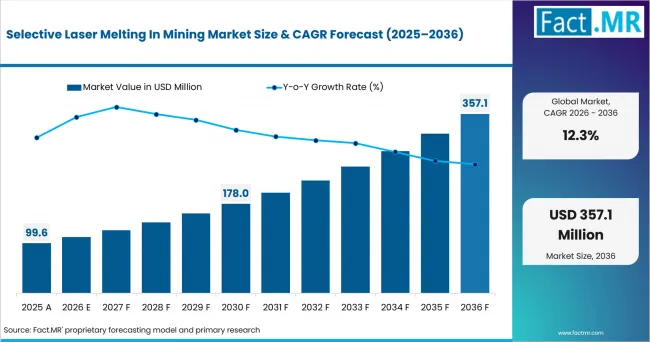
Selective Laser Melting In Mining Market Market Value Analysis | Source: Fact.MR
What are the defining numbers behind selective laser melting in mining market growth?
USD 245.2 million absolute opportunity by 2036, led by software and workflow automation alongside surface mining applications.
- Demand Drivers in the Market
- Mine maintenance teams require faster qualified spare-part routes supported by scan-based build preparation and inspection records.
- Mining OEMs depend on controlled alloy processing driven by repeatable laser parameters for brackets and fluid-system parts.
- Additive service bureaus need mine-grade production workflows reinforced by build logs and post-processing evidence.
- Plant engineers use automated workflow control shaped by fewer manual handoffs between design files and inspection teams.
- Key segments analyzed
- By Material: Titanium alloys are estimated to represent 31% share in 2026, shaped by lightweight strength and corrosion-resistant mining part needs.
- By Application: Spare parts production is forecast to account for 42% share in 2026, reinforced by replacement delays and qualified repair workflows.
- By Component: Crusher & mill parts are projected to account for 34% share in 2026, driven by wear exposure and heavy-duty processing requirements.
- By End use: Metal mining is projected to account for 56% share in 2026, backed by copper and critical mineral repair demand.
- Analyst Opinion at Fact.MR
- Shambhu Nath Jha, Senior Analyst at Fact.MR, states: “Selective laser melting in mining is drawing attention due to qualification evidence needed between a printable part and a field-ready part. Adoption is projected to favor providers able to connect powder traceability and inspection records into one audit path.”
- Strategic Implications
- Mine maintenance teams are likely to map recurring delayed parts before approving metal additive projects.
- Mining OEMs are expected to validate printed part performance against abrasion and heat exposure.
- Service bureaus are projected to document powder origin and inspection evidence for each mining account.
- Software providers are anticipated to connect machine logs and inspection results inside one controlled workflow.
Additive Industries introduced MetalFab 420K in November 2025 for demanding production applications. Machine builders and mining repair networks gain a clearer route to shorter qualification loops and safer powder handling workflows.
India is forecast to post 14.1% CAGR by 2036, led by coal output scale and maintenance pressure across heavy mining fleets. China is expected to record 13.4% CAGR through 2036, driven by metal and coal production depth. Australia is projected to advance at 12.1% CAGR from 2026 to 2036, shaped by iron ore fleet intensity and remote-site replacement needs. UK is anticipated to record 11.8% CAGR between 2026 and 2036, reinforced by quarrying, aggregates and mining technology services. U.S. is estimated to post 11.6% CAGR during the study period, attributable to iron ore and critical-mineral repair requirements. Germany is forecast to record 11.3% CAGR during the forecast period, supported by metal additive engineering depth. Japan is projected to post 11.0% CAGR to 2036, backed by precision manufacturing and equipment-service discipline.
How does the selective laser melting in mining market break down by segment?
Metal mining is likely to lead at 56%; Spare parts production is anticipated to lead at 42%.
Which material category is projected to lead?
Titanium alloys are likely to hold 31% share in 2026.
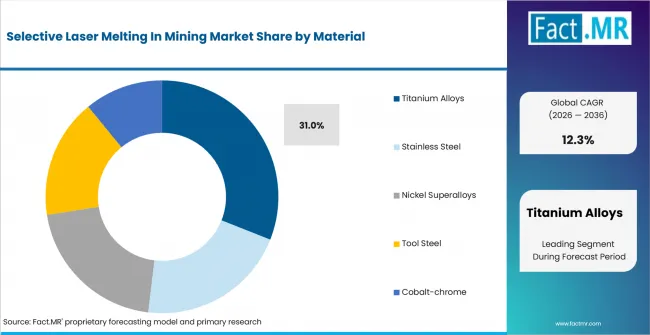
Selective Laser Melting In Mining Market Analysis By Material | Source: Fact.MR
Titanium alloys are expected to garner 31% share in 2026, guided by strength-to-weight needs and corrosion-resistant part applications. Stainless steel follows through broader repair use in brackets and fluid-handling parts. Nickel superalloys support heat-exposed and high-stress mining components. Tool steel and cobalt-chrome remain linked to wear-focused repair programs and specialty part qualification. Sandvik and Additive Industries reported in June 2025 stating initial PLT supply covering 3 alloys, including IN718, 316L stainless steel, and Ti-6Al-4V-ELI, reinforcing alloy-specific qualification needs.
Which application area is forecast to capture the leading share?
Spare Parts Production is estimated to secure 42% share in 2026.
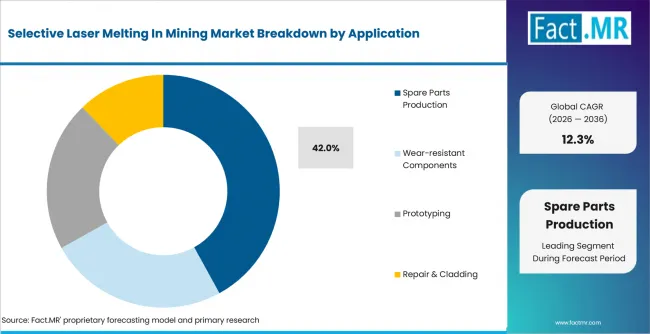
Selective Laser Melting In Mining Market Analysis By Application | Source: Fact.MR
Spare parts production is projected to account for 42% share in 2026, led by delayed replacement cycles and low-volume mining repair needs. Wear-resistant components follow as operators test printed parts exposed to abrasion and fatigue. Prototyping supports design checks before field qualification. Repair & cladding remains relevant for extending part life where full replacement is costly. Nikon SLM Solutions stated in March 2026 its high-speed metal additive systems use up to 12 lasers and build rates of up to 1,000 ccm/h, supporting faster repair routes for urgent mining parts.
Which component category is predicted to hold the leading position?
Crusher & mill parts are projected to represent 34% share in 2026.
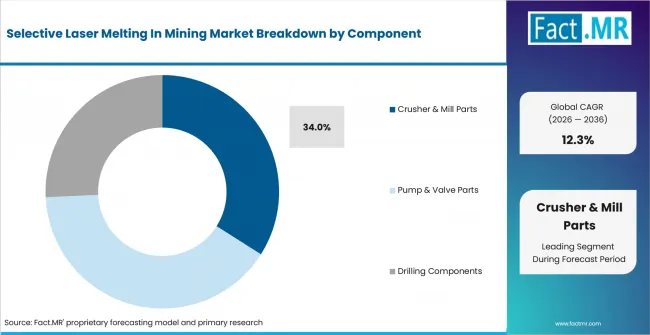
Selective Laser Melting In Mining Market Analysis By Component | Source: Fact.MR
Crusher & mill parts are anticipated to capture 34% share in 2026, driven by high wear intensity and repeated replacement needs in mineral processing circuits. Pump & valve parts follow through fluid-system maintenance and complex internal geometry requirements. Drilling components support field repair and redesign programs for demanding operating conditions. EOS launched its M 290 1kW system in March 2024 with a volume rate of up to 55.4 cm3/h, improving the production case for dense and demanding metal components.
Which end use is estimated to see the strongest demand?
Metal mining is set to account for 56% share in 2026.
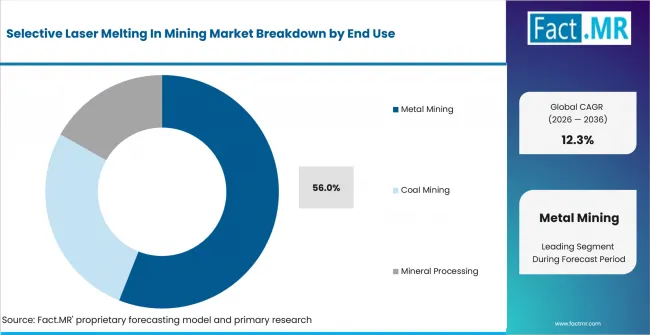
Selective Laser Melting In Mining Market Analysis By End Use | Source: Fact.MR
Metal mining is estimated to represent 56% share in 2026, shaped by repair demand across nickel and critical mineral operations. Coal mining follows through heavy fleet maintenance and equipment wear. Mineral processing supports selective laser melting use for nozzles and crusher-linked parts. International Energy Agency reported in May 2025 claiming lithium demand rose nearly 30% in 2024, while graphite and rare earth demand rose 6-8%, strengthening the case for uptime-focused repair programs in metal mining.
What is accelerating selective laser melting in mining market adoption, and what is holding it back?
Spare-part qualification drives it; process proof burden restrains it.
Drivers Impact Analysis
| Driver | (~) % Impact on CAGR | Geographic Relevance | Impact Timeline |
|---|---|---|---|
| Spare-part delay reduction | +1.0% | Global mining hubs | Medium term (2-4 years) |
| Critical-mineral output pressure | +0.8% | India, China, Australia and U.S. | Medium term (2-4 years) |
| Build-file workflow control | +0.6% | North America and Europe | Short term (≤2 years) |
| Powder traceability requirements | +0.5% | Europe, U.S. and Japan | Medium term (2-4 years) |
| Complex metal part redesign | +0.4% | Global OEM repair networks | Long term (≥4 years) |
Source: Fact.MR analysis. Updated Jul 10, 2026
- Spare-part delay reduction: Mine maintenance teams lose time sourcing cast or machined replacement parts for aging equipment. Nikon SLM Solutions stated in March 2026, its high-speed metal additive systems use up to 12 lasers and build rates of up to 1,000 ccm/h. Higher build speed supports urgent replacement work by shortening the route from repair file to usable metal part.
- Critical-mineral output pressure: Higher mineral demand places extra pressure on equipment uptime in mines handling lithium, nickel and copper value chains. International Energy Agency reported in May 2025, lithium demand rose nearly 30% in 2024, and graphite and rare earth demand rose 6-8%. Output pressure is projected to increase interest in faster repair and remanufacturing routes.
- Build-file workflow control: Additive projects need traceable movement from design file to machine setup and inspection. Materialise and Renishaw reported in April 2024, TEMPUS technology saves up to 9 seconds per build layer and cuts part build time by up to 50%. Faster scan control has commercial value only after build processors and inspection records stay aligned.
- Powder traceability requirements: Powder origin and reuse history shape final part confidence. Sandvik and Additive Industries reported in June 2025 that initial PLT supply covered 3 alloys, including IN718, 316L stainless steel and Ti-6Al-4V-ELI. Alloy-specific supply control helps mine-part providers reduce approval friction during qualification.
- Complex metal part redesign: Selective laser melting supports lighter brackets and integrated fixtures for hard-to-source mining parts. EOS launched its M 290 1kW system in March 2024 with a volume rate of up to 55.4 cm3/h. Higher-power processing improves the case for copper-rich or thermally demanding redesigns used near heavy equipment systems.
Opportunity Impact Analysis
| Opportunity | (~) % Impact on CAGR | Geographic Relevance | Impact Timeline |
|---|---|---|---|
| Qualified spare-part libraries | +0.7% | Australia, U.S. and India | Medium term (2-4 years) |
| Alloy parameter development | +0.6% | Germany, Japan and U.S. | Medium term (2-4 years) |
| Service bureau networks | +0.5% | Asia Pacific and North America | Short term (≤2 years) |
| Powder handling integration | +0.4% | Europe and China | Long term (≥4 years) |
Source: Fact.MR analysis. Updated Jul 10, 2026
- Qualified spare-part libraries: Mining companies have many low-volume parts with long replacement cycles. Oak Ridge National Laboratory reported in July 2025, researchers designed and deployed large reusable 3D-printed forms in 14 days. Fast qualification cycles help additive teams build evidence libraries before similar logic moves into mining repair programs.
- Alloy parameter development: Mining parts often need wear resistance or heat tolerance. Farsoon Technologies reported in March 2025, its beam-shaping work achieved part density exceeding 99.95% in metal powder bed fusion. Higher-density output helps providers prove that printed alloys can move beyond trial samples toward field-ready repair parts.
- Service bureau networks: Several mines lack internal metal additive equipment yet need faster access to printed components. 3D Systems and Precision Resource announced in July 2024, Precision Resource was integrating 2 DMP Flex 350 Dual printers into its manufacturing workflow. Such capacity shows how specialist manufacturers can serve external accounts with qualified metal additive production.
- Powder handling integration: Safer powder loading and cleaner handling reduce risk during metal additive production. Additive Industries introduced MetalFab 420K in November 2025 with 4 × 1kW lasers for demanding production applications. Integrated machine and powder workflows create room for mining repair providers to raise throughput without weakening part-control discipline.
Restraints Impact Analysis
| Restraint | (~) % Impact on CAGR | Geographic Relevance | Impact Timeline |
|---|---|---|---|
| Process proof burden | -0.8% | Global | Short term (≤2 years) |
| Machine and powder cost | -0.6% | India, China and Australia | Medium term (2-4 years) |
| Site skill shortage | -0.4% | Global mine sites | Medium term (2-4 years) |
| Design ownership concern | -0.3% | OEM repair networks | Long term (≥4 years) |
Source: Fact.MR analysis. Updated Jul 10, 2026
- Process proof burden: Mining parts require evidence beyond print completion. National Institute of Standards and Technology stated in 2025, AM-Bench included 8 metal benchmark sets and 1 polymer benchmark set. Benchmark depth shows why operators ask for composition and melt-pool evidence before field approval.
- Machine and powder cost: Laser powder bed fusion machines and alloy powders increase entry costs. Additive Industries reported in June 2025, its PLT can contain 175 L of metal powder by amounting to about 600 kg of steel powder depending on density. Large powder volumes raise storage and working-capital demands for smaller repair teams.
- Site skill shortage: Mine sites do not always have additive engineers near maintenance teams. Materialise reported in July 2024 that benchmark tests on a LiM-X260 dual laser showed 45× faster slicing and hatching time, reducing processing from 15 hours to less than 20 minutes. Such gains require trained users able to apply software correctly during part preparation.
- Design ownership concern: OEM drawings and reverse-engineered parts create approval risk for repair teams. 3D Systems launched AddiTrak in April 2026 for secure on-premises fleet monitoring, process control, data collection and customizable analytics. Controlled data systems reduce exposure risk, yet legal approval for safety-critical replacement files still slows adoption.
What countries are scaling selective laser melting in mining market adoption?
India 14.1%; China 13.4%; Australia 12.1%; UK 11.8%; U.S. 11.6%.
.webp "Top Country Growth Comparison Selective Laser Melting In Mining Market Cagr (2026 2036)")
Top Country Growth Comparison Selective Laser Melting In Mining Market Cagr (2026 2036) | Source: Fact.MR
Regional analysis covers North America, Latin America, Europe, East Asia, South Asia and Pacific, and Middle East and Africa.
| Country | CAGR |
|---|---|
| India | 14.1% |
| China | 13.4% |
| Australia | 12.1% |
| UK | 11.8% |
| U.S. | 11.6% |
Source: Fact.MR analysis. Updated Jul 10, 2026
What is powering India’s outlook?
14.1% CAGR through 2036, driven by coal output scale and repair demand.
Coal-heavy mining creates a large base of mobile equipment and wear parts. Industry in India is forecast to post 14.1% CAGR by 2036 as maintenance teams seek shorter spare-part cycles. Ministry of Coal reported in January 2026 stating coal production reached 1,047.523 million tonnes in 2024-25, up 4.98%, reinforcing replacement demand.
How is China scaling market demand?
13.4% CAGR by 2036, driven by mining scale and local manufacturing depth.
China’s mining and machinery ecosystem supports faster testing of metal additive workflows near equipment manufacturing clusters. Market in China is expected to record 13.4% CAGR from 2026 to 2036, due to operators aligning printed parts with heavy industrial repair programs. National Bureau of Statistics of China reported in February 2026 coal output of 4.85 billion tons for 2025, up 1.4%, supporting a deep service base for mining equipment.
What supports Australia’s demand outlook?
12.1% CAGR between 2026 and 2036, driven by iron ore fleet intensity.
Australia’s remote mines place high value on faster access to qualified replacement parts. Demand in Australia is projected to advance at 12.1% CAGR during the forecast period, led by iron ore operators explore spare-part printing and redesign support. Department of Industry, Science and Resources reported in March 2025 stating iron ore export volumes reached 902 Mt in 2024, up 1.2%, strengthening the case for repair agility.
What underpins the UK outlook?
11.8% CAGR during the forecast period, driven by quarrying and mining technology services.
UK demand is shaped by quarrying and engineering services connected to mining equipment support. Sector in the United Kingdom is anticipated to record 11.8% CAGR during the study period, driven by repair specialists using selective laser melting for low-volume metal parts. British Geological Survey reported 172.3 million tonnes of land-based minerals extracted for sale in 2024, giving service firms a steady industrial base.
How is the U.S. market advancing?
11.6% CAGR through 2036, driven by critical-mineral repair needs.
U.S. mining programs are using additive manufacturing as a repair option for complex metal parts in iron ore and mineral-processing equipment. Sales in the United States are estimated to post 11.6% CAGR by 2036, backed by operators assessing qualified printing for shorter part replacement cycles. U.S. Geological Survey estimated 1.0 million tons of U.S. copper mine production in 2025, down 5% from 2024, increasing focus on uptime in producing regions.
What supports Germany’s outlook?
11.3% CAGR between 2026 and 2036, driven by metal additive engineering depth.
Germany combines machine-building know-how with a deep base of industrial additive expertise. Market in Germany is forecast to record 11.3% CAGR through 2036, guided by service providers adapting metal powder bed fusion for replacement parts and tooling. EOS launched the EOS M 290 1kW metal additive system in March 2024, adding a serial-production option for higher-power laser processing.
How is Japan developing market demand?
11.0% CAGR during the forecast period, driven by precision manufacturing and equipment-service discipline.
Japan’s precision manufacturing culture supports careful qualification of printed metal parts before field use. Demand in Japan is projected to post 11.0% CAGR between 2026 and 2036, reflected by OEM repair teams evaluating laser powder bed fusion for complex components. Nikon SLM Solutions reported a March 2026 NXG 600E order tied to large-format metal additive manufacturing, supporting active industrial development.
Who leads the selective laser melting in mining market?
Nikon SLM Solutions and Additive Industries lead direct machine coverage; EOS and Renishaw strengthen production and workflow capability.
Nikon SLM Solutions brings large-format metal laser powder bed fusion capability for industrial users. Additive Industries supports modular metal additive production and powder workflow control led by MetalFab systems. EOS adds industrial metal printer depth through DMLS and laser powder bed fusion platforms used across demanding production settings.
Renishaw, 3D Systems, Farsoon Technologies and Materialise add capability due to direct metal printing and build software. Farsoon supports beam-shaping work for metal powder bed fusion. Materialise supports build preparation and workflow control. Competition through 2036 is expected to be shaped by qualified build records and service support near mining clusters.
What companies are the key providers?
Nikon SLM Solutions and Additive Industries are key providers. EOS and Renishaw are also profiled. 3D Systems, Farsoon Technologies and Materialise complete the company set.
- Nikon SLM Solutions
- Additive Industries
- EOS
- Renishaw
- 3D Systems
- Farsoon Technologies
- Materialise
Bibliography
- Additive Industries. (2025, June 24). Sandvik and Additive Industries announce PLT powder supply partnership. Additive Industries.
- Additive Industries. (2025, November 4). Additive Industries announce the launch of new flagship system: The MetalFab 420K. Additive Industries.
- British Geological Survey. (2026, April 21). UK Minerals Yearbook 2025 now available. British Geological Survey.
- Department of Industry, Science and Resources. (2025, March 31). Resources and energy quarterly: March 2025. Australian Government.
- EOS. (2024, March 14). EOS launches its EOS M 290 1kW metal AM system. EOS.
- Farsoon Technologies. (2025, March 17). Farsoon unveils revolutionary beam shaping technology for metal powder bed fusion. Farsoon Technologies.
- International Energy Agency. (2025, May 21). Executive summary: Global Critical Minerals Outlook 2025. International Energy Agency.
- Materialise. (2024, April 15). Materialise and Renishaw announce partnership to increase efficiency of metal 3D printing. Materialise.
- Materialise. (2024, July 29). How to keep up with large, complex metal 3D-printed parts. Materialise.
- Materialise. (2024, November 19). Materialise announces collaborations and software updates to increase customization in 3D printing. Materialise.
- Ministry of Coal. (2026, January 12). Ministry of Coal’s Year End Review-2025. Press Information Bureau, Government of India.
- National Bureau of Statistics of China. (2026, February 28). Statistical communiqué of the People’s Republic of China on the 2025 national economic and social development. National Bureau of Statistics of China.
- National Institute of Standards and Technology. (2025). Additive Manufacturing Benchmark Test Series. National Institute of Standards and Technology.
- Nikon SLM Solutions. (2026, March 2). HII places second Nikon SLM Solutions NXG 600E order, advancing first-of-its-kind LPBF capability in nickel aluminum bronze for U.S. naval applications. Nikon SLM Solutions.
- 3D Systems. (2024, July 8). 3D Systems & Precision Resource announce strategic partnership to advance metal additive manufacturing. 3D Systems.
- Oak Ridge National Laboratory. (2025, July 23). Four ways 3D-printing innovations are fueling the future of nuclear energy. Oak Ridge National Laboratory.
- 3D Systems. (2026, April 13). 3D Systems accelerates production-scale additive manufacturing with new high-throughput platform and next-generation factory software. 3D Systems.
- U.S. Geological Survey. (2026). Copper, Mineral Commodity Summaries 2026. U.S. Geological Survey.
This Report Addresses
- The report provides strategic intelligence on selective laser melting in mining across component and application choices shaping repair workflows.
- Segment analysis covers software and workflow automation.
- Regional outlook evaluates India, China, Australia, UK, U.S., Germany and Japan.
- Competitive analysis profiles Nikon SLM Solutions, Additive Industries, EOS, Renishaw, 3D Systems, Farsoon Technologies and Materialise.
- Component assessment covers software, services and API tools used across mining additive manufacturing programs.
- Application assessment covers workflow automation and governance across mining part qualification and build management.
- Forecast interpretation uses official mining output statistics and metal additive technology evidence.
- Provider review confirms active company participation in metal laser powder bed fusion and mining-adjacent industrial additive manufacturing during 2026.
What does the selective laser melting in mining market cover?
Software, services, API tools and metal laser powder bed fusion workflows used for mining repair and part qualification.
The selective laser melting in mining market covers software-enabled metal laser powder bed fusion systems, service support and workflow tools used to produce mining-related metal components. Coverage includes spare-part redesign, build preparation, powder traceability and inspection-linked production records.
Market scope differs from general additive manufacturing in mining since coverage focuses on selective laser melting and direct support workflows. Polymer printing, construction printing and non-mining additive uses are excluded unless connected to metal mining equipment repair.
What is included in the scope?
Selective laser melting in mining systems used across mine repair, OEM part support and metal additive service workflows.
Scope includes software, services and API tools across cloud, on-premise and hybrid deployment models. Coverage also includes SME service providers, large mining organizations, mine owners, contractors and additive service bureaus. Application coverage spans workflow automation, analytics and governance for build preparation, job approval, powder records and inspection-linked documentation. End-use coverage includes surface mining, underground mining, mineral processing and mining services. Coverage also considers metal powder bed fusion systems, part qualification workflows and service bureau support since each area shapes commercial adoption in mining repair programs.
What is excluded from the scope?
General 3D printing and non-metal mining software are outside the scope.
Scope excludes polymer additive manufacturing, concrete printing and general mine planning software without selective laser melting use. Conventional casting, CNC-only repair and standard machining services are outside scope unless connected to a qualified selective laser melting workflow.
How was the analysis built?
120+ sources, 40+ company portfolios, 25+ countries, 20+ interviews.
- Primary Research
- Primary research includes interviews with mining maintenance managers, metal additive service bureaus, mining OEM repair teams. It also includes input from build-preparation software specialists, plant engineers, inspection teams and distributor sales teams involved in part qualification and additive manufacturing commercialization.
- Desk Research
- Desk research reviews official mining output statistics, additive manufacturing benchmark resources, metal printer portfolios, software product pages and powder handling updates. Company announcements, technical publications and mining equipment service information are also evaluated to assess market developments and competitive positioning.
- Market-Sizing and Forecasting
- Forecasting uses mining equipment intensity, spare-part replacement needs, additive service bureau capacity, software attachment rates and laser powder bed fusion adoption. Forecast models also consider part qualification cycles, regional mining activity, deployment preference and workflow automation adoption across end-use applications.
- Data Validation and Update Cycle
- Forecasts are validated through industry interviews that test assumptions on part demand, technology adoption and service bureau readiness. Regional mining assessment and provider feedback help confirm market direction. Ongoing reviews of machine launches and official statistics support forecast updates.
Segmentation
What is the report’s scope and coverage?
| Attribute | Details |
|---|---|
| Quantitative Units | USD million in 2026 to USD million by 2036 at CAGR |
| Market Definition | Metal laser powder bed fusion and connected workflow systems used to qualify mining repair parts, replacement components, build preparation and inspection records |
| Material | Titanium Alloys; Stainless Steel; Nickel Superalloys; Tool Steel; Cobalt-chrome |
| Application | Spare Parts Production; Wear-resistant Components; Prototyping; Repair & Cladding |
| Component | Crusher & Mill Parts; Pump & Valve Parts; Drilling Components |
| End Use | Metal Mining; Coal Mining; Mineral Processing |
| Regions Covered | North America; Latin America; Europe; East Asia; South Asia and Pacific; Middle East and Africa |
| Countries Covered | India; China; Australia; UK; U.S.; Germany; Japan |
| Key Companies Profiled | Nikon SLM Solutions; Additive Industries; EOS; Renishaw; 3D Systems; Farsoon Technologies; Materialise |
| Forecast Period | 2026 to 2036 |
| Approach | Hybrid top-down and bottom-up approach using mining equipment intensity; spare-part delays; laser powder bed fusion adoption; software attachment; workflow automation needs; |
Source: Fact.MR analysis. Updated Jul 10, 2026
How is the market segmented?
-
By Material:
- Titanium Alloys
- Stainless Steel
- Nickel Superalloys
- Tool Steel
- Cobalt-chrome
-
By Application:
- Spare Parts Production
- Wear-resistant Components
- Prototyping
- Repair & Cladding
-
By Component:
- Crusher & Mill Parts
- Pump & Valve Parts
- Drilling Components
-
By End Use:
- Surface Metal Mining
- Coal Mining
- Mineral Processing
-
By Region:
- North America
- United States
- Canada
- Latin America
- Brazil
- Mexico
- Chile
- Europe
- Germany
- United Kingdom
- France
- Italy
- Spain
- East Asia
- China
- Japan
- South Korea
- South Asia and Pacific
- India
- Australia
- ASEAN
- Middle East and Africa
- GCC
- South Africa
- North America
Frequently Asked Questions
Which material type holds the highest share in the Selective Laser Melting in Mining Market in 2026?
Which application holds the highest share in the Selective Laser Melting in Mining Market in 2026?
Which end use holds the highest share in the Selective Laser Melting in Mining Market in 2026?
What will be the size of the Selective Laser Melting in Mining Market by 2036?
What country records the stated CAGR lead?
How is China predicted to progress in the market?
How is Australia set to perform in the market?
How is the UK estimated to expand in the market?
How is the U.S. projected to scale in the market?
How is Germany likely to grow in the market?
How is Japan anticipated to perform in the market?
What is the primary driver in the market?
What is the main restraint in the market?
Why is workflow automation significant?
Who worked on this report


Preview the report firsthand - request a free sample
Free SampleGet the brochure for pricing and purchase details
Download PDF