- Market Value (2025): USD 445.4 Mn
- Estimated Value (2026): USD 530.0 Mn
- Forecast Value (2036): USD 3018.0 Mn
- CAGR (2026-2036): 19.0%
What is the Self-Repairing Sealants Market forecast to be worth by 2036?
USD 530.0 million in 2026 to USD 3018.0 million by 2036 at a 19.0% CAGR.
- The Self-Repairing Sealants Market reached USD 445.4 million in 2025.
- Demand is projected to increase from USD 530.0 million in 2026 to USD 3018.0 million by 2036.
- The market is forecast to record 19.0% CAGR from 2026 to 2036 as vehicle OEMs and construction formulators tighten durability targets.
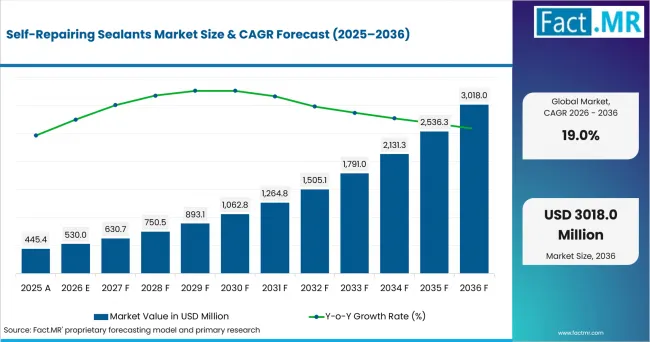
Self Repairing Sealants Market Value Analysis | Source: Fact.MR
What are the defining numbers behind Self-Repairing Sealants Market growth?
An absolute opportunity of USD 2488.0 million is expected between 2026 and 2036.
- Demand Drivers in the Market
- Automotive engineers need sealants that retain adhesion after vibration. The U.S. Census Bureau reported USD 334.8 billion in manufactured durable-goods orders in June 2026.
- Construction specifiers need water-barrier materials that reduce repair visits after façade movement and repeated weather exposure.
- Electronics assemblers need flexible gasketing compounds where heat and humidity place repeated stress on compact module housings.
- Fleet maintenance teams need repairable seams so adhesive joints remain serviceable between scheduled inspection cycles.
- Key Segments Analyzed
- By Chemistry: Polyurethane is expected to hold 37.0% share in 2026 because flexible chains support elongation and repeated crack closure.
- By Form: Liquid coating is projected to account for 36.0% share in 2026 as brush, spray and bead application suit curved surfaces.
- By Performance: Self-repair is anticipated to capture 41.0% share in 2026 since it connects directly with service-life extension.
- By Application: Automotive is estimated to represent 37.0% share in 2026 owing to body seams, glass bonding and electronics sealing.
- By Customer: OEMs are forecast to hold 47.0% share in 2026 as they qualify materials before platform-level release.
- Analyst Opinion at Fact.MR
- Shambhu Nath Jha, Principal Consultant at Fact.MR, states, “Self-repairing sealants are drawing attention because maintenance cost is moving into the material-selection discussion. Buyers are expected to ask for proof that a sealant keeps adhesion and barrier function after movement, heat or small surface damage. Suppliers that combine chemistry control, application support and documented aging results are better placed in qualification programs.”
- Strategic Implications
- Chemical suppliers should publish crack-closure and adhesion-retention data that matches automotive, construction and electronics test conditions.
- OEM engineering teams should qualify sealants by surface type, cure window and repair access before wider material release.
- Automotive repair channels should track primerless systems. Sika launched Sikaflex P2G Premium in May 2025 with a 3-hour Minimum Drive-Away Time and describes it as a primerless polyurethane auto-glass adhesive.
- Formulators should balance self-repair behavior with thermal stability where batteries and electronic modules expose seals to higher operating temperatures.
Germany records 24.7% CAGR through 2036 because manufacturing order recovery supports higher-value sealant qualification. The UK posts 22.1% CAGR with zero-emission vehicle programs adding sealing work around lighter platforms. Japan reaches 17.5% CAGR through battery-policy support and precision manufacturing. South Korea advances at 14.5% CAGR due to ICT exports and electronics assembly demand. The USA is estimated to hold 13.4% CAGR as factory output and repair channels sustain adoption.
How does the Self-Repairing Sealants Market break down by segment?
Polyurethane leads Chemistry at 37.0% share in 2026; OEMs lead Customer at 47.0% share.
Which Chemistry dominates?
Polyurethane is expected to hold 37.0% share in 2026.
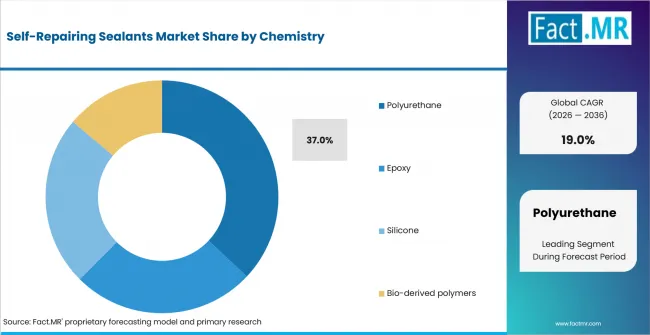
Self Repairing Sealants Market Analysis By Chemistry | Source: Fact.MR
Polyurethane leads because flexible molecular segments suit moving joints and automotive seams. Epoxy systems remain relevant where stiffness and barrier strength carry more weight than elongation. Silicone systems fit higher-temperature sealing and weather-exposed joints. Bio-derived polymers are anticipated to gain attention where brands need lower-carbon material stories while preserving repair function.
What leads the Form segment?
Liquid coating is projected to account for 36.0% share in 2026.
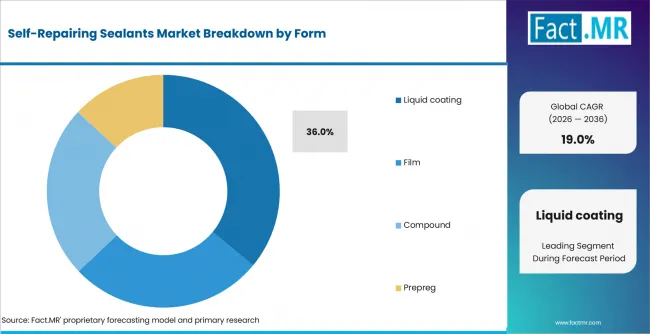
Self Repairing Sealants Market Analysis By Form | Source: Fact.MR
Liquid coating leads because applicators apply it across irregular parts and field-repair areas with simple dispensing tools. Film formats fit flat laminated surfaces and controlled aerospace layups. Compounds remain useful for bead, potting and gasketing work. Henkel reports LOCTITE AA 5885 can cure in as little as 30 seconds, an adjacent example of fast-curing liquid gasketing.
How does Performance shape demand?
Self-repair is anticipated to lead with 41.0% share in 2026.
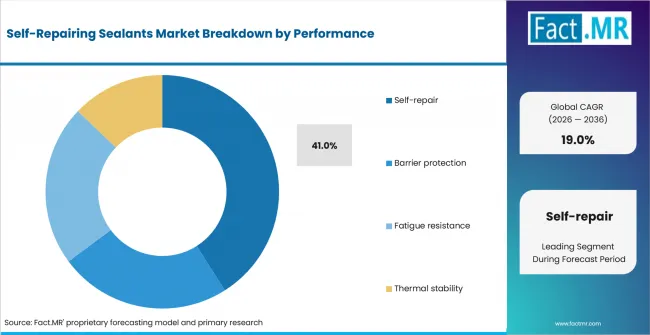
Self Repairing Sealants Market Analysis By Performance | Source: Fact.MR
Self-repair leads because it is the performance claim that separates the category from ordinary sealants. Barrier protection remains central where moisture, salt spray or fuel exposure threatens the joint. Fatigue resistance is relevant for vehicle bodies and aircraft structures. Thermal stability shapes product selection in power electronics, batteries and industrial equipment rooms.
What supports Automotive within Application?
Automotive is estimated to represent 37.0% share in 2026.
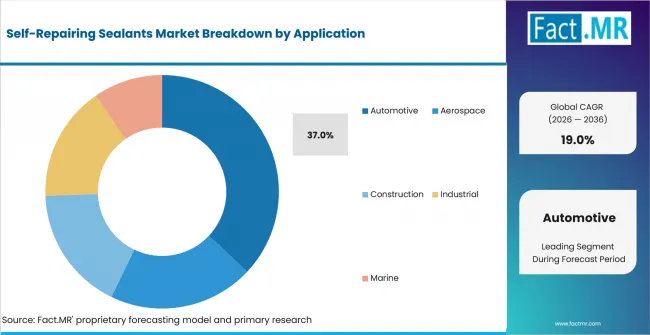
Self Repairing Sealants Market Analysis By Application | Source: Fact.MR
Automotive leads because vehicles combine body movement, weather exposure and electronics density in one platform. The U.K. Department for Transport reported 528,000 zero-emission vehicles were first registered in 2025, up 24% from 2024.
What supports OEMs within Customer?
OEMs are forecast to hold 47.0% share in 2026.
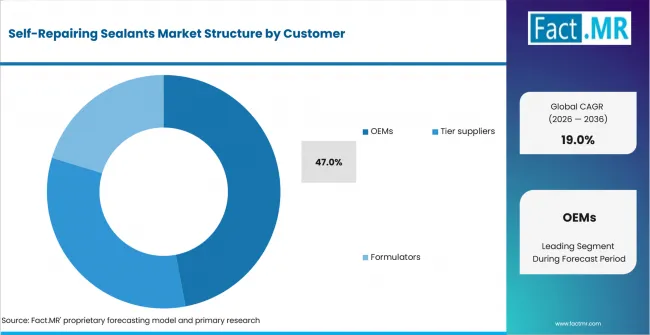
Self Repairing Sealants Market Analysis By Customer | Source: Fact.MR
OEMs lead because self-repairing chemistry needs validation before it reaches serial production or large construction programs. Tier suppliers still influence chemistry choice when they deliver modules, glass systems or composite parts. Formulators serve retrofit and specialty projects where smaller batch adaptation is required. OEM approval therefore anchors volume while other customers widen use cases.
What is accelerating Self-Repairing Sealants Market adoption, and what is holding it back?
Durability needs drive it; qualification cost restrains it.
Drivers Impact Analysis
| DRIVER | (~) % IMPACT ON CAGR | GEOGRAPHIC RELEVANCE | IMPACT TIMELINE |
|---|---|---|---|
| Automotive sealing durability in electric and connected vehicles | +2.0% | North America, Europe, East Asia | Short term (<= 2 years) |
| Construction waterproofing and façade movement protection | +1.5% | Europe, North America | Medium term (2-4 years) |
| Electronics gasketing and thermal cycling requirements | +1.2% | South Korea, Japan, USA | Medium term (2-4 years) |
- Automotive sealing durability: Electric vehicles place more sealing work around battery housings, sensors and thermal systems. Sealants that recover from small cracks are expected to reduce warranty exposure. Primerless glass and seam systems show how application simplicity is becoming part of durability decisions.
- Construction waterproofing: Buildings expose joints to moisture, temperature swings and movement. Destatis reported in August 2026 that the construction of 21,600 dwellings was permitted in Germany in June 2026, up 13.8% from June 2025.
- Electronics gasketing: Vehicle and industrial electronics need sealants that protect against heat and moisture while fitting compact housings. Cured-in-place gasketing suits automated assembly lines. Suppliers are therefore expected to focus on pumpability, bead control and long-term seal-force retention.
Opportunity Impact Analysis
| OPPORTUNITY | (~) % IMPACT ON CAGR | GEOGRAPHIC RELEVANCE | IMPACT TIMELINE |
|---|---|---|---|
| Primerless and low-prep automotive sealants | +1.4% | USA, Germany, UK | Short term (<= 2 years) |
| Battery pack and electronics module protection | +1.1% | Japan, South Korea, USA | Medium term (2-4 years) |
| Repair and retrofit coatings for building envelopes | +0.8% | Europe, North America | Medium term (2-4 years) |
| Specialty marine and aerospace barrier systems | +0.6% | USA, UK, Japan | Long term (>= 4 years) |
- Primerless automotive sealants: Fewer pretreatment steps reduce shop time and installer variability. Primerless systems are expected to gain attention where repair networks need speed and repeatability. The best route is application support tied to surface-specific guidance.
- Battery pack protection: Battery housings need sealing against moisture, vibration and thermal cycling. Sealants with repair behavior are anticipated to gain trial use around covers, cable entries and sensor housings. Qualification depth remains the deciding factor for platform release.
- Building retrofit coatings: Liquid coatings fit repair work on irregular surfaces where owners prefer targeted sealing over component replacement. Retrofit crews need materials that tolerate movement after cure. Training and surface preparation guidance are expected to decide field performance.
- Marine and aerospace barriers: Salt, fuel and temperature exposure raise the value of specialty sealants in high-duty environments. Self-repair behavior is expected to stay selective until buyers finish aging and fatigue tests for exact substrates.
Restraints Impact Analysis
| RESTRAINT | (~) % IMPACT ON CAGR | GEOGRAPHIC RELEVANCE | IMPACT TIMELINE |
|---|---|---|---|
| High qualification cost and long validation cycles | -0.8% | Global | Short term (<= 2 years) |
| Raw material and specialty additive price pressure | -0.6% | North America, Europe | Medium term (2-4 years) |
| Field installation sensitivity | -0.5% | Construction, repair channels | Medium term (2-4 years) |
| Limited long-term proof for new chemistries | -0.4% | Global | Long term (>= 4 years) |
- High qualification cost: OEMs need aging, adhesion and fatigue proof before approving self-repairing sealants. That process is expected to slow conversion from standard polyurethane and silicone materials. Suppliers with clear test packages shorten the approval path.
- Field installation sensitivity: Surface preparation, cure time and bead geometry still control field performance. Self-repairing sealants lose commercial value when crews apply them outside the intended window. Training is therefore expected to shape construction and repair-channel results.
- Limited long-term proof: Newer bio-derived and healing chemistries need multi-season evidence before broader adoption. Buyers are expected to request data on humidity, heat and fatigue exposure. The restraint is strongest where applications touch safety or warranty claims.
Which countries are scaling the Self-Repairing Sealants Market through 2036?
- The country comparison spans 11.3 percentage points between Germany and the USA across the forecast period.
- Germany remains 2.6 percentage points above the UK as manufacturing orders and construction validation support specialty sealants.
- The UK remains 4.6 percentage points above Japan as vehicle-electrification funding supports sealing around lighter platforms.
- Japan remains 3.0 percentage points above South Korea through battery manufacturing policy and precision industrial demand.
- South Korea remains 1.1 percentage points above the USA as electronics exports strengthen module-sealing opportunities.
- The USA closes the displayed range while manufacturing output and repair channels sustain practical adoption.
Comparable CAGRs create different entry conditions due to vehicle-platform mix, building cycles, electronics output and qualification culture. Full report coverage includes North America, Latin America, Western Europe, Eastern Europe, East Asia, South Asia & Pacific, Middle East & Africa.
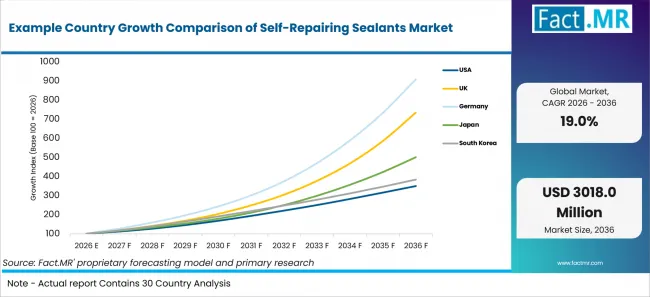
Example Country Growth Comparison Of Self Repairing Sealants Market | Source: Fact.MR
| Country | CAGR (2026-2036) |
|---|---|
| Germany | 24.7% |
| UK | 22.1% |
| Japan | 17.5% |
| South Korea | 14.5% |
| USA | 13.4% |
What supports Germany adoption?
24.7% CAGR, supported by manufacturing order recovery and construction validation.
Germany is estimated to record 24.7% CAGR through 2036. Destatis reported that real new orders in German manufacturing rose 3.1% month over month in June 2026, on a seasonally and calendar-adjusted basis. Automotive-industry orders increased 3.8% during the month, providing a favorable industrial backdrop for suppliers serving automotive manufacturing.
What supports UK growth?
22.1% CAGR, supported by vehicle-electrification funding and advanced manufacturing.
The UK is projected to post 22.1% CAGR through 2036. Department for Business and Trade guidance updated on 10 August 2026 describes DRIVE35 as a GBP 4.0 billion capital and R&D programme for the automotive industry to 2035.
How is Japan developing demand?
17.5% CAGR, led by battery policy and precision manufacturing demand.
Japan is forecast to reach 17.5% CAGR through 2036. METI revised the Battery Industry Strategy as the Battery and Power Industry Strategy on 2 June 2026, targeting a domestic manufacturing base of 150 GWh per year from 2030 to the mid-2030s.
What supports South Korea adoption?
14.5% CAGR, supported by ICT exports and electronics assembly demand.
South Korea is anticipated to advance at 14.5% CAGR through 2036. MOTIR and MSIT reported Korea’s ICT exports reached USD 53.36 billion in July 2026, up 140.6% year on year.
What supports USA adoption?
13.4% CAGR, supported by manufacturing output and repair-channel demand.
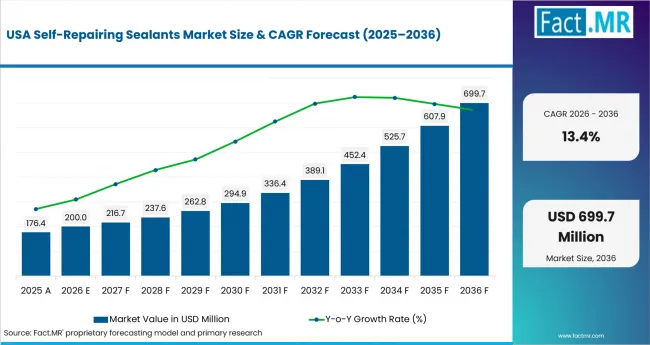
Self Repairing Sealants Market Country Value Analysis | Source: Fact.MR
The USA is expected to hold 13.4% CAGR through 2036. The Federal Reserve Board reported U.S. manufacturing production grew 0.2% in July 2026 after a 0.3% June increase.
Who leads the Self-Repairing Sealants Market?
Sika, Henkel, 3M, Bostik, and Dow are profiled for direct or adjacent sealant capability. Bostik documents self-healing properties for Powermastik, while Sika’s Sikaflex P2G Premium provides a primerless polyurethane solution for automotive-glass replacement and Henkel’s LOCTITE AA 5885 provides rapid UV-cured cure-in-place gasketing for automotive electronics. Bostik also maintains bonding and sealing portfolios spanning construction, automotive and aerospace applications.
Dow contributes silicone-based adhesives and sealants for construction and electronics applications. Bostik’s construction portfolio includes moisture-management, sealing and bonding solutions, alongside technical guidance and applicator training. Across these portfolios, documented curing performance, substrate compatibility, application procedures and product testing provide relevant differentiation during sealant selection and qualification.
Which companies are the key providers?
Key companies include Sika; Henkel; 3M; Bostik; and Dow.
- Sika
- Henkel
- 3M
- Bostik
- Dow
Bibliography
- U.S. Census Bureau. (2026, July 27). Monthly advance report on durable goods manufacturers' shipments inventories and orders.
- Henkel. (2025, April 3). Henkel expands rapid cure gasketing sealant range with Loctite AA 5885, optimized for automotive electronics applications.
- Sika Corporation. (2025, May 22). Sika launches new Sikaflex® P2G Premium, primerless auto glass replacement (AGR) adhesive.
- Department for Transport. (2026, April 29). Vehicle licensing statistics, United Kingdom: 2025. GOV.UK.
- Federal Statistical Office (Destatis). (2026, August 6). New orders in manufacturing in June 2026: +3.1% on the previous month.
- Federal Statistical Office (Destatis). (2026, August 18). Baugenehmigungen für Wohnungen im Juni 2026: +13,8 % zum Vorjahresmonat [Building permits for dwellings in June 2026: +13.8% on the same month a year earlier].
- U.S. Bureau of Labor Statistics. (2026, August 13). Producer Price Indexes—July 2026.
- Department for Business, Innovation, Science and Trade, & Department for Business and Trade. (2026, August 10). DRIVE35 Funding Programme: Scale-Up. GOV.UK.
- Ministry of Economy, Trade and Industry. (2026, June 2). “Battery Industry Strategy” revised as the “Battery and Power Industry Strategy”.
- Ministry of Trade, Industry and Resources, & Ministry of Science and ICT. (2026, August 14). Korea’s ICT exports reach record $53.36 billion for July.
- Board of Governors of the Federal Reserve System. (2026, August 18). Industrial production and capacity utilization—G.17.
This Report Answers
- The report explains where self-repairing sealants are used across chemistry and form. It also covers performance, application and customer group.
- Segment analysis identifies the leading subsegments and the operational reasons engineers prioritize them.
- Country analysis examines Germany, the UK, Japan, South Korea and the USA with official demand indicators.
- Competitive analysis reviews Sika, Henkel, 3M, Bostik, and Dow across sealant portfolios and application reach.
- Application analysis assesses how automotive, construction and electronics requirements shape material selection.
What does the Self-Repairing Sealants Market cover?
The Self-Repairing Sealants Market covers polyurethane, epoxy, silicone and bio-derived polymer systems used to protect seams, joints and surfaces after small damage events. These products are assessed by their ability to restore sealing behavior or maintain adhesion under movement, moisture and thermal stress.
The assessment differs from ordinary sealant coverage because self-repairing function is part of the product value proposition. Standard fillers, caulks and adhesives are outside the core boundary unless they are sold with a documented self-repair or crack-closing performance claim.
What is included in the scope?
The scope includes self-repairing sealants used in automotive seams, glass bonding, battery packs, electronic modules, building joints, industrial equipment and specialty marine or aerospace applications. It covers liquid coatings, films, compounds and prepreg formats across polyurethane, epoxy, silicone and bio-derived polymer chemistries.
What is excluded from the scope?
The scope places ordinary caulks, passive coatings and generic adhesives outside the core boundary when repair behavior is absent. It also places standalone structural composites and coating resins outside the scope when sealing function is absent. Aerospace adhesives and sealants and silicone sealant categories remains adjacent unless the product is positioned with self-repairing or crack-closing behavior.
How Was the Analysis Built?
The analysis draws on 120+ sources, 35+ company portfolios, 25+ countries, and more than 20 industry interviews.
- Primary Research: Primary research includes discussions with manufacturers, service providers, technology developers, distributors, end users, procurement teams, and subject-matter experts. These conversations examine purchasing priorities, product adoption, operational challenges, approval requirements, competitive positioning, and the factors that influence wider market acceptance.
- Desk Research: Desk research covers government statistics, regulatory publications, company filings, trade data, technical studies, industry associations, standards, public policy, and other authoritative sources. Every source used in the analysis is documented in the bibliography.
- Market Sizing and Forecasting: Market estimates combine historical performance, demand indicators, pricing and volume trends, segment shares, company participation, country-level growth, adoption patterns, investment activity, and barriers to market expansion.
- Data Validation and Update Cycle: Findings are validated by comparing primary interviews with public data, company activity, regulatory changes, trade patterns, and industry developments. Regular updates review new product launches, capacity changes, partnerships, approvals, procurement trends, and shifts in commercial adoption.
What is the report’s scope and coverage?
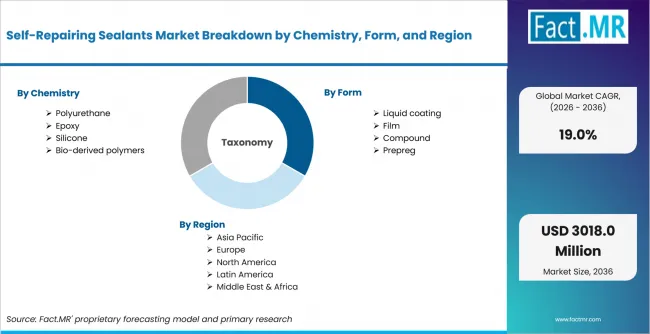
Self Repairing Sealants Market Breakdown By Chemistry, Form, And Region | Source: Fact.MR
| Attribute | Details |
|---|---|
| Quantitative Units | USD million in 2026 to USD million by 2036 at a CAGR |
| Market Definition | Sealants designed to repair microcracks, restore barrier behavior or maintain adhesion after small damage events in service. |
| Chemistry | Polyurethane; Epoxy; Silicone; Bio-derived polymers |
| Form | Liquid coating; Film; Compound; Prepreg |
| Performance | Self-repair; Barrier protection; Fatigue resistance; Thermal stability |
| Application | Automotive; Aerospace; Construction; Industrial; Marine |
| Customer | OEMs; Tier suppliers; Formulators |
| Regions Covered | North America; Latin America; Western Europe; Eastern Europe; East Asia; South Asia & Pacific; Middle East & Africa |
| Countries Covered | United States; United Kingdom; Germany; Japan; South Korea |
| Key Companies Profiled | Sika; Henkel; 3M; Bostik; Dow |
| Forecast Period | 2026 to 2036 |
| Approach | Hybrid top-down and bottom-up approach using application demand, chemistry fit, customer qualification routes, country adoption and provider portfolio review. |
How is the market segmented?
-
By Chemistry:
- Polyurethane
- Epoxy
- Silicone
- Bio-derived polymers
-
By Form:
- Liquid coating
- Film
- Compound
- Prepreg
-
By Performance:
- Self-repair
- Barrier protection
- Fatigue resistance
- Thermal stability
-
By Application:
- Automotive
- Aerospace
- Construction
- Industrial
- Marine
-
By Customer:
- OEMs
- Tier suppliers
- Formulators
-
By Region:
- North America
- Latin America
- Western Europe
- Eastern Europe
- East Asia
- South Asia & Pacific
- Middle East & Africa