- Base Value(2025): 77.10 Bn
- Estimated Value(2026): 81.88 Bn
- Forecast Value (2036): 149.43 Bn
- CAGR (2026 - 2036): 6.2%
Adhesives & Sealants Market Size, Market Forecast and Outlook By Fact.MR
The adhesives & sealants market was valued at USD 77.10 billion in 2025, projected to reach USD 81.88 billion in 2026, and is forecast to expand to USD 149.43 billion by 2036 at a 6.2% CAGR. E-commerce packaging volume growth and automotive structural bonding adoption are creating sustained demand for adhesive technologies that replace mechanical fasteners and enable lightweight multi-material assembly designs. Building construction sealant consumption is accelerating as energy efficiency mandates require high-performance weatherproofing systems that maintain air and moisture barrier integrity over extended service lifetimes.
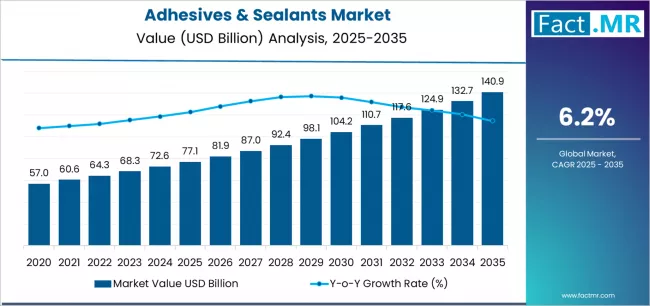
Adhesives & Sealants Market Market Value Analysis | Source: Fact.MR
Summary of Adhesives & Sealants Market
- Market Overview
- The adhesives & sealants market is valued at USD 77.10 billion in 2025 and is projected to reach USD 149.43 billion by 2036.
- The industry is expected to grow at a 6.2% CAGR from 2026 to 2036, creating an incremental opportunity of USD 67.55 billion.
- The market is a broad-based industrial consumables category where e-commerce packaging volumes, automotive structural bonding adoption, construction sealant specifications, and VOC emission regulations define competitive dynamics.
- Demand and Growth Drivers
- Demand is accelerating as e-commerce packaging volume growth drives consumption of hot melt and water-based adhesives in automated case sealing and labeling operations.
- Automotive OEMs are replacing mechanical fasteners with structural adhesives to enable lightweight multi-material body assembly designs that meet fuel efficiency targets.
- Building energy efficiency mandates are increasing sealant consumption as construction projects require high-performance weatherproofing systems with verified air and moisture barrier ratings.
- Among key countries, India leads at 8.5% CAGR, followed by China at 7.8%, South Korea at 6.2%, the USA at 5.5%, Germany at 5.0%, the UK at 4.8%, and Japan at 4.5%.
- Product and Segment View
- Adhesives and sealants are bonding and sealing materials formulated from acrylic, polyurethane, epoxy, silicone, EVA, and other polymer chemistries, applied in liquid, paste, film, or hot melt forms to join substrates or seal joints across packaging, construction, automotive, and industrial assembly applications.
- Adhesive applications span paper & packaging, building & construction, automotive, furniture, footwear, and medical sectors. Sealant applications concentrate in construction, automotive, and packaging.
- Acrylic leads by Adhesive Product with 36.7% share in 2026. Silicone Sealants lead by Sealant Product with 33.0% share.
- Paper & Packaging leads by Adhesive Application with 29.4% share. Construction leads by Sealant Application with 44.7% share.
- Scope includes all adhesive and sealant product types across water-based, solvent-based, hot melt, and reactive technologies, excluding mechanical fasteners, welding consumables, and cement-based tile adhesives.
- Geography and Competitive Outlook
- India and China are the fastest-growing markets due to rapid packaging, construction, and manufacturing sector expansion, while the USA and Germany represent mature markets driven by e-commerce packaging growth and automotive structural bonding specifications.
- Competition is shaped by adhesive chemistry breadth, application equipment partnerships, and multi-sector distribution network coverage.
- Key companies include Henkel AG & Co. KGaA, 3M Company, Ashland Inc., Avery Dennison Corporation, H.B. Fuller Company, Sika AG, Pidilite Industries Limited, Huntsman Corporation, Wacker Chemie AG, and RPM International Inc.
- Analyst Opinion at Fact.MR
- Shambhu Nath Jha , Principal Consultant for Chemicals and Materials, opines: 'In my analysis, I have observed that the true procurement complexity in adhesives and sealants lies not in product chemistry selection but in the application-specific qualification testing that locks end users into supplier relationships for 3 to 5 year cycles. Packaging line operators that qualify a hot melt adhesive for high-speed case sealing face 2 to 4 week requalification timelines for each alternative supplier product. Automotive structural bonding specifications require 12 to 18 months of accelerated aging test data before a new adhesive formulation can enter production. Companies delaying water-based adhesive conversion to meet tightening VOC regulations face compressed reformulation timelines as compliance deadlines approach.'
- Strategic Implications / Executive Takeaways
- Adhesive manufacturers must maintain application engineering support teams that help packaging line operators qualify new formulations within the compressed timeline windows between production seasons.
- Automotive OEM bonding engineers should initiate structural adhesive qualification programs 18 months before vehicle launch dates to accommodate accelerated aging test data requirements.
- Construction sealant suppliers must develop product portfolios certified to updated building energy code air barrier performance standards to qualify for specification in new construction projects.
Adhesives & Sealants Market Key Takeaways
| Metric | Details |
|---|---|
| Industry Size (2026) | USD 81.88 billion |
| Industry Value (2036) | USD 149.43 billion |
| CAGR (2026 to 2036) | 6.2% |
Source: Fact.MR analysis. Updated Apr 7, 2026
The absolute dollar opportunity of USD 67.55 billion between 2026 and 2036 reflects broad-based consumption growth across packaging, construction, automotive, and industrial assembly applications. Water-based adhesive technologies continue gaining specification share as VOC emission regulations tighten across manufacturing environments. Hot melt adhesives are capturing packaging line conversion as automated case sealing and labeling operations prioritize instant bond strength and reduced downtime. Reactive adhesive systems including structural epoxies and polyurethanes command premium pricing in automotive and aerospace bonding applications where load-bearing joint performance is mandatory.
All major adhesive and sealant consumption corridors reflect accelerated growth patterns. India sets the pace with an 8.5% CAGR as packaging, construction, and consumer product manufacturing volumes expand rapidly. China follows at 7.8% with infrastructure construction and automotive assembly plant expansion. South Korea tracks at 6.2% through electronics assembly adhesive demand from semiconductor and display panel manufacturing. United States operations advance at 5.5%, supported by e-commerce packaging volume growth and residential construction activity. Germany registers a 5.0% pace anchored by automotive structural bonding specification adoption. United Kingdom expands at 4.8% through building retrofit weatherproofing sealant demand. Japan tracks at 4.5% through electronics and precision assembly adhesive specification tightening.
Why is the Adhesives & Sealants Market Growing?
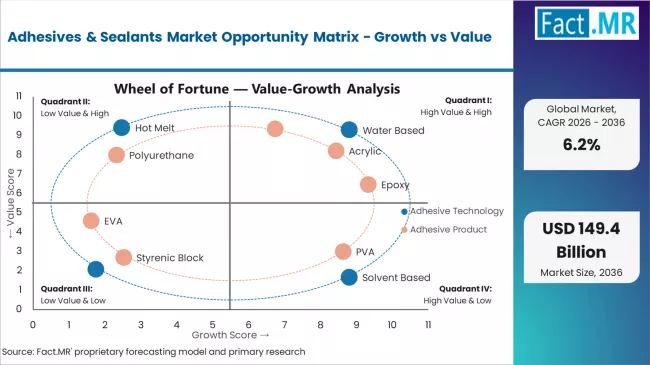
Adhesives & Sealants Market Opportunity Matrix Growth Vs Value | Source: Fact.MR
The adhesives & sealants market grows by enabling manufacturers to achieve superior bonding performance and production efficiency while addressing lightweighting requirements and design flexibility that mechanical fasteners cannot provide across automotive, construction, and packaging applications.
Manufacturers face mounting pressure to reduce product weight and improve fuel efficiency while maintaining structural integrity and safety standards, with modern adhesives typically providing superior stress distribution, corrosion resistance, and aesthetic finishing compared to traditional welding or riveting methods alone, making advanced bonding solutions essential for contemporary manufacturing processes.
The industrial sector's need for versatile and high-performance joining technologies creates demand for specialized adhesive and sealant solutions that can provide substrate compatibility, environmental durability, and automated application capabilities without compromising production speed or quality consistency.
Engineering specification adoption and proven performance in demanding applications drive implementation across automotive assembly plants, construction sites, and electronics manufacturing facilities, where bonding reliability has direct impact on product warranty claims and end-user safety outcomes. The expanding e-commerce sector globally, driving exponential growth in corrugated packaging and shipping materials, creates massive demand for paper and packaging adhesives enabling efficient carton sealing.
Rising construction activities in emerging markets and building renovation projects in developed economies enable widespread sealant adoption for weatherproofing and energy efficiency applications. Substrate surface preparation requirements and curing time constraints may limit universal adhesive adoption and create challenges for rapid production cycles among diverse manufacturing operations with varying process capabilities.
Segmental Analysis
The market is segmented by adhesive technology, adhesive product, adhesive application, sealant product, sealant application, and region. By adhesive technology, the market is divided into water based, solvent based, hot melt, and reactive & others. Based on adhesive product, the market is categorized into acrylic, PVA, polyurethane, styrenic block, epoxy, EVA, and other products.
By adhesive application, the market includes paper & packaging, building & construction, consumer & DIY, furniture & woodworking, footwear & leather, automotive & transportation, medical, and other applications. Based on sealant product, the market is divided into silicone sealants, acrylic sealants, polyurethanes, polyvinyl acetate, and other products. By sealant application, the market includes construction, automotive, packaging, assembly, consumers, and other applications. Regionally, the market is divided into Asia Pacific, Europe, North America, Latin America, and Middle East & Africa.
By Adhesive Technology, Which Segment Accounts for the Dominant Market Share?
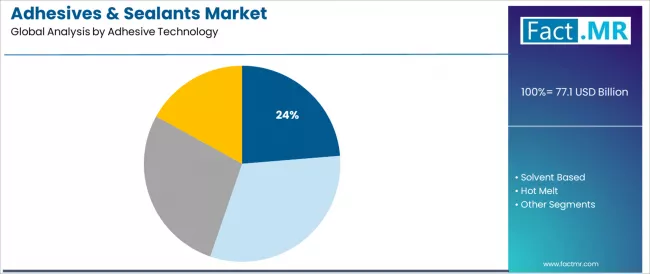
Adhesives & Sealants Market Analysis By Adhesive Technology | Source: Fact.MR
The water-based adhesives segment represents the dominant force in the adhesives & sealants market, capturing 23.7% of the market share in 2025. This established technology category encompasses solutions featuring water as the primary carrier medium and environmentally responsible formulations, including advanced polymer dispersions combining acrylic, polyurethane, and vinyl acetate chemistries that enable superior sustainability profiles and workplace safety characteristics across packaging, woodworking, and consumer product assembly applications worldwide.
The water-based segment's market leadership stems from its superior environmental compliance and regulatory advantages, with solutions capable of meeting stringent VOC emission limits and eliminating hazardous air pollutant concerns while maintaining excellent adhesion performance and cost-effectiveness across diverse substrate combinations. Within the water-based segment, acrylic emulsions represent the preferred chemistry for many applications, driven by their excellent UV resistance, aging properties, and versatile bonding capabilities across porous substrates. This sub-segment benefits from continuous innovation in crosslinking technologies and tackifier systems improving performance characteristics.
The solvent-based adhesives segment maintains a substantial market share in the 21.4% range, serving demanding industrial applications and specialized bonding requirements where fast evaporation rates, high initial tack, and superior adhesion to non-porous substrates including plastics and metals remain critical performance criteria.
Solvent-based adhesives offer exceptional bonding strength for manufacturers managing challenging assembly processes while providing sufficient flexibility to accommodate thermal expansion and mechanical stress. The solvent-based segment demonstrates stable demand patterns in specific industrial niches, driven by unmatched performance in footwear manufacturing, flexible packaging lamination, and automotive interior trim applications.
Within the technology category, hot melt adhesives demonstrate growing adoption, driven by rapid setting characteristics enabling high-speed production lines and 100% solid content eliminating solvent emissions entirely. This sub-segment benefits from expanding applications in packaging automation and product assembly operations prioritizing throughput efficiency.
Key performance advantages driving the water-based segment include:
- Advanced environmental compliance enabling regulatory approval across stringent jurisdictions and supporting corporate sustainability commitments
- Established workplace safety characteristics allowing improved employee health protection and reduced ventilation infrastructure requirements
- Enhanced substrate compatibility providing effective bonding across paper, cardboard, wood, and textile materials while maintaining processing flexibility
- Superior cost-effectiveness delivering optimal total ownership economics through reduced waste disposal expenses and simplified handling protocols
By Adhesive Product, Which Segment Accounts for the Largest Market Share?
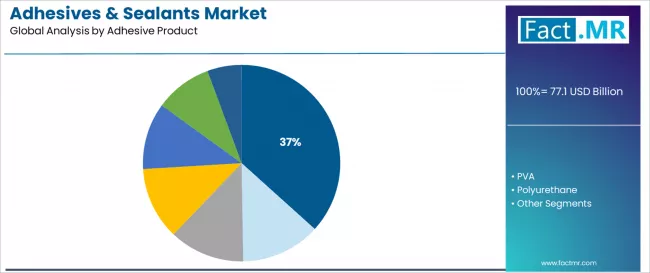
Adhesives & Sealants Market Analysis By Adhesive Product | Source: Fact.MR
Acrylic adhesives dominate the adhesives product landscape with a 36.7% market share in 2025, reflecting the critical role of acrylic chemistry in supporting versatile bonding applications and pressure-sensitive tape manufacturing across industrial, commercial, and consumer markets worldwide. The acrylic segment's market leadership is reinforced by exceptional weathering resistance, outstanding optical clarity, and superior aging characteristics that enable long-term performance reliability in outdoor applications and UV-exposed environments.
Within this segment, acrylic emulsion adhesives represent the core technology for water-based formulations, driven by excellent bonding to porous substrates and environmental compliance supporting packaging and woodworking applications. This sub-segment benefits from continuous innovation in polymer architecture and crosslinking chemistry improving wet strength and heat resistance.
The PVA segment represents an important product category demonstrating steady demand through specialized requirements for woodworking, paper bonding, and educational craft applications where non-toxic formulations and easy cleanup properties create compelling user benefits. This segment benefits from established market positions in furniture manufacturing and packaging industries requiring cost-effective bonding solutions.
Within product categories, polyurethane adhesives demonstrate premium positioning through exceptional flexibility, superior impact resistance, and outstanding structural bonding capabilities for demanding applications. Epoxy adhesives serve specialized high-performance requirements requiring maximum strength and chemical resistance, while hot melt EVA formulations address high-speed packaging operations.
Key market dynamics supporting product category growth include:
- Acrylic technology advancement enabling pressure-sensitive adhesive innovation and structural bonding applications requiring optical clarity
- Polyurethane formulation development trends require specialized isocyanate chemistry expertise and moisture-curing mechanisms
- Integration of hybrid technologies combining multiple polymer platforms enabling optimized performance characteristics across application requirements
- Growing emphasis on bio-based acrylic monomers and sustainable raw material sourcing driving environmental responsibility without performance limitations
By Adhesive Application, Which Segment Accounts for a Significant Market Share?
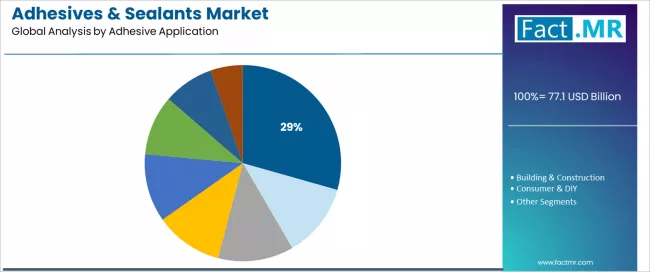
Adhesives & Sealants Market Analysis By Adhesive Application | Source: Fact.MR
Paper & packaging represents the leading adhesive application segment in the adhesives & sealants market with a 29.4% market share in 2025, reflecting the fundamental role of adhesives in corrugated box manufacturing, flexible packaging lamination, and labeling operations supporting global supply chain logistics. The paper & packaging segment demonstrates consistent demand driven by exponential e-commerce growth creating massive requirements for shipping cartons and protective packaging materials requiring reliable sealing performance.
Within paper & packaging applications, corrugated box assembly represents the largest category, driven by ubiquitous use of cardboard packaging across consumer goods distribution and industrial shipping operations. The segment benefits from continuous innovation in starch-based and synthetic adhesive formulations optimizing production speed and box strength.
The building & construction segment emerges as an important application category with robust growth potential, driven by infrastructure development in emerging markets and building renovation activities in developed economies requiring tile adhesives, flooring installation systems, and panel bonding solutions. Contractors seeking durable installation performance drive adoption of specialized construction adhesives offering superior load-bearing capabilities and environmental resistance.
Within application types, consumer & DIY demonstrates accessible market positioning through retail distribution channels serving home improvement and craft applications. Furniture & woodworking addresses cabinet assembly and veneer bonding requiring high-strength wood adhesives, while automotive applications represent technically demanding segments requiring structural bonding and interior trim attachment.
Key application dynamics include:
- Paper & packaging requirements accelerating across e-commerce fulfillment operations with emphasis on automated packaging lines and rapid box assembly
- Building & construction applications driving demand for tile adhesives, construction sealants, and insulation bonding supporting green building initiatives
- Automotive segment prioritizing lightweight material bonding and structural adhesive applications replacing traditional welding processes
- Medical applications emphasizing biocompatible formulations and sterilization resistance for device assembly and wound care products
By Sealant Product, Which Segment Accounts for the Dominant Market Share?
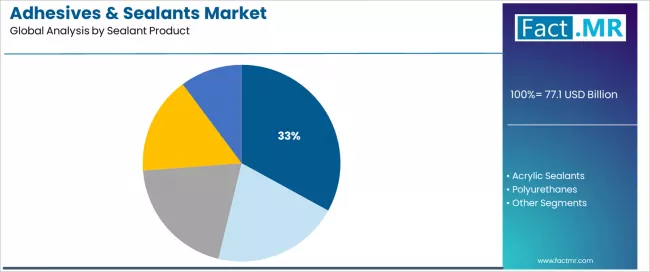
Adhesives & Sealants Market Analysis By Sealant Product | Source: Fact.MR
Silicone sealants dominate the sealant product landscape with a 33.0% market share in 2025, reflecting the critical role of silicone chemistry in supporting extreme temperature resistance and outstanding weathering durability across construction, automotive, and industrial applications worldwide. The silicone sealants segment's market leadership is reinforced by exceptional flexibility retention across wide temperature ranges, superior UV stability enabling long-term outdoor performance, and excellent adhesion to diverse substrates including glass, metal, and plastic materials.
Within this segment, neutral-cure silicone sealants represent a growing technology approach, driven by improved substrate compatibility and reduced corrosion potential on sensitive materials compared to acetoxy-cure alternatives. This sub-segment benefits from expanding applications in curtain wall glazing and electronic component potting.
The acrylic sealants segment represents an important product category demonstrating steady growth through cost-effectiveness, paintability characteristics, and environmental friendliness for interior construction applications. These formulations offer sufficient performance for non-movement joints and gap-filling operations while providing easy cleanup and tooling properties.
Within product categories, polyurethane sealants demonstrate premium positioning through exceptional adhesion strength, superior abrasion resistance, and outstanding chemical resistance for demanding industrial applications. Polyvinyl acetate sealants serve specialized interior construction requirements prioritizing paintability and ease of application.
Key market dynamics supporting sealant product growth include:
- Silicone technology expansion driven by high-performance construction glazing and automotive assembly applications requiring extreme durability
- Acrylic formulation innovation trends require improved flexibility and moisture resistance while maintaining paintability benefits
- Integration of hybrid sealant technologies combining silicone and polyurethane characteristics enabling optimized performance profiles
- Growing emphasis on low-modulus formulations accommodating building movement and thermal expansion without bond failure
By Sealant Application, Which Segment Accounts for the Largest Market Share?
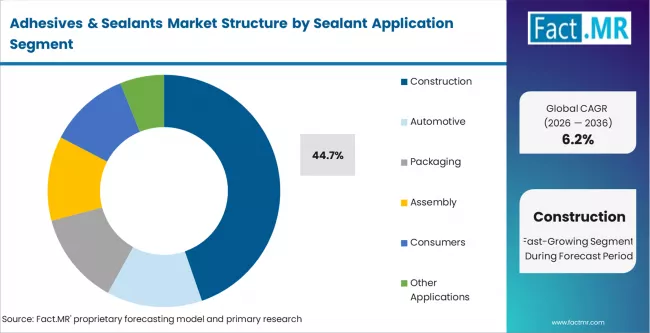
Adhesives & Sealants Market Analysis By Sealant Application | Source: Fact.MR
Construction represents the leading sealant application segment with a 44.7% market share in 2025, reflecting the fundamental role of sealants in building envelope weatherproofing, glazing installations, and joint sealing applications protecting structures from moisture infiltration and air leakage. The construction segment demonstrates consistent demand driven by ongoing infrastructure development, building renovation activities, and increasing emphasis on energy-efficient building practices requiring comprehensive air sealing strategies.
Within construction applications, facade and glazing sealing represents the largest category, driven by extensive curtain wall installations in commercial buildings and window perimeter sealing in residential construction. The segment benefits from advancing green building standards emphasizing thermal performance and airtightness specifications.
The automotive segment emerges as an important application category with steady demand patterns, driven by vehicle body sealing, windshield bonding, and interior noise reduction requirements across passenger car and commercial vehicle manufacturing. Assembly line integration and crashworthiness contributions drive adoption of specialized automotive sealants offering structural bonding capabilities.
Within application types, packaging demonstrates specialized requirements through flexible packaging sealing and carton closure applications. Assembly applications address industrial equipment fabrication and electronic component sealing, while consumer products represent retail distribution channels serving home maintenance and repair needs.
Key application dynamics include:
- Construction segment requirements accelerating across energy retrofit projects with emphasis on air barrier systems and thermal envelope improvements
- Automotive applications driving demand for lightweight material bonding and acoustic dampening sealants supporting vehicle electrification
- Packaging segment prioritizing flexible packaging seal integrity and modified atmosphere package performance
- Assembly applications emphasizing electronic potting and industrial equipment gasketing for environmental protection
What are the Drivers, Restraints, and Key Trends of the Adhesives & Sealants Market?
The market is driven by three concrete demand factors tied to manufacturing efficiency and regulatory requirements. First, rising automotive lightweighting initiatives create expanding opportunities for structural adhesives across vehicle assembly applications, with bonding technologies representing a critical enabler for multi-material vehicle architectures combining aluminum, high-strength steel, and composites, requiring comprehensive joining solutions. Second, growing e-commerce penetration and packaging consumption drive adhesive demand, with corrugated box production demonstrating significant volume increases supporting online retail fulfillment operations and direct-to-consumer shipping requirements by 2030. Third, increasing building energy efficiency regulations enable more stringent air sealing requirements that improve thermal performance while supporting sustainability goals through reduced heating and cooling energy consumption.
Market restraints include volatile raw material pricing for petroleum-derived components including styrene, acrylonitrile, and propylene that can challenge margin predictability and cost competitiveness, particularly during crude oil price fluctuations affecting feedstock economics and forcing frequent price adjustments across value chains. Technical performance limitations for bonding low-surface-energy plastics pose another significant obstacle, as adhesion to polyolefin materials including polypropylene and polyethylene requires specialized surface treatments or primer applications, potentially limiting adoption in simplified manufacturing processes. Competition from mechanical fastening innovations and advanced welding technologies creates additional market pressure, demanding continuous adhesive performance improvements in load-bearing capabilities and process integration efficiency.
Key trends indicate accelerated bio-based adhesive adoption in developed markets, particularly Europe and North America, where manufacturers demonstrate commitment to renewable content targets and reduced carbon footprint objectives supporting corporate sustainability reporting. Automation integration trends toward robotic dispensing systems and inline quality monitoring enable enhanced application precision that optimizes material usage and eliminates human error throughout production operations. However, the market thesis could face disruption if significant breakthroughs in reversible bonding technologies or major regulatory restrictions on chemical components reduce reliance on traditional permanent adhesive and sealant systems.
Analysis of the Adhesives & Sealants Market by Key Countries
.webp "Top Country Growth Comparison Adhesives & Sealants Market Cagr (2026 2036)")
Top Country Growth Comparison Adhesives & Sealants Market Cagr (2026 2036) | Source: Fact.MR
| Country | CAGR (2026-2036) |
|---|---|
| India | 7.8% |
| China | 7.2% |
| South Korea | 6.9% |
| USA | 6.5% |
| Germany | 5.7% |
| UK | 5.4% |
| Japan | 4.9% |
Source: Fact.MR analysis. Updated Apr 7, 2026
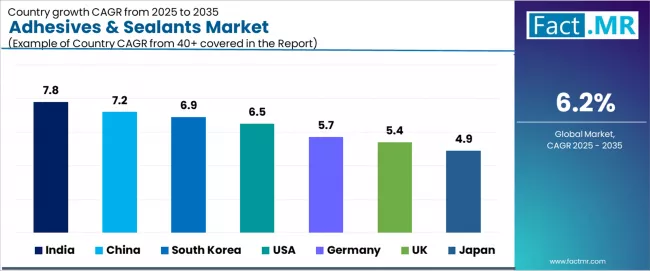
Adhesives & Sealants Market Cagr Analysis By Country | Source: Fact.MR
The global adhesives & sealants market is expanding robustly, with India leading at a 7.8% CAGR through 2036, driven by massive infrastructure development programs and expanding manufacturing sector requiring comprehensive bonding solutions. China follows at 7.2%, supported by extensive construction activities and electronics manufacturing concentration. South Korea records 6.9%, reflecting advanced semiconductor packaging applications and automotive industry innovation.
USA advances at 6.5%, leveraging automotive lightweighting initiatives and sustainable formulation leadership. Germany posts 5.7%, focusing on industrial adhesive innovation and chemical manufacturing excellence, while UK grows steadily at 5.4%, emphasizing construction renovation and aerospace applications. Japan demonstrates 4.9% growth, anchored by precision electronics assembly and automotive manufacturing quality standards.
How is India Leading Global Market Expansion?
India demonstrates the strongest growth potential in the adhesives & sealants market with a CAGR of 7.8% through 2036. The country's leadership position stems from massive infrastructure investment programs, rapidly expanding packaging industry, and growing automotive manufacturing supporting comprehensive adhesive adoption across construction, industrial, and consumer applications. Growth is concentrated in major manufacturing regions and metropolitan areas, including Maharashtra, Gujarat, Tamil Nadu, and Karnataka, where industrial clusters increasingly demand advanced bonding technologies for diverse assembly operations.
Distribution channels through specialized chemical distributors, direct manufacturer relationships, and emerging technical support networks expand accessibility across small and medium enterprises. The country's expanding middle-class consumption patterns provide strong momentum for packaged goods adoption, including comprehensive penetration across food, beverage, and consumer product categories requiring reliable packaging adhesives.
Key market factors:
- Manufacturing expansion concentrated in automotive hubs and industrial corridors with growing demand for assembly adhesives
- Construction sector growth through government infrastructure initiatives including housing programs and transportation projects
- Comprehensive packaging industry development ecosystem supporting flexible packaging lamination and corrugated box manufacturing
- Local adhesive manufacturers offering competitive pricing and regionally adapted formulations serving domestic market requirements
Why is China Emerging as a High-Growth Market?
In major industrial centers including Guangdong, Jiangsu, Zhejiang, and Shandong provinces, the adoption of adhesives & sealants solutions is accelerating across construction projects, electronics manufacturing, and automotive assembly operations, driven by extensive infrastructure development and expanding export-oriented manufacturing capabilities. The market demonstrates strong growth momentum with a CAGR of 7.2% through 2036, linked to comprehensive urbanization trends and increasing emphasis on quality manufacturing standards.
Manufacturers are implementing advanced bonding technologies and automated dispensing systems to enhance production efficiency while meeting growing domestic and international quality expectations. The country's dominant position in global electronics manufacturing creates ongoing demand for specialized adhesives supporting smartphone assembly, display bonding, and component attachment operations.
Key development areas:
- Electronics manufacturing clusters leading adhesive adoption with emphasis on miniaturized device assembly and thermal management
- Distribution expansion through both regional chemical distributors and direct technical support from multinational suppliers
- Construction modernization initiatives implementing curtain wall systems and prefabricated building components requiring structural sealants
- Growing preference for automated adhesive dispensing systems integrating with Industry 4.0 manufacturing environments
What drives USA’s Market Resilience?
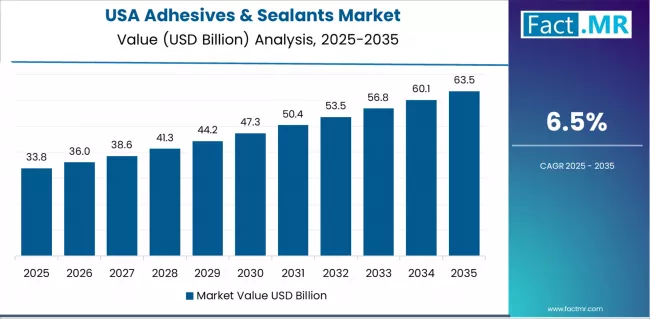
Adhesives & Sealants Market Country Value Analysis | Source: Fact.MR
USA’s market expansion is driven by diverse innovation requirements, including structural adhesive development for automotive lightweighting and sustainable water-based formulations for packaging applications across sophisticated industrial segments. The country demonstrates steady growth potential with a CAGR of 6.5% through 2036, supported by continuous research investment from established adhesive manufacturers and specialized formulation companies.
Manufacturers face implementation challenges related to skilled labor availability for proper adhesive application and comprehensive surface preparation requirements, demanding extensive technical training and process documentation. However, established automotive and aerospace industries create stable baseline demand for high-performance adhesives, particularly among manufacturers pursuing weight reduction strategies where structural bonding drives primary joining method decisions.
Market characteristics:
- Automotive OEMs and aerospace manufacturers showing robust demand with substantial annual adhesive consumption across lightweighting programs
- Regional preferences varying between Midwest industrial adhesive focus and West Coast emphasis on electronics and clean technology applications
- Future projections indicate continued premiumization with emphasis on bio-based content and carbon footprint reduction initiatives
- Growing emphasis on electric vehicle battery assembly adhesives and thermal interface materials supporting electrification transition
How does Germany Demonstrate Technical Excellence Leadership?
The market in Germany leads in industrial adhesive innovation based on comprehensive chemical industry expertise and advanced manufacturing capabilities supporting precision bonding applications across automotive, machinery, and specialized industrial sectors. The country shows strong potential with a CAGR of 5.7% through 2036, driven by continuous technology development and engineering excellence in major markets, including North Rhine-Westphalia, Bavaria, Baden-Württemberg, and Hesse.
German manufacturers are adopting advanced polyurethane and epoxy formulations for demanding structural bonding applications, particularly in automotive body-in-white assembly and composite material fabrication requiring rigorous performance validation. Distribution channels through specialized industrial distributors and direct technical service organizations expand coverage across precision manufacturing operations and quality-focused production facilities.
Leading market segments:
- Automotive adhesive adoption in major manufacturing centers implementing multi-material vehicle architectures and aluminum bonding
- Industrial manufacturing partnerships with machinery builders achieving high automation integration rates
- Strategic collaborations between adhesive manufacturers and automotive OEMs expanding structural bonding applications
- Focus on sustainability initiatives and bio-based polyol development addressing renewable content requirements
What positions the UK for Construction Application Leadership?
In London, Manchester, Birmingham, and other major cities, contractors are implementing adhesives & sealants solutions through building renovation projects and new construction developments, with documented performance in historic building restoration showing substantial weatherproofing improvements through modern sealant technologies.
The market shows steady growth potential with a CAGR of 5.4% through 2036, linked to ongoing building stock renovation, emerging modular construction adoption, and increasing emphasis on energy efficiency standards in major regions.
Construction professionals are adopting high-performance sealants with comprehensive building movement accommodation to enhance durability while maintaining standards demanded by stringent building regulations. The country's established construction industry creates ongoing opportunities for specialized façade sealants that differentiate through proven weathering performance and aesthetic versatility.
Market development factors:
- Construction professionals leading adoption of advanced sealant technologies across UK building projects
- Building regulation compliance providing growth opportunities in air tightness testing and thermal performance improvement
- Strategic partnerships between sealant manufacturers and architectural glazing contractors expanding curtain wall applications
- Emphasis on historic building conservation and compatible restoration materials addressing heritage preservation requirements
How does Japan Show Quality Assurance Leadership?
Japan's adhesives & sealants market demonstrates sophisticated quality standards focused on precision manufacturing and rigorous testing protocols, with documented integration of automated dispensing systems achieving substantial application consistency improvements across electronics assembly and automotive manufacturing operations.
The country maintains steady growth momentum with a CAGR of 4.9% through 2036, driven by mature market dynamics emphasizing manufacturing excellence and continuous process improvement methodologies that align with Japanese quality management principles applied to industrial production.
Major manufacturing regions, including Tokyo, Aichi, Osaka, and Kanagawa prefectures, showcase advanced adhesive implementations where robotic application systems integrate seamlessly with lean manufacturing philosophies and comprehensive quality assurance programs.
Key market characteristics:
- Quality-conscious manufacturers driving demand for certified adhesive products with emphasis on consistent performance validation
- Technology partnerships enabling advanced dispensing automation with comprehensive process monitoring capabilities
- Collaboration between Japanese adhesive manufacturers and automotive companies expanding structural bonding expertise
- Emphasis on miniaturization support and precision electronics assembly addressing semiconductor packaging requirements
What characterizes South Korea's Market Development?
In major industrial centers including Seoul, Busan, Ulsan, and Incheon, the adoption of adhesives & sealants solutions is expanding across semiconductor manufacturing, display production, and automotive assembly facilities, driven by technology leadership in electronics and growing emphasis on advanced material joining. The market demonstrates solid growth potential with a CAGR of 6.9% through 2036, linked to comprehensive electronics industry concentration and increasing automotive manufacturing sophistication.
South Korean manufacturers are implementing specialized adhesive technologies for flexible display bonding, battery assembly, and automotive interior applications to enhance product performance while meeting growing quality expectations in global markets. The country's semiconductor industry creates ongoing demand for underfill adhesives and die attach materials, while increasing electric vehicle production drives adoption of thermal management and structural bonding solutions.
Key development areas:
- Electronics manufacturers leading adhesive adoption with emphasis on display bonding and semiconductor packaging applications
- Distribution expansion through specialized technical distributors and direct support from global adhesive suppliers
- Automotive industry integration supporting electric vehicle battery assembly and lightweight material bonding innovations
- Technology collaboration between Korean conglomerates and international adhesive manufacturers expanding application development
Europe Market Split by Country
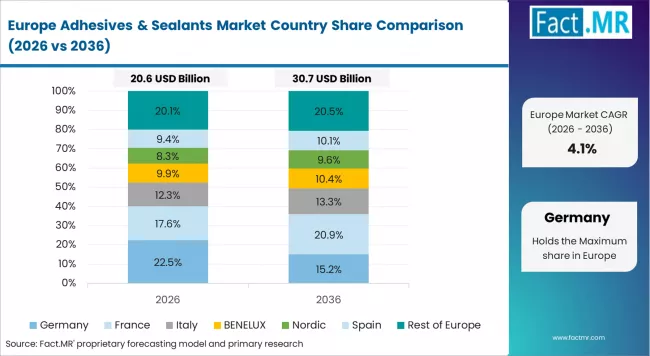
Adhesives & Sealants Market Europe Country Market Share Analysis, 2026 & 2036 | Source: Fact.MR
The adhesives & sealants market in Europe is projected to grow from USD 18.9 billion in 2026 to USD 33.6 billion by 2036, registering a CAGR of 5.9% over the forecast period. Germany is expected to maintain its leadership position with a 26.0% market share in 2026, adjusting to 25.6% by 2036, supported by its extensive chemical manufacturing infrastructure, comprehensive automotive industry integration, and advanced industrial adhesive expertise serving major European markets.
France follows with a 19.5% share in 2026, projected to reach 19.8% by 2036, driven by comprehensive aerospace adhesive applications and construction sealant adoption concentrating in major urban development regions implementing green building standards. The United Kingdom holds a 15.9% share in 2026, expected to maintain 15.2% by 2036 through ongoing construction renovation activities and specialized industrial applications.
Italy commands a 16.0% share, while Spain accounts for 13.5% in 2026. The Rest of Europe region is anticipated to gain momentum, expanding its collective share from 9.1% to 9.8% by 2036, attributed to increasing adhesive adoption in Nordic countries and emerging Eastern European manufacturing facilities implementing modern assembly technologies.
How Does Quality Define Adhesives & Sealants Adoption in Japan?
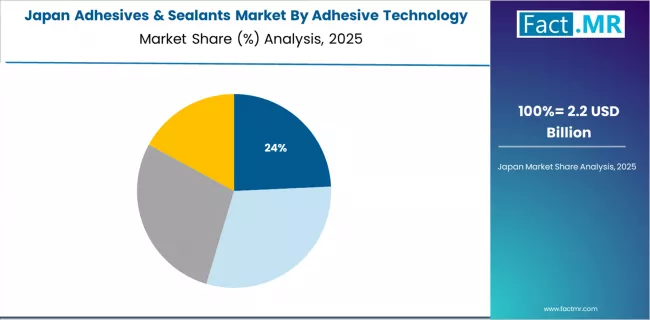
Adhesives & Sealants Market Japan Market Share Analysis By Adhesive Technology | Source: Fact.MR
The Japanese adhesives & sealants market demonstrates a mature and precision-focused landscape, characterized by sophisticated integration of automated dispensing technologies with comprehensive quality control systems across automotive, electronics, and industrial manufacturing applications, supported by rigorous testing protocols and continuous improvement programs.
Japan's emphasis on manufacturing excellence and zero-defect production drives demand for high-reliability adhesive solutions that support exacting assembly tolerances and long-term performance requirements in mission-critical applications.
The market benefits from strong partnerships between international adhesive suppliers and domestic manufacturers, including established automotive companies and electronics producers, creating comprehensive technical ecosystems that prioritize consistent quality and innovation collaboration.
Manufacturing centers showcase advanced adhesive implementations where vision-guided dispensing systems achieve performance improvements through integrated process monitoring approaches and comprehensive statistical process control programs.
What Drives Innovation Positioning in South Korea's Market?
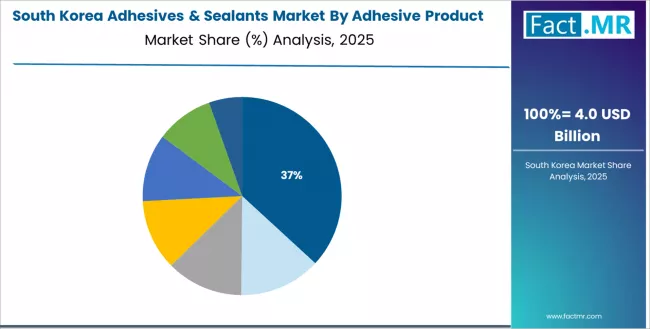
Adhesives & Sealants Market South Korea Market Share Analysis By Adhesive Product | Source: Fact.MR
The South Korean adhesives & sealants market is characterized by strong technology-driven presence, with companies like local chemical manufacturers and international adhesive suppliers maintaining significant positions through comprehensive technical portfolios and advanced formulations for semiconductor packaging and display manufacturing applications.
The market is demonstrating a growing emphasis on specialized electronic adhesives and advanced structural bonding solutions, as Korean manufacturers increasingly demand high-performance formulations that combine thermal conductivity with electrical insulation properties and precise rheology control deployed across electronics assembly operations and automotive manufacturing facilities.
Local innovations and specialty product launches are gaining market share through strategic emphasis on underfill technologies, offering specialized formulations including anisotropic conductive adhesives and thermal interface materials for comprehensive electronics assembly support.
The competitive landscape shows increasing collaboration between adhesive manufacturers and electronics conglomerates, creating integrated development models that combine material science expertise with application engineering insights and rapid commercialization capabilities.
Competitive Landscape of the Adhesives & Sealants Market
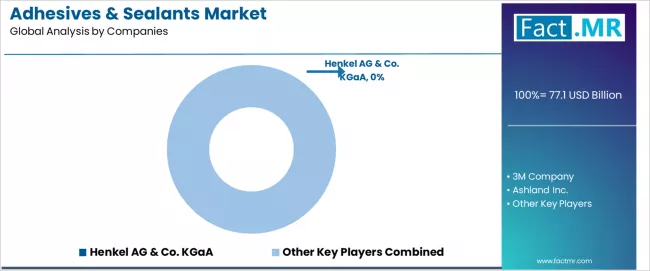
Adhesives & Sealants Market Analysis By Company | Source: Fact.MR
The adhesives & sealants market features approximately 20-25 meaningful players with moderate concentration, where the top three companies control roughly 25-35% of global market share through established brand recognition, comprehensive product portfolios, and extensive technical support networks. Competition centers on formulation innovation, application expertise, and sustainable technology development rather than commodity pricing alone.
Market leaders include Henkel % Co. KGaA maintaining a 12.9% market share, 3M, and H.B. Fuller, which maintain competitive advantages through comprehensive research capabilities, global manufacturing footprints, and deep expertise in diverse bonding technologies, creating strong customer relationships among industrial manufacturers seeking reliable technical partnerships. These companies leverage continuous innovation in sustainable formulations and strategic acquisitions to defend market positions while expanding into adjacent categories including specialty coatings and functional materials.
Challengers encompass diversified chemical companies including Sika, Ashland, and BASF, which compete through vertical integration capabilities and comprehensive material science platforms. Regional specialists, including Pidilite in India and specialized players like Avery Dennison in pressure-sensitive applications, focus on local market knowledge and application-specific expertise, offering differentiated capabilities in cost-competitive formulations, responsive technical service, and regional distribution networks.
Emerging specialty adhesive manufacturers and bio-based technology developers create competitive pressure through innovative sustainable formulations and niche application focus, particularly in high-growth markets including India and China, where local production capabilities provide advantages in pricing flexibility and rapid customer response.
Market dynamics favor companies that combine technical expertise with sustainability leadership and comprehensive application support that addresses the complete value chain from product selection through process optimization and quality assurance. Strategic emphasis on renewable raw materials, carbon-neutral manufacturing operations, and circular economy partnerships enables differentiation in increasingly sustainability-focused industrial sectors across automotive, construction, and packaging industries worldwide.
Global Adhesives & Sealants Market — Stakeholder Contribution Framework
Adhesives & sealants represent a critical enabling technology that allows manufacturers to achieve superior bonding performance and production efficiency while addressing lightweighting requirements and design flexibility that mechanical fasteners cannot provide across automotive, construction, and packaging applications, typically delivering superior stress distribution, corrosion resistance, and aesthetic finishing compared to traditional joining methods alone while ensuring structural integrity and comprehensive manufacturing versatility.
With the market projected to grow from USD 77.1 billion in 2025 to USD 140.9 billion by 2035 at a 6.2% CAGR, these solutions offer compelling advantages for sustainable formulations, automotive lightweighting, and diverse industrial bonding applications. Scaling market penetration and sustainable manufacturing achievement requires coordinated action across environmental policy, technical standards development, adhesive manufacturers, end-user industries, and workforce training initiatives.
How Could Governments Spur Local Development and Adoption?
- Manufacturing Modernization Programs: Include advanced joining technologies in industrial competitiveness initiatives, providing targeted support for adhesive application training in technical schools and supporting research institutions through bonding technology development grants and testing facility investments.
- Tax Policy & Investment Support: Implement reduced tax rates for bio-based adhesive manufacturing, provide tax incentives for companies investing in low-VOC formulation capabilities and automated dispensing equipment, and establish favorable tariff structures that encourage renewable feedstock procurement over petroleum-derived alternatives.
- Regulatory Framework Development: Create streamlined approval processes for new adhesive chemistries across construction and automotive applications, establish clear VOC emission standards and workplace safety requirements for solvent-based products, and develop international harmonization protocols that facilitate cross-border product registrations.
- Sustainability & Circular Economy Support: Fund research into recyclable bonding technologies, invest in adhesive recycling infrastructure development that supports material recovery from end-of-life products, and explore extended producer responsibility frameworks for bonded product disassembly.
- Research & Innovation Support: Establish public-private partnerships for advanced bonding technology research, support academic-industry collaborations investigating bio-based raw materials and reversible adhesive systems, and create regulatory environments that encourage innovation in sustainable formulation approaches.
How Could Industry Bodies Support Market Development?
- Technical Standards & Testing Protocols: Define standardized performance testing methodologies for adhesive strength assessment across diverse substrate combinations, establish universal quality specifications and application guidelines, and create performance databases that engineers and specifiers can rely on for product selection.
- Market Education & Best Practices: Lead messaging that demonstrates adhesive advantages over mechanical fastening, emphasizing weight reduction benefits, design flexibility, and cost-effectiveness compared to traditional joining methods through coordinated industry awareness campaigns.
- Environmental Standards Development: Develop guidelines for VOC content reduction, bio-based content verification, recyclability enhancement, and carbon footprint assessment, ensuring environmental responsibility across formulation and application operations.
- Professional Development: Run certification programs for adhesive applicators, quality control personnel, and design engineers on optimizing bonding performance, surface preparation requirements, and troubleshooting application challenges across diverse manufacturing environments.
How Could Manufacturers and Technology Players Strengthen the Ecosystem?
- Advanced Product Development: Develop next-generation adhesive formulations with enhanced sustainability profiles, optimized curing characteristics, and application-specific performance that improves bonding reliability while reducing environmental impact through bio-based content and reduced emissions.
- Technical Application Support: Provide comprehensive surface preparation guidance, dispensing equipment recommendations, and process optimization consultation that helps manufacturers successfully implement adhesive bonding into production operations.
- Sustainability Innovation Programs: Offer comprehensive bio-based raw material integration, solvent-free formulation alternatives, and end-of-life recyclability solutions that support circular economy objectives and transparent environmental impact reporting.
- Research & Development Networks: Build comprehensive R&D capabilities, collaborative testing programs, and application development laboratories that ensure adhesives maintain superior performance standards and continuous innovation across diverse industrial applications.
How Could End-User Industries and Manufacturers Navigate the Market?
- Advanced Joining Technology Adoption: Incorporate structural adhesive bonding into comprehensive lightweighting strategies, with particular focus on automotive multi-material architectures, composite structure assembly, and weight reduction verification.
- Process Integration Excellence: Establish comprehensive surface preparation protocols, automated dispensing implementation, and quality assurance systems through optimized production workflows and operator training programs.
- Supply Chain Partnership: Implement collaborative relationships with adhesive suppliers ensuring reliable material supply, technical support access, and joint development opportunities throughout product lifecycle.
- Innovation Collaboration: Develop co-creation programs with adhesive manufacturers exploring new bonding applications, substrate combinations, and performance requirements that differentiate products and enhance manufacturing efficiency.
How Could Investors and Financial Enablers Unlock Value?
- Manufacturing Capacity Financing: Provide growth capital for established companies like Henkel, 3M, and regional manufacturers to expand production facilities and automated dispensing equipment supporting market demand growth.
- Innovation Investment: Back startups developing bio-based adhesive technologies, smart bonding systems, and reversible adhesive platforms that enhance sustainability credentials and functional capabilities.
- Market Expansion Funding: Finance distribution network expansion for adhesive manufacturers establishing operations in high-growth regions including India and China, supporting localization initiatives that address regional application requirements.
- Technology Integration Investment: Support companies developing AI-driven dispensing control systems, inline quality monitoring technologies, and digital twin simulation platforms that enhance application precision through technology-enabled solutions.
Key Players in the Adhesives & Sealants Market
- Henkel AG & Co. KGaA
- 3M Company
- Ashland Inc.
- Avery Dennison Corporation
- H.B. Fuller Company
- Sika AG
- Pidilite Industries Limited
- Huntsman Corporation
- Wacker Chemie AG
- RPM International Inc.
Bibliography
- European Committee for Standardization. (2024). EN 15274:2024 General purpose adhesives for structural bonding. CEN.
- ASTM International. (2024). ASTM C920-24 Standard specification for elastomeric joint sealants. ASTM.
- U.S. Environmental Protection Agency. (2024). National emission standards for hazardous air pollutants: Adhesive and sealant manufacturing. EPA.
- European Adhesive and Sealant Industry Association. (2025, February). FEICA annual report 2024: Market statistics and regulatory update. FEICA.
- Bureau of Indian Standards. (2024). IS 9103:2024 Specification for adhesives for woodworking and general purposes. BIS, Government of India.
This bibliography is provided for reader reference. The full Fact.MR report contains the complete reference list with primary research documentation.
This Report Addresses
- Market sizing and quantitative forecast metrics detailing adhesive and sealant expenditure across packaging, construction, automotive, and industrial assembly sectors through 2036.
- Segmentation analysis mapping the adoption velocity of adhesive technologies and sealant products, evaluating the VOC regulations and structural bonding specifications driving formulation selection.
- Regional deployment intelligence comparing rapid industrialization-driven growth in Asia against mature specification-driven conversion in North American and European manufacturing sectors.
- Regulatory compliance assessment analyzing how VOC emission standards and building energy codes drive adhesive technology and sealant product transitions across major markets.
- Competitive posture evaluation tracking multi-chemistry product portfolios, application engineering capabilities, and distribution network coverage across market segments.
- Application engineering guidance defining the bond strength, open time, and environmental resistance specifications required for target packaging, construction, and automotive applications.
- Supply chain analysis identifying raw material availability constraints and polymer feedstock price volatility factors affecting adhesive and sealant production costs.
- Custom data delivery formats encompassing interactive dashboards, raw Excel datasets, and comprehensive PDF narrative reports.
Adhesives & Sealants Market Definition
Adhesives and sealants are polymer-based bonding and sealing materials formulated to join substrates or fill and seal gaps in industrial, construction, packaging, and consumer applications. Adhesive product categories include acrylics, polyvinyl acetates, polyurethanes, epoxies, styrenic block copolymers, and ethylene-vinyl acetates delivered through water-based, solvent-based, hot melt, and reactive application technologies. Sealant products include silicones, acrylics, polyurethanes, and polyvinyl acetates formulated to maintain flexible, weather-resistant joint seals in construction, automotive, and packaging environments.
Adhesives & Sealants Market Inclusions
Market scope includes all adhesive and sealant product types across water-based, solvent-based, hot melt, and reactive technologies sold for industrial, construction, packaging, automotive, and consumer applications. The report covers global and regional market sizes, forecast period 2026 to 2036, and segment breakdowns by adhesive technology, adhesive product, adhesive application, sealant product, and sealant application.
Adhesives & Sealants Market Exclusions
The scope excludes mechanical fasteners, welding and brazing consumables, cement-based tile adhesives and grouts, pressure-sensitive adhesive tapes sold as finished products, and dental and surgical adhesives classified under medical device regulations.
Adhesives & Sealants Market Research Methodology
- Primary Research: Analysts engaged with adhesive formulation chemists, packaging line engineers, automotive bonding specification leads, and construction sealant contractors to map qualification cycles and procurement decision timelines.
- Desk Research: Data collection aggregated packaging production volume statistics, construction permit databases, automotive assembly plant capacity announcements, and VOC emission regulation compliance schedules.
- Market-Sizing and Forecasting: Baseline values derive from a bottom-up aggregation of adhesive and sealant consumption volumes per unit of packaging produced, construction floor area completed, and vehicles assembled, applying application-specific adhesive usage intensity factors.
- Data Validation and Update Cycle: Projections are tested against publicly reported adhesive and sealant segment revenues from major manufacturers and industry association consumption survey data.
Segmentation
Scope of the Report
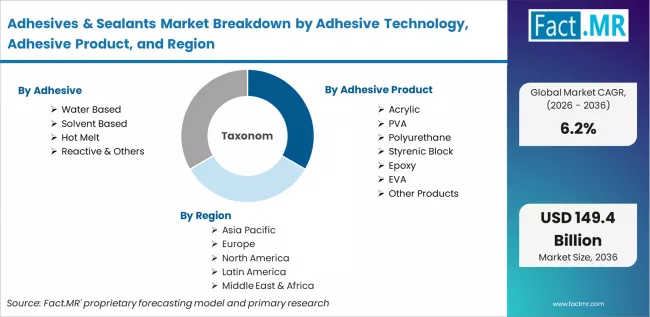
Adhesives & Sealants Market Breakdown By Adhesive Technology, Adhesive Product, And Region | Source: Fact.MR
| Metric | Value |
|---|---|
| Quantitative Units | USD 81.88 billion to USD 149.43 billion, at a CAGR of 6.2% |
| Market Definition | Adhesives and sealants are polymer-based bonding and sealing materials formulated to join substrates or fill and seal gaps in industrial, construction, packaging, and consumer applications. Adhesive product categories include acrylics, polyvinyl acetates, polyurethanes, epoxies, styrenic block copolymers, and ethylene-vinyl acetates delivered through water-based, solvent-based, hot melt, and reactive application technologies. Sealant products include silicones, acrylics, polyurethanes, and polyvinyl acetates formulated to maintain flexible, weather-resistant joint seals in construction, automotive, and packaging environments. |
| Adhesive Technology Segmentation | Water Based, Solvent Based, Hot Melt, Reactive & Others |
| Adhesive Product Segmentation | Acrylic, PVA, Polyurethane, Styrenic Block, Epoxy, EVA, Other Products |
| Adhesive Application Segmentation | Paper & Packaging, Building & Construction, Consumer & DIY, Furniture & Woodworking, Footwear & Leather, Automotive & Transportation, Medical, Other Applications |
| Sealant Product Segmentation | Silicone Sealants, Acrylic Sealants, Polyurethanes, Polyvinyl Acetate, Other Products |
| Sealant Application Segmentation | Construction, Automotive, Packaging, Assembly, Consumers, Other Applications |
| Regions Covered | North America, Latin America, Europe, East Asia, South Asia, Oceania, Middle East & Africa |
| Countries Covered | India, China, USA, Germany, Japan, South Korea, UK, and 40 plus countries |
| Key Companies Profiled | Henkel AG & Co. KGaA, 3M Company, Ashland Inc., Avery Dennison Corporation, H.B. Fuller Company, Sika AG, Pidilite Industries Limited, Huntsman Corporation, Wacker Chemie AG, RPM International Inc. |
| Forecast Period | 2026 to 2036 |
| Approach | Baseline values derive from a bottom-up aggregation of adhesive and sealant consumption volumes per unit of packaging produced, construction floor area completed, and vehicles assembled, applying application-specific adhesive usage intensity factors. |
Source: Fact.MR analysis. Updated Apr 7, 2026
Adhesives & Sealants Market by Segments
-
Adhesive Technology :
- Water Based
- Solvent Based
- Hot Melt
- Reactive & Others
-
Adhesive Product :
- Acrylic
- PVA
- Polyurethane
- Styrenic Block
- Epoxy
- EVA
- Other Products
-
Adhesive Application :
- Paper & Packaging
- Building & Construction
- Consumer & DIY
- Furniture & Woodworking
- Footwear & Leather
- Automotive & Transportation
- Medical
- Other Applications
-
Sealant Product :
- Silicone Sealants
- Acrylic Sealants
- Polyurethanes
- Polyvinyl Acetate
- Other Products
-
Sealant Application :
- Construction
- Automotive
- Packaging
- Assembly
- Consumers
- Other Applications
-
Region :
- Asia Pacific
- China
- Japan
- South Korea
- India
- Australia
- Thailand
- Rest of Asia Pacific
- Europe
- Germany
- UK
- France
- Italy
- Spain
- Denmark
- Sweden
- Norway
- Rest of Europe
- North America
- USA
- Canada
- Mexico
- Latin America
- Brazil
- Argentina
- Rest of Latin America
- Middle East & Africa
- South Africa
- Saudi Arabia
- UAE
- Kuwait
- Rest of Middle East & Africa
- Asia Pacific
Frequently Asked Questions
How large is the demand for adhesives & sealants in the global market in 2026?
What will be the market size of adhesives & sealants in the global market by 2036?
What is the expected demand growth for adhesives & sealants in the global market between 2026 and 2036?
Which Adhesive Technology is poised to lead global sales by 2026?
How significant is the role of Paper & Packaging in driving adhesive adoption in 2026?
What is the India growth outlook in this report?
What is China's growth outlook in this report?
What are adhesives & sealants and what are they mainly used for?
Who worked on this report


Preview the report firsthand - request a free sample
Free SampleGet the brochure for pricing and purchase details
Download PDF