- Market Value (2025): USD 2.2 Bn
- Estimated Value (2026): USD 2.5 Bn
- Forecast Value (2036): USD 7.5 Bn
- CAGR (2026-2036): 11.7%
What is the Semiconductor Facility Conductive Coatings Market forecast to be worth by 2036?
USD 2.5 billion in 2026 to USD 7.5 billion by 2036 at an 11.7% CAGR.
- The semiconductor facility conductive coatings market reached USD 2.2 billion in 2025.
- Demand is forecast to rise from USD 2.5 billion in 2026 to USD 7.5 billion by 2036.
- The market is forecast to grow at an 11.7% CAGR from 2026 to 2036. New fabs are adding cleanroom space and static-control surfaces.
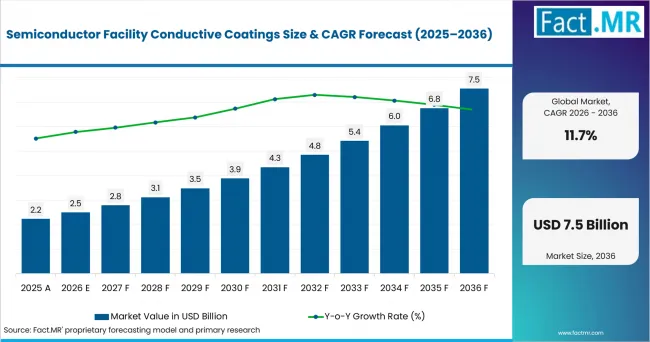
Semiconductor Facility Conductive Coatings Value Analysis | Source: Fact.MR
What are the defining numbers behind Semiconductor Facility Conductive Coatings Market growth?
The market offers an absolute opportunity of USD 5.0 billion from 2026 to 2036.
- Demand Drivers in the Market
- Chip plants need ESD control near delicate tools. ANSI/ESD standards give methods to test floor resistance and static charge.
- New chip fabs is widening the installed base for special coatings. SEMI reported in January 2025 that 18 new semiconductor fab build projects were expected to start in 2025, including fifteen 300 mm facilities.
- Output growth also increases the number of cleanroom and subfab surfaces that need durable static-control coatings. SEMI forecast global semiconductor output to reach 33.6 million wafers per month in 2025, a 6.6% annual increase.
- More chip output means more fabs and controlled work areas. Static-control floors must pass resistance tests.
- Key Segments Analyzed
- By Conductive Additive: Carbon black is forecast to hold a 34.0% share in 2026. It is widely used because it offers repeatable electrical results at a practical cost.
- By Conductivity Target: Antistatic is forecast to hold a 31.0% share in 2026. Many site surfaces need controlled charge decay rather than very high current flow.
- By End-use Facility: Fabs are forecast to hold a 36.0% share in 2026. Fabs need ESD control, chemical resistance, low contamination, and durable floors.
- By Coating System: Epoxy is forecast to hold a 29.0% share in 2026. Epoxy floors offer strong adhesion, wear resistance, and chemical resistance. They can also provide static control.
- Analyst Opinion at Fact.MR
- Shambhu Nath Jha, Principal Consultant at Fact.MR, states, “Firms must keep electrical results within the set range after install. They must also meet cleanroom needs. Product quality, use, and final testing all matter.”
- Strategic Implications
- Coating firms should publish surface-resistance ranges and test conditions. Engineers can then compare antistatic, static-dissipative, conductive, and EMI systems.
- Flooring providers should treat an ESD floor as one system. ESD Association guidance notes that each floor layer can affect measured resistance. The installed floor also needs a final check.
- Cleanroom contractors should match coating cure time with site handover. This keeps floor tests and cleaning on track before equipment moves in.
- Material firms should separate site ESD uses from enclosure EMI shielding. The two uses need different resistance levels, surfaces, and use methods.
France and the USA are forecast at 12.3% CAGR through 2036. China and Germany are forecast at 12.1%. Japan is forecast at 11.0%. Growth is tied to new fabs and chip investment in each market.
How does the Semiconductor Facility Conductive Coatings Market break down by segment?
Fabs lead End-use Facility at a 36.0% share in 2026. Carbon black leads Conductive Additive at 34.0%.
Which Conductive Additive dominates?
Carbon black is forecast to hold a 34.0% share in 2026.
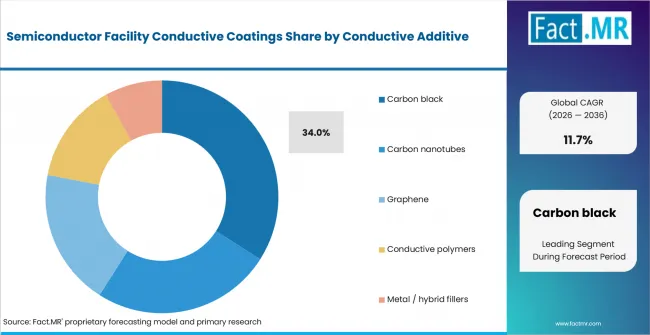
Semiconductor Facility Conductive Coatings Analysis By Conductive Additive | Source: Fact.MR
Carbon black leads because it offers reliable current flow at a practical cost. Carbon nanotubes, graphene, conductive polymers, and metal or hybrid fillers also serve this market. Each option fits a different electrical or physical need.
What leads the Conductivity Target segment?
Antistatic is forecast to hold a 31.0% share in 2026.
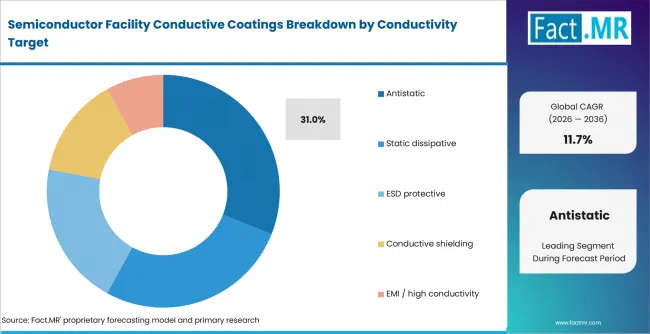
Semiconductor Facility Conductive Coatings Analysis By Conductivity Target | Source: Fact.MR
Antistatic systems lead because many site areas need controlled charge decay. Static-dissipative and ESD-protective coatings serve more delicate areas. Conductive shielding serves zones that need stronger electrical control. Selection depends on the resistance target and site use.
What supports Semiconductor fabs within End-use Facility?
Fabs are forecast to lead with a 36.0% share in 2026.
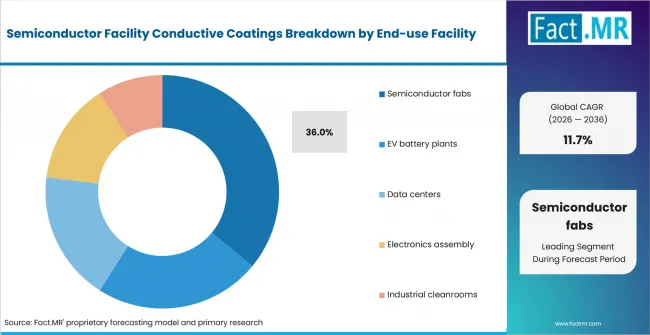
Semiconductor Facility Conductive Coatings Analysis By End Use Facility | Source: Fact.MR
Fabs lead because wafer output uses highly sensitive electronic tools. The Semiconductor Industry Association reported global chip sales of USD 791.7 billion in 2025, up 25.6% from 2024. The market also covers EV battery plants, data centers, electronics assembly sites, and industrial cleanrooms.
What leads the Coating System segment?
Epoxy is forecast to hold a 29.0% share in 2026.
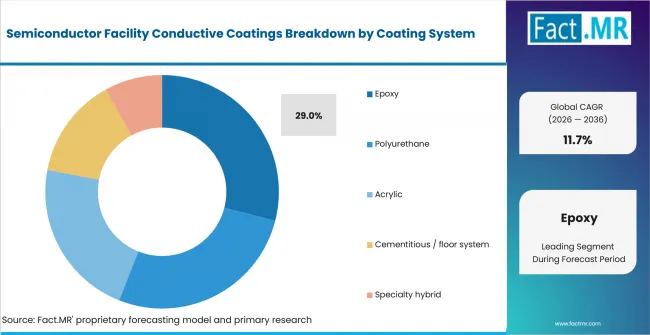
Semiconductor Facility Conductive Coatings Analysis By Coating System | Source: Fact.MR
Epoxy leads because it bonds well to floors and resists wear and chemicals. Polyurethane adds flexibility. Acrylics suit some fast-cure jobs. Cement-based and hybrid systems serve sites with different floor or use needs.
What is accelerating Semiconductor Facility Conductive Coatings Market adoption, and what is holding it back?
New fabs and ESD needs support demand. Long tests and delicate install can slow use.
Drivers Impact Analysis
| DRIVER | (~) % IMPACT ON CAGR | GEOGRAPHIC RELEVANCE | IMPACT TIMELINE |
|---|---|---|---|
| New semiconductor fab construction | +1.6% | North America, East Asia, Europe | Short term (<= 2 years) |
| Cleanroom and subfab ESD requirements | +1.2% | Global | Medium term (2-4 years) |
| Higher semiconductor production capacity | +0.9% | East Asia, North America | Medium term (2-4 years) |
| Expansion of controlled electronics facilities | +0.6% | Global | Long term (>= 4 years) |
Opportunity Impact Analysis
| OPPORTUNITY | (~) % IMPACT ON CAGR | GEOGRAPHIC RELEVANCE | IMPACT TIMELINE |
|---|---|---|---|
| Low-outgassing cleanroom coating systems | +0.8% | North America, Europe, East Asia | Medium term (2-4 years) |
| Fast-cure renovation systems | +0.6% | Global | Short term (<= 2 years) |
| Hybrid conductive filler formulations | +0.4% | Global | Long term (>= 4 years) |
Restraints Impact Analysis
| RESTRAINT | (~) % IMPACT ON CAGR | GEOGRAPHIC RELEVANCE | IMPACT TIMELINE |
|---|---|---|---|
| Installation and grounding sensitivity | -0.6% | Global | Short term (<= 2 years) |
| Qualification burden in clean environments | -0.4% | North America, Europe, East Asia | Medium term (2-4 years) |
| Conductive filler cost and dispersion control | -0.3% | Global | Long term (>= 4 years) |
Which countries are scaling the Semiconductor Facility Conductive Coatings Market through 2036?
- France and the USA share the top rate at 12.3% CAGR. Chip investment is adding clean output space.
- China and Germany are both at 12.1% CAGR, or 0.2 percentage point below the top rate.
- Germany is 1.1 percentage points above Japan. New Dresden fab capacity supports added production space.
- Japan closes the range at 11.0% CAGR. Public support is adding new chip output.
The country range spans 1.3 percentage points. The report covers North America, Latin America, Western Europe, Eastern Europe, East Asia, South Asia & Pacific, and Middle East & Africa.
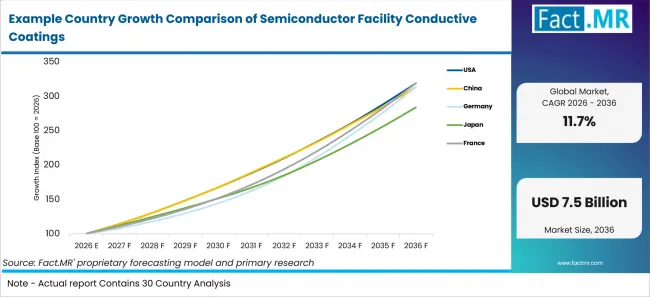
Example Country Growth Comparison Of Semiconductor Facility Conductive Coatings | Source: Fact.MR
| Country | CAGR (2026-2036) |
|---|---|
| USA | 12.3% |
| France | 12.3% |
| China | 12.1% |
| Germany | 12.1% |
| Japan | 11.0% |
What supports USA adoption?
12.3% CAGR, supported by chip investment and new fab construction.
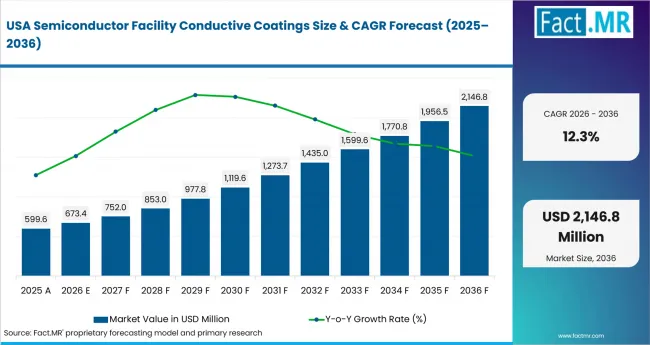
Semiconductor Facility Conductive Coatings Country Value Analysis | Source: Fact.MR
The USA is forecast to grow at 12.3% CAGR as new projects add clean output space. In June 2025, the U.S. Department of Commerce said Micron planned USD 200 billion in chip output and R&D investment across Idaho, New York, and Virginia. These projects add sites that need cleanroom and ESD infrastructure.
How is France scaling demand?
12.3% CAGR, backed by public chip investment and electronics output.
France is forecast at 12.3% CAGR as public programs support chip output. On May 26, 2026, the Ministry of Economy said France would invest another EUR 550 million in semiconductors. New fabs can need ESD-safe, clean, and durable surfaces.
What supports China’s outlook?
12.1% CAGR, driven by a large fab base and continued construction.
China is forecast at 12.1% CAGR. The National Bureau of Statistics reported in February 2026 that integrated-circuit output reached 484.28 billion pieces in 2025, up 10.9% from 2024. A large chip base creates steady demand for new and renewed site surfaces.
What is supporting Germany’s adoption?
12.1% CAGR, supported by Dresden fab growth and European chip policy.
Germany is forecast at 12.1% CAGR as Dresden adds chip capacity. In February 2025, the European Commission said Infineon planned a EUR 3.5 billion plant in Dresden, backed by up to EUR 920 million in German state aid. The project adds cleanroom and static-control space.
How does Japan perform?
11.0% CAGR, led by public support for next-generation chip output.
Japan is forecast at 11.0% CAGR as public support expands advanced chip sites. METI said in April 2025 that JPY 802.5 billion of added Rapidus support would bring total support to JPY 1,722.5 billion. New sites need stable resistance and clean surfaces after install.
Who leads the Semiconductor Facility Conductive Coatings Market?
Stonhard, PPG Industries, AkzoNobel, Sika, and Sherwin-Williams are the key providers profiled in the Semiconductor Facility Conductive Coatings Market. Their competitive position is tied to coatings used on floors, walls, enclosures, and other controlled-site surfaces where static control or electrical shielding is required.
The competitive landscape covers epoxy and polyurethane systems along with acrylic, cementitious, and specialty hybrid coatings. Suppliers need to address antistatic, static-dissipative, ESD-protective, and conductive-shielding requirements across semiconductor fabs and other controlled facilities.
Semiconductor fabs place particular emphasis on cleanroom compatibility, chemical resistance, durability, and dependable electrical performance. Coating systems must also work with grounding arrangements and provide stable resistance after installation, cleaning, and routine facility use.
Competition therefore centers on electrical-performance consistency, installation quality, cleanroom fit, coating durability, and the ability to match each system with the required resistance range. Suppliers that provide clear testing conditions and application guidance are better positioned for controlled semiconductor environments.
Which companies are the key providers?
Key firms include Stonhard, PPG Industries, AkzoNobel, Sika, and Sherwin-Williams.
- Stonhard
- PPG Industries
- AkzoNobel
- Sika
- Sherwin-Williams
Bibliography
- SEMI. (2025, January 7). Eighteen new semiconductor fabs to start construction in 2025, SEMI reports.
- Semiconductor Industry Association. (2026, February 6). Global annual semiconductor sales increase 25.6% to $791.7 billion in 2025.
- U.S. Department of Commerce. (2025, June 12). President Trump secures $200B investment from Micron Technology for memory chip manufacturing in the United States.
- Bundesministerium für Wirtschaft und Klimaschutz. (2025, February 20). Europäische Kommission genehmigt weiteres deutsches Chips-Act-Projekt: Infineon baut seine Chip-Produktion in Dresden aus.
- Ministry of Economy, Trade and Industry. (2025, April 1). Press conference by Minister Muto (Excerpt).
- Ministère de l’Économie, des Finances et de la Souveraineté industrielle, énergétique et numérique. (2026, May 26). Souveraineté technologique : la France investit 1 milliard d’euros supplémentaire dans la stratégie nationale quantique et 550M€ dans les semi-conducteurs.
- National Bureau of Statistics of China. (2026, February 28). Statistical communiqué of the People’s Republic of China on the 2025 national economic and social development.
- Parker Hannifin Corporation, Chomerics Division. (2026, July). Electrically conductive specialty materials selector guide.
This Report Answers
- The report shows where conductive coatings are used by additive type and conductivity target. It also covers site type and coating system.
- Segment analysis shows the leading 2026 subsegments and the main electrical needs behind them.
- Country analysis covers the USA, France, China, Germany, and Japan. Each section links demand with a known investment or output driver.
- Competitive analysis reviews site-coating firms and related conductive-material firms.
- Application analysis reviews resistance, grounding, durability, and cleanroom fit.
What does the Semiconductor Facility Conductive Coatings Market cover?
The market covers coatings that control static charge or provide shielding in fabs and other controlled sites. It includes floors, walls, access floors, and selected equipment surfaces where electrical results are part of the specification.
The scope separates site-scale floors and cleanroom surfaces from conductive materials used only inside devices. General protective coatings are included only when electrical control is a stated function.
What is included in the scope?
The scope includes epoxy and polyurethane systems, plus acrylic, cement-based, and hybrid builds. It covers antistatic, static-dissipative, and ESD-protective targets.
Conductive shielding is included when a coating serves a site or enclosure. Related coverage includes antistatic polymer compounds and modular cleanroom systems.
What is excluded from the scope?
The scope excludes normal architectural coatings with no electrical-control function. Standalone conductive plastics and packaging films are outside the market. Chip process chemicals are also outside the market unless used as a site or enclosure coating.
Device-level conductive inks and printed electronics are outside the market unless they are used on an enclosure or site part for static control or shielding.
How Was the Analysis Built?
The analysis uses 120+ sources, 35+ company portfolios, 25+ countries, and more than 20 industry interviews.
- Primary Research: The study uses interviews with makers, service firms, distributors, users, and industry experts. These talks cover buying needs, product use, operating issues, approvals, competition, and market use.
- Desk Research: The study reviews government data, rules, company filings, trade data, technical studies, industry groups, standards, and public policy. All sources appear in the bibliography.
- Market Sizing and Forecasting: Market estimates use past results, demand, prices, volumes, segment shares, company activity, country growth, and investment trends.
- Data Validation and Update Cycle: The study checks interview findings against public data, company activity, rule changes, trade patterns, and industry trends. Updates track launches, capacity, partnerships, approvals, and market use.
What is the report’s scope and coverage?
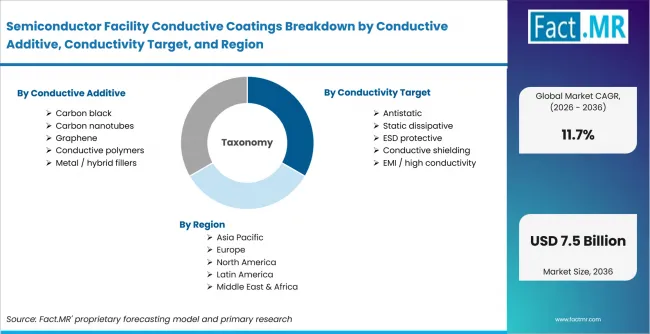
Semiconductor Facility Conductive Coatings Breakdown By Conductive Additive, Conductivity Target, And Region | Source: Fact.MR
| Attribute | Details |
|---|---|
| Quantitative Units | USD Billion |
| Market Definition | Coatings used on floors, walls, enclosures, and selected site surfaces for ESD control or shielding in fabs and other controlled sites. |
| Conductive Additive | Carbon black; Carbon nanotubes; Graphene; Conductive polymers; Metal / hybrid fillers |
| Conductivity Target | Antistatic; Static dissipative; ESD protective; Conductive shielding; EMI / high conductivity |
| End-use Facility | Fabs; EV battery plants; Data centers; Electronics assembly; Industrial cleanrooms |
| Coating System | Epoxy; Polyurethane; Acrylic; Cementitious / floor system; Specialty hybrid |
| Regions Covered | North America; Latin America; Western Europe; Eastern Europe; East Asia; South Asia & Pacific; Middle East & Africa |
| Countries Covered | USA; China; Germany; Japan; France |
| Key Companies Profiled | Stonhard; PPG Industries; AkzoNobel; Sika; Sherwin-Williams |
| Forecast Period | 2026 to 2036 |
| Approach | Top-down and bottom-up review using fab build, installed surfaces, coating mix, site demand, country growth, and supplier portfolios. |
How is the market segmented?
-
By Conductive Additive:
- Carbon black
- Carbon nanotubes
- Graphene
- Conductive polymers
- Metal / hybrid fillers
-
By Conductivity Target:
- Antistatic
- Static dissipative
- ESD protective
- Conductive shielding
- EMI / high conductivity
-
By End-use Facility:
- Semiconductor fabs
- EV battery plants
- Data centers
- Electronics assembly
- Industrial cleanrooms
-
By Coating System:
- Epoxy
- Polyurethane
- Acrylic
- Cementitious / floor system
- Specialty hybrid
-
By Region:
- North America
- Latin America
- Western Europe
- Eastern Europe
- East Asia
- South Asia & Pacific
- Middle East & Africa