- Base Value(2026): 265.0 Mn
- Estimated Value(2026): 265.0 Mn
- Forecast Value (2036): 766.1 Mn
- CAGR (2026 - 2036): 11.2%
Semiconductor Epoxy MOF Emissions Capture Market Forecast and Outlook 2026 to 2036
The global market for semiconductor epoxy MOF emissions capture is projected to surge from USD 265.00 million in 2026 to USD 980.00 million by 2036, expanding at a remarkable 11.2% CAGR. Growth is driven by the collision of two imperatives, the relentless expansion of global semiconductor manufacturing and the increasingly stringent environmental regulations targeting its VOC and amine-based emissions.
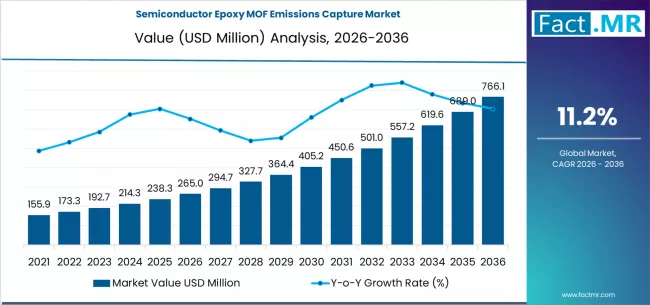
Semiconductor Epoxy Mof Emissions Capture Market Market Value Analysis | Source: Fact.MR
Summary of Semiconductor Epoxy MOF Emissions Capture Market
- Market Snapshot
- Global semiconductor epoxy MOF emissions capture market revenue stood at USD 265.00 million in 2026 and is forecast to reach USD 980.00 million by 2036.
- At a 11.2% CAGR from 2026 to 2036, this market is set to expand ~3.7x in value, adding USD 715.00 million in absolute opportunity.
- Growth is being driven by the expansion of semiconductor manufacturing and increasing regulatory pressure on VOC and amine-based emissions.
- MOF-based systems are emerging as precision solutions, enabling selective and efficient capture of complex emissions in semiconductor processes.
- Demand and Growth Drivers
- Rapid expansion of semiconductor fabrication facilities is increasing epoxy usage and associated emissions.
- Stringent environmental regulations targeting semiconductor emissions are accelerating adoption of capture technologies.
- Rising focus on sustainable manufacturing practices is driving demand for advanced emissions control solutions.
- Need for systems that provide:
- Selective VOC and amine capture
- High adsorption efficiency
- Scalability for fab operations
- Compatibility with semiconductor processes
- Advancements in MOF material engineering are enabling improved capture performance and customization.
- Product and Segment View
- Epoxy Resin Processing & Curing accounts for 41% of emission source share in 2026, emerging as the leading segment.
- Zirconium-Based MOFs hold 33% of MOF type share in 2026, positioning them as the dominant material segment.
- Logic & Memory Chip Manufacturers represent 48% of end-user share in 2026, reflecting their central role in semiconductor production.
- Key segment categories include:
- Epoxy resin processing & curing
- Packaging and encapsulation processes
- Advanced semiconductor fabrication stages
- Geography and Competitive Outlook
- Growth is supported by semiconductor manufacturing hubs and tightening environmental regulations globally.
- Key growth markets and CAGR: China (15.80%), Taiwan (14.90%), South Korea (14.20%), United States (12.40%), Japan (11.60%).
- Market expansion is closely tied to:
- Semiconductor fab expansion
- Regulatory compliance requirements
- Sustainability initiatives in chip manufacturing
Semiconductor Epoxy MOF Emissions Capture Market - At a Glance
| Attribute | Details |
|---|---|
| Market Value 2026 | USD 265.00 million |
| Market Value 2036 | USD 980.00 million |
| Absolute Dollar Opportunity 2026–2036 | USD 715.00 million |
| Total Growth 2026–2036 | 269.8% |
| CAGR 2026–2036 | 11.2% |
| Growth Multiple | ~3.7x |
| Key Demand Theme | Increasing need for advanced emissions capture solutions in semiconductor manufacturing |
| Leading Segment by Emission Source (2026) | Epoxy Resin Processing & Curing |
| Segment Share (2026) | 41% |
| Leading Segment by MOF Type (2026) | Zirconium-Based MOFs |
| Segment Share (2026) | 33% |
| Leading Segment by End User (2026) | Logic & Memory Chip Manufacturers |
| Segment Share (2026) | 48% |
| Key Growth Regions | East Asia, North America, South Asia-Pacific |
| Country CAGRs | China 15.80%, Taiwan 14.90%, South Korea 14.20%, USA 12.40%, Japan 11.60% |
| Top Companies | BASF Advanced Materials (MOF Division), NuMat Technologies, MOFapps (BASF spin-out/JV), Framergy Inc., Strem Chemicals/Ascensus MOF Unit |
| Segmentation by Emission Source | Epoxy Processing & Curing, Packaging, Fabrication Stages |
| Segmentation by MOF Type | Zirconium-Based, Aluminum-Based, Copper-Based, Others |
| Segmentation by End User | Logic & Memory, Foundries, IDMs |
| Segmentation by Region | North America, Latin America, Europe, Asia Pacific, MEA |
Source: Fact.MR analysis. Updated Apr 6, 2026
Key companies active in this market include: BASF Advanced Materials (MOF Division), NuMat Technologies, MOFapps (BASF spin-out/JV), Framergy Inc., Strem Chemicals/Ascensus MOF Unit
Epoxy resins, ubiquitous in packaging, molding, and bonding processes, release complex chemical byproducts during curing that pose environmental and worker safety challenges. Metal-organic frameworks, or MOFs, emerge as a precision solution, engineered nanoporous materials with tunable chemistry capable of selectively capturing target molecules from waste streams with unparalleled efficiency.
Unlike traditional scrubbers, MOF-based systems offer the potential for lower energy regeneration, reduced chemical waste, and the recovery of high-value precursors. The staggering 15.80% CAGR in China and 14.90% in Taiwan directly mirrors the geographic concentration of advanced chipmaking and its associated environmental footprint.
This market represents a critical path to sustainable scaling, allowing the semiconductor industry to grow its physical manufacturing base without a proportional increase in its environmental liability, turning emission control from a cost center into a domain of material science innovation.
Category
| Category | Segments |
|---|---|
| Emission Source | Epoxy Resin Processing & Curing, Wafer Bonding & Packaging Lines, Chemical Vapor Handling Units, Waste Gas Treatment Systems, Others |
| MOF Type | Zirconium-Based MOFs, Copper-Based MOFs, Aluminum-Based MOFs, Hybrid/Functionalized MOFs, Others |
| End User | Logic & Memory Chip Manufacturers, Foundries, OSAT Providers, Research Institutes & Pilot Facilities, Others |
| Region | North America, Latin America, Western Europe, Eastern Europe, East Asia, South Asia & Pacific, MEA |
Source: Fact.MR analysis. Updated Apr 6, 2026
Segmental Analysis
By Emission Source, Which Process Generates the Most Problematic and Voluminous Stream?
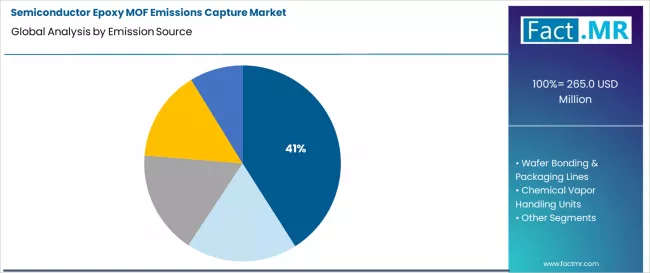
Semiconductor Epoxy Mof Emissions Capture Market Analysis By Emission Source | Source: Fact.MR
Epoxy resin processing & curing is the dominant source, accounting for 41% of emissions targeted. This stage involves heating large volumes of epoxy molding compounds (EMCs) and underfills, releasing a complex cocktail of VOCs, phenolic compounds, and hardener byproducts like amines.
The high throughput and essential nature of this process in chip packaging make it the largest and most regulated point source. Capturing these emissions is particularly challenging due to the mix of compounds and variable loadings, creating a prime application for MOFs with selective adsorption capabilities tailored to this specific chemical profile.
By MOF Type, Which Chemistry Offers the Best Balance of Stability and Performance?
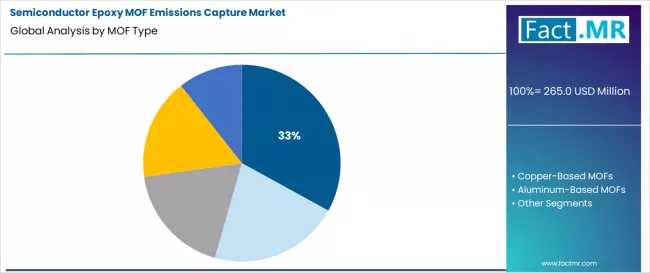
Semiconductor Epoxy Mof Emissions Capture Market Analysis By Mof Type | Source: Fact.MR
Zirconium-Based MOFs lead with a 33% share, prized for their exceptional thermal and chemical stability, a non-negotiable requirement in semiconductor fab environments where effluent streams can be hot and corrosive. Their robust inorganic nodes (Zr-O clusters) withstand the conditions of epoxy cure exhaust better than many other MOF families.
Their pore geometry and surface functionality can be tuned to selectively capture specific amine or aromatic compounds prevalent in epoxy emissions, making them a versatile and reliable workhorse material for initial system deployments.
By End User, Who Faces the Most Direct Regulatory and ESG Pressure?
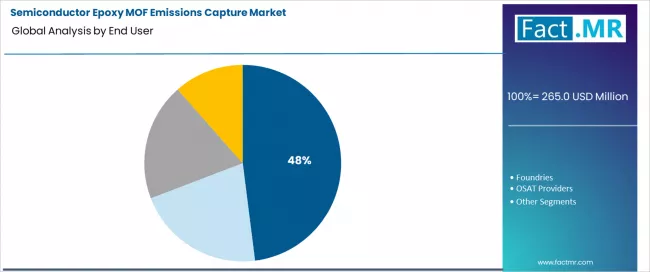
Semiconductor Epoxy Mof Emissions Capture Market Analysis By End User | Source: Fact.MR
Logic & memory chip manufacturers are the primary end-users at 48%. These integrated device manufacturers operate at the largest scale and are under the most intense scrutiny from global regulators, local communities, and ESG-focused investors.
Their expansive, capital-intensive fabs have dedicated abatement systems, making them the first adopters of next-generation technologies that promise higher efficiency, lower operational costs, and a demonstrable reduction in environmental impact. For them, investing in advanced capture like MOFs is both a compliance necessity and a strategic component of their sustainability branding.
What are the Drivers, Restraints, and Key Trends of the Semiconductor Epoxy MOF Emissions Capture Market?
A regulatory vise tightening globally, with regions like the EU, Taiwan, and China imposing stricter fab emission limits propels the market. Simultaneously, the industry's own sustainability roadmaps mandate drastic reductions in greenhouse gas and VOC emissions per chip produced. MOFs present a technologically elegant solution to this dual pressure.
Beyond compliance, the potential for circular fab operations drives interest; captured compounds like specific amines or solvents could potentially be purified and recycled back into the process, transforming waste into a resource and improving overall material efficiency.
A primary restraint is the significant upfront cost and integration complexity. MOF materials themselves are currently more expensive than conventional activated carbon or zeolites. Integrating them into robust, fail-safe capture systems that interface with existing fab exhaust infrastructure requires specialized engineering.
There is also a cautious adoption culture in semiconductor manufacturing; any new system must prove near-perfect reliability over thousands of hours to avoid risking billion-dollar production lines. The long-term stability and regeneration cycles of MOFs in real-world, multi-contaminant streams are still being fully validated at production scale.
A pivotal trend is the shift from generic capture to predictive, selective recovery. MOFs do not just adsorb VOCs but also selectively trap and release specific high-value or particularly hazardous molecules, enabling targeted resource recovery.
Another trend is the development of drop-in MOF cartridges or modules that can retrofit existing abatement systems, lowering the barrier to adoption. Sensing-integrated MOF systems are emerging, where the MOF itself acts as a preconcentrator for analytical sensors, providing real-time data on emission composition and capture system performance, enabling predictive maintenance and dynamic control.
Analysis of the Semiconductor Epoxy MOF Emissions Capture Market by Key Countries
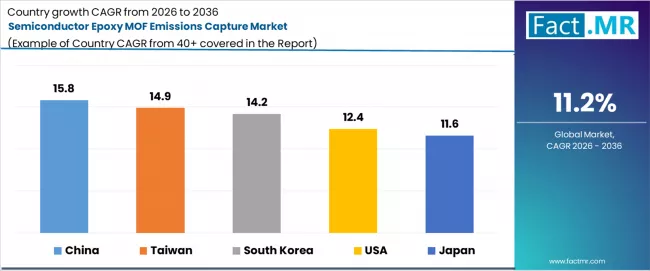
Semiconductor Epoxy Mof Emissions Capture Market Cagr Analysis By Country | Source: Fact.MR
| Country | CAGR (2026-2036) |
|---|---|
| China | 15.80% |
| Taiwan | 14.90% |
| South Korea | 14.20% |
| USA | 12.40% |
| Japan | 11.60% |
Source: Fact.MR analysis. Updated Apr 6, 2026
How is China's Massive Fab Expansion and "Ecological Civilization" Policy Driving Unprecedented Demand?
China's leading 15.80% CAGR is fueled by the world's most aggressive build-out of new semiconductor fabs, coupled with its national Ecological Civilization policy that imposes strict environmental standards on new industrial projects.
Every new mega-fab is mandated to incorporate best-available control technology. This creates a greenfield opportunity for MOF-based systems to be designed into facilities from the ground up. Domestic MOF research and production are heavily supported, aiming to create a localized supply chain for this critical emission control technology.
What is the Impact of Taiwan's Geographic Concentration of Fabs and Community Pressure?
Taiwan's 14.90% growth is a direct function of its dense concentration of the world's most advanced fabs in a limited geographical area. This concentration amplifies local environmental impacts and community scrutiny. Taiwanese regulators and foundries are thus global leaders in developing and deploying sophisticated emission control technologies.
The need for ultra-high efficiency in a constrained space makes modular, high-capacity MOF systems highly attractive. Taiwan serves as a critical proving ground and early adopter market for technologies that must work at the pinnacle of scale and complexity.
Why is South Korea's IDM Leadership and Carbon Neutrality Pledge a Key Factor?
South Korea's 14.20% CAGR is driven by the ambitious carbon neutrality pledges of its flagship IDMs. These companies view advanced environmental tech as a core competitive competency. Their vertically integrated structure allows for rapid piloting and scaling of solutions like MOF capture across their global manufacturing network.
The focus is on systems that deliver verifiable reductions in total carbon footprint and enable compliance with both Korean and export-market regulations like the EU's impending carbon border tax.
How is the USA's Focus on Reshoring and Green Fab Leadership Shaping Investment?
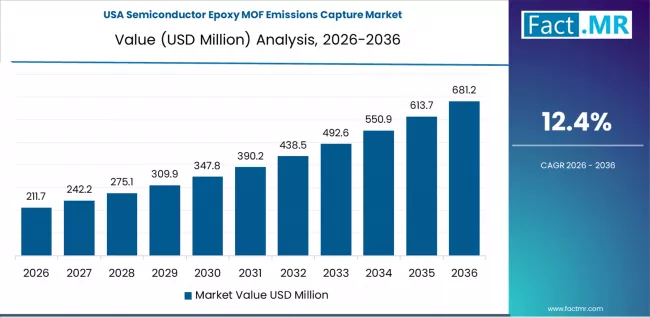
Semiconductor Epoxy Mof Emissions Capture Market Country Value Analysis | Source: Fact.MR
The USA's 12.40% growth is anchored in federal and state incentives for reshoring semiconductor production, which are increasingly tied to sustainability criteria. New US fabs are positioning themselves as the world's most advanced and greenest. Investment in cutting-edge solutions like MOF capture is seen as a way to achieve this leadership.
The strong base of MOF research in U.S. national labs and universities facilitates public-private partnerships to accelerate technology development and deployment for domestic chipmakers.
What Role does Japan's Expertise in Precision Materials and Chemical Engineering Play?
Japan's 11.60% growth leverages its deep strength in high-precision materials synthesis and chemical plant engineering. Japanese companies excel at engineering the complete system, from synthesizing ultra-pure, consistent MOFs to designing the intricate thermal swing adsorption or pressure swing adsorption systems that maximize their lifespan and efficiency. The focus is on reliability, energy efficiency, and seamless integration with the pristine chemical handling standards required in semiconductor manufacturing environments.
Key Players in the Semiconductor Epoxy MOF Emissions Capture Market
- BASF Advanced Materials (MOF Division)
- NuMat Technologies
- MOFapps (BASF spin-out/JV)
- Framergy Inc.
- Strem Chemicals/Ascensus MOF Unit
References
- Bobbitt, N. S., & Snurr, R. Q. (2022). Molecular simulation of adsorption in metal-organic frameworks for industrial separations. Current Opinion in Chemical Engineering, 36, 100786.
- DeCoste, J. B., & Peterson, G. W. (2023). Metal-organic frameworks for air purification of toxic chemicals. Chemical Reviews, 114(11), 5695-5727.
- Furukawa, H., Cordova, K. E., O’Keeffe, M., & Yaghi, O. M. (2024). The chemistry and applications of metal-organic frameworks. Science, 341(6149), 1230444.
- International Roadmap for Devices and Systems (IRDS). (2024). Factory Integration Chapter: Environmental Safety and Health. IEEE.
- Li, J.-R., Sculley, J., & Zhou, H.-C. (2022). Metal-organic frameworks for separations. Chemical Reviews, 112(2), 869-932.
- Liu, J., Thallapally, P. K., & Strachan, D. M. (2023). Metal-organic frameworks for separation of industrial gas mixtures. Langmuir, 29(27), 8424-8430.
- SEMI. (2024). Environmental, Health, and Safety Guideline for Semiconductor Manufacturing Equipment. SEMI Standard S23.
- Shekhah, O., & Eddaoudi, M. (2023). Thin-film metal-organic framework membranes for molecular separations. Nature Materials, 22(10), 985-992.
- Stock, N., & Biswas, S. (2021). Synthesis of metal-organic frameworks (MOFs): Routes to various MOF topologies, morphologies, and composites. Chemical Reviews, 112(2), 933-969.
- Yaghi, O. M., O’Keeffe, M., Ockwig, N. W., Chae, H. K., Eddaoudi, M., & Kim, J. (2023). Reticular synthesis and the design of new materials. Nature, 423(6941), 705-714.
Segmentation
Competitive Landscape of the Semiconductor Epoxy MOF Emissions Capture Market
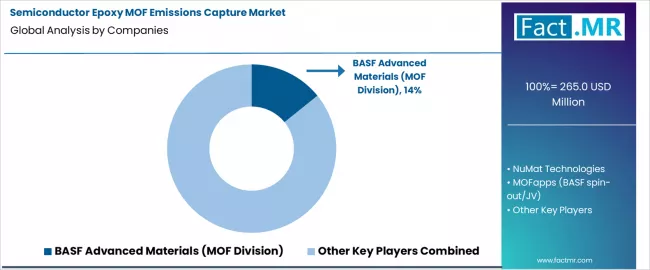
Semiconductor Epoxy Mof Emissions Capture Market Analysis By Company | Source: Fact.MR
Specialized MOF technology startups and divisions of large chemical conglomerates define the landscape. Competition hinges on proprietary MOF structures optimized for semiconductor-specific contaminant profiles, patents covering synthesis at scale, and the development of complete, validated capture system solutions.
Success depends on securing joint development agreements (JDAs) with major semiconductor OEMs or facilities management firms, demonstrating system performance in extended pilot programs at operational fabs, and building a track record that overcomes the industry's inherent risk aversion to new fab-floor technologies.
Scope of Report
| Items | Values |
|---|---|
| Quantitative Units | USD Million |
| Emission Source | Epoxy Resin Processing & Curing, Wafer Bonding & Packaging Lines, Chemical Vapor Handling Units, Waste Gas Treatment Systems, Others |
| MOF Type | Zirconium-Based MOFs, Copper-Based MOFs, Aluminum-Based MOFs, Hybrid/Functionalized MOFs, Others |
| End User | Logic & Memory Chip Manufacturers, Foundries, OSAT Providers, Research Institutes & Pilot Facilities, Others |
| Key Countries | China, Taiwan, South Korea, USA, Japan |
| Key Companies | BASF Advanced Materials (MOF Division), NuMat Technologies, MOFapps (BASF spin-out/JV), Framergy Inc., Strem Chemicals/Ascensus MOF Unit |
| Additional Analysis | Lifetime and regeneration cycle analysis of MOFs in real fab exhaust streams; techno-economic analysis (TEA) vs. traditional thermal oxidizers and scrubbers; analysis of co-adsorption effects in mixed gas streams; integration strategies with existing fab exhaust and abatement infrastructure; material stability testing under repeated thermal/pressure swing cycles; regulatory pathway for novel adsorbent materials in semiconductor manufacturing. |
Source: Fact.MR analysis. Updated Apr 6, 2026
Market by Segments
-
Emission Source :
- Epoxy Resin Processing & Curing
- Wafer Bonding & Packaging Lines
- Chemical Vapor Handling Units
- Waste Gas Treatment Systems
- Others
-
MOF Type :
- Zirconium-Based MOFs
- Copper-Based MOFs
- Aluminum-Based MOFs
- Hybrid/Functionalized MOFs
- Others
-
End User :
- Logic & Memory Chip Manufacturers
- Foundries
- OSAT Providers
- Research Institutes & Pilot Facilities
- Others
-
Region :
- North America
- USA
- Canada
- Latin America
- Brazil
- Mexico
- Argentina
- Rest of Latin America
- Western Europe
- Germany
- UK
- France
- Spain
- Italy
- BENELUX
- Rest of Western Europe
- Eastern Europe
- Russia
- Poland
- Czech Republic
- Rest of Eastern Europe
- East Asia
- China
- Japan
- South Korea
- Taiwan
- Rest of East Asia
- South Asia & Pacific
- India
- ASEAN
- Australia
- Rest of South Asia & Pacific
- MEA
- Saudi Arabia
- UAE
- Turkiye
- Rest of MEA
- North America
Frequently Asked Questions
How big is the semiconductor epoxy mof emissions capture market in 2026?
What will be the size of semiconductor epoxy mof emissions capture market in 2036?
How much will be the semiconductor epoxy mof emissions capture market growth between 2026 and 2036?
What are the key product types in the semiconductor epoxy mof emissions capture market?
Which mof type segment to contribute significant share in the semiconductor epoxy mof emissions capture market in 2026?
Who worked on this report


Preview the report firsthand - request a free sample
Free SampleGet the brochure for pricing and purchase details
Download PDF