- Base Value(2025): 12.5 Bn
- Estimated Value(2026): 13.68 Bn
- Forecast Value (2036): 33.58 Bn
- CAGR (2026 - 2036): 9.4%
Smart Surfaces Market Size, Market Forecast and Outlook By Fact.MR
The smart surfaces market was valued at USD 12.5 billion in 2025, projected to reach USD 13.68 billion in 2026, and is forecast to expand to USD 33.58 billion by 2036 at a 9.4% CAGR. Rising regulatory mandates around energy efficiency in commercial buildings and growing adoption of self-cleaning coatings in healthcare settings are accelerating the transition from conventional materials to smart surface technologies across global construction and infrastructure networks.
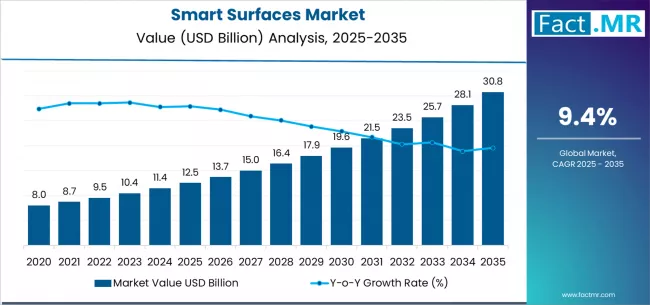
Smart Surfaces Market Market Value Analysis | Source: Fact.MR
Summary of Smart Surfaces Market
- Market Overview
- The market is valued at USD 12.5 billion in 2025 and is projected to reach USD 33.58 billion by 2036.
- The industry is expected to grow at a 9.4% CAGR from 2026 to 2036, creating an incremental opportunity of USD 19.90 billion.
- The market operates as a technology-integration category where coating performance certifications, energy efficiency compliance, and antimicrobial efficacy standards define competitive positioning.
- Demand and Growth Drivers
- Demand is accelerating as commercial building operators face tighter energy performance certification thresholds that require active thermal management through facade-integrated smart coatings.
- Healthcare facility refurbishment programs across developed economies are specifying antimicrobial surface coatings as a baseline infection control measure, expanding consumption of silver-ion and photocatalytic surface technologies.
- Self-cleaning coating adoption is rising in automotive glazing and solar panel applications where maintenance cost reduction justifies the material price premium over conventional glass treatments.
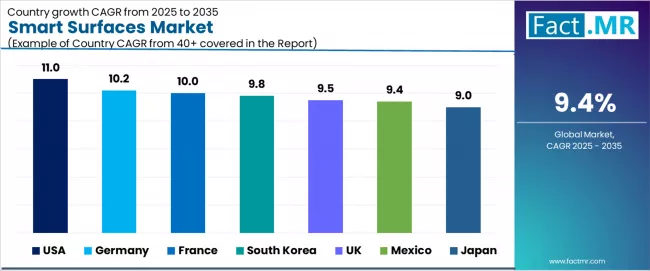
- Among key countries, USA leads at 11% CAGR, Germany at 10.2%, France at 10%, South Korea at 9.8%, UK at 9.5%, Mexico at 9.4%, Japan at 9%.
- Product and Segment View
- The market includes coatings and material systems engineered to respond to environmental stimuli, covering self-cleaning photocatalytic layers, antimicrobial silver-ion and copper-based coatings, and thermochromic/electrochromic thermal control films.
- Primary applications span commercial building facades, healthcare facility interiors, automotive glazing, solar panel protection, and industrial equipment surfaces.
- Self-cleaning leads by Technology with 45% share in 2026, sustained by photocatalytic titanium dioxide coating adoption across building exterior and solar panel maintenance applications.
- Construction leads by End Use with 50% share in 2026, reflecting specification mandates for energy-responsive facades and antimicrobial interior surfaces in new commercial and healthcare builds.
- Scope includes functional coatings applied to glass, metal, polymer, and ceramic substrates. Standard decorative paints, structural glazing sealants, and bulk insulation materials without active surface response properties are excluded.
- Geography and Competitive Outlook
- USA and Germany are the fastest-growing markets, supported by federal energy efficiency mandates and large-scale healthcare infrastructure modernization programs.
- North America and Europe remain the highest-value demand bases, where regulatory compliance for building energy performance and infection control standards sustain premium coating specification volumes.
- Competition is defined by coating technology breadth, substrate compatibility range, and certified performance data across energy, antimicrobial, and self-cleaning application categories.
- Key players include AGC Inc. (Asahi Glass Company, Limited), Compagnie de Saint-Gobain S.A., 3M Company, Corning Incorporated, Arkema S.A., The Dow Chemical Company, DuPont de Nemours, Inc..
- Analyst Opinion at Fact.MR
- Shambhu Nath Jha , Principal Consultant for Chemicals and Materials, opines: 'In my analysis, I have observed that the primary constraint in smart surfaces adoption is not technology readiness but the gap between coating performance certification timelines and commercial building project procurement cycles. Facility managers specifying antimicrobial or thermal control surfaces face qualification lead times that conflict with construction schedules. Coating suppliers who compress their certification-to-delivery pipeline will capture specification share from incumbents still operating on legacy qualification frameworks.'
- Strategic Implications / Executive Takeaways
- Coating manufacturers must secure third-party performance certifications for antimicrobial efficacy and thermal response metrics to qualify for healthcare and commercial construction specifications.
- Building material procurement directors should evaluate total cost of ownership calculations that include maintenance reduction and energy savings when comparing smart surface coatings against conventional alternatives.
- R&D teams must prioritize substrate-agnostic formulation development to address the growing requirement for single-coating-system compatibility across glass, metal, and polymer building envelope materials.
Smart Surfaces Market Key Takeaways
| Metric | Details |
|---|---|
| Industry Size (2026) | USD 13.68 billion |
| Industry Value (2036) | USD 33.58 billion |
| CAGR (2026 to 2036) | 9.4% |
Source: Fact.MR analysis. Updated Apr 3, 2026
The absolute dollar opportunity between 2026 and 2036 amounts to USD 19.90 billion. This growth is tied to the conversion of existing building stock toward energy-responsive facades and the specification of antimicrobial coatings in hospital refurbishment projects. As per Fact.MR, material cost premiums for functional coatings remain a gating factor for mid-tier construction projects, though falling production costs for photocatalytic titanium dioxide layers are narrowing the price differential against conventional surface treatments.
All major regional markets reflect accelerated deployment parameters. USA leads the pace with a 11% CAGR, followed by Germany at 10.2%, followed by France at 10%, followed by South Korea at 9.8%, followed by UK at 9.5%, followed by Mexico at 9.4%, and Japan expands at a 9% trajectory.
Why is the Smart Surfaces Market Growing?
Market expansion is being supported by the increasing global demand for advanced intelligent materials and the corresponding need for smart surface technologies that can provide superior functionality benefits and performance advantages while enabling enhanced operational efficiency and extended compatibility across various construction and healthcare applications.
Modern building operators and facility specialists are increasingly focused on implementing proven intelligent technologies that can deliver effective maintenance reduction, minimize traditional cleaning concerns, and provide consistent performance throughout complex building configurations and diverse operational conditions. Smart surfaces proven ability to deliver exceptional functionality against traditional alternatives, enable advanced building integration, and support modern facility protocols makes it an essential component for contemporary construction and healthcare operations.
The growing emphasis on operational efficiency and maintenance optimization is driving demand for surfaces that can support large-scale facility requirements, improve building outcomes, and enable advanced facility systems. Operator preference for materials that combine effective functionality with proven maintenance reduction and performance enhancement benefits is creating opportunities for innovative smart surface implementations. The rising influence of green building trends and operational awareness is also contributing to increased demand for smart surfaces that can provide advanced features, seamless building integration, and reliable performance across extended operational cycles.
Opportunity Pathways - Smart Surfaces Market
The smart surfaces market is poised for steady growth and technological advancement. As building facilities across North America, Europe, Asia-Pacific, and emerging markets seek materials that deliver exceptional functionality characteristics, advanced coating capabilities, and reliable performance options, smart surface solutions are gaining prominence not just as specialty materials but as strategic enablers of intelligent technologies and advanced facility functionality.
Rising self-cleaning adoption in construction applications and expanding healthcare enhancement initiatives globally amplify demand, while processors are leveraging innovations in coating engineering, advanced functionality integration, and performance optimization technologies.
- Pathway A - Self-cleaning Technology Implementations. Premium construction and healthcare facilities increasingly require surface solutions with self-cleaning bases and advanced functionality profiles for enhanced operational appeal and maintenance positioning capabilities. Technology developers who develop self-cleaning platforms with superior performance standards can command premium pricing. Expected revenue pool: USD 6.9 billion - USD 10.4 billion.
- Pathway B - Construction Application Platforms. Growing demand for construction applications, high-performance capabilities, and unique functionality features drives need for advanced construction capabilities with specialized building integration. Opportunity: USD 7.7 billion - USD 11.6 billion.
- Pathway C - Healthcare Applications. Advanced healthcare formulations capable of meeting specific functionality requirements, facility compatibility, and specialized coating profiles enable market expansion and enhanced operational appeal for healthcare-focused operations. Revenue lift: USD 4.6 billion - USD 7.0 billion.
- Pathway D - Anti-microbial Technology Integration. Expanding reach into anti-microbial applications with optimized functionality delivery, advanced coating capabilities, and extended performance features. Manufacturers will seek partners who supply integrated anti-microbial solutions with complete surface functionality. Pool: USD 4.6 billion - USD 7.0 billion.
- Pathway E - Geographic Expansion & Local Manufacturing. Strong growth in APAC, particularly China, India, and Southeast Asia. Local manufacturing lowers costs, reduces transportation complexity, and enables faster response to regional building preferences. Expected upside: USD 4.6 billion - USD 7.0 billion.
- Pathway F - Thermal Control Development. Increasing demand for thermal control systems, application-specific functionality, and specialized coating profiles with validated performance characteristics for building facilities. USD 3.8 billion - USD 5.8 billion.
- Pathway G - Industrial Applications Expansion. Developing comprehensive industrial surface solutions, custom coating services, and enhancement programs creates differentiation and addresses specialized requirements for industrial applications and facility operators. Growing demand from independent facility services. Pool: USD 3.1 billion - USD 4.6 billion.
Segmental Analysis
The market is segmented by technology, end use, and region. By technology, the market is divided into self-cleaning, anti-microbial, and thermal control categories. By end use, it covers construction, healthcare, and industrial segments. Regionally, the market is divided into North America, Europe, and Asia-Pacific.
By Technology, the Self-cleaning Segment Accounts for 45.0% Market Share
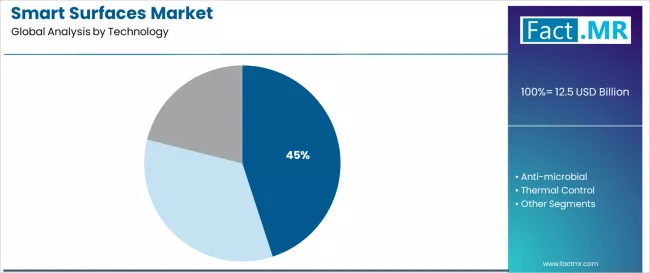
Smart Surfaces Market Analysis By Technology | Source: Fact.MR
The self-cleaning segment is projected to account for 45.0% of the smart surfaces market in 2025, reaffirming its position as the leading technology category. Building facilities and surface integrators increasingly utilize self-cleaning implementations for their superior maintenance characteristics when operating across diverse application platforms, excellent functionality properties, and widespread acceptance in applications ranging from basic building enhancement to premium healthcare operations. Self-cleaning technology's established coating methods and proven functionality capabilities directly address the facility requirements for dependable surface solutions in complex building environments.
This technology segment forms the foundation of modern construction adoption patterns, as it represents the implementation with the greatest market penetration and established operator acceptance across multiple application categories and functionality segments. Facility investments in self-cleaning standardization and system consistency continue to strengthen adoption among construction producers and healthcare companies. With operators prioritizing maintenance reduction and operational efficiency, self-cleaning implementations align with both functionality preferences and cost expectations, making them the central component of comprehensive facility enhancement strategies.
By End Use, the Construction Segment Accounts for 50.0% Market Share
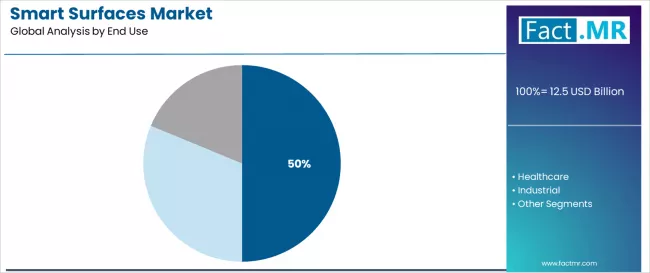
Smart Surfaces Market Analysis By End Use | Source: Fact.MR
Construction applications are projected to represent 50.0% of smart surfaces demand in 2025, underscoring their critical role as the primary end use type for functionality enhancement across building and infrastructure operations. Building facilities prefer smart surfaces for construction use for their exceptional performance characteristics, scalable implementation options, and ability to enhance operational efficiency while ensuring consistent surface quality throughout diverse construction platforms and building operations. Positioned as essential functionality components for modern construction systems, smart surface solutions offer both technological advantages and operational efficiency benefits.
The segment is supported by continuous innovation in coating technologies and the growing availability of specialized implementations that enable diverse construction requirements with enhanced functionality uniformity and extended performance capabilities. Additionally, construction facilities are investing in advanced technologies to support large-scale surface integration and building development. As intelligent building trends become more prevalent and functionality awareness increases, construction applications will continue to represent a major implementation market while supporting advanced building utilization and technology integration strategies.
By End Use, the Healthcare Segment Accounts for 30.0% Market Share
The healthcare segment is expected to capture 30.0% of the smart surfaces market in 2025, driven by increasing demand for hygienic surface materials that enhance infection control while maintaining operational efficiency. Healthcare facilities are increasingly adopting smart surfaces for hospital walls, medical equipment, and patient care areas due to their superior antimicrobial properties and maintenance reduction characteristics. The segment benefits from growing infection control requirements and continuous innovation in coating formulations tailored for healthcare applications.
What are the Drivers, Restraints, and Key Trends of the Smart Surfaces Market?
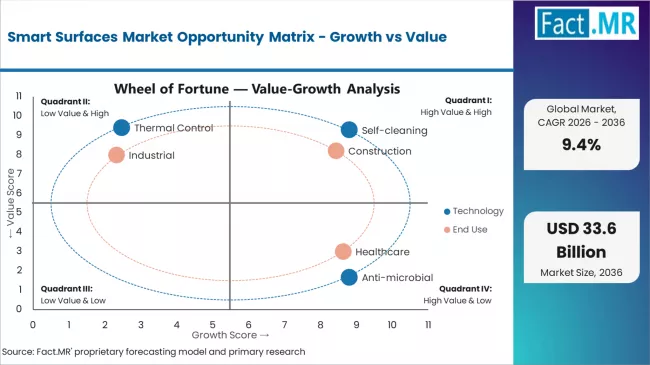
Smart Surfaces Market Opportunity Matrix Growth Vs Value | Source: Fact.MR
The smart surfaces market is advancing steadily due to increasing demand for advanced intelligent materials and growing adoption of smart surface technologies that provide superior functionality characteristics and operational benefits while enabling enhanced facility efficiency across diverse construction and healthcare applications. The market faces challenges, including complex coating requirements, evolving performance standards, and the need for specialized functionality expertise and integration programs. Innovation in coating methods and advanced surface systems continues to influence product development and market expansion patterns.
Expansion of Intelligent Building Technologies and Facility Integration
The growing adoption of advanced intelligent building solutions, sophisticated coating capabilities, and operational efficiency awareness is enabling surface developers to produce advanced smart surface solutions with superior functionality positioning, enhanced coating profiles, and seamless integration functionalities. Advanced intelligent systems provide improved operational outcomes while allowing more efficient facility workflows and reliable performance across various building applications and operational conditions. Developers are increasingly recognizing the competitive advantages of facility integration capabilities for market differentiation and technology positioning.
Integration of Advanced Coating Methods and Functionality Engineering
Modern smart surface manufacturers are incorporating advanced coating technology, functionality integration, and sophisticated production solutions to enhance product appeal, enable intelligent surface features, and deliver value-added solutions to building customers. These technologies improve smart surface performance while enabling new market opportunities, including multi-stage coating systems, optimized functionality treatments, and enhanced performance characteristics. Advanced coating integration also allows developers to support comprehensive building technologies and market expansion beyond traditional surface approaches.
Analysis of the Smart Surfaces Market by Key Countries
.webp "Top Country Growth Comparison Smart Surfaces Market Cagr (2026 2036)")
Top Country Growth Comparison Smart Surfaces Market Cagr (2026 2036) | Source: Fact.MR
| Country | CAGR (2026-2036) |
|---|---|
| USA | 11.0% |
| Mexico | 9.4% |
| Germany | 10.2% |
| France | 10.0% |
| South Korea | 9.8% |
| UK | 9.5% |
| Japan | 9.0% |
Source: Fact.MR analysis. Updated Apr 3, 2026
Smart Surfaces Market Cagr Analysis By Country | Source: Fact.MR
The smart surfaces market is experiencing exceptional growth globally, with the USA leading at an 11.0% CAGR through 2036, driven by expanding construction capacity, growing healthcare facility programs, and significant investment in intelligent building technology development. Mexico follows at 9.4%, supported by increasing construction expansion, growing technology integration patterns, and expanding building infrastructure. Germany shows growth at 10.2%, emphasizing building technology leadership and surface development. France records 10.0%, focusing on expanding construction capabilities and technology modernization. South Korea exhibits 9.8% growth, emphasizing technology innovation excellence and premium surface development. The UK demonstrates 9.5% growth, prioritizing advanced building technology development and quality-focused surface patterns. Japan shows 9.0% growth, supported by facility efficiency initiatives and quality-focused coating patterns.
USA Leads Global Market Growth with Construction Technology Expansion
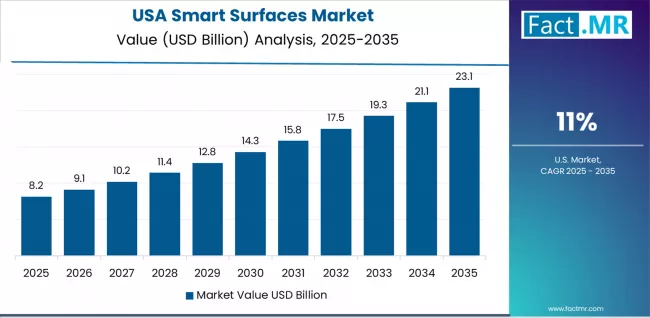
Smart Surfaces Market Country Value Analysis | Source: Fact.MR
Revenue from smart surfaces in the USA is projected to exhibit robust growth with a CAGR of 11.0% through 2036, driven by expanding construction capacity and rapidly growing healthcare integration supported by government initiatives promoting intelligent building technology development. The country's strong position in construction and increasing investment in building technology infrastructure are creating substantial demand for advanced smart surface implementations. Major construction facilities and technology companies are establishing comprehensive coating capabilities to serve both domestic construction demand and expanding healthcare markets.
Government support for building efficiency initiatives and intelligent construction development is driving demand for advanced smart surface systems throughout major construction regions and building centers across the country. Strong construction growth and an expanding network of technology-focused operators are supporting the rapid adoption of smart surfaces among facilities seeking advanced functionality capabilities and integrated building technologies.
Mexico Demonstrates Strong Construction Growth and Technology Expansion
Revenue from smart surfaces in Mexico is growing at a CAGR of 9.4%, driven by the country's expanding construction sector, growing building capacity, and increasing adoption of intelligent surface technologies. The country's initiatives promoting construction modernization and growing building development awareness are driving requirements for technology-integrated surface systems. International smart surface providers and domestic construction companies are establishing extensive coating and integration capabilities to address the growing demand for advanced surface solutions.
Strong construction expansion and expanding modern building operations are driving adoption of integrated functionality systems with superior coating capabilities and advanced integration among large construction producers and progressive building operations. Growing technology diversity and increasing construction enhancement adoption are supporting market expansion for advanced smart surface implementations with seamless integration profiles and modern functionality delivery throughout the country's construction regions. Mexico's strategic location and expanding construction market make it an attractive destination for surface manufacturing facilities serving both domestic and North American markets.
Germany Demonstrates Building Technology Leadership with Innovation Growth
Revenue from smart surfaces in Germany is expanding at a CAGR of 10.2%, supported by the country's building technology heritage, strong emphasis on intelligent surface technology, and robust demand for advanced smart surface systems in construction and healthcare applications. The nation's mature construction sector and technology-focused operations are driving sophisticated surface implementations throughout the industry. Leading facilities and building specialists are investing extensively in coating development and advanced integration technologies to serve both domestic and international markets.
Rising demand for intelligent building technologies and advanced construction systems is creating requirements for sophisticated smart surface solutions with exceptional functionality capabilities among quality-conscious facilities seeking enhanced building experiences and advanced integration methods. Strong construction tradition and growing investment in intelligent technologies are supporting adoption of quality surface platforms with advanced development methods and enhanced functionality profiles across construction operations in major building regions.
France Focuses on Construction Development and Building Enhancement Programs
Revenue from smart surfaces in France is growing at a CAGR of 10.0%, driven by the country's expanding construction sector, growing building development programs, and increasing investment in surface technology development. France's large construction market and commitment to building advancement are supporting demand for diverse smart surface solutions across multiple facility segments. Technology providers are establishing comprehensive integration capabilities to serve the growing domestic market and expanding construction opportunities.
Strong construction expansion and expanding modern building operations are driving adoption of integrated functionality systems with superior surface capabilities and advanced integration among large construction producers and progressive building operations. Growing technology diversity and increasing construction enhancement adoption are supporting market expansion for advanced smart surface implementations with seamless integration profiles and modern functionality delivery throughout the country's construction regions.
UK Exhibits Building Technology Development and Premium Innovation Growth
Revenue from smart surfaces in the UK is growing at a CAGR of 9.5%, driven by the country's focus on building technology advancement, emphasis on premium construction innovation, and strong position in intelligent surface development. The UK's established construction innovation capabilities and commitment to technology diversification are supporting investment in specialized smart surface technologies throughout major building regions. Industry leaders are establishing comprehensive technology integration systems to serve domestic premium construction production and enhancement applications.
Innovations in functionality platforms and surface integration capabilities are creating demand for advanced smart surface implementations with exceptional performance properties among progressive construction facilities seeking enhanced technology differentiation and building appeal. Growing premium construction adoption and increasing focus on surface innovation are driving adoption of advanced smart surface platforms with integrated functionality delivery and coating optimization across construction enterprises throughout the country.
Japan Shows Quality Processing Focus and Technology-Driven Building Systems
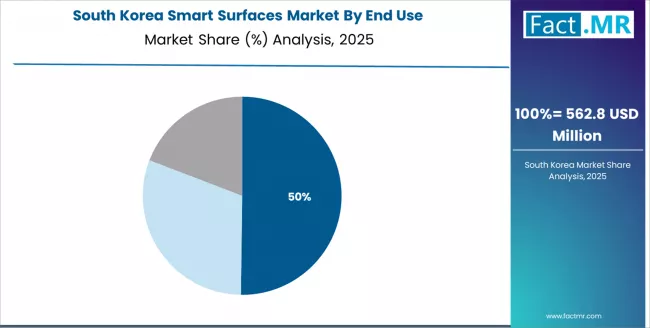
Smart Surfaces Market South Korea Market Share Analysis By End Use | Source: Fact.MR
Revenue from smart surfaces in Japan is expanding at a CAGR of 9.0%, supported by the country's building excellence initiatives, growing quality technology sector, and strategic emphasis on advanced surface development. Japan's advanced quality control capabilities and integrated building systems are driving demand for high-quality smart surface platforms in premium applications, construction technology, and advanced enhancement applications. Leading facilities are investing in specialized capabilities to serve the stringent requirements of technology-focused construction and premium building producers.
Quality construction advancement and technology-focused development are creating requirements for specialized smart surface solutions with superior quality integration, exceptional functionality capabilities, and advanced coating features among quality-conscious construction operations and premium building producers. Strong position in construction technology innovation is supporting adoption of advanced smart surface systems with validated functionality characteristics and quality integration capabilities throughout the country's construction technology sector.
South Korea Demonstrates Strong Construction Integration and Technology Development
Smart Surfaces Market South Korea Market Share Analysis By End Use | Source: Fact.MR
Revenue from smart surfaces in South Korea is growing at a CAGR of 9.8%, driven by the country's expanding construction sector, growing technology integration capacity, and increasing adoption of intelligent building technologies. The country's initiatives promoting construction modernization and growing building development awareness are driving requirements for technology-integrated surface systems. International smart surface providers and domestic construction companies are establishing extensive coating and integration capabilities to address the growing demand for advanced surface solutions.
Rising construction requirements and expanding building programs are creating opportunities for smart surface adoption across construction centers, progressive producers, and modern building facilities in major construction regions. Growing focus on functionality integration and surface improvement features is driving adoption of smart surface platforms among operators seeking enhanced functionality capabilities and advanced coating experiences.
Europe Market Split by Countries
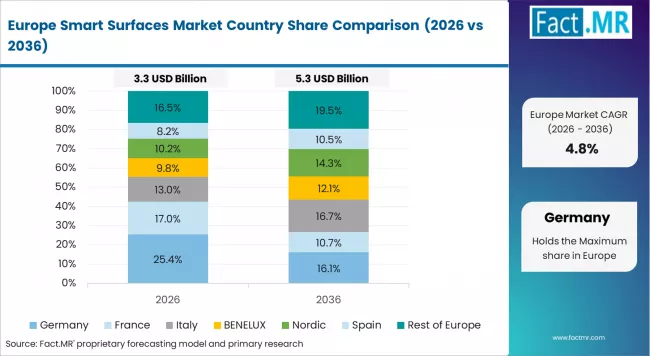
Smart Surfaces Market Europe Country Market Share Analysis, 2026 & 2036 | Source: Fact.MR
The smart surfaces market in Europe is projected to grow from USD 3.8 billion in 2026 to USD 9.2 billion by 2036, registering a CAGR of 9.9% over the forecast period. Germany is expected to maintain its leadership position with a 28.0% market share in 2026, growing to 29.2% by 2036, supported by its strong building technology culture, sophisticated construction capabilities, and comprehensive facility sector serving diverse surface applications across Europe.
France follows with a 24.0% share in 2026, projected to reach 24.5% by 2036, driven by robust demand for construction technologies in building applications, advanced facility development programs, and functionality markets, combined with established construction infrastructure and technology integration expertise. The UK holds a 20.0% share in 2026, expected to reach 19.3% by 2036, supported by strong building technology sector and growing premium construction activities. Italy commands a 15.0% share in 2026, projected to reach 14.5% by 2036, while Netherlands accounts for 8.0% in 2026, expected to reach 8.5% by 2036. The Rest of Europe region is anticipated to maintain momentum, with its collective share moving from 5.0% to 4.0% by 2036, attributed to increasing construction modernization and growing technology penetration implementing advanced surface programs.
Competitive Landscape of the Smart Surfaces Market
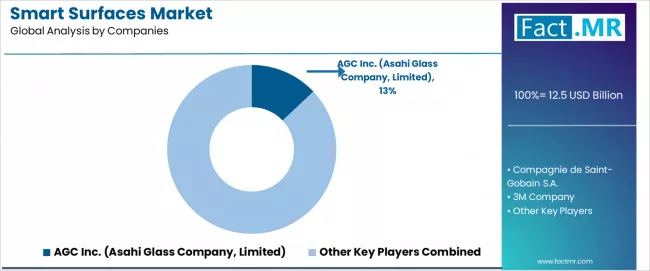
Smart Surfaces Market Analysis By Company | Source: Fact.MR
The smart surfaces market is characterized by competition among established materials companies, specialized surface technology manufacturers, and integrated coating solution providers. Companies are investing in coating technology research, functionality optimization, advanced manufacturing system development, and comprehensive surface portfolios to deliver consistent, high-quality, and application-specific smart surface solutions. Innovation in advanced functionality integration, coating enhancement, and building compatibility improvement is central to strengthening market position and competitive advantage.
AGC Inc leads the market with a 13% market share, offering comprehensive surface solutions including quality coating platforms and advanced functionality systems with a focus on premium and construction applications. Saint-Gobain provides specialized materials capabilities with an emphasis on advanced smart surface implementations and innovative building solutions. 3M delivers comprehensive coating services with a focus on integrated platforms and large-scale construction applications. Corning specializes in advanced surface technologies and specialized smart surface implementations for premium applications. Arkema focuses on construction-oriented surface integration and innovative coating solutions.
The competitive landscape is further strengthened by companies like Dow, which brings expertise in advanced coating processing, while DuPont focuses on high-performance surface solutions for diverse applications. BASF emphasizes sustainable surface systems and environmental compatibility, and AkzoNobel specializes in architectural coating formulations. These companies continue to invest in research and development, strategic partnerships, and manufacturing capacity expansion to maintain their market positions and capture emerging opportunities in the growing smart surfaces sector.
Key Players in the Smart Surfaces Market
- AGC Inc. (Asahi Glass Company, Limited)
- Compagnie de Saint-Gobain S.A.
- 3M Company
- Corning Incorporated
- Arkema S.A.
- The Dow Chemical Company
- DuPont de Nemours, Inc.
- BASF SE
- Akzo Nobel N.V.
- NSG Group (Pilkington)
- SCHOTT AG
Bibliography
- 1. European Commission, Directorate-General for Energy. (2024). Energy Performance of Buildings Directive (EPBD) Recast. European Commission.
- 2. U.S. Environmental Protection Agency. (2024). ENERGY STAR Commercial Buildings Program Requirements. U.S. EPA.
- 3. International Organization for Standardization. (2023). ISO 27447: Fine ceramics, Test method for antibacterial activity of semiconducting photocatalytic materials. ISO.
- 4. Organisation for Economic Co-operation and Development. (2024). Green Building Policy Compendium. OECD.
- 5. World Health Organization. (2024). Environmental Surfaces and Infection Prevention in Healthcare Facilities. WHO.
This bibliography is provided for reader reference. The full Fact.MR report contains the complete reference list with primary research documentation.
This Report Addresses
- Market sizing and quantitative forecast metrics detailing the precise expenditure dedicated to smart surfaces across major industrial sectors through 2036.
- Segmentation analysis mapping the adoption velocity of specific self-cleaning and related product categories and evaluating the technical drivers behind segment leadership shifts.
- Regional deployment intelligence comparing growth trajectories across USA, Germany, France and other major consuming markets.
- Regulatory compliance assessment analyzing how national and international standards shape procurement specifications and supplier qualification requirements.
- Competitive posture evaluation tracking the integration strategies, capacity investments, and certification portfolios of leading market participants.
- Capital project strategic guidance defining the procurement specifications and qualification requirements for next-generation product and process technologies.
- Supply chain analysis identifying feedstock sourcing constraints, logistics bottlenecks, and production concentration risks across the global supply network.
- Custom data delivery formats encompassing interactive dashboards, raw Excel datasets, and comprehensive PDF narrative reports.
Smart Surfaces Market Definition
Smart surfaces represent engineered material systems and coatings designed to actively respond to environmental stimuli such as light, temperature, moisture, or biological contact. These surfaces are applied across glass, metal, polymer, and ceramic substrates to deliver self-cleaning, antimicrobial, thermal regulation, or anti-fogging functions. Core end-use sectors include commercial construction, healthcare facilities, automotive glazing, and solar energy infrastructure. The technology layer converts passive building and equipment surfaces into active functional elements that reduce maintenance costs, improve energy efficiency, or control microbial contamination.
Smart Surfaces Market Inclusions
Market scope includes self-cleaning photocatalytic coatings, antimicrobial surface treatments (silver-ion, copper-based, and photocatalytic), thermochromic and electrochromic thermal control films, anti-fogging coatings, and superhydrophobic surface treatments. Protocol-specific application layers for glass, metal, polymer, and ceramic substrates fall within defined boundaries. Global and regional market sizes, forecast period 2026 to 2036, and segment breakdowns by technology, end use, and region are fully incorporated.
Smart Surfaces Market Exclusions
Standard decorative paints and finishes without active stimulus-response properties are excluded. Structural glazing sealants, bulk thermal insulation materials, and conventional anti-corrosion primers that do not incorporate smart functionality fall outside the analytical scope. Consumer electronics screen coatings marketed primarily for scratch resistance without antimicrobial or self-cleaning function are also omitted.
Smart Surfaces Market Research Methodology
- Primary Research: Analysts engaged with procurement specialists, production engineers, and supply chain directors across leading manufacturers and end-use sectors to map decision gates and specification criteria.
- Desk Research: Data collection phases aggregated regulatory standards, trade body publications, company annual reports, and patent filings relevant to the market category.
- Market-Sizing and Forecasting: Baseline values derive from a bottom-up aggregation of production volumes and trade data, applying region-specific adoption curves to project future demand velocity.
- Data Validation and Update Cycle: Projections are tested against publicly reported financial guidance from leading industry participants and cross-referenced with government statistical agency trade data.
Segmentation
Scope of the Report
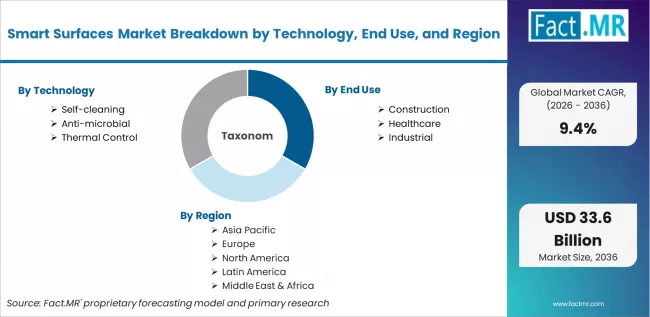
Smart Surfaces Market Breakdown By Technology, End Use, And Region | Source: Fact.MR
| Quantitative Units | USD 13.68 billion to USD 33.58 billion, at a CAGR of 9.4% |
|---|---|
| Market Definition | Smart surfaces represent engineered material systems and coatings designed to actively respond to environmental stimuli such as light, temperature, moisture, or biological contact. These surfaces are applied across glass, metal, polymer, and ceramic substrates to deliver self-cleaning, antimicrobial, thermal regulation, or anti-fogging functions. |
| Segmentation | Technology: Self-cleaning, Anti-microbial, Thermal Control; End Use: Construction, Healthcare, Industrial |
| Regions Covered | North America, Latin America, Europe, East Asia, South Asia, Oceania, Middle East & Africa |
| Countries Covered | USA, Germany, France, South Korea, UK, Mexico, Japan, and 40 plus countries |
| Key Companies Profiled | AGC Inc. (Asahi Glass Company, Limited), Compagnie de Saint-Gobain S.A., 3M Company, Corning Incorporated, Arkema S.A., The Dow Chemical Company, DuPont de Nemours, Inc., BASF SE, Akzo Nobel N.V., NSG Group (Pilkington) |
| Forecast Period | 2026 to 2036 |
| Approach | Forecasting models apply a bottom-up methodology starting with global production and trade data, cross-validated against company financial disclosures and regulatory filing databases. |
Source: Fact.MR analysis. Updated Apr 3, 2026
Smart Surfaces Market by Segments
-
Technology :
- Self-cleaning
- Anti-microbial
- Thermal Control
-
End Use :
- Construction
- Healthcare
- Industrial
-
Region :
- North America
- USA
- Canada
- Mexico
- Europe
- Germany
- UK
- France
- Italy
- Spain
- Nordic
- BENELUX
- Rest of Europe
- Asia-Pacific
- China
- Japan
- South Korea
- India
- ASEAN
- Australia & New Zealand
- Rest of Asia-Pacific
- North America
Frequently Asked Questions
How large is the demand for Smart Surfaces in the global market in 2026?
What will be the market size of Smart Surfaces in the global market by 2036?
What is the expected demand growth for Smart Surfaces in the global market between 2026 and 2036?
Which Technology is poised to lead global sales by 2026?
How significant is the role of Construction in driving Smart Surfaces adoption in 2026?
What is driving demand in USA?
What is Smart Surfaces and what is it mainly used for?
How does Fact.MR build and validate the Smart Surfaces forecast?
Who worked on this report


Preview the report firsthand - request a free sample
Free SampleGet the brochure for pricing and purchase details
Download PDF