Struvite-based Slow Release P Fertilizer Program Market
The Struvite-based Slow Release P Fertilizer Program Market is analyzed across its key product, application and end-use segments, with regional trends and demand outlook, forecast 2026 to 2036.
By Fact.MR Chemical & Materials DeskFact-checked under the Fact.MR editorial processUpdated
9 min read
Struvite-Based Slow-Release P Fertilizer Program Market Forecast and Outlook 2026 to 2036
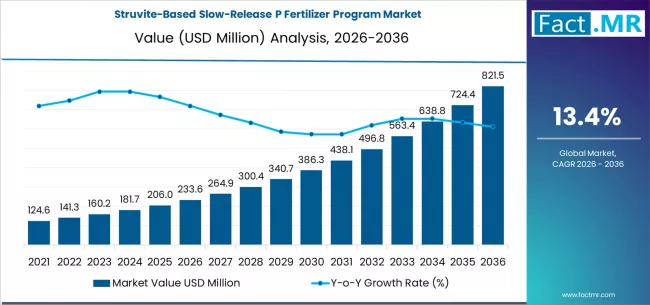
The global market for struvite-based slow-release phosphorus fertilizer programs is projected to experience substantial expansion, rising from USD 233.61 million in 2026 to USD 821.52 million by 2036, progressing at a CAGR of 13.4%.
Struvite Based Slow Release P Fertilizer Program Market Market Value Analysis | Source: Fact.MR
Summary of Struvite-Based Slow-Release P Fertilizer Program Market
Market Snapshot
Global struvite-based slow-release P fertilizer program market revenue stood at USD 233.61 million in 2026 and is forecast to reach USD 821.52 million by 2036.
At a 13.4% CAGR from 2026 to 2036, this market is set to expand ~3.5x in value, adding USD 587.91 million in absolute opportunity.
Growth is being driven by increasing adoption of phosphorus recovery and circular nutrient management systems, where struvite serves as a sustainable slow-release fertilizer.
Struvite-based fertilizers are emerging as closed-loop nutrient solutions, enabling recovery of phosphorus from waste streams while improving fertilizer efficiency and reducing environmental impact.
Demand and Growth Drivers
Rising global concern around phosphorus scarcity and nutrient runoff is driving adoption of recovered phosphorus fertilizers such as struvite.
Increasing regulatory pressure on wastewater treatment and nutrient discharge is accelerating deployment of struvite recovery systems.
Growing focus on sustainable agriculture and circular economy practices is reinforcing demand for slow-release fertilizers derived from waste streams.
Struvite fertilizers offer advantages such as:
Controlled nutrient release
Reduced leaching and runoff
Improved phosphorus use efficiency
Expansion of precision agriculture and nutrient efficiency programs is further supporting market adoption.
Product and Segment View
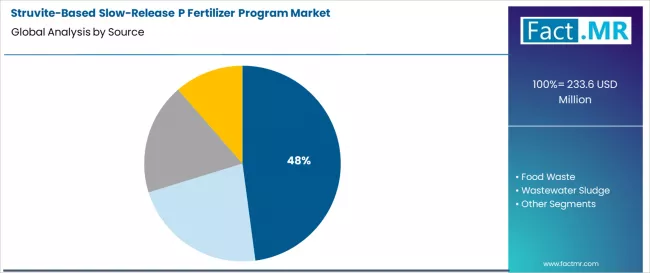
Animal manure accounts for 48% of source segment share in 2026, emerging as the leading segment due to high nutrient recovery potential.
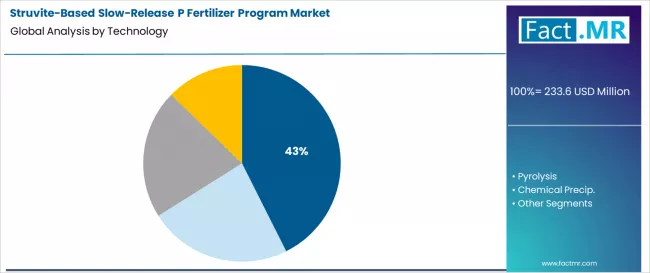
Anaerobic digestion holds 42.6% of technology segment share in 2026, positioning it as the dominant production pathway for struvite recovery.
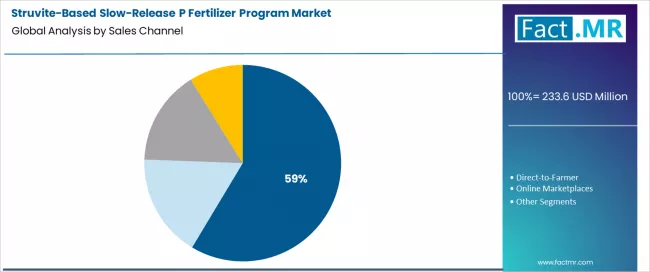
Ag-retailers account for 59% of sales channel share in 2026, reflecting their role in distributing specialized fertilizer products and advisory support.
Additional sources include:
Wastewater sludge
Food waste
Crop residues
Geography and Competitive Outlook
Growth is supported across Europe, North America, and Asia Pacific, driven by regulatory frameworks and adoption of circular nutrient management practices.
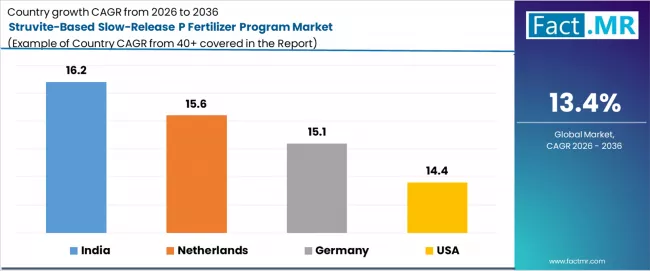
India (16.2% CAGR), Netherlands (15.6%), Germany (15.1%), and United States (14.4%) are key growth markets.
Market expansion is closely tied to wastewater infrastructure development, nutrient recovery mandates, and sustainable agriculture policies.
Key companies active in this market include Ostara, Veolia, Suez, OCP Group, Nutrien Ltd., and ICL Group.
Struvite-Based Slow-Release P Fertilizer Program Market — At a Glance
Attribute
Details
Market Value 2026
USD 233.61 million
Market Value 2036
USD 821.52 million
Absolute Dollar Opportunity 2026–2036
USD 587.91 million
Total Growth 2026–2036
251.6%
CAGR 2026–2036
13.4%
Growth Multiple
~3.5x
Key Demand Theme
Adoption of circular phosphorus recovery and sustainable slow-release fertilizer programs
Leading Segment by Source (2026)
Animal Manure
Segment Share (2026)
48%
Leading Segment by Technology (2026)
Anaerobic Digestion
Segment Share (2026)
43%
Leading Segment by Sales Channel (2026)
Ag-Retailers
Segment Share (2026)
59%
Key Growth Regions
Europe, North America, Asia Pacific
Country CAGRs
India 16.2%, Netherlands 15.6%, Germany 15.1%, USA 14.4%
Top Companies
Ostara, Veolia, Suez, OCP Group, Nutrien, ICL Group
North America, Latin America, Western Europe, Eastern Europe, East Asia, South Asia & Pacific, MEA
This market represents the commercialization of a high-efficiency phosphorus recovery pathway, crystallizing the nutrient from waste streams into magnesium ammonium phosphate (struvite). Unlike commodity fertilizers, struvite is valued for its inherent slow-release properties, high phosphorus content, and low heavy metal profile, positioning it as a premium, environmentally engineered input for precision nutrient management.
Growth is driven by the critical need to address simultaneous crises: the non-renewable depletion of phosphate rock and the eutrophication of freshwater bodies from phosphorus runoff. Struvite recovery programs offer a tangible solution by extracting phosphorus directly from wastewater, manure, and food processing effluent before it becomes a pollutant, transforming it into a controlled-release fertilizer that minimizes leaching.
The program aspect signifies a shift from mere product sales to integrated service models that may include technology deployment at waste facilities, guaranteed offtake agreements, and agronomic support for optimal field use.
The evolution of this market centers on enhancing crystallization process efficiency, reducing operational costs, and expanding the range of compatible waste streams. Success depends on demonstrating the dual value proposition to municipalities and industries which is waste treatment cost reduction and revenue generation, and to farmers superior nutrient use efficiency and crop yield response compared to conventional soluble phosphate fertilizers.
North America, Latin America, Western Europe, Eastern Europe, East Asia, South Asia & Pacific, Middle East & Africa
Segmental Analysis
By Source, Which Feedstock is Optimal for Struvite Formation?
Struvite Based Slow Release P Fertilizer Program Market Analysis By Source | Source: Fact.MR
Animal manure, particularly from swine and poultry operations, leads with a 48% share. Its dominance is due to a favorable combination of high phosphorus and ammonium concentrations, which are the primary reactants for struvite crystallization.
The liquid fraction of separated manure provides an ideal stream for continuous reactor-based recovery, offering waste handlers a method to significantly reduce nutrient loading in lagoon systems while producing a valuable co-product.
By Technology, Which Process Creates the Ideal Conditions for Recovery?
Struvite Based Slow Release P Fertilizer Program Market Analysis By Technology | Source: Fact.MR
Anaerobic digestion is the leading associated technology with a 42.6% share. The digestion process releases organically bound phosphorus into solution and increases ammonium levels, creating a nutrient-rich centrate or digester reject water that is highly amenable to subsequent struvite precipitation. This synergy makes AD facilities a prime deployment site for struvite recovery units, adding a valuable revenue stream to the biogas business model.
By Sales Channel, Where is Technical Education Most Critical?
Struvite Based Slow Release P Fertilizer Program Market Analysis By Sales Channel | Source: Fact.MR
Ag-retailers constitute the main channel at 59%. The effective use of struvite, with its unique release kinetics, requires agronomic education. Retailers serve as the essential link, educating farmers on application timing, placement, and integration with other nutrients to maximize its benefits for specific crops like corn, potatoes, and horticultural produce. Their trusted role is crucial for moving struvite from a novel product to a mainstream phosphorus management tool.
What are the Drivers, Restraints, and Key Trends of the Struvite-Based Slow-Release P Fertilizer Program Market?
The primary driver is the escalating regulatory and economic pressure on point sources like wastewater treatment plants and large livestock operations to remove phosphorus from effluent discharges. Struvite recovery turns a compliance cost into a potential profit center. For agriculture, the driver is the proven reduction in phosphorus loss and improved seasonal nutrient availability, which aligns with precision farming and sustainability certification goals.
A significant restraint is the capital cost of crystallization reactor systems and the need for precise chemical control such as pH and magnesium addition to ensure harvestable crystal formation and purity. The fertilizer’s higher cost per unit of P compared to soluble alternatives like MAP or DAP can deter adoption in commodity crop systems focused solely on short-term input cost. Market awareness of its agronomic advantages remains limited among many growers.
Key trends include the development of smaller-scale, modular recovery units suitable for individual large farms or food processors. There is a growing focus on co-recovery programs that extract both struvite and other valuable products like ammonium sulfate or clean water. The market is also seeing the rise of performance-based service contracts, where technology providers share in the revenue from fertilizer sales, aligning incentives for optimal system operation.
Analysis of the Struvite-Based Slow-Release P Fertilizer Program Market by Key Countries
Struvite Based Slow Release P Fertilizer Program Market Cagr Analysis By Country | Source: Fact.MR
Country
CAGR (2026-2036)
India
16.2%
Netherlands
15.6%
Germany
15.1%
USA
14.4%
How is India's Urbanization and Agricultural Demand Fueling High Growth?
India’s leading CAGR of 16.2% is driven by severe phosphorus pollution in waterways from untreated urban wastewater and a concurrent agricultural need for efficient fertilizers. Government programs promoting biogas from urban and agricultural waste create an ideal platform for integrating struvite recovery.
The potential to produce a domestically sourced, slow-release fertilizer for India’s intensive vegetable and cereal production presents a compelling solution to twin environmental and food security challenges.
Why are the Netherlands a Global Leader in Technology Deployment?
The Netherlands' 15.6% growth is a direct result of its legally mandated phosphorus recovery targets and sophisticated waste processing infrastructure. The country hosts some of the world's first and largest commercial struvite recovery facilities at wastewater treatment plants.
Dutch innovation focuses on maximizing crystal purity and size for optimal fertilizer handling, and on integrating recovery into the national phosphorus management strategy, creating a mature and regulated market.
What is Germany's Focus in Engineering and Product Quality?
Germany’s 15.1% CAGR reflects its engineering precision and high environmental standards. German technology firms are leaders in designing efficient air-driven or fluidized bed crystallizers.
The market emphasizes producing a consistent, high-purity struvite product that meets strict fertilizer quality standards for use in Germany’s quality-sensitive agricultural sector, including organic farming where approved slow-release P sources are limited.
How is the USA's Regulatory and Agricultural Context Shaping the Market?
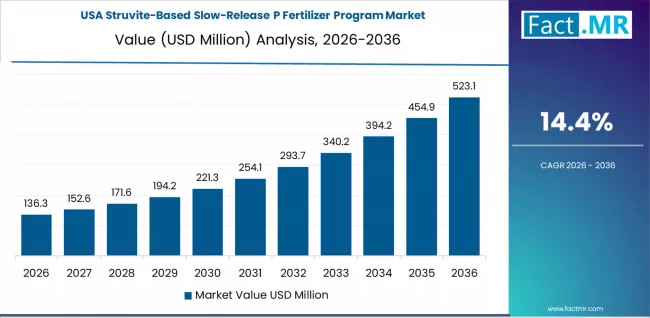
Struvite Based Slow Release P Fertilizer Program Market Country Value Analysis | Source: Fact.MR
The USA’s 14.4% growth is emerging from specific regulatory hotspots and corporate sustainability initiatives. Adoption is advancing in regions with nutrient-impaired watersheds, where water utilities invest in recovery to meet discharge permits.
Large agri-food corporations with sustainability commitments are facilitating programs to recycle phosphorus from their processing waste into struvite for use in their supply chains, creating a market pull.
Competitive Landscape of the Struvite-Based Slow-Release P Fertilizer Program Market
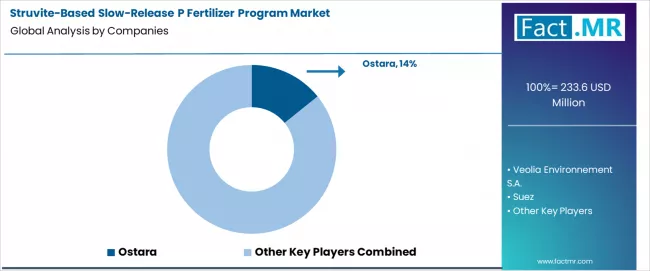
Struvite Based Slow Release P Fertilizer Program Market Analysis By Company | Source: Fact.MR
The competitive landscape is characterized by a mix of specialized technology pioneers like Ostara, global water and waste management corporations, and traditional fertilizer companies expanding into circular nutrients.
Competition hinges on proprietary reactor design for lower operational costs and higher crystal yield, securing strategic partnerships with major municipal water authorities, and building a recognized brand for agronomic reliability. The ability to offer comprehensive nutrient management as a service, from recovery to field application guidance, is becoming a key differentiator.
Key Players in the Struvite-Based Slow-Release P Fertilizer Program Market
Ostara, Veolia Environnement S.A., Suez, OCP, Nutrien, ICL Group Ltd.
Additional Analysis
Agronomic efficiency trials across soil types and crops; detailed chemical and physical characterization of recovered struvite; lifecycle cost-benefit analysis for wastewater treatment plants; review of global regulations enabling phosphorus recovery; technology benchmarking of crystallization reactor designs; analysis of market acceptance and willingness-to-pay among different grower segments.
Market by Segments
Source :
Animal Manure
Food Waste
Wastewater Sludge
Crop Residue
Technology :
Anaerobic Digestion
Pyrolysis
Chemical Precipitation
Composting
Sales Channel :
Ag-Retailers
Direct-to-Farmer
Online Marketplaces
Cooperatives
Region :
North America
USA
Canada
Latin America
Brazil
Mexico
Argentina
Rest of Latin America
Western Europe
Germany
UK
France
Spain
Italy
BENELUX
Rest of Western Europe
Eastern Europe
Russia
Poland
Czech Republic
Rest of Eastern Europe
East Asia
China
Japan
South Korea
Rest of East Asia
South Asia & Pacific
India
ASEAN
Australia
Rest of South Asia & Pacific
MEA
Saudi Arabia
UAE
Turkiye
Rest of MEA
Frequently Asked Questions
How big is the struvite-based slow-release p fertilizer program market in 2026?
The global struvite-based slow-release p fertilizer program market is estimated to be valued at USD 233.6 million in 2026.
What will be the size of struvite-based slow-release p fertilizer program market in 2036?
The market size for the struvite-based slow-release p fertilizer program market is projected to reach USD 821.5 million by 2036.
How much will be the struvite-based slow-release p fertilizer program market growth between 2026 and 2036?
The struvite-based slow-release p fertilizer program market is expected to grow at a 13.4% CAGR between 2026 and 2036.
What are the key product types in the struvite-based slow-release p fertilizer program market?
The key product types in struvite-based slow-release p fertilizer program market are animal manure, food waste, wastewater sludge and crop residue.
Which technology segment to contribute significant share in the struvite-based slow-release p fertilizer program market in 2026?
In terms of technology, anaerobic digestion segment to command 42.6% share in the struvite-based slow-release p fertilizer program market in 2026.